



Abstract
Studies have shown that women’s stronger rights to productive assets, particularly land, are linked to household overall welfare due to increased female intra-household bargaining power. Through in-depth interviews with 282 rural women in Ogun State, Nigeria, this study examines women’s involvement in land-related decision-making in their households as well as its socioeconomic determinants. This study models the empirical relationship between women’s land-related bargaining power over land. Women’s land-related bargaining power was estimated with principal component analysis (PCA), and Tobit regression model was used for its determinants. It was found that the women’s mean age was 44 years. On average, the household size was six persons. Women have low bargaining power regarding household land-related decision-making, particularly bequeathing land. Farm households’ land endowment shows that married monogamous households hold an average of 2.64 hectares, cohabiting monogamous households hold 1.82 hectares, and polygamous households hold an average of 4.01 hectares. Women in polygamous household types have lower (19 per cent) access to households’ land through marriage compared to their monogamous counterparts with 61 per cent and 44 per cent for both married and cohabiting monogamous households. 78 per cent of the women have low land-related bargaining power. A mean score of 0.19 was estimated for women’s land-related bargaining power. Women’s land-related bargaining power is influenced by their marital status among other factors; the reverse is the case of their husbands, regardless of whether they are monogamous or polygamous.
Introduction
It has been acknowledged in most African countries that the use and ownership of land are discriminated against women by customary laws and practices (ACORD et al., 2012) as an average citizen’s statutory laws knowledge with respect to land is poor. It has been widely observed that some women may overcome land ownership through the help of their husbands or any other male relatives. This suggested that oftentimes, women are faced with the challenges of accessing and controlling productive assets, including land, through their male relatives, which put them in a vulnerable condition (Fletschner, 2009; USAID, 2011).
The establishment of the Nigerian Land Use Act in 1978 allowed both men and women to acquire, use and transfer land ownership. However, this act only benefits women who are legally married and hence, limits women’s rights to land ownership and inheritance. Also, there is illegal land ownership among rural landowners in Nigeria as a result of not having legal documentation to prove land ownership. This is the reason statutory laws are ineffective in the security and equitable land tenure for both women and men, in comparison to customary practices. The statutory law is gender discriminatory.
The fifth Sustainable Development Goals (SDGs) emphasised that, in order to end poverty, it is important that equal rights in land ownership and control and inheritance of productive resources are ensured. The SDGs also suggested that in order to achieve gender equality and empowerment of all women and girls, there is a need for policies and legal reforms that will give women equal rights to access, own and control land and other productive resources. Therefore, women’s land rights are important in the international development agenda as an important pathway for achieving poverty reduction and gender equality.
The inequalities in gender access to land and productive resources have become a cause for alarm among Nigerian women. However, many gender scholars have argued that customary laws limit women’s access to land (Tripp, 2004; Whitehead & Tsikata, 2003). There is a call for legislation that will replace customary laws with international and regional human rights, enabling women to purchase, own and inherit land with their own name even after the death of their husbands.
Evidence of inequalities in the access to land by gender is overwhelming. FAO (2011) affirmed that women have a lower likelihood to own or use and rent land, and even if they are able to access land, the quality is poor and of smaller plots. Even when rural women own land, they are faced with the challenges of controlling what to produce and the resources needed to farm (Deere et al., 2011). This shows that women face discrimination in land ownership rights. According to the World Bank (2012), women’s access to land through markets and redistributive reforms is very low because of discrimination in terms of land markets, social, income and credit. This is discouraging despite the increasing role that women played in agricultural production, accounting for 43 per cent to 60–80 per cent of the labour force (Foresight, 2011; Mucavele & MuGeDe, 2015; World Bank, 1996).
Pervasive patriarchy is the major factor discriminating against women and promoting gender gap in the access to land and other productive resources, commonly expressed in gender stereotypes, perceptions and norms. This is associated with the belief that men, as household heads, control and manage land. The implication of this is that women are often assumed to be incapable of the management of land effectively, as oftentimes, land owned by women is lost through marriage, divorce or partner’s death (Canadian HIV/AIDS Legal Network, 2009).
The gender gap in the access to land has a negative effect on women’s and households’ welfare in terms of productivity, income, social status and ability to influence household and community decisions. Studies have shown that in Africa, Asia and Latin America, women’s access to and control of productive resources such as land affect the decision-making in their household (Datta, 2006; Field, 2003), agricultural output and income (Allendorf, 2007; Deere et al., 2005; Fletschner, 2008; Quisumbing, 1996), food consumption (Quisumbing & Maluccio, 2002) and non-food expenditures (Doss, 2006; Katz & Chamorro, 2003). Hanstad (2010) suggested that the provision of land rights to women will improve their income within the household.
The reduction in gender asset gap has been shown to positively influence women not only themselves but also their households. Also, women’s asset ownership has been shown to increase their bargaining power in household expenditure, education and health decision-making (Allendorf, 2007). According to FAO (2011), there is an interlink in gender asset differences. For instance, female farmers have lower technology levels due to their lower access to land, labour and extension services. This implies ripple effects in gender asset differences.
The important factor in the economic development of rural areas is access to productive resources, including land. Households in rural areas negotiate for their livelihoods in order to obtain access to productive resources for better welfare (Valdivia & Gilles, 2001). However, access to these productive resources is an important factor in gender empowerment in a developing country like Nigeria.
The typical aspect of gender inequality is low participation in decision-making. Ibrahim and Ibrahim (2012) stated that women who are farmers in Africa face severe hardship regarding gender asset inequality. However, land ownership cannot be discussed in isolation from decision-making, particularly assets owned by women. It is, therefore, to establish the extent to which women can sell, rent and bequeath land and every produce. This study used household data from women and their husbands to examine rural women bargaining over land ownership in Ogun State, Nigeria, by analysing women’s bargaining over land-related decision-making within their households. More specifically, the extent to which rural women are involved in households’ land-related decisions regarding agricultural production or how the associated income will be spent and inherited. This influences whether or not there are multiple wives or whether traditional or other marriage rites are recognised. All these were examined in this study.
Materials and Methods
This article was a study of rural communities in agricultural development zones in Ogun State, Nigeria. Ogun State, which is one of the 36 states in Nigeria, lies in the south-western part of the country. The study made use of primary data from a cross-sectional survey of 400 farm households between October and December 2019. This study was based on data for demographics and women’s land-related decision-making.
Specifically, married women living with husbands, excluding female-headed households, were our respondents. This is because unmarried and women living without husbands are considered as the primary decision-makers in their households. In order to avoid bias, this study was based on married women, either married properly or cohabiting and whose primary occupation was farming and whose households own land. This is to avoid the comparison between rural women in landless and landed households and not to bias the estimates. Hence, this study was based on arable crops landed by rural women. As Allendorf (2007) rightly posited that landed households are more wealthy and have access to more resources that may impact women’s decision-making than landless households. This study compared spousal information as there are possible differences in spousal decision-making power; gender analysis was done which accounted for intra-household dynamics.
Selection of the respondents was made using a multistage sampling procedure. One block was randomly selected from each zone, making four blocks our first stage. However, the second stage was a random selection of five cells making 20 cells. Besides, 20 households in each of the selected cells make 400 farm households. After cleaning the data from potential outlier and incomplete observations, 282 farm households were used for this study. Two types of farm households were used for this study, the monogamous and polygamous farm households. Based on women’s household type, 108 were married monogamous, 73 were cohabiting monogamous, and 101 were polygamous. For the monogamous households, both the husband and the wife were interviewed, but for the polygamous households, this study focus on the husband and the first wife (‘most senior wife’). They were interviewed simultaneously, and separately in order to avoid spousal-influenced responses.
Both quantitative and descriptive techniques were employed to analyse the data. The women’s land-related bargaining power was captured following Sariyev et al. (2017) women’s participation in decision-making index (WPDMI). PCA was used to generate WPDMI combining 10 land-related decision-making variables capturing key decision domains within a household. Women’s participation in land-related decision-making (WPDMI) is calculated using Equation (1):

Use of plot Crops to plant Sales of crop produced Use of money from crop sales Sales of plot Use of money from plot sales Renting out of plot Use of money from plot rent Offering of plot as collateral and Inheritance of the plot
Both husband and wife were asked to provide information on their household’s plots, the plot size and the extent of their participation in the land-related decisions stated above. Respective women’s bargaining power over land-related decision-making was generated from the 10 decision domains, and weighted scores were assigned. This is followed by a PCA to transform these decision-making variables into land-related decision-making index.
In order to determine the factors influencing women’s land-related bargaining power, Tobit regression model was used. This study assumed that women’s land-related bargaining power can be influenced by her own and husband’s socioeconomic characteristics. The model is specified thus:

where
Yi = women’s bargaining power over land-related decision-making. The independent variables are:
Women’s characteristics:
X1= Age (years)
X2= Marital status dummies
X21= Married monogamous (Yes = 1, No = 0)
X22= Cohabiting monogamous (Yes = 1, No = 0)
X23= Polygamous (Yes = 1, No = 0)
X3= Education (years)
X4= Number of dependents
X5= Have son (Yes = 1, No = 0)
X6= Value of land inherited (N)
Husband’s characteristics:
X7= Age (years)
X8= Education (years)
X9= Awareness of women’s right to land (Yes = 1, No = 0)
X10= Marital status dummies
X21= Married monogamous (Yes = 1, No = 0)
X22= Cohabiting monogamous (Yes = 1, No = 0)
X23= Polygamous (Yes = 1, No = 0)
Household’s characteristics:
X11= Land holding (hectares)
X12= Household size
X13= Type of land ownership dummies
X131= Sole ownership (Yes = 1, No = 0)
X132= Joint ownership (Yes = 1, No = 0)
Results and Discussion
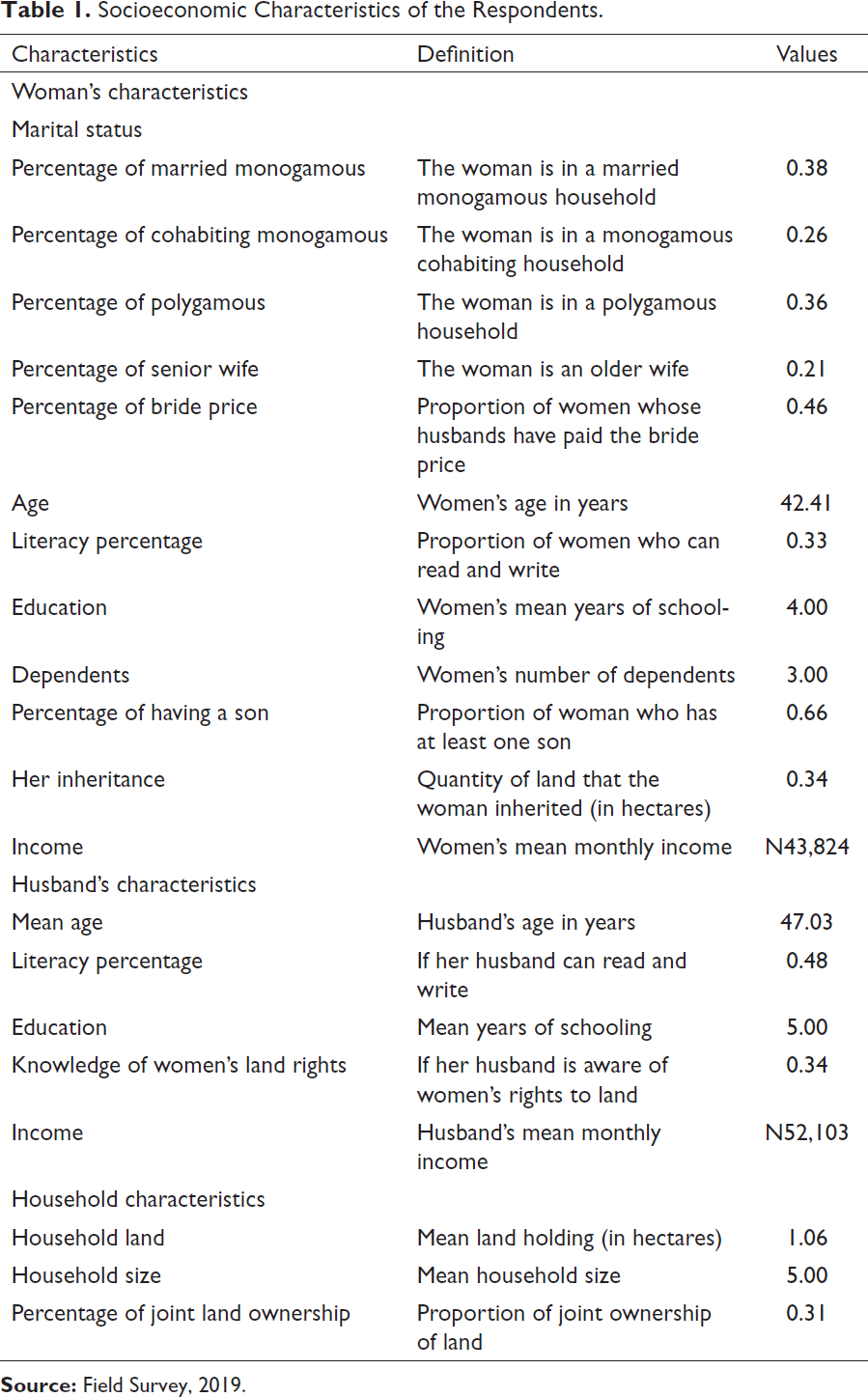
Table 1 provides the results of the socioeconomic characteristics of the respondents. The results show that of all the women participants, 38 per cent were in married monogamous, 26 per cent in cohabiting monogamous, and 36 per cent in polygamous household type. Also, 46 per cent have their bride price paid by their husbands. The mean age of rural women was 42 years with average literacy rate of 33 per cent. This implies that 33 per cent have the ability to read and write. The mean spousal age difference was 7 years. The mean household size was five persons.
Socioeconomic Characteristics of the Respondents.
Patterns of Access, Ownership and Use of Household Land by Household Type
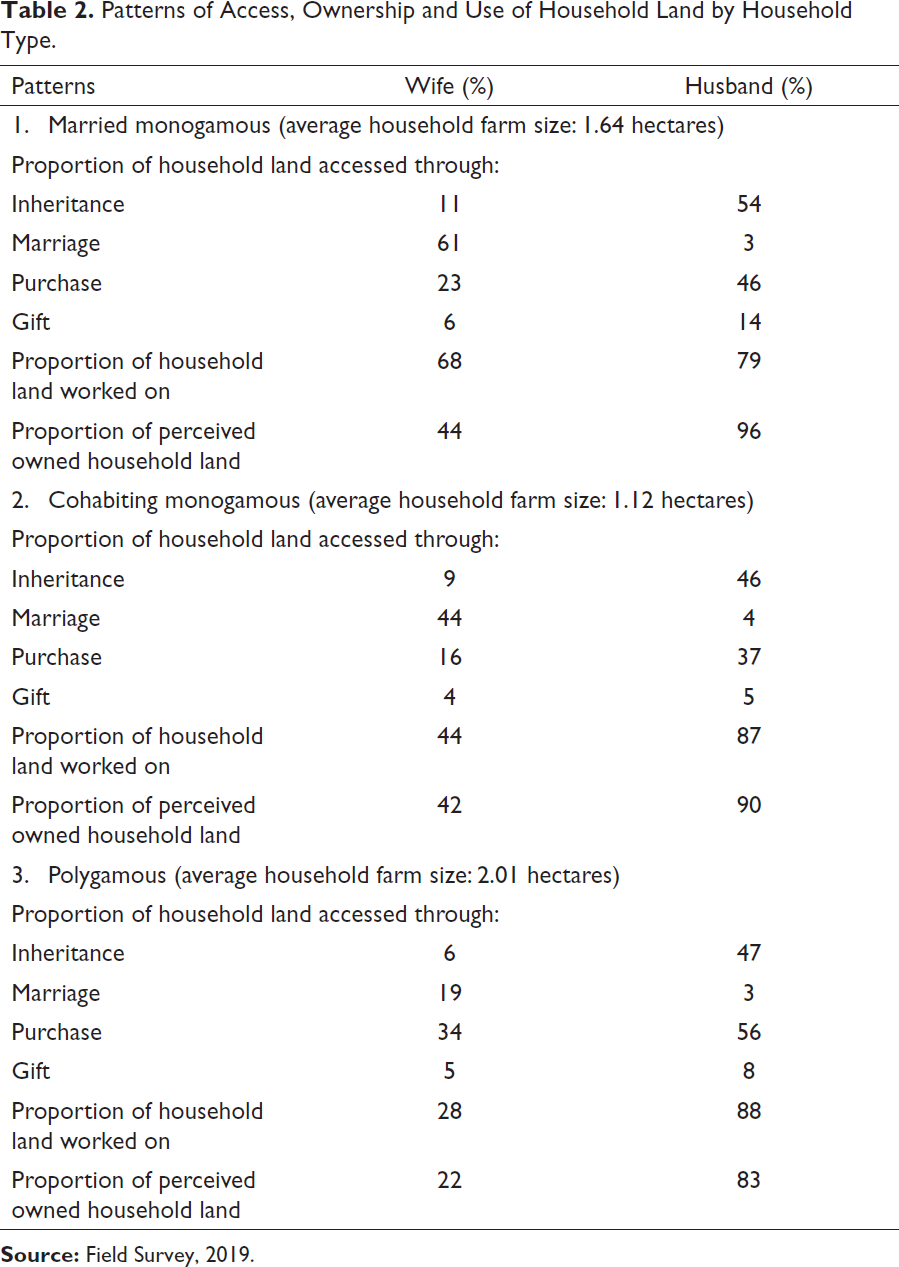
Table 2 provides the distribution of the respondents’ access through inheritance, marriage, purchase, gift, ownership and use of household farmland by the type of household. Based on land endowment, married monogamous households hold an average of 1.64 hectares, cohabiting monogamous households hold 1.12 hectares, and polygamous households hold an average of 2.01 hectares. The avenue to access land by women was their husbands through marriage. Similar result was found by Santos et al. (2014) that the most likely avenue of women’s access to land was their husbands. Evidence from married monogamous and cohabiting monogamous household type shows that women appear to have acquired access to 61 per cent and 44 per cent, respectively, of their households’ land through marriage. In polygamous household type, 19 per cent acquired access to households’ land through marriage. This implies women in polygamous household types have lower access to households’ land through marriage compared to their monogamous counterparts. Regarding access to land through purchase and gift, women generally have a lower proportion. Women and men’s share of household land they worked reveals that monogamous couples worked 68 per cent and 79 per cent of the household land. Based on perceived land ownership, access to land was biased towards men. Comparing women’s access to land through purchase, 34 per cent have access to land through purchase. This explains the reason why polygamous farm households hold more land (2.01 hectares) than their monogamous counterparts.
Patterns of Access, Ownership and Use of Household Land by Household Type.
Women’s Land-related Intra-household Decision-making
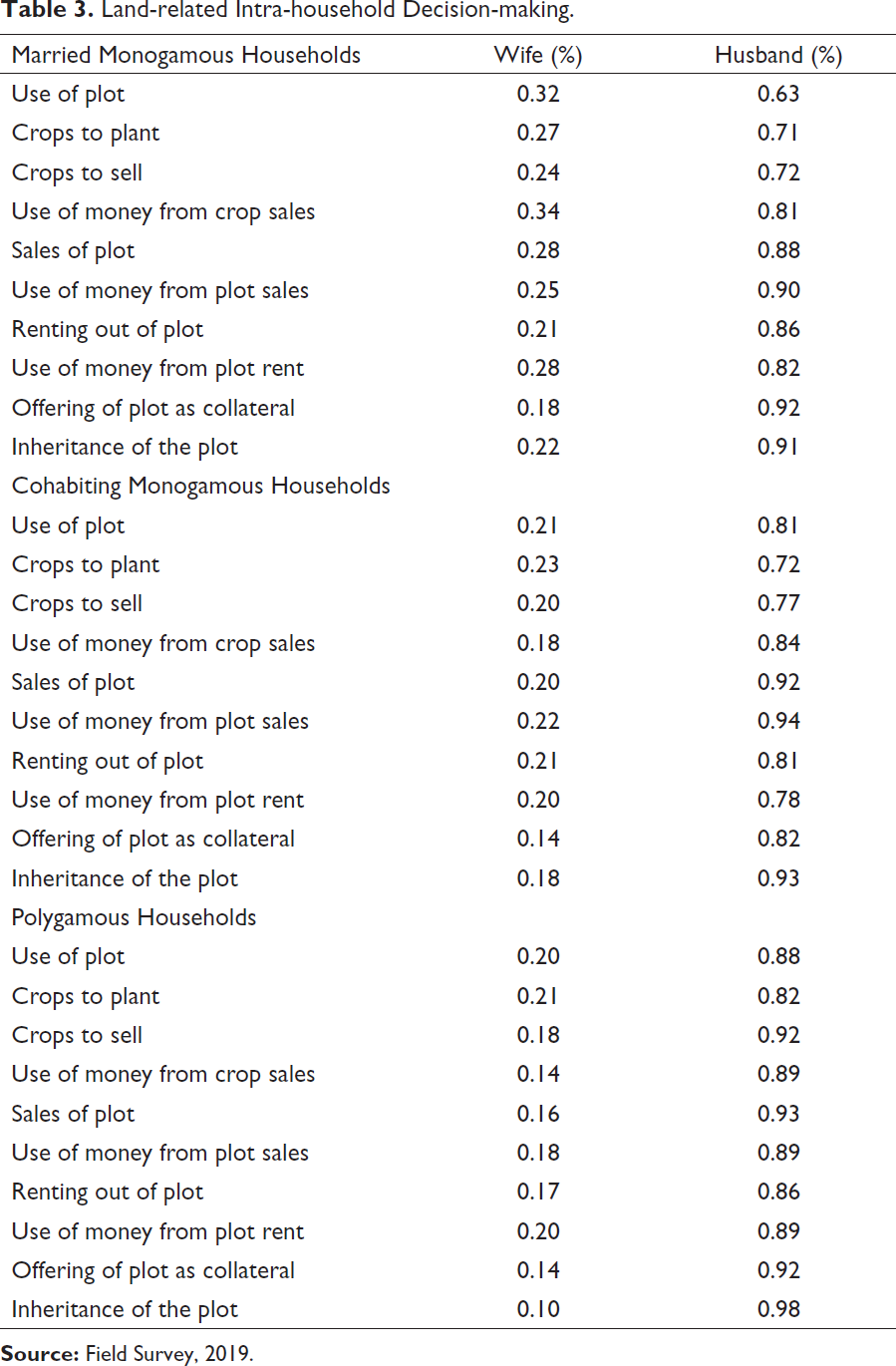
Table 3 shows the distribution of land-related decision-making based on the type of household. Women in households have very low decision-making when compared to men. This implies that women do not have full decision-making power regarding land-related decisions within the household. Even though women do not possess full land-related decision-making authority, neither do their husbands. Also, there is a wide gender gap in land-related decision-making power; hence, men in the household decide how land will be bequeathed as they participate more in all the decision domains and hence from the current and future use of land. According to Santos et al. (2014), husbands are entrusted typically with the power to bequeath land, and hence husbands are more likely to gain more from the long-term security and benefits that accrue from both the current and future ‘loyalty’ of the perceived heirs. Comparing women’s land-related decision-making power by household type shows that women who are in polygamous households have a low decision-making power across the domains, particularly in the decisions related to inheritance. Women’s decision-making power appears to be affected by their household type, as women in married monogamous households are involved more in decision-making when compared to their counterparts. However, the reverse is the case of their husbands regardless of whether they are monogamously married or cohabiting or polygamous. Also, decisions on who inherits the land are heavily made by men making women vulnerable in their ability to influence household land-related behaviour. Because of this, women find themselves in a vulnerable position since their rights to continue accessing their households’ land can depend on their husbands’ goodwill, the strength of their marriage, and their husbands staying alive. Therefore, women are in a relatively weaker bargaining position with their husbands, which in turn affects their own well-being and their families’ overall welfare (Manser & Brown, 1980; McElroy & Horney, 1981).
Land-related Intra-household Decision-making.
Patterns of Women’s Land-related Bargaining Power
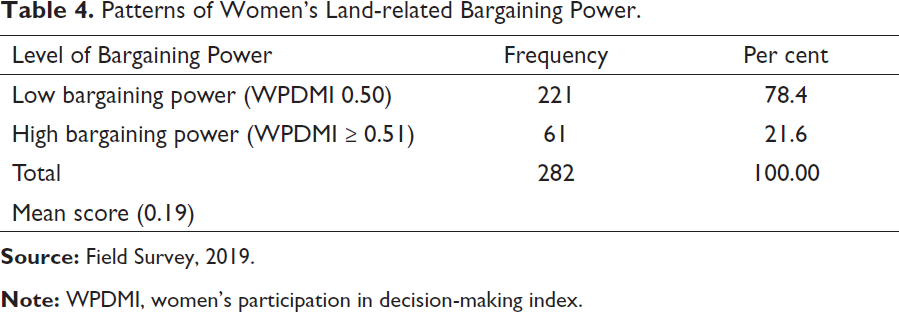
Table 4 shows the distributions of women’s land-related bargaining power. Women’s land-related decision-making index ranges from 0 to 1. The result shows that 78 per cent of the women’s land-related decision-making index falls below 0.5, indicating a low level of women’s land-related bargaining power in the households. However, a mean score of 0.19 was estimated for women’s land-related bargaining power.
Patterns of Women’s Land-related Bargaining Power.
Factors Influencing Women’s Land-related Bargaining Power over Land Ownership
Women’s land-related bargaining power depends mainly on their age, their marital status, their ability to have a son, their value of land inherited, their husbands’ age, husband’s education, household land holding and type of land ownership. Women’s age is negatively significant. The implication of this result is that the older women were disadvantaged when it comes to household land-related decision-making. The coefficients of marital status were significant and negative. The coefficients were negative implying that women in either cohabiting monogamous or polygamous household types have a lower level of land-related decision-making power when compared to their married monogamous counterparts. Santos et al. (2014) found that legally married women in monogamous households are the ones with the highest land-related decision-making power. Married women in monogamous households do significantly better than their cohabiting monogamous counterpart. Also, women whose bride price has been paid, tend to have more influence on household land-relatesd decision-making as payment of bride price also implies recognition of their worth by their husbands publicly. Also, women’s land-related bargaining power is influenced by the gender of the children she has and the amount of land she inherited. Husband’s education significantly influenced women’s land-related bargaining power positively. This implies that the more the husbands are knowledgeable and educated about their women’s legal rights to land, the more likely their wives are to be involved in land-related decisions in their households. Women in households who do own land jointly have more land-related bargaining power when compared to their sole or individual rural landed counterparts. This implies that women who do not own land jointly with their husband have a low land-related bargaining power within the household, and thus are less likely to have access to other productive resources and participate in decision-making (ILC, 2011, 2012) (Table 5).
Tobit Regression Results of the Factors Influencing Women’s Bargaining over Land Ownership.
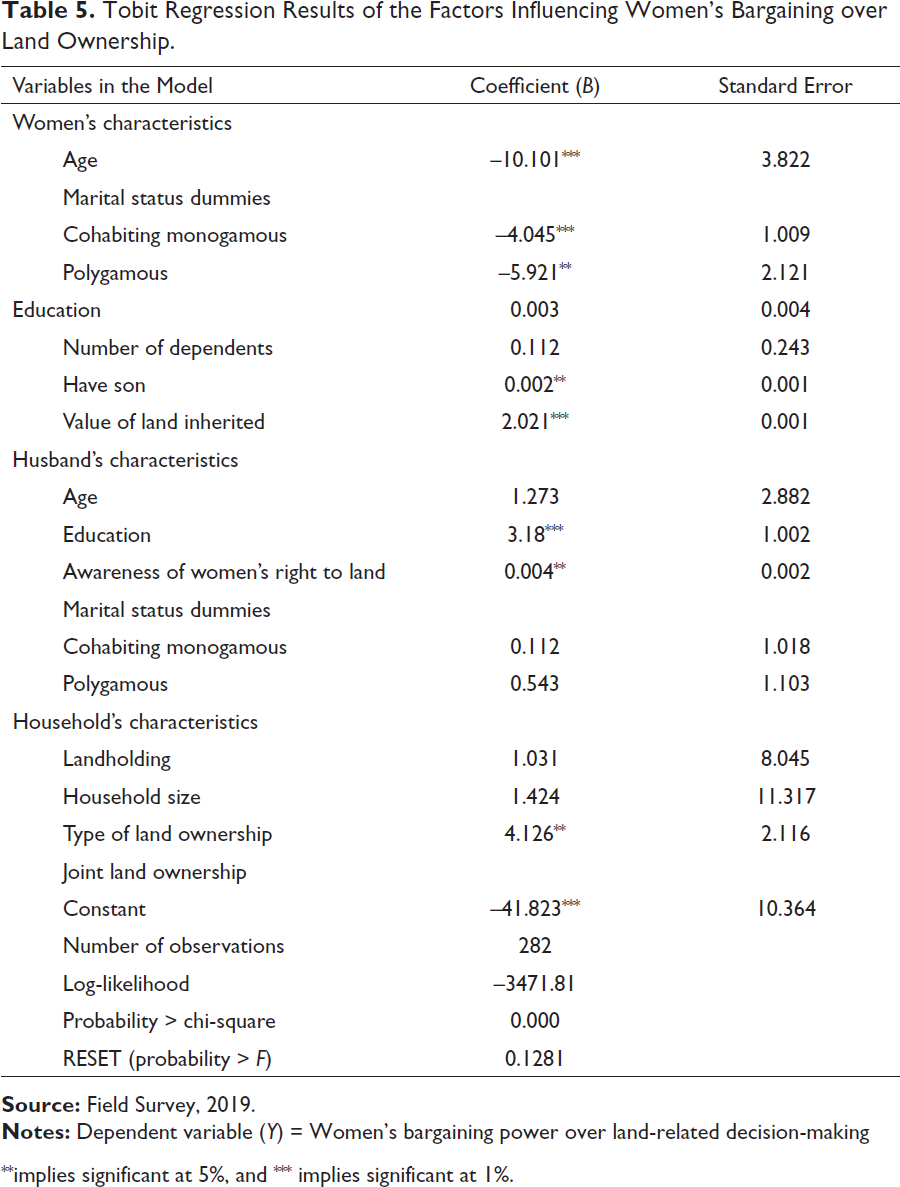
**implies significant at 5%, and *** implies significant at 1%.
Conclusion
Despite women making up a significant portion of the agricultural workforce in most developing nations, they are less likely to own or control land, and their land rights are often weaker and more susceptible to dispute. This study examines how rural women bargain over land-related decision-making and its socioeconomic determinants. The study found that rural women’s bargain over land-related decision-making within their households depends on their age, their marital status, their ability to give birth to a son, their value of landed asset brought into marriage, their husbands’ education and knowledge of women’s rights to land, and their type of land ownership, whether sole or joint ownership. Policy issues aimed at strengthening women’s land-related bargaining power should focus more on encouraging joint ownership of land between woman and their husband, an increase in women’s awareness of the rights to own and inherit land through land rights awareness campaigns and programmes.
Footnotes
Declaration of Conflicting Interests
The authors declared no potential conflicts of interest with respect to the research, authorship and/or publication of this article.
Funding
The authors received no financial support for the research, authorship and/or publication of this article.
