



Abstract
As clinical legal education (CLE) is becoming an increasingly popular form of teaching in law schools across the globe,2 it is important for institutions to consider the realities and risks of each kind of model. Certain kinds of CLE may be a very realistic portrayal or simulative of practice, but carry more risks to those involved. This article explores the realities and risks3 of all kinds of CLE by using an ordinal scale to measure them. This scale was tested at the 8th Worldwide GAJE Conference in Turkey. Those who attended the session became the scale themselves, moving and discussing the kinds of CLE to where they believed they were in terms of reality and risk. This article analyzes the results of that session, exploring what some clinicians from across the globe think of the realities and risks of CLE, and whether we can balance them together to provide students with a sound educational experience. As clinicians, we aim to expose our students to the realities of practice whilst keeping the risks involved to an absolute minimum so that they gain a practical legal education without any adverse effects.
Introduction
As clinical legal education (CLE) has grown and expanded throughout the globe, research has grown with it. This research, empirical or theoretical, is to help us justify the work we do and to share our experiences. This article explores all kinds of models of CLE, focusing on the realities and risks of each. The reason I chose to look at this particular element of CLE has stemmed from my PhD. My PhD focuses on live client clinics (LCCs), 4 collecting and exploring data on whether and, if so, how these clinics provide students with the skills they need to start practice competently. In order to give explanation for why I chose to focus only on LCCs and to exclude all other kinds of CLE, I began to look at what each kind of CLE offers. Thus, I developed an ordinal scale, with the main models of CLE to show my justification. Figure 1 shows the final result of the scale.
Diagram used to Aid PhD Research in the Decision of what Kind of CLE to Explore
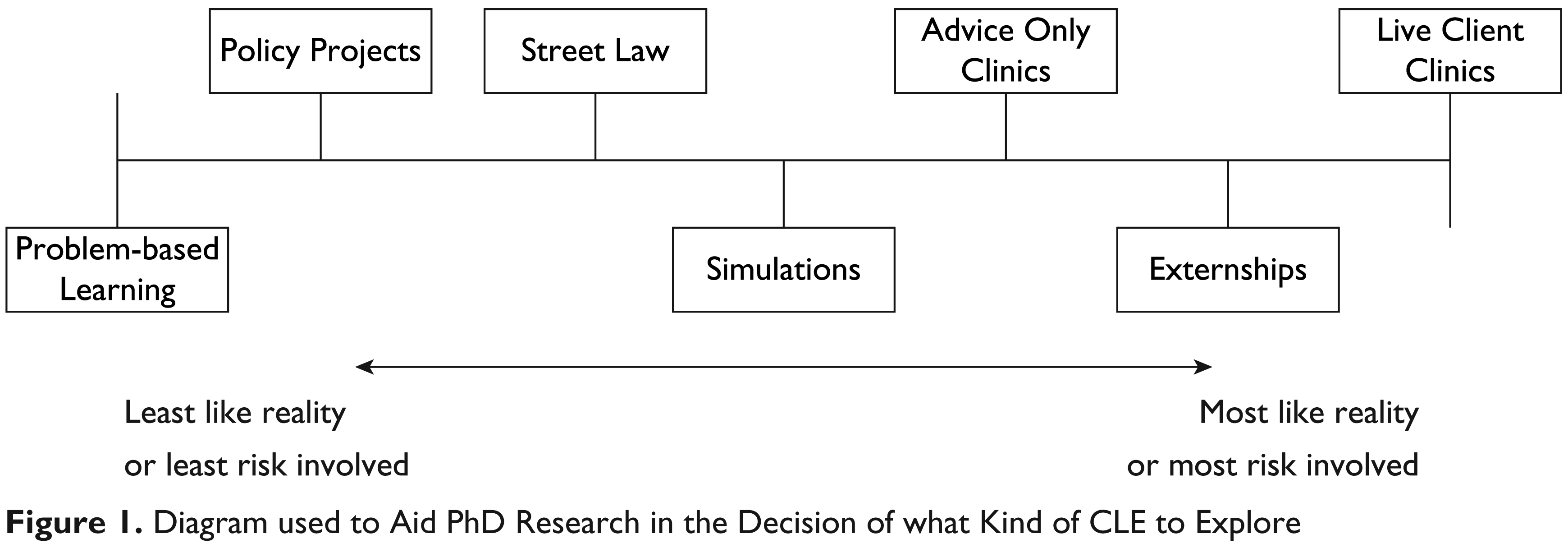
I believe that the scale remains the same for reality and risk. LCCs remain the best kind of CLE for my research, as they are the most realistic portrayal of practice and more risks for students and clinicians to consider than other kinds of CLE.
In order to validate my scale, I presented it at the 8th Worldwide GAJE Conference, in conjunction with the International Journal of Clinical Legal Education, Turkey. I asked participants in my session their views on my scale and recorded it to be collected as data.
Whilst the issues surrounding the realities and risks of CLE will be familiar to clinical educators already, there is little literature which explicitly discusses the interaction of these ideas. Mkwebu 5 highlights this in a systematic review conducted on CLE literature. He identifies that research into CLE is primarily concerned with social justice issues and pedagogical values. Thus, the issues surrounding institutional and academic decisions into CLE are still overlooked, and there is not much research into what influences these decisions. There are various goals of CLE, and the employability of our law graduates is an aim which we strive to improve as a wider goal of CLE. 6 By designing our CLE courses to introduce our students to the realities of practice whilst remaining aware of the risks, we should meet this aim. However, how real does it have to be to meet this aim?
The aim of this article is to inform the reader of what some clinicians think about these issues and the worries which they have had when establishing and running some form of CLE. It is hoped that more literature will be generated and the decision-making process regarding CLE will become a more prominent area of research within the field.
The first part of this article explores why I have placed the kinds of CLE on the scale in this order. It discusses the literature surrounding this area and how it influenced my scale. The second part of this article discusses my methodology and exactly how I collected data during the conference session. The final part explores the results of the session, analyzing conversations and layouts of the scale the participants came up with.
Reasons for My Scale
Reality
By reality I mean the kind of CLE which is the most realistic portrayal of practice for a lawyer. I placed LCCs at the top of my scale as they involve working with an actual client. They allow students to practice a wide range of skills, including legal writing, interviewing, legal research and, in some instances, advocacy. There is scope for all of the basic skills to be developed in LCCs which will give students a feel of practice.
As the students are working with the law in this practical way, they are sometimes faced with unfamiliar issues and situations. This sporadic nature of practice 7 is one which they must adapt to, and an LCC provides a suitable platform for this development. A student may be faced with a completely unfamiliar area of law or legal procedure or learn that what may seem a trivial fact is actually very important to the outcome of their client’s case. Antoniou and Hassan-Morlai state that the ‘unpredictability of working with real clients allows for a more realistic experience’, 8 as this is not something which can be replicated in a simulation.
There is academic debate regarding LCCs and externships. During an externship, a student may not work directly with the clients themselves, but they witness a qualified lawyer do this work in an actual law firm. They are often exposed to the realities of a legal career, which may not happen in an LCC. Rosenfeld states that externships
offer students rich raw material to study, and a wealth of opportunities to practice critical assessment and reflection. The law office and judges’ chambers where students work typically operate at breakneck pace, examples of lawyering ranging from exemplary to dastardly, and clients with intractable woes or unremitting demands.
9
Rosenfeld is highlighting that a student will experience a variety of issues which can arise during a case. It is fast paced work, which will test their time management and organization skills. It also enables them to how lawyers interact with their clients and how clients can act very sporadically. Allowing students to witness work in a law firm first-hand and then asking them to reflect on it in a pedagogical setting may indeed be a better form of education than LCCs.
Another consideration is the nature of how some LCCs operate. Not all LCCs will take on every case that comes through the door. Some may, but some do not have the resources to do so. At Northumbria University, for example, only those cases are taken which provide some educational value
10
to the students. Sylvester et al. confirm what educational value means to Northumbria by stating:
The aims of the Law Office were not only to develop traditionally recognised lawyers’ skills and to give the students a taste of real practice. From the outset we also wanted to encourage a shift in approach to tackling legal problems; one that took into account all the complex influences that affect the outcome of every case.
11
Whilst this aim is being met, this picking of cases by supervisors is arguably making LCCs less realistic. In a way it could be said that they are being sheltered from some realities by their supervisor. By exposing our students to the uncertainties of legal practice, we can help to equip them with how to tackle these uncertainties. Whilst our supervisors cannot predict if cases will be uncertain and expose students to this reality, they must prepare their students for the chance they will be.
I still do, however, believe that LCCs are the most realistic portrayal of practice, as the students are working with the client themselves. Whilst an externship may open them up to new situations they may not have been aware of, actually working with a client allows them to practise handling the uncertainties and to reflect more deeply. It is better for a student to reflect on their own actions and experiences than someone else’s. This may mean that the most realistic portrayal of practice may not carry more educational value, but students working with the clients may still better prepare them for practice. Hyams outlines how the use of reflection on a student’s own experiences results in developing professionalism. In order for students to reflect, they must be put into unfamiliar situations, working outside of their comfort zone. He goes on to state that ‘Clinical legal education provides the perfect laboratory for action and reflection’. 12 Externships can be argued to be more realistic, but they do not always offer everything which LCCs do, resulting in perhaps less educational value.
Furthermore, clinicians are trained in clinical teaching and pedagogy, knowing how to transfer knowledge and experience to students in LCCs. The same cannot always be said for a lawyer with an extern student. Hovhannisian provides insight into this point, arguing that externships can be flawed as they
rely on practicing lawyers and judges to teach about the practice of law in an instructed setting such as law offices and courts. As a result, the student’s experience of legal practice is mostly one of trial and error without clear instructions and guidance, generally without significant pedagogical value.
13
Thus, this may not be a great advantage to legal education, apart from allowing students to witness the uncertainties of practice, which in turn provide a realistic experience of practice.
These kinds of CLE, in my opinion, are the complete opposite of problem-based learning (PBL). PBL has been defined as courses which ‘…start with problems rather than the exposition of disciplinary knowledge. They move students towards the acquisition of knowledge and skills through a staged sequence of problems presented in context, together with associated learning materials and support from teachers.’ 14 There is no live client involved, and even though the legal problem may be presented similar to that of practice, it can lack the complexities of legal practice and interpersonal skills vital for working with clients. This is not to say, however, that PBL is not as useful as LCCs. PBL is a great way to lay the legal practice foundation before students progress to working with live clients. Problem-solving is an essential lawyer skill, and providing students with the opportunity to develop this before they go onto more complex work is necessary. On the other hand, this does not make PBL more realistic than LCCs, due to the lack of a live client.
Risk
When referring to risk, I mean risk to a client, student, supervisor or institution. There are many different risks associated with CLE, and it was hard to think only one particular kind of risk when creating the scale, so I wished to cover them all when testing it. The only kinds of risks I do not include are sustainability and funding risks. I described risk during the conference session:
[R]isk can kind of come in different forms with clinical legal education. So we’re not just looking at risk to the client, which is probably the most obvious one. We’re looking at risk as well to the students, to the tutors that are teaching the students and also to the institution as a whole, where the clinic is based. So the risks that we’re looking at really are negligence, that affect it can have on reputations and with the clients we’re looking at risk of the outcome of their case really. If you get students that aren’t turning up to court or aren’t filing documents on time, that’s going to have a big impact on the client. So risk can come in all these different forms. So when I’ve made the scale for risk I’ve kind of put them all into one.
I understand it is a broad definition, which was brought to my attention by a colleague during the session. However, all of these risks contribute to the scale and are included, even if it is ‘difficult to just have one pin point that has risk for all of them’, as my colleague mentioned. My definition can be nicely summed up by Jones et al., who provide:
[Student misconduct can] place clients in jeopardy of losing their cases. It can lead to liability for the law school. It can imperil a supervising attorney’s license. And, to the extent it calls into question a student’s character or fitness to practice law, it can put at risk a student’s opportunity for bar admission.
15
Again, LCCs were placed at the top of the scale as the most risky kind of CLE. Whilst student misconduct is not an issue regularly encountered in the UK, it is a risk LCCs can face. Students work, in the majority of LCCs, under their supervisor’s practising certificate. All work is checked before it is released to the client to ensure that there are no mistakes of negligent comments. However, there is still an element of trust here to be satisfied that a student is going to comply with these rules and not do anything which will be negligent. 16 If something were to go wrong, that can affect the supervisor’s practising certificate, the student’s future career, the client’s case and the reputation of the institution.
There is little written on this issue in the academic literature, 17 which may be because student misconduct does not happen often. Usually LCCs in universities will reject cases which are judged to carry too much liability, if something were to go wrong. 18 However, mistakes and misconduct can still happen. Jones et al. highlight issues they have experienced, such as students not turning up for court hearings, neglecting cases and working for clients outside of the clinic. 19 These are risks that can all be avoided or dealt with as they arise. However, the nature of these risks has resulted in LCCs being placed at the top of the scale.
Due to the risks of working with live clients, other kinds of CLE were placed at the bottom of the scale. For example, PBL is again at the bottom of the scale. As there is no client, the risks discussed above do not appear to be as great.
Methodology
I knew there would be many experienced clinicians from across the globe attending the Worldwide GAJE Conference in Turkey in 2015. Thus, it was an opportunity for me to test my scale on a variety of experienced clinicians and colleagues in an interactive way. Before the session started, each participant was given an informed consent form. They had the option to either sign the consent form and participate in the session or to sit as an observer and not contribute. This worked rather well, as it meant those who did not wish to be part of the research were still able to watch the presentation and listen to their colleague’s opinions on the different kinds of CLE. I presented my scale for 10 minutes, explaining my placing, and then opened it up to my colleagues. There were 24 colleagues who participated during my session. Seven of them began the interactive element of the session by volunteering to become my scale, in human form. Those who became the scale still contributed to the discussion and moved the kinds of CLE around. They were each given a kind of CLE and asked to stand in a line at the front of the room in the order of my scale.
I then opened up the session to the entire room, allowing colleagues to move the kinds of CLE where they wanted them, with discussion around why they thought it should be placed in that way. I recorded the entire interactive element of my session on my iPad, capturing the movements of the kinds of CLE and the discussions surrounding it. We did this twice: once for reality and once for risk. Allowing colleagues this freedom to move the scale around as they wished created a very simple but effective methodology, helping to stimulate discussion.
Results
One consideration I never had when designing this research was that not all of my colleagues would come to the same conclusion. I imagined I would have two final scales, which would either be similar or very different to my own. I never thought that there would not be a mutual consensus as to where the kinds of CLE should be placed. Thus, the results will discuss the differing opinions of the clinicians who participated, focusing on the movements of the human scale and the reasons behind these movements. Certain themes emerged during the discussions and these will be taken in turn throughout this next section. Any time a colleague’s name was spoken during the session, it has been removed during the transcription phase to maintain anonymity, and replaced with ‘[participant name]’.
Position of Human Reality Scale When Simulations was Moved Down
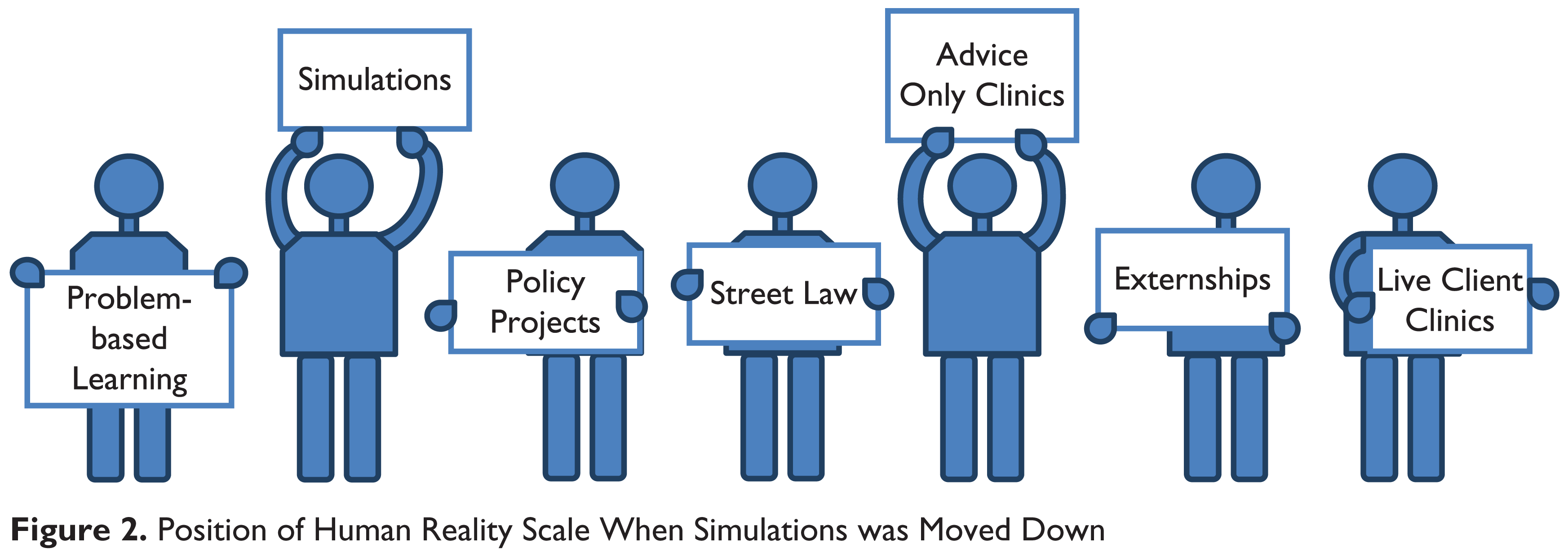
Reality
The first theme to emerge from the reality human scale was that reality depended on how the activity was created. If the kind of CLE is created by an academic, this makes it less realistic. For example, a colleague stated that ‘I think that simulations, because they have been created by academics, so they are, as [participant name] would say quite tightly framed and classified, I think we may have to move this person over here, closer to problem based learning.’
The scale moved to this position:
By placing simulations here, all of the academic made kinds of CLE are at the bottom of the scale as the least realistic. If an academic is creating the legal problem which the students work with, they are deciding which elements of practice the student engages with and how far they expand their legal knowledge. Creation by an academic does take some of the reality out of the activity. The case does not move at the pace of which a normal case would, but rather at the pace the academic decides.
Working with the community was discussed in terms of reality. One colleague proposed that policy projects should be above street law, as they
deal with, or create government decisions, that that are much more complex than dealing with the small cases that are simulated or with cases that don’t involve working with legal clients (pointing at his street law sign). So that is more complex than street law or advice only clinics. They are more skilful and more broadly understanding.
This is an interesting point. This colleague is highlighting that working with the complexities of the law makes it more realistic and engaging with this skill makes policy projects more realistic than the kinds of CLE which do not involve an actual legal client. I have always considered policy projects to be the odd one out here, as working with consultations and policy involves writing for a different audience than the usual client. They do not exercise as many lawyering skills as maybe the other kinds of CLE do. They involve intense legal research and writing, able to include legal terminologies which we encourage students to abandon or explain more fully with their clients. However, this may be more realistic than working on a very short small case or giving a street law presentation, as this colleague mentioned.
This was quickly rebutted by another colleague who, when looking to my definition of reality, was of the opinion that not many practising lawyers really engage with the community or policy projects, asking for policy projects to be placed in between street law and Advice Only Clinics (AOCs). He stated that lawyers rarely ‘will be going out into the community to do a street law presentation or something like that, whereas occasionally, if it affects their practice, they might do a consultation response but not very frequently’. This is a sound point. Unless a suggested law reform affects the practice of a lawyer, will they want to engage with policy projects? Furthermore, it is not often you hear of law firms sending their staff out to engage with the community in legal presentations. It is not always a common activity for a lawyer, as it comes outside of the scope of normal expected practice.
This was, however, disagreed with. A colleague stated that ‘as a lawyer I went out and did a lot of street law presentations as a corporate lawyer we would do a lot of that, go out into the community and do “what is a trademark, what is a company”’. One of my colleagues fed their own experience of practice into their opinion on reality, providing that some lawyers do engage with projects such as street law during practice.
During this discussion, policy projects moved quite vigorously. When it was first moved, it was placed just below LCCs. It was then moved in between street law and AOCs, before being placed back in the position shown above in the diagram, in between simulations and street law. These extreme movements display how the opinions of my colleagues varied greatly, particularly when they were drawing on their own experience. The realities they were thinking of were their own and how they operated in practice. This provided great insight into how lawyers in the real world work and engage with the clinical opportunities we provide our students with.
Models of CLE emerged during this discussion. I realized quite quickly that I had viewed my scale in a very broad way, not thinking of how the models vary. Whilst I can appreciate that this may affect my scale, if I did not do it in this way there would never be a final scale. It would change continuously, depending on different situations. One colleague provided:
[I]t is not entirely black and white because externships and live client clinics can form very different models. So an externship you could be fully immersed into the world of that firm and working, effectively, as a trainee solicitor, or you could be walking around just shadowing somebody and you would never say that’s the reality.
This is very true. Externships can provide students with very different experiences. Some may be actually drafting documents, conducting legal research and other various legal activities. Others may be merely watching what the lawyer does and not actively engaging with their work. This can also be said of LCCs; in that, it is completely dependent on what kind of case you get. Some students will have a very good case, where they can work on it from start to end, practising many different skills. Sometimes students get a case which is a disappointment; it does not go much further than an initial interview and their contact with the client is minimal. Thus, if a student has a very good externship, this will be more realistic than a bad case in an LCC.
Street law was also discussed in this way. A colleague volunteered, ‘I think with street law that can take sort of different forms, and sometimes students are replicating the same types of street law presentation, and I wonder how really realistic that is. Even compared to problem based learning and simulations.’ If a student is replicating the same presentation each year, is this realistic? If the student is not developing the skills expected in street law, this can mean that PBL and simulations will be more realistic.
After the discussion, the scale looked like this:
This is already quite a change to how my scale looked. Having policy projects higher than externships was surprising. This is mainly because those working with my scale were drawing off their own experiences, as I had when I created the scale.
Placement of Human Scale for Reality, After Discussion of Different Models of CLE
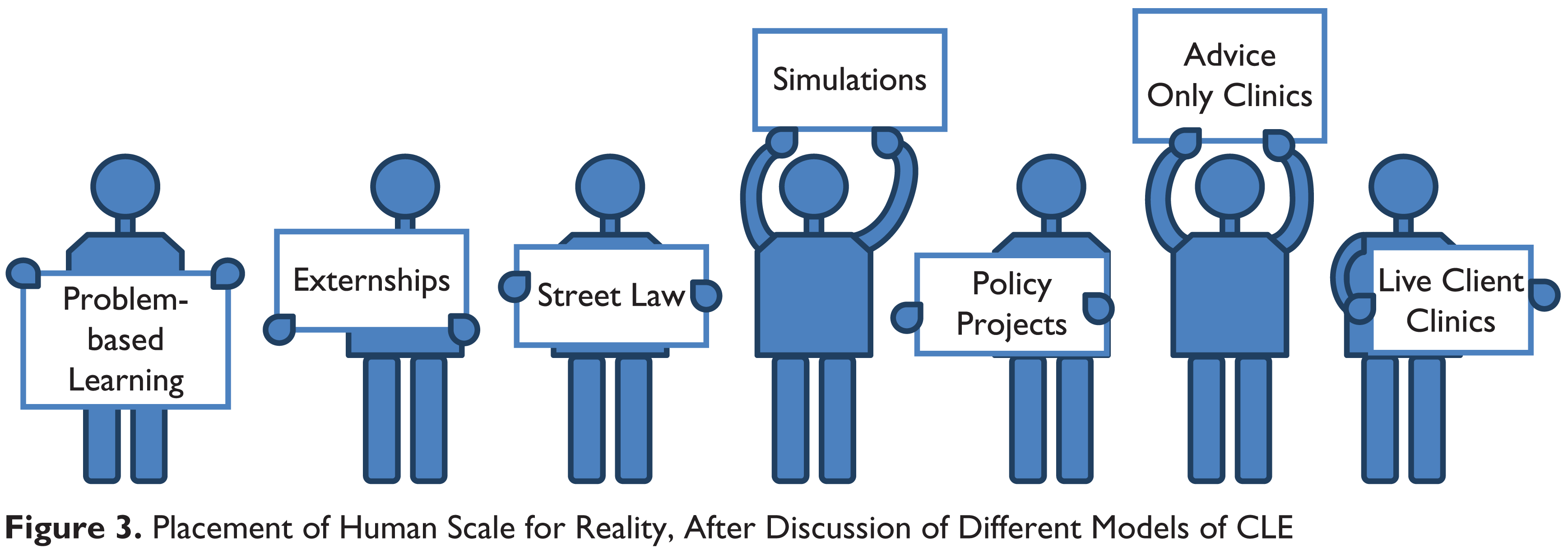
The next theme which came out during the reality scale, which has already been slightly discussed, was which skills the kind of CLE entailed. Colleagues were of the opinion that the skills the kind of CLE exercised determined if it was more realistic. This links in with another theme, which is whether the students have the opportunity to practise these skills in the real world, or if this is simply not available to them.
A colleague highlighted that not all jurisdictions allow for students to engage with certain elements of practice. Whilst students may be able to advocate in a court in the USA, this is generally not allowed in the UK, for example. This colleague stated:
What about an advocacy simulation, which is a cross-examination in a courtroom setting, with a real judge sitting there but a pretend case…I would question whether many jurisdictions allow, if it’s advocacy, in live client or externship, would allow that level of realism, because generally you’re not gonna put a student in a courtroom. So, you could put simulation at the top!
In some instances, simulations are the furthest you can go with CLE, and this opens up students to the most realistic portrayal of practice. Most students will not get an opportunity to try advocacy, and it is not common to allow students into a courtroom on behalf of a client. Simulating this will help students to develop these skills and gain some experience.
Furthermore, the depth of certain cases was discussed:
I’m just thinking about the nature of our clinic. You know, if you get one big, complex, interesting case, as a student in a law office you get one experience. One area of the law you become really expert in. That may be less realistic to what your practice is going to be like.
If a student works only on one big case, they are just practising a set of skills once or twice in a certain area of law. If a student were to take on 20 advice only cases, they are experiencing different areas of law and are able to interview, draft client care letters and conduct legal research many times. This may be more realistic than taking on only one big case, getting a wider range of skills and experience. This colleague moved AOC above LCCs at the top of the scale.
Position of Human Scale for Reality, at the End of the Discussion
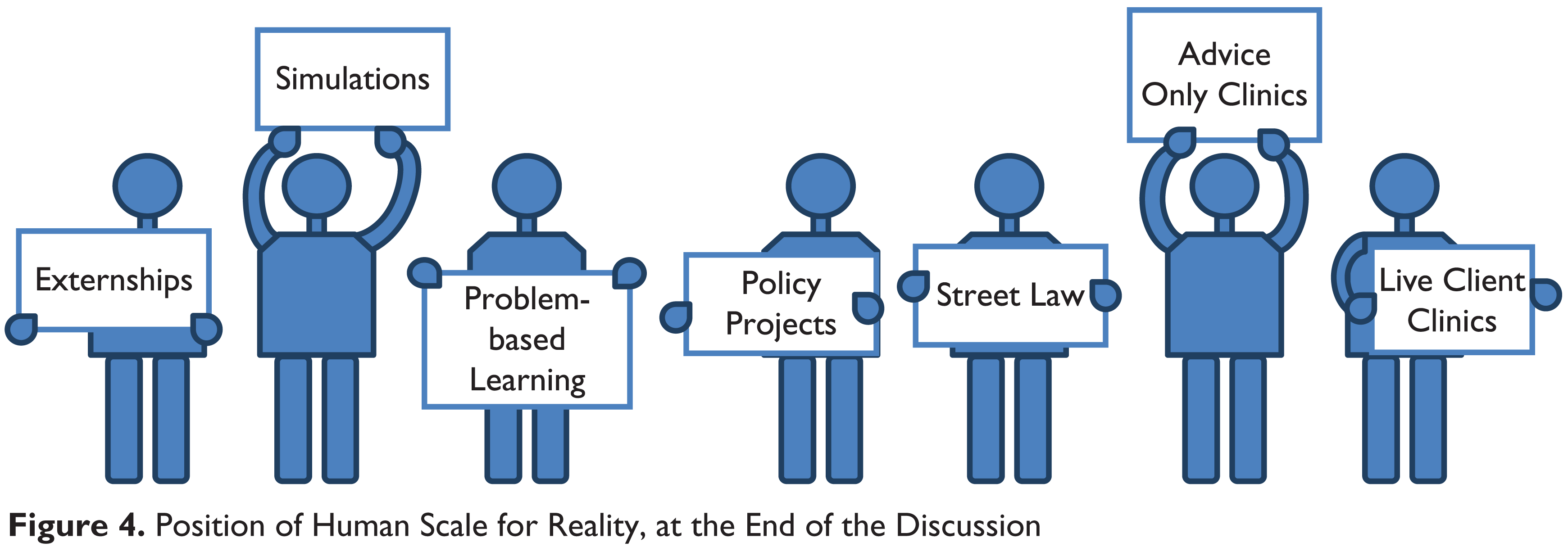
This was, however, disagreed with. It was pointed out that, particularly in the UK, more lawyers are becoming more specialized and are focusing on one area of law, due to our changing legal climate. This results in ‘a lot of lawyers out there that basically run exactly the same cases over and over again’. If we look at legal practice in this manner, then repeating the same cases over and over is more realistic than working in many different areas. This is, obviously, something which can change in time. This may have made AOCs more realistic 10 years ago, but maybe not so much now.
The final comment on this theme was regarding PBL. I always thought PBL was the least realistic due to the lack of a client, real or created. A colleague stated:
[P]roblem-based learning sometimes has more reality, if it is about tackling ambiguous uncertain problems, that you have not been taught about, I would move problem-based learning up to, probably above simulations, quite often. I think all of the others probably often involve the same thing. But simulations and externships sometimes involve the students not tackling complex uncertain problems from scratch.
This is something which I discussed earlier in this article. I do not deny that PBL plays an extremely important role in legal education, providing students with a foundation to gain the answers to legal questions. However, I never considered how much of a role PBL can play. Simulations and externships may not involve a student working with complex legal problems, meaning that they are not getting this reality of practice. It is another skill in itself which cannot be better taught any other way and is integrated into other kinds of CLE.
The final placing of the scale for reality was as follows:
This is not what I was expecting at all. Even though this was not a final consensus for the placing of reality, it was quite different to the scale I had made.
Risk
During this part of the session, many people drew on their own experiences of what has gone wrong, or they fear could go wrong, when working with CLE. Even though my definition of risk is broad, as discussed previously, there were still certain risks which I had not considered when I made my scale. The scale started in the position it ended for reality, shown above.
The first theme discussed concerned reputation. For example, one colleague highlighted that externships could be on any part of the scale for risk, as ‘it would depend if they’re heavily sort of coached or supervised or if they’re just left to conduct their own work’. Whilst this relates heavily to another theme of control, this colleague stated that it would depend on the kind of student which you are sending on the externship. If it is a ‘competent’ student, then this makes an externship less risky. If the student is capable of doing the work, the risk of damaging the reputation of the university is minimal, and will influence ‘what the firm’s perception of that student is’. This is a very interesting point, which is not one I considered. I always thought of risk to reputation being more of a negligent issue rather than the calibre of our students. This prompted externships to be moved up, in between street law and AOCs.
This was not the only occasion in which reputation was mentioned, noting relation to professional negligence or misconduct. It was also mentioned for policy projects and street law. If students are not producing sound responses to policy documents, it can have an adverse impact on the reputation of the university, as they are affiliated with the university’s name. However, it was pointed out that with policy projects, it is ‘more likely that they’ll be heavily supervised by an experienced academic’. This can be true for many institutions. At Northumbria University, we have a dedicated society which responds to consultation papers set by various governmental bodies. The work is checked continuously by a lecturer, who is also the person sending the final copy to the body. This, obviously, eliminates a large element of the reputational risk.
One colleague mentioned a reputational risk of student satisfaction. This, again, is something I would never have considered as a risk. When looking at student satisfaction, this colleague stated that it is the kinds of CLE such as simulations and PBL which are harder to provide students satisfaction. With LCCs and AOCs it is easier to create student satisfaction, as the students are more excited about the work they are doing. He stated that
the danger when running simulations and problem based learning, I think, is student satisfaction. I think that the others are more likely, not always, but more likely to create student satisfaction. Externships are perhaps slightly risky I think, because it’s where the student goes.
This is not something which I included in my thinking when creating the scale. As this colleague works very closely to student satisfaction and ensuring it is maintained, it is not surprising that this is a risk they consider to be high. Again, there was a kind of CLE which was seen as dependant on how it worked: externships. If a student has a very good externship experience, obviously their satisfaction will be higher compared to a bad experience. With PBL and simulations there is the fear that students will not enjoy them or see the educational benefit. They are not as exciting as working with live clients.
After this discussion, the scale looked like this:
Placement of Human Scale for Risk, after the Discussion of Level of Supervision and Student Satisfaction
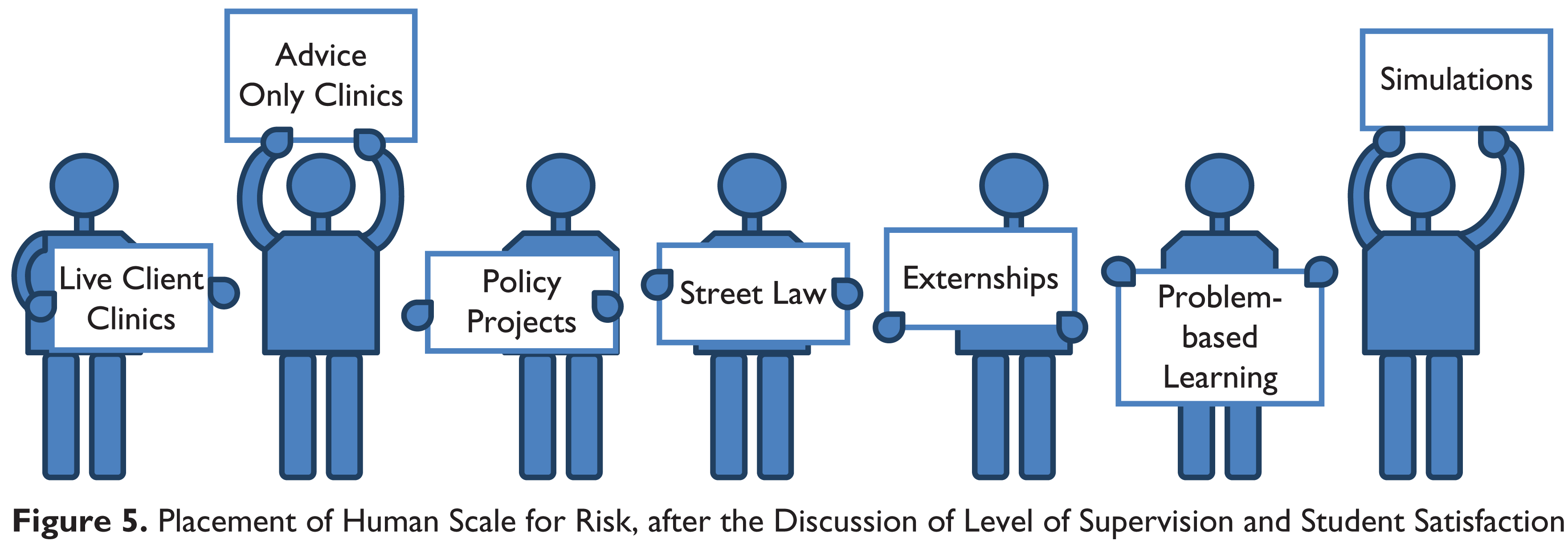
This, mainly due to the student satisfaction comment, has created a very different scale to my own. Having LCCs as least risky is not a position I ever imagined it to be in and having PBL near the top was surprising. For the reasons I discussed previously, I will always assume PBL is one of the least risky kinds of CLE. So it was very interesting to know what this colleague thought and what his worries were.
This leads us onto the theme of control. When my colleagues discussed control, it was in relation to how much they can intervene and take over a kind of CLE. One colleague discussed her work in an LCC and, being from the USA, how tricky advocacy can be to supervise:
[F]rom the point of view from risk to the client I think any situation where it’s not easy to supervise and intervene is the most risky. And for me that would be in court, where we have the students litigate and I sit behind and I try not to intervene. So, those are the very high risk situations that I face. Everything else I can review their writing or their policy work. Hopefully I can sit in on their consultations. But courtroom scenarios are very risky.
This is something which I did consider. Whilst not many of our students will advocate in a court in the UK, they can speak at tribunals. This means that there is an added risk here for clinicians to consider. If a student says something wrong in an interview or a client care letter, it can be rectified relatively easily, without much of a negative impact. If a student says something wrong in court, it cannot be taken back. That fact that some elements of practice are harder to supervise creates a very high risk. You would not get this with something such as PBL or simulations, and LCCs was moved back to the top of the scale.
This prompted another colleague to share why he thought AOCs are more risky than LCCs:
[C]ases where I’m representing I’m very much in control of the case and how that case goes and I can react to different situations and, I don’t know if other people have had it, where the client, if you just give them advice, goes off sits in court and tells the judge that you told them something completely different to what you actually did tell them.
This theme of control is very strong in the comment. If you can control the case, then you can control the level of risk. This is clearly quite difficult to do when your contact with the client stops after the advice is given, and you do not know what they are saying in court themselves. Whilst this colleague admitted that he had never seen that happen in a law clinic, he had seen it in practice. This made AOCs to be moved to the top of the scale, above LCCs.
Street law was also discussed in relation to control. First, students can give wrong information during a street law presentation and this wrong information can spread to other people. This will obviously have a reputational hit, as mentioned above, and this is what happened to that certain colleague. This led another colleague to admit that she had always felt ‘freaked out’ when it comes to street law presentations as, ‘I think they’re quite difficult to control and to know exactly what’s been said.’ This element of control impacts what clinicians think of risk. If they can control the situation, they feel as though there is less risk involved. It is when they do not know what is being said or what the students may do that they panic. Street law was moved higher up the scale, above simulations.
Confidentiality was highlighted as an issue for risk, but not in the way I would have thought. Confidentiality in LCCs and AOCs was not discussed at all, which I find rather surprising. I thought there may have been fears shared of students breaching confidentiality when working with live clients. Rather, it was discussed in relation to PBL and what examples are used for this kind of CLE. A colleague told of when he was teaching a case in an LCC and a student recognized it as an example used earlier in their degree. He stated that ‘…if you’re using examples from casework that you’ve actually done there is always a risk that a student will recognise that case from the facts and could actually identify’. This risk can have detrimental outcomes for many people involved, and whilst we should use real example to help aid teaching, we need to ensure that confidentiality is maintained throughout. This colleague admitted that PBL, in his opinion, is not ‘extremely low risk’ for this reason and moved it to above policy projects.
Placement of Human Scale for Risk, after Discussion of Whether the CLE is Internal or External to the Institution, and the Final Placement for Risk
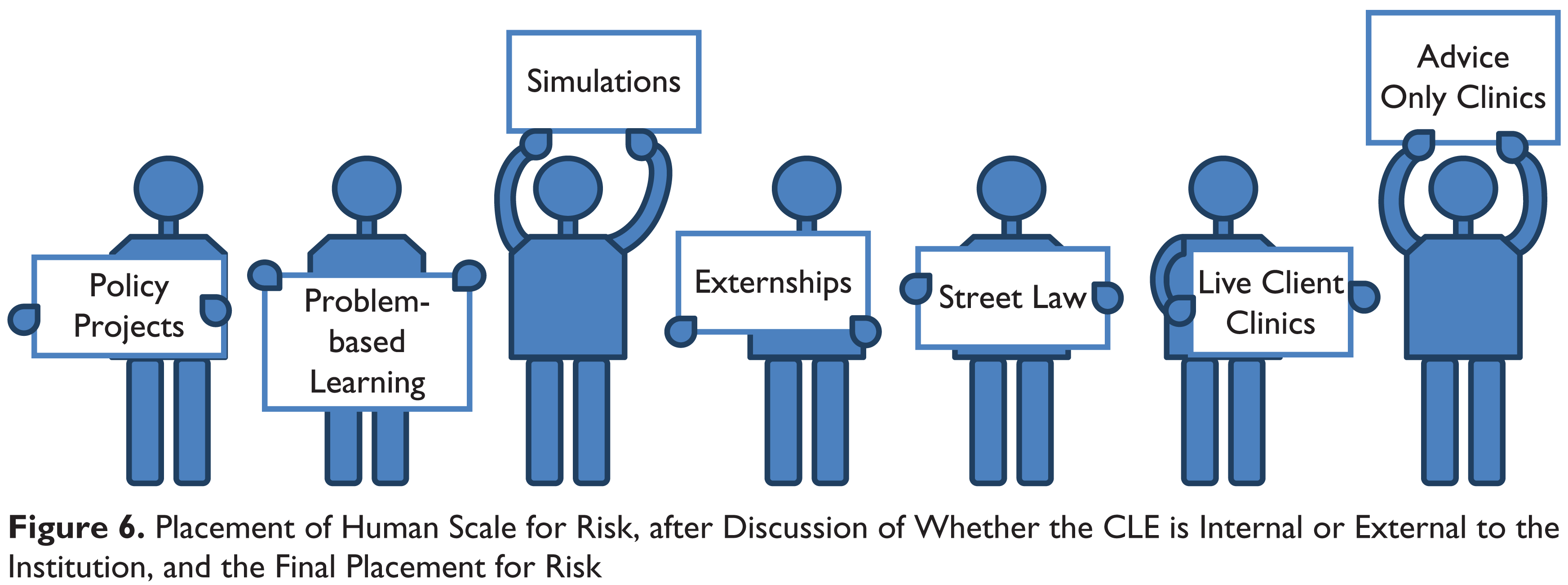
Whether the activity is internal or external to the university played a part in the control theme. One colleague provided, ‘I’d move simulations down, because I think at the end of the day anything that is contained within the university is less risky. So anything that’s external to the university, so externships by its very name, would move up one.’ This was agreed with by someone else:
It’s very interesting because when the problem’s internal to the institution they do have a level of control and you can remedy before you lose your reputation or before you have big problems. But when you have an external course then it’s out of your control. So I think I agree. For the risk external is more risky than the internal ones.
Thus, when the kind of CLE is contained within a university, the clinicians feel as though they have some element of control. This element of control is what helps them to minimize risk and feel more in control of the kind of CLE. Thus, it is not so much what can happen, but rather what can be put in place and done to stop something from happening.
The final placing, at the close of the session, for risk was:
This reflects strongly the last part of the discussion. All of the kinds of CLE which are contained within the university are at the least risky end of the scale. All the kinds external or with a live client are in the middle and moving towards the more risky end of the scale. This is not radically different from the scale I created for risk as a final placing, but as stated previously, this was not a final consensus. Given the opportunity, the kinds of CLE could be moved up and down the scale all day, depending where people wanted them placed. The movements could occasionally be rather sporadic, a kind of CLE placed somewhere I did not think was likely. I had a great insight into the different risks of CLE due to this session.
Conclusion
I can appreciate that this data is not representative of all clinicians. I learnt quite quickly in this session that all clinicians have different opinions, based on their differing experiences of working with CLE.
My scale was very broad and I thought generally of the risks and realities in CLE. I believe I had to do this in order to make a final scale. If I had always thought throughout that it depends on what happens during an externship or how a street law presentation could go, then I would not have had a final scale myself. However, it was a good opportunity to get some feedback and opinions from my colleagues in Turkey. It is not often that there are so many clinicians from across the globe available to discuss these kinds of things.
Whilst this article highlights the research I have done for my own PhD, I hope that it will be of help to others. When deciding what kind of CLE is suitable for an institution, educators must think about the best form of pedagogy for their students and what risks could possibly be attached. There is not much literature surrounding the risks of CLE and perhaps it is time for us to be sharing these experiences in order to help advise others that there can be situations arising which they may not have considered.
Even after this session I will not be changing the scale for my thesis. I still stand by my original decision. However, it has given me food for thought and to not be as limited in my approach when making decisions like this in the future. I am very thankful to all who took part and learnt a lot from some very experienced educators.