



Abstract
Legal clinics in the MENA region countries—like in other developing parts of the world—might be in a position, especially in their first years of activity, where they are obliged to provide legal assistance in various areas to the vulnerable groups of the society due to two factors. First, there is a lack of specialized and professional activists and volunteers, alongside the need for other resources like funds and supporting organizations. Second, the basic civil needs in the society that have not been met by other juridical organizations are diverse, and, therefore, they are passed on to legal clinics trying to meet the basic legal information and needs of the society, let alone concentrating on specialized matters such as environmental subjects. The main outline of this article is to indicate that for having a more effective performance by legal clinics in the legal structure of their countries, it is necessary that they transition from offering legal aid and teaching laws in every area to much more specialized fields like environmental law due to the local needs of where they are situated and referring to their professional human resources. If clinics specialize in special areas of law such as environmental law, they would gain at least two achievements—first, being able to protect the vulnerable ecology of their local rich environment and to enrich their own knowledge on their rights and laws they should be aware, and second, these specialized clinics would have the opportunity to play a creative and significant role in the legal and juridical system of the country, for example, through comparative studies, exposing the new point of view to the jurists and judges, drafting new legal bills and altering the existing impractical laws that do not answer the local needs.
The Geography that Summons
Every country is bound to its geography and the circumstances that the geography imposes on it. For example, Afghanistan and Tajikistan do not have access to the seas, a large part of Saudi Arabia is an indigenous desert and Cyprus is an island. Each of these geographic states imposes limitations, as it sometimes gives rise to some unique advantages. Geography has always been a two-edged sword for Iran. In terms of both area and population, Iran is the largest country in the Middle East. It is the 17th largest in the world in terms of population. With the right management and environmental policy, the government could find the opportunity to overcome the problems and issues enforced upon their nation’s people and economy and to move towards sustainable development goals. 3 For these goals to be reached, everyone needs to do their part, meaning the governments, the private sector, civil society and people need to contribute as necessary. In this part, a summary of Iran’s geographical situation, which is somehow similar to other MENA region countries will be explained.
Iran, with an area of 1,648,000 sq. km, ranks eighteenth in size among the countries of the world located in West Asia, facing various environmental pressures from its geographical state, which is worsened due to mismanagement and exploitation of forests and water resources in the past decades. Even though Iran borders the Caspian Sea, Persian Gulf and many rivers in its borders sharing water with neighbouring countries, it is facing a great water scarcity and following water scarcity, facing related problems such as deforestation, desertification, and sand and dust storms.
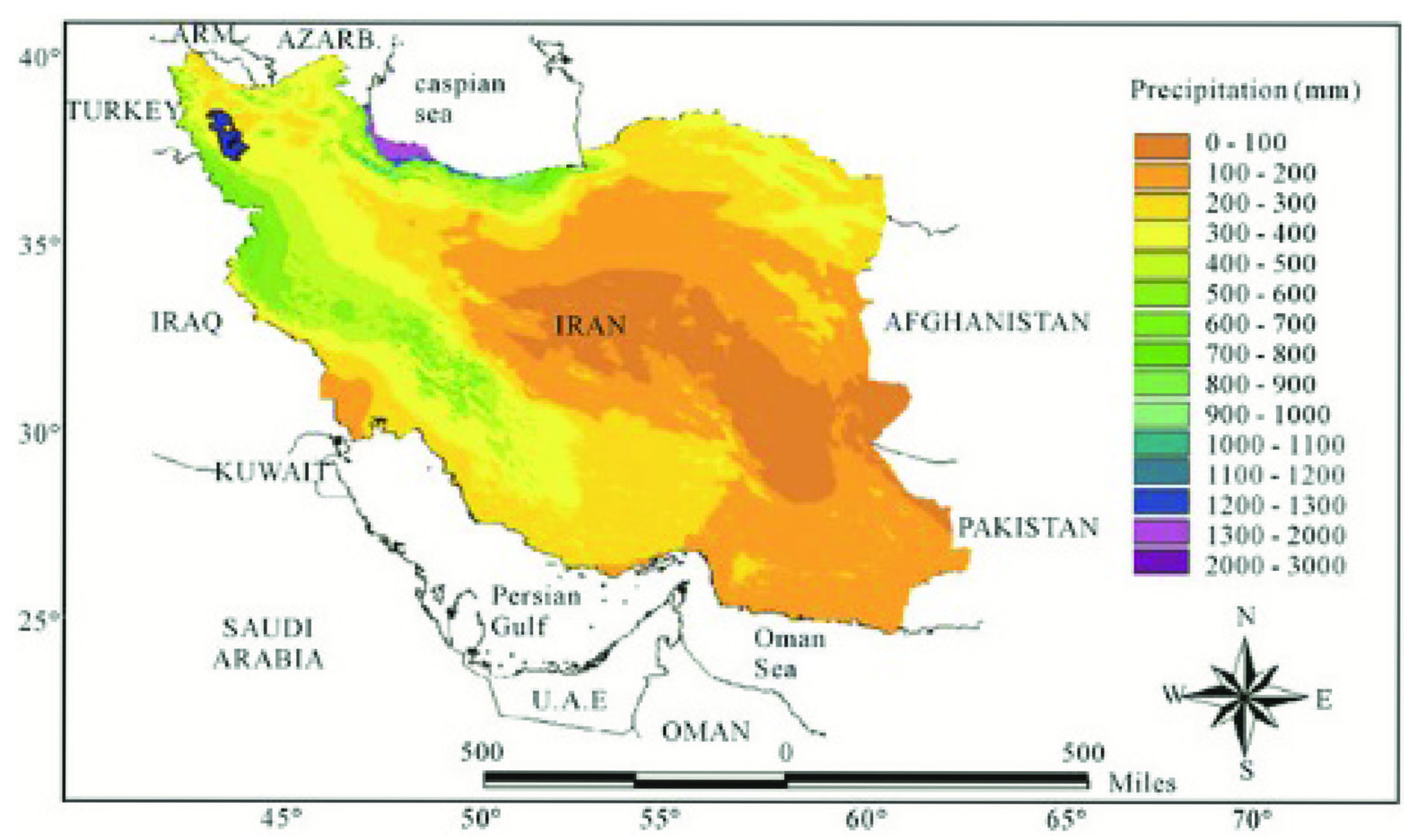
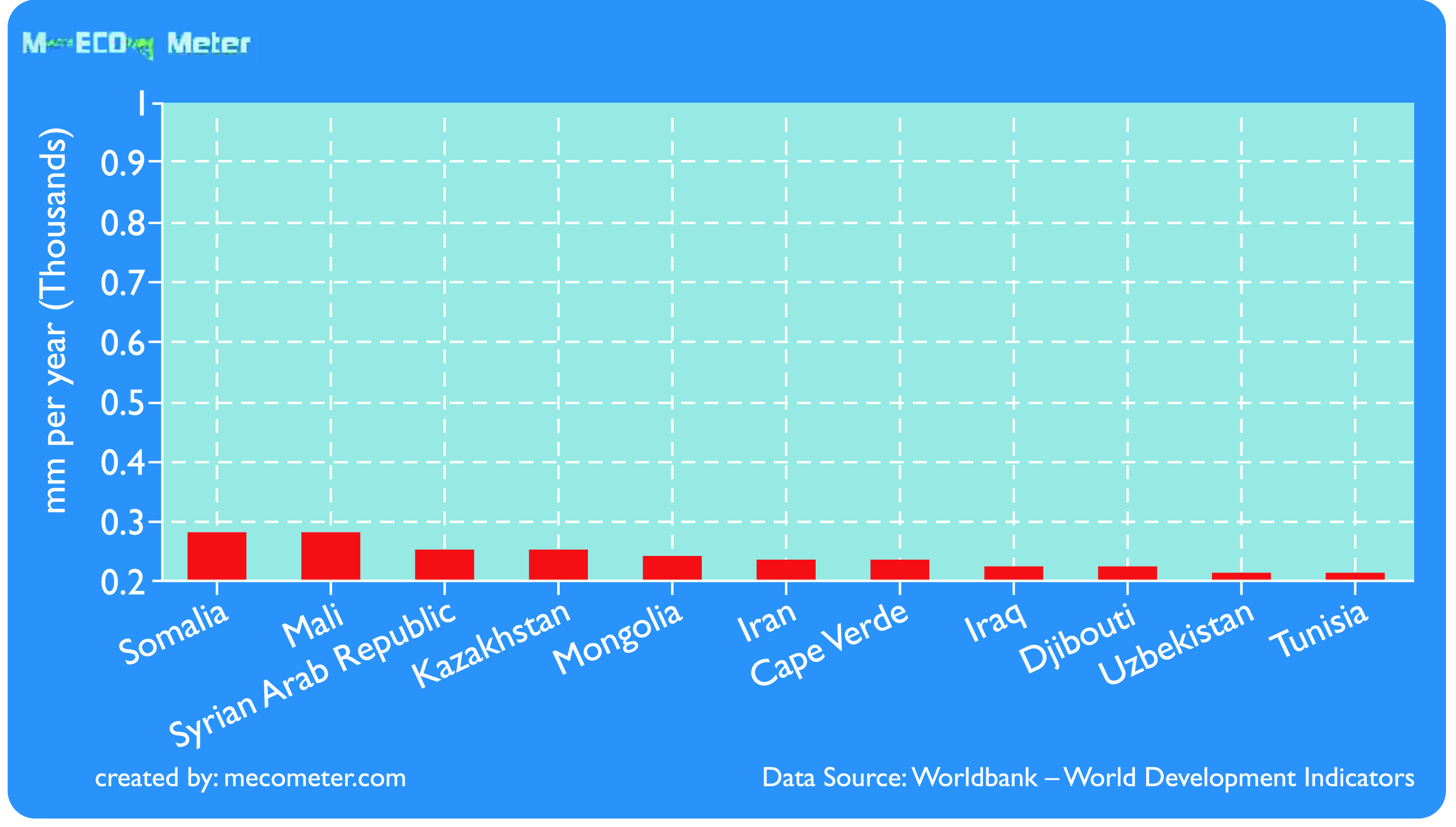
In general, Iran has an arid climate in which most of the relatively scant annual precipitation falls from October through April. In most of the country, yearly precipitation averages 250 mm or less. The major exceptions are the higher mountain valleys of the Zagros and the Caspian coastal plain, where precipitation averages at least 500 mm annually. In the western part of the Caspian, rainfall exceeds 1,000 mm annually and is distributed relatively evenly throughout the year. This contrasts with some basins of the Central Plateau that receive 10 cm or less of precipitation. 4
Except south of the Caspian Sea, most of Iran’s area is covered by deserts and wastelands such as Dasht-e Kavir, 5 also known as Kavir-e Namak 6 (salty lowlands), which is a large desert lying in the middle of the Iranian plateau. It is about 800 km by 320 km with a total surface area of about 77,600 km,2 making it the Earth’s 26th largest desert. 7 The area of this desert stretches from the Alborz mountain range in the northwest to the Dasht-e Lut in the southeast as can be seen in Figure 1. It is partitioned among the Iranian provinces of Khorasan, Semnan, Tehran, Isfahan and Yazd which have the least precipitation as shown in Figure 2.
Another big desert is the Lut Desert, widely referred to as Dasht-e Lut, 8 a large salt desert located in the provinces of Kerman and Sistan and Baluchestan, Iran. It is the world’s 27th largest desert, and was inscribed on UNESCO‘s World Heritage List on 17 July 2016. 9 The surface of its sand has been measured at temperatures as high as 70°C (159°F), 10 making it one of the world’s driest and hottest places. Precipitation in Iran increased to 32.77 mm in December from 16.97 mm in November of 2015. Precipitation in Iran averaged 18.72 mm from 1901 until 2015, reaching an all-time high of 81.40 mm in March of 1996 and a record low of 0.15 mm in August of 1995.



There are no major rivers in Iran. Of the small rivers and streams, the only one that is navigable is the 830 km long Karun (Figure 5), which shallow draft boats can negotiate from Khorramshahr to Ahvaz, a distance of about 180 km.
Due to the aforementioned water scarcity explained, only 7 per cent of the country is forested. The most extensive growths are found on the mountain slopes rising from the Caspian Sea, with stands of oak, ash, elm, cypress and other valuable trees. Therefore, saving the ecosystem and livestock there and avoiding deforestation is one of the most important topics in the recent decade.
However, Iran’s bio-diversity ranks 13th in the world. 11 There are 272 conservation areas around Iran for a total of 17 million h under the supervision of Department of Environment, variously named national parks, protected areas and natural wildlife refuges, all meant to protect the genetic resources of the country.
Regarding the geographical state of Iran and other MENA region countries, the malpractice of economic units and negligence of governmental authorities, current environmental issues in the region are air pollution, especially in urban areas, from vehicle emissions, refinery operations and industrial effluents, deforestation, desertification, oil pollution in the Persian Gulf, wetland losses from drought, soil degradation (soil salinity), inadequate supplies of potable water in some areas, water pollution from raw sewage and industrial waste, and urbanization. MENA’s rapid population growth exacerbates the challenges that this region faces as it enters the third millennium. For hundreds of years, the population of MENA fluctuated around 30 million, reaching 60 million early in the twentieth century. Only in the second half of the twentieth century did population growth in the region gain momentum. The total population increased from around 100 million in 1950 to around 380 million in 2000—an addition of 280 million people in 50 years. During this period, the population of the MENA region increased 3.7 times, more than any other major world regions. 12
As explained in this part, the environmental fragility of the countries and the dryness, forces legal clinics to move away from generic legal clinics covering family law, labour law, criminal cases and offering various legal aids to specialize in particular fields focusing on main issues which could result in conflicts between different countries and provinces of each country like such as environmental problems. Establishing environmental law focused legal clinics could help offer results by doing comprehensive researches and educating the indigenous habitants of each region by use of street law to help understand their ecology better and to have a better perspective towards their future.
Reasons Why the Governmental Administration Is Not Enough
This part will cover the inefficiency of governmental administration in guarding environmental premises. It will illustrate how the conflict of interests that is faced by the government affects this important role of the authorities. The government is responsible for developing industries and economic growth but it must restrict industrial activities due to protection of the environment. Hence, the government faces conflict of interests and cannot fulfil its role since the economic growth is seen to be short term and more achievable rather than planning for sustainability of economy in long term.
It should be mentioned that empowering legal clinics and civil non-governmental organizations to demand and make legal claims is not welcome in less democratic countries as it would require res ponsiveness from the governmental authorities and organizations. Meanwhile, they prefer to keep humanitarian and environmental organizations not funded and cause administrative obstacles and problems to stop them from becoming active and realizing their goals in the society. These developing countries in the MENA region, similar to Iran, are not welcoming towards such organizations which enable students, lawyers, professors and civilians challenging existing difficulties and future prospects.
The state prefers to exploit the resources as much as possible to increase its gross domestic product and does not contemplate on sustainable development, in countries such as Iran and some other MENA countries. Being responsive and having a long-term plan for environmental matters are not a priority for these state authorities. Therefore, the governmental organizations are not very efficient.
To be more precise, in Iran’s case, we should indicate the governmental organization dedicated to environmental objectives. In Iran, there is only the Department of Environment formed since 1956, under the supervision of the president that is responsible for matters related to safeguarding the environment. There are three main objectives defined for this organization. First, the realization of Article 50 of Islamic Republic of Iran’s Constitution Law aiming at conservation and protection of the environment and assuring sustainable development. Second, preventing and prohibiting pollution and destruction of the environment. Third, protecting biodiversity and expansion of environmental resources.
Nevertheless, with the three main difficult objectives mentioned previously which needs great power and influence, it is not yet established as a ministry or an organization dependent on a powerful ministry. This decreases the power and the fund it receives from the state, even though as per the law, all projects need an EIA report and a certificate from this department to proceed with their projects.
Another way of determining how reluctant the state is by looking at the budget the state allocates to this department. For 2018, the budget is only US$24,269,695 which is very low in relation to such a vast country and all the environmental obstacles it has, to compare, EPAs budget for 2018 is US$5.655 billion.
We can observe that the governmental administration is not yet convinced to put all its force for protecting the environment regarding the vast problems environmental issues are raising in the country. Hence, legal clinics with the help of lawyers and students should become active and play their role in guarding their society to address the issues that the government ignores.
The Potential Role of Legal Clinics Specializing in Environmental Law
This part will demonstrate how law students and professors can play an important role in inflicting entities to abide the law. The advantages law schools and the communities will receive back from housing a legal clinic specialized on environmental law will be discussed as well.
As Emile Durkheim said to law students in his social science class at Sorbonne on 1888,
[W]e should not trap ourselves in the dry words of legal texts; if we dedicate our time only to interpret legal texts and in each subject our only concern be finding out legislator’s intention, we will get used to thinking that the source of law lies in legislator’s intention and sacrifice means for words, and sacrifice reality for appearance.
Many people mistakenly think ‘law’ is equivalent to ‘legal approvals’. As many law students believe their assignment is to understand ‘legal approvals’ and consider that one who knows the statute book better is more acknowledged. Even worse, they do not know how these laws are applied. If by any chance, they find themselves in a court room, they will find a great gap between what they have learned and what is practiced. The same story of engineering schools and the industry applies to law schools and Department of Justice.
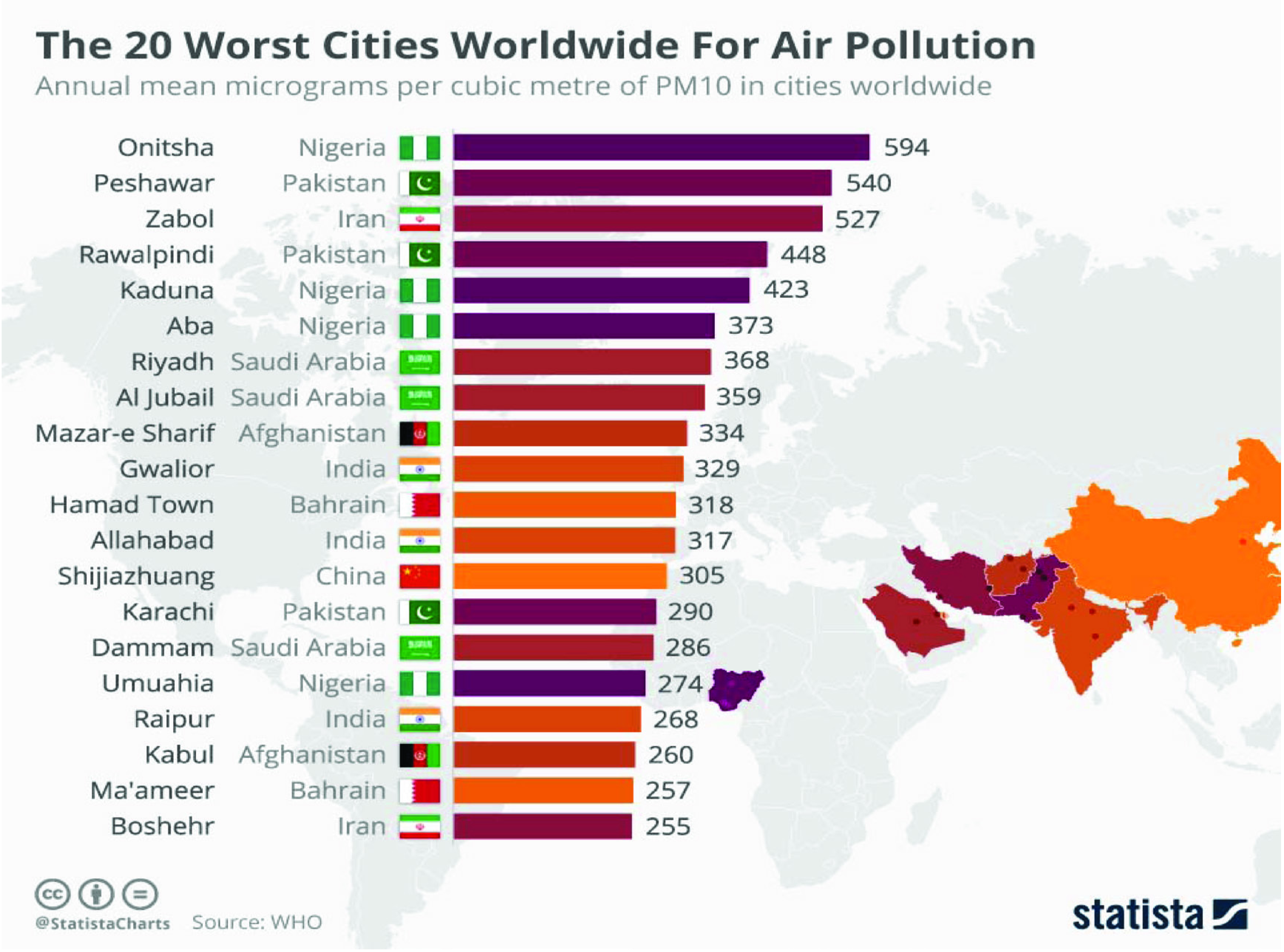
One of the ways that can bring law students close to the reality of legal works is through the introduction of legal clinics and legal training in clinics. In this article, by legal clinics we mean a subdivision in law school that would follow two goals simultaneously. First, the practical teaching of law to environmental law students via real cases happening in the environment and second, offering professional, qualified and free legal services to vulnerable communities and individuals of the society who cannot afford it, such as farmers, women and children who must search for water for their families and citizens dying because of air pollution and sand storms (see Figure 6).
In other words, legal clinics are meant to teach law as an independent free-of-charge institute and as part of the university. Also, they take no political sides, are interested in laws that effect everyday lives of people and wish to pursue ways to alter them.
Opening legal clinics and commencing practical teachings through them for environmental law students in universities have very important outcomes for different groups and individuals of the society. In this part, we will discuss some of these outcomes that are most effective.
Outcomes for Law Students
The presence of law students in these clinics will expand their theoretical knowledge of the law to higher levels of reality in the society. Interaction between students and clients who are normally in difficult financial states and are from vulnerable classes of the society will help law students to become familiar with the vast variety of legal cases arising in the society and will help these students who are normally in the final terms of their education to challenge their own competence and capabilities in solving legal environmental problems, exactly like medical students who attend patients at their bedside under the supervision of their professor and examine their medical information and diagnosis.
It could be said that this pons asinorum is the most important outcome of legal clinics for law students because it brings out their weakness and strength. Legal clinics can create an environment where those seeking legal aid could be assisted. These clinics source the pleasuring feeling of being useful to others and therefore, develop a positive energy in students and also teach students to take part in collective pro bono activities. Further, they teach students the secrets of success in their professional life, including but not limited to filing a case, preparing a summary of the case, legal writing, correspondence, and juridical process, interview skills, legal advising skills, problem-solving, legal ethics in advocacy and judging, and the ways of increasing professional capacities.
All this would be under the supervision of environmental law professors who are teaching law students and are a member of the Bar Association. Their supervision will assure the success of students associated with the clinic.
This experience will be gained by law students via the learning system of learning-by-doing, which is one of the most successful methods of teaching by which students can acquire skills and knowledge needed for their future competence.
Another important outcome of these clinics is organizing and making use of student’s extra-curricular activities. For instance, since law students are required to pass sometime after passing the Bar exam as an intern in order to be licensed, accepting pro bono work in legal clinics as some of the required time of internship may be considered by the Bar Association. This would raise legal clinics in law schools to a new serious horizon. As a result, students would be more motivated to put effort into it.
Outcomes for Law Departments and Universities
Offering free but qualified and professional legal consultation under supervision and management of law schools to the community, especially to the vulnerable class, will increase law school’s social and intellectual status. This fact is even more apparent with ?in-house clinics and life/real clinics.
It is noteworthy that legal clinics are divided into two types based on where they are situated, namely, in-house clinics and out house clinics. The former is situated inside the campus while the latter is situated elsewhere or maybe even with no exact location and such as in the case of a mobile clinic. Legal clinics may also be divided into life clinics and simulation clinics. While life/real clinics are those where legal services as teaching, consultation and advocacy is directly offered to the client simulation, clinics are used mostly for teaching students and reviewing hypothetical cases.
Evidently, founding any kind of an environmental legal clinic will improve law schools’ social status and its interaction with the community. Nonetheless, in house clinics and life/real clinics are more functional and have better outreach because of their accessibility; those in need of legal aid can simply arrive at the campus, head to the building and directly talk to law students working under their teachers’ supervision and provide legal advice on environmental cases.
Outcomes for Legal Faculty Members and Professors
Law professors like in other fields have specific and established opportunities to demonstrate their theoretical knowledge. The exalted place of lawyers in society and the attraction to study law in all countries create a wide range of audience for law teachers. Through legal clinics, these teachers can convey their real-life experiences in this field alongside their theoretical knowledge to their wide audience. This allows them to prevent stagnation and at the same time multiply their influence on the society. Teaching in legal clinics helps to avoid being trapped in libraries and university classes, avoids ignorance on the part of students regarding what happens in court rooms and makes students face new questions and viewpoints which might encourage them to participate in the change-making process.
Outcomes for the Civil Society
There are many civil organizations, foundations and NGOs who are in need of legal counsel to achieve their intentions and settle part of their problems. However, due to their limited funding, they cannot afford such expenses. Legal clinics subordinated to universities could be accommodating of the needs of these organizations because their services are free of charge and pro bono.
In addition to this, specialized legal clinics in environmental law and an effort towards teaching law to indigenous and native societies in need through specialized street lawyers would benefit the whole society by preventing waste of energy and resources which is spent on working on the same topics by different activists. It will also stop the sidestepping of some areas of law that are left unattended due to the division of work between legal clinics and those active in street-based legal awareness building. To avoid stagnation of legal clinics and to have an active and progressive system of street-based legal dissemination, these clinics must move towards becoming specialized in the legal services they provide to be able to adequately protect and safeguard the environment.
Outcomes for the Judicial System
Environmental legal clinic services allow those beneficiaries who cannot afford a lawyer to benefit from legal counsel before pleading or before being summoned to court. These legal counsels offered by advocates collaborating with legal clinics subordinated to universities can cause some complaints to be resolved peacefully before being pleaded and for other lawsuits to be pleaded accurately. While one of the most important problems of the judiciary system is the massive pendency of lawsuits, the outcome of legal clinics would be in the nature of reducing and filtering lawsuits and allowing the pleadings to be efficient and effectual. If done effectively, this would be a great help to the judicial system.
Outcomes for the Vulnerable Fragile Groups and Individuals of the Society
In most countries, legal services are among the most expensive services. Many people, especially in developing countries, cannot afford legal services because of their financial struggles, even though they are aware of the importance of these services. This means that many persons, often do not have access to one of their most important human rights during juridical proceedings, that is, having access to a lawyer. This could lead to widespread suppression of rights. Legal clinics with their specialization and law professors’ social recognition can be a place of trust and reliance for those who cannot benefit from legal advisors and advocates because of their financial difficulties.
Facilitating access to justice for vulnerable groups and individuals is one of the most important social functions of the legal clinics. Legal clinics can by means of using legal instruments, offering legal services to everyone, developing capacities in related sections, building competence in vulnerable groups and helping those who are driven to the margins to take control over their lives, assist in the expansion of human rights and perceptible justice in the society. Promoting advocacy of human rights culture, legal service as pro bono, legal clinical teachings, developing legally educated citizens by street law, reconstructing the law, trying to alter faltered laws through manifestation of those interested are only a few ways in which legal clinics can institutionalize respect for environmental rights in the society.
Outcomes for Other Members of the Society
It can be said that legal clinics work like insurance companies. This comparison is apt since those covered by insurance are more than those actually using the insurance, but those who might for many years not use their insurance, still have a feeling of security and mental comfort and so they are happy to pay for the costs of insurance to enjoy the advantage from this comfort. Merely, the realization of the fact that those who cannot afford legal services may, if needed, go to legal clinics in the nearby university as a reliable and pro bono institution and benefit from the legal services, will make them feel secure and protected. This is akin to when citizens know that there is a medical emergency centre where treatment is available free of charge and there is a police station nearby keeping the society safe.
Response of the Iranian Legal System to Legal Clinics
In this part, we will examine Article 66 of Code of Criminal Procedure (CrPC) of Iran ratified in the year 2014 in relation to NGOs and conclude from that point of view how legal clinics will be seen if they wish to make a complaint and stand in court. Apart from the constitutional law, the CrPC in each country is the best way to understand how much a legal system is dedicated to securing the freedom and human rights of its citizens. The first Iranian CrPC was ratified in the year 1911 and went through different changes during the past century, with the last revision being in the year 2014.
Due to the Iranian CrPC, anyone can declare a crime to the court and the attorney general must review the case and proceed if the components of a crime or a delict are proved. Hence, anyone can report an environmental crime and take it to court even if they are not a direct beneficiary or directly aggrieved, since the attorney general must legally consider the case.
In Article 66 of the CrPC, NGOs are also granted the right to take cases to court and to petition a complaint and to also appeal in front of the court. However, since it gave NGOs the power to put forth demands before the courts, the Iranian government passed an amendment to Article 66 which only allows NGOs which are approved by the Ministry of Justice to be able to appeal before courts. The names of these NGOs are published every year by the ministry.
From the aforementioned position, we can conclude that an environmental legal clinic can also draft a memorandum and make a complaint in case an environmental case is raised to the criminal system. However, it may not be able to follow the case and make an appeal against the court’s ruling.
The best way that environmental legal clinics can act in the society is through street activism by informing local persons in small cities around the forests, deserts and rivers who have direct contact with the environment and play an important role in protecting them about key legal aspects. Also, these societies are the first to detect a change in these natural features and the first to be impacted by them, so they should be educated as to how first, they can protect their own environment and second, how they can make complaints to the government based on them being affected due to governmental land selling, industrializing and building of dams.
International and Regional Foreign Policy
The role of foreign policy and cooperation between regional countries sharing the same environmental matters will be discussed in this part in addition to how they could decrease the financial and social costs that each country is forfeiting at the time being.
Environmental issues are not restricted to one region or country as well expressed in the butterfly effect concept. In the MENA region, as in other parts of the world, environmental problems are collective, existing between all neighbouring countries because of the sharing of rivers, water resources and ecosystems. In addition to this, due to global warming, countries with drier climates like countries in the MENA region are facing hard times in relation to protecting their fragile ecologies and rich wildlife. Hence, a regional effort should be made by these countries to establish an integrated management to help them handle issues such as water scarcity between riparian countries, sand storms raising and floating from nearby countries, desertification, and therefore flooding. For example, Iran and Turkey are negotiating for decades about the dams constructed by Turkey over Tigris and Euphrates due to Guneydogu Anadolu Project, which diminishes Arvan River water share to less than 70 per cent. 13 Iran and other countries argue that this project is against international water law. The same conflict has also been raised between Pakistan and Afghanistan. 14

Sand and dust storms are common phenomena in arid and semi-arid areas. The West Asia region, especially Tigris–Euphrates alluvial plain, has been recognized as one of the most important dust source areas in the world. Six main clusters are recognized as dust source areas, of which, 3 clusters situated in Tigris–Euphrates plain and another cluster in Sistan plain are also potential source areas. These storms are driven by the climate system including Siberian and Polar anticyclones, monsoon from the Indian subcontinent and depression from north of Africa. Sand and dust storms floating from Iraq and entering Iranian provinces cause respiratory problems for citizens especially children and elderly as discussed during International Conference on Combating Sand and Dust Storms held in Tehran, Iran on 3 July 2017. As seen in Figure 7, dust storms are the subject of an international environmental dispute between countries which surely needs an international policy to resolve.
The aforementioned issues could be solved by foreign policy by apprehending these issues as one community and seeing all stakeholders as potential beneficiaries. The gravity of international cooperation could also be observed from the proceedings of the 2015 United Nations Climate Change Conference held in Paris, France, from 30 November 2015 to 12 December 2015. These issues are particularly crucial since they not only raise grave conflicts between countries but also internal conflicts and tribal wars on water resources resulting in water wars.
Aside from activities of the Foreign Ministry, we suggest that NGOs and other non-profit organizations such as legal clinics alongside local education by street lawyers could help create an amicable atmosphere, thus, helping different societies and tribes in perceiving the global view and understanding the outcomes.
Legal clinics could also help studies according to local information and customs which could help legislators ratify more accurate and applicable laws which could be applied in that region. The legal clinics play a big role as collectors of useful information by means of studies and researches by students and advisors. Such local researches and information could prove to be priceless for the committees of the Parliament studying bills.