




Abstract

I have over 13 years of experience in management consulting, business research and HR analytics and have worked as both a seller of research/consulting and a user in two large IT services firms.
Currently, I run a start-up called Unearth Insights wherein we are developing decision insights products for niche technology start-ups, venture capitalists and enterprise clients. We are attempting to disrupt consulting and analytics through a model of ‘pay for insight’ rather than big and thick data.
I have been associated and actively participated with senior business and HR leaders to shape operations strategies of companies, identify human capital implications and design people practices, enhancing performance and productivity of the organisation. On the consulting side, I have engaged with global giants on market entry strategy, industry analysis and assessment, talent supply mapping, vendor analysis, peer group benchmarking, financial analysis and war gaming across IT, software product development, pharma/FMCG and agri-manufacturing sectors.
Additionally, my fortitude lies in crafting expertise in business development initiatives like industry teasers, target identification and proposal development.
Prior to Unearth, I was with HCL Technologies, leading the Market Intelligence and HR Analytics practice, delivering value consulting through research and analytics to CHRO, CEO and the board. I have also worked with Accenture India and boutique consulting firms such as Zinnov and Knowledge Faber.
Unfortunately, most HR leaders and practitioners are not clear about the difference between HR reporting and HR analytics. The latter is stating facts and past performance, and to be honest it has existed ever since HR started recording data on word document or excel sheets. Core HR analytics is all about generating insights from people data. Establishing a cause-and-effect relationship between what HR does and business outcomes—and then creating strategies based on that information—is what HR analytics in the modern era means. Generating decision insights by drawing correlations between HR metrics, business metrics and outcomes of business performance.
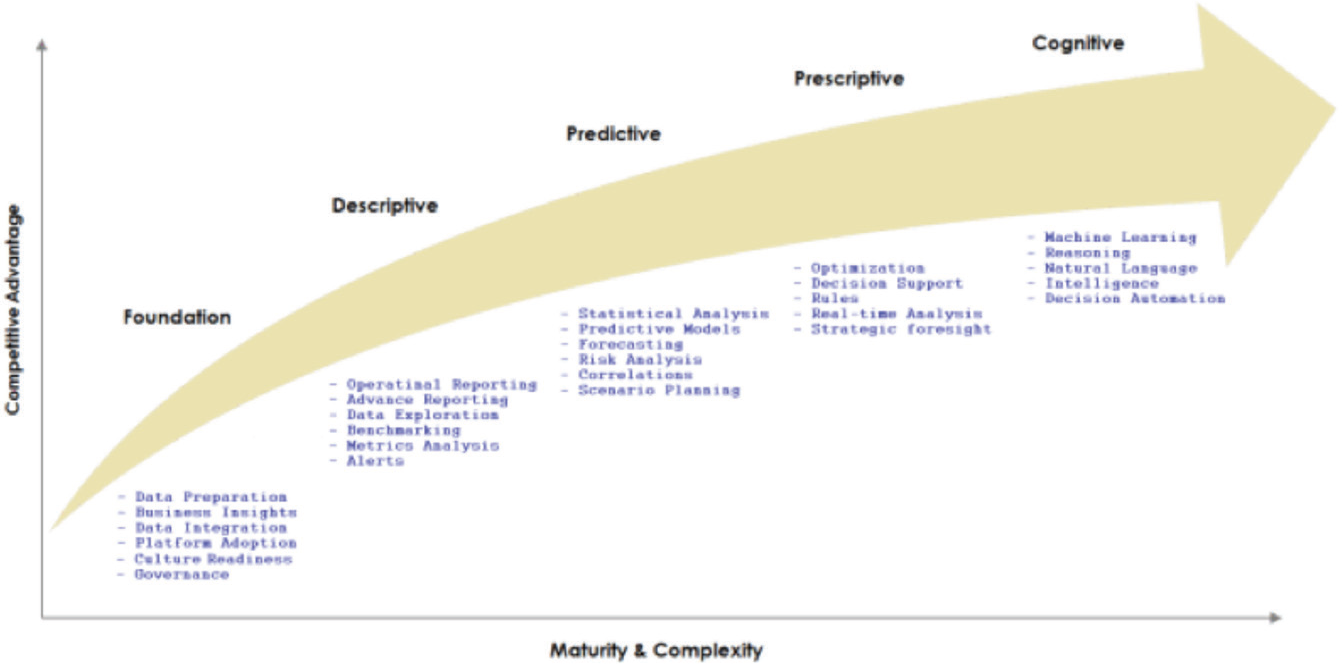
In fact, mature organisations not only understand the difference but have started moving to predictive and prescriptive analytics which drives business outcomes aided by HR organisations. In analytics, the journey has many layers, and it pushes from transactional reporting which is ‘Level 1’, that is, operational reporting of ‘lag metrics’ to proactive reporting which is ‘Level 2’ known as advanced reporting or lead indicators to moving up the ladder to ‘Level 3’ which is predictive analytics and finally to ‘Level 4’ prescriptive analytics/insights for various business scenarios.
One of the biggest concerns with HR function globally is the lack of standards. Currently, I am working with COO and the board of a large IT services firm wherein surprisingly the first exercise was cleaning up the definitions of HR metrics measured internally. Finance, sales and even marketing have principles or standards which are reasonably understood and followed across enterprises. Unearth Insights is testing marketing metrics with small- venture capital firms who want to measure start-ups in India on marketing metrics in Business to Customer (B2C) space. The idea there is to measure if marketing dollars are driving sales or if the B2C business model, product and services levels on its own are generating growth. Something like this is currently unthinkable in HR function and Unearth experienced this with a Tier-II IT services firm wherein it took nearly 2–3 months to baseline HR metrics and then helped them benchmark with apple to apple comparison.
To further elaborate on your question of why HR has taken so long also stems from the fact that only baselining and benchmarking is not good enough to understand hidden insights behind numbers. HR leaders and HR analytics teams need to have a mix of financials and business skills which is a difficult combination given the lack of emphasis of these in the education system. Let me share an example and explain what I am trying to say here. VC investing in 3–5-year-old fast growing B2C ecommerce or SaaS product firms understand that SG&A plus marketing spend can be over 30 per cent of sales, but the same becomes unacceptable if the SaaS product firm has crossed the seven- to nine-year mark, continues to remain loss-making with <5 per cent market share. Unearth did something similar in HR space recently wherein we saw the HR leader and his talent acquisition team singing praises of effectiveness of their hiring metrics and functions until we highlighted that with a slower business growth and stagnant hiring cycle they were maintaining industry-leading joiner per recruiter, however, at the cost of higher dependency on vendor or agency channel with higher cost per hire (Which was lower than industry but higher than faster growing peers i.e., revenue growth).
As per a Deloitte report ‘High-Impact Talent Analytics, Bersin by Deloitte, 2013/2014’ at a global level, 56 per cent of organisations are at the initiation of analytics which is operational reporting with 30 per cent organisations gradually moving to advanced reporting. You will be surprised to know that only 10 per cent of the organisations have strategic analytics in place, and ‘only 4 per cent have predictive analytics in practice’
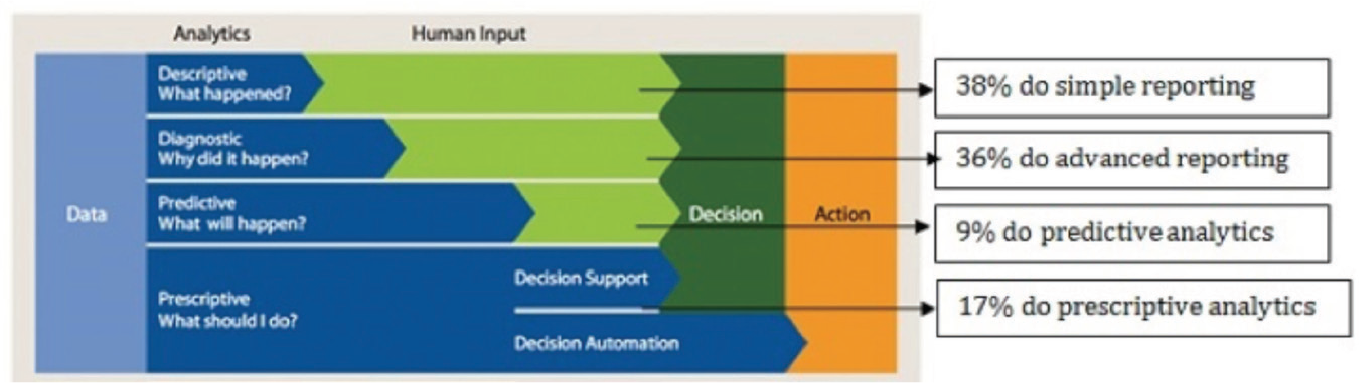
In 2016 People Matters benchmarked the maturity level of organisations surveyed against Gartner’s Analytics Maturity Model based on Workforce Analytics Study and found global organisations to have matured in the journey to ‘9 per cent predictive and 17 per cent prescriptive analytics’ which is almost double of the 2013/2014 levels (Figure 2).
However, organisations across industries in Southeast Asia and India are still in the process of increasing adoption of digital tools integrated with analytics for their candidates, employees and customers. Clean slate provides the opportunity to not only create a roadmap for the future but also to understand the strengths, weaknesses and possibilities for the growth across Southeast Asia and India.
Personally, based on my experience, people-driven organisations in India across sectors like technology services, software product development firms, retail and healthcare have realised the value plus impact of HR analytics and are correlating the same to business decisions. Having personally researched, interacted and now consulting reporting and analytics functions of four to five large and mid-size IT services firms, I can easily say HR Analytics is at a nascent stage with 98 per cent of organisations still running HR Analytics on Excel sheets while we have a huge number of tools/technologies and core analytics vendor capability to help drive business outcomes through people analytics.
Select IT Services firms that I have known or worked with in India have begun to explore/leveraged tools and technology such as R, SPSS, SAS or even IBM Talent Insights to predict future people metrics to proactively take actions driving business impact.
What do you think are typical traits of organisations that lead the HR analytics bandwagon versus laggards—their vision, leadership and how they hire or groom HR analytics competencies in particular?
According to Gartner Analytics Maturity Model, for HR analytics to be able to function properly, there are three pillars that need to be intact for organisation no matter which part of the world we are talking about.
Technology: Without a central data warehouse with employee data across employee lifecycle companies would even struggle to prepare a click of a button Tableau or Qlik- or Lumira-based HR report leave aside core analytics such as predictive demands, predicting offer to joining or predictive employee exits/ attrition. Based on my experiences with two large IT services firms’ data collation, cleaning and preparation is 86 per cent of time versus 14 per cent in statistical tools to derive trends/predictors to predict prescriptive intelligent insights. HR Competency: HR competency is simply put consumer competency, that is, people process teams or HR leaders who can use consumer insights to drive decisions out of insights to eventually impact outcome. US$5+ billion IT services firms in India have started experimenting with direct outcome delivered to business leaders (One of the mid-size IT services firm exposes HR dashboards and predictive metrics to customer-delivery teams to drive business decisions) Analytics Competency: Any analytics team needs to deliver descriptive and predictive models with intelligence, insights and prescriptive actions to drive value. This is where a combination of statisticians, data scientists and domain experts come together for organizing data into informational dockets, in other words, reporting. Reporting translates raw data into information. Analysis transforms data and information into game-changing insights.
I personally see two trends emerging across the globe and in India as well.
One, HR analytics will go down the consumer analytics path wherein direct business leaders or as it is called account/customer delivery teams driving and taking control of deriving true business outcomes from analytical insights. Google has mastered the art of delivering consumer insights directly with Google Maps, Google Adwords and Google Trends. Business leaders and mature organisations will start taking control of people data across employee lifecycle and start deriving insights to drive efficiencies with advance open-source tools.
Two, human resources management system (HRMS) products and stand-alone solutions like ATS, performance management, learning and engagement tools will build descriptive, predictive and prescriptive analytics capabilities across employee lifecycle and with a layer of advance AI technologies. This will also impact growth of pure stand-alone analytics product like Tableau, IBM Talent Insights, Qlik or Power BI because the cost of replacing systems of records to system of intelligence and analytics is extremely high in HR with the smallest technology spend budget across the globe.
As per a Gartner study, ‘just 15% of business leaders have changed a decision in the past year as a result of HR data. However, HR can boost gross profit margins by 4% and drive talent outcomes by up to 23% by improving analytic impact.’
HR Analytics is extremely critical to organisations whose service delivery model or product has people dependencies. Industries like IT, BPO, software products, pharma and even retail consider HR analytics critical to achieving business outcomes like revenue, profits and EPS. If you study both listed and non-listed firms in Southeast Asia and even in India, you will find 30 per cent of the organisations spend >50 per cent operating costs on people directly or indirectly and if you do not drive efficiency decisions using HR or people analytics, you are bound to get caught on operating levers to help drive efficiencies to deliver not just business outcomes but even shareholder value creation.
As per Unearth research across 200 listed IT/IT-enabled Services (ITES)/Banking, Financial services and Insurance (BFSI) companies in India, the budget that companies have allocated for HR analytics (per annum) is highlighted below
72 per cent companies at ` 5 million 19 per cent companies between ` 5 million and 10 million 7 per cent companies between ` 10 million and 30 million 2 per cent companies over 30 million
In my opinion CEOs, COOs and CFOs have to drive HR leaders towards the concept of balance scorecard and then gradually move them to start standardising what they measure plus measure with a purpose to link it to business objectives. Indian enterprises might take at least 4 to 5 years to really move towards interlinked HR and business analytics.
Given the current state, this sounds tough but operationalizing HR analytics needs mature HR processes, integrated HRMS and investment into core analytics talent with advance technologies for the same.
When CXOs and leaders think of operationalizing HR analytics or even build an in-house analytics team, they need to answer below questions
Successful outcomes of analytics and return on investments are a result of organisational data quality so as a leadership team are you ready to fail fast? Are your HR processes streamlined to capture clean data which is automated? Does organisation have a central data warehouse? Do we have technology to support advanced data analytics?
Some of the prominent analytics tools in use in India are:
Analytics in general and HR analytics would soon get extremely commoditised and all levels of analytics from descriptive to prescriptive would be plugged into the HRMS and stand-alone HR technology tools. HRMS and HR tools of the future need to have the capability to provide decision analytics support or Google-like recommenders for key actions across the employee lifecycle from pre-hiring to hiring to performance management to career goals as an example wherein career goals of employees linked to business goals of organisation showcasing the gaps between organisation readiness versus talent readiness impacting future revenues and margins.