



Abstract
Garden variety creativity has a vital but often overlooked role in business. Garden variety creativity happens whenever someone develops a new way of dealing with a workplace issue. It contrasts with institutional creativity—actions meant to develop radical new business methods and products at an organizational level. Institutional creativity advances a business’ place in an industry. Garden variety creativity makes daily routines more efficient and fulfills employees’ need for expression in the workplace. This article examines how leader communication—as captured by the motivating language framework—influences employee’s perceptions of the creative environment. Structural equation model analysis found a strong, significant, and positive relationship between leader motivating language use and worker perceptions of their creative environment. Motivating language use explained 55% of the variance in creative environment perceptions in a sample of over 140 workers drawn from diverse organizations. Findings also showed a 7% increase in creative environment perceptions for every 10% increase in motivating language use.
Introduction
To be human is to be creative. We express our creativity in diverse ways. We paint, we craft, we write poetry. And then we can be creative in practical ways. We rearrange our closets for more space, we add shelves to hold our things, we throw a drape over a stained couch. Most such ideas do not turn out to be useful—creative ideas (different ways of doing something), but not innovations (that lead to long-term changes and improved outcomes; M. Mayfield, 2011a). But in either case, being creative brings people pleasure and increases our happiness (Inglehart, Foa, Peterson, & Welzel, 2008; Lyubomirsky, 2008). So why must we leave our creativity behind when we walk through the office door?
Examining workplace creativity from the employee’s viewpoint (rather than a managerial one) is congruent with the positive psychology and organizational behavior movement. Positive organizational behavior looks at workplaces as more than vehicles to maximize owner wealth but rather as situations that help human beings realize potential and be more fulfilled (Luthans, 2002; Seligman & Csikszentmihalyi, 2014). It is also congruent with the aspiration that leaders help their followers connect to a higher purpose—the idea behind logoleadership (M. Mayfield & Mayfield, 2012; Scholtz, 2014; Scholtz, Crous, & Thomas, 2015), and Inglehart’s proposition that after gaining sufficient wealth for daily living needs people seek happiness from work (Inglehart et al., 2008). Increased creativity does benefit employers through higher employee productivity, reduced absenteeism, lower turnover, and more efficient workspaces (Amabile, Hadley, & Kramer, 2002; Hülsheger, Anderson, & Salgado, 2009; M. Mayfield, 2009a, 2011b). But nurturing the creative environment also makes the workplace more appealing for employees—a benefit for them instead of the organization.
This article focuses on how leaders construct talk to nurture worker creative support. Leader talk cannot create a creative workspace from nothing—there has to be some base support for creativity. But leaders can help followers understand what support is available, and so facilitate their use and understanding of these resources. Leaders can also use communication to support creative activities, and thus make a supportive and welcoming environment for employee creativity. In this way, leader talk does make a workspace more creative for an individual—leader talk shows a follower what is possible and enhances the creative environment (Evans & Steptoe-Warren, 2015; Lauring & Klitmøller, in press). Such talk most helps garden variety creativity workers—people whose jobs do not focus on innovation and creativity, but can still use their natural creative drives in their daily job situations (Dehlin, 2013; M. Mayfield, 2009b)—rather than creativity professionals—people whose jobs focus on creating new products and processes (Bilton, 2007).
Unfortunately, everyday creative acts are mostly ignored by researchers who focus on large scale creativity and innovation. Such institutional innovation (Hargrave & Van de Ven, 2006; Ruttan & Hayami, 1984) has an organizational role. It drives new product line development, creation of novel markets, and may even change society. But this kind of creativity occurs rarely and is limited to professional creativity workers (Hargrave & Van de Ven, 2006; M. Mayfield, 2011b). Most people engage in a very different type of creativity at work: garden variety creativity (M. Mayfield, 2009a; Stafford, 1998). Garden variety creativity occurs on a small scale, an individual scale. Such creativity happens when a worker tries a new way to deal with some workplace irritant—something in her or his work environment that could be done better. It could be such ideas as how to better handle customer service questions in a department store, a better way to organize the stock room in an automotive shop, how to make deliveries faster during rush hour for a copy service, or new ways to decorate a cake in a bakery. When these creative ideas work and become routine, they turn into everyday innovations (Lafley & Charan, 2010; Nählinder & Sundin, 2009).
Yet, for employees, workplace creativity plays a role that goes beyond efficiency and improved workplace performance. Garden variety creativity becomes a way to be more engaged and fulfilled at work. These people can use their natural urge for creativity in their work life and doing so will increase their self-efficacy and happiness (Cherian & Jacob, 2013; Lyubomirsky & Layous, 2013; J. Mayfield & Mayfield, 2012). Therefore, being able to engage in garden variety creativity becomes a benefit for employees.
Leader communication can nurture such creativity and has been cited by a number of researchers as a critical factor in employee perceptions of a highly creative environment (Amabile, 1997; Conger, 1998; Leonard & Straus, 1998; J. Mayfield & Mayfield, 2012; M. Mayfield & Mayfield, 2016). These messages play a pivotal role in guiding employees to better find workplace resources that nurture creativity. Leader communications help people feel more supported creatively in several ways. The most basic way is to simply let someone know that their creativity is valued. Leader communication can also help a follower more clearly understand what opportunities are available to express creativity and persuade an employee to engage in them. In addition, leader communication can reduce creative apprehension to raise an employee’s comfort zone to undertake creative tasks. Still, another means of instilling employee confidence in their garden variety creativity is to delineate boundaries. In other words, the leader can communicate guidance as to how an employee can shape her or his creative ideas to align with the organizational vision. As a result, leaders should be aware of these opportunities to target their communication in to helping employees feel freer to be creative at work (Madlock, 2012; Madlock & Sexton, 2015).
However, leader communication is a vast term and covers many communication behaviors. To study leader communicative behaviors, a lens must be used to focus on specific aspects. For this article we chose motivating language (ML) as the lens (Holmes, 2016; J. Mayfield, 1993; J. Mayfield, Mayfield, & Kopf, 1995; Sullivan, 1988). ML is a well-developed framework of leader-to-follower speech that was originally proposed by Sullivan (1988) and subsequently developed by other researchers (Gutierrez-Wirsching, Mayfield, Mayfield, & Wang, 2015; J. Mayfield et al., 1995) and shown to be a consistent predictor of major workplace outcomes (Holmes, 2012; J. Mayfield & Mayfield, 2009). ML categorizes all leader-to-follower speech into three facets: direction giving language (giving specifics of how and when tasks need to be accomplished), empathetic language (language that supports emotional bonds in the workplace and creates emotional ties), and meaning-making language (language that links personal goals of a follower to the larger organizational culture). The ML framework also has four major assumptions: leaders must follow-through on what they tell workers; ML operates on what the worker understands rather than a hypodermic needle message from the leader; ML refers to the full range of leader-to-follower talk; all three facets should be used over time to optimize positive outcomes (J. Mayfield, Mayfield, & Sharbrough, 2015).
Employees use such leader communication to better understand workplace situations as part of their sensemaking process (Weick, Sutcliffe, & Obstfeld, 2005). With ambiguous situations, people seek external cues to understand reality and place events in context; cues such as a leader’s communication. These communications signal expectations, cultural norms, and provide emotional support for dealing with daily workplace issues. ML captures how a leader expresses these communicative processes through speech and gives followers an understanding of the creative environment—what support an organization gives for their expressing creativity at work and for becoming a more complete person in the workplace (J. Mayfield et al., 2015; J. Mayfield & Mayfield, 2016).
ML also clarifies how leader communication enhances a follower’s confidence in being creative at work. Direction giving language gives workers an anchor for their creative ideas. While creativity is about novelty, too much choice can hamper creativity. Articulating tangible performance goals and processes helps followers focus and bring forth their creative ideas. This operates in the same way that telling someone be creative for a party idea can be overwhelming, but asking someone to help come up with ideas for a Wizard of Oz themed anniversary party can light a spark. And while most workplaces will not reward your writing novels, they may welcome insightful reports. The next ML dimension—empathetic language—emotionally sustains the follower when experimenting with new and creative ideas. Being creative involves psychological risk and can be daunting in a work setting. People who are trying new things need leaders to communicate their emotional support. Finally, meaning-making language integrates creative ideas to the larger organizational culture. This promotes creative actions in a similar way to direction giving language—it is easier to be creative when we know what will succeed in a given cultural setting. Also, meaning-making language shows a follower how their personal desire to be creative ties in with larger organizational goals, thus encouraging them to explore their creative potential. Relatedly, ML has been shown to significantly predict worker innovation—a construct that is strongly linked to worker creativity (M. Mayfield & Mayfield, 2004).
As with leader communication, there are many ways that the creative environment can be modeled. A useful way of capturing the creative environment was put forth by M. Mayfield and Mayfield (2010)—the creative environment perceptions (CEP) model. This model has been tested in the United States, Mexico, and Korea in multiple organizational settings and has demonstrated robust scale properties in all of them. CEP has also been strongly linked to many important individual outcomes (Boada-Grau, Sánchez-García, Prizmic-Kuzmica, & Vigil-Colet, 2014; Jo, 2012; J. Mayfield & Mayfield, 2008; M. Mayfield & Mayfield, 2011). The model classifies an organization’s creative environment into three areas: support for creativity, the nature of the work itself, and blocks to creativity. Support for creativity measures the level of encouragement that an employee perceives for creative endeavors from coworkers, a direct supervisor, and the organization as a whole. The nature of work area captures how much the structure (design and responsibilities) of a worker’s job promotes creativity. The blocks to creativity questions are intended to reflect how organizational policies, politics, and time constraints inhibit workplace creativity. Appendix 1 present the CEP and ML scales.
We propose that ML facets encourage workers to perceive their workplace as being supportive of creativity. The following hypothesis provides a formal statement of this expectation:
Figure 1 presents this relationship graphically.
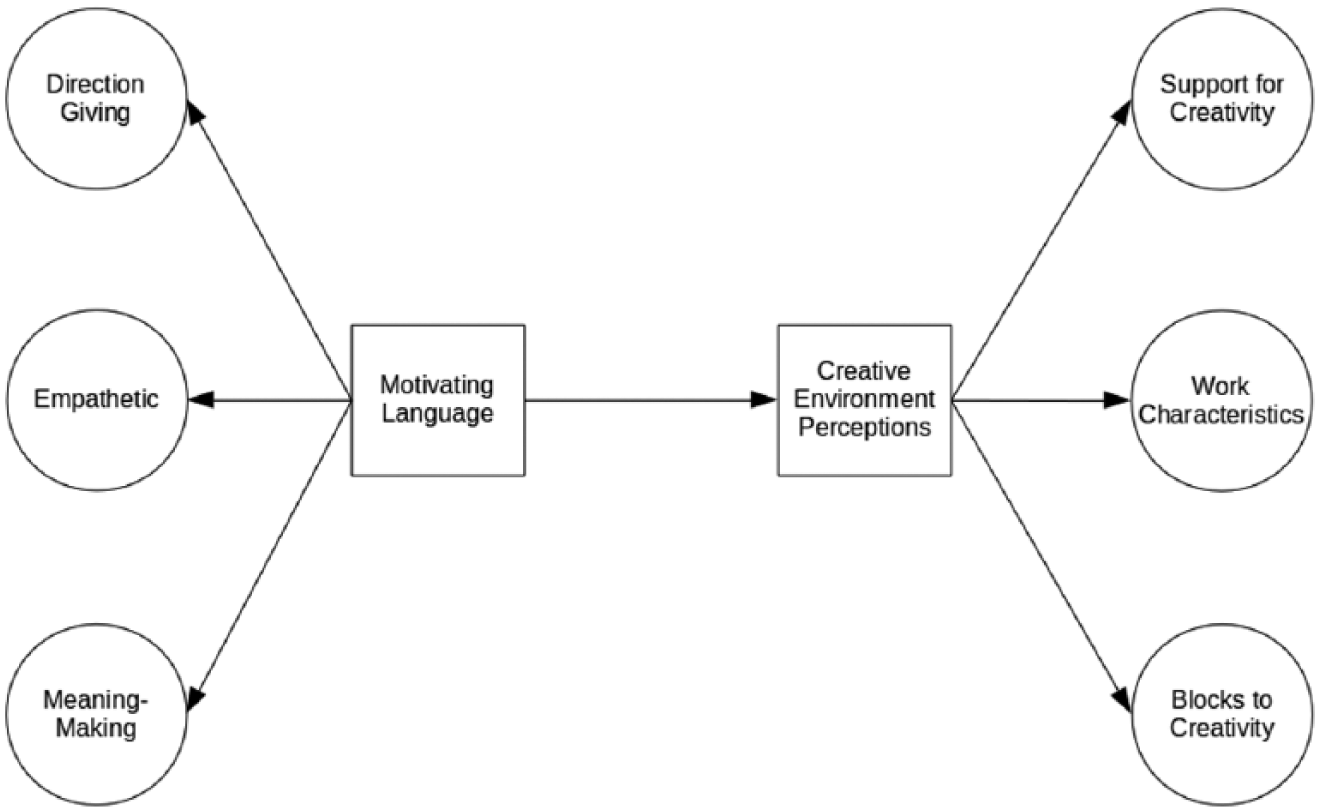
A graphical representation of the expected relationship between motivating language and creative environment perceptions. The left-hand side of the model shows a leader’s motivating language use and the three indicants (direction giving, empathetic, and meaning-making) of this language use. The right-hand side shows the follower’s creative environment perceptions, and the three indicants of this perception (support for creativity, work characteristics, and blocks to creativity).
Method
Participants
Study respondents were graduate and undergraduate students enrolled in management courses at a medium-sized university located in the southwestern United States. The majority of the university’s enrollment consists of nontraditional students who are either in full-time work situations or have returned to campus with a substantial amount of work experience. Study participation was voluntary, and survey completion did not affect student grades. However, survey feedback provided a participation incentive. A total of 142 out of 162 canvassed respondents chose to participate. A subsequent total of 9 surveys were removed from the study due to the respondents’ lack of work experience. There were a total of 133 usable surveys, or a 76% response rate.
The average respondent was 25.12 years old and had 7.37 years of total work experience with 4.95 years of full time work experience. Subjects also held a variety of job types with 52% of respondents classifying themselves as skilled workers, 33% as professional or managerial workers, and 14% as nonskilled workers. A slight majority of respondents were female (58%). Most respondents were U.S. citizens (80%), and the remaining respondents were from Mexico (8%), Canada (6%), and India (6%).
Measures
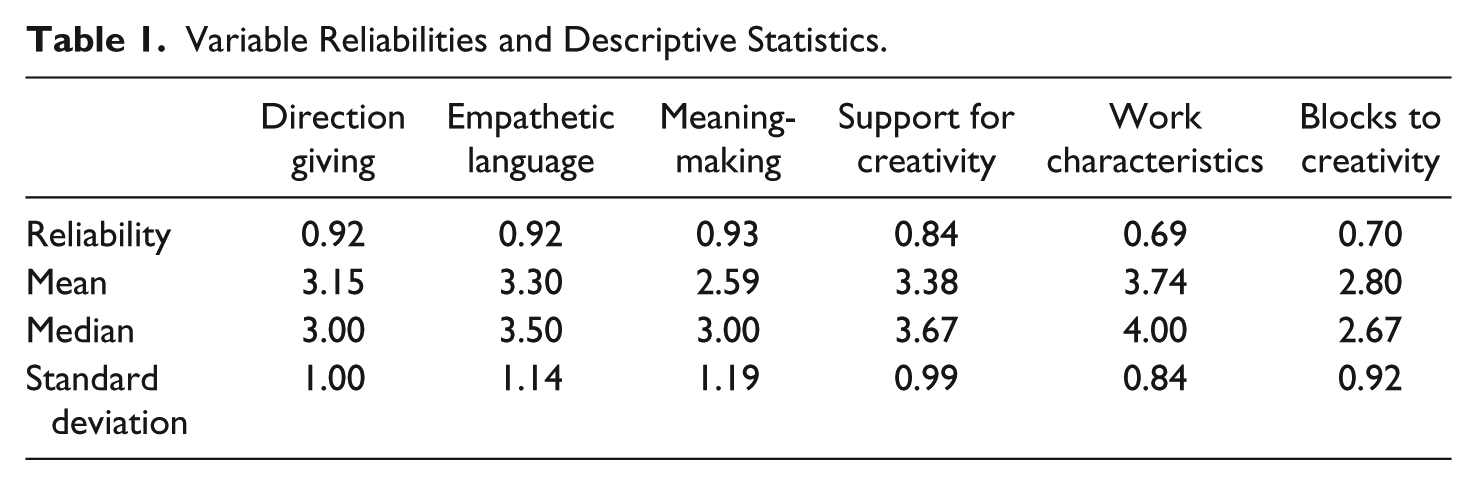
Study variables were analyzed through two scales. Leader ML use was measured by the motivating language scale (J. Mayfield et al., 1995). The instrument’s reliability, validity, and generalizability have been tested in a number of studies (J. Mayfield et al., 1995; J. Mayfield, Mayfield, & Kopf, 1998). This scale includes the three ML dimensions—direction giving, meaning-making, and empathetic language, which were measured through separate subscales, and each subscale demonstrated a reliability of .92 or better (Churchill, 1979).
Worker perceptions of the creative environment were captured through the CEP—a nine-item instrument that has been previously tested for reliability, validity, and an appropriate factor structure (M. Mayfield & Mayfield, 2008, 2010). As with the motivating language scale, this measure has demonstrated appropriate reliability levels (Churchill, 1979) and its reliabilities are similar to other creativity scales (Amabile, Conti, Coon, Lazenby, & Herron, 1996). The CEP is composed of three subscales: support for creativity, the nature of the work itself, and blocks to creativity. Support for creativity measures the level of encouragement that a worker receives for creative endeavors from coworkers, direct supervisor, and the organization as a whole. The nature of work subsection is designed to capture how much the structure (design and responsibilities) of a worker’s job promotes creativity. The blocks to creativity questions are intended to reflect how organizational policies, politics, and time constraints inhibit workplace creativity. The CEP and ML reliabilities and descriptives are presented in Table 1. Scale items from both measures are reproduced in Appendix 1.
Variable Reliabilities and Descriptive Statistics.
Procedures
As discussed previously, data were collected through self-report surveys. Such surveys appear to be appropriate for the research question since both variables are best captured through respondents’ evaluations of their respective individual cognitive states (Calabrese & Zepeda, 1999; Churchill, 1979; Spector, 1992; Sullivan, 1988). ML is based on perceived leader talk, so it is an internalized construct rather than an external quantity, and is consequently expected to vary between subordinates who report to the same superior (Sullivan, 1988). Therefore, the individual employee’s perceptions of leader language use is the appropriate level of analysis. Similarly, creative environment perception is an affective construct and is expected to be most meaningfully captured through an individual’s self-report (Brinberg & McGrath, 1985; Sullivan, 1988).
After the data were collected and coded, the ML and CEP responses within each subscale were averaged to create latent variable indicants. The process of combining individual questions of a given construct reduces random variance in the measure and therefore provides a more reliable measure of the same construct (Brinberg & McGrath, 1985; Joreskog & Sörbom, 1989; Schumacker & Lomax, 1996). This procedure is also congruent with previous ML research analysis. The interrelationships between the study variables are presented in Table 2.
Variable Interrelationships.
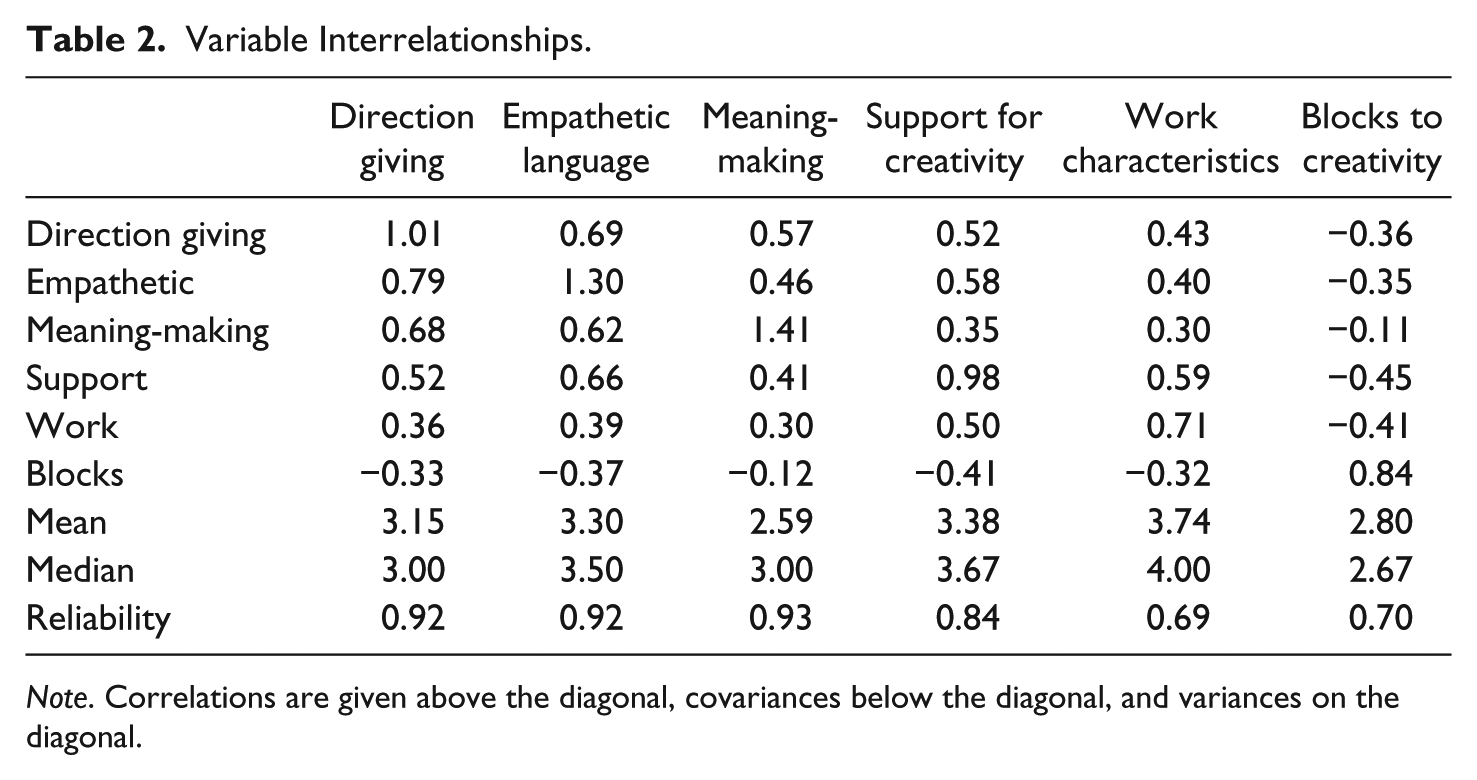
Note. Correlations are given above the diagonal, covariances below the diagonal, and variances on the diagonal.
Results
Analysis
Data were analyzed via a structural equation model (SEM) using the sem package for the R statistical analysis program. SEM analysis is appropriate for this study because it allows researchers to simultaneously investigate a model’s overall fit to a data set along with the strength its variables’ relationships. SEM analysis is also consistent with previous ML studies.
Results
Overall, the SEM analysis showed a close fit between the proposed model and the data. The goodness of fit index was 0.97, and the adjusted goodness-of-fit index was 0.92. Both of these numbers are well within generally accepted standards for model fits (Joreskog & Sörbom, 1989; Schumacker & Lomax, 1996). Also, the chi-square test showed no significant discrepancies between the proposed model and the actual data. The model’s root mean square of approximation score was 0.07. This number indicates a slight discrepancy between the model and data, but it still points to an acceptable data fit for research purposes. Overall model results are presented in Table 3.
Overall Model Test Results.

Structural path tests revealed similar support for the model. There was a significant and positive link between a leader’s ML and a worker’s perceptions of an organization’s creative environment. Also, leader ML use accounted for approximately 55% of the variance in worker perceptions of the creative environment. All other indicants loaded significantly and in the directions predicted by the model. Results from individual path tests are presented in Table 4, and a graphical representation of the model’s standardized path coefficients is presented in Figure 2.
Tests of Individual Paths.

Note. All path coefficients were significant with a p value of less than .001.
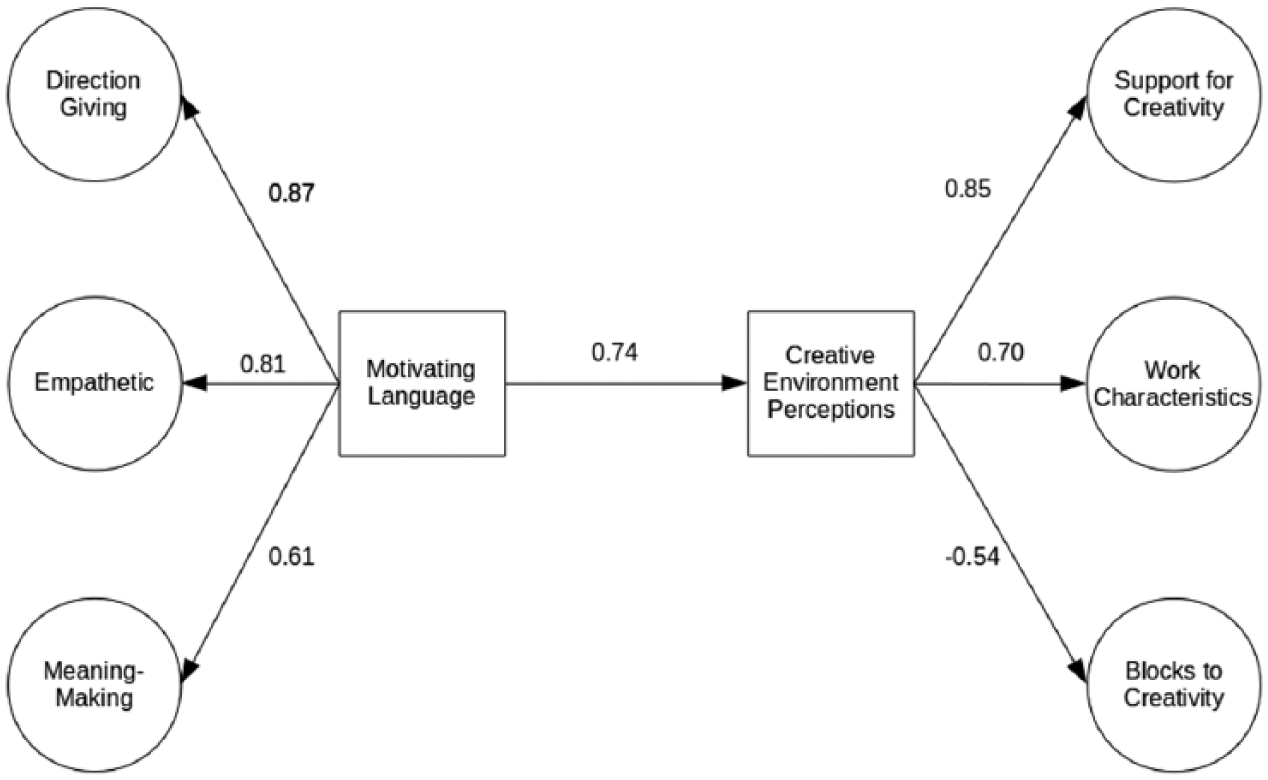
A graphical representation of the relationship between motivating language and creative environment perceptions. The standardized coefficients of these relationships are presented beside the paths. All coefficients are significant at the .01 level.
Conclusions and Implications
Our preliminary findings support an important relationship between leader ML and an employee’s positive perceptions of the creative environment at work—with ML accounting for 55% of CEP variance. Such a strong link underscores ML’s potential to improve an employee’s work life by encouraging creativity. This discovery extends research that identifies leadership behavior and perceived support as key facilitators of employee creativity (Amabile, 1996; De Stobbeleir, Ashford, & Buyens, 2011; Eisenberger & Rhoades, 2001; Graen & Scandura, 1987; Stafford, 1998; Zhou & Hoever, 2014) by specifically exploring linguistic influences.
Our findings have important implications for business communication and creativity development. First, ML can positively influence employee creativity, but it must be used in context to optimize its benefits. Respected creativity scholars assert that the creative process is interactive and the result of several interrelated factors, including—but not limited to—supervisory behaviors, rewards, organizational culture and climate, individual personality, job design, and time pressure (Amabile, 1996; Eisenberger & Rhoades, 2001; Scott, Leritz, & Mumford, 2004; Woodman, Sawyer, & Griffin, 1993; Zhou & Hoever, 2014). All these factors should be integrated systematically to attain desirable growth in employee creativity (Zhou & Hoever, 2014). Case in point, a seemingly positive creative influence, ML, could become negative in an organization with a reward system that devalues creativity.
This interactive perspective also includes the creativity nurturing factor of appropriate training. Some creativity training is effective by linking with innovative outcomes and improved employee affect. Yet some approaches are not (Birdi, Leach, & Magadley, 2012; Kim, Hon, & Crant, 2009; Scott et al., 2004). For example, cognitively anchored instruction, such as problem identification and convergent thinking, which emphasizes specific skills, incorporates real-world applications, and is lengthy in duration has reported the highest success rates for resultant innovation over time. On the other hand, holistically designed creativity training that does not target analytical skills has not demonstrated a significant track record (Scott et al., 2004). In addition, creativity training may be enhanced through booster sessions and social networking in the organizations (introducing buddy systems within trainee groups; Birdi et al., 2012). Ideally, relevant creativity training programs for employees will be partnered with ML instruction for managers. The impact of this combination could be positively synergistic.
In conclusion, these expectations are bounded by the exploratory nature of our study. It was also limited by generalizability, potential response bias from surveys, and indeterminate causality. We hope that future research will explore these issues through broader more diverse sample groups, multiple research tools (quantitative and qualitative), and with experimental/longitudinal methodological designs. In practice, creativity and ML training could be conducted which tracks related outcomes and compares them with control groups.
Employee creativity is a vital path to organizational innovation, competitive advantage, and employee well-being (Amabile, Barsade, Mueller, & Staw, 2005; Scott et al., 2004; Zhou & Hoever, 2014). Our study suggests that leader speech can help to clear the way. In other words, motivating language, especially when used in a creativity supportive environment, can invigorate this fulfilling process.
Footnotes
Appendix 1
Declaration of Conflicting Interests
The author(s) declared no potential conflicts of interest with respect to the research, authorship, and/or publication of this article.
Funding
The author(s) received no financial support for the research, authorship, and/or publication of this article.