



Abstract
This article presents a single case study investigating the role of change communication in the early stages of change implementation at a European government agency. It adopts a multimethod approach, relying on quantitative methods and adding qualitative components to clarify core assumptions. The quantitative part of the research relies on a survey of 718 staff members, based on existing instruments—the ICA audit, the Organizational Change Recipients’ Belief scale, and the Cynicism about Organizational Change scale. The qualitative part of the research relies on 18 semistructured in-depth interviews. The findings demonstrate how a lack of clear, unambiguous communication proves a major obstacle for succeeding in unfreezing employees; it leads them to mainly think about their own self-interest, maintain the status quo and avoid needless risks.
Keywords
Introduction
In their book, Reinventing Government: How the Entrepreneurial Spirit is Transforming the Public Sector, Osborne and Gaebler (1992) proposed a citizen-as-customer approach to government reform, recommending a departure from the traditional, bureaucratic-centered model of government and a move to establish a closer interaction between government employees and the citizens they serve. At the time, their blueprint for a better government was considered thought-provoking and hailed as a must-read for burned-out civic reformers. Around the same period, the term New Public Management was coined by academics in the United Kingdom and Australia (Hood, 1991; Hood & Jackson, 1991) to describe an emerging trend toward a more businesslike, efficient, and effective bureaucracy.
Thirty years later, the topic is still relevant (Bryson, Crosby, & Bloomberg, 2014; Torfing & Triantafillou, 2017). Indeed, 21st-century’s public servants now freely (and duly) speak about stakeholders, customers and clients, performance indicators, business plans, and vision statements. For over three decades, academics and consultants, realizing that transforming public organizations is difficult, have dissected the subject (see Kuipers et al., 2014, for an overview of the literature between 2000 and 2010; Micelotta, Lounsbury, & Greenwood, 2017, for an overview of the literature between 1990 and 2015). They have sung the praises of leaders who communicate vision (Gelaidan, Al-Swidi, & Mabkhot, 2016) and walk the talk (van der Voet, Groeneveld, & Kuipers, 2014) in order to make change efforts succeed (Ward, 2017). They have pointed at the importance of increasing public service motivation (Teo, Pick, Xerri, & Newton, 2015), teased out the tensions between top-down transformation efforts and participatory approaches to change (Ryan, Williams, Charles, & Waterhouse, 2008; van der Voet, 2014), and they have exhorted public executives to communicate in ways that appeal to people’s hearts and minds (van der Voet, 2016). Nonetheless, public sector executives still struggle to grasp the human dimension of change projects. They tend to view the organization from an objective perspective—as “an assemblage of parts that can be arranged and rearranged to produce predictable outcomes” (Owen & Dietz, 2012), neglecting the volatile forces of subjective beliefs and expectations. For instance, in 2017, Ramboll (a Danish engineering, design, and consultancy company) conducted 30 interviews with public sector executives in national ministries, regional, and local governments in Northern Europe in order to describe their approaches to and their experience with change implementation. Regardless of the type of change, a surprisingly large number of the public executives they interviewed still believed that if a plan is based on a precise analysis, it is simply a matter of sheer logic whether the implementation process will reach its objectives.
In designing the research for this article, we shifted from a typical fact-based approach toward a value-based approach (see also Owen & Dietz, 2012). We started from the assumption that “a description of an organizational outcome, event or act by someone is subject to being believed by other persons” (Armenakis, Bernerth, Pitts, & Walker, 2007, p. 483). Our core assumption was that when implementing change, “the individual’s perceptions of the attributes of change, rather than the attributes as classified objectively by experts or change agents affect its rate of adoption” (Rogers, 2003, p. 223). Research probes into the perceptions and motivations of 718 change recipients right after the first 2-year phase of a complex, large-scale, multiyear (6) reorganization of a government agency located in Brussels (Belgium). The agency employs more than 27,000 staff members. It is responsible for maintaining control over public spending, setting the direction of the country’s economic policy, and sending out taxation forms.
The aim of the change was twofold: (a) restructure infrastructure and (b) reduce bureaucracy to enhance effectiveness. Viewed from an objective perspective, it may well be argued that the implemented change was developmental rather than transformational: although large-scale, and spread over many years, alterations were mostly structural, “relatively narrow, and involved stretching rather than discarding institutionalized arrangements” (Micelotta et al., 2017, p. 1897). Yet, viewed from a more subjective perspective, it is worth mentioning that earlier attempts to restructure the agency had been dragging on for a decade, with change fatigue rampant and looming. Adding up to that, organizational units were about to be merged and reorganized in such a way that there was a significant reallocation of posts and responsibilities within it, often involving relocation to another office. In short, change fatigue and concerns about job security severely impeded employees’ openness to change in the early stages of reform.
Management opted for a design approach (Boonstra, 2004): the change was first conceptualized and then implemented. When introducing the change, management empowered staff members by means of a choice-based system, allowing them to either opt for a new job location/function, or stay in the same entity. Employees who already worked at a location were given priority to either stay in the same entity or move to a nearby location if their entity would be closed due to the reorganization. Traditional top-down strategies were used to introduce and implement the change: the multiyear organization plan was crafted by the highest echelons of management, before consulting the lower echelons of bureaucracy. Change agents openly stressed that the top-down information flow to the lower echelons should be transparent, clear, and well-timed, to avoid any insecurity and resistance to change. Employees were given the opportunity to ask questions during several informative sessions, but apart from that, bottom-up communication was never explicitly encouraged or discouraged.
Our aim was to investigate whether change recipients indeed experienced communication to be transparent, unambiguous, and timely, and whether they perceived it had accelerated or decelerated their individual readiness to change. To answer this question, we took a staggered approach, amounting to three subquestions listed below (cf. Section 3 “How the case was studied” for a detailed discussion):
First, we investigated employees’ individual readiness to change (Holt, Armenakis, Field, & Harris, 2007) after the first 2-year phase of reorganization. We examined their attitudes toward the change on the basis of seven dimensions, adapted from the Organizational Change Recipients’ Belief Scale (OCRBS), developed by Armenakis et al. (2007) and Armenakis and Harris (2009), and the measure of cynicism about organizational change (CAOC; Wanous, Reichers, & Austin, 2000, 2004). After the survey, we conducted 18 in-depth interviews to help clarify survey participants’ answers.
Second, we traced whether employees rated the efforts of the agency’s internal communication department as positive and effective. In doing so, we relied on Michels’ (2016, p. 104) adapted version of the International Communication Association audit, “one of the boldest and most comprehensive attempts to measure all aspects of an organization’s communication system” (Hargie & Tourish, 2000). After the survey was taken, 18 in-depth interviews helped to explain survey participants’ answers.
Third, we asked 18 participants of the survey how they perceived the impact of communication on involving and engaging them in the change, and why.
Before answering the three research questions, we will first define the key concepts that guided the design of the case study and provide a review of recent literature on the communication of change in the public sector in the Literature Review (Section 2). In How the Case was Studied (Section 3), we spell out how we collected the data for this case and how we analyzed them, relying on both quantitative and qualitative methods. Section 4 presents the Findings. Discussion, Limitations, and Suggestions for Future Research (Section 5) spells out the implications and the limitations of this case, along with avenues for future research.
Literature Review
In what follows, we first define Organizational Readiness for Change—a key concept guiding the design of the case study. We explore how it is and has been conceptualized, and how it can be measured. Next, we proceed to a review of recent studies on communication as a factor contributing to the effective implementation of organizational change in the public sector.
Organizational Readiness for Change 1
Conceptualization
From the 1990s of the past century onward, change management researchers have increasingly emphasized the importance of establishing organizational readiness for change and recommended various ways to prepare for change (Lehman, Greener, & Flynn, 2012; Weiner, 2009). When organizational readiness for change is high, renowned experts contend, organizational members are more dedicated to the change effort, spend greater effort in the change process, and show stronger perseverance in the face of obstacles or setbacks—all of which contribute to more successful change implementation (Armenakis & Harris, 2002; Kotter, 1996; Scott, Jaffe, & Scott, 1995). While the majority of the articles on the topic published between 1990 and 2007 “use some variant of the term readiness for change, other commonly used terms include change acceptance, change commitment, attitudes toward change, reactions to change, and agency capacity” (Weiner, Amick, & Lee, 2008, p. 384).
Weiner et al. (2008) stress the need to recognize organizational readiness for change as a two-dimensional construct that refers both to organizational members’ motivation and capability to implement intentional organizational change. The authors insist on a definition of Organizational Readiness for Change as “the extent to which organizational members are psychologically and behaviorally prepared to implement organizational change” (Weiner et al., 2008, p. 381). This two-dimensional view mirrors the colloquial use of the term readiness, which connotes being willing and able to do something: In the military, for example, unit readiness refers to a unit’s psychological and behavioral preparedness to fight. A unit that is demoralized, but well trained and equipped, is no more ready for battle than is a unit that is gung ho but poorly trained or equipped. Recommendation is to reserve the term organizational readiness for change for those conceptualizations that capture fully the theoretical content of the readiness construct that includes both the psychological and behavioral connotations of readiness. (Weiner et al., 2008, p. 424-425)
In line with this view, this article treats “readiness” as a perception-based construct that embraces not only organizational members’ motivation to implement change but also their perceived behavioral capability, or, more accurately, perceived efficacy to implement change.
In particular, we will adopt the view of a prominent and foundational piece of writing by Armenakis, Harris, and Mossholder (1993, p. 683), who used the term readiness for change to indicate “organizational members’ beliefs, attitudes, and intentions regarding the extent to which changes were needed and the organization’s capacity to make those changes.”
Measurement
Recent overview articles by Bouckenooghe (2010), Weiner et al. (2008), and Oreg, Vakola, and Armenakis (2011) report a large number of straightforward and instant measuring instruments for resistance and willingness to change. Many of the models and instruments developed over the past 30 years are loosely based on the oldest and also most famous model of organizational change created by Kurt Lewin (1947; Burnes & Bargal, 2017). Lewin (1947, p. 34) regarded change management as a process consisting of three stages: “unfreezing” the existing situation, “moving” toward the new one, and then “freezing” or consolidating that new situation. In other words, organizations should first make sure that everyone acknowledges the need for change, then they can implement the change, and finally they need to make the change last.
In this article, we zoom in on the first stage described by Lewin, commonly considered as the most problematic and challenging, because it involves breaking down the status quo, creating a controlled crisis, preparing stakeholders to accept that change is crucial and getting the necessary buy-in. We measure individual organizational readiness, drawing on two complementary measurement instruments (cf. infra Section 3). First, we rely on the OCRBS, a 24-item assessment tool developed by Armenakis et al. (2007) and Armenakis and Harris (2009). The scale can be administered at any of the three stages of the change process (readiness, adoption, and institutionalization), and can be used in conjunction with other instruments developed to assess organizational conditions. They argue that change recipients’ beliefs are a basic precursor to behavior, and therefore, “change leaders should execute a process to influence the beliefs of the change recipients and monitor those beliefs as a way of assessing progress” (Armenakis et al., 2007, p. 483). Armenakis et al. state that an effective message of change should meet five criteria. Employees need to be convinced that the change is necessary (“discrepancy”), believe that the proposed change is the correct one for the situation (“appropriateness”), trust that the organization is able to successfully implement the change (“efficacy”), believe that formal leaders in the organization are committed to the success of the change (“principal support”), and be convinced that there is something in it for them (“valence”). The questionnaire is a classic, prominent instrument (Paul, van Peet, & Reezigt, 2012) based on research conducted by organizational scientists dating to the 1940s, and still used in recent research endeavors investigating the recipient side of organizational change (e.g., Burgan & Burgan, 2014; Sundborg, 2017).
Customizing the research design to the fit the organizational context, we supplemented the OCRBS with two dimensions drawn from Wanous et al.’s (2000, 2004) 12-item measure of CAOC. Wanous et al. (2000) conceptualized CAOC as consisting of two components: a pessimistic view about change and the blame on “those responsible.” They defined CAOC as “a pessimistic viewpoint about change efforts being successful because those responsible for making change are blamed for being unmotivated, incompetent, or both” (Wanous et al., 2000, p. 133). The scale was subjected to validation and cross-validation procedures by Albrecht (2008) using data collected from two Australian public sector organizations.
Communicating Change Management: The Public Sector
Over the past two decades, the study of institutional change has become a principal research area, not only in organization theory but in related disciplines such as sociology, economics, and political science (Mahoney & Thelen, 2009; Micelotta et al., 2017). In spite of this steadily growing interest, there is still a paucity of research explicitly zooming in on the role of communication in the implementation of organizational change in the public sector (Kuipers et al., 2014). In what follows, we will list eight studies that have inspired the case study, starting with a recent systematic literature review, followed by three relevant survey studies, and concluding with four case study approaches.
Aher and Luoma-Aho (2017) report findings from a systematic literature review of articles from 1990 to 2016 using thematic analysis in order to answer three research questions: Is change in the public sector different from change in the private sector? What is the perceived role of communication for public sector change efforts? What insights can be found from previous literature about three topics connected with change communication: employees, organizational culture and management? The authors warn about implementing a top-down approach to change, and call for communication practices that emphasize engagement (Van Ruler, Smit, Ihlen, & Romenti, 2017, p. xii)
Hameed, Khan, Sabharwal, Arain, and Hameed (2017) bring together public and private sector research on change management to highlight the important role of public servants as recipients of change, which, according to the authors, is “underemphasized in the public management literature” (p. 1). Relying on data collected from public sector research and development organizations in Pakistan, the authors highlight that “a readiness for change mind-set can be achieved through involved communication that creates a sense of ownership among employees” (p. 17).
Jong (2018) obtained data from federal government employees responding to the 2012 Federal Employees Viewpoint Survey. The author points at the need for adopting public sector management strategies that encourage higher levels of social support from supervisors or colleagues in order to increase employees’ positive attitudes.
Bakari, Hunjra, and Niazi (2017) collected survey data from 258 employees of three public sector hospitals of Pakistan undergoing restructuring. The results suggest that for successful implementation of planned change, authentic leaders need to create employees’ readiness for change (unfreezing) that will in turn develop their commitment to change (moving) and behavioral support for change (refreezing).
Barker, McKeown, Wolfram Cox, and Bryant (2018) present a dual case study approach of two Australian public sector organizations that implemented the same positive work change agenda, but experienced very different outcomes. Using a critical realist approach, the authors draw on a mix of qualitative techniques to suggest that textbook notions of “successful change,” which are often derived from large private sector expectations, may fail to capture the complex nature of how public sector change initiatives may unfold.
Zorn, Page, and Cheney (2000) reports a case study of change-related communication in the business services department of a large local-government organization in New Zealand. The authors explore the change communication from the three perspectives suggested by Trujillo (1992), what he terms the “functional,” the “romantic,” and the “critical.” In terms of communication, each perspective highlights different change-related communication practices and/or alternative dimensions of the same practice.
Waterhouse and Lewis (2007) use a case study approach to study the relationship between communication and change in a public sector department, zooming in on the human resource implications of that relationship. Senior administrators of the department signified their intention to change the culture from one that was considered to be bureaucratic, technically oriented and inward-looking to one more outward-looking, continually learning, more relationship-oriented and inclusive of broader objectives such as commercialization, the environment, social justice, and community relations. Findings from the research indicate that, despite an objective of shifting to a state of continual change with the mode of communication becoming two-way and dialogic, communication faltered due to a failure to address the need of lower level staff for a set vision and stated future direction.
Frahm and Brown (2007) adopt a case study approach, examining the first 100 days’ change communication and employee receptivity in a public sector organization chartered with technology diffusion. The researchers cross-compared the results of employee observation, internal communication documentation analysis, focus group interviews, and surveys of employees. The findings suggest that the majority of employees felt positive and accepting of change at the very beginning of the proposed change. However, as the change implementation unfolded, those employees who were close to middle range management remain positive toward the change, whereas those employees who did not interact with management expressed uncertainty and a concern at the lack of organizational vision and direction and felt frustrated because of a lack of involvement in the change process and a lack of information about the changes. The communication vacuum between middle managers and employees led to employees constructing their own change realities through informal discussions, resulting in cynicism, contempt, and decreased receptivity to the change process.
How the Case Was Studied
To answer the research questions, we used a mixed-method approach, complementing descriptive, quantitative analysis with interpretative, and qualitative methods. Quantitative methods were used to make the main inferences, with qualitative components added to test the assumptions, clarify the core issues, and make new discoveries. We set up a large-scale quantitative survey study with 718 staff members involved in the change. After the survey, 18 semistructured interviews were conducted by a trained fieldworker, addressing a representative sample of the canvassed participants.
Large-Scale Survey 2
By means of the survey, we were able to answer Research Question 1 (“Do employees accept the change process”) and Research Question 2 (“Are employees satisfied with the way the change has been communicated”) on a broad scale. At the outset of the research, 10,472 staff members were eligible for participation in the survey, including all employees of the government agency who had been involved in the organizational change. Due to the large size, we decided to carry out a sample survey with only one fifth of the staff (i.e., 2,095 employees). The sample was composed by selecting each fifth respondent from the original employee list in order to obtain a representative sample for age, gender, position, and mother tongue. The 2,095 selected staff members received an invitation by e-mail to complete the questionnaire online. Both a French and a Dutch version of the questionnaire were made available. One reminder was sent and a total of 718 staff members participated in the survey (i.e., a response rate of 34.27%). The median age of survey participants is 51 years. The minimum age is 23 years and the maximum age is 65 years. In terms of gender makeup, 51% of survey participants are male, whereas 49% are female. Indeed, 65.6% of the canvassed employees is Dutch-speaking, 30.9% French-speaking, 1% speaks German, and 2.5% has a mother tongue other than the country’s three official languages or declares to be multilingual. However, 74.9% of survey participants (n = 712) works as clerical staff, 22% as officer in a middle-management position, 1.7% has an executive position, and 0.6% is laborer. These numbers are representative of the labor division in the agency at the time of the survey, with a vast majority of clerical support staff run by mostly middle management positions.
The survey consisted of 32 questions addressing sociodemographics (15), a measurement of employees’ attitudes to the change (Research Question 1; 5), and an assessment of their satisfaction with the way the change had been communicated (Research Question 2; 12).
We examined staff members’ attitudes toward the change (Research Question 1) on the basis of seven dimensions. The first five dimensions of the survey have been adapted from the OCRBS, developed by Armenakis et al. (2007) and Armenakis and Harris (2009; cf. supra Section 2). Customizing the research design to the fit the organizational context, we supplemented the OCRBS scale with two dimensions drawn from Wanous et al. (2000, 2004).
For all seven dimensions, respondents were asked to give their opinion on a 5-point Likert-type scale (1 = I strongly disagree, 5 = I strongly agree). The statistical analyses were performed with SPSS 22 software and all significance tests were conducted with a reliability level of p ⩽ .05.
Second, we examined staff’s satisfaction with the way the change had been communicated (Research Question 2), drawing on Michels (2016) adaption of the International Communication Audit Questionnaire (Goldhaber & Rodgers, 1979). We set off by asking respondents through which channels they had received information about the change. Next, we asked them to provide an overall score (1-10) for internal communication, followed by a question asking if they were satisfied about the availability of information about the change. For this question, respondents were asked to give their opinion on a 5-point Likert-type scale (1 = very dissatisfied, 5 = very satisfied). The remainder of the questions queried their assessment of the present situation, along with their view on necessary steps that would need to be taken for achieving optimal or better ways to communicate about the change in the future. The questions broadly covered the following main areas: (a) the amount of information received, (b) the kind of information received, (c) the various communication channels used to send and receive information, (d) troublesome communication issues, and (e) an evaluation of communication flows.
Semistructured Interviews
Interviewing participants after the survey for approximately 30 minutes allowed us to probe into details and reasons behind answers they had provided in the survey, relating to Research Question 1 and Research Question 2. In addition, we also explored a human dimension which had been impossible to tackle by means of the closed survey questions: We explored participants’ perceptions of how the internal communication had affected their willingness or resistance to change (Research Question 3).
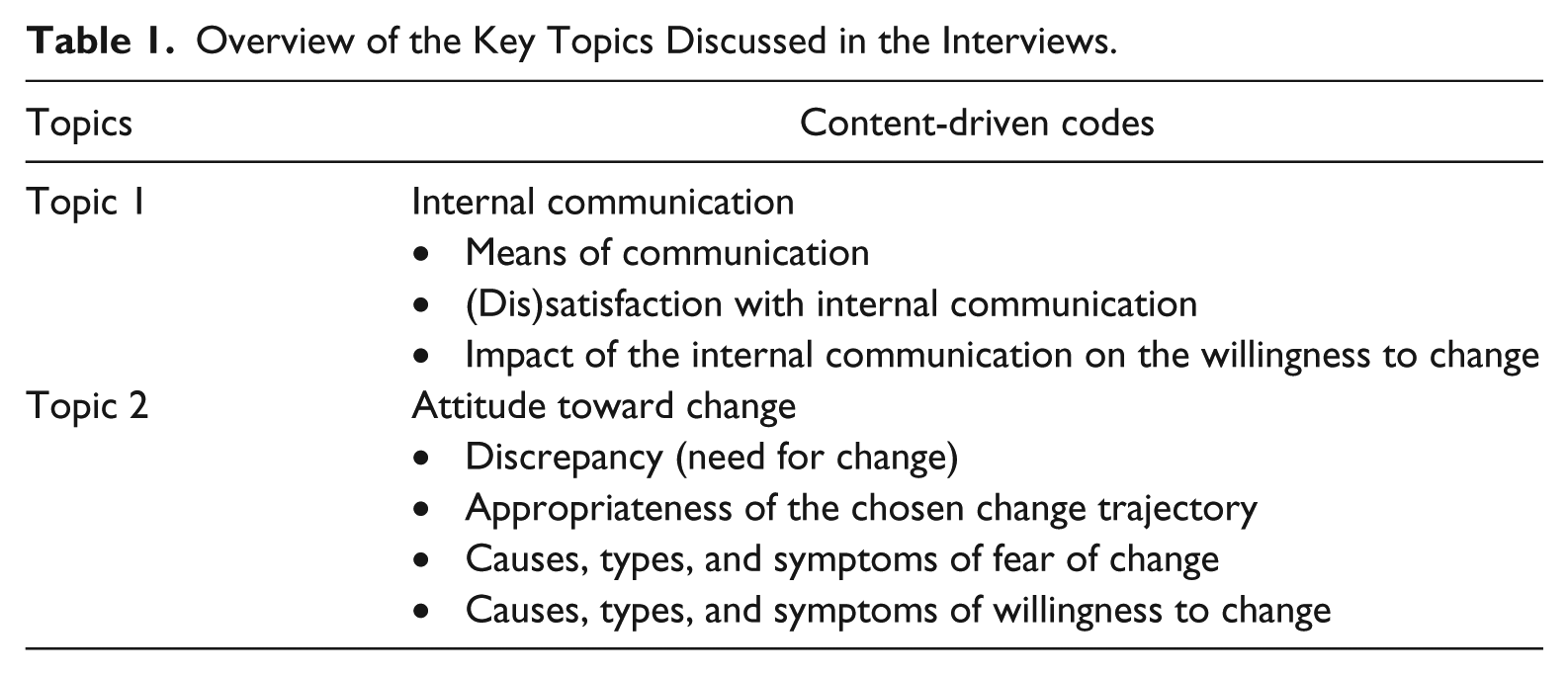
Knowing it is impossible to specify the number of qualitative interviews necessary to complete a project at its inception, we set off aiming for a sample of loosely around 30 respondents, and decided to stop gathering data when empirical saturation would be reached. Sample size adequacy, like all aspects of research, is subject to peer review, consensual validation, and judgment (Marshall, Cardon, Poddar, & Fontenot, 2013); hence, we took this decision after careful deliberation involving the two authors of the article and the fieldworker connected to the project. Alongside an extremely large number of articles, book chapters, and books on qualitative methodology suggesting anywhere from 5 to 50 participants as adequate, our decision to roughly set the target at 30 participants was based on Marshall et al.’s (2013) rigorous examination of qualitative interviews in ISI listed studies, recommending that single case studies should generally contain 15 to 30 interviews. There are several debates concerning what sample size is the right size for qualitative research endeavors (Dworkin, 2012), but most scholars argue that the concept of saturation is the most important factor when making sample size decisions in qualitative research (see Saunders et al., 2018, for an overview of distinct approaches). Saturation is defined by many as the point at which the data collection process no longer offers any new or relevant data. Another way to state this is that conceptual categories in a research project can be considered saturated “when gathering fresh data no longer sparks new theoretical insights, nor reveals new properties of your core theoretical categories” (Charmaz, 2006, p. 113). Guided by the themes developed in the online survey, we detected seven content-driven codes (see Table 1) within the first three interviews transcripts. After completion of the 14th interview, no significant new subcodes were added onto the main codes. In other words, no new information was being gathered. Because the majority of the research participants we had managed to interview by that point were nonexecutive staff, working at central offices in Brussels, we decided to include four extra interviews with executive staff members in the regional offices to safeguard representativeness of the sample. In all, we ended up with 18 one-on-one interviews representing an equal number of executive and nonexecutive staff, with 10 staff members working in the central office in Brussels and 8 in the regional offices (see Table 2).
Overview of the Key Topics Discussed in the Interviews.
Overview of the 18 Respondents in the Interview Sample.

We transcribed the interviews in full and listened several times to the recordings to identify key topics in the transcripts. Analyzing the interviews amounted to a highly structured process to condense the raw interview data into categories, and to eventually determine the central themes, key concepts, and interrelations. We relied on inductive coding, carefully reading the full transcripts of all 18 interviews, and simultaneously adding a representative code to illustrative, explanatory or striking words or phrases, examples, relationships and to concluding remarks that had some bearing on one of the three research questions. NVivo software was used to support the coding of the data. Each time a new code was created, the name of this code was added to the codebook. If the code fitted one of the initial subthemes of the codebook, the code was assigned to this subtheme. If not, an additional subtheme was created. To guarantee the reliability of the analysis and interpretation, we set up peer reviews during the coding and indexing stage. If the three peer reviewers involved did not agree on the interpretation of the data, the issue was further discussed until consensus was reached.
Results
Research Question 1: Do Employees Accept the Change Process?
Large-Scale Survey
The internal consistency of the seven scales was tested by means of Cronbach’s alpha, which each time generated excellent results (Table 3). Although the pessimism score was slightly lower, all items contributed sufficiently to the scale: the item-total correlations exceeded .20 and did not include any negative correlation coefficients. Removing the fourth item could have raised Cronbach’s alpha to .765, but this increase was negligible and did not outweigh the disadvantage of leaving out the item and the valuable content it offers.
Overview of the Seven Scales With Cronbach’s Alpha and Average Scores (N = 718).
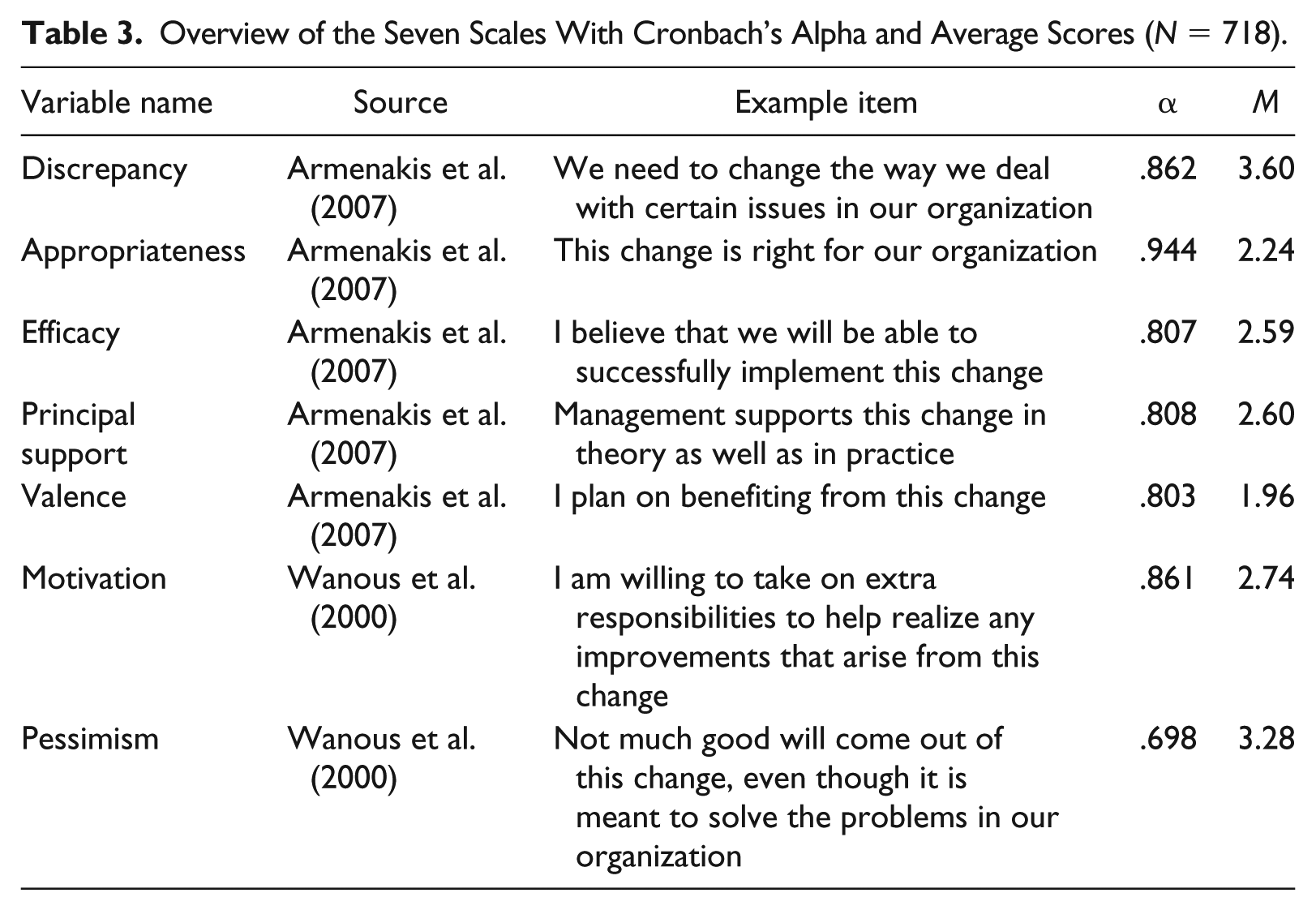
The results indicate that the respondents acknowledge the need to improve the day-to-day operations of the organization (M = 3.60). Nevertheless, they are not convinced that the reorganization is the best way to accomplish this, as is shown by the low scores for appropriateness (M = 2.24), efficacy (M = 2.59), and valence (M = 1.96). As an additional problem, the respondents get the feeling that they do not get enough support from their supervisors to go through the change process (M = 2.60). Furthermore, they have a neutral to slightly negative attitude as far as their motivation to turn the change into a success is concerned (M = 2.74) and have a neutral to slightly pessimistic view on the reorganization’s chances of success (M = 3.28). A within-subjects repeated measures test reveals that the differences between these seven scales are significant, Pillai’s trace = 0.778, F(6, 674) = 394.553, p = .000, with the exception of two scales—efficacy and principal support—that do not differ significantly (pairwise comparison, p = .758).
A t test shows that respondents who had been obliged to take up a new position (13% of our total sample) are significantly less convinced of the need for change, M = 3.36, t(685) = 2.644, p = .008, the principal support, M = 2.42, t(684) = 2.354, p = .019), as well as the valence, M = 1.77, t(684) = 2.539, p = .011). Also, they are less motivated to turn the change into a success, M = 2.57, t(684) = −2.280, p = 0.023.
Semistructured Interviews
The findings obtained from the survey are confirmed in the interviews. All but one respondent acknowledge the need for change. Two respondents emphatically confirm that the chosen change trajectory is the right one. The remaining 16 interviewees are partially convinced or even disapprove of the appropriateness of the change design. Recurring issues are the duration and complexity of the change, as well as the lack of precise information on how the change will be implemented. Some interviewees also feel that not enough thought went into planning the change and question its abruptness and efficiency, as can be seen in the comment below: Well, I’m not too sure about this change because I wonder if it’s really necessary [ . . . ] you could also just slowly progress towards your objectives. (Male, executive staff)
Various symptoms of change resistance turn up in the interviews: interviewees report that several departments have resisted the change (e.g., by going on strike) and that a few staff members have involved the Council of State in an attempt to stop it. Others mention how colleagues are being forced to change jobs but still believe their immediate supervisor can pull some strings, allowing them to return to their old position after all.
Research Question 2: Are Employees Satisfied With the Way the Change has Been Communicated?
Large-Scale Survey
Regardless of whether they had been forced to change jobs, respondents are generally quite negative about the internal change communication: on average, respondents rate the quality of the internal communication as 4.6 on a scale from 0 to 10. We also found that staff working in the central offices in Brussels (5.3) are significantly (p = .012) more positive (or less negative) about change communication than staff in the regional offices (4.5), despite the fact that the communication department at the headquarters in Brussels had made extra efforts to adequately inform staff in the regional offices by organizing roadshows and local information sessions.
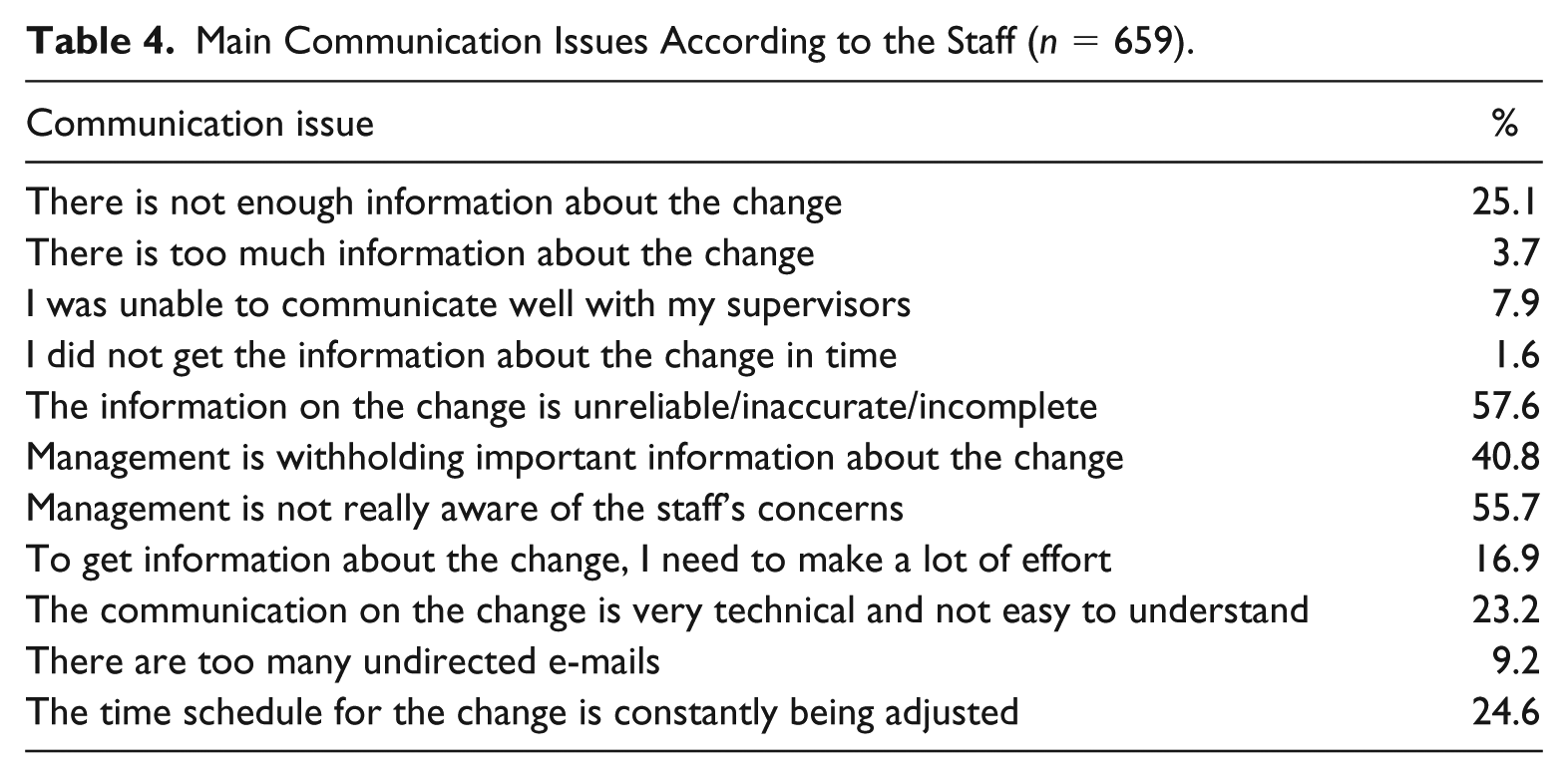
We asked respondents to indicate their top three communication issues choosing from a list of 13 potential troublesome issues (including a string option for issues that were not listed). The findings (Table 4) point at three main communication problems: (a) the information about the change is unreliable/inaccurate/incomplete (57.36% of the staff put this in their top three), (b) management is not aware of the staff’s concerns (55.7%), and (c) management is withholding important information about the change (40.8%). These results suggest that there is an inadequate vertical flow of information, both in a bottom-up (i.e., the staff feel that they are not being listened to) and top-down sense (i.e., the supervisors provide insufficient or unreliable information).
Main Communication Issues According to the Staff (n = 659).
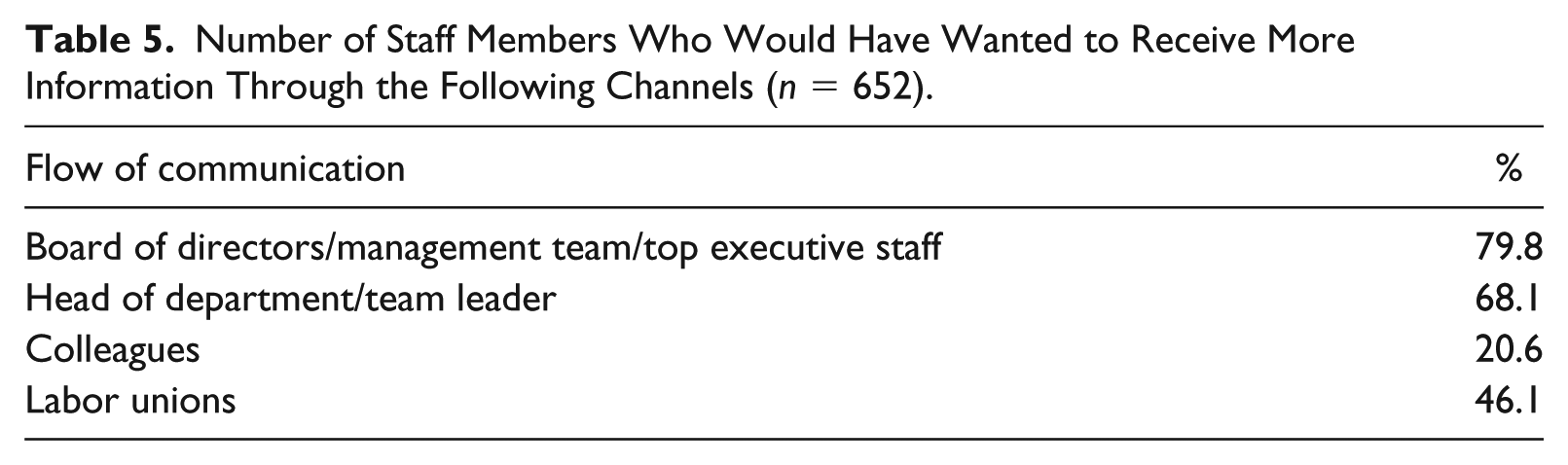
What’s more, respondents reported that they would have liked to receive more information through personal conversations with their supervisors: 79.8% of respondents had hoped to get more information from the highest echelons (the board of directors, the management team, or other top executives) and 68.1% would have preferred more input from their immediate supervisors (heads of department, team leaders; see Table 5).
Number of Staff Members Who Would Have Wanted to Receive More Information Through the Following Channels (n = 652).
Semistructured Interviews
Exploring this issue deeper, the follow-up interviews confirm the results of the survey. Interviewees regularly criticize the volatility and unreliability of the information, as can be observed in the following extract: Well actually, all communication is actually rather confusing and often changes too. I often joke about how our HR Department gets paid for every new idea they launch. At a certain point you just couldn’t open the intranet without seeing a message about some kind of new plan. And then after a while you didn’t hear anything more about it and you were like, yeah, whatever happened to that idea? Will that actually happen or not? (Male, nonexecutive staff)
When asked about the flow of communication, interviewees unanimously identify it as top-down, blaming the higher echelons for an inadequate flow of information. Several interviewees allude to a good working relationship with their immediate supervisors, and acknowledge that they did not have access to information, nor the real power to act upon it. The following comment from a nonexecutive staff member illustrates this point: She didn’t really get that much information either. So, yeah, she knew just about as little as we did. I think she attended one extra information session that was meant for executives only. And everything they told her was all very general, not specific at all. The fact of the matter is she didn’t have that much to say about it either. (Male, nonexecutive staff)
Unsurprisingly, our findings show that colleagues and, to a lesser extent also labor unions, played an important role in compensating for this (perceived) lack of information. In accordance with the existing literature (DiFonzo, Bordia, & Rosnow, 1994; Elving, 2005; Frahm & Brown, 2007), the survey and the interviews reveal that the inadequate vertical flow of information gave rise to a parallel, informal information circuit, which in its turn provoked cynism, low-trust relations, and a resistance to change. In the extracts below, two executive members of staff mention the negative effects on change implementation: As soon as the first rumors start to spread about how things will be calculated and so on, everyone starts to make these calculations for themselves, and you create a lot of concern, a lot of rumors. So people waste a lot of time on these things during working hours, there’s no doubt about that. And on top of that you get discord and jealousy. (Male, executive staff) Well, people are just very mistrustful now. Everything they find on the Internet, intranet, it just comes from the top, from a hierarchy. They’re like: “yeah, sure, we’ll see if this hasn’t changed by tomorrow.” So they just don’t trust anything anymore. (Female, executive staff)
Research Question 3: Do Employees Feel That the Internal Communication has Affected Their Willingness or Resistance to Change?
With the conclusion of the survey crystal-clear, pointing at low change readiness, and a chiefly negative assessment of change communication, we decided to dig deeper into participants’ perceived relationship between individual change readiness and change communication efforts. Our aim was to find out if and to which extent staff members believed that communication about the change had affected their change readiness or change averseness.
It is difficult to formulate a synopsis as interviewees’ responses were divergent. Overall, nonexecutive staff we interviewed were not very concerned about the change (communication) because, in fact, most of them were able to maintain their position in the new organizational structure. This is illustrated by the following comment from a nonexecutive staff member: And why do you think that that hasn’t affected your attitude towards this transition? Because when push comes to shove, nothing has changed really. And I’m happy, so I’m staying where I am. (Female, nonexecutive staff)
As can be witnessed in the extract below, one of the executive staff members openly criticizes the communication about the change, but insists on supporting the change regardless of that: In the meantime, it’s become some kind of frightful monster, the way they’ve been trying to sell it to people, because it was always one piece at a time […]. You need to sell something as a whole and do this consistently. That’s just how I see it. But oh well yeah, it just didn’t go that way. Still, I keep on defending it, though, because there’s no way around it. (Female, executive staff)
Another executive staff member involved in the negotiations preceding the change process firmly criticizes the appropriateness of the change. In the following comment, he stresses that poor communication has only added to that: I was already quite critical of the change itself, whether or not it was the best way to go about it and whether it was actually necessary to begin with. So these communication issues that followed, they kind of came on top of that feeling. (Male, executive staff)
At first sight, this seems to hint at a random effect, depending on interviewees’ rank, engagement, and future position in the organization. Still when digging deeper, the same patterns returned. First and foremost, interviewees repeatedly suggested that many colleagues chose to maintain their position because the consequences of deciding otherwise were vague. According to participants who considered taking the leap, the criteria that were used in the process changed regularly during the communication process and were hence unclear. Interviewees mentioned that they could only get information about where they would be working, not about the precise job content. This may in part (see also Section 5) explain why many employees were hesitant to trade their current position for the unknown: 73% of our total survey sample in fact favored to keep their job and current location.
Second, when exploring respondents’ reason for choosing a particular job/location, the crucial role of self-interest as a predictor of vote choice came to the fore. Whether preferring a status quo, or changing, all interviewees explicitly mention that the choice was beneficial to their own self-interest: they want to reduce their daily commute by working close to home, or intend to climb the corporate ladder and believe that taking up a new position will provide more opportunities to do so.
Discussion, Limitations, and Suggestions for Future Research
In this article, we assessed the role of change communication right after the first “readying” phase of change in a European government agency. The findings of the survey indicate that, on average, respondents rate communication negatively (4.6 on a scale from 0 to 10). They report (a) a disrupted flow of vertical communication, (b) unreliable/inaccurate/incomplete information and complain that (c) management is not aware of employee concerns, and (d) withholds important information about the change. Interviewees repeatedly criticize the volatility and unreliability of the information, and complain about a disrupted flow of vertical communication. What is more, interviewees mention that they are chiefly focusing on activities that will bring them personal gain, or at least inflict no harm. Summarizing, the findings all point in the same direction: a lack of clear, unambiguous communication proves a major obstacle for succeeding in unfreezing employees: it leads employees to mainly think about their own self-interest, maintain the status quo, and avoid needless risks. Surely, alongside poor communication, other factors may have influenced participants’ choice, such as job insecurity, the possibility of demotion, imperiled status, a salary cut, or, simply, typical human resistance to change. Still from the in-depth interviews, we can conclude that the volatility and vagueness of the information only seems to have added to that.
The mixed-methods case study approach we used shows potential as a way for public organizations to gain insight into both the level of support for communicating about a proposed change (quantitative methodology) and the factors behind (qualitative methodology) change recipients’ positive and negative beliefs with respect to the change communication. There are two suggestions for future research building on this approach.
It is always dangerous to extrapolate from a small sample. Hence, our first suggestion for future research is to conduct a multiple-case study: multiple organizations would add statistical rigor to the study, reveal differences in change recipients’ beliefs across public organizations and provide valuable information for planning strategies to resolve deficiencies. Second, the research would benefit from repeating it after the final phase of reorganization has been completed, so as to progressively scan employees’ attitudes and beliefs during the multiyear process of change. This would provide a moving picture rather than a single snapshot.
Regardless of these limitations, we would like to formulate a number of takeaways from the case, and present them as challenges for the field. To take a structured approach, we will boil them down to two:
Move Away From Traditional Top-Down Communication
In the case we described, top management was aware of the value of transparent communication. Still when the need for clear information intensified in the course of the first phase of change, this was not immediately recognized by the higher echelons. They did not feel the pain caused by the substandard flow of information and ideas within the organization, mainly because the flow of communication had been predominantly top-down.
Top-down change has been commonly used in efforts to bring about public sector reform, but has been variously criticized for assuming that transformation is a linear and uniform process and for ignoring the processual and ongoing nature of large-scale change (Ryan et al., 2008). While the top-down approach is a potent way of initiating transformational change and sustaining high-level support for change, lack of participation in decisions has been shown to affect employee commitment to change, undermining a successful implementation of the change (Aher & Luoma-Aho, 2017). The case-study presented in this article (see also Ryan et al., 2008, for a similar case-related observation) highlights the need to complement top-down change strategies with center-down, center-out, and bottom-up approaches. Using the words of the World’s Bank senior vice president, Kyle Peters (2017), “When top-down change isn’t working, hand the keys to frontline staff.”
Align Public Interest and Self-Interest
If anything, our findings show that managing (and communicating) the different needs and self-interests of all stakeholders is a crucial factor in ensuring effective change. Not everyone will fall in line just because the change is necessary and will benefit public service. People have a fundamental need for safety, position, and security, so they will evaluate every proposal for change in terms of their own self-interest (De Jong, 2000). These findings tie in with recent research by van den Heuvel, Schalk, Freese, and Timmerman (2016). Interviewing 39 human resource directors, change managers and management consultants in eight European countries, the researchers observed that the key notion mentioned in the interviews was “what’s in it for me?” Managers stated repeatedly that if an employee sincerely believes he or she can personally benefit from the change, whether it concerns reward, job content, or another element relevant to the particular individual, this employee will demonstrate considerably less resistance to the change. Addressing employee’s personal values and aligning them with the institution’s goals (Paarlberg & Perry, 2007) may advance the change process with staggering efficiency.
To conclude, the findings of this article bear witness to a key challenge for 21st-century public sector change-agents. They show that understanding the personal domain of the change process is essential in making planned change successful: purposive change must take into account the subjective reality of those being asked to change. Unless and until public organizations understand these subjective concerns, employees may resist even what seems to be a highly beneficial change. Organizational processes can form cycles or closed loops (Greenhalgh, Robert, Macfarlane, Bate, & Kyriakidou, 2004), which can be virtuous (upward improvement) or, as our case-study shows, vicious (downward degrading) spirals. To avoid the risk of a self-perpetuating negative spiral, change communicators should be attuned to individual differences in attitudes and beliefs with respect to organizational change. Public organizations are seldom, if ever, monolithic, despite mighty attempts by those who speak from the top. Without checking the outcome of communication—that the information has been received, that it has been understood directly, how it has been interpreted, and whether it has been translated into action—there is no true communication, just the distribution of information and the broadcasting of messages (Quirke, 2008).
Footnotes
Authors’ Note
The article describes original work and is not under consideration/published by any other journal. The research was presented at the Association for Business Communication (ABC) Conference in Capetown (South-Africa, January 6th to 8th, 2016).
Declaration of conflicting interests
The author(s) declared no potential conflicts of interest with respect to the research, authorship, and/or publication of this article.
Funding
The author(s) received no financial support for the research, authorship, and/or publication of this article.
