



Abstract
Consumer-brand identification (CBI) establishes when consumers use the defining attributes of a brand to define themselves. This study examines whether and how CBI influences the effectiveness of corporate response strategies suggested by the situational crisis communication theory in preventable crises and whether this influence is moderated by a threat to the self-defining attributes shared between consumers and a brand. A total of 868 consumers of two brands took part in an online experiment. CBI increases the effectiveness of corporate response strategies at mitigating negative consumer reactions. Response strategies are even more effective when a crisis does not threaten the shared defining attributes. Additionally, compensation is the strategy that really reduces consumers’ negative reactions, instead of apology strategy. More theoretical and practical implications were discussed.
Keywords
Crises are critical events that interrupt the normal business of an organization or even threatens its survival (Fearn-Banks, 2001). For example, Chipotle’s profits in the second quarter of 2016 were down by 82% from the summer of 2015 after its E. coli food poisoning scandal (Wattles, 2016). Organizations need to respond to crises properly to regain the trust and support of their publics. Consequently, the effectiveness of organizational response strategies is an important topic in crisis communication research (e.g., Brown & White, 2011; Coombs, 2007, 2014; Coombs & Holladay, 2002; Dean, 2004; Grappi & Romani, 2015). Some research has examined how organization-public relationships (OPRs; Brown & White, 2011; Coombs, 2007, 2014; H. Park & Reber, 2011) influence the effectiveness of crisis response strategies at mitigating publics’ negative reactions. Little is known about how other relational concepts influence this effectiveness.
Consumers are a vital group of publics. Consumers often equate a company (a brand’s manufacturer) with the brand (Aggarwal, 2004). Consumer-brand identification (CBI; Kressmann et al., 2006; Lam, Ahearne, Hu, & Schillewaert, 2010) establishes when consumers think themselves and the brand have the same defining attributes. The defining attributes of a brand are the “distinctive, central, and enduring” (Dutton, Dukerich, & Harquail, 1994, p. 239) attributes that the consumers perceive the brand possesses. CBI is an important relational concept, as it is a closer type of relationship that consumers establish with companies compared with OPRs, which are parasocial (Coombs & Holladay, 2015). Several recent studies (Einwiller & Johar, 2013; Hong & Yang, 2009; Hong, Yang, & Rim, 2010) have shown that CBI affects company-consumer communication.
This study examines whether and how CBI affects the effectiveness of corporate response strategies at mitigating consumers’ negative reactions to crises, including consumers’ brand attitudes, certain discrete emotions, and behavioral intentions. Specifically, this study examines whether CBI has buffering effects or love-becomes-hate effects (Grégoire & Fisher, 2006, 2008; i.e., making corporate response strategies more or less effective). Additionally, it examines whether such effects function differently depending on whether a crisis threatens the self-defining attributes shared between the consumers and a brand.
By examining how CBI, crises, and their interaction influence the effectiveness of corporate response strategies, this study contributes to corporate crisis communication research and public relations in multiple ways. First, the current literature has well examined how parasocial OPRs affect crisis communication. This study advances the relationship research in crisis communication by focusing on CBI, a close relationship. Second, this study contributes to emotion research in crisis communication by examining disappointment as an outcome. Emotion research in crisis communication has overwhelmingly focused on anger and sympathy (e.g., Coombs & Holladay, 2005; Grappi & Romani, 2015; Jin, 2014), but stakeholders may feel other discrete emotions in crises, such as disappointment. Although consumers with high-quality brand relationships express a lower amount of negative emotions in service failures, including disappointment, it is unknown how closer relationships such as CBI affect the change of consumers’ disappointment in a context of crisis. Disappointment influences consumer behaviors (Xie & Heung, 2012; Zeelenberg & Pieters, 2004). Information on how CBI affects disappointment will help explain consumer behaviors. Third, this study compares the effectiveness of different accommodative response strategies in the situational crisis communication theory (SCCT; Coombs, 2014), including apology and compensation, as well as reminder which is a supplementary strategy. Crisis communication research has unfairly compared apology and compensation with less accommodative strategies such as denial and excuse (Coombs & Holladay, 2008). The comparison of the equally accommodative strategies is more meaningful because such a comparison “can help crisis managers make choices when they face particular crises” (Coombs & Holladay, 2008, p. 252). Additionally, this study helps business communicators better communicate with consumers who identify with the brands in the context of crisis.
Consumer-Brand Identification
The concept of identification is rooted in the social identity theory (Ashforth & Mael, 1989). Identification is defined as “the perception of oneness with or belongingness” (Ashforth & Mael, 1989, p. 21) to a social group, such as an organization or a consumer group. In the consumer-brand context, a consumer identifies with a brand when the consumer’s “self-concept has many of the same characteristics he or she believes define” the brand (Dutton et al., 1994, p. 239). These attributes or characteristics are “the essence of the brand . . . most closely associated with the brand’s meaning and success” (Greyser, 2009, p. 592). The shared defining attributes are the foundation of CBI (Dutton et al., 1994). For example, Harley-Davidson’s consumers embrace “safe rebellion,” which is the essence or the defining attribute of this brand (Baskin, 2013, para. 2). Consumers identify with a brand that represents the self-concept that they want to acquire or maintain (Einwiller, Fedorikhin, Johnson, & Kamins, 2006; Johnson, Matear, & Thomson, 2011).
With CBI, a brand represents who I am for a consumer (Johnson et al., 2011) and helps build his or her self-concept in multiple ways (Hollenbeck & Kaikati, 2012; Fennis, Pruyn, & Maasland, 2005; J. K. Park & John, 2010). People perceive themselves more positively after using products of a brand with an appealing personality for a short period of time (Fennis et al., 2005; J. K. Park & John, 2010). College students frequently use brand-related information in their social media posts to manage their image (Hollenbeck & Kaikati, 2012). CBI also benefits brands by increasing consumers’ intentions of positive word-of-mouth about the company (Hong & Yang, 2009), intentions to engage in dialogues with it (Hong et al., 2010), and consumer loyalty (Kressmann et al., 2006).
Crises and CBI
The crisis that elicits the most negative reactions from publics is a preventable crisis (Coombs, 2007; Coombs & Holladay, 2002) when an organization is fully aware that its actions are inappropriate, threaten stakeholder well-being, but it still takes these actions. Preventable crises include organizational misdeeds, human-error accidents, and human-error product harm (Coombs, 2007). This study examined preventable crises because they are the most challenging crises for organizations to recover from (Coombs, 2007).
A crisis may or may not directly threaten the defining attributes shared between consumers and a brand (hereafter referred to as shared attributes), depending on whether the attribute is the center of the crisis (Greyser, 2009). When a crisis directly threatens the defining attributes, the brand’s “marketplace position and its brand meaning are seriously challenged” (Greyser, 2009, p. 592). Such a crisis is harder to recover from for a brand (Greyser, 2009). For example, suppose that consumers identify with a luxury brand because the luxuriousness (i.e., the defining attribute) represents the consumers’ economic status. The shared attribute is directly threatened when the brand makes its products with cheap materials. By contrast, the shared attribute is not directly threatened when the brand pollutes the environment.
Corporate Response Strategies
Crisis response strategies are an organization’s words and actions to protect its reputation in a crisis (Coombs, 2007). Response strategies research originated from corporate apologia (Coombs, Frandsen, Holladay, & Johansen, 2010), which is “a communicative effort to defend the corporation against reputation/character attacks,” (Coombs et al., 2010, p. 338) so as to “repair and restore the image, credibility, and legitimacy” of the corporation (Arendt, LaFleche, & Limperopulos, 2017, p. 517). Ware and Linkugel (1973) identified four strategies (i.e., denial, bolstering, differentiation, and transcendence) under apologia, and more strategies have been identified in theories such as image repair theory and SCCT (Coombs et al., 2010). Corporate apologia research is rhetorical and sender oriented (Coombs et al., 2010; B. K. Lee, 2005), whereas SCCT is more receiver-oriented and uses experiments to examine how publics react to a crisis and crisis response strategies (Coombs et al., 2010). SCCT recommends organizations use rebuild strategies for preventable-type crises (Coombs, 2007, 2014) and supplementary bolstering strategies if they have positive precrisis OPRs.
Rebuild Strategies
Rebuild strategies include apology (the organization takes responsibility and offers a full apology to its publics) and compensation (the organization offers material compensation to those affected by the crisis). Rebuild strategies are most effective at protecting organizational reputation and reducing public opposition to organizations during preventable crises (Brown & White, 2011; Dean, 2004; Grappi & Romani, 2015; Lyon & Cameron, 2004; Ma & Zhan, 2016; H. Park & Reber, 2011), as SCCT predicts. Publics perceive a company that apologizes as more likable and prosocial than a company defending itself, and they are also more likely to purchase and recommend the apologetic company’s products (Lyon & Cameron, 2004). Confession results in less anger and more sympathy felt by consumers than denial, excuses, or no comment (Grappi & Romani, 2015). Compensation tells stakeholders that the organization is willing to solve the problem (Bentley, 2017).
Bolstering Strategies
Bolstering strategies rely on the reservoir of public goodwill that an organization builds prior to a crisis (Coombs, 2007). Bolstering strategies include reminder (the organization reminds its publics about its past good deeds), ingratiation (the organization thanks its publics for their support during the crisis), and victimization/victimage (the organization portrays itself as a victim of the crisis). Bolstering strategies should only be supplemental because they focus on the organizations and using them alone “seem rather egocentric” (Coombs, 2014, p. 149). The empirical evidence for this proposition, however, is inconclusive. Ki and Brown (2013) found that when used alone, a reminder has no effect on college students’ attribution of responsibility to their university or on OPRs during a financial crisis. On the contrary, Brown and White (2011) found that a reminder, when used independently, reduces the responsibility attributed to the organization more than an apology during a university’s financial crisis. The current study is set to further test this SCCT proposition in a corporate setting. Additionally, limited research has examined whether a combination of bolstering and rebuild strategies is more effective than rebuild strategies alone. This study will partially fill this research gap.
Consumers’ Reactions to Crises
Consumers can have attitudinal, emotional, and behavioral reactions to brands involved in crises. Two consumer behaviors have a huge impact on a brand: Consumers’ purchases directly affect the brand’s profits, and consumers’ negative word-of-mouth (NWOM) communication can influence others’ perceptions of the brand. Attitudes and certain discrete emotions lead to the intentions of these two behaviors. Consumer attitudes toward a brand refer to how much consumers evaluate the brand positively or negatively (Grappi & Romani, 2015). Consumers’ brand attitudes predict their loyalty and support for the brand (Lyon & Cameron, 2004; McDonald, Sparks, & Glendon, 2010).
The integrated crisis mapping (ICM) model (Jin, Pang, & Cameron, 2007, 2012) predicts publics’ emotions in crises. According to ICM, publics feel different levels of anger, fright, anxiety, and sadness in different crises, depending on publics’ coping strategies and the level of organizational engagement. The action tendency of anger is attacking the organization: anger has been found to increase consumers’ NWOM intentions and decrease purchase intentions (Coombs & Holladay, 2007; McDonald et al., 2010). Fright, anxiety, and sadness typically lead to escape from the situation (Jin et al., 2012): these discrete emotions may lead consumers not to think about how to punish the organization and therefore not lead to consumers’ NWOM.
On the other hand, sympathy and disappointment are two discrete emotions that are found to have consequences for brands but are not included in the ICM model. Sympathy is defined as “the heightened awareness of the suffering of another person as something to be alleviated” (Wispé, 1986, p. 318). People felt disappointed at an agent when she or he held the agent responsible for an undesirable situation and thought that the agent did something the agent should not have done. People felt that the situation revealed the true nature of the agent and felt abandoned by the agent (Van Dijk & Zeelenberg, 2002). Disappointment has been found in the service literature to affect consumers’ NWOM and purchase intentions in a similar way as anger does (Xie & Heung, 2012; Zeelenberg & Pieters, 2004), while sympathy works the opposite way (Grappi & Romani, 2015). In this study, the effectiveness of response strategies is gauged by the change in consumers’ attitudes, anger, sympathy, disappointment, and behavioral intentions.
Researchers are interested in how different factors affect the effectiveness of corporate crisis communication, such as OPRs and a brand’s precrisis reputation (e.g., Dean, 2004; Lyon & Cameron, 2004, H. Park & Reber, 2011), the voice of crisis response (Jahng & Hong, 2017) and threat type and duration (Jin & Cameron, 2007). This study adds to this part of the literature by examining how a direct threat to the shared attribute, CBI, and their interaction affect the effectiveness of corporate response strategies. Consumers feel betrayed when a brand consciously compromises its defining attributes (Ma, 2018) and they are less forgiving (Grégoire & Fisher, 2008; Ma, 2018). Additionally, a sense of betrayal may reduce trust which is the foundation of effective corporate communication. Consequently, response strategies may be less effective at changing consumers’ attitudes, anger, disappointment, sympathy, and behavioral intentions when the shared attribute is the center of a crisis. Hypothesis 1 is proposed as follows:
Compared with OPRs, CBI symbolizes a deeper and more powerful psychological connection (Coombs & Holladay, 2015). Public relations literature conceptualizes OPR as a four-dimensional concept including trust, commitment, satisfaction, and control mutuality (Hon & Grunig, 1999). Neither a positive OPR (H. Park & Reber, 2011) nor positive precrisis reputation (Dean, 2004; Lyon & Cameron, 2004) makes organizational response strategies more effective at changing public attitudes. The impact of CBI on response strategies is unknown. Strong CBI indicates a large overlapping area of consumers’ self-concept and the brand’s image (Lam et al., 2010). Consequently, consumers with strong CBI may engage in motivational reasoning and forgive the brand, so that they can keep their own self-concept intact. Affective identification mitigates the effect of a car product-recall crisis on purchase intention (Lin, Chen, Chiu, & Lee, 2011). Fans who strongly identified with Ray Rice, the NFL player, also experienced less negative moral emotions and tended to disengage themselves from his domestic violence transgression so that they can continue supporting him (J. S. Lee, Kwak, & Braunstein-Minkove, 2016). Strong CBI may motivate consumers to accept the corporate side of the story and make the response strategies more effective. Hypothesis 2 is proposed as follows:
The impact of CBI on the effectiveness of corporate response strategies may be moderated by a direct threat to the shared attributes. When the shared attribute is directly threatened, consumers with strong CBI may feel more betrayed because the brand undermines the foundation of the CBI. The sense of betrayal may reduce the effectiveness of response strategies. On the contrary, when the shared attribute is not directly threatened, the overlapping area of consumers’ self-concept and the brand image remains intact. Consequently, consumers with strong CBI may be motivated to accept the corporate account of the crisis. Hypothesis 3 examined this possible interaction of CBI and a threat to the shared attributes:
Scholars concluded that apology and compensation are more effective than the less accommodative strategies (Brown & White, 2011; Dean, 2004; Grappi & Romani, 2015; Lyon & Cameron, 2004; H. Park & Reber, 2011). However, few studies (Coombs & Holladay, 2008) have compared the effectiveness of apology and compensation at mitigating consumers’ negative reactions in a preventable crisis. Coombs and Holladay (2008) found that apology, compensation, and sympathy do not differ in recovering reputation and reducing anger and NWOM intention. To compare the effectiveness of equally accommodative strategies and to examine whether a combination of bolstering and rebuild strategies is more effective than rebuild strategies alone, the following research question is proposed:
Method
Pilot Study
A pilot study was conducted to select two real brands with which consumers established CBI based on clearly shared attributes. Thirty-six participants were recruited on the Amazon Mechanical Turk (MTurk) platform, including 18 males and 18 females. First, the concept of CBI was explained in plain language. Then, the participants answered whether they were consumers of a particular brand. If they answered yes, the survey asked how much they identified with the brand on a 1 (not at all) to 11 (very much) scale. If a participant’s rating was higher than the midpoint of 6, the survey further asked what the self-defining attributes the participants shared with the brand. The brands used on the questionnaire were from Corebrand’s list (Taube, 2014) of the 10 most respected brands in America. Participants also listed the brands with which they had strong CBI but not on the list and the shared attributes.
Whole Foods Market and Apple were selected for the main study. Both brands are American-based international brands. Apple sells its products all over the world, and Whole Foods has stores in the United States, Canada, and the United Kingdom (Whole Foods, n.d.). The self-defining attribute that consumers shared with Whole Foods was embracing of a healthy lifestyle. The shared attribute for Apple was innovativeness. Such a clear and unified shared attribute would make the manipulation of a direct threat to the attribute in crises more straightforward in the main study. If consumers identify with a brand for different attributes, the crisis stimuli would have to threaten all these attributes for the manipulation to work with most participants. Such a complicated scenario may be confusing and weaken the direct threat to each attribute. For other brands either from Corebrand’s list or named by the participants, most consumers either did not identify with them or identified with them for different attributes.
Procedures
Data were collected in a 2 (brand type: Whole Foods vs. Apple) × 2 (crisis type: directly threatening vs. not directly threatening the shared attribute) × 8 (corporate response strategy: apology × compensation × reminder 1 ) between-subject online experiment. Participants were recruited from Amazon MTurk participant pool. To be eligible to participate in the study, participants needed to (a) have purchased and used for some time one or multiple products from Apple, or (b) have shopped at Whole Foods stores multiple times. As a screening process, participants were asked what Apple products that they had consumed or their frequency of shopping at Whole Foods. The experiment automatically terminated if a participant was not a consumer of either brand.
After CBI measurement, participants were randomly assigned to one of the two crisis conditions of one brand, depending on whether a participant was a Whole Foods or Apple consumer. After reading about a crisis, participants rated scales regarding their attitudes, discrete emotions, and behavioral intentions. Then, participants were randomly assigned to one condition of corporate response strategies, and their attitudes, emotions, and behavioral intentions were measured again after they read the response. The scale items were randomized to eliminate ordering effects. Participants’ demographic information was also collected.
Crisis type (directly threatening vs. not directly threatening the shared attribute) was manipulated in the context of a news story. Fictional crises based on real events were written, and a public relations professional reviewed the crisis stimuli and agreed that they resembled news stories. For Whole Foods, the crisis that directly threatens the shared attribute was a selling-nonorganic-and-unhealthy-food scenario. The crisis that did not directly threaten the attribute was an anti-unionization scenario. For Apple, the crisis directly threatening innovativeness was a technology-stealing scenario, and the crisis not directly threatening innovativeness was a tax-avoidance scenario. The corporate responses were written based on real corporate responses to crises. For apology condition, the brand apologized for what it did and promised to avoid similar mistakes in the future. For the compensation condition, the brand paid in full for the damage it cost. For the reminder condition, the brand reminded its consumers of its leadership in its industry and its contribution to society. Please refer to the appendix for an example of the apology-compensation strategy. The participants were debriefed that what they had read was fictional before they exited the study, and they were instructed to refer to credible news outlets and the companies for accurate information about the brands.
Participants
A total of 868 participants provided useable questionnaires, of which 395 were Whole Foods consumers and 473 were Apple consumers. Thirty-seven percent of the participants (n = 325) were males, and 56% of the participants were females (n = 488). A majority of the participants were Euro American (n = 563, 64.9%), followed by Asian American (n = 68, 7.8%), African American (n = 57, 6.6%), Hispanic-American (n = 39, 4.5%), and other (n = 86, 10%). The mean age of the participants was 35.83 (range = 18-79). The annual income data were as follows: less than $10,000 (n = 59, 7.00%), $10,000-$49,999 (n = 398, 45.85%), $50,000-$99,999 (n = 250, 28.80%), $100,000-$150,000 (n = 59, 7.00%), more than $150,000 (n = 19, 2.19%). A small percentage of participants skipped certain demographic questions.
Manipulation Check
The unhealthy-food crisis (M = 7.39, SD = 3.01) posed a much higher perceived threat to Whole Foods’ image of a healthy grocery store than the anti-unionization crisis (M = 4.43, SD = 3.20), t(391) = −9.49, p < .001, one tailed. The technology-stealing crisis (M = 6.87, SD = 3.03) posed a much higher perceived threat to Apple’s innovative image than the tax-avoidance crisis (M = 4.56, SD = 3.32), t(469) = −7.91, p < .001, one tailed. The crisis manipulation of both brands was effective. 2 Participants rated whether the crises were realistic and believable toward the end of the study. The average scores of these items for each crisis were above 7 on an 11-point scale, indicating each crisis was perceived as realistic and believable.
Measures
All variables were measured on 11-point scales. Nine items adapted from the self-brand connection scale (Escalas & Bettman, 2003) measured the CBI, including statements such as “I use Whole Foods to communicate who I am to other people.” Four items measured brand attitudes (Grappi & Romani, 2015), and an example item was dislike/like. Four items measured anger (Dillard & Shen, 2005; Jin, 2010), three items measured sympathy (Grappi & Romani, 2015; Jin, 2010), and three items measured disappointment (Yi & Baumgartner, 2004; Zeelenberg & Pieters, 2004). An example item was how angry/sympathetic/disappointed the participant felt at the brand. A five-item scale measured NWOM intention (Coombs & Holladay, 2007; Grappi & Romani, 2015), including statements such as “I intend to mention unfavorable things about Whole Foods to my friends, relatives, and other people.” A three-item scale measured purchase intention (Currás-Pérez, Bigné-Alcañiz, & Alvarado-Herrera, 2009). A sample item was “I will definitely continue to buy a product of Whole Foods.” All the scales were reliable, with Cronbach’s alpha ranging from .81 to .98.
Results
The change scores of attitudes, emotions, and behavioral intentions prior to and after participants’ reading the strategy indicated the effectiveness of corporate response strategies. The statistical significance of analyses was judged at the .05 level. The statistical results of Hypothesis 1 and Research Question are summarized in Table 1, and the results of Hypothesis 2 and Hypothesis 3 are in Table 2.
The Effects of Direct Threat, Brand Types, Their Interaction, and Response Strategies on Consumers’ Reactions.

Note. NWOM = negative word-of-mouth. p Value was reported in the parentheses. η2 was reported if the predictor was statistically significant at .05 level.
p < .001.
The Effects of CBI and Interaction Between CBI and Direct Threat on Attitudes and Sympathy.
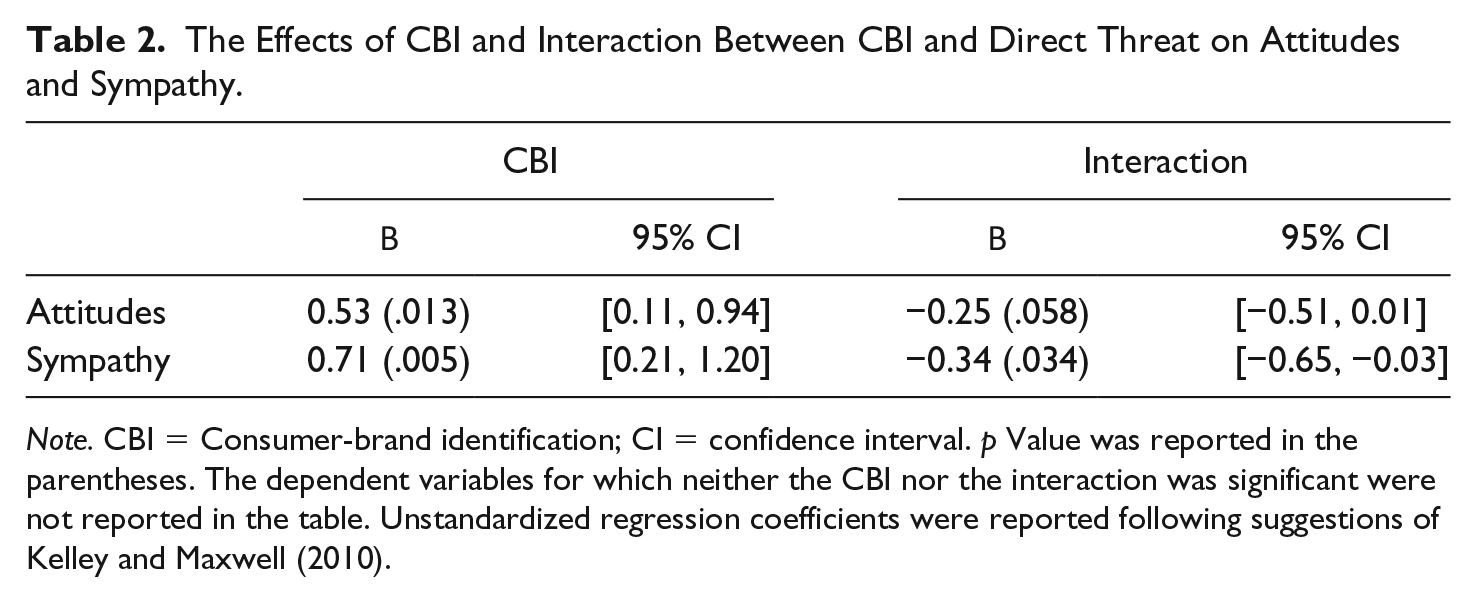
Note. CBI = Consumer-brand identification; CI = confidence interval. p Value was reported in the parentheses. The dependent variables for which neither the CBI nor the interaction was significant were not reported in the table. Unstandardized regression coefficients were reported following suggestions of Kelley and Maxwell (2010).
Hypothesis 1 proposes that corporate response strategies are less effective when a crisis directly threatens shared attributes. A two-way analysis of variance (ANOVA) was conducted to examine the main effect of the direct threat to the shared attribute (hereafter referred to as the direct threat), the main effect of the brand types (i.e., whether the effectiveness of strategies differs across two brands), and the interaction effect (i.e., whether the effect of the direct threat differs across two brands). For the effectiveness of response strategies on attitudes, none of the predictors was significant at .05 level. Hypothesis 1a was not supported.
For the effectiveness of response strategies on anger, although neither main effect was statistically significant, the interaction effect was significant. Corporate response strategies were more effective at mitigating anger, t(363) = −1.91, p = .029, in the anti-unionization crisis than in the unhealthy-food crisis for the Whole Foods consumers. The direct threat did not influence the effectiveness of response strategies at mitigating anger, t(454) = 0.84, p = .200, for the Apple consumers. The direct threat had a statistically significant effect on the effectiveness of response strategies at changing sympathy. Corporate response strategies were less effective at generating sympathy when a crisis directly threatens the shared attribute (M = 0.50, SD = 1.76 vs. M = 0.26, SD = 1.66). The main effect of the brand types was not statistically significant, neither was the interaction. The direct threat had no effect on how response strategies mitigate disappointment. The main effect of the brand types and the interaction were also not significant. Hypothesis 1b was partially supported.
For the effectiveness of response strategies on mitigating NWOM intention, none of the predictors was statistically significant. The direct threat had a statistically significant effect on the effectiveness of response strategies at changing purchase intention. The main effect of the brand types was not statistically significant, nor was the interaction. Corporate response strategies were less effective at recovering purchase intention when a crisis directly threatens the shared attribute (M = 0.35, SD = 1.46 vs. M = 0.15, SD = 1.29). Hypothesis 1c was partially supported.
Hypothesis 2 proposes that CBI increases the effectiveness of the corporate response strategies, and Hypothesis 3 proposes that the impact of the CBI is moderated by the direct threat. A multiple regression analysis was performed, in which the independent variables included CBI, the direct threat, the brand types, and all the two-way and three-way interaction terms of these variables. The brand type was coded as 1 = Whole Foods and 2 = Apple. The direct threat was coded as 1 = Whole Foods’ anti-unionization crisis/Apple’s tax-avoidance crisis and 2 = Whole Foods’ unhealthy-food crisis/Apple’s technology-stealing crisis.
The regression coefficient from the CBI (M = 6.51, SD = 2.57) to the attitude change was statistically significant. Positive attitude increased by 0.53 units with every one unit increase of the CBI, controlling for the effects of all the other variables and the interactions. Hypothesis 2a was supported. The interaction between the CBI and the direct threat was very close to being significant. Hypothesis 3a was marginally supported. The model explained 2.9% variance of the attitude change.
None of the coefficients was statistically significant when anger or disappointment was regressed. CBI had no impact on the effectiveness of response strategies regarding mitigating anger or disappointment, regardless of whether the crisis directly threatens the shared attribute. Strong CBI made response strategies more effective at increasing sympathy. Sympathy increased more by 0.71 units with every one unit increase of the CBI, holding all the other variables and the interactions constant. The interaction between the CBI and the direct threat was also significant, indicating that the buffering effect of the CBI was weaker when the crisis directly threatens the shared attribute. Additionally, the interaction between the CBI and the brand types was also significant (β = −0.32, p = .032, 95% confidence interval [CI: −0.62, −0.03]). The buffering effect of the CBI was stronger among Whole Foods consumers than among Apple consumers. The model explained 3.2% variance of the sympathy change. Hypothesis 2b and Hypothesis 3b were partially supported.
The coefficient of the CBI on the change score of NWOM intention or purchase intention was not statistically significant; neither was the coefficient of the interaction between the CBI and the direct threat on NWOM intention or purchase intention. CBI had no impact on the effectiveness of response strategies regarding mitigating the NWOM intention or recovering the purchase intention, regardless of whether the crisis directly threatens the shared attribute.
The research question seeks to determine which response strategy is most effective at mitigating consumers’ negative reactions regardless of the direct threat. A two-way ANOVA (independent variables: response strategies and brand types) was performed to examine whether the effect of the corporate strategy was statistically significant and whether the change of consumers’ reactions varied across two brands. If the main effect of the response strategies was statistically significant, then the Tukey-Kramer pair-wise multiple comparison procedure was used to examine which groups were statistically different from each other. The main effect of the brand types and the interaction between the brand types and the response strategies were not significant in any of those two-way ANOVA tests.
The effect of response strategies was statistically significant on the change of all outcome variables. For the attitude change, the apology-compensation-reminder combination had the highest change score (M = 0.89, SD = 1.79), and this combination was statistically more effective than no-comment (M = −0.32, SD = 1.26; p < .001), apology-only (M = 0.25, SD = 1.35; p = .021), and reminder-only (M = 0.12, SD = 1.19; p = .002). For the anger change, the apology-compensation-reminder combination (M = −1.63, SD = 2.63) was statistically more effective than the no-comment (M = 0.08, SD = 1.15; p < .001), the apology-only (M = −0.34, SD = 1.53; p < .001), the reminder-only (M = −0.27, SD = 1.44; p < .001), and the apology-reminder combination (M = −0.65, SD = 1.66; p = .009). The apology-compensation-reminder was also marginally significant than the compensation-reminder (M = −0.80, SD = 2.20; p = .057). For the sympathy change, the apology-compensation-reminder combination (M = 0.87, SD = 2.20) was statistically more effective than the no-comment (M = −0.30, SD = 1.12; p < .001) and reminder-only (M = −0.003, SD = 1.46; p = .007). For disappointment change, the apology-compensation-reminder combination (M = −1.48, SD = 2.17) was statistically more effective than the no-comment (M = 0.05, SD = 1.53; p < .001), apology-only (M = −0.53, SD = 1.84; p = .010), and the reminder-only (M = −0.46, SD = 1.63; p = .006). For the NWOM intention change, the compensation-reminder combination had the highest change score (M = −0.63, SD = 1.47). It was statistically more effective than the no-comment (M = 0.30, SD = 1.16; p < .001) and was marginally more effective than the reminder-only (M = −0.11, SD = 1.13; p = .052). For the purchase intention change, the apology-compensation-reminder combination (M = 0.66, SD = 1.51) was statistically more effective than the no-comment (M = −0.40, SD = 1.47; p < .001), the reminder-only (M = 0.02, SD = 1.17; p = .018), and apology-reminder (M = 0.06, SD = 1.14; p = .031).
Discussion
Corporate response strategies are more effective at changing consumers’ discrete emotions such as anger and sympathy as well as recovering purchase intention when a crisis does not directly threaten the shared defining attributes. How the direct threat affects the effectiveness of response strategies on changing certain emotions, such as anger, may also depend on the brand types. After hearing the corporate responses, consumers strongly identifying with a brand perceive it more positively and feel more sympathetic than consumers weakly identifying with the brand. Additionally, the increased effectiveness of response strategies because of CBI is more obvious when the crisis does not directly threaten the shared attributes. In general, apology-compensation-reminder is more effective than no-comment, apology-only, and reminder-only. Compensation, not a verbal apology, maybe is the strategy that really mitigates consumers’ negative reactions.
Consumers feel betrayed when a brand voluntarily undermines its defining attributes shared with its consumers (Ma, 2018). Consequently, they are less forgiving, less sympathetic, and less likely to buy the brand’s products in the future. The direct threat to the shared attributes affects the effectiveness of response strategies on mitigating consumers’ anger only for Whole Foods but not for Apple. Whole Foods consumers may feel the brand undermines the consumers’ attachment to the brand by selling unhealthy food, while Apple consumers may normalize technology steal into a business competition and perceive it as less unethical. In addition, consumers’ perceived involvement influences their emotional reactions to a crisis (Choi & Lin, 2009). Whole Foods consumers may feel involved in the unhealthy-food crisis and get angry even when they were not personally affected. On the contrary, Apple consumers may not feel much involved in Apple’s industrial competition.
CBI increases the effectiveness of response strategies at increasing positive attitudes and sympathy. Strong CBI indicates a large overlapping area of consumers’ self-concept and the brand’s image. It is difficult for consumers with strong CBI to sever their ties with the brand, and they need a positive perception and sympathy to preserve the ties. The buffering effects of CBI are more obvious when the crisis does not directly threaten the shared attributes. After all, the shared attribute is the foundation of CBI (Dutton et al., 1994). The crisis may erode the impacts of CBI when the crisis threatens CBI’s foundation.
The buffering effects of CBI on consumers’ sympathy increase are also more obvious for Whole Foods than for Apple. Whole Foods consumers may feel more motivated to accept corporate responses due to the brand’s close connection to their daily life. Consumers only have direct contact with Apple when they buy tech products or need customer services. Additionally, some Whole Foods consumers may also identify with the brand because the connection symbolizes their social economic status. Such symbolization motivates them even more to accept the corporate responses.
In general, apology-compensation-reminder is more effective than no-comment and reminder-only at mitigating consumers’ negative reactions. Not surprisingly, no-comment is the least effective strategy. Corporations should not be stonewalling when consumers expect them to account for what has happened. Similarly, it is counterproductive to not mention anything about the crisis and only remind the consumers of the corporation’s past good deeds. The reminder-only strategy may cause the consumers’ psychological reactance, because they “may view it as an attempt to distract from the crisis” (Coombs, 2014, p. 148) and evade responsibility.
In general, the apology-compensation-reminder strategy is no more effective than compensation-only, apology-compensation, or compensation-reminder. When publics attribute a moderate amount of responsibility to an organization, apology, compensation, and sympathy are equally effective at changing reputational evaluation, anger, and NWOM intentions (Coombs & Holladay, 2008). The findings from the current study showed that when a corporation is fully responsible for the crisis, the strategy that really mitigates consumers’ negative reactions is compensation, not the verbal apology.
In its crisis responses, a corporation can remind its consumers about their identification with the brand because CBI makes response strategies more effective. A new strategy that strengthens the CBI needs to be integrated into the theory and practices of crisis communication. For example, a luxury brand can remind its consumers that the brand has well represented their social economic status in the past. A brand can also promise its consumers that it will protect the shared defining attributes in the future. With such a promise, the brand could ask its consumers to continue supporting the brand through a difficult time and give it a second chance. This new strategy can be named identification-intensifier. It can be categorized as a substrategy of SCCT-suggested reminder strategy. In other words, identification-intensifier is a bolstering strategy to supplement the primary strategies.
This study examined how CBI, the direct threat to self-defining attributes shared between consumers and a brand, and their interaction influence the effectiveness of corporate response strategies at changing consumers’ cognitive, emotional, and behavioral reactions. It also examined which strategy or strategy combination is most effective. By answering those questions, this study contributes to the theory-building and practices of corporate crisis communication and public relations.
Theoretical Implications
Although previous research shows that OPRs do not influence the effectiveness of response strategies very much, this study reveals that close psychological connections (i.e., CBI) can affect how response strategies change consumers’ negative reactions. The relationship research in crisis communication should pay more attention to organization-public identification. Not only can consumers identify with a brand or an organization, other groups of publics, such as employees and investors, may have an even stronger attachment to the brand or the organization. Second, the corporate response strategies are less effective when a crisis threatens the defining attributes shared between a brand and its consumers. SCCT (Coombs, 2007, 2014) suggests corporations choose response strategies primarily according to the publics’ attribution of responsibility. Corporations should also consider how much the crises threaten the essence of their brands (Greyser, 2009) and respond accordingly. Additionally, the dominant typology of crises is based on the attribution of responsibility (Coombs, 2007). How much the crises threaten the defining attributes of brands or organizations, including companies and nonprofits, offers another criterion to categorize crises. Finally, this study enriches our understanding and operationalization of response strategies by adding the identification-intensifier. The nuanced distinction between reminder of identification and reminder of past good deeds will crystallize the effects of different reminder substrategies.
Practical Implications
This study provides several important guidelines for corporate crisis communication practices. First, brands that have strong and distinct defining attributes should cautiously protect the primary attributes that their consumers share with them because jeopardizing such attributes will cause major crises that are more challenging to recover from. If the brands ever undermine such attributes, they should use an identification-intensifier as a bolstering strategy to supplement other strategies. Second, compensation is the strategy that really reduces consumers’ negative reactions. A corporation that fears a verbal apology could hold it legally accountable can mitigate consumers’ negative reactions with compensation only. Combining these two suggestions on the selection of response strategies, the compensation-identification-intensifier combination may be effective. However, an ethical corporation should apologize verbally and take responsibility if it causes the crisis so that the victims can get the peace of mind. For example, Chipotle apologized to the consumers affected by the E. coli food poisoning (Peterson, 2015). Additionally, when loyal consumers raise a concern and a brand does not address it timely, the brand will need to sincerely apologize to the consumers. Compensation without apologizing may insult the loyal consumers, as shown in Lululemon’s product recall (Creelman, 2015). Finally, this study helps corporate communicators better understand consumers’ perspectives. Communicators can use the findings to help management “see potential decisions through the lenses” of consumers’ value systems and goals (Bowen, 2009, p. 428) so that management can make ethical decisions that fulfill the consumers’ needs and protect their well-being.
Limitations and Directions for Future Research
This study had several limitations. First, the study examined two brands whose products are relatively expensive, which means that their consumer base is relatively affluent compared with that of other brands in their industry. The examined relations among concepts may present a different pattern with the consumer base of less expensive brands. Second, the use of multiple brands enhanced the external validity of the study, but it also required different crisis stimuli between the two brands to make the stimuli realistic and effective. The use of different crisis scenarios may have caused some of the different results between the brands. Third, the participants were recruited from an online panel (i.e., Amazon MTurk), and they took the study in an environment they chose. Although several attention checkers were used throughout the experiment to make sure that the participants paid good attention to the study, some participants may have been distracted while taking the study. Moreover, the study used fictitious crises. Although the crisis stimuli were based on real crises, real crises can be not as clear-cut as the stimuli. Consequently, consumers’ reactions to real crises may be more complicated than what the study shows. Additionally, the outcome constructs included behavioral intentions instead of actual behaviors. Behavioral intentions may not perfectly predict the actual behaviors, and the actual NWOM and purchase behaviors would be more convincing.
For future research, scholars can examine how CBI, the direct threat to the shared attributes, and their interaction affect crisis communication of other brands that are less expensive. Moreover, social media has changed the landscape of crisis communication. Future research can examine how these concepts affect consumers’ reactions to crises on social media, such as leaving comments on a brand’s account. Additionally, it would be beneficial to examine how these concepts connect in real crises by using survey method.
Footnotes
Appendix
Acknowledgements
This research is an important part of the author’s dissertation. The author thanks her advisor, Dr. Elizabeth L. Toth, and all her committee members, Drs. Edward Fink, Nicholas Joyce, Brooke Fisher Liu, Erich Sommerfeldt, and Laura Stapleton, for their helpful feedback.
Declaration of Conflicting Interests
The author declared no potential conflicts of interest with respect to the research, authorship, and/or publication of this article.
Funding
The author received no financial support for the research, authorship, and/or publication of this article.
