




Abstract
This case study examined the extent to which expected Gen Y traits surfaced in a well-managed U.S. company. The results indicate that certain Gen Y traits typically regarded as undesirable in the workplace are especially persistent, even in an optimal organizational setting, but others are not. The findings also reveal both expected and unexpected attitudes on the part of the Gen X and Boomer employees and managers. Such studies can help us move beyond generational stereotyping to more accurate, context-sensitive advice about cross-generational communication.
Keywords
Countless publications about the different generations in the workplace have appeared since the beginning of this millennium, when commentators first began to note that “Millennials,” now more commonly called Generation Y, exhibited striking, consistent differences from the three previous generations. These differences have been of particular interest to educators and managers, who have often found the Gen Yers’ behavior perplexing, if not downright exasperating.
One can learn a great deal about how to teach and manage this young cohort by consulting the voluminous literature on the subject. However, this literature essentially treats Gen Yers as if they were all the same and behaved in the same ways regardless of context. No published studies have examined Gen Y employees in particular workplace settings. This article is an effort to begin to fill this gap by examining the extent to which the expected Gen Y traits surfaced in a particular company. The company was in many ways the perfect “lab” for such a study because it employed three generations of employees and because the culture, size, and mission of this company would be likely to bring out the best in Gen Y employees and minimize cross-generational conflict or misunderstanding. Thus, the data would be likely to identify generational traits that would be particularly ingrained as well as traits that might defy the generational norms.
To examine the company’s Gen Yers and their managers’ attitudes about them, this study used a company-wide survey as well as interviews and focus groups. The main goals were to learn (a) whether the managers, like those at so many other companies, believed the Gen Yers to be deficient in workplace attitudes and skills (e.g., work ethic) as compared to young employees of the past; (b) whether the Boomer and Gen X managers would evaluate the Gen Yers differently; (c) whether the Gen Yers had a greater need to send and receive information as compared to the older two generations; and (d) how accurate a sense the Gen Yers had of their own abilities. The findings confirmed some generational stereotypes and refuted others, indicating the importance ofbothunderstanding the prevailing stereotypesandpaying attention to the attitudes and skills of particular people in particular workplace situations. Studies of this type can help professional communication faculty, communication consultants, and managers find more specific, context-sensitive solutions for bringing out the best in Gen Yers and facilitating successful cross-generational communication.
The Need for Cross-Generational Case Studies
Information about the current generations in the workplace has come from three main types of publications: (a) articles on the Internet and in magazines (e.g.,Bradt, 2014;“Connecting with Generation Y Workers,” n.d.;Derven, 2014;Glassman, 2010;“Managing the Facebookers,” 2008;Meister & Willyerd, 2010;Robinson, 2008;Rowe, 2010;Stein, 2013); (b) articles in academic journals (e.g.,Deal, Altman, & Rogelberg, 2010;Hartman & McCambridge, 2011;Myers & Sadaghiani, 2010;Schullery, 2013); and (c) book-length works (seeTable 1). None of these publications has provided a detailed picture of Gen Y employees in a specific multigenerational workplace. Instead, these publications have either talked about or sought to produce a generalized picture of what Gen Yers value, how they act, and how to manage them.
Selected Book-Length Studies of Gen Yers in the Workplace (Chronological Order).
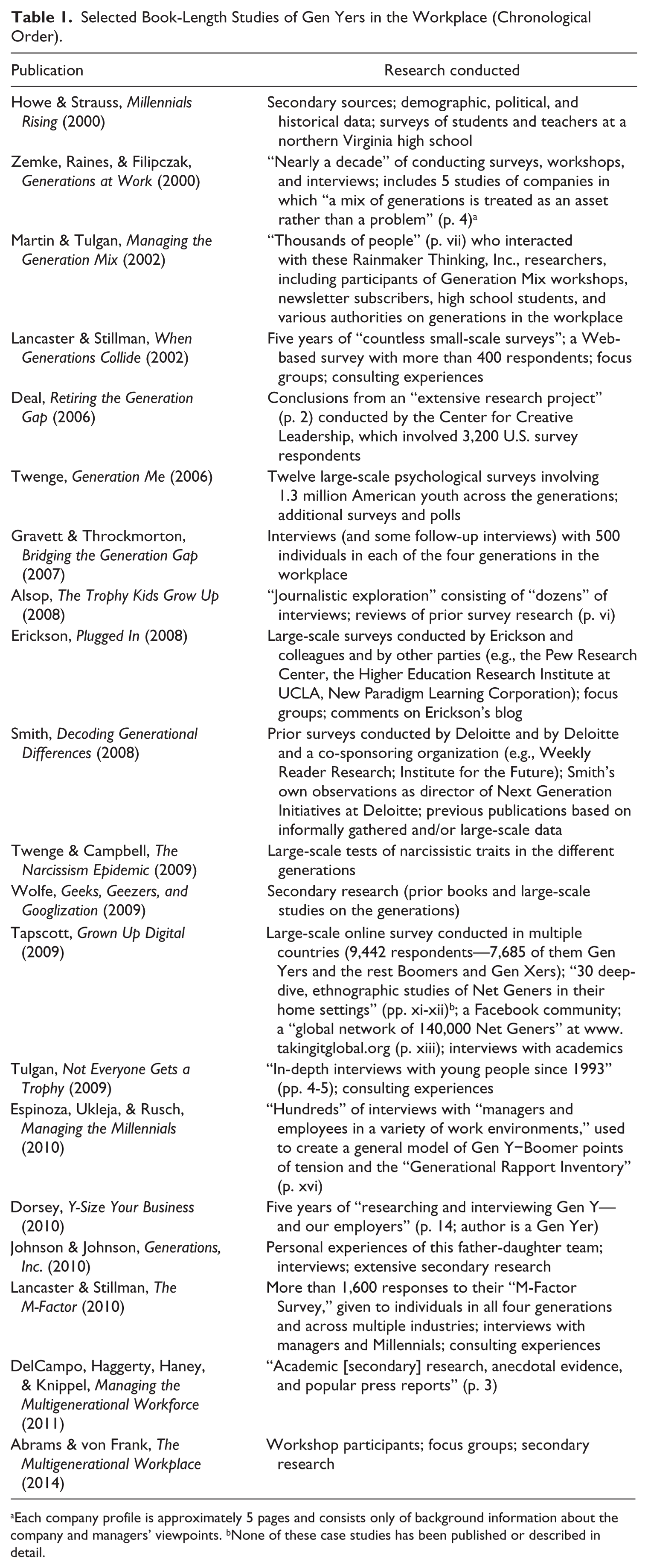
Each company profile is approximately 5 pages and consists only of background information about the company and managers’ viewpoints.bNone of these case studies has been published or described in detail.
AsTable 1shows, extensive research has informed many of these generalized pictures. What is needed now is not further information about Gen Y as a cohort but more micro-oriented research that helps us see how different kinds of Gen Yers perform in different kinds of settings and thus understand better how to coach our preprofessional students. Indeed, the generalizations are so well established that the discourse about Gen Yers now risks falling into stereotyping. AsKadakia (2014)commented, “Businesses must look more closely to truly understand Millennials and their impact on the workforce” if they don’t want to fall into “age discrimination” based on stereotype-based expectations (p. 16). The same caution would apply to faculty who are preparing students for success in the workplace.
Case studies of Gen Yers in specific organizations can help us develop a more refined sense of which types of workplace cultures bring out which kinds of behaviors and attitudes in Gen Yers. A case study “investigates a contemporary phenomenon within its real-life context, when the boundaries between phenomenon and context are not clearly evident, and in which multiple sources of evidence are used” (Yin, 1984, p. 23). While case studies do not produce generalizable results in the strict scientific sense, they are useful for testing the validity of certain generalizations. They also enable readers to relate the case study to other cases they know about and thus generalize in an intuitive, informal way from the observed case to similar cases (Rentz, 1999, based onStake, 1995).
This study was primarily directed toward the first goal: To see the extent to which general observations about Gen Y employees held true when Gen Yers in a particular type of work environment were studied. But the quantitative and qualitative details that the study yielded also enable it to be used as a rough indicator of how Gen Yers will tend to behave, and be viewed, in similar circumstances (e.g., for similar companies).
The Study Site
The site chosen for this study was a small, privately owned software development company in a major city in the southeastern United States. In exchange for sharing the findings with the company, I was granted permission to conduct this research and to use the data for academic purposes as long as I kept the company and the participants anonymous. At the time of the study, the company had recently celebrated its 10th anniversary. It had been cofounded in 1999 by its CEO and its president, who soon recruited the three additional members of the company’s executive team. These five original members—consisting of four Boomers and one Gen Xer—operated the company in its early days out of a one-room office. The business was based on the then-innovative idea of providing “software as a service” (SaaS), which later became widely used and known as cloud-based software. The company’s software was intended to help a large segment of small to midsized organizations in the nonprofit sector manage their organizations and facilities.
The company had become highly successful in its first 10 years. At the time of the interviews, it was helping its clients save $1 billion annually (according to the company’s president). It had also reached $2 million in annual revenue, which put it in the top 1% of the 2,300 SaaS companies in the world at that time (CEO), and it had ranked highly on a “Fastest-Growing Companies” list for multiple years.
As a place to study the behavior of Gen Yers in the workplace, it had these advantages:
It was a successful, relatively informal company, so all the top executives were accessible and willing to be interviewed and to grant access to many other personnel.
It was a small company (100 stateside employees, with a small technical branch in Malaysia), which enabled me to meet and talk with a relatively high percentage of the personnel.
The company employed a relatively high percentage of Gen Yers (24 total: 1 manager and 23 nonmanagerial employees).
The company also employed two other generations of employees—Boomers (15 total: 3 executives, 6 managers, and 6 nonmanagerial employees) and Gen Xers (61 total: 2 executives, 19 managers, and 40 nonmanagerial employees)—which enabled analysis of generational differences.
Beyond these logistical and demographic advantages, the company had the advantage of having a motivational, team-like culture that generated strong company loyalty among its employees. According to the HR director, 95% of their hires were referrals from current or previous employees, and the employees had voted the company as #1 or #2 on the area’s “Best Places to Work” list for each of the previous 4 years. As a company in which all employees pulled together, it had apparently found ways to avoid the kinds of cross-generational conflict that plague many other companies and to successfully integrate Gen Y employees into its operations.
Over the course of interviews with the five executives, five managers, and the HR director, it became clear that the management philosophy supporting this culture stemmed from the company’s CEO, who was much influenced by management experts W. Edwards Deming (especially his “Principles for Transformation of Western Management,”1986) and Jim Collins (Good to Great,2001). He identified these key components of his management style:
Being mission and people oriented rather than money driven
Being long-term rather than short-term oriented (building something of lasting value)
Cultivating “distributed leadership” (“Our leaders are all over the organizational chart—they’re the ones who have internalized the company’s vision and can articulate it.”)
Creating a “no fear” environment in which the best ideas can surface from anyone
Promoting a consistent philosophy that grounds an ever-evolving vision (“Rules are a substitute for thought.”)
Demonstrating “tremendous respect for individual contributors”
The other interviewees echoed this orientation. The sales VP likened the company to a “family” and called the management style “employee centric.” The president commented on the company’s “no fear,” “team” culture, which encouraged “honesty” at every level, and on the appeal of the company’s larger purpose (“we can show how our product is making a difference”). Employees were additionally motivated by “department and job specific” bonus plans, which rewarded those who had “made their numbers” (president). The highest honor bestowed each year was making the President’s Club, which earned one an invitation to an elite outing at a resort.
The employee-focused culture of the company was backed up by tangible benefits (described in materials provided by the HR director). The salaries were competitive, especially for a start-up in the industry. The benefits package included insurance of every sort (medical, vision, drug, dental, life, disability), as well as a flexible spending account and a generous 401k plan. The list of benefits also included an employee assistance program and a wellness program, and the CEO told me that he had personally paid the tuition for any employees who wanted to continue their education.
All in all, the company was managed in such a way as to elicit enthusiasm and loyalty from the employees. But key to sustaining this culture was “getting the right people on the bus”—the title of a chapter inCollins’s (2001)book and a phrase that both the CEO and president used in their interviews. The company had a rigorous hiring process that included a screening interview and then a full day of interviews with executives, managers, and rank-and-file employees. When asked what the company looked for in its hires, the CEO commented, “We interview more on the intangibles,” looking for “great people” who value “fun and fulfillment, fairness,” and a team orientation. The sales VP echoed these remarks and added that successful applicants had a strong work ethic and “integrity.”
The company had gotten good at this: As one Gen X manager in customer service said, “We’ve erred on [the new hires’] potential in terms of their skill set, but we haven’t erred on personality or soft skills.” The customer service VP told a story about an interviewee who had gotten far in the hiring process but lost out because he was rude to the server at lunch. The HR director mentioned that a deal-killer in one interview was that the applicant had asked, as one of his first questions, “Will I get an iPhone?” Everyone involved in hiring appeared to understand that identifying people who were a “good fit” with the company culture was critical to the company’s continued success.
Several means of communication supported this team-like culture. The CEO did a good bit of “management by walking around” (a phrase coined byPeters & Waterman, 1982). Two or three times a year, he sent out a long email conveying “the state of [the company].” There were also numerous social events, and almost everyone participated in “[Company] University,” a get-together with customers that took place at a beachfront location. The sales staff had an annual meeting off site, every department had its “own meeting rhythms” (president), and some regular cross-department meetings were held. Once a month, members of the “Business Units”—small groups of employees representing each area of the company—gave a presentation to the executives. Employees did a lot of IM-ing on Salesforce and frequently dropped by each other’s offices. LCD screens in the lobby and the main employee break room announced the acquisition of new customers, results of customer surveys, and employee birthdays.
Three of the Boomers on the executive team mentioned the challenge of adapting their communication styles to the company’s youngest cohort of employees. The president noted cases in which his “style hadn’t worked”; he would say “‘let’s go kick that competitor’s butt’” or “‘let’s win,’” but “they’re more kumbaya—we all win.” The CEO said, “So much of my style and thinking is ineffective” with them; “they say they’re independent but they desperately need leadership; they want to advance but they’re not working as hard as I did; they say they’re strong but they break easily.” These executives had attended workshops on managing Gen Y to learn how to make their youngest employees a successful part of the team. The sales VP’s attitude seemed to be shared among the leadership: “I like young people because they’re energetic. They want to grow. There’s a lot of naiveté, but they’re very refreshing. They give you a chance to mold them.”
In short, this company was doing many things right in terms of its hiring and treatment of Gen Y employees. It therefore afforded an opportunity to study generational differences and cross-generational interactions in a setting in which differences among the generations would tend to be muted or negated by the positive, cooperative work atmosphere, thus enabling the most salient generational traits to surface.
Research Methodology
I was granted approval to study the company in response to a proposal I submitted to the company president in June 2010. He was interested in the data the study would yield and, in subsequent communications with the employees, gave my research his full support. In return for providing extensive access to company personnel, he would be allowed to shape the survey questions somewhat and also receive a detailed report of my findings. The study took place in July and August of 2010. Of particular help was the HR director, with whom I worked most closely in conducting the research and who supplied me with extensive information and with research participants at various points.
Background Research
Because this case study was in many ways a communication audit, I consulted the literature on how to conduct such research. Largely on the advice ofDowns and Adrian (2004)andHargie and Tourish (2009), I employed the following strategies:
Researched the organization’s background by reviewing all publications by and about the company.
Interviewed the top executives to gather their perspectives, gain their buy-in, and learn about their particular information needs.
Used multiple means of data gathering (both quantitative and qualitative) to strengthen the validity of the data and interpretations of those data.
Encouraged employees’ participation and honesty by making sure they knew of the executives’ support of the study. A liaison from the company, the HR director, also arranged the interviews and focus groups, as recommended byDowns and Adrian (2004, p. 217).
Tested the questionnaire—the main research method—before distributing it to the employees.
Based many of my interview, survey, and focus group questions on those used in communication audits.
I also reviewed the extensive literature on generations in the workplace, discussed earlier, to be able to test the extent to which the Gen Yers in this company, and the older employees’ views of them, conformed to the generational norms.Table 2provides a synopsis of what this literature has said about Boomers, Gen Xers, and Gen Yers. The following Gen Y traits served as the basis for many of my questions on the survey and in the interviews and focus groups:
Have less respect for hierarchy/authority than older employees; tend to overestimate the value of their own opinions
Are (too) confident in their abilities; feel entitled to succeed but underestimate the work that takes
Want quick solutions/results; don’t want to “waste” time; want to give each task only the effort they think it deserves
Able to quickly sort through extensive information; prefer multitasking to prolonged attention to one project
Desire extensive feedback and direction; need more praise that earlier generations; sensitive to criticism
Want a clear map for success; intolerant of ambiguity; not aware of or interested in the big picture
Technologically adept but prone to overuse of technology
Summary of Generational Traits Noted in the Literature.

Note. The generational cutoff dates used here are commonly, though not always, used.
It is worth noting that much of the literature has discussed Boomer attitudes toward Gen Yers, but almost none of it has discussed Gen X attitudes toward the younger cohort. One goal of the study, then, was to help fill this gap.
Empirical Research
The primary research took place in three phases. The first consisted of hour-long, face-to-face, on-site interviews with the HR director and with all five company executives: the CEO, the president, the sales VP, the VP of technology, and the VP of customer service. I also interviewed two managers in the technology division, three in the customer service division, and one in operations (accounting), all of whom had been invited to participate by the HR director on the basis of the likely accuracy and value of their comments. The participants provided me with the history of the company, information about employee benefits and hiring practices, their views of the Gen Y employees and of cross-generational interaction in the company, and insights into the company culture.
The next phase of the study consisted of a SurveyMonkey survey that was distributed to all employees, including the executives. Before the survey was distributed, the HR director and I tested a draft of the survey with four employees (two managerial, two nonmanagerial). We sat down with them in a conference room and went through all the questions, changing or clarifying the wording as needed. Care was taken to design the survey in such a way that no particular respondent could be identified from his/her responses.
The survey was distributed by email to all personnel, with cover messages by me and by the HR director. The president had earlier sent out a company-wide email message in which he had notified employees of the study, praised their accomplishments, and encouraged everyone’s participation. Respondents were given a week and a half to respond. The survey was then sent out a second time and closed a week later.
The survey had seven parts, five of which pertain to this study:
A demographic information page that asked respondents to indicate the range of years within which they were born, the length of time they had been with the company, and their rank in the company hierarchy. 1
A “Survey Page for People Managers” that appeared only to those who indicated that they were executive or managerial personnel. This page asked respondents to assess current and past young employees on 25 criteria derived from the literature on Gen Y and from the interviews. The page also asked respondents to indicate how many years of managerial experience they had, and it enabled the executive respondents to skip to the end of the survey.
A page asking respondents to indicate how much information they currently receive on certain topics and how much they would like to receive.
A page asking respondents to indicate how much information they are expected to send on certain topics and how much they would like to send.
A page asking respondents to indicate their own skill level on 19 employee traits (e.g., working on team projects, listening to others).
Recipients were assured that their responses would be anonymous and that only the researcher would have access to the raw data.
Finally, I conducted postsurvey focus groups with these personnel:
Three Gen Y employees (one manager, two nonmanagers)
Two Gen X employees (nonmanagers)
Two Gen X managers
The participants had been selected by the HR director on the basis of their knowledge of the company and their likely insights on company issues; several of them had served or were serving on the company’s Business Units as representatives of their functional areas. Their participation was kept confidential, and each participant signed a consent form. Each session lasted about an hour.
The participants were first invited to share their observations about how the different generations work and get along in the company—for example, “How do you think Gen Y strengths compare to Gen X strengths? To Boomer strengths?” They were then prompted for possible explanations for some of the survey results (e.g., “The respondents in your age group indicated that they’d like to receive considerably more information about advancement opportunities. How would you explain that response?”). The data from the focus groups were used to augment interpretations of the survey data.
Survey Results
Out of the 100 possible respondents, 56 (56%) participated in at least part of the survey. Response rates for specific questions as well as generational breakdowns for the respondents will be provided as the responses are discussed.
Managers’ Assessments of Present and Past Young Employees
Survey respondents who indicated their position as either executive or people manager on the first page of the survey were sent to a “Survey Page for People Managers.” The third category of respondents (“Professional/technical/other salaried employee”) skipped to the subsequent pages of the survey. Three executives and 20 people managers, for a total of 23 respondents (out a possible 31, for a 74% response rate), answered the questions on this page.
Managers were asked to rate the company’s current employees aged 30 years and younger on 25 criteria by using a 5-point scale, with 1 meaning “strongly disagree” and 5 meaning “strongly agree.” 2 For each criterion, they were also asked to rate employees of that age whom they had managed or worked with in the past, using the same scale. The purposes of this page were (a) to gauge the extent to which the company’s Gen Y employees, according to their managers, were exhibiting the strengths and weaknesses that Gen Yers in general are purported to have in comparison to young employees of the past; and (b) to see if there were differences between how the Boomer and Gen X managers rated present and past young employees.
Managers’ Responses Overall
Figure 1shows how the managers rated the company’s Gen Yers in comparison to young employees of the past. As the figure shows, the Gen Yers in this company edged out their counterparts of the past on every criterion.
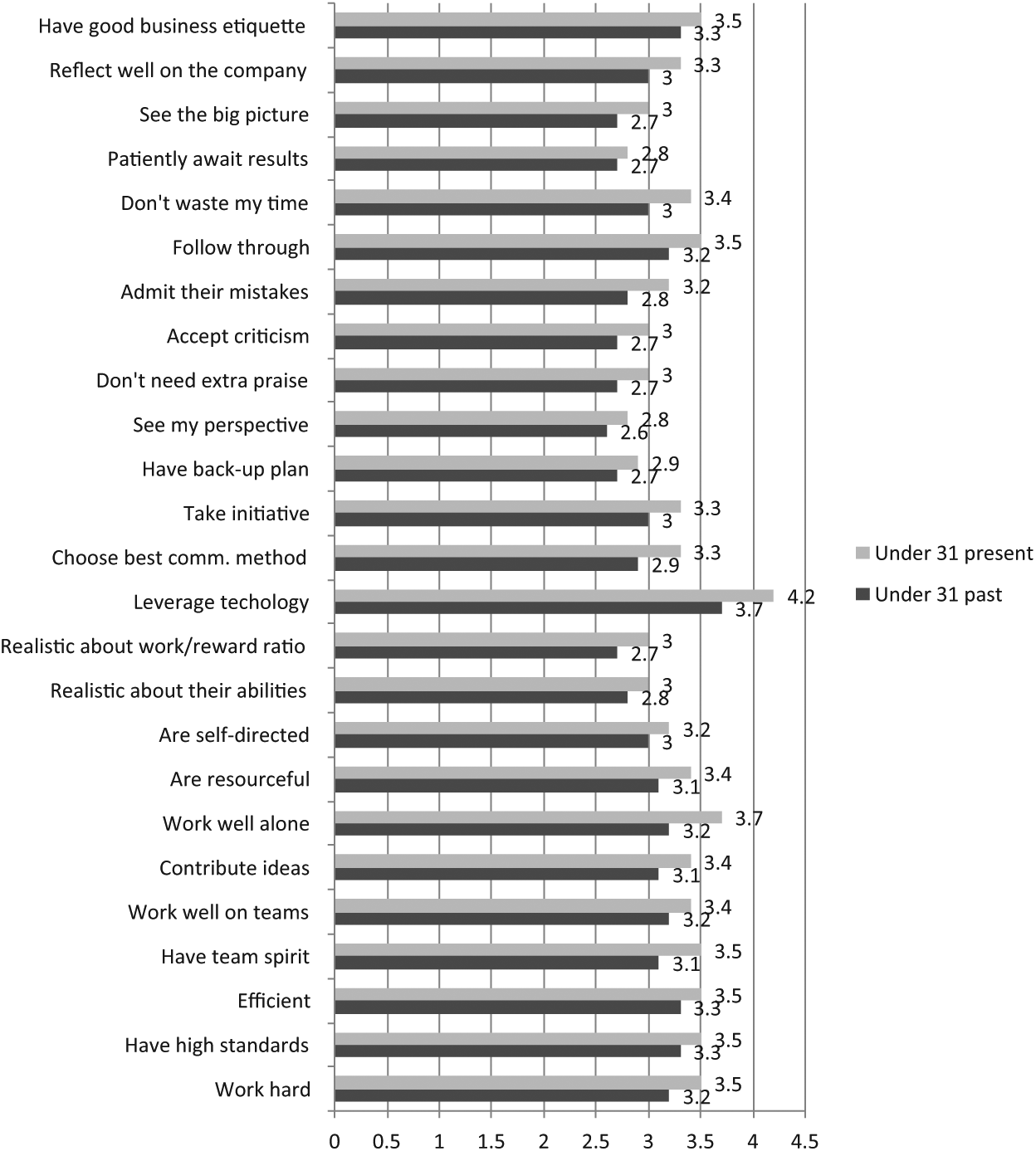
Managers’ assessment of present and past young employees (n= 23).
This finding runs contrary to what one would expect from reading the widespread complaints about Gen Y employees, who are routinely pronounced to be inferior to past young employees on such criteria asbeing realistic about their abilities, being realistic about rewards, andworking hard. The company’s strong culture of employee appreciation and their rigorous hiring standards, two themes that emerged repeatedly in the interviews, seem to have offset certain undesirable tendencies exhibited by the Gen Y generation in general.
Of particular note are the criteria on which the Gen Y employees’ scores were 0.4 or 0.5 points higher than those of their earlier counterparts:not wasting their manager’s time, admitting their mistakes, choosing the best communication method, leveraging technology, working well alone, andhaving team spirit.
Their high marks for technology use are not surprising since Gen Yers are the most technologically immersed generation in history. It is also not surprising that these employees worked well alone, since most Gen Yers have spent many solitary hours doing online socializing. That they did better than previous young employees on choosing the best communication method was somewhat unexpected, since not only the literature but also some of the interviewed managers had commented that the Gen Yers tend to overrely on electronic media and underuse the phone and face-to-face conversation. It is possible that this rating was strongly influenced by the responses of the customer service managers, most of whose Gen Y employees needed to interact with customers and staff using several different methods. As for the other criteria on which the Gen Yers most outdistanced their earlier counterparts, the company’s high-touch, family-like, “no-fear” culture, as well as its careful screening process for job applicants, would seem to account for these results.
Of interest also are the criteria on which the Gen Yers received their lowest scores (below a 3 rating)—patiently await results, see their manager’s perspective, andhave a back-up plan. While one should not make too much of these results since past young employees also got low scores on these criteria, it appears that these weak spots persist in Gen Y and are ones that not even this company’s culture and hiring practices could offset by much. These, then, are traits that managers in any kind of company may need to consciously address when mentoring Gen Yers, and ones that we as teachers can help tomorrow’s employees avoid.
Boomer and Gen X Managers’ Ratings of the Gen Y Employees
Given the way the generations are described in the literature, one would expect the Boomer managers to give the company’s youngest employees lower marks than the Gen X managers would give them. Not only are Boomers two generations removed from Gen Yers; they also have less in common with them than the Gen X generation does.
That expectation was supported by the survey results; Boomer managers rated the company’s Gen Y employees noticeably lower than the Gen X managers did, as shown inFigures 2and3.
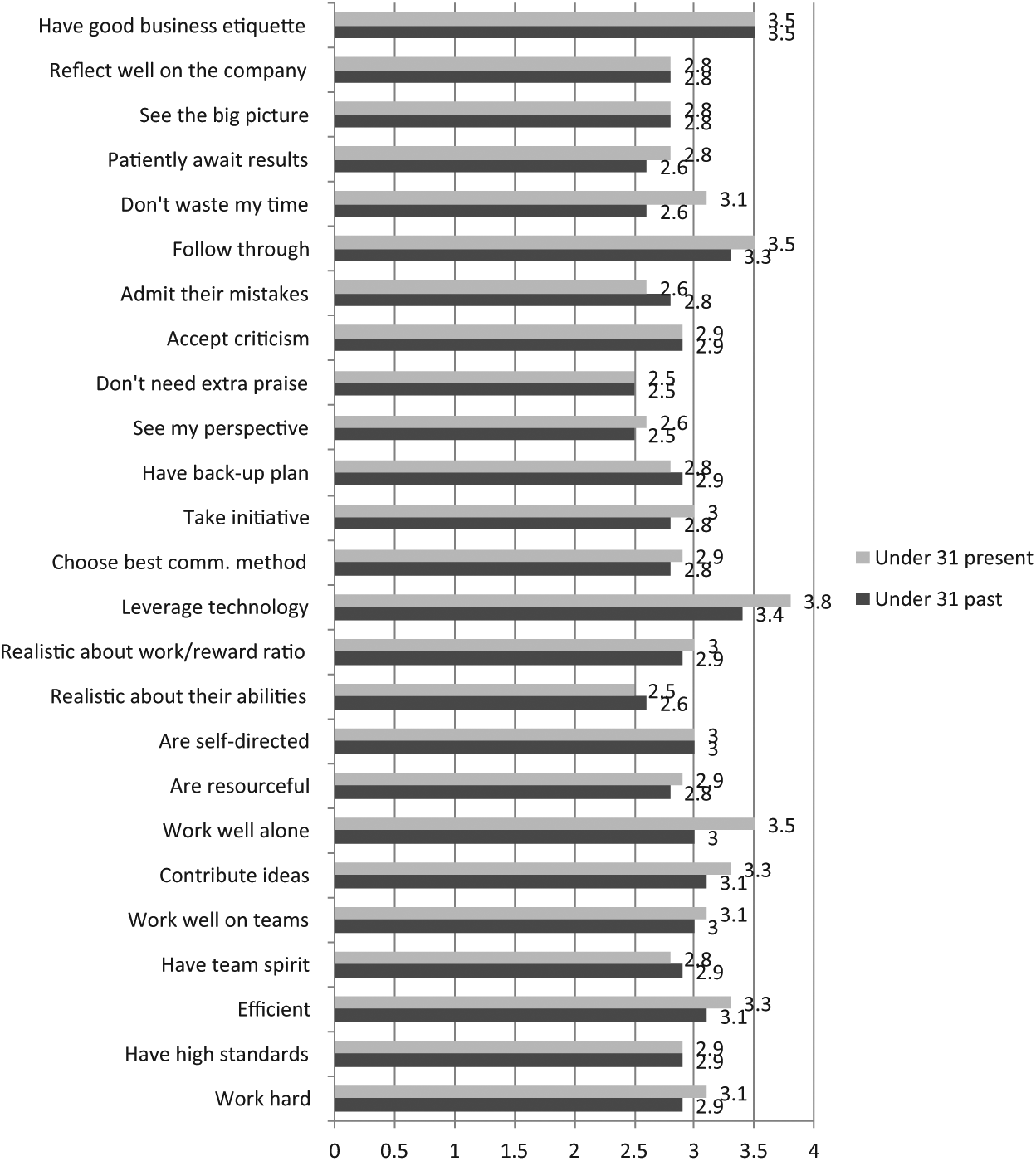
Boomer managers’ ratings of present and past young employees (n= 8).
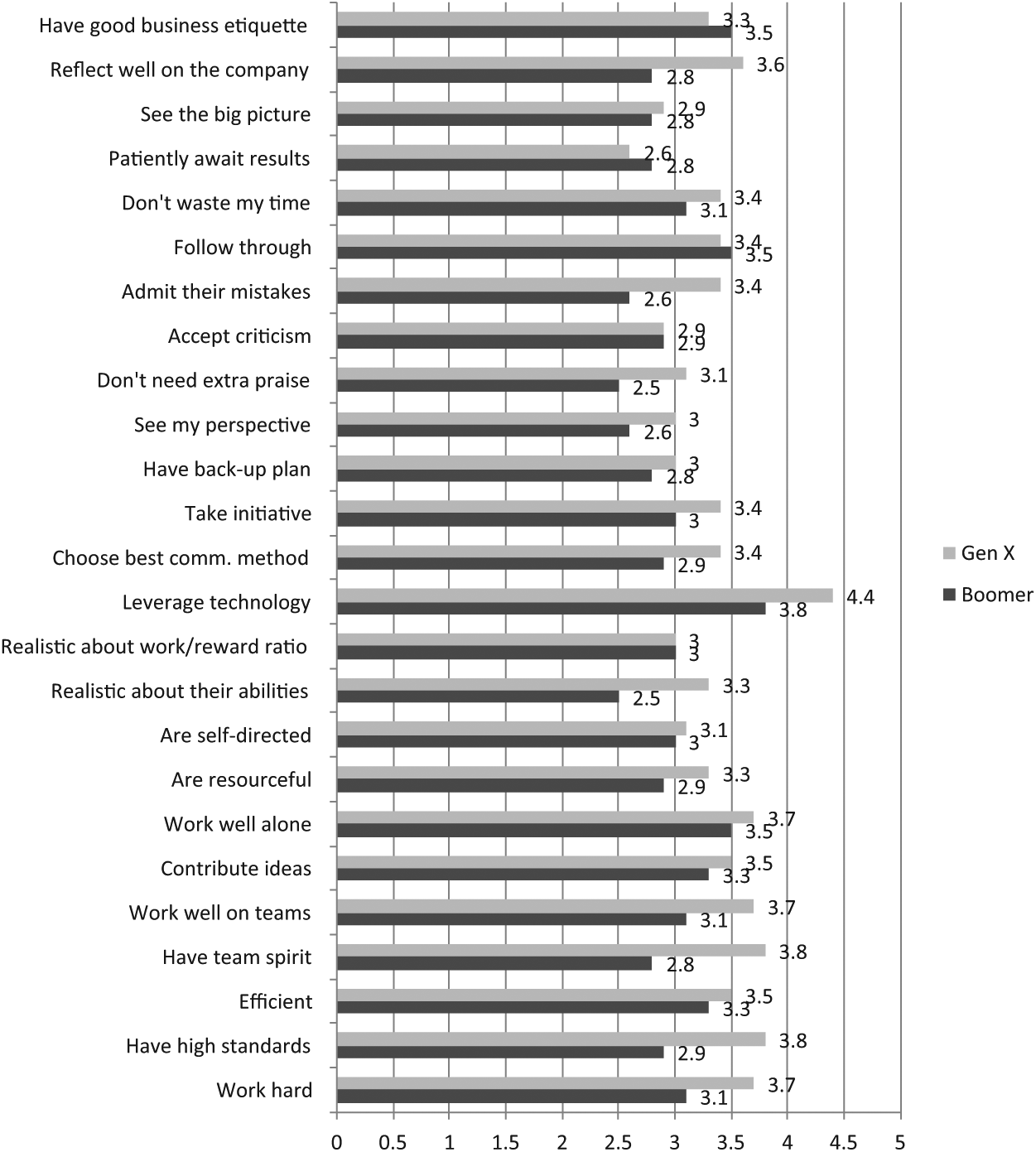
Gen X versus Boomer managers’ ratings of the company’s Gen Yers (for Gen X,n= 15; for Boomers,n= 8).
When compared toFigure 1,Figure 2shows that, in general, the Boomers were not as positive about the company’s Gen Y cohort as the managers were overall (and, by implication, that the Gen X managers were more positive than the Boomer managers). While the ratings of the managers as a whole tended to fall in the 3 to 4 range, the Boomer ratings tended to fall in the 2 to 3 range. The Boomers also gave the Gen Yers lower marks than young employees of the past onadmit their mistakes, have a back-up plan, arerealistic about their abilities, andhave team spirit. Given the culture and success of this company, the areas in which the Boomers were noticeably tougher than the managers overall would seem to be ones that would be particular sticking points for Boomer managers in other companies as well.
Figure 3shows the extent to which the Gen X managers gave Gen Y employees higher ratings than the Boomer managers did.The only three criteria on which Boomers were more favorable than Gen Xers werehave good business etiquette, patiently await results, andfollow through. The two manager groups tied on their ratings of Gen Yers’ ability toaccept criticismand berealistic about the work/reward ratio. On the remaining 20 criteria, Gen Xers gave higher ratings, and they gave a rather dramatic edge (a 0.5-point difference or higher) to the Gen Yers on 10 of these.
The Boomer managers had more managerial experience—and thus perhaps a more critical, realistic perspective—than the Gen X managers, so that could be part of the explanation. But it also seems evident that the values and standards of Boomers and Gen Xers really are different, as the literature claims. These two generations grew up in very different circumstances, with the Boomers being rewarded for a strong work ethic, competitiveness, and respect for the chain of command, and the Gen Xers learning to be skeptical, resourceful, independent, and comfortable with technology. Given these different backgrounds, it makes sense that the company’s Gen Xers would be more appreciative of what their younger colleagues bring to the table than the Boomers were. Interestingly, though, the Gen X managers—who, as a group, worked more closely with the Gen Yers than the Boomers did—found the younger cohort to be less polite, patient, and dependable (in terms of follow through) than the Boomer managers did.
Did more years of managerial experience make the Gen X managers more similar to their Boomer elders? To find out, I used the survey data indicating respondents’ years of managerial experience to separate out those Gen X managers with “9 years or more” of experience. AsFigure 4shows, the answer turned out, surprisingly, to be “no.”

More experienced Gen X versus Boomer managers’ ratings of the company’s Gen Yers (for older Gen Xers,n= 5; for Boomers,n= 8).
On every criterion, the more experienced Gen X managers gave a higher rating than the Boomers did, and sometimes drastically so; on 10 criteria, the difference is a full point or more. These results indicate that generational differences between Boomer and Gen Xers will persist or even increase, not lessen, as Gen X managers become more seasoned. The results also suggest that more experienced Gen X managers can be one of a company’s biggest assets in helping employees cross the generational divide. As a group, Gen Xers have been shown to harbor some resentment toward Gen Yers; having come of age in a poor job market, they have felt threatened by the entry of another generation of creative, tech-savvy youngsters into the workplace (Erickson, 2010). But this study suggests that older, managerial-level Gen Xers are beyond this attitude. They seem to have the right background, experience, job security, and expectations not only to connect with young employees but also to help their Boomer elders better understand the company’s youngest cohort.
The Gen Yers’ Communication Needs
After the “Survey Page for People Mangers” came several questions about the employees’ communication needs. The goal was to identify any communication gaps the employees were experiencing and any communication practices that might need changing. The results from this section were the main payoff for the company in terms of data that could be used to enhance its performance. This analysis will focus on the generational differences reflected by the data.
The Different Generations’ Desire to Receive Information
The survey recipients (now excluding the executives) were asked to indicate how much information they currently received on 18 topics and then how much they would like to receive. To do so, they used a scale from 1 to 5, with 1 meaning “very little or no information” and 5 meaning “a lot of information.” Here, only the 33 nonmanagerial employees’ responses will be analyzed so as to compare the needs of employees at roughly the same organizational level. Thirty-three employees out of a possible 71, for a 46% response rate, answered this question.
Figures 5and6show how the Gen Yers’ desire for nine types of information about their jobs differed from that of the older employees (Gen Xers and Boomers combined).

Gen Y employees’ responses on information received about their jobs (n= 14).

Older employees’ (Gen X and Boomers’) responses on information received about their jobs (n= 19).
The first result to notice is that the responses of the two groups were remarkably similar in terms of the information they currently received about their jobs. The company appears to have been successful in ensuring that the employees were equally informed on these topics.
In terms of information they wanted to receive, the two groups felt the most acute information gaps on the same four topics:promotion and advancement paths, what it takes to succeed here, criteria I’m being evaluated on, andhow well I’m doing my job. In the interviews, both the president and sales VP had mentioned the problem of too little space at the top into which to promote high-performing employees; mostly for this reason, the executives were in the process of discussing how to become a significantly bigger company. In the focus groups, participants also noted their desire for a more standardized, formal performance-evaluation system.
In light of these facts, it seems noteworthy that the Gen Yers reported a bigger information gap onpromotion and advancement pathsandwhat it takes to succeed here, as well as a stronger desire for this kind of information. Perhaps these younger employees valued this information more just because they were young, but it seems likely that the widely noted Gen Y craving for quick advancement and plentiful feedback played a role in these participants’ answers.Smith (2008)would probably see here as well the influence of video games, which cultivate a desire for clear objectives and boundaries and for a predictable path to higher levels.
Figures 7and8show how the Gen Yers’ desire for nine types of information about the company differed from that of the older employees.

Gen Y employees’ responses to information received about the company (n= 14).

Older employees’ (Gen X and Boomers’) responses to information received about the company (n= 19).
Looking first at the amount of information currently being received about the company, it is noticeable that the Gen Yers felt better informed than the older employees did. Since it is likely that the Gen Y group included more new hires than the older employee group, their recent onboarding experiences probably helped account for this result.
It is striking, though, that the older employees were considerably less satisfied than the Gen Yers onemployee news(a 1.7 gap for older employees vs. a 0.2 gap for the Gen Yers),what other departments’ work entails(a 1.6 gap vs. a 0.6 gap), andnew products/services for clients(a 1.4 gap vs. a 0.4 gap). This result aligns with the widely noted tendency on the part of Gen Yers to be less aware of and interested in the big picture than their managers want them to be. The one type of information on which the Gen Yers registered both a bigger information gap and a greater desire for information than the older employees did wassuccesses of the company. While it makes sense that the youngest employees would be more focused on their narrow realm of work and on the stability of the company than the older employees would be, one might see here a bit of the excessive “me” focus that is purported to be a trait of their generation.
The Different Generations’ Desire to Send Information
The survey recipients were then asked to indicate how much information they currently sent on nine topics and then how much they would like to send. To do so, they used a scale from 1 to 5, with 1 meaning “very little or no information” and 5 meaning “a lot of information.” As with the previous analysis on information received, only the nonmanagerial employees’ responses were used for this comparison. Thirty employees out of a possible 71, for a 42% response rate, answered this question.
Figures 9and10show how the Gen Yers’ desire to send different types of information about their jobs differed from that of the older employees. The Gen Yers registered a higher “would like to send” rating on six out of the nine topics, with a 0.4-point difference or greater oncommunication to those in my group, input on my workgroup, input on the company, andmy manager’s performance. The most notable difference (1.0) occurred oninput on the company, with Gen Yers wanting to send a 4.4 amount of information versus 3.4 from the older employees. The Gen Yers registered a notably bigger communication shortfall than the older employees oninput on the company(a gap of 2.0 vs. a 1.2 gap for the older employees) and onmy manager’s performance(a gap of 1.6 vs. 0.8 for the older employees).

Gen Y employees’ responses on information sent (n= 12).

Older employees’ (Gen X and Boomers’) responses on information sent (n= 18).
In general, the company’s Gen Yers believed more strongly than the older employees that their opinions, even regarding their superiors’ performance, were worth sharing. A culture that stresses “distributed leadership” could partly account for these findings. But it seems likely that the company’s Gen Yers were also exhibiting the widespread Gen Y trait of wanting, and expecting, to be heard, despite their youth and inexperience.
One can also detect here a somewhat bigger preoccupation with performance—their own and that of their managers and peers—than the older employees had (though, as discussed earlier, the Gen X employees also desired increased performance feedback). Gen Yers’ desire for reassuring feedback has been well established, and those who participated in the focus groups confirmed that this trait is in evidence among the company’s Gen Y employees.
In their focus group, the Gen Yers remarked that the “handholding” that Gen Yers overall, including themselves, had experienced while growing up had led them to want more guidance than previous generations wanted, but it had also made them somewhat afraid to ask for this guidance from elders who were not parents or teachers. Thus, the company’s “open door policy” method of getting guidance (i.e., that “managers expect that you’ll seek them out”) “[did] not work well enough” for the Gen Y employees. They would have liked more explicit invitations for their questions, views, and concerns. The participants in the Gen X employees’ focus group interpreted the Gen Yers’ hesitancy to step forward as not being willing “to seize opportunities or make opportunities” and as a lack of “passion.” But it is more likely that the Gen Yers—who were born after the “latchkey kids” generation and belonged to the “helicopter” (hovering) parents” generation—were shaped by their different upbringing. As the CEO commented in my interview with him, the Gen Yers “say they’re independent,” but “they desperately need leadership.”
The Different Generations’ Assessments of Their Skills
The final page of the survey asked respondents (managers and nonmanagers, not executives) to indicate their proficiency level on various work-related skills. This section first presents and compares the responses of the different generations and then compares the Gen Yers’ self-assessments to the managers’ assessments of this cohort.
The Three Generations’ Self-Assessments
The question asked respondents to use a 5-point scale to rate themselves on 19 work-related skills, with 1 meaning “not very proficient” and 5 meaning “very proficient.” Forty survey recipients, including both managerial and nonmanagerial employees, answered this question, for a response rate of 42%. For ease of reading, the 19 skills listed in this question have been divided into two groups, those pertaining to “hard” skills (having to do with performance) and “soft” skills (having to do with interpersonal interaction).
Figure 11shows how the company’s three generations rated themselves on the “hard” skills. The Gen Yers’ self-assessments were highest for only 2 skills:leveraging technologyanddoing top-quality work. They gave themselves the lowest ratings of the three groups (mostly by slim margins) onbeing efficient, having good follow-through, taking initiative, working on team projects, andworking alone.
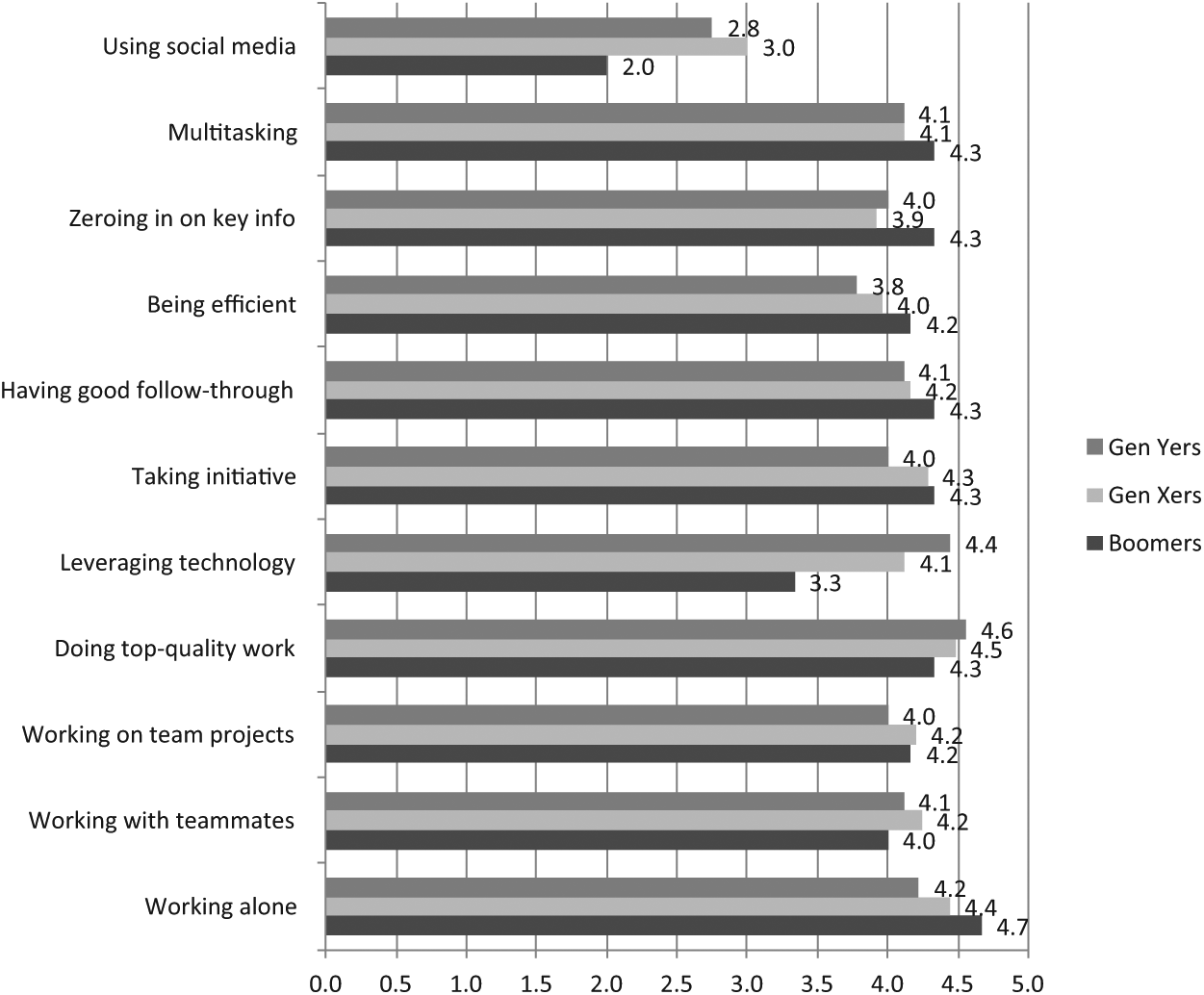
The three generations’ self-assessments of their “hard” skills (for Boomers,n= 6; for Gen Xers,n= 25; for Gen Yers,n= 9).
In light of what the literature says about Gen Yers’ inflated sense of their skills, this company’s Gen Yers were a relatively modest group. They seemed aware that they had a lot to learn. (On the other hand, their view that they did “top-quality work” was not validated by their managers’ assessments of them, asFigure 13will show.)
In contrast, the Boomer group (which included 4 managers) gave themselves the highest self-assessments on 7 of the 11 skills. Even taking into account their advanced experience and rank, the fact that their self-assessments were so strong as compared to those of the other two groups is somewhat surprising since they’d shown a tendency on the earlier survey pages to be conservative in their ratings. It is worth noting that 4 of these 7 skills in the list—multitasking, zeroing in on the key information, being efficient, andworking on team projects—are often associated with Gen Yers. These findings indicate the importance of noticing how the Boomers in a given company may depart from their generational stereotype.
The Gen Xers got the highest self-assessment marks on only two skills:using social media for professional purposesandworking with teams(they also tied with the Boomers onworking on team projects). 3 Interestingly, they had the lowest self-assessments of the three groups onzeroing on key information. On the other hand, they compared well with the leader on every skill, suggesting—as earlier parts of this study do—that they are the most well rounded of the cohorts and thus a potentially valuable resource for younger employees.
Figure 12shows how the three generations rated themselves on the softer skills. The Gen Yers’ self-assessments edged out those of the other two groups on only 2 skills:maintaining a work/life balanceandseeing others’ perspectives. They had the lowest self-assessments of the three groups onlistening, accepting criticism, andaccepting responsibility for mistakes. While these are, in fact, widely noted weak spots in Gen Yers’ business skills, what is interesting here is, again, that the Gen Y respondents admitted to these weaknesses. So while they reinforced the Gen Y stereotype, they also defied the norm with their seeming awareness of their limitations.
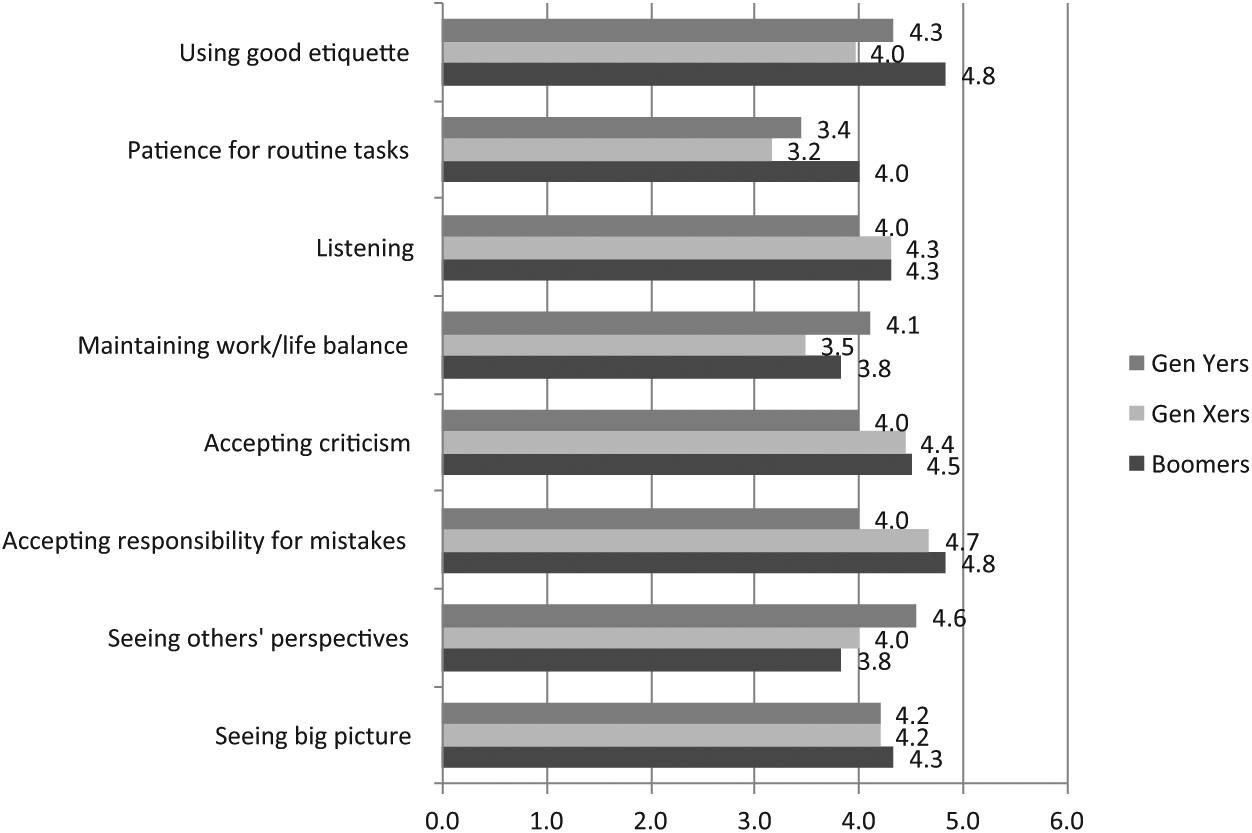
The three generations’ self-assessments of their “soft” skills (for Boomers,n= 6; for Gen Xers,n= 25; for Gen Yers,n= 9).
For the other two generations, the self-assessments were largely what one would expect given their age and generational profile: The Boomers regarded themselves as strong onetiquetteand beingpatient with routine tasks, and not as good atwork/life balance; the Gen Xers rated themselves lowest onusing good business etiquette, patience for routine tasks, andmaintaining a work/life balance; and both groups rated themselves high onlistening, accepting criticism, accepting responsibility for mistakes, andseeing the big picture. A somewhat curious finding is that 1 of the 2 skills on which the Boomers gave themselves their lowest rating wasseeing others’ perspectives. Perhaps their having come of age professionally in less nurturing environments accounts for this—or perhaps the Boomers are registering some difficulty with seeing things from the other generations’ points of view.
Gen Y Self-Assessments Versus Assessments of Their Managers
To gauge the extent to which the company’s Gen Y cohort exhibited Gen Yers’ widely noted tendency to overrate their own abilities, I compared how the company’s Gen Yers rated themselves on the self-assessment page to how their managers rated them on the “Survey Page for People Managers” as previously shown inFigure 1.Figure 13shows the result.
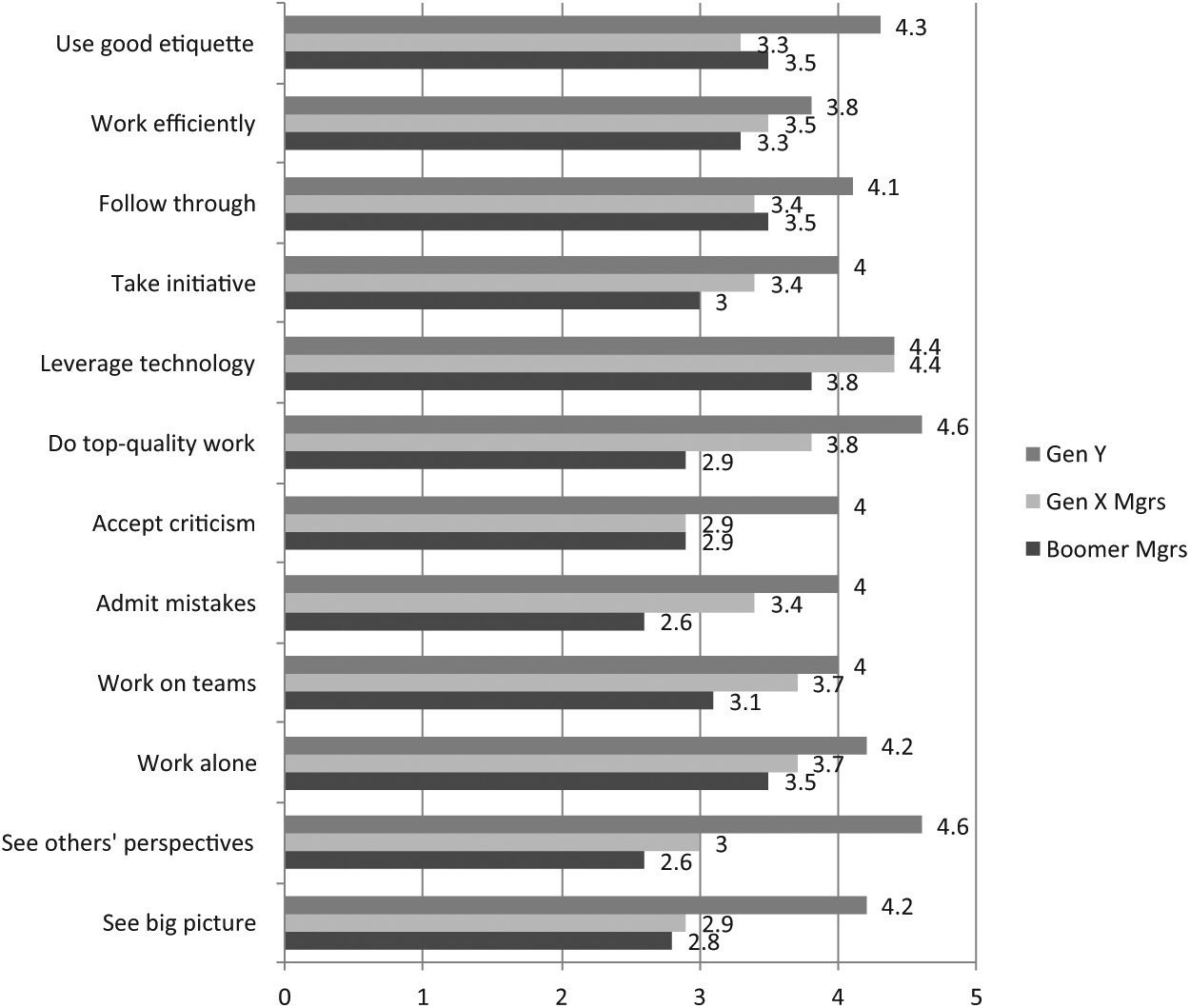
Gen Yers’ self-assessments versus assessments by their managers (for Gen Yers,n= 9; for Gen X managers,n= 15; for Boomer managers,n= 8).
We see that the Gen Yers’ self-assessments exceeded the assessments of their managers for all skills but one (leverage technology, for which the Gen Yers’ self-assessments and Gen X managers’ assessments matched).
Employees’ self-assessments are likely to be higher than assessments by their superiors in any setting, especially when it is known that the results will be shared with the executives; probably the self-assessments of all three generations in this company would be likely to be higher than their managers’ assessments. Still, we can use this chart to identify the areas in which it seems the Gen Yers are most in need of greater realism.
The Gen Yers’ self-ratings most notably exceeded the higher of the two ratings they got from their Gen X and Boomer managers (by 0.8 points or more) in the following areas:
Using good business etiquette
Doing top-quality work
Accepting criticism
Seeing others’ perspectives
Seeing the big picture
And the Gen Yers’ self-ratings exceeded their managers’ ratings by 0.6 points on three more:following through, taking initiative, andadmitting mistakes.
Thus, while the company’s Gen Yers, compared to Gen Yers at large, were more willing to be self-critical, they did not realize that many of the criteria against which they were measuring themselves were not viewed by their managers as being rigorous enough.
Summary and Discussion of Findings
In this relatively small well-run company with rigorous hiring standards and a cohesive, engaging culture, the Gen Yers defied the general stereotype in several ways, but they also still exhibited some stereotypical features (summarized inTable 3):
Judging from the evaluations of their managers, this company’s Gen Y employees did not exhibit the decline in many of the workplace skills and attitudes (e.g., weaker work ethic, lower quality standards, unrealistic sense of work/reward ratio, and reluctance to own their mistakes) that Gen Yers in general are reported to exhibit when compared to young employees of previous generations. In fact, the managers overall rated the company’s 20-somethings more positively than they rated young employees of the past on every given criterion.
Not surprisingly, these Gen Yers got their highest rating onleveraging technology, but they also scored higher than young employees of the past on the traditional business values ofhaving high standards, working hard, andfollowing through.
On the other hand, they barely edged out their predecessors onpatiently await results, see [their managers’] perspective, andhave a back-up plan.
They overrated their skills, particularly theirbusiness etiquette, quality of work, ability to accept criticism, ability to see others’ perspectives, andability to see the big picture. Their youth and inexperience surely affected their self-assessments. But the Gen Xers in the focus groups commented that the current generation of young employees needed more “Business 101” training than they had needed when they were in this age group.
True to the Gen Y stereotype, they had a noticeably smaller desire than the other employees for information about the big picture (company news, what other departments do, new products/services), a stronger interest in advancement, and a greater desire to have a say in the running of their workgroup and the company and in evaluations of their peers and managers. On the other hand, in their focus group, the company’s Gen Yers voiced respect for their superiors and eagerness to learn the appropriate ways to contribute their opinions.
How Stereotypical Were the Gen Yers in this Study?
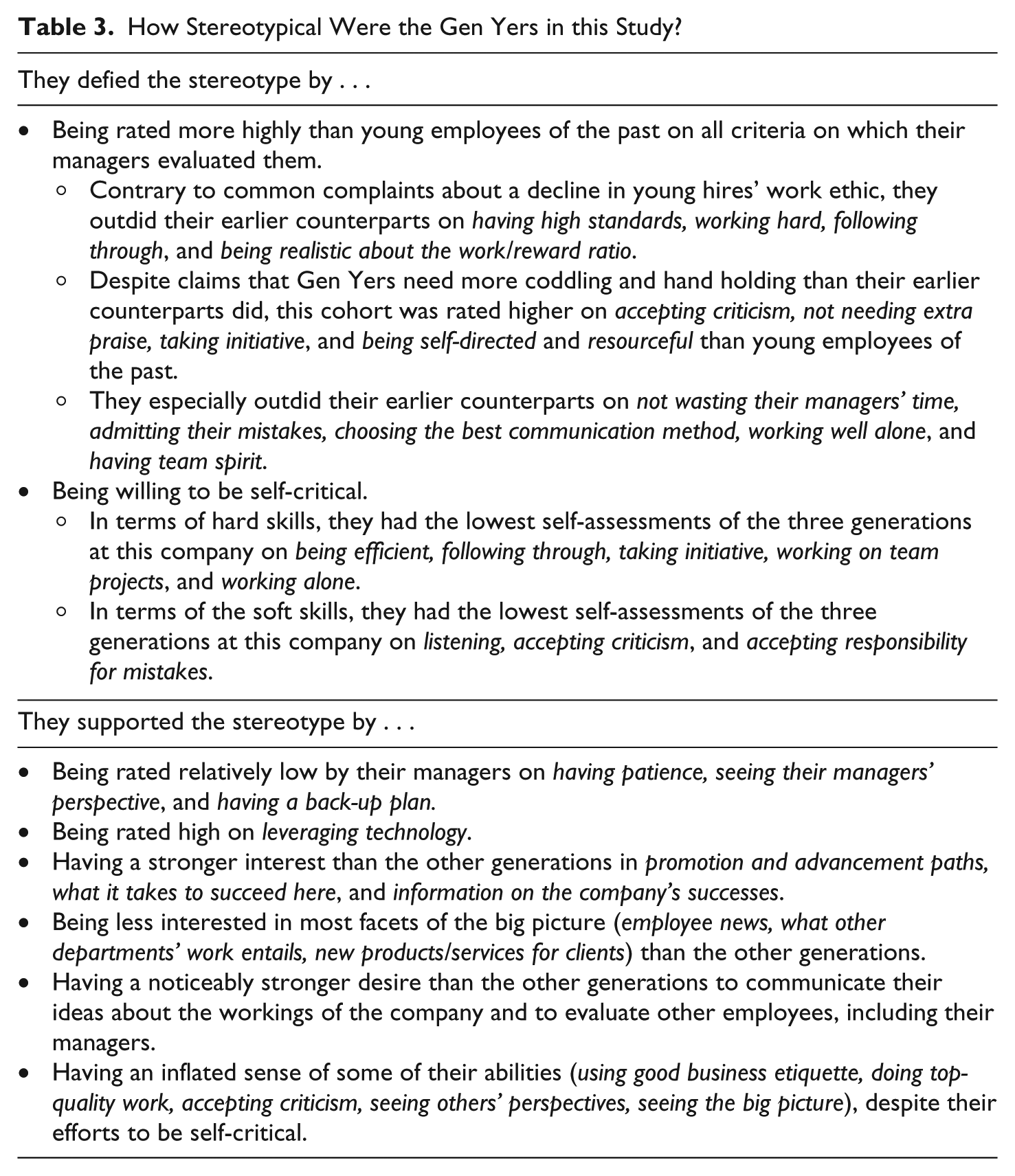
These findings indicate that a company’s mission, culture, size, and hiring practices can have a great deal to do with the kinds of traits its Gen Y employees will exhibit. But it also indicates that Gen Yers have been dubbed a distinct generation for good reason and that certain outlooks and tendencies developed over their lifetimes will manifest themselves, even in an “employee-centric” company that does its best to hire good fits for the team.
The survey also yielded some interesting findings about the other two generations:
Even in this company, where commonality and camaraderie are strongly stressed, the Boomer managers gave lower ratings to the company’s Gen Yers than the Gen X managers did. Here, too, the data suggested that even in a close-knit multigenerational company, the outlooks and standards that Boomers have developed over their lifetimes will lead to a certain amount of tension with, if not disappointment in, their Gen Y reports. On the other hand, the Boomers in this company rated themselves highly on some skills associated with younger employees (e.g., multitasking).
The more experienced Gen X managers were the biggest Gen Y champions. These findings make intuitive sense because the two groups have similar backgrounds in many ways. On the other hand, the company’s Gen Xers, true to the “latchkey generation” stereotype, were a bit impatient with Gen Yers’ reluctance to jump in and take care of business. As they revealed in the focus groups, they felt they had a “passion to solve problems” and a seriousness about their work that the Gen Yers did not yet share.
Judging from these findings, it is important for students to learn about the general traits of the generations that precede them, to understand where those traits came from, and to respect what the different generations can contribute. It is also important, though, that students be ready to throw over the generational stereotypes when they do not hold true in a particular setting.
Conclusion
This study indicates that the extent to which the different generations’ stereotypical traits will surface can depend a great deal on what the company does, how big it is, how successful it is, and how it is managed. The more a company can pull employees and managers together in a common, meaningful effort, the less pronounced Gen Y’s idiosyncrasies—and those of the other generations—are likely to be.
On the other hand, it also indicates that no matter how successful or well run a company is, it is likely that some generational tensions will occur; the differences are just too ingrained in the different cohorts to be offset by even the best efforts to make the company a cohesive team. This means that both students and employees need to be cognizant of generational differences and taught how to deal with those in a way that keeps misunderstandings to a minimum and cooperation high.
In our business and professional communication classes, such activities as the following can help us achieve this goal:
Teachers can also collect stories from prior students and from managers to help students see what will likely be expected of them in certain kinds of situations. Such concrete examples will not only be instructive and compelling; they will also help us move beyond the stereotypes to more accurate, targeted advice about cross-generational communication.
Footnotes
Author’s Note
This study was considered exempt from review by the Institutional Review Board of the University of Cincinnati. Participant comments from interviews and survey questions are reproduced by permission. A portion of the findings was presented at the annual meeting of the Association for Business Communication in Montreal, 2011.
Declaration of Conflicting Interests
The author declared no potential conflicts of interest with respect to the research, authorship, and/or publication of this article.
Funding
The author disclosed receipt of the following financial support for the research, authorship, and/or publication of this article: This research was funded in part by a grant from the Charles Phelps Taft Research Center at the University of Cincinnati.
Notes
Author Biography