



Abstract
The aim of this study was to investigate the influence of the four listening styles of business communication students on their demonstration of compassion for others and themselves. A sample of 387 business students completed a questionnaire that inquired about their perceptions of their preferred listening style, their compassion for others, and their self-compassion for those in a given organization. This study found that people listening positively affected both compassion and self-compassion. Another finding was that action listening negatively affected both compassion and self-compassion. Other findings are also discussed along with future directions.
Compassion is our deepest nature. It arises from our interconnection with all things.
Compassion is a concept that has gained popularity regarding its value in the business world. Organizations that have compassionate managers and employees are being identified for serving as exemplary role models of “ethical” leadership (Dutton, Workman, & Hardin, 2014). Discussions about organizational compassion are taking place at various compassionate business conferences and public forums hosted by top-ranking business institutions (Lilius, Kanov, Dutton, Worline, & Maitlis, 2012). Compassion is defined as “the collective noticing, feeling, and responding to another’s suffering in order to provide ease” (Dutton, Lilius, & Kanov, 2007, p. 108;Dutton, Worline, Frost, & Lilius, 2006). The ability to respond with compassion to the pain expressed by an employee or customer in the workplace can greatly benefit any organization. For instance, studies have shown that offering compassion improves work performance (Sutton, 2010), cultivates collegiate relationships (Dutton et al., 2007), strengthens individuals’ identities (Frost et al., 2006), and improves employees’ retention rates (Dutton et al., 2007). Despite the recognized value of compassion in the business world, very little is known about how communication skills such as listening skills affect compassion. Thus, the purpose of this study is to examine how business students’ people, content, action, and time listening styles affect compassion toward the self and others.
Listening continues to be one of the most critical interpersonal communication skills that business managers and business practitioners possess in this globalized society (Bates, 2002;Peterson, 2007;Walters, 2005). AFortune 500study found that business executives spend an average of 75% to 80% of their time engaging in communication activities such as receiving and sending messages, which is about 45 minutes for each working hour (Meskill, 1996;Peterson, 2007). Business managers and organization employees who possess quality communication skills such as listening are more likely to advance in their careers (Gray, 2010). Not only are communication skills linked to career success, but they are also linked to success in an organizational environment given that managers and employees who communicate competently are perceived to be high-quality employees (Camacho, 2015;Certo, 2000;Du-Babcock, 2006). Because listening enables managers to make employees feel “heard” and “valued,” listening can motivate employees at various organizational levels to perform at optimum levels within an organization (Gustafsson, 2005).
Despite these recognized advantages of possessing communication skills, many business managers and employees continue to have poor communication skills. Several business communication studies have reported that recent undergraduate students tend to lack the effective communication skills to survive in the 21st-century job market (Gaffney & Kercsmar, 2016;McMurray, Dutton, McQuaid, & Richard, 2016;Washington, 2014). In a listening study,Hemby (2015)found that business students (regardless of major) reported having only one listening preference, which suggests that business students may be facing listening obstacles during their conversations with others. These communication skills include interpersonal communication abilities such as the ability to listen actively to employees or colleagues in order to fulfill organizational duties in an efficient manner (Conrad & Newberry, 2011;McMurray et al., 2016). For instance, recently hired managers rank themselves as havingpoortofairlistening skills (Jahromi, Tabatabaee, Abdar, & Rajabi, 2016). This suggests that graduates in managerial positions are experiencing communication deficiencies (Gray, 2010). Yet, despite these deficiencies, there is also evidence that business managers and employees may have different listening style preferences (Peterson, 2007;Stone, Lightbody, & Whait, 2013), which can affect their practice of compassion within an organization. Thus, the following sections will illustrate how preferred listening styles may affect compassion for the self and for others.
People and Content Listening Styles and Compassion
Listening styles are defined as “attitudes, beliefs, and predispositions about the how, where, when, who, and what of the information reception and encoding process” (Watson, Barker, & Weaver, 1995, p. 2). People listening is one of the most empathic interpersonal listening styles, which can serve to predict compassion for others.People listeningrefers to a listener’s ability to accurately perceive another’s feelings and emotions (Barker & Watson, 2000). Because people listening focuses on responding to others’ troubles and concerns, people listeners are able to develop deep relationships in a variety of contexts, including the workplace (Bodie & Villaume, 2003). A study byWeaver and Kirtley (1995)found a relationship between the people listening style and the expression of sympathy and empathy, which can be useful in nurturing workplace relationships. Others have found that the people listening orientation style is associated with conversational sensitivity (Chesebro, 1999) and verbal benevolence (Villaume & Bodie, 2007). Furthermore,Bodie and Villaume (2003)found that individuals who prefer the people listening style are less likely to be apprehensive when discussing one-to-one issues.Worthington (2005)also found an inverse relationship between people listeners and verbal aggressiveness. Moreover, people listening has been associated with the use of effective nonverbal communication to avoid hurting another person’s feelings when discussing problems (Worthington, 2003).
Instead of focusing on people’s emotions,content-oriented listenersfocus on evaluating the facts of the messages received during conversations. Content listeners prefer to listen to the facts, evidence, and technical information that serve to support a speaker’s arguments (Keyton & Rhodes, 1994). Instead of making snap judgments, content listeners may withhold evaluation of the speaker’s messages to gather the facts to enable them to make informed decisions.Worthington (2005)also found an inverse relationship between the content listening style and verbal aggressiveness. Thus, content listeners are more likely to ask questions to gather facts before judging a speaker negatively (Barker & Watson, 2000). Content listeners are also more likely to engage in conversational sensitivity when interacting with others (Chesebro, 1999). Because content listeners tend to strive for objectivity and fairness, they may be more likely to engage in compassion toward others (Worthington, 2003). Since sex and educational levels are known to affect listening styles and compassion (Johnston, Weaver, Watson, & Barker, 2000;Weaver, Watson, & Barker, 1996), sex and education level will be controlled, and based on the previous social listening styles literature, the following hypotheses are posed.
Action and Time Listening Styles and Compassion
Unlike people and content listeners,action listenerstend to avoid paying active attention to people during a conversation. According toKeyton and Rhodes (1994), action listeners focus more on a speaker’s inconsistencies and errors because they prefer to listen to logical and direct communicators. A study byBarker and Watson (2000)found that action listeners are more likely to judge speakers because they are quick to jump to conclusions and form early opinions about speakers. Another study found that action listeners are more likely to be impatient and neurotic in conversations (Weaver, 1998). Thereby, action listeners are less likely to behave compassionately toward others during conversations given their inability to focus on people’s emotions and preference toward logical aspects of conversations.
Similarly, individuals with a time orientation listening style tend to focus more on the passage of time than paying attention to others’ concerns during conversations.Time listenersmay focus more on their watch and on time management issues rather than listening to others’ emotions (Worthington, 2001). Because time listeners are time conscious, their communication may include interruptions, especially when individuals appear to be wasting their “valuable” time (Barker & Watson, 2000). This is why much of the conversations with time listeners appear rushed and distant (Sargent, Fitch-Hauser, & Weaver, 1997). Time listeners are also more apprehensive in their dyadic interactions, which trigger uncomfortable and awkward conversations (Bodie & Villaume, 2003). Given this previous listening style research, the following hypotheses will be examined in the present study.
Self-Compassion and Caring for Others
Previous research findings have found strong links between the concern for others and self-compassion.Neff’s (2003a)comprehensive definition of self-compassion includes the ability of “being touched by and open to one’s own suffering, not avoiding or disconnecting from it, [and] generating the desire to alleviate one’s suffering and to heal oneself with kindness” (p. 87). More specifically,Neff (2003b)defines self-compassion by integrating the following three elements: self-kindness, sense of common humanity, and mindfulness.Self-kindnessrefers to the self-caring process that is triggered when encountering difficult moments. For instance, if a person lost his or her job, instead of engaging in self-criticism, a person may engage in the self-caring process by treating him or herself to a comforting movie or a day spa massage to cope with this difficult emotional experience.Sense of common humanityfocuses on an individual’s ability to look beyond his or her inner self to others’ suffering, and to see suffering outside of the self. For example, if one person is unhappy due to a breakup, this person can recognize that other people experience similar breakups, and that it is normal to feel this way as part of a shared human experience.Mindfulness, on the other hand, focuses on being present and aware of one’s experience from a wider perspective. For instance, a person engages in mindfulness when finding out that he or she has a terminal illness by learning to accept the condition, but without overidentifying to the illness in a way that affects his or her emotional well-being. Thus, self-compassion is not a selfish activity, but rather the ability to look beyond the self and recognize that one suffers along with everyone else (Neff, 2003b).
People and Content Listening Styles and Self-Compassion
Studies have also shown that there are strong links between self-compassion and social characteristics. For example, research has found that individuals with self-compassion are likely to be more socially connected, extraverted, agreeable, and conscientious (Neff, Rude, & Kirkpatrick, 2007). A study byGerber, Tolmacz, and Doron (2015)found a positive relationship between self-compassion and the healthy concern for others’ well-being. Another study found that being self-compassionate is positively correlated with compassion for others (Neff & Pommier, 2013). Furthermore, self-compassion is the ability to support the self and others during any hardship that may occur in relational situations (Yarnell & Neff, 2013). More specifically,Crocker and Canevello (2008)found that those reporting high self-compassion had more compassionate goals in their intimate relationships in comparison with those who reported having low self-compassion. Because both people and content listening styles are shown to be supportive and nonconfrontational listening styles in dyadic conversations (Barker & Watson, 2000;Bodie & Villaume, 2003;Keyton & Rhodes, 1994), these listening styles can positively relate to self-compassion. People listening focuses on listening to others’ emotional needs and desires, and thus, individuals who possess this listening style may react with self-compassion (Barker & Watson, 2000;Yarnell & Neff, 2013). Furthermore, content listening focuses on examining the facts and avoiding criticizing the speaker; thus, content listening may positively relate to self-compassion (Chesebro, 1999;Yarnell & Neff, 2013). Despite all of these correlational findings linking self-compassion to other-oriented variables, no previous study has explored the links between listening styles and self-compassion. Also, due to the findings of previous studies that have indicated that sex and educational level might affect self-compassion, these variables will be controlled, to explore the direct association between people and content listening styles and self-compassion. Thus, the following hypotheses will be examined.
Time and Action Listening Styles and Self-Compassion
Studies have found that self-compassion is negatively related to antisocial variables. For instance, a study byNeff et al. (2007)found that self-compassion is negatively related to neuroticism. Another study found that self-compassion is negatively associated with pathological concern for others and positively associated with a healthy concern for others (Gerber et al., 2015). Other studies have found that self-compassion is more likely to correlate positively with perspective taking and mindfulness toward others (Davidson, 2012;Neff & Pommier, 2013). Thus, given that action listeners tend to be more neurotic and jump to erroneous conclusions when listening to others’ problems (Barker & Watson, 2000;Keyton & Rhodes, 1994), they may be less likely to be self-compassionate as well. Furthermore, time listeners are also more focused on the time that is “wasted” in conversations rather than being present in the moment during their listening experiences (Worthington, 2001). Thus, time listeners may be less self-compassionate during conversations with others. Given these previous correlational findings, this study will explore the following hypotheses.
Method
Participants
The sample included 194 female and 193 male (N= 387) business students at a large Midwestern university. The average age of the participants was 29 years (SD= 13.33; range = 19 to 60). The ethnicity of the participants included 253 (65.4%) White/Caucasian, 26 (6.7%) African American, 56 (14.5%) Hispanic, 34 (8.8%) Asian, 2 (0.5%) Native American, and 16 (4.1%) of some other ethnic background. There were 183 (47.3%) undergraduate and 204 (52.7%) graduate business students. The levels of education of the participants were as follows: 24 (6.2%) high school graduate/GED, 71 (18.3%) some college, 80 (20.7%) 2-year college degree, 180 (46.5%) 4-year college degree, 25 (6.5%) master’s degree, 2 (0.5%) doctoral degree, and 5 (1.3%) professional degree (JD, MD).
Procedure
After institutional review board approval was obtained, participants were recruited in undergraduate and graduate business courses and were invited to participate in an online listening survey in exchange for a small amount of extra credit. Participants who provided their consent to participate in this study were referred to a web link via Qualtrics to complete a questionnaire. Participants were also asked to respond to questions about their demographics, listening styles, compassion, and self-compassion tendencies.
Measures
Listening Styles
The Listening Styles Profile (LSP-16;Rubin & Roberts, 1987;Watson, Barker, & Weaver, 1995) was used to measure listening styles. This measure uses four subscales to represent the four listening styles, which include (a) people, (b) action, (c) time, and (d) content. The questionnaire included several items for people (e.g., “I focus my attention on the other person’s feelings when listening to them”), action (e.g., “I am impatient with people who ramble during conversations”), content (e.g., “I prefer to listen to technical information”), and time (e.g., “When hurried, I let the other person[s] know that I have a limited amount of time to listen”). Participants indicated whether each statement applied to them on a scale from 0 (never) to 4 (frequently). The alpha reliabilities of each of the subscales in this study were as follows: people (α = .67), action (α = .67), content (α = .75), and time (α = .61). These alpha reliabilities are consistently low to moderate across a variety of listening style studies (Bodie & Worthington, 2010;Bodie, Worthington, & Gearhart, 2013). However, the LSP-16 is still used in several listening style studies because the measure has gone through a rigorous validation process of its factorial structure supporting the four listening styles and the scholars who report using this measure continue to report moderate alpha reliabilities in their studies (Dailey, 2014;Gearhart, Denham, & Bodie, 2014;Hemby, 2015;Worthington, 2008).
Compassion
The Compassion Scale validated byPommier (2011)was used to measure compassion for others. This 24-point scale ranged from 1 (strongly disagree) to 5 (strongly agree), and higher scores indicated a higher level of compassion for others. Sample items of this measure included, “When people cry in front of me, I often don’t feel anything at all,” “I pay careful attention when other people talk to me,” “I feel detached from others when they tell me their tales of woe,” and “When others feel sadness, I try to comfort them.” The alpha reliability of this scale was .93.
Self-Compassion
The Self-Compassion Scale–Short Form (Raes, Pommier, Neff, & Van Gucht, 2011) was used to measure perceived self-compassion. Participants indicated the extent of their agreement on 12 statements from 1 (strongly disagree) to 7 (strongly agree). Sample items included, “When something upsets me I try to keep my emotions in balance,” “When I feel inadequate in some way, I try to remind myself that feelings of inadequacy are shared by most people,” and “When something painful happens I try to take a balanced view of the situation.” The alpha reliability of this scale was .78.
Preliminary Analysis
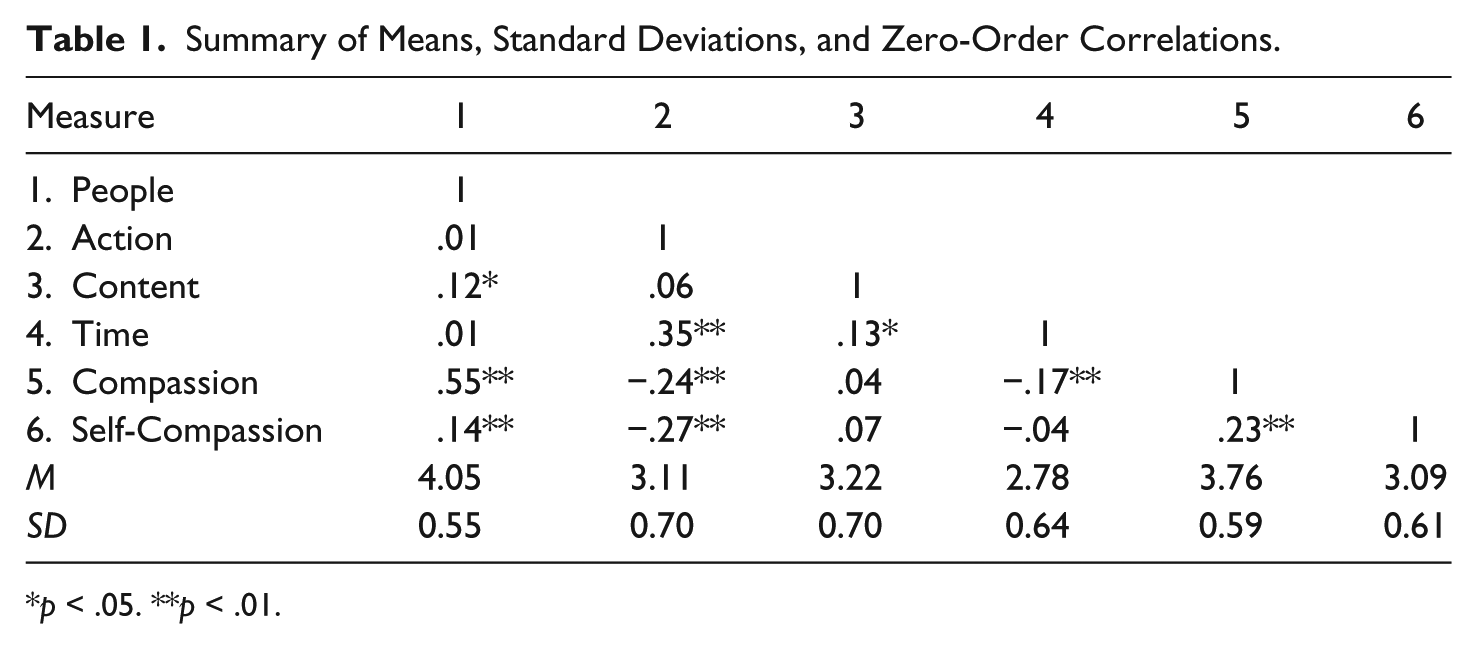
Correlations were examined for the variables in this study to determine the strength of the relationships (seeTable 1). In addition, the tolerance statistics and variance inflation factor were examined in the regression analyses to uncover any possible multicollinearity issues among the independent variables. The lowest tolerance statistic was .10 and the highest variance inflation factor was .87, which showed that multicollinearity was not a main concern in this study givenMertler and Vannatta’s (2002)recommendations.
Summary of Means, Standard Deviations, and Zero-Order Correlations.
p< .05. **p< .01.
Main Analysis and Results
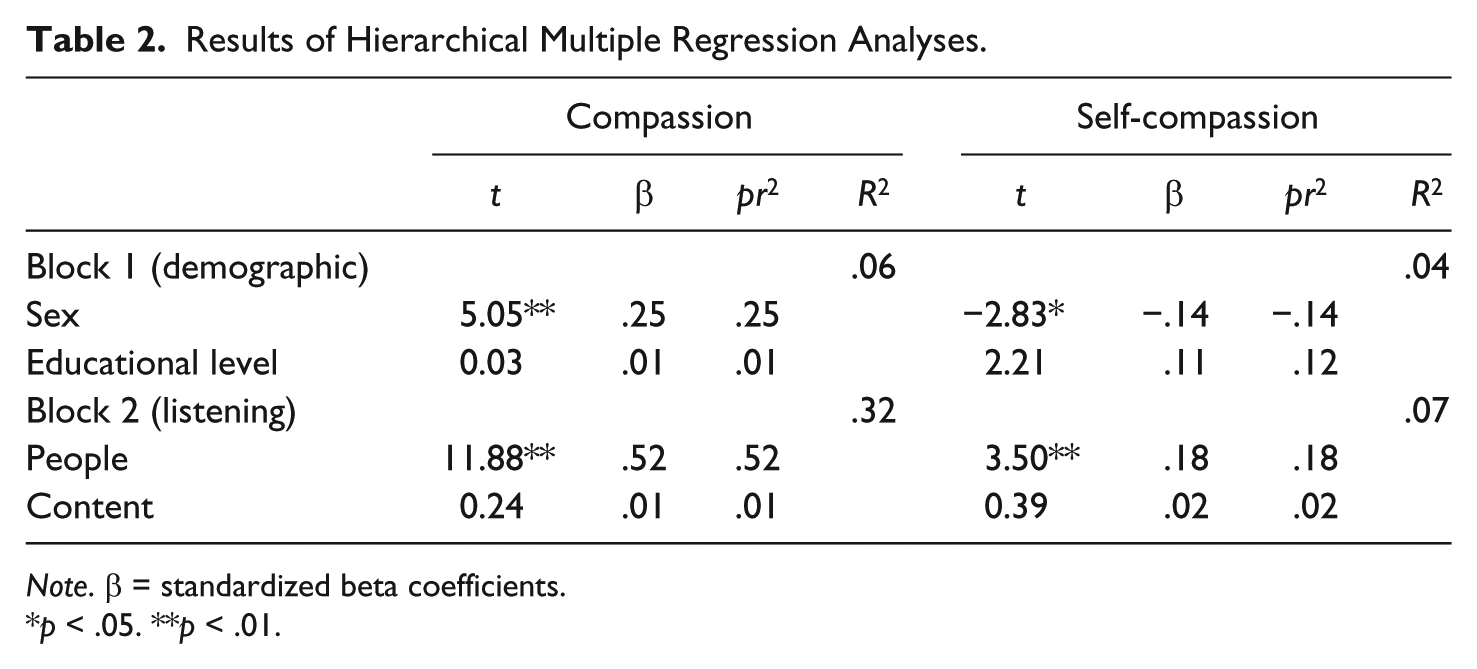
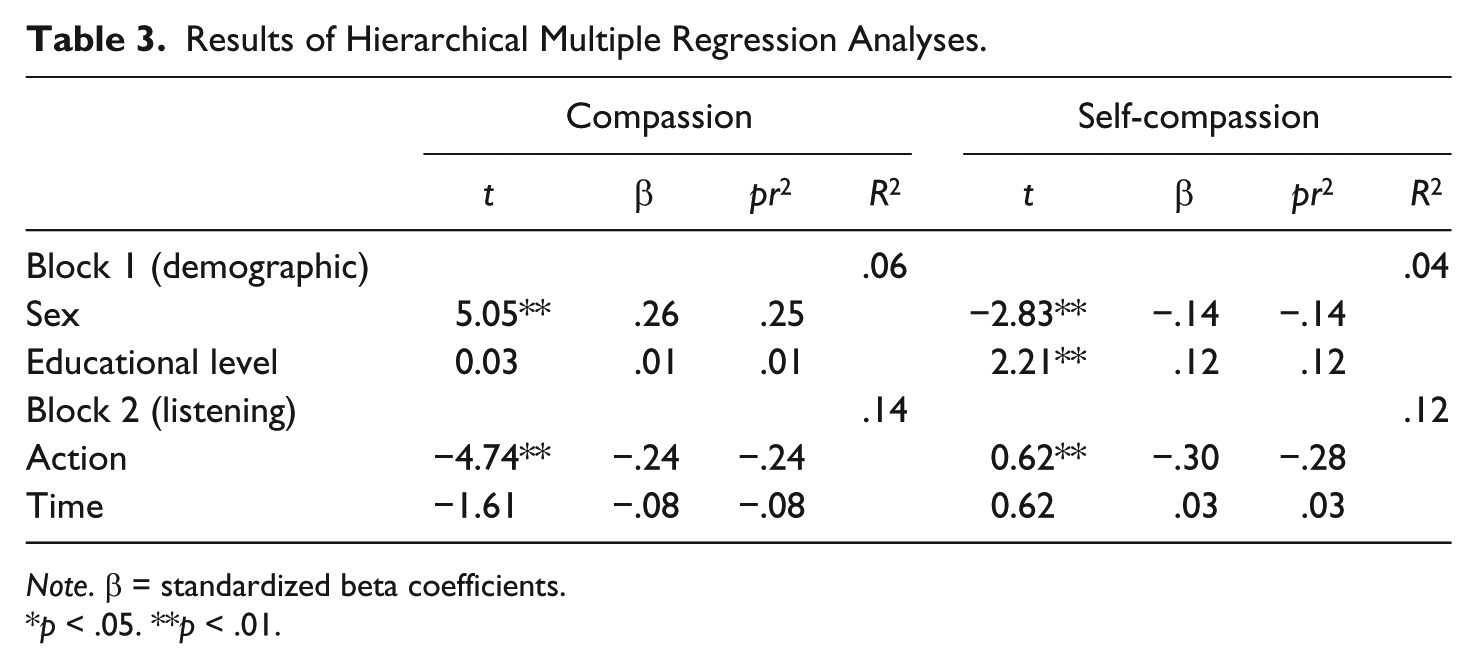
A series of hierarchical multiple regressions were used to analyze the hypotheses. For summaries of the multiple regression findings, seeTables 2and3.
Results of Hierarchical Multiple Regression Analyses.
Note. β = standardized beta coefficients.
p< .05. **p< .01.
Results of Hierarchical Multiple Regression Analyses.
Note. β = standardized beta coefficients.
p< .05. **p< .01.
It was predicted that after controlling for sex and education level, people listening (Hypothesis 1) and content listening (Hypothesis 2) would positively affect compassion. The multiple regression analysis revealed a significant model,R 2= .32,F(4, 377) = 44.75,p< .001, after putting the controlling variables in the first block and people listening and content listening in the second block. In the first block (R 2= .06), sex (β = .25,t= 5.05,p< .001,pr 2= .25) was found to be a predictor of compassion, but the level of education was not found to be a predictor (β = .01,t= 0.03,p> .05,ns). In the second block, after accounting for the demographic variables (R 2= .32), people listening (β = .52,t= 11.88,p< .001,pr 2= .52) positively affected compassion; therefore, Hypothesis 1 was supported. However, content listening (β = .01,t= 0.24,p> .05,ns) was not found to be a predictor of compassion. Thus, Hypothesis 2 was not supported.
Hypotheses 3 and 4 also predicted that after controlling for sex and education level, action listening and time listening will negatively affect compassion. The results of a multiple regression analysis revealed a significant model,R 2= .14,F(4, 377) = 15.45,p< .001, after controlling for the demographic variables. In the first block (R 2= .06), sex (β = .26,t= 5.05,p< .001,pr 2= .25) was shown to be a predictor of compassion. Yet level of education (β = .01,t= 0.03,p> .05,ns) was not shown to be a predictor. In the second block (R 2= .14), action listening (β = −.24,t= −4.74,p< .001,pr 2= −.24) negatively affected compassion, therefore supporting Hypothesis 3. However, time listening (β = −.08,t= −1.61,p> .05,ns) was not a predictor of compassion after accounting for sex and level of education. Thus, Hypothesis 4 was not supported.
The fifth and sixth hypotheses posed that after controlling for sex and educational level, people listening and content listening will be positively related to self-compassion. The results of a multiple regression analysis revealed a significant model,R 2= .07,F(4, 377) = 6.90,p< .001. In the first block (R 2= .04), sex (β = −.14,t= −2.83,p< .01,pr 2= −.14) was shown to be a negative predictor of self-compassion, and level of education (β = .11,t= 2.21,p< .05,pr 2= .12) was shown to be a positive predictor of self-compassion. In the second block (R 2= .07), people listening (β = .18,t= 3.50,p< .001,pr 2= .18) was found to be a positive predictor of self-compassion, which supported Hypothesis 5. However, content listening (β = .02,t= 0.39,p> .05,ns) was not a predictor of self-compassion. Thus, Hypothesis 6 was not supported.
The final hypotheses posed that after controlling for sex and education level, action listening (Hypothesis 7) and time listening (Hypothesis 8) would be negatively associated with self-compassion. The results of a multiple regression analysis revealed a significant model,R 2= .12,F(4, 377) = 12.417,p< .001. In the first block (R 2= .04), sex (β = −.14,t= −2.83,p< .001,pr 2= −.14) was shown to be a negative predictor of self-compassion, and education level (β = .12,t= 2.21,p< .001,pr 2= .12) was shown to be a positive predictor of self-compassion. The second block (R 2= .12) showed that action listening (β = −.30,t= 0.62,p< .001,pr 2= −.28) was a negative predictor of self-compassion, which supported Hypothesis 7. However, time listening (β = .03,t= 0.62,p> .05,ns) was not a predictor of self-compassion. Therefore, Hypothesis 8 was not supported.
Discussion
The Listening Styles as Predictors of Compassion for Others
The main purpose of this study was to examine the listening style associations and the predictors of the compassion variables. This study found a positive correlation between the people listening style and individuals’ compassion for others, but more important, it found that the people listening style served as a strong predictor for compassion for others. This finding supports prior studies’ findings that indicate that people listeners adopt a relational perspective in their communication patterns by focusing on others’ feelings (Bodie & Villaume, 2003;Watson et al., 1995;Worthington, 2008). This study also demonstrates that people listening can be used as a predictor of compassion for others because people listeners are more likely to engage in compassion during their conversations with others.
On the other hand, content listening was not significantly correlated to compassion. One reason this finding lacked support might have been that content listeners are more interested in understanding the complexity of the information provided by the other person (Barker & Watson, 2000). Content listeners may focus their cognitive attention more on the speaker’s perspective and approaching this perspective with objectivity, instead of being present with the other in the listening process (Barker & Watson, 2000;Keyton & Rhodes, 1994). Despite content listeners’ ability to withhold negative evaluation, this did not affect their ability to show compassion toward others.
Another valuable finding was that the action listening style negatively influenced individuals’ compassion for others. Action listeners tend to focus on others’ mistakes during conversations rather than listening to others’ emotions (Watson et al., 1995). This study showed that action listeners do not report engaging in compassion for others because it requires individuals to empathize and be mindful toward others during the listening process. Studies have found that action listeners are more likely to be neurotic and less empathic (Weaver, 1998;Weaver et al., 1996). Thus, this study confirmed that individuals who prefer the action listening style reported having less compassion for others during the listening process.
Although the time listening style was negatively associated with compassion, the correlation was very weak. Time-oriented listeners might focus more on interrupting others during their interactions and they may not pay attention to others’ emotional states; thus, compassion might be irrelevant to them during their interactions with other people (Barker & Watson, 2000;Sargent et al., 1997). This finding also suggests that time-oriented listeners may be slightly less likely to engage in compassion in conversations with others who may be experiencing distress. A previous study found that time-oriented listeners are under certain time constraints in their conversations, and these constraints lead to less connection in conversations with others (Watson & Barker, 1995). This might explain why this construct is not strongly correlated with compassion. Thus, time-oriented listening is only weakly correlated with compassion.
The Listening Style Associations With Self-Compassion
Another finding of this study was that the people listening style was positively associated with self-compassion. Because people listeners may be more likely to express genuine concern for others, they may be more likely to engage in self-compassion. AsNeff (2003b)suggests, self-compassion cannot occur without stepping outside of one’s own suffering, and thus, acknowledging another person’s suffering through the people listening process may trigger individuals’ self-compassion processes. This study also shows that people listeners may report being self-compassionate individuals during the listening process. Previous studies have also suggested that people listeners have personality attributes that are more empathic, sympathetic, and emotionally sensitive, so this finding concurs with several of these findings (Chesebro, 1999;Pearce, Johnson, & Barker, 1995;Weaver & Kirtley, 1995;Worthington, 2003).
However, content listening was not associated with self-compassion. One reason for the lack of association may have been that content listeners’ cognitions were focused on the information and how to best obtain sufficient detail and evidence to ground their own arguments (Barker & Watson, 2000;Worthington, 2003). Content listeners might not be able to engage in self-compassion during the listening process due to their focus on the intellectual process of evaluating others’ ideas (Worthington, 2003).
This study also found that the action listening style was negatively associated with self-compassion. Because action listeners focus on others’ inconsistencies (Watson & Barker, 1995), they are less likely to engage in self-compassion during the listening process. Action listeners also focus on looking for others’ errors and may be less likely to engage in self-compassion (Sargent et al., 1997). Self-compassion entails social connectedness for the self and the other during the listening process, and thus, action listeners may not be effectively equipped to engage in self-compassion in conversations. Also, the action listening style has been associated with neuroticism (Weaver, 1998), which helps explain why action listeners may be less likely to engage in self-compassion.
The time listening style was not correlated with self-compassion. One reason for this finding might be that time listeners may be focusing so much on their time management concerns in conversations that they do not have the time to engage in self-compassion (Sargent et al., 1997). Because time-oriented listeners may be less patient with others (Barker & Watson, 2000), they might also be less patient with themselves; hence, time-oriented listeners may be less likely to engage in self-compassion. Thus, time listening does not appear to be associated with self-compassion.
Strengths
The present study revealed several strengths that will be noted. First, this is the first study that has found support of the linkages between the listening styles and the variables of compassion and self-compassion. No previous listening style study has examined the possible correlations between these compassion constructs. Thus, this study can serve to stimulate future listening style studies that can link these compassion constructs in the workplace, or in other educational contexts. Business communication scholars, for example, can continue to expand this initial work by developing additional correlational support for the linkages between the listening styles of business students and their perceived self-compassion and compassion for others in moments of distress in professional conversations. Second, this study used an adequate sample size of business students, which represents the current perceptions of future workplace managers and leaders. Thus, this study’s findings may be generalizable to other business students outside of the realms of this study.
Limitations and Future Directions
Despite these strengths, this study also had some limitations that will be discussed with ideas for future directions. First, this study used self-reported instruments that rely on the perceptions of the participants. Future studies should explore other-reported instruments to ensure that participants’ perceptions are cross-examined by peers, or should develop new listening behavioral observation scales by using content analyses and factor analytical techniques to enable the objective observation of others’ listening styles. Second, the alpha reliabilities for the LSP-16 were low in this study, which suggests that this measure may sometimes yield low alpha reliabilities. Future studies should consider adopting Pearce et al.’s (1995) Listening Styles Inventory instrument, which has demonstrated having moderate reliabilities of .70 to .75. To date, there is still a need to develop a listening style instrument that demonstrates consistent high alpha reliabilities (Bodie et al., 2013). Third, even though this study was grounded on the findings of previous listening style and compassion studies, it did not have strong theoretical support. Future studies should focus on developing compassion theories, or compassion models to strengthen the future scholarship of compassion. Fourth, this study only controlled for the sex and educational level of the participants. Future studies should incorporate additional control variables such as the years of work experience to determine whether some participants differ in their work experience, and how this control variable might influence the listening styles and the compassion variables. Fifth, this study focused on a convenience sample of college students. But, now that we have initial support of the linkages of the listening styles and the compassion variables, future studies can examine other samples such as middle-aged adult managers.
Implications and Conclusion
There are several practical implications that can be derived from this study. First, because this study focused on undergraduate and graduate business students, education was controlled in all of the hypotheses, and it was not shown to have affected business students’ listening styles and their perceptions of compassion and self-compassion. Thus, future studies may not need to control for this education variable. Second, sex was also controlled in this study, and it was found to be a strong predictor of both compassion and self-compassion in this business student sample. Interestingly, after reviewing the post hoc results of the sex control variable, this study found that women reported being significantly more compassionate toward others in comparison with males; however, males reported being slightly more self-compassionate than females. Thus, future studies may further examine the potential sex differences of business students’ perceptions of compassion during the listening process. Practitioners may also need to recognize that sex can affect listeners’ compassionate behaviors. Third, this study demonstrated that many business students do report engaging in both compassion and self-compassion during the listening process. Thus, scholars and practitioners may continue to examine the role that compassion and self-compassion may have in business students, especially the graduate students who are already in management positions. Fourth, more attention on the people listening style is needed to determine how it positively affects compassion and self-compassion in different business contexts. For example, practitioners and researchers may ask whether the people listening style can be taught through workshops or encouraged in the workplace to help employees become more compassionate toward themselves and others.
To conclude, this study lays out an initial foundation to understand how listening style preferences may affect business students’ and recently hired managers’ compassionate tendencies in the business world. The purpose of this study was to examine the correlations and influence of the listening styles on compassion and self-compassion. The study found that people listening positively influenced compassion and self-compassion, but content listening did not. This suggests that developing people listening skills, or a strong concern for others’ emotions during conversations, may be a valuable business communication skill that will enable recent business graduates and newly hired managers to better display compassion in the workplace to build positive business relationships. Action listening also negatively influenced compassion for others and self-compassion, but time listening did not. This suggests that newly graduated managers and employees may need to be mindful when adopting the action-oriented listening style (e.g., being impatient or critical) in business conversations, because it may become a potential barrier to engaging in the compassion process at work. Overall, this study provides initial evidence that (a) people and action listening styles are correlated to the compassion variables and (b) people and action listening styles serve as predictors of the compassion variables.
Difficult as it is really to listen to someone in affliction, it is just as difficult for him to know that compassion is listening to him.
Footnotes
Author’s Note
This study was approved by the Institutional Review Board of West Texas A&M University.
Declaration of Conflicting Interests
The author(s) declared no potential conflicts of interest with respect to the research, authorship, and/or publication of this article.
Funding
The author(s) received no financial support for the research, authorship, and/or publication of this article.
Author Biography