




Abstract
Applying an intersectionality framework to nuance the concepts of cumulative dis/advantage, this article examines the barriers to and/or pathways by which highly skilled North African and Tamil-Indian immigrant women access professional labor markets in France and the United States, respectively. We find that the cumulative, interactive effects of four mediating mechanisms—interaction of local labor markets and immigration regimes, the education-work experience nexus, social capital in social networks, and racialization—result in divergent labor market outcomes for North African and Tamil women. While for Tamil women, early disadvantage in immigration is converted to contingent advantage enabling them to access highly paid, professional work in the United States, for their North African counterparts, comparative early advantages are eroded to categorical disadvantage and their confinement to feminized, low-wage work in France. We argue that the downward economic mobility associated with skilled immigrant women’s labor market transitions is not as universal as is often theorized.
Keywords
Introduction
The growing scholarship on skilled immigrant women’s labor market access—their ability to access the primary labor market, namely, well-paying, high-status professional jobs, commensurate with their transported skills and their premigration professional experience—predominantly theorizes their large-scale experience of deskilling in Western countries (Kofman and Raghuram 2006; Kontos 2011; Liversage 2009b; Man 2004; McCoy and Masuch 2007; Meares 2010; Purkayastha 2005; Raghuram 2005). The attendant losses of this deskilling, including the economic ones, hurt not only the immigrants themselves but also their destination countries. In this article, we question whether this downward occupational mobility occurs across immigrant groups and in different national contexts. Applying an intersectionality framework to nuance the concepts of cumulative dis/advantage, we examine the barriers to and/or pathways by which highly skilled North African and Tamil-Indian 1 immigrant women access professional labor markets in France and the United States, respectively.
Respondents in both groups emigrated with favorable human capital (tertiary education, fluency in French/English); were migrating to high-income, postindustrial destination countries, both of which were emphasizing skilled migration as reflected in their policy regimes; and were trying to find professional jobs in the 1980s and 1990s. However, in the hegemonic imaginary of both immigrant groups in France and the United States, women are rarely associated with skilled migration and thus relatively invisible in labor market narratives. In addition, both groups are racialized as non-white in their respective migration destinations. Although they have these similarities, the North African and Tamil women in our sample emigrated through different migration channels—as predominantly independent and family migrants respectively—and had different family statuses—with the majority of the former being single without children and the latter being married with children. These make them interesting cases in which to uncover the comparative salience and operation of social location, the effects of immigration and family status, and different educational and labor market opportunity structures for obtaining skilled work, and thereby provide a more nuanced account of female immigrants’ labor market access.
When framed within the intersectional perspective, our comparative analysis identifies the cumulative interaction of four mediating mechanisms—interaction of local labor markets and immigration regimes, the education-work experience nexus, social capital in social networks, and racialization—which result in divergent labor market outcomes for North African and Tamil women. We find that in contrast to the extant scholarship above, Tamil women, who largely migrate as “trailing spouses,” are, albeit over time, ultimately successful in obtaining highly skilled work, while, surprisingly, their largely unmarried or child-free North African counterparts experience deskilling leaving them trapped into low-skilled positions. For Tamil women, the cumulative, interactive effect of these mechanisms allows them to convert their early disadvantages in immigration to what we refer to as “contingent advantage” resulting in them becoming highly paid professionals whose families enjoy an upper-middle class status in America. For their North African counterparts, however, these same mechanisms contribute to the erosion of their early advantages leading to their “categorical disadvantage” in being confined to feminized, low-wage service work with few ladders to the primary labor market in France. In identifying these interactive mechanisms, our article points to both the complex processes through which some highly skilled women might be successful in entering new labor markets relative to others and to specific legislative initiatives and institutional practices that could improve their life chances in destination countries.
Background
Labor market outcomes are traditionally theorized in terms of human capital differences, meaning how much education and job experience an individual has invested in her or his labor market skills (Brekke and Mastekaasa 2008). In contrast to the more popular human capital and supply and demand explanations for the labor market outcomes of different race and gender groups, the intersectional perspective holds that employment opportunities, including job access, wages, job mobility, and conditions of work are fundamentally gendered, classed, and racialized (Browne and Misra 2003; McDowell 2008; Torres Stone, Purkayastha, and Berdahl 2006). The interplay of intersecting structures of domination in the labor market occurs both through ideological mechanisms (systems of meaning about race, gender, etc.) and material interests (control of economic and political resources embodied in immigration regimes, organizational control, etc.) to generate labor market inequality (Browne and Misra 2003).
Central to intersectional theorizing is the recognition that race, class, gender, sexuality, and nation are socially constructed categories, “fluid, historical and situationally contingent” (Browne and Misra 2003:489), whose operation and meanings are not only defined by macro socioeconomic and political processes such as imperialism, capitalism, globalization, racism, and patriarchy, and variable across historical and local conditions but also constituted through each other. Moreover, they are not merely individual identities but the organizing principles of social life—that is, structures of domination (oppression) that work through each other to produce and maintain social hierarchy such that individuals and groups’ access to opportunities, privileges, and disadvantages are systemically organized (Amott and Matthaei 1996; Browne and Misra 2003; Collins 2000; Zinn and Thornton Dill 1996). Accordingly, intersectionality posits that these structures of domination are not independent analytic categories that can simply be added together but rather “interlocking systems” that constitute what Collins (2000) calls a “matrix of domination.” These systems of domination then operate at all levels of social life, organizing among others economic, familial, and political institutions to shape groups’ access to institutional opportunities, privileges, and disadvantages, and also individuals’ identities, consciousness, and interactions.
As an outgrowth of human capital theorizing, cumulative dis/advantage refers to the idea that the early experiences of advantages or risk factors can have cumulative effects over the life course such that advantages may be compounded over time leading to further advantage while the disadvantaged experience cascading risks (Brekke and Mastekaasa 2008; Dannerfer 2003; DiPrete and Eirich 2006; Ferraro and Kelley-Moore 2003). Although classically, cumulative dis/advantage perspectives often neglected intersectional structures of domination, following Purkayastha (2005), we argue that the interactive systemic effects of race/ethnicity, class, migration status, and gender cumulatively generate dis/advantage. These factors operate through multiple institutional arrangements (such as labor markets, political systems, immigration policies) to differentially position groups within a society’s opportunity structures cumulatively advantaging or disadvantaging them vis-à-vis a variety of social outcomes, one of which is labor market incorporation (Collins 2000).
The consensus in scholarship is that skilled immigrant women’s labor market transition is much more difficult compared with their male counterparts (Kofman and Raghuram 2006; Liversage 2009b; Man 2004; Meares 2010; Purkayastha 2005; Yeoh and Khoo 1998). This is attributed to gendered and racialized institutional processes that create barriers to these women’s labor market access. These include the nontransfer of transported credentials and accreditation barriers (Purkayastha 2005; Salaff and Greve 2003), the privileging of male-dominated fields in immigration and corresponding devaluation of feminized ones (Kofman and Raghuram 2006; Kontos 2011; McCoy and Masuch 2007), lack of local work experience and discounting of experience gained abroad (George and Chaze 2009; Meares 2010; Van Ngo and Este 2006), women’s lack of diverse social networks (George et al. 2011; Salaff and Greve 2003, 2004), women’s dependent visa status (Cooke 2007; Man 2004; Yeoh and Khoo 1998) and corresponding domestic responsibilities (Cooke 2007; Meares 2010; Purkayastha 2005), and discrimination based on gender, race/ethnicity, and immigrant status (Bauder 2005; Brekke and Mastekaasa 2008; Liversage 2009b; Meares 2010).
However, these findings are predominantly based on discrete studies of immigrant women’s experiences in particular destination countries. Missing from this is a cross-national comparative perspective (for exceptions, see Kofman and Raghuram 2006; Lewin-Epstein et al. 2003) that could uncover relational mechanisms that structure labor market access to generate both barriers and pathways to successful entry into new labor markets. After all, although the experiences of advantage/disadvantage are universal, they are not absolute but rather configured by the specific “matrix of domination” that is in part shaped by the particular local contexts in which they are experienced (Collins 2000). In other words, issues of race/ethnicity, class, gender, and immigration status intersect in different ways in different contexts with different combinations of macro and micro socioeconomic, political, and interactional processes. Responding to a growing call for cross-national immigration research (see Alba 2005; Lewin-Epstein et al. 2003), we compare two groups of racial minority, immigrant women in different countries to examine the interplay of intersectional effects on work trajectories.
These findings are based on ethnographic projects of first-generation North Africans in France and Tamils in the United States. In 1999, the first author conducted semistructured interviews with 45 Algerian, Moroccan, and Tunisian women living in Paris of varying socioeconomic statuses who were recruited through immigrant associations, personal contacts, and snowball sampling (Table 1). The 18 participants included in this article had at least some college instruction, including 12 who had completed a master’s, a PhD, or a medical degree. They ranged in ages from 31 to 58 years and had arrived in France between 1983 and the mid-1990s, with two arriving in 1965 and 1998, respectively (for further details, see Killian 2006). 2 Between 2007 and 2008, the second author conducted feminist life history interviews with 33 married Tamil Brahmin (upper caste) women in Atlanta, Georgia, who were recruited using snowball sampling (Table 2). They immigrated to the United States between 1971 and 1996, with three arriving between 1998 and 1999. These participants ranged in age from 31 to 65 years. They were engaged in a variety of managerial and professional occupations (for further details, see Manohar 2013). Although interviewed at different times, the labor market transitions of both groups occurred during the 1980s and the 1990s facilitating a comparison. Both projects relied on a grounded theory analytic method to build narratives and identify patterns of immigrant women’s labor market experiences.
North African Sample Demographics.

Note. Education: French diplomas differ from those in the United States. In this table, Associate’s = diplôme d’études universitaires générales (DEUG; two years of college); Bachelor’s = license (three years of college—final college diploma); Master’s = maitrise; MA+ = diplôme d’etudes approfondies (DEA); PhD = doctorat;. DVM = diplôme de vétérinaire. All the degrees were completed in France unless they are marked with an asterisk, in which case they were completed in North Africa.
Tamil Sample Demographics.
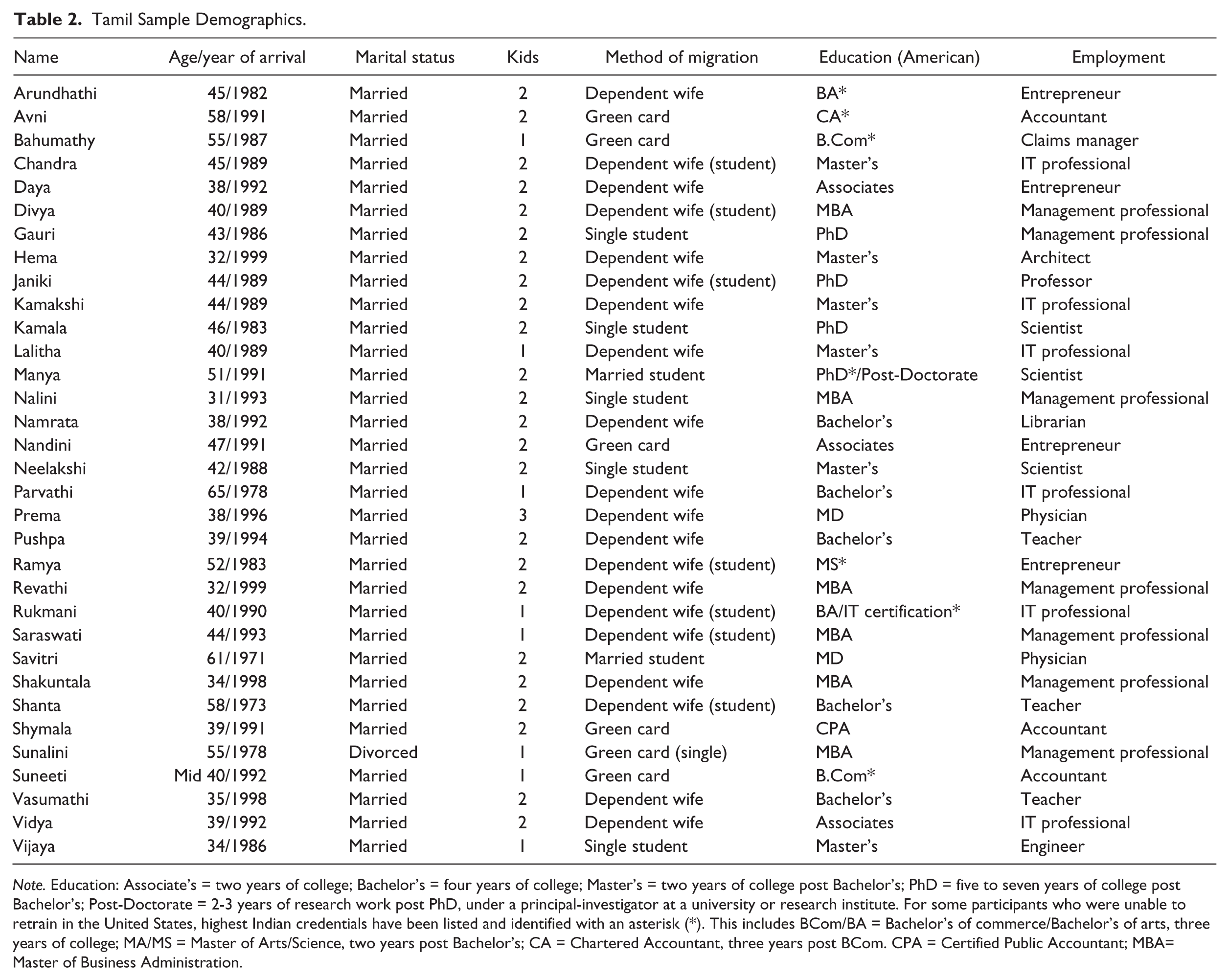
Note. Education: Associate’s = two years of college; Bachelor’s = four years of college; Master’s = two years of college post Bachelor’s; PhD = five to seven years of college post Bachelor’s; Post-Doctorate = 2-3 years of research work post PhD, under a principal-investigator at a university or research institute. For some participants who were unable to retrain in the United States, highest Indian credentials have been listed and identified with an asterisk (*). This includes BCom/BA = Bachelor’s of commerce/Bachelor’s of arts, three years of college; MA/MS = Master of Arts/Science, two years post Bachelor’s; CA = Chartered Accountant, three years post BCom. CPA = Certified Public Accountant; MBA= Master of Business Administration.
North Africans in France and Tamils in the United States
France heavily recruited foreign labor postwar in the 1950s. Given Algeria’s status as a colony of France, Algerian men were the largest group from the three North African countries to seek work in France. Men from Morocco and Tunisia, protectorates of France until the mid-1950s, increasingly migrated to France during the 1950s and 1960s in search of work. Although entry of foreign workers was temporarily suspended in 1974 due to a downturn in the economy, French policies promoting family unification led to swelling numbers of female North Africans in France in the 1980s and 1990s. The majority of women came to follow husbands and fathers, but some, including the highly skilled women in this sample, came to further their own educations, for employment opportunities, or to escape traditional family and community pressures to marry and settle down (Killian et al. 2012). While originally North African men were recruited by the French specifically as low-wage laborers, the North African women in this sample who chose to pursue their educations or escape family pressures decided to migrate to France because of the shared language and cultural connections forged through colonization. Those who attended school past the most primary level were fluent in French as North African universities taught not only the language but also French philosophy and ideologies. Women who pursued their higher education in France—some because they were disappointed with the lack of resources in the institutions in their home countries—believed that French credentials would lead to career opportunities and upward mobility (Killian et al. 2012). Some Algerian women who went to France simply to pursue advanced university studies and planned to return were caught by the civil war that ravaged Algeria in the 1990s. Many students therefore decided to remain in France indefinitely, and other Algerian women left deliberately during that decade to escape the turmoil and violence in their home country.
In the context of the United States, the Immigration and Nationality Act of 1965 heralded the entry of highly skilled immigrants especially from Asian countries. These immigrants included Indian professionals who emigrated in two phases: the first of largely male professionals and their dependent families in the 1960s, followed by that of highly educated professionals of both genders in the 1970s, 1980s, and 1990s (Devi 2002). Tamil immigrants constitute an important category of these Indian professionals. Tamil Brahmins, who occupy the upper echelons of the caste hierarchy in southern India, have historically been the priestly, educated, and land owning caste. During British colonialism, they transitioned into an urbanized, English speaking, professional, middle-class group, overrepresented in skilled occupations (e.g., information technology, science, etc.), which became the basis of their international migration (Fuller and Narasimhan 2008). Like other Indian professional immigrants of the time, Tamil Brahmin immigration was guided primarily by economic motives of improved employment and mobility opportunities in the United States compared with the high levels of unemployment and low job and salary growth that characterized the socialist postcolonial Indian economy (Manohar 2013). 3
In addition, Tamil Brahmin immigration was fundamentally gendered. Independent migration was a masculine domain bolstering men’s status as providers while the movement of women was sanctioned only through their roles as wives and mothers in married migration (Fuller and Narasimhan 2008). The majority of Tamil women (25 of 33) emigrated as family migrants—primarily as “H1-B wives,” and some as legal permanent residents on green cards—with only a few (eight) coming as single or married students. As “H1-B wives,” despite being highly educated in India—with all having undergraduate and/or graduate degrees in a variety of liberal arts and natural science disciplines—they were legally designated as “dependents” rather than skilled workers within American immigration regimes. Instituted in the 1980s, the H1-B visa program enables American employers to recruit highly skilled workers from other countries—with India and China being the biggest beneficiaries—through temporary work permits for three years. 4 As the program privileges male-dominated skills (IT, engineering, etc.), our participants’ husbands were its primary beneficiaries, with women being relegated to “dependent wife” status (Purkayastha 2005).
Given our comparative intersectional framework, it is important to note that although the immigrants in our sample are highly skilled women emigrating from traditionally patriarchal cultures, they are perceived very differently in their respective host countries. In the United States, the legacy of slavery has positioned African Americans at the lowest rung of the racial hierarchy in comparison with whom immigrant groups, particularly Asians, are positioned higher and more preferably. In addition, given the post-1965 emphasis on skilled immigration, as middle-class, educated, English speaking immigrants, Indians are characterized as the “model minority,” associated not only with superior science/technology skills but also with “occupational, educational and residential success. . .,” which “resembles or surpasses [that of] their white-middle class counterparts. . .,” while being characterized as “hardworking, passive, uncommunicative and submissive” (Dhingra 2008:43; Le 2009). However, North African men originally came to France as unskilled laborers, and when they began to bring their wives, many were illiterate. Stereotypes of poorly educated Arab immigrants interact with fears about Muslims. The lasting trauma of the Algerian War of Independence on both sides of the Mediterranean, various terrorist bombings in Europe, and current Islamophobia post-9/11 contribute to a more hostile environment for Arabs in France than Asians in the United States. 5
Comparing North African and Tamil Women’s Labor Market Access
At first blush, the highly skilled North African women in France appeared comparatively advantaged vis-à-vis their Tamil counterparts. Immigrating as native French speakers from an education system that is very similar due to colonial ties, they often came as students for higher education in France and subsequently acquired French credentials (11 of the 18 completed their educations in France). The majority immigrated as single women, and the six who were married had husbands who supported their educational and work ambitions. As the literature holds that host-country-specific and validated credentials, as well as lack of family care responsibilities, especially for women, are instrumental to their successful labor market incorporation, we therefore expected their professional trajectory to reflect this advantage (Brekke and Mastekaasa 2008; Kontos 2011; Liversage 2009a; Mushaben 2009; Yeoh and Khoo 1998). Surprisingly, however, the majority held low-level jobs, often including those with the most advanced degrees. In fact, of the three women who had doctorates in natural sciences and veterinary medicine, one was unemployed despite seeking work assiduously, another worked as a ticket-seller to a park amusement ride, and the third was a school aide (who helped take children on field trips and watched them after school before the parents arrived; she was not teaching science). One woman with a doctorate in the social sciences was doing part-time work in a child care center despite looking for a better job for three years, and another was also unable to find work in anything related to her field and was doing menial jobs. An artist was barely making enough to support herself as were two friends who had opened a small business together. Three women in the sample wanted to teach in middle or high school, but only one had succeeded in obtaining a full-time position, the other two were temping and sometimes filling in as substitute teachers, including one who had lived in France for several years. A woman with a master’s degree from a French university was a computer technician but was unhappy with her position and pay and explicitly stated that she had expected to be much further in a career by her age. By far the most successful woman was a producer at a production company, but her case was unusual. A similar woman with even more production work-related experience had been trying unsuccessfully for three years to secure employment in her field.
Tamil women, who had generally done higher education in India, encountered many barriers to labor market incorporation immediately upon arrival in the United States, including the devaluation and nontransfer of their Indian qualifications, nonvaluing of Indian work experience, and corresponding lack of its American counterpart. Critically important was the lack of legal work authorization stemming from their classification as dependents. In addition, unlike most of the skilled North African women, the majority of the Tamil women were mothers and/or became mothers shortly after arrival and thus responsible for the family’s caring work. We could therefore expect them to experience significant disadvantage in becoming professionals, including outcomes such as permanent low-wage work and/or redomestication. Yet, at the time of the interviews, all were engaged in full-time, well-paying, skilled professional work. Twelve were engaged in information technology (IT), science, engineering, and medical-related professions; 10 were in academic/teaching jobs, accountancy, architecture, and technical skilled jobs; seven were management professionals; and four were in small business entrepreneurship.
The relative success of Tamil women in accessing skilled work compared with the failure of their North African counterparts in France complicates a traditional human capital explanation of early disadvantage and/or advantage compounding cumulatively into further disadvantage/advantage over time. Indeed, our data challenge the claim that migration negatively impacts the careers of highly skilled women, relegating them to the “bleak reality of unemployment and underemployment” (Van Ngo and Este 2006:30). Rather, using an intersectional lens, we find that far from being universal, disadvantage/advantage in skilled labor market access is relative across the national contexts of the United States and France such that for Tamil and North African women, downward and upward occupational mobility is experienced in different ways, at different stages in settlement and to a relatively less and more severe degree. Therefore, Tamil women, as largely family migrants, experience downward occupational mobility early in the settlement process, but redress this later in settlement to eventually become highly skilled professionals. Skilled North African women, however, as primarily independent, education migrants appear to be more advantageously positioned to enter the labor market but witness the erosion of this advantage over their settlement to become confined to the low-wage, secondary labor market in France. Our analysis reveals the operation of four mechanisms that enable Tamil women to convert their early disadvantage into what we call “contingent advantage” compared with North African women, whose early advantage appears to become almost “categorical disadvantage.” These are (a) interaction of immigration regimes and local labor markets, (b) education-work experience nexus, (c) social capital embedded in networks (both school/work and family), and (d) racialization.
Interaction of Immigration Regimes and Local Labor Markets
First is the interaction of immigration regimes and local labor markets in the United States and France. Although Tamil women who emigrated as “H1-B wives” were unauthorized to work in the United States upon arrival, several did unpaid skilled work through internships and volunteering aligned with their transported skills. Prema, a physician who had just completed her medical training in India before emigrating as a new wife, explains,
. . . Because of visa stipulations, you know, I could not work. I was [on] a dependent visa at that time. I did whatever I could. I studied for my [licensing] exams, and I began looking for some position to work. You can only do voluntary things. So I can’t call [my voluntary work at a hospital] “work, work.”
Although traditionally conceptualized as an exploitative pathway that deskills immigrants and permanently confines them to this work, corroborating recent evidence to the contrary (see George and Chaze 2009; McCoy and Masuch 2007), we find that low-wage/unpaid work enabled some Tamil women to acquire specific technical and cultural skills to operate in the American workplace, gain substantial work experience that for some became their “credentials,” and develop professional networks with Americans, critical to facilitating their transition to skilled work. Shymala, a 39-year-old CPA, began working for a grocery store chain:
[After] two months [on the floor], I moved up into the pricing department. See back home [India], none of the offices were computerized [in early 1990s]. So the pricing department was good for me [to get work experience] . . . just get into Excel and Word . . . the computer. From there, I moved to the accounting office of the [national grocery retailer]. It was through an [American] contact that knew me from the pricing department. She called when there was an opening in the [name of accounting] department [and] I was in various accounting positions there for [a couple of years]. And I got all my accounting terms [training and accounting credentials] there. . . . [And] I became the manager for the [regional] division.
These advantages, however, do not preclude their vulnerability to exploitation in these jobs as the case of Revathy, a management professional with a business degree from a prestigious Indian university and a few years of work experience in India:
At that point, I just wanted to work! . . . The employer said, “I am going to apply for your transfer from H4 [dependent visa] to H1-B, but until that happens, I can’t really pay you.” So I said, “that’s fine, we’ll agree on a salary, but defer it . . .” So I was basically working with them as a business development person and wasn’t getting paid. . .The idea was that [the IT company] was going to apply for my H1-B and after that came through, they were supposed to retroactively pay me. I did that for a year. I actually made a lot of money for those guys. It went on . . . and no sign of the H1-B. And then we finally found out. They never applied for my H1-B [and so no money as well]. So at that point, I was thinking, this is going nowhere really fast. I’ll lose the rest of my life. What do I do?
Tamil women’s arrivals between the 1970s and 1990s coincided with the redesigning of American immigration regimes to actively recruit foreign workers with “critical or high-skills” for the increasingly service oriented and “dynamic economy of high tech industries” (Rodriguez 2004:465). Tamil women experienced not only expanding job opportunities in these fields but also a favorable immigration climate. Thus, after initially being barred from work, they were eventually able to change their legal status. Many readjusted their status from dependents to students, explained next, as Revathy eventually did to complete her MBA, and were able to avail themselves of measures built into student visas that provide one-year work authorizations in jobs directly related to their areas of study (Wasem 2012). 6 They used these authorizations to successfully participate in internships, detailed later, converting these to employer-sponsored H1-B work permits when they culminated in job opportunities. Other Tamil women became legal permanent residents through their husbands and were ultimately authorized to work.
At the same time as the United States was creating “skilled immigrant labor streams” (Rodriguez 2004:453), France was pursuing a bifurcated immigration policy. North African women encountered a French labor market, which, although experiencing a similar demand for skilled workers, was more protectionist in its preference for migrants from the European Union (EU) to fill this demand (Chaloff and Lemaitre 2009; Ochel 2000). Simultaneously, North African immigrants continued to arrive under family reunification policies resulting in the association of skilled migration with Europeans and low-skilled migration with racialized minorities like North Africans. Tinhinan, an Algerian with a master’s in the sciences, best exemplifies this in her comment, “they [French] don’t like to see a foreigner take their place . . . [I]mmigrants do the dirty jobs, but they don’t like to see a foreigner [read: non-EU immigrant] work as an engineer.” Consequently, skilled North African women experienced challenges in obtaining work authorizations—either only being afforded temporary work permits with few possibilities of conversion to permanent status (see Chaloff and Lemaitre 2009) or encountering the catch-22 situation described by Houriya, an Algerian who completed her doctorate in the sciences:
It’s a vicious cycle because to work, they ask for you to be French, and for the prefecture to give me a work permit, they ask for a [work] contract. The company has to sign a paper. And the company refuses to sign because it wants the authorization already. The prefecture wants the company to sign, and the company wants the prefecture to give the authorization, so it goes in circles. It’s done on purpose.
Although France purports to facilitate visas for highly qualified professional immigrants, many like Houriya are unable to transition from a student visa to a work visa or residency permit. 7 Thus, unlike their Tamil counterparts in the United States, their legal status as students did not include adequate measures for work authorization, resulting in North African women lacking the requisite work permits to access skilled work upon completing their educations. Yusra, a Moroccan finishing her doctorate in Paris, is a case in point. She noted that “one law, well it changes your whole life. It changes everything. Now, for work for foreign students . . . I find it ridiculous because . . . it prevents me from finding work.”
This was further complicated by local labor market conditions in France, particularly the increasing reliance on short-term labor contracts even within skilled, professional jobs with few ladders to stable, permanent employment. While this feature of the French labor market is problematic for French nationals (Peet 2012), it is particularly disadvantageous to those of non-European ethnicity. Accordingly, despite being highly educated with French credentials, North African immigrant women are often trapped in a series of temporary professional and/or semiprofessional jobs rather than permanent employment within their specialties.
Leila, a Tunisian teacher, recounts having to move from job to job even though she has a 10-year resident card, the longest residency card issued in France and therefore considered “permanent” compared with the one-year residency card:
I haven’t succeeded in having a regular job all the time. I’ve worked as a temp, I had short-term contracts, I did things like that. It’s not a regular job. . . . Work now is very difficult in France. . . . Of course they prefer to have a French person work, more than a foreigner.
Leila had lived in France from the mid-1970s until 1985, returned to Tunisia, then returned to France permanently in 1991. She noted that it had been much easier to find work the first time around. French companies’ reliance on temporary contract labor, even among French citizens, had proliferated in the subsequent years. Currently, only one out of five young workers on temporary contracts will be hired permanently (Peet 2012). Although short-term contracts are affecting all workers in France, especially younger ones, their effects are worse for non-French natives in general, and probably, as we detail later, even worse for non-white, non-native women.
Education-Work Experience Nexus
Despite requiring investments of time, money, and physical and emotional effort, (re)education was the golden key to affording Tamil women direct entry to high-paying, skilled work (Banerjee and Verma 2011). This was the most popular route to skilled work, used by all (including by some of those who started with low-wage work) but a handful of participants.
8
Far from being facile, Tamil women’s participation in postmigration (re)education was framed by an array of mediating factors resulting in either early or delayed labor market transitions. The most salient was the financial stability of their families. Tamil women were reliant on husbands financially supporting their (re)education, determined by the latter’s job security. Especially for those women who joined husbands just as they were beginning to establish their careers, onset of education and labor market entry was delayed five to 10 years after immigration—as they moved frequently following husbands’ jobs needed to retain their immigration status. Shakuntala, a management professional, explains,
. . . I wanted to start working when [daughter] was three. To have my own career, I needed that degree. . . . I was getting a master’s in computer science. [Then] my husband’s company had a mass lay off, so . . . he got this job in Atlanta. Wherever my husband got a job, we had to go there. I was still studying in Citiville. I completed my semester there, while he moved to Atlanta, and then once I had admission to [university in Atlanta], I transferred and completed [degree].
Tamil women whose husbands were more financially established, and the few who joined student husbands while receiving admission at the same universities as their spouses, were relatively better positioned to a more direct route to (re)education—beginning most often within the first three years after their arrival. 9 For a significant proportion of Tamil women, choosing (re)education early in settlement enabled them to readjust their immigration status from dependent wives to international students—a visa classification that rendered them eligible for university provided financial aid, reducing the financial burden on their households, as Revathy’s significant tuition scholarship for her MBA did.
As Shakuntala’s statement indicates, the second mediating factor was Tamil women’s family situations. Tamil women who were child-free reported being better able to start (re)education fairly early compared with those who started families immediately following immigration and/or immigrated “en famille.” The latter became disproportionately responsible for care work in the United States—because of the absence of kin-based or paid assistance available in India, husbands’ focus on establishing themselves professionally, and the salience of care work in ensuring the smooth settlement of families (Cooke 2007; Manohar 2013; Meares 2010)—resulting in their significantly delayed (re)education. Daya, a management professional, explains, “I took classes just once a week so I would just be away [from her family] one night . . . the primary responsibility [for care work] was still for me.”
In contrast, as education migrants, the majority of the North African women acquired local credentials early in settlement. Yet only for Tamil women did this result in access to skilled work. We theorize that this is because credentials alone are insufficient; rather, their efficacy is mediated by the criticality of local work experience. Tamil women acquire this through education-labor market bridges—“training and employment/license preparation programs designed to bridge educational and work experience gaps” (George et al. 2011:9)—that are a feature of American universities (Banerjee and Verma 2011). These programs allow immigrants to respond effectively to employers’ emphasis on “relevant experience and on-the-job demonstration of skills and competence” to prove that they can be “immediately productive” (George et al. 2011:4; McCoy and Masuch 2007). Lalitha, an IT professional, is a case in point:
When I was doing the degree [master’s] in nutrition, I got my job. I was doing my internship at a public hospital. And when I was doing that, they called me for this job. So when I was done with my schooling, I started working there.
Tamil women thus availed themselves of internships, work-study and cooperative programs between universities and businesses, giving them entrée to American workplaces either during or after their education. In acquiring the “documented” work experience to supplement their credentials, they were also exposed to the “habitus of the . . . workplace” (Bauder 2005:83)—the norms and codes of conduct of the American workplace, enabling them to develop cultural competence around work. Moreover, professors, classmates, and co-workers connected Tamil women to job opportunities, many of which tended to be unadvertised and filled through referrals, and became their mentors in strategizing labor market access both during and after graduation (Van Ngo and Este 2006):
. . . [A]ctually the economy was pretty bad when I was graduating. Jobs were very difficult to come by. [But] it was simple for me. It was my professor. Being in my [department at] university, we had a connection with [Company] at that time. We had folks ahead of me who were in [Company] and my professor knew other folks there . . . and said, “Yeah, one of my students is ready for a job” and the company asked me to interview. So I had two different departments in [Company] offer me a job. (Gauri, management professional)
None of the North African women reported accessing similar education-labor market bridges largely because in the French educational system, internships and professional mentoring are rare with the exception of “les Grandes Ecoles” that train France’s political and business leaders. Immigrants are scarce at these elite schools that offer mentorship and direct access to positions of power. In addition, alumni networks are not as prevalent in France as in the United States where they are pervasive. Indeed, North African women worked in “small jobs,” such as part-time child care while completing their degrees, rather than in those connected to their professional training as their Tamil counterparts did. Yusra states, “I have to find solutions, small jobs (‘petits boulots’), you see. But well, you do it because I don’t say no to work. I work anything, secretary, operator, everything, everything. . . .”
The situation was even more difficult for the few in the sample like Lina and Rym, trained veterinarians in Algeria, who had come to France six years earlier to do specializations in veterinary medicine, but whose original diplomas did not correspond exactly to French medical degrees. Rym was selling tickets to a park amusement ride and simply hoping to one day find any decently paid white-collar work. Lina, however, was still coming to terms with losing her dream of practicing veterinary medicine:
The failure here in Paris for me is the fact that I haven’t been able to work in my field. You see a lot of my friends have gotten over that. And me no. I haven’t gotten over that because I love the studies that I did; I did it for love, I love animals, and I don’t see myself in another vocation. Everyone says to me, “Lina, change, you have to convert yourself into something else,” and I can’t do it. . . . I spent several years unemployed. . . . I worked because I had to work, I had to pay rent. Working in the school [entry-level, nonteaching job], I stayed two years. I liked that because of the social aspect . . . but at the same time everything that’s office work, me, it’s not my thing. Me it’s being on the terrain or in the lab or the pharmacy or something . . . being in my field.
Social Capital Embedded in Networks
Our comparative analysis also highlights the almost paramount importance of social networks as the third mechanism in accessing the American and French labor markets, corroborating similar findings in the extant scholarship (Bauder 2005; Brekke and Mastekaasa 2008; Cooke 2007; George and Chaze 2009; George et al. 2011; McCoy and Masuch 2007; Salaff and Greve 2004). Social networks are crucial during the immigrant settlement process and a key form of social capital in navigating labor market incorporation. They orient immigrants to the new labor market, enable them to find jobs, deal with occupational changes, and establish economic security (George and Chaze 2009; Salaff and Greve 2004).
We observed the salience of two types of social networks—professional and ethnic/kinship networks—and the social capital these embodied. Although both groups participate in (re)education and/or low-wage work initially in settlement, only for Tamil women does this materialize into integration into professional networks. We theorize that this is because Tamil women’s professional networks are cross-cultural in nature and with high-status members—upwardly mobile, professional Americans created in part through the aforementioned education-to-work bridges. Tamil women, like Revathy, cited below, obtain referrals from American employers demonstrating American work history and/or have well-connected mentors who provide them information about jobs, promotions, and assistance in strategizing labor market access. Professional networks thus afforded Tamil women crucial bridging social capital (see George and Chaze 2009) facilitating their more advantageous location and access to the skilled labor market.
In management, your network is all you have. I do [financial] analysis [but] my skills aren’t quantifiable. . . . So my network is actually very critical. . . . I got this [current corporate job] job through my network. It’s not through a headhunter or nothing.
For North African women like Leila and Nour, however, their emigration resulted in the loss of formal professional networks. Recreating these in the immigrant context proved to be a time-consuming process significantly disadvantaging them in labor market access compared with their Tamil counterparts (Purkayastha 2005; Yeoh and Khoo 1998). Lina, the trained veterinarian cited earlier, unable to practice in France explains,
I applied to be a veterinary assistant; I wasn’t asking to be at my status [veterinarian]. I was asking to make $1,000 a month, be in an office, get back on track, you see? Get with it again because you lose it when you don’t practice. It was a closed milieu. The veterinary milieu is a hermetic milieu. I applied, I was listed for five years at the unemployment office. You need someone’s help to get in; you have to have it.
Nour, with extensive experience in film production in Algeria, also noted the same problem:
In French society the only place where I’m at ease is the musical artistic milieu, or in certain production houses that are really healthy, very cool, very independent, you see? And you have to know people to get in. So there. It’s really complicated. . . .I’m in an infernal circle, if you don’t have contacts, you don’t find jobs. . . .
Furthermore, as wives of skilled husbands integrated into resource rich networks, Tamil women are embedded in an ethnic community of middle-class, upwardly mobile skilled immigrants and benefitted from ethnic networks. Extended family and husbands’ friends with Indian wives like themselves oriented them toward (re)education, referred them to work opportunities, and provided recommendations (Manohar 2013). Revathy recalls, “. . . mutual friends of his [her husband] . . . put me in touch with somebody who got me a job with one of these IT companies.” Thus, although in the literature, families and marriage have been theorized as barriers to skilled work for immigrant women’s transitions, our work highlights the potential advantages that family/marital networks provide, especially when mediated by a favorable class status in settlement.
In contrast, North African women’s reliance on ethnic networks to mitigate their labor market disadvantage was less efficacious. They were embedded in a working-class ethnic community and even among those who were married; their husbands’ jobs were similarly low skill due to labor market discrimination. Rym observes, “I see around me, I see my friends, my brothers, my husband and all, for work they have a lot of trouble . . . my husband doesn’t have the means.” Similarly, Mbruka, an IT professional, relates her belief that racism contributed to her husband’s 18-month long period of unemployment. Indeed, we argue that although they interacted with North Africans who might have been professionals in the Maghreb, the absence of a professionally oriented North African community in France meant that these coethnics were unable to provide them the social capital or bridges to professional work as they were similarly struggling themselves. Moreover, North African women’s labor market experiences become the classic case of immigrants getting trapped in ethnic economies by work that pays disproportionately low returns on their human capital and offers few bridges into the primary labor market (Zhou and Logan 1998). This was evident among those who worked in ethnic associations in an attempt to circumvent the formal labor market, but whose jobs were often semiskilled (secretarial, peer-counseling) and not necessarily commensurate with their academic credentials, and the two women, Labiba and Hayat, who opened a store in a predominantly North African neighborhood in an impoverished Northern suburb of Paris, selling Algerian garments and decorations predominantly to coethnics. North African women, therefore, are serving immigrants often poorer than themselves who have few resources to facilitate the former’s upward mobility.
However, four Tamil women became successful entrepreneurs. This had largely occurred because at the time of immigration, these women had made “dyadic compromises” (Salaff and Greve 2004:156) with their husbands—involving husbands taking the lead in retraining and/or reestablishing themselves professionally, justified in terms of their greater earning power, while wives sequentially followed. The latter, however, failed to happen as wives’ domestic responsibilities escalated, and they aged making them more intimidated to (re)educate (Liversage 2009b). Entrepreneurial work, then, was both a means of circumventing barriers and a career choice—a way to have a challenging, skilled job that was family friendly (Mushaben 2009). Integral to Tamil women choosing this pathway was their favorable class status in the United States. While women eventually became coproviders for their families, husbands’ high incomes enabled them to rely on family incomes for the initial capital to establish their businesses and support them until they were in the black. In addition, Tamil women relied on a combination of ethnic, familial, and American networks to develop all aspects of their businesses—from start-up to business development planning. The four Tamil entrepreneurs had clients who were primarily upwardly mobile Indians and/or non-Indians, which enabled them to capitalize on opportunities beyond the ethnic economy. Unlike their North African counterparts, they were also business owners rather than employees, and thus avoided paternalistic and exploitative coethnic male bosses (Banerjee 2013), or their businesses, two of which were ethnically oriented, were not physically located within ethnic enclaves or reliant on informal ethnic labor practices.
The case of Nandini, a realtor, is an example. The mother of two children, Nandini spent her first 10 years in the United States caring for them and working part-time in a variety of skilled technician jobs rather than (re)educating as she had hoped. When she was laid off, she took courses on teaching English as a second language at community college, supplementing her master’s degree in English from India, and started a small business teaching business English, using her contacts at her last job to contract with them as they employed a large contingent of non-native English speakers. However, this became increasingly demanding as she had to work evenings and weekends. At that time, her American neighbor pointed her in the direction of real estate, and both decided to train together to become licensed realtors. “I did the state [licensing] exam. And I came out with a real high score,” which enabled her to franchise with a national realty company—“They are the brokers, but I have to solicit my own clients. It’s my business.” Moreover, during the onset of the U.S. recession in 2008 when other realtors saw business shrink, as one of the few Indian realtors in Atlanta, she realized, “thank God I’m Indian,” because through her Indian networks she had a small but steady pool of upwardly mobile Indian clients moving to Atlanta and buying homes there.
Racialization
The final mechanism in mediating labor market access is the role of race/ethnicity. Upon migration, both Tamil and North African women are positioned as racial/ethnic minorities within the existing racial framework in the United States and France. In turn, a global assessment of their experiences appears to corroborate extant scholarship that as racial minorities they deal with racial prejudice and discrimination in the labor market (Purkayastha 2005; Van Ngo and Este 2006). However, our comparison complicates this picture, revealing that the differences in the operation of race regimes in the United States and France contributes to the divergent outcomes for “contingent advantage” for Tamil women and “categorical disadvantage” for their North African counterparts.
In the context of the labor market, the racialization as model minority frames Indians’ characterization as professionals and “appropriate workers” for the “critical skill” jobs discussed earlier. Indeed, this has often led to employers’ preference for them and selective recruitment into these specific jobs compared with other immigrants and native born minority groups. Prema explains,
. . . They [American employers] generally have this idea that Indians are smart, Indians speak good English and Indians are hardworking. . . . You know, I can’t say they’ll understand [another racial/ethnic] group.
Being perceived as model minorities does not preclude workplace discrimination such as ceilings on occupational mobility and gender/race inequalities at work to which several Tamil women attest (Manohar 2013). However, we contend that viewing their racial position comparatively with the North African case uncovers their relatively advantageous racial social location. As Silberman, Alba, and Fournier (2007:17) argue, the French landscape does not offer an indigenous minority like African Americans to whom immigrants can be favorably compared, so “negative scrutiny is more likely to attach to one or more immigrant groups, especially where prior colonial experiences provide a ready-made set of stereotypes and prejudices.” Accordingly, for North Africans, the legacy of colonialism has functioned similarly to slavery in the United States to place them at the bottom of the French racial hierarchy (Horowitz 1998; Silverstein 2004). In addition, our participants are racially “othered” as Muslims—at best, believed to be unassimilable and at worst, stigmatized as violent and globally viewed through the lens of “Islamic extremism.” Besma, who worked in an ethnic organization observes,
It’s how others look at you; it’s in the devalorization . . . that immediately sees in you a bunch of things that don’t have anything to do with you [like] an Islam that’s a type of [extremism], that because you’re Arab you’re seen as someone who is violent . . . we are . . . stigmatized.
In addition, unlike Tamils, they are stereotyped as working-class immigrants, due to the bulk of early immigration during colonization and the early postindependence period being made up of low-skilled, male laborers and later, in the 1970s and 1980s, of accompanying wives with very little education. While the nature of North African immigration diversified in the 1980s and 1990s, with the increasing arrival of better educated immigrants, including Algerians fleeing the civil strife of the 1990s, the previous history resulted in the hegemonic imagery of North Africans as uneducated and only able to communicate poorly. Therefore, unlike their Indian counterparts in the United States, in the French imaginary, North Africans are not expected to have advanced degrees or be upwardly mobile professionals but rather to work in low-skilled, service capacities. Left to mediate the labor market on their own in the light of the above-mentioned factors, this racialization results in North African women being predominantly slotted into the feminized, low-status, and often part-time jobs, particularly cleaning and child care work, for which they are deemed “appropriate” as Arab, immigrant women. This is illustrated by a number of participants who despite their academic credentials have only been able to find child care work, like the three women in our sample who are school aides, or other minimum wage jobs despite repeatedly trying to access the professional labor market. At best, their efforts afford them poorly paid semiskilled positions, which, unlike their counterparts in the United States, provide them no ladders to well-paying, professional jobs. This phenomenon then complicates simplistic arguments of immigrant men’s advantage in labor market access to illustrate how the gendered, classed racialization of Arabs serves to relatively benefit North African women, even if only in the limited way of being able to find work (even low-wage work) as opposed to be unemployed
10
as acknowledged by Rym:
. . . [For women], [even] in a bad situation you can babysit, clean houses, do telemarketing. I do sub-work, like selling tickets at the amusement park, and I’ve done everything, I’ve done cleaning, restaurants, I’ve done everything.
Although cobbling together baby-sitting jobs is acceptable to lower-class North African women with language difficulties, it is certainly not the expectation of college educated women like Yusra: “I’ve learned with time to detach myself from the work, from what I do. I do it for what it brings in.” Unfortunately, a resume consisting of “petits boulots” may further reinforce the stereotype that Arab women are not professionals and may ultimately further impede their attempts to secure employment commensurate with their degrees and lead to their deskilling.
Nour’s story also demonstrates the cumulative intersections of foreign work experience and race. Despite having a European passport thanks to her mother’s nationality, she was fighting to enter the television and film business and had done internships but was still unemployed:
I know the last internship I had, I got along with everyone. They didn’t hire me. After I left they hired someone else. Especially because I’m atypical which means that if the person has 20 CVs, she’s not necessarily going to stop on mine, because I’m Algerian and I had a lot of professional experience in Algiers, so that scares them a little. There’s racism in regards to that. . . . I know I have abilities. . . . I speak several languages . . . but I have a lot of difficulty because I don’t fit in their system. I don’t fit their norms. It’s not because I’m incompetent. . . . You have to correspond to their norms . . . talk a certain way, you have to fit that. I could have evolved following their codes . . . I could have evolved professionally. . . .
The reticence to hire someone whose work experience was gained in Algeria means that Nour cannot acquire local work experience necessary for learning the norms of working in France. For immigrants like Nour, their inability to “. . . obtain employment because they lack local experience, and [inability to] obtain local experience because employers will not hire them” (Meares 2010:477) coupled with the disqualification of foreign credentials are key factors contributing to their deskilling (Bauder 2005; Cooke 2007; Pfeiffer et al. 2008). Added on to this problem for immigrants in general, however, is the further element of racism and who is deemed an appropriate job candidate thus highlighting the need for looking at our four factors through an intersectional lens. Nour, Leila, and Malika all discussed racism (see Bauder 2005; Van Ngo and Este 2006) as a factor in their employment histories, with Malika, a producer and the most successful North African woman in the sample, specifically noting that some men at her job objected to working for a North African woman.
Conclusion
Why did the majority of well-educated North African women ultimately face poor career prospects despite their educational and familial advantages early in settlement and Tamil women eventually succeed in their work goals despite their initial disadvantages? Our analysis reveals multiple, intersecting impediments to Arab women being hired for skilled work in France commensurate with their training while Tamil women in the United States overcome early setbacks to ultimately succeed in their careers. These findings challenge the traditionally linear cumulative dis/advantage explanations. Rather, we contend that these are eroded and/or converted across the course of settlement into what we call “categorical disadvantage” for North African women and “contingent advantage” for their Tamil counterparts, mediated by the interactive nexus of four factors.
We use the term “categorical disadvantage” to refer to the almost permanent and fixed nature of North African women’s downward mobility and consignment to the low-wage echelons of the French labor market. Our comparison revealed the interactive effect of their lack of access to education-labor market bridging programs and corresponding effective social capital, including capital from well-positioned husbands’ professional networks, a relatively rigid French labor market and immigration policy climate, and their racialization as Muslims and low-skilled workers. This has long-term consequences affecting their economic and life chances leaving them relatively worse-off and poorer than their Tamil counterparts in the United States, with very few opportunities to reverse these. In contrast, for Tamil women, availability of and access to education-labor market bridging programs, middle-class and professional social networks, derived both from American university mentoring and internship programs and from spouses and ethnic ties, a more flexible American labor market and immigration climate, and a relatively positive racialization as model minority members become the necessary bases of their successful labor market entry as professionals over the duration of their settlement. Their advantage is not immediate or predictable, however, but rather “contingent” on the above web of mediating factors, which themselves are structured by the matrices of gender, race, and class that play out differently in various local contexts. These categories overlap and interact, as is clear from the respondents’ experiences (e.g., combined effects of lack of in-country work experience with discrimination against a particular group and stereotypes about what kind of person is appropriate for what job leading to not being able to get in-country experience).
Our study of the labor market incorporation of racialized, immigrant women therefore illustrates two key tenets for intersectional theorizing: that privilege and disadvantage are not absolute but rather best understood as relative and that the experience of dis/advantage changes over life course trajectories such that immigrant groups can experience various advantages and disadvantages at different times in the settlement process. We identify the unique “matrices of domination” (Collins 2000) of a small sample of two particular immigrant groups who share some characteristics and not others and how these are influenced by institutional and national factors in two countries. Going forward, the goal is to look at a variety of groups of skilled immigrant women in different contexts as this will further theorizing about how intersectional effects influence dis/advantage over time and additional factors that may be important in other destinations.
While highlighting the importance of the institutional factors described above, we also recognize the intensely personal and emotional consequences that result. Yeoh and Khoo (1998) assert that employment not only keeps immigrant women occupied, facilitates learning the local way of life, and increases personal freedom, but it also leads to psychological benefits such as improving morale, sense of well-being, and confidence in their abilities. Tamil women did report some level of demoralization and frustration with their decredentialing in the United States and need to retrain. That said, their eventual success in obtaining highly skilled, well-paid work, building identities as professionals, and becoming co-breadwinners in their families (see Manohar 2013) mitigated much of this stress over time. In achieving a dual-career, dual-income household, Tamil women had fulfilled their migrant dreams, albeit more slowly than they might have liked given the constraints related to their gender. In contrast, the emotional cost of trying to make it in the labor market was much heavier for the majority of highly skilled North African women in France. Prolonged, unsuccessful attempts at securing professional work commensurate with their training were particularly devastating and undermined mental health and well-being even leading to depression in some cases. In fact, at the time of the study, Lina, the veterinarian, and Keltouma, who had completed a doctorate in the social sciences, were both considering the possibility of returning to North Africa. Keltouma had become depressed over her inability to find a job that matches her credentials:
Unfortunately, finding work is really hard actually . . . it doesn’t seem normal that after three years I haven’t found anything. It’s a stressful life here, especially professionally speaking. When you look for work and after a certain time, which is really a long time, you realize it’s a vicious circle really, and you don’t have a way out. It’s true it’s stressful. And very demoralizing.
Losing qualified, highly skilled workers to return migration, especially after investing in their educations, is a loss to a host country. In addition, the human toll exacted when years of study and expectations are not met with appropriate-level work is a serious blow to the mental well-being of individuals. For those arriving post-2000, the situation may be deteriorating rather than improving. Both the social landscape and immigration policy are in flux. In the United States, for instance, it is harder to obtain H1-B visas from employers, and there are longer delays in transitioning to legal permanent residence (Wasem 2012). This suggests the need for real immigration reform. Easing accreditation in both countries would help migrants transition to professional work more quickly, as would easier access to work permits for country-trained professionals. When Tamil women in the United States went back to the university to retool, they did integrate into social and professional networks that helped them achieve their goals after obtaining their credentialing. However, credentials obtained in the host country are not an automatic panacea to labor market barriers. Degrees must be combined with networking, which was sorely lacking in France, so a key recommendation would be the development of university-based networks in France such that the schooling system facilitates connections to employers and groups of alumni stay in contact about professional opportunities. Finally, while Tamil women have generally benefitted from the model minority perception in the United States, the attacks of 9/11 and later terrorist attacks in Europe have further damaged how Arabs, and some South Asians mistaken as Arabs, are viewed in Western countries. There is a need for structural and policy interventions to alter the cultural and racial climate such that in France people will see more examples of North African women in powerful business and political positions consequently changing their stereotypes of these women as uneducated, menial, domestic workers. In sum then, our article demonstrates the centrality of a comparative, intersectional perspective in uncovering the relative experience of advantage and disadvantage across national contexts. We use these findings to contribute to thinking about government policies and institutional practices that will help skilled immigrant women find employment that matches their training and experience, thus avoiding the personal and societal costs of deskilling.
Footnotes
Declaration of Conflicting Interests
The author(s) declared no potential conflicts of interest with respect to the research, authorship, and/or publication of this article.
Funding
The author(s) disclosed receipt of the following financial support for the research, authorship, and/or publication of this article: We wish to acknowledge Emory University for research funding and Brooklyn College, CUNY and Drew University for research support.