



Abstract
Executive Summary
Uganda has long promoted refugee self-reliance as a sustainable livelihood strategy with progressive land-allocation and free-movement-for-work policies. Framed as a dialogue with related Oxford University Refugee Studies Centre (“the Centre”) research on refugee economies, this article explores sustainable solutions that benefit refugees as well as the host populations that receive them. It explores the self-reliance opportunities that depend on the transnational, national, and local markets in which refugees participate. It acknowledges the Centre’s substantial work and welcomes its focus on economic outcomes. For Nakivale Refugee Settlement in Uganda, however, the discussion of “refugee economies” may not be complete without problematizing the effects on the host populations living alongside the refugees.
Based on qualitative data collected at Nakivale in 2013 (concurrent with the Centre’s fieldwork), the article discusses the Centre’s market-based approach to refugee economies by emphasizing four essential considerations: Land distribution in Nakivale is not sustainable. Corruption strongly influences the refugee and host populations living in Nakivale. The impact on the local host population is not homogeneous. Among refugees, the Somali–Congolese relationship is exploitative, not amicable.
This article discusses how Uganda’s refugee policies create economic profit for some but poverty for others. As a result, its welcoming open door is on the verge of collapse. The recommendations address alternative refugee-protection approaches that aim to lower the pressure on land allocation, enable a self-sustainable approach that protects the host population, and provide refugees with some degree of self-reliance. This discussion does not discount the Centre’s finding that entrepreneurship is an important part of such solutions. Instead, it addresses the challenges of using entrepreneurship as a durable solution — as long as Uganda’s dominant policy is self-reliance based on distribution of food and land and the refugees’ limited cultivation of that land. To addresses some of the obstacles for durable solutions in a way that protects both the refugees and the host population, this article makes four recommendations for policy and practice. With assistance from the international community, the Ugandan government should: Prioritize the welfare of its citizens who live in Nakivale in the national land-allocation strategy. Enact clear and consistent legislation regarding autochthonous land ownership and use of eviction policies, and design economic reforms to eliminate systemic corruption. Include non-agricultural income-generating activities in the self-reliance policy, and finance entrepreneurs through governmental or international funding. Allow refugees to move away from the settlement without loss of refugee status or access to assistance.
Introduction
By the end of 2019, conflict, violence, and human rights violations had displaced more than 79.5 million people worldwide from their homes, nearly double the number since 2009 (UNHCR 2019). Most of these people have taken refuge in a developing country, often remaining in protracted refugee situations, which means being in exile for five or more years without prospects for implementing durable solutions (Carciotto and Ferraro 2020; Edwards 2018; Hyndman and Giles 2017). This refugee crisis has increased pressure among Europeans to prevent secondary movement of refugees from those first countries of asylum to Western countries (Hansen 2018; Hovil 2018; Hyndman and Reynolds 2020). As a response to these concerns, and led by the UN High Commission for Refugees (UNHCR, the Refugee Agency), the 2016 Global Compact on Refugees offered a framework to address refugee protection in protracted displacement situations, as well as for the people who host them. Part of that compact is the Comprehensive Refugee Response Framework (CRRF), which has four strategic objectives predicated on global sustainability: (1) Ease pressure on host countries, (2) enhance refugee self-reliance, (3) expand access to third-country solutions, and (4) support conditions in the refugees’ countries of origin so they can return with safety and dignity (UNHCR 2018).
Uganda is one of eight African countries that agreed to apply the CRRF concepts (Carciotto and Ferraro 2020, 88). With 1.4 million refugees, Uganda has become one of the world’s largest refugee-hosting nations (UNHCR n.d.a). It is also hailed as one of the most welcoming countries for refugees, having implemented an open-door policy and self-reliance approaches since 1999. Uganda’s progressive policies allow refugees a plot of land and significant freedom of movement to work and trade elsewhere (Clements, Shoffner, and Zamore 2016; United Nations Development Program 2017).
Among Uganda’s 11 refugee settlements is the Nakivale Refugee Settlement in southwestern Uganda — 185 km2 of land allocated for refugee protection. As of 2020, Nakivale hosts nearly 132,000 refugees from various African countries, more than twice as many as it had in 2014 (58,000). 1 In partnership with the Uganda Office of the Prime Minister (OPM), UNHCR, other UN and nongovernmental agencies, and civil society organizations administer the settlement and provide support to refugees through international aid funds. The OPM ensures the refugees’ security and is responsible for the generous land-allocation policy.
Land has been a contested issue in Nakivale Settlement since the inception of Uganda’s self-reliance and land allocation strategies. 2 As early as 2003 — when the settlement’s refugee population was only 14,000 — Bagenda, Naggaga, and Smith (2003) described social tension due to conflicts with the host population living on the land set aside for the refugees. UNHCR (2014) acknowledged the existence of the 35,000 nationals living inside the settlement boundaries, 3 but the Ugandan government perceives them as illegal settlers because the settlement land is allocated for the refugees. In theory, the host population benefits from the presence of the international refugee regime through access to school, health, and water facilities. Initially, the host population living in Nakivale lived peacefully alongside the refugee population. As the increased flow of refugees to Nakivale Refugee Settlement further pressured the hosts’ livelihood opportunities, however, hospitality was replaced by conflict over arable land, grazing land, water, forest, and other resources (Ahimbisibwe 2019; Bagenda, Naggaga, and Smith 2003; Gardner 2016; Hovil 2018; Kaiser 2006; Kalyango 2006; Kamukasa and Bintoora 2014; Meyer 2006). Thus, the refugees — backed by an intervening regime of international actors and external funding — became actors in a competitive game for resources.
Starting in 2014, researchers from Oxford University’s Refugee Studies Centre (“the Centre”) presented multiple optimistic writings on Nakivale. This article discusses four of them: one report (Betts et al. 2014), two books (Betts et al. 2017; Betts and Collier 2017), and a journal article (Betts, Omata, and Bloom 2017).
Based on their groundbreaking research on the economic life of refugees in Uganda, those researchers challenged the need for donor-state-led assistance and demonstrated that refugees are connected to wider networks and to the global economy. The Centre used its data to bring new, refreshing insights to the complex economic interactions among the refugee and host populations in Uganda. As a result, it received much media attention and has significantly informed policy and practice on refugee economies. The Centre’s findings from the fieldwork in 2013–2014 focused on market-based approaches that can create and sustain self-sufficiency. The economic independence that the reports demonstrated, however, involved a relatively small group of refugees in Nakivale; the majority of people there still live in poverty. Thus, their output has been criticized for describing “refugees in Uganda as better off than they actually are” (Kigozi 2017, 3).
This study aims to unpack economic impacts of the relationships among actors in the Nakivale Refugee Settlement to describe mechanisms that challenge the CRRF goals of easing pressure on the host population and enhancing refugee self-reliance. The discussion is framed as a dialogue with findings from the Centre’s fieldwork in 2013–2014 (Betts et al. 2014, 2017; Betts and Collier 2017; Betts, Omata, and Bloom 2017). Drawing on empirical data from my work in Nakivale in 2013, the article emphasizes four considerations that are essential for a more comprehensive understanding of the situation in the Nakivale Refugee Settlement: Land distribution in Nakivale is not sustainable. Corruption strongly influences the refugee and host populations living in Nakivale. The impact on the local host population is not homogeneous. Among refugees, the Somali–Congolese relationship is exploitative, not amicable.
Nakivale Refugee Settlement
Before delving deeper into the four considerations, it is helpful to place the Nakivale Refugee Settlement in geographic, historical, and administrative context. The settlement is located in Bukanga County, about 50 km south of Mbarara. It spreads across Rugaaga and Ngarama subcounties in the Isingiro District of southwestern Uganda (Figure 1). Established in 1958 to offer protection to Tutsi refugees who fled the Hutu-initiated “social revolution” in Rwanda, the settlement received official recognition in 1960 and has operated ever since. Later conflicts in the Great Lakes Region and the Horn of Africa brought refugees from other African countries. Inaugurated as a transitional solution, 60 years later the settlement has become a permanent institution.
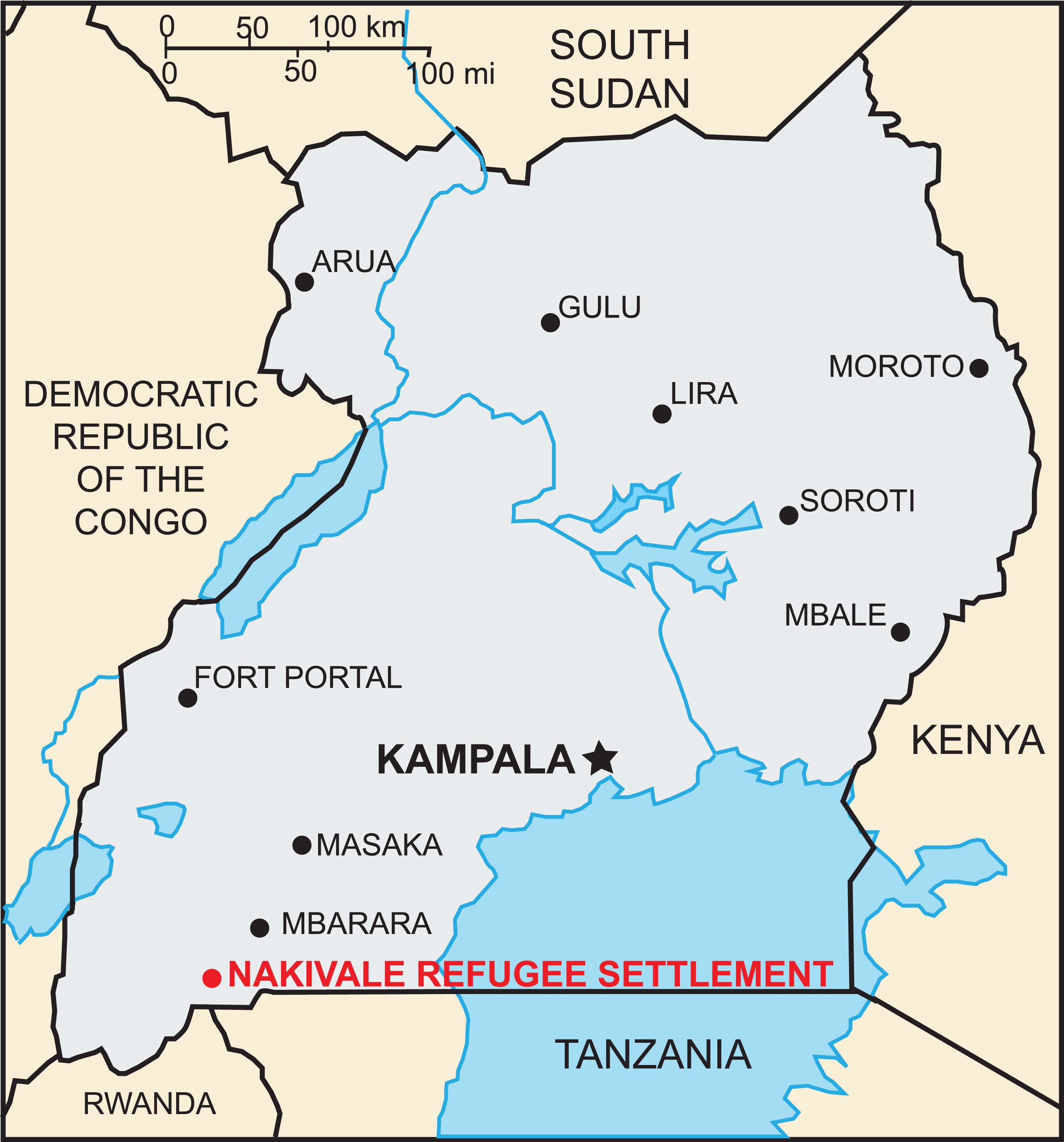
Map of Uganda and the Nakivale Refugee Settlement Site.
The OPM and UNHCR jointly administer the Nakivale Refugee Settlement. The settlement commandant, the highest-ranked OPM officer in Nakivale, also serves as its chief administrative officer. The main international agencies, UNHCR and the World Food Programme, subcontract with several national and international implementing partners. The OPM provides security and allocates land to refugees, and UNHCR coordinates basic services, such as counseling, livelihood-skills training, education, and food rations. Because the Government of Uganda’s self-reliance policies encourage refugees to become self-sustaining during the time they live in the settlement, the refugees’ food rations are reduced according to their length of stay.
Driving through the settlement, Nakivale appears to be typical countryside — not a stereotypical refugee camp. 4 Its centrally located “basecamp” (administrative center) thrives with markets, small shops, restaurants, hair salons, and a guesthouse for visitors. Approximately 80 villages, of which 68 are for refugees, surround the basecamp. Ugandan nationals inhabit the other dozen villages.
Some Ugandans living inside the settlement boundaries claim to be autochthonous to the land (Turyamureeba 2017), including the fertile Lake Nakivale wetlands. Other nationals — especially pastoralists searching for open land during the 1980s (Bagenda, Naggaga, and Smith 2003) — migrated into the area from throughout Uganda and either rented or purchased land from the national population residing in Nakivale.
Access to the land among the national population living within the settlement area has, however, been affected by two factors in particular: (1) In 2013, the National Environmental Management Authority (NEMA) implemented a policy to clear all agricultural activity within 200 meters of Lake Nakivale, the settlement’s main water source, for environmental protection of the lake; and (2) the OPM settlement commandant described nationals residing in the settlement area as illegal encroachers because the land was reserved for refugees by the Government of Uganda. The OPM position is that the land belongs to the government, whose job is to enforce settlement policies and provide land to refugees. Thus, in attempts to chase local Ugandan citizens from the land, it is not uncommon for government authorities to enter Ugandan villages within the settlement area, cut down the residents’ matooke (banana) trees, and demolish their brick houses. In turn, these locals live in a state of chronic insecurity, fearing eviction from the land on which they desperately depend for harvests and their livelihood.
Few positive changes have occurred in Nakivale Refugee Settlement during the past decade. Uganda’s policy has been one of refugee self-reliance since 1999, and its adoption of the CRRF concepts is not expected to lead to new approaches. Some government stakeholders have declared Uganda’s CRRF implementation “a continuation of past policy and practices” while recognizing the CRRF’s value for a better governance structure, which could reduce the OPM’s monolithic position as the sole governmental body entrusted with refugee affairs (cited in Crawford et al. 2019, 12). According to an Economic Policy and Research Centre report (Depio et al. 2018, 3), the districts that host refugees in Uganda — including that of Nakivale — remain among the country’s poorest and most vulnerable districts. Furthermore, a recent World Bank (2019) report described how the increased influx of refugees has worsened conditions in those hosting areas due to the nationals’ limited resilience to shocks, the local institutions’ limited capacities, and the area’s low levels of human capital. Thus, the considerations that provide the conceptual framework for this article are as essential today as when they emerged in 2013.
Theoretical, Methodological, and Ethical Considerations
Theory
This article assumes that refugees and hosts have agency in determining their lives and, thus, cannot be perceived as only victims or dependents (see also Bakewell 2007, 2008; Bascom 1998; Demmers 2012; Horst 2006). More important than “having agency” is how refugees realize that agency, given the social, economic, and political conditions, constraints, and opportunities they face (Bjørkhaug 2017; van Dijk, de Bruijn, and Gewald 2007). Adapting from Giddens and from de Certeau’s analysis of trajectories, strategies, and tactics, Honwana (2005, 2006) differentiated tactical from strategic agency. Tactical agency is the short-term responses people make within the societal structure. Even in constrained situations and from a position of weakness, people initiate and develop strategies to cope. Strategic agency is agency in a longer timeframe, when events and actions can be planned rather than “determined by random factors they could neither predict nor control” (Honwana, 2006, 71). In a competitive structure, such as in this story from Nakivale, people make choices for their lives in a vulnerable context. Thus, as the following empirical discussion shows, the refugee and host populations often act from a position of weakness. They nevertheless can make choices and bargains in their lives (Bjørkhaug 2017; Bøås 2013; Bøås and Bjørkhaug 2014).
Method
This article compares the Centre’s findings on the Nakivale Refugee Settlement with empirical data I collected at the settlement from August to October 2013. The overall aim of the original research was to understand how the refugee–host relationships unfolded in Nakivale. 5 During the same timeframe, the Centre’s researchers investigated the impact of refugee autonomy on both refugees and the wider host community in Uganda via a mixed-methods study. Their study aimed to understand the refugee economies at three field sites — Kampala, Nakivale, and Kyangwali Settlements — with a focus on entrepreneurship. Similar to the Centre’s qualitative data, my data was collected onsite and comprised in-depth unstructured and semistructured interviews, focus-group discussions, and observations. The Centre’s research seemed to have had a broader methodological scope (three diverse urban and rural settings), whereas my work enabled a deep analysis of the lives of people in Nakivale specifically. Coupled with dissimilar research objectives, it is not surprising the two projects produced different insights. Together, however, they may provide a more holistic, less romanticized understanding of the competitive dynamics at play in refugee–host and refugee–refugee relationships.
This article is framed by four essential considerations that emerged during my original analysis of the 2013 data, which consisted of 15 qualitative interviews and three focus-group discussions with refugee-population representatives; 10 qualitative interviews and five focus-group discussions with host-population representatives living inside and outside the settlement borders; and ongoing discussions with five Ugandan government officials working with the Nakivale Refugee Settlement and five representatives from international and national organizations. My inductive approach opened space to explore topics outside the main research subject. I analyzed the data with a thematic approach to the text, in combination with an understanding of the context in which the narratives of the people interviewed were shaped. I rented a room in a guesthouse run by a Congolese family in Nakivale during the seven-week data collection period and experienced few obstacles to accessing refugees, who were eager to share their stories. Access to the national residents, who sometimes associated the presence of researchers with recent land-eviction events, introduced more challenges (Bjørkhaug 2017). It was possible to conduct many of the interviews in English; in other cases, I asked the translator to read the transcripts for accuracy. The participant quotations herein were selected based on the thematic analysis. All respondents are referred to by pseudonyms. Information that might identify them is excluded from the public text.
Ethics
Research in a refugee setting entails a number of ethical concerns, among them asking for signed written consent. Not only might illiteracy be prevalent among the participants, but also, as Mackenzie, McDowell, and Pittaway (2007) discussed, the standard procedures of requesting a signature or using an audio or video recorder might be culturally inappropriate and expose the respondents to risk, mistrust, or suspicion. Given the sensitive context of the fieldwork in Nakivale, I relied on oral consent based on a relational approach instead of the standard written consent forms. I applied the same principles for security and trust to the choice for documenting the interviews. Many participants shared personal challenges of life in Nakivale, including sensitive stories of sexual violence and abuse (Bjørkhaug 2020). Rather than use a recorder, I actively wrote notes throughout all interviews and focus-group discussions and, the same day, transcribed the interviews, observations, and reflections into a computer document. The final material used for analysis comprised 61 pages. 6
Discussion
Displacement Economy in Nakivale: A Discussion with the Centre’s Findings
The findings are discussed here according to the four essential considerations addressed in the introduction, framed in a dialogue with the Centre’s findings based on their 2013–2014 fieldwork. Although the Centre provided new and valuable insight into the refugee economy in Uganda, the debate still lacks a thorough discussion of other problematic economic issues that protracted refugee displacement can cause or exacerbate. The Centre’s reporting of refugees’ livelihood approaches based on entrepreneurship in Nakivale represented alternative self-reliance approaches that do not depend on land. A holistic understanding of the settlement, however, also must address the underlying conflicts that Nakivale’s competitive structure engenders. As such, this discussion aims to provide new analyses to review the Centre’s perspective and to shed light on how Uganda’s refugee policy, abetted by the international refugee regime, fosters a culture of competition between different groups living side by side in Nakivale.
Land Distribution in Nakivale Is Not Sustainable
Refugees receive temporary plots of up to 30 m2 and are not allowed to grow perennial crops, which would represent a long-term agricultural approach. Instead, the refugees are presumed to be temporary; that is, they will ultimately hand over their plots to someone else and return home. Many refugees, however, remain in Nakivale for decades. As Betts et al. (2014, 4) noted, “Rather than transitioning from emergency relief to long-term reintegration, displaced populations too often get trapped within the system.” Despite Uganda’s liberal freedom-of-movement for trade policy, a refugee who permanently moves elsewhere in Uganda or integrates into the host society risks losing refugee status and the resultant humanitarian aid.
For the majority of people living in Nakivale, land is essential for income, and land distribution is essential for the self-reliance approach to refugee policy that earned Uganda acclaim. Poor land-allocation management can only amplify conflicts between the refugee and host populations (Ahimbisibwe 2016) and threaten Uganda’s self-reliance approach. In their refugee economies analyses (Betts et al. 2014, 2017; Betts and Collier 2017; Betts, Omata, and Bloom 2017), the Centre argued that a functioning land-allocation system can be an effective means to support refugees who come from agricultural backgrounds. Although they acknowledged that the land quality and distribution in Nakivale were inadequate, the Centre’s analyses lacked a discussion of the social tensions that the land-distribution policy engendered among Nakivale residents (refugee as well as host) or of its sustainability.
New refugee influxes resulted in less and poorer-quality land available for both new arrivals and Ugandan citizens, and reduced the size of the plots allotted to refugees (Iclan, Oliver, and Connoy 2015). By 2018, only half of the refugees in Uganda had access to land (World Bank 2019). Betts et al. (2019, 22) later described this weakness in the land-allocation policy (e.g., revealing that 80 percent of Congolese refugees who arrived in Nakivale before 2012 had access to land, compared to 17 percent of those who arrived later), but without addressing its potential ripple effects. For instance, the shift from predominantly cattle-keeping to crop-farming on small land plots with requirements to grow annual crops, coupled with the increasing human settlement and urbanization around Nakivale, have led to land degradation, wetland encroachment, and loss of wildlife habitats and crucial wetland resources (Kamukasa and Bintoora 2014).
The government addressed some of these environmental challenges by establishing NEMA as a semi-autonomous institution in 1995 to fight climate changes. In 2013, NEMA mandated the eviction of people who illegally settled on forest land, national game parks, swamps, and wetlands — and an end to farming within 200 meters of Lake Nakivale. The fear of eviction from lands they claim as their own has led the local host population to argue that the government’s land-allocation policy prioritizes the well-being of refugees above that of Ugandan citizens. One informant explained,
When the president was a refugee in Sweden, he did not have any land. He was confined in one place. Land cases [legal cases against the government] started three years ago. Now, we are treated like foreigners. I am personally affected. Since 2006, I have not had a peaceful moment. Before that, I could produce sufficiently to support my family. Now, I cannot produce enough to send my children to school. (Ugandan national, Nakivale villager)
We are scared because of NEMA. What happened to us in February changed our lives. Our basis for a livelihood has changed. The education of our children is affected by the lack of income. People who were born here have been told [by NEMA] that they should seek a new life. This is the challenge. The environment is protected by NEMA. They came here with police, equipped with guns. They destroyed all the houses.
The plantations are down. We are working for the refugees for 3,000 UGX per day.
7
Sometimes they pay us by cassava. We work from 7:00 a.m. until 1:00 p.m. Our lives have changed seriously. Before, our children used to go to school; now, we work for the refugees to get food. We might be better off, and life might improve, after the next harvesting season, even if some of it [land] is given to the refugees. That is, if NEMA does not come back. We are constantly on alert. When we work on our plots, we keep looking over our shoulders.
Fishing in Lake Nakivale is the only legitimate income-generating activity available for the Ugandan host population living in Nakivale. Although it is the one livelihood opportunity without competition from refugees, the lake water is polluted, and the fish stock reduced:
We can still provide some income through fishing, but that is mainly sold to the refugees and nationals in the area.…Around 8:00 a.m., [intermediaries] come and purchase the fish. The fish cannot travel far, as it is sold fresh. Fishing is a privilege for the Ugandans only. The refugees are not allowed to fish in the lake. We feel bad about the inequality between the refugees and the nationals, [but] the refugees have more income-generating activities and can have land sizes up to 30 acres. Every day, almost, we are told that this land is allocated for refugees. It started already in 1994, after the influx of refugees from Rwanda. But we are not angry at the refugees. They are not to be blamed for being here. We are angry at the government. The refugees are not supposed to be given land in Uganda. In other places, they are designated to certain places. The government is the problem. (Ugandan national, Nakivale villager)
The issues of rights to the land, rights as citizens, and the government’s precarious balancing of citizens’ rights with refugee rights are far beyond the scope of this article. More germane is the conflict it fosters between the refugee and host populations in Nakivale. Given the ever-increasing influx of refugees into Uganda, continuing with the existing policies and practices risks not only increasing exploitation and abuse, but also the overall failure of Uganda’s refugee self-reliance approach.
Corruption Strongly Influences the Refugee and Host Populations Living in Nakivale
In 2018, a corruption scandal in Uganda led to the removal of four OPM officials for misusing resources allocated for refugees (Sserunjogi 2018). The scandal lent credence to respondents’ accounts (which otherwise had been difficult to verify) of a culture of bribery and corruption. The Centre’s analyses did not, however, problematize the implications of such a culture. Nor is this article’s discussion intended as an investigation or measurement of the corruption or its impacts; instead, it addresses how the perception of a culture of corruption affects the everyday lives of the refugee and host populations in Nakivale.
In the interviews, the host-population representatives repeatedly reported that they had offered bribes to authorities who threatened to expropriate the land Ugandan citizens perceived as their own. Paying bribes is a short-term solution for those with the finances to do so. It could strengthen their capital and allow continued access to their existing (or to even larger) land plots. It is, however, an irregular strategy that can reinforce inequalities: People with no means to pay bribes often remain the losing party in the resources game in Nakivale. Land is the main livelihood for many nationals living in Nakivale, and the threat of being chased off it is a constant stress factor for the host population. Ugandan nationals often described Nakivale as a place that favors refugees:
The matter has worsened. Refugees bribe the commandant. For 30,000 to 50,000 UGX [US$8–14], you can buy one shy of land [0.25 acre]. Ugandans…are told that the land is for the refugees and not for Ugandans. The high court wrote to the responsible authorities, asked them not to evict the nationals. The authorities still play the “underground” game, evict them, and give it to the refugees.…A refugee can own 30 acres; a national can own one shy. Even the new refugees have large plots of land. Those who stay here add more land through the commandant. We do not have a problem with the refugees but with the leaders who allow this to happen. We feel desperate and fed up with the situation. Our rights and our security are insecure. We do not feel like Ugandans. (Host community focus group)
They [OPM officials] break down the crops; even houses. They come here with a team of refugees and soldiers to tear down our properties. Everyone in the community is now afraid because we have seen the houses of our neighbors have been demolished. (Host community focus group)
The host population’s relationship with Congolese refugees living nearby was quite peaceful, however, despite their competition for land and resources. Their children attended the same schools, and the host villagers employed refugees during harvest season. The village leader estimated that 30 households regularly employed refugees and paid them 4,000 UGX (US$1.08) for a day’s work. Like many national villages in Nakivale, this village could export matooke, beans, maize, and groundnuts via trucks that came from Kampala to Nakivale. Its citizens relied on networks outside of Nakivale because, as long as they lived inside the settlement, they made every effort to avoid being seen or heard by the authorities. Thus, even within the marginalized and vulnerable population of local citizens living inside Nakivale, access to resources varies. Paying bribes is one factor that contributes to those distinctions.
Another space for negotiations that existed among the host population in Nakivale was the irregularity of the OPM’s practice of evicting local citizens. The courts had halted OPM’s evictions in some cases, and ongoing cases against OPM and NEMA for the brutality of their evictions provided some hope of stalling further evictions (Kabasongora 2013). In some cases, Ugandan President Yoweri Museveni had sided with the evictees, apparently to win political support (Médard and Golaz 2013). Such inconsistent support for the eviction process nurtured resistance to evictions among the host population in Nakivale and gave them hope for an opportunity to stay. As long as the rules for defining and dealing with “encroachers” remain arbitrary, discretionary, and inconsistently enforced by local authorities, however, the opportunities for bribery and corruption will likely continue.
The Impact on the Local Host Population Is Not Homogeneous
The Centre illustrated how refugees often contribute positively to the host-state economy, demonstrate economic diversity, and create sustainable livelihood opportunities for themselves. The researchers concluded that a thorough understanding of refugees’ economic outcomes could improve their local, national, and transnational market-based opportunities. Thus, they aimed to promote sustainable opportunities for market-based approaches that lead to refugee autonomy and self-reliance. In addition, by arguing that refugees are economically diverse, Betts et al. (2017) rightfully challenged the government’s strategy that assumes all refugees could become self-reliant through agricultural productivity (see also Bøås 2015). Betts et al.’s (2014) study of refugee economies showed that the refugee population is shaped not only by what the soil provides but also by innovative entrepreneurship that significantly affects the local market. Betts et al. (2017, 716) proposed that “refugee economies represent a distinctive analytical space insofar as refugees face different formal and informal institutional barriers and distortions in their economic lives compared to nationals or other migrants” (emphasis added).
This article argues, however, that Nakivale Refugee Settlement exposes the refugees and the local host population living inside the settlement to the same institutional space but without the same formal rights and protections. This condition goes beyond what Betts et al. (2019, 33) later addressed as a source of tension. Instead, to produce sound and holistic policies, it is necessary to understand the constraints among the Nakivale host population. As previously described, many of these nationals (whom the Ugandan authorities defined as “encroachers”) live as illegal settlers in constant fear of being evicted. They have no viable “Plan B” for alternative livelihoods. With nowhere to go and no money to buy land elsewhere, they must try to navigate a livelihood and a life that make them as invisible as possible to the authorities.
Nakivale exemplifies a situation in which the cost of a country’s refugee-welcoming policy can come at the expense of its citizens, who compete for existing resources. The dependency rate in Nakivale is as high as 67 percent, meaning most households live with high food insecurity, and refugees depend on humanitarian support for survival. Betts et al. (2014) reported that refugees in Nakivale also depend on extra income beyond those handouts. This inadequate access to social support and protection for both the refugee and the host populations in Nakivale can contribute to marginalizing and excluding refugees who are unable to make a sufficient income without humanitarian aid (Iclan, Oliver, and Connoy 2015). It challenges Uganda’s self-reliance policy and adds pressure on the host population living inside the settlement.
Kigozi (2015) reflected on the difficult balance of promoting a positive image of the refugee situation without underestimating the hardships. This article suggests that balance may be found with a focus on how the Nakivale conditions have created, for some, interdependence between refugees and host communities and, for others, high competition for resources. The “burden-versus-benefit” debate has become complicated beyond a simplistic dichotomy of winners and losers. Omata and Weaver (2015) proposed that local stakeholders will most likely experience a combination of positive and negative impacts of varying magnitudes. The local citizens living inside the official borders of the Nakivale Refugee Settlement are a vulnerable population, but the degree of vulnerability is not constant. For example, as explored more deeply in the preceding discussion on corruption, this population has tactical agency. That is, they have opportunities to improve small aspects of their lives according to the resources they can muster in expectation of needing to pay bribes. Regardless of what they can pay, however, the local citizens have the same chronic fear of eviction. A bribe is a short-lived, tactical move to secure their livelihood a little while longer. A respondent described the feeling of hopelessness in cases of eviction:
This man was born in this area. He is 80 years old. He has documentation on taxes he paid in 1940, before the refugees arrived. He produced his children here. His parents even lived here before he was born. Where do they have the authority to chase him away, and where should he go? (Host community focus group)
We now sell very little, and what we sell is sold to the refugees. The trucks that come here mainly purchase from the refugees. We sell some matooke but only inside the settlement. We used to sell large-scale to the trucks but that was before everything was destroyed. A bunch of matooke could be sold for 15,000 [UGX]. (Host community focus group)
We have not had any challenges here with the presence of the refugees. On the contrary, we benefit from the access to hospital, water points, and schools. Refugees come to the village in search for work. Not in big numbers, but some come seeking for work. When they do, they often travel together with someone, and if there is work available, they are employed. If we are satisfied with the work, we ask them to come back the next day. If you hire a national, they are paid 5,000 UGX a day, while the refugees are paid 4,000 UGX a day or they pay them in matooke. (Ugandan national living outside the settlement)
Among Refugees, the Somali–Congolese Relationship Is Exploitative, Not Amicable
Although the bulk of this analysis has discussed the refugee–host relationship, the effects of refugee–refugee relationships and the tactical agency invoked therein also merit mention. This final section explores the relationship between refugee groups in Nakivale, in this case the Somali and the Congolese.
Betts and Collier (2017, 125) discussed how Somali exceptionalism affects Nakivale’s economic geography with commercial activity that attracts refugees from across the settlement. They found the Somalis’ economic networks to be more organized, systematic, and extensive than those of other refugee nationalities. Betts et al. (2017, 723) supported their findings by presenting estimated economic differences among the refugee groups. For example, in Nakivale, 21.6 percent of Somali earned more than 300,000 UGX (US$80) per month compared to only 0.9 percent of Congolese primary earners. Kigozi’s (2017, para. 7) response targeted the Centre’s concept of refugee economies as being based on a single refugee community: “Excessive concentration on the economic performances of a limited number of Somalis in certain settlements risks obscuring the fact that the majority of refugees in Uganda live at subsistence level” (para. 19). Furthermore, although the Centre’s outputs applauded refugees for “seeking solutions to their own economic challenges” (para. 24), they did not address the potentially exploitative effects of those solutions. Instead, Betts et al. (2017, 119) described an “amicable relationship” between the Somalis and other refugees.
“New Congo” (where Congolese refugees live in Basecamp 2) and “Little Mogadishu” (where Somali refugees live in Basecamp 3) border each other, separated by only a small fence. New Congo looks like a poor semi-urban town, with small brick houses along narrow, dusty streets; a few water points where people line up to fetch water; and some small shops selling small items. Little Mogadishu, in contrast, is organized with clean streets, large shops full of a variety of items, hair salons, video parlors, restaurants, and even a bus station for travel to Mbarara or Kampala. In his book about the politics of conflict economies, Bøås (2015) showed how the Somali community was economically better off than were the other Nakivale communities. The Somalis’ external support networks, combined with good business skills, placed them atop Nakivale’s socioeconomic hierarchy. That uneven socioeconomic hierarchy, however, seldom leads to an “amicable relationship” (Betts et al. 2017, 119).
The Somali and Congolese socioeconomic and cultural differences influence the way they perceive each other:
The Somali and Eritrean communities serve the Congolese by giving them work. The Congolese are the “real refugees”; they do not work well. They sit all day on their bum, eat maize, and wait for resettlement. Some have been waiting for 17 years. They lack initiative and, even when we hire them, they need to be pushed. The Somalis, Eritreans, and Ethiopians are hard workers. They seize opportunities and are business oriented. Most of the people in these communities have support through remittances. If you receive $100 per month, you can do fine here in Nakivale. (Focus group with Somali and Eritrean refugee respondents)
The water is not safe, the food is too little, the children have no schooling and the men no work. We are indeed suffering here in Nakivale. Nothing has changed. We thank them [the hospital, OPM, and UNHCR] for a place to sleep, but they do not want to hear about our problems. We wash for the Somalis; we prostitute ourselves for one dollar. If you are lucky, you only have to sleep with one man.
For many people, life in Nakivale is a constant struggle. Alberto, from eastern Democratic Republic of the Congo (DRC), was 34 years old and the eldest of five siblings living together in a small house in Nakivale. He lacked agricultural skills — he had been a teacher in the DRC — and did not speak much English. The Mai-Mai rebel group in the DRC had killed his father, mother, and son; his pregnant wife was missing. He lived at Basecamp 2 in a small house without electricity. The family lived off handouts and small ad hoc income from work they found within the settlement — mostly, washing the Somalis’ clothes and making bricks. His life represented a constant struggle for survival, always looking for small bargains in Nakivale that could secure their family’s livelihood:
We eat one time per day. If we eat twice, the food will not be enough.…When somebody in the household makes money, we make it together. We need money for charcoal. One bucket of charcoal costs 6,000 UGX. We sell half of our food rations to cover other expenses. Every month, when we get the food, we sell half of it.…I cannot sleep. I think too much.
Conclusion
The Centre’s initial optimistic findings on the refugee economy in Nakivale overshadowed the fact that the majority of people there still depend on humanitarian aid. They emphasized the refugees’ economic lives by highlighting the success of some entrepreneurs amid a land-based agriculture economy. As long as the main approach to livelihood in Nakivale remains the same — namely, to maintain some production through cultivation of allocated land, food distribution, and provision of basic services — then the challenges to the self-reliance strategy described in this article will persist. Uganda’s national refugee policy aims for a holistic approach that provides for the well-being of both the refugee and host populations. To date, the modus operandi of refugee policies in Nakivale and throughout Uganda has not changed significantly since implementing the self-reliance strategy in 1999. What had been the gold standard for welcoming refugees becomes more challenging with the increasing influx of refugees to Uganda. Thus, this article points to several mechanisms in the Nakivale Refugee Settlement that show how ad hoc self-reliance strategies provide opportunities for survival tactics but leave little room for durable solutions. A complicating factor in this difficult game for resources is the environmental challenges that are exhausting Nakivale’s fertile land. There are simply too many people and too little land available to maintain sufficient livelihood opportunities for all.
If the problematic trends outlined in this article continue, a worst-case scenario would be that Uganda’s generous policy eventually changes from refugee settlements into refugee camps to manage the refugees’ ongoing needs. Uganda’s welcoming open-door policy is on the threshold of collapse. New approaches are urgently needed to manage the flow of refugees into Nakivale and, presumably, other Ugandan settlements. The current approach to refugee protection is at best insufficient and at worst harmful. Moreover, the international perception that Uganda’s refugee policy is exceptional might come at the cost of investment in other durable solutions.
The Nakivale Refugee Settlement represents a complex refugee situation with actors of different nationalities and concerns living side by side. Once upon a time, Nakivale was relatively peaceful, but the area’s rapid population increase intensified demand for limited resources and fostered a culture of fear and competition. Today, most people living in Nakivale adjust to life there because, they argue, they have nowhere else to go. Nakivale’s livelihood opportunities, however, are molded by an environment shaped from fear, corruption, and inconsistent policies. Its economy creates profit for a few but a life of just “getting by” for most. The permanent losers in this game for resources are the host nationals who live in fear on land allocated to refugees and must manage under severely constrained conditions.
The Centre’s work showed that refugees could establish an economic base without dependence on humanitarian aid. Instead, remittances, entrepreneurial skills, and the growth of local, national, and global networks could enable trade beyond Nakivale’s borders. If this were implemented as an overall approach to refugee policy, however, it would require a fundamental change in Uganda’s longstanding policy of refugee protection. In addition to suggesting the need for further studies about the refugee–host and refugee–refugee relationships in Nakivale, this article demands a new, critical debate about the extent to which Uganda’s refugee policies fuel local conflicts and marginalize the national population.
In closing, this article presents four recommendations for policy and practice, which largely track the CRRF objectives to ease pressure on host countries and enhance refugee self-reliance. First, refugee policy, practice, and interventions should limit, improve, or repair the ways that hosting refugees can challenge the national population — such as the land concerns for citizens living in Nakivale. The Government of Uganda should capitalize on the CRRF’s first objective — to ease pressure on host countries — and prioritize the welfare of its citizens in the national land-allocation strategy. To cut down citizens’ plantations and effectively abandon them will invariably create a marginalized population in a permanent limbo. If the government does not want its nationals to settle in Nakivale, then it must help them find alternative land or compensate them for loss of the land on which their families have lived for decades and, in some cases, for generations.
Second, within Uganda’s land-allocation system, authorities operate under unclear rules of how to define or handle “encroachers.” This lack of clarity cedes authority (by default) to local leaders in the settlement who are vulnerable to corrupt practices. In tandem with the recommended land-distribution reform, the Ugandan parliament and judiciary should craft clear, consistent, and fair national legislation regarding autochthonous land ownership and the use of eviction practices. The international community can help eliminate mechanisms that facilitate corruption in the land-allocation system by, for example, assisting in the design of economic reforms that supplement systemic integrity components.
Third, “leveling the playing field” in the competitive game for resources is closely tied to rethinking Uganda’s land-distribution policy, which has assumed a self-reliance based in agriculture. As the Centre suggested, the policy of self-reliance should include non-agricultural, income-generating activities to a greater degree than in the past. This shift would help ease land-distribution conflicts and expand the livelihood opportunities for citizens as well as refugees. In a survey of small businesses in Uganda, however, 74 percent highlighted limited access to finance as a key constraint to entrepreneurship, and 86 percent had used their own funds for start-up (FSD Uganda 2015, 18, 36). If Uganda were to promote non-agricultural income-generating activities as a viable alternative livelihood approach for Nakivale’s refugee and host populations, then those activities must be made accessible, even for people who do not have access to private remittances or loans, through governmental or international funding.
Fourth, although refugees are allowed to move freely out of the settlement, they must live in the settlement to maintain their status and registration as refugees — and thus their access to humanitarian aid. To ease the ever-increasing pressure on the Nakivale Refugee Settlement, the Government of Uganda could consider allowing refugees to opt out of the settlement and pursue their livelihoods elsewhere without losing refugee status or access to assistance.
Footnotes
Declaration of Conflicting Interests
The author declared no potential conflicts of interest with respect to the research, authorship, and/or publication of this article.
Funding
The author(s) disclosed receipt of the following financial support for the research,authorship, and/or publication of this article: The Research Council of Norway funded the research of this study in Nakivale, Uganda.