



Abstract
In this article, I explore different forms of perceived threat posed by the presence of minority groups and how threat impacts residential segregation and neighborhood preferences. I extend previous research by exploring non-Hispanic white residents’ preferences regarding black and Latino neighbors using qualitative data from in-depth interviews with white adults conducted in multiple neighborhoods in Buffalo, New York, and Ogden, Utah. My findings suggest that white residents perceive threat differently for blacks and Latinos. In general, blacks and Latinos elicit crime threat but Latinos also elicit concerns about a cultural threat to dominant American culture. I distinguish between perceived threat in neighborhood preferences based on: (1) perceived threat to individuals surrounding personal safety and neighborhood conditions and (2) perceived threats to national identity and economic well-being of the state. Several studies have looked at the role of cultural threat in how whites perceive racial and ethnic minorities; however, few studies look at how this threat affects neighborhood preferences specifically. Studying blacks and Latinos sheds new light on how multiple forms of perceived threat affect whites’ neighborhood preferences.
Scholars have documented the role of perceived threat in dominant group responses to racial minorities and immigrant groups (i.e., Iceland and Sharp 2013; Quillian 1995; Raijman and Semyonov 2004; Wilson 2001). Group-level forms of threat include the size of the subordinate group (group threat theory)—comprising competition for resources as well as fear of political mobilization by minority groups (Blalock 1967; Quillian 1995)—and culture threat—including perceived threat to the dominant group’s way of life and national homogeneity (Hopkins 2010; Raijman and Semyonov 2004). While several scholars discuss how threat impacts white prejudice generally, few consider how various forms of threat impact the residential choices of white Americans. I consider these forms of threat in the context of racial and anti-immigrant prejudice as they pertain to non-Hispanic white residents’ neighborhood preferences regarding the racial composition of their neighborhoods.
Blumer (1958) argued decades ago that prejudice against other racial groups is based on a sense of group positioning and collective threat. A key component of Blumer’s argument is that the dominant group feels a sense of prejudice based on their position in society being threatened and feel the need to protect the status and resources they think belong to them. Dominant group members therefore respond to growing numbers of subordinate groups negatively and defensively. Moreover, the impact of group size in minority-majority group relations often results in dominant group fear about competition for resources and loss of political power (Blalock 1967). Thus, the relative size of the minority group can be expected to have negative consequences for the amount of perceived threat a dominant group may experience. While Blumer and Blalock developed these ideas based on general perceptions of threat and prejudice, several scholars (Fox 2004; Giles and Buckner 1993; Glaser 1994; Quillian 1996; Taylor 1998) argue that similar theoretical arguments can be made regarding neighborhood preferences and segregation outcomes.
Because group size is positively associated with levels of perceived threat from whites, I explore how group threat, racial prejudice, and culture affect non-Hispanic white Americans’ preferences for blacks and Latinos as neighbors in two cities that vary in several ways, but most specifically in terms of the relative size of their black and Latino populations. Data come from qualitative interviews conducted in Buffalo, New York, and Ogden, Utah. I explore whether whites’ perceptions of threat posed by blacks and Latinos differ and how these differences may influence residential preferences.
Trends in Segregation
In American metropolitan areas, residential segregation amplifies and exacerbates urban problems, leaving racial and ethnic minorities disadvantaged economically, concentrated in poor neighborhoods, and segregated from opportunities, mobility, lucrative jobs, and good schools (i.e., Denton and Massey 1988; Logan and Stults 2011; Wilkes and Iceland 2004). While there has been a decrease in residential segregation for African Americans, they remain more segregated from whites than other groups are (Fischer 2003; Glaeser and Vigdor 2001, 2012; Logan and Stults 2011), and in most American metropolises segregation remains high (Charles 2003; Emerson, Yancey, and Chai 2001; Iceland and Wilkes 2006; Massey and Denton 1993; Sui and Wu 2006). Hispanic-white segregation as measured by dissimilarity has declined slightly between 2000 and 2010, while Hispanic isolation increased (Logan and Stults 2011) as a consequence of Hispanic population growth, particularly in metropolitan areas with significant Hispanic populations (Charles 2003; Iceland and Sharp 2013; Lewis et al. 2011; Logan and Stults 2011; Massey and Fisher 1999; Wilkes and Iceland 2004). Although scholars have found that Latinos and Asians are less segregated from whites than African Americans (Charles 2003; Massey and Fisher 1999; Wilkes and Iceland 2004) and that whites’ negative attitudes regarding race are strongest for blacks (Dixon 2006; Emerson et al. 2001), Tolbert and Grummel (2003) identify an increase in white hostility in areas with large Latino populations.
As the United States becomes increasingly diverse, patterns of prejudice against Latinos may become more similar to patterns of prejudice against blacks. Stereotyping of Latinos may be tied to citizenship and language (Oliver and Wong 2003; Rocha and Espino 2009)—factors not often considered in studies of neighborhood preferences. Increasing diversity and rising segregation for new immigrant groups necessitate investigations into how neighborhood preferences associated with other minority groups compare to the segregation blacks experience. With other groups to consider when making residential choices, white-black preferences might liberalize or might harden. Neighborhood expectations and perceived threat may change as Latinos enter neighborhoods (DeFina 2009). This underscores the need to explore various forms of threat and how threat may impact white preferences differently depending on the minority group they are considering as neighbors.
Threat, Culture, and Neighborhood Preferences
One explanation for white aversion to black neighbors, and increasingly to Latino neighbors, is that majority group members become averse to growing populations of minority group members because they feel their power and status threatened. Previous studies indicate a strong relationship between the size of the black population and whites’ prejudice toward blacks (Fox 2004; Giles and Buckner 1993; Glaser 1994; Quillian 1996; Taylor 1998). From this perspective, the size of a minority group has a powerful influence on the majority groups’ aversion to minority group members (Blalock 1967; Quillian 1995).
White flight, while a somewhat different process, relates to group threat as a social distance mechanism (i.e., not wanting to share close physical proximity with out-groups). Quillian (1999) finds that white migration out of neighborhoods with more than a small percentage of African Americans is key to understanding residential segregation (see also Crowder 2000; Quillian 1996). Even when controlling for crime and other neighborhood characteristics, the percentage of young black men in a neighborhood is strongly associated with perceptions of crime, therefore increasing whites’ reluctance to move into that neighborhood (Quillian and Pager 2001). Similarly, while Krysan and Bader (2007:723) did not directly measure group threat, they found that whites “were very likely to ‘never consider’ all black, mostly black and racially integrated communities,” even in affluent, suburban areas. Other research indicates a relationship between white flight and areas that are more than 20 percent, 33 percent, or 50 percent black (Bobo and Zubrinsky 1996; Farley et al. 1994)—suggesting that whites feel comfortable sharing neighborhoods with blacks but only to a certain point (Crowder 2000). Bolstering arguments about the important role group size plays in perceived threat, research shows that southern whites living in close proximity to a large black population are more likely to support policies that are unfavorable to blacks (Giles 1977; Giles and Buckner 1993; Giles and Evans 1985; Giles and Hertz 1994; Key [1949] 1984).
Emerson et al. (2001) argue that white fear of racial turnover in a neighborhood only applies to large numbers of blacks in their neighborhoods and that this relationship does not exist for Asians and Latinos. Similarly, others suggest that there is no significant relationship between large groups of Latinos or Asians and increased white prejudice (Dixon 2006; Dixon and Rosenbaum 2004; Fox 2004; Hood and Morris 1997). Finally, Taylor (1998) finds that white feelings of threat are directly associated with anti-black prejudice and are not extended to other ethnic or racial minority groups.
Conversely, other scholars (Iceland and Sharp 2013; Oliver and Wong 2003; Tolbert and Grummel 2003) argue that group threat does apply to other groups, including Latinos and Asians, as group size increases. Similarly, Oliver and Wong (2003) argue that whites feel threatened by Asians, Latinos, and African Americans irrespective of group size. Tolbert and Grummel (2003) note an increase in white hostility in areas with large Latino populations. Moreover, Iceland and Sharp (2013) found that even though whites’ exposure to other groups has increased over time, large populations of any minority group are positively associated with segregation, prejudice, and discrimination.
Interestingly, while Iceland and Sharp (2013) found that areas with greater diversity led to increased racial threat from whites, DeFina (2009) found that diversity actually reduces racial threat—areas with multiple minority groups had less segregation and experienced less racial tension. Consequently, we may need to reassess how we talk about and define diversity. Looking ahead, it may be the case that as we encounter greater diversity (presence of multiple minority groups) within our neighborhoods, we may experience fewer racial tensions and less perceived threat.
Buckler, Swatt, and Salinas (2009) found that, along with other forms of threat, culture threat had a significant impact on attitudes about illegal immigration. Similarly, Raijman and Semyonov (2004: 785), in their study of immigrant rights in Israel, argue that “the perception of threat to cultural and national homogeneity may give rise, for example, to discriminatory attitudes and anti-immigrant sentiments.” Moreover, Oliver and Wong (2003) argue that neighborhood preferences are guided by racial motivations as well as by a sense of nationalism and indicate that whites are more positive toward Latinos who speak English. Finally, Rocha and Espino (2009) find that whites’ attitudes are more negative toward Spanish-speaking Latinos compared to English-speaking Latinos. Accordingly, minority groups who pose a threat to cultural values and a nation’s sense of homogeneity may give rise to feelings of prejudice. Moreover, the greater the perceived cultural differences are between the dominant group and the minority group, the more pronounced feelings of threat will be.
Jaret (1999) found when comparing anti-immigrant sentiments during 1880–1924 and 1970–1998 that several forms of threat from the past are echoed in contemporary sentiments regarding immigrant groups. For example, past and current fears about immigrant groups challenging “American” identity and ways of life remain prevalent—as does the expectation that “they” should become “like us.” Likewise, Hopkins (2010) found that national conditions and perceptions of groups impact local politics and perceptions of immigrant groups.
This suggests that as the United States becomes increasingly diverse, historic patterns of prejudice against blacks may be augmented by an increase in white hostility toward other minority groups, especially Latinos. While several scholars have examined whites’ preferences toward African Americans and Latinos (i.e., Charles 2003; Emerson et al. 2001; Oliver and Wong 2003; Tolbert and Grummel 2003) and others have examined whites’ attitudes toward Latino immigration (Buckler et al. 2009) and the fear of a subsequent American cultural shift (Fraga and Segura 2006), none have directly connected whites’ fears and attitudes about immigration with the preferences they have for whom they would like in their neighborhoods.
Aims of My Study
While several forms of threat have been shown to influence whites’ attitudes toward minority groups more generally, it is less clear how these forms of threat manifest themselves in neighborhood preferences or how threat varies across minority groups. I examine the various ways threat manifests itself in regard to the neighborhood preferences of white Americans. By focusing on whites’ preferences for blacks and Latinos as neighbors, we can better understand how culture moderates the relationship between group size and prejudice and how this may affect neighborhood preferences. I examine white preferences in two cities with different proportions of black and Latino residents. I specifically focus on how white preferences are influenced by racial and/or anti-immigrant prejudice. I conceptualize anti-immigrant prejudice as any expression by white residents related to fear of increasing heterogeneity, loss of “American” ways of life, remarks about presumed immigration status, and discussions about the English language. Because race and class are linked in the minds of many Americans when they think about neighborhoods, it becomes difficult to talk about social class without talking about race, and vice versa (Krysan 2002b; Krysan et al. 2009). Thus, I conceptualize racial prejudice as any remarks made by white residents relating to racial proxy factors (Harris 2001) such as neighborhood safety, housing conditions, and crime rates, as well as deliberate race-specific remarks about the racial composition of an area. While I treat all remarks related to proxy factors as a reflection of prejudice, such remarks may reflect race-neutral concerns about safety and housing investment risks.
Data and Methods
Data for this article come from 33 in-depth, face-to-face interviews conducted with white adult residents of Ogden, Utah, and Buffalo, New York. Interviews took place between September 2008 and March 2009, prior to more recent immigration-related laws that have been passed (e.g., Utah’s HB 497 gives police officers authority to arrest people who are perceived as being in violation of immigration laws and requires individuals to be able to prove their legal status at all times [le.utah.gov]). Data were collected before and immediately following President Obama’s election. This potentially affected how respondents felt talking about race and blackness, more specifically, as it may have either heightened or muted feelings about the importance of race in the minds of my respondents.
As a white woman, I was aware that my race and gender might influence residents’ responses. While there were no times during the interviews that respondents directly addressed my race or gender, it is possible that their stated preferences would have differed were I of another race. Being of the same race may have helped me gain the trust of local whites, resulting in them being more open and honest about their prejudices.
During the interviews, I asked about residents’ backgrounds, where they grew up, the racial composition of their neighborhood as a child, how well they knew their neighbors, and other questions about childhood and current neighborhoods. Interviews lasted about one hour and were recorded and transcribed. The interviews typically followed a formal structure; however, there were times I felt I needed to deviate from the order of the questions based on respondents’ comfort levels. If it seemed I needed more time to build rapport with a respondent before asking more sensitive, race-focused questions, I would rearrange the order of the questions.
Following each interview, I wrote a brief analysis based on theoretical foundations in previous literature. I did not formally analyze the data until I transcribed all the interviews. I followed a system of open coding and created codes based on existing literature and respondent interviews. For example, if a respondent mentioned feeling an aversion to a neighborhood because of the size of a minority population, I would add the code (GROUPTHREAT) next to the entry and then file that response accordingly. I did not use software to code or analyze my data.
To gain information about the residents’ preferences for actual neighborhoods, I used maps of several neighborhoods in each city (see Table 1) and asked residents to indicate if they would find those neighborhoods desirable and to explain why. The neighborhoods that I used for sample selection were the same neighborhoods I used for the maps shown to residents. When shown the map that reflected the respondents’ own neighborhood, I asked them to describe how they felt living where they did. I also used showcards (see Farley et al. 1978; Krysan 2002a; Krysan and Bader 2007; Krysan and Farley 2002) representing different racial compositions of hypothetical neighborhoods (see Figure 1). Using maps and showcards facilitated comparisons between hypothetical preferences and preferences for actual neighborhoods. All respondents were asked about the same neighborhoods in their respective cities and saw the same showcards.
Racial Composition, Median Household Income, and Percentage in Poverty for Real Neighborhood Maps and Resident’s Neighborhoods.

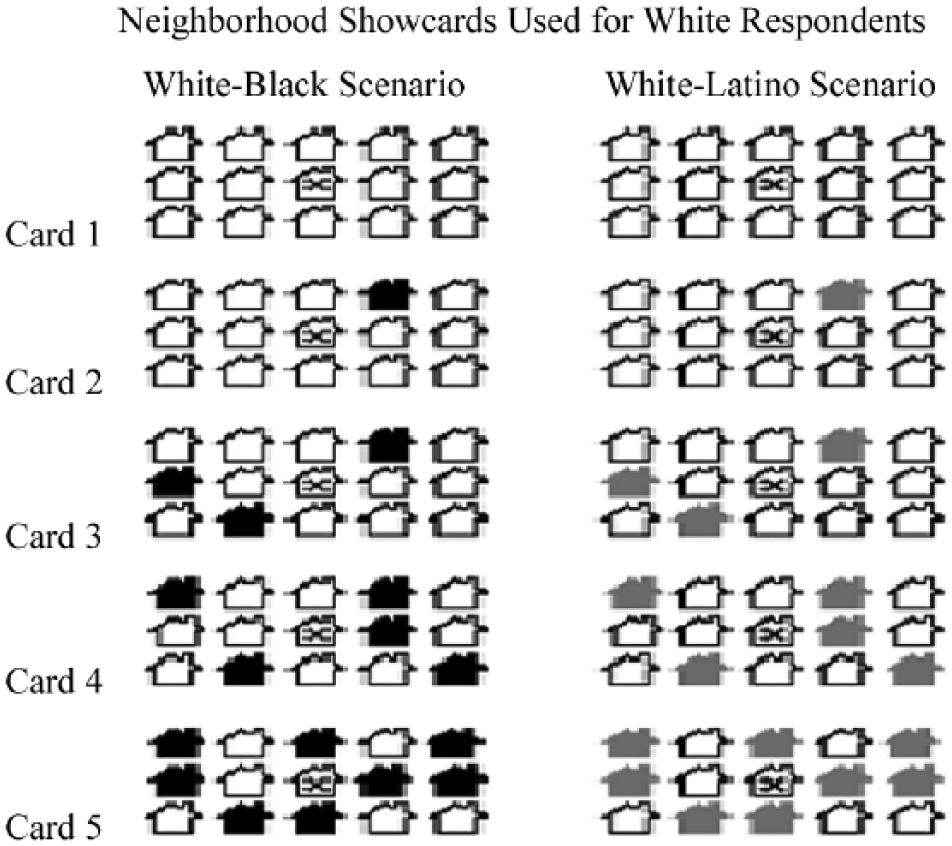
Hypothetical neighborhood showcards.
Sample
Because I wanted to select respondents from a diverse set of neighborhoods, I used census data to employ purposive stratified multistage sampling. First, I selected a stratified random sample of block groups, defining strata based on racial composition and median household income. Because the relative sizes of the black or Latino populations in Buffalo and Ogden differed dramatically, it was necessary to use a relative measure of minority group size rather than an absolute standard. Block groups were stratified in a manner that permitted me to distinguish between neighborhoods with relatively large (Buffalo: >90 percent black, >90 percent white; Ogden: >90 percent white, >50 percent Latino) and moderate populations in each area with high (>$60,000), middle ($30,000 to <$60,000) and low (<$30,000) median incomes (for specific racial compositions of the neighborhoods, median household income, and percentage in poverty, see Table 1). Thus, a neighborhood that is 90 percent black in one city may be perceived as being a “black neighborhood,” while a neighborhood that is 50 percent Latino may be perceived as being a “Latino neighborhood” in the other. Because I was selecting neighborhoods based on racial composition and median household income, I was limited in terms of income distribution or variation because I wanted to ensure specific racial compositions.
Second, I randomly selected two blocks within each sampled block group. Third, I randomly selected houses from the sampled block. I counted the number of residences in the selected block and divided that total number of residences by the total number of interviews for the block. Beginning with a randomly selected residence, I then selected every nth house.
When people refused to be interviewed, I would start my selection of housing units over. If I were selecting every nth house in a block and someone refused to be interviewed, I would restart my count from that house, selecting every nth home. When I interviewed people in mixed-race neighborhoods, I described the project to residents and explained that if they fit the selection criteria, I would call to set up an appointment for an interview. My sample in Buffalo more closely mirrored the local population than it did in Ogden (population data come from U.S. Census Bureau 2010, www.census.gov; see Table 2).
Descriptive Statistics for Ogden and Buffalo Sample and Populations.

The Cities
I chose these cities for several analytically important reasons. Buffalo was chosen because it is a prototypical northern, industrial rust belt city with a large black population. Selecting Ogden as the second city permitted a greater understanding of neighborhood preference data from individuals in a city with less residential segregation and where blacks are not the predominant minority group. While selecting two similar-sized cities in the northeast would have held region constant, there was no northeastern city in which African Americans were not the largest (or nearly largest) minority group.
Group threat theory posits that as minority group size increases, whites’ prejudice will increase because of the perceived threat posed by the group; I explore this proposition by comparing two cities that vary in terms of the relative sizes of their minority populations. There are several differences between the two cities that potentially impacted respondents’ racial attitudes, such as Latino ethnicity (Mexicans in Ogden vs Puerto Ricans in Buffalo—which could affect the perceived “legality” of the Latino group), religion (there is a large Mormon population in Ogden), state immigration policies, immigrant ethnicity (Utah does not have a recent history of European immigration but does have a number of immigrants from Central and South America), age of respondents, and political views (see Table 2). While I was not able to hold these variables constant, one interesting thing about my data is that despite these differences, I have found that respondents in both cities have similar ways of talking about Latinos. While these two cities may not be the obvious choice for comparison because of their stark differences, this comparison is valuable because of how respondents reacted to group size and culture in a way that is quite similar in both places.
Ogden
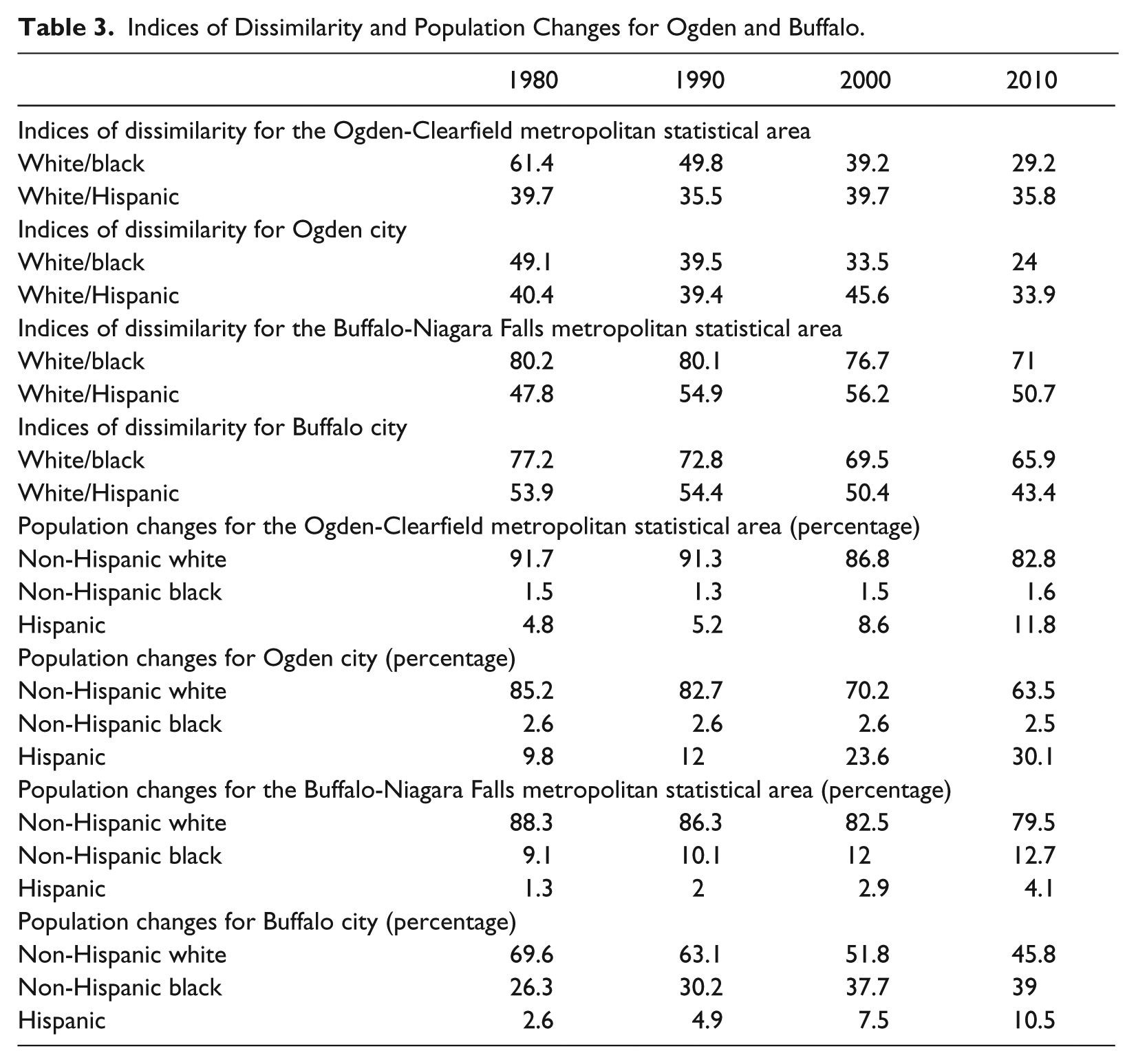
Whites make up about 83 percent of the metropolitan population in Ogden (about 64 percent of the city population). Ogden has a much smaller African American population (1.6 percent of the metro population,1.9 percent of the city) than Latino (11.8 percent of the metro population, 30.1 percent of the city). The percentage Latino in the city of Ogden has increased from 9.8 percent in 1980 to 30 percent in 2010 and 4.8 percent to 11.8 percent at the metro level (see Table 3). Mexicans are the largest Latino subgroup (American FactFinder 2010). While the population of African Americans in Ogden at both city and metro levels has remained about the same since 1980 (1.9 percent and 1.5 percent, respectively), this does not reflect changes that have occurred at the neighborhood level. Several residents spoke of a once concentrated vibrant and large black community in downtown Ogden, now replaced by a large Mexican population served by ethnic grocery stores, bakeries, and restaurants.
Indices of Dissimilarity and Population Changes for Ogden and Buffalo.
Buffalo
Buffalo is a highly racially segregated metropolitan area (Massey and Denton 1993; Wilkes and Iceland 2004). Buffalo’s metropolitan area has a white population of about 80 percent (about 46 percent of the city), a large African American population (about 13 percent of the metro area and 37 percent of the city), and a modest-sized Latino population (about 4 percent of the metro area and 10.5 percent of the city). Puerto Ricans are the largest Latino subgroup (American FactFinder 2010). Many Buffalo neighborhoods are racially and ethnically homogenous.
Segregation Scores
Black-white segregation, as measured by the index of dissimilarity, is higher in Buffalo than in Ogden and has decreased more slowly over the past three decades. The index of dissimilarity for whites and blacks in 2010 for the Ogden-Clearfield metropolitan area is 29.2, a marked decrease from 61.4 in 1980. For whites and Hispanics, the index of dissimilarity in 2010 is 35.8—slightly lower than 39.7 from 1980. Hispanics in the Ogden metro region are more segregated from whites than blacks are. The dissimilarity index in 2010 for whites and blacks in Buffalo is 71, and while lower than it was in 1980 (80.2), values above 60 are considered high. The dissimilarity index for whites and Hispanics in the Buffalo metro region is 50.7—slightly higher (47.8) than it was in 1980 (see Table 3 for more information on indices of dissimilarity over time for the Ogden and Buffalo metros and cities).
The dissimilarity score for whites and blacks in Ogden is considered low, and given the relative size of the black population in Ogden, it makes sense that whites in Ogden may not have the same level of aversion toward black Americans as they do for Latinos. Latinos in the Ogden metro region are more segregated from whites than blacks are. The growing population of Latino residents in Ogden could have a substantial impact on white neighborhood preferences and segregation outcomes. In Buffalo, while dissimilarity scores for blacks have decreased, they remain considerably more segregated from whites than Latinos are. However, dissimilarity scores for Latinos in the Buffalo metropolitan region have increased slightly, potentially contributing to white neighborhood preferences in this area.
Findings
Three general themes arose from my data: First, in both cities, my respondents’ preferences reflect a greater desire to avoid Latinos as neighbors; however, when only comparing whites’ preferences for blacks as neighbors, they expressed a greater desire to avoid blacks in Buffalo where there is a larger and more visible population of African Americans. This being said, whites still expressed greater aversion toward neighborhoods that were densely populated with blacks or Latinos compared to neighborhoods with few minority residents. While previous studies have indicated that whites tend to be more averse to blacks than Latinos (i.e., Dixon 2006; Emerson et al. 2001; Fox 2004; Hood and Morris 1997), recent literature (Iceland and Sharp 2013; Oliver and Wong 2003; Tolbert and Grummel 2003) has shown that white aversion to Latino groups has increased in areas with large Latino populations. My data reflect this as well.
Second, large populations of both blacks and Latinos negatively impacted white preferences. In general, respondents expressed greater fear and reluctance to live in neighborhoods with large concentrations of either group. Moreover, in areas with large concentrations of blacks or Latinos, whites were likely to fear things like high crime rates, gang violence, and limited neighborhood upkeep regardless of whether they were Latino or black neighborhoods. This suggests that general stereotypes related to racial prejudice affect whites’ preferences for both groups. Third, while whites’ reactions to Latinos included fear of crime and social problems, their concerns also centered around fear of cultural differences and threats to American cultural identity—indicating that whites are responding to blacks and Latinos differently. While both groups elicit crime threat, Latinos also elicit cultural threat. Respondents’ preferences suggest that personal experience, the attitudes of significant others, and the local and national media influenced preferences, but my data do not permit me to conclude which source was most important.
General Preferences of Whites
Whites in both cities were more likely to say they would prefer neighborhoods with blacks compared to Latinos, even in areas where blacks made up a significantly larger proportion of the population. For example, in Ogden, statements like “Probably more comfortable with African Americans” and “I see more problems with the Hispanics” were common. One woman from an all-white neighborhood in Ogden said she would not mind living in a mixed-race area, but not around Latinos, who had an especially bad local reputation: No, I think it would depend on the area . . . Hispanic groups in inner Ogden . . . would be a deterrent for me. (Ogden, white woman, upper-income, all-white, suburban neighborhood)
One white man in Ogden expressed more of an aversion to Latinos, mostly because of associations with them in the news as being more inclined to criminal behavior: Probably [more comfortable around] African Americans—it seems to me, now this is just an observation that I get from the newspaper and other things that there’s more problems among the . . . Hispanics than the African Americans. (Ogden, white man, middle-income, all-white, suburban neighborhood)
One upper-income woman from an all-white Ogden neighborhood points out the political climate surrounding immigration and perceptions of Latinos in the news: Because of everything that is going on with illegal immigration; [and] what’s happening in the inner city. . . . I think racial-wise at least according to the news, there is a higher percentage of Hispanics, not black . . . in the gangs, in the crime. (Ogden, white upper-middle-class woman, all-white, suburban neighborhood)
Several whites in Ogden express mistrust toward Latinos living in the area on several levels. For example, one woman who grew up around Latinos and now lives in a mixed-race neighborhood with Latinos said Halloween was coming up and that she no longer answers the door because “the Hispanics” will drop off 50 or 60 kids at the corner and she does not trust them. She would not choose to live in a neighborhood that was predominantly Latino: No. I don’t trust them. Even in the third grade, I had a little eighth grader girl pull a knife on me. I just don’t trust them. I’ve worked with them, and the ones I’ve worked with, we’ve gotten along fine, but I just plain don’t trust them. (Ogden, white woman, middle-income, mixed-race, urban neighborhood)
Overall, Ogden residents were more likely to associate a number of social problems with Latinos, more often than African Americans.
Similarly, in Buffalo, comments such as “You read about a lot of crime activity in that zip code area,” “I guess they have a lot of crime,” “Because it seems like neighborhoods with that kind of culture—they’re dangerous neighborhoods,” “I don’t like it over there, because it’s too much crime going on. There’s too much, I wouldn’t even go around that area,” and “I think they have a lot of crime in this area” are common when describing largely Latino neighborhoods.
When whites in Buffalo were given the choice between black or Latino neighbors, they commonly made remarks such as “I don’t have much experience with Hispanics. I have more experience with African Americans,” “I think there’s more Hispanics there than anything and I don’t know if I would fit in there,” “Hispanics . . . because of stereotyping that they have. It’s a high crime area,” “I wouldn’t live there, it’s Puerto Rican. It’s ghetto also,” and “I trust black people more than I trust Latinos to tell you the truth.” One Buffalo resident stated that she would prefer to live in a neighborhood mixed with African Americans because of recent experiences with new neighbors: “[I prefer] black because the people that have moved into my neighborhood are nice people. They take care of their children. They keep their homes up and they’re friendly. They’ll wave to you at least” (Buffalo, white woman, lower-income white neighborhood). Similarly, comments such as “Growing up where I have and just seeing Puerto Ricans, it’s not my type of crowd I want to hang out with” and “I just feel a little more trusting of black people because I’ve always dealt with black people. I have black friends” were very common.
Because group size is a primary component of group threat, one would expect whites to express more aversion toward blacks in Buffalo where they are the clear majority between the two groups. However, with my respondents, this was not the case. This is not to say that whites in Buffalo were comfortable with the idea of living in largely black neighborhoods, but when given the choice between the two, whites in both cities expressed more comfort with having African American neighbors than Latino.
Group Size and Neighborhood Expectations
In general, white residents’ desire to avoid blacks was greater in Buffalo where there is a larger black population. Once any neighborhood was more than two-thirds black or Latino, whites in Buffalo associated the neighborhood with high crime, high poverty, and little sense of community and upkeep—suggesting that group size does matter for both groups. For example, a white woman living in a white, lower-income Buffalo neighborhood, echoing the sentiments of several other residents, said: No, because I think that neighborhood is definitely turning. It’s getting more predominantly ethnic, where it’s more the black population than the white . . . I seen a progression of things when I seen my neighborhood turn. I watched it over the years. . . . We had card 3, which were a lot of great people. Once you hit card 4, that’s when you started to get into troublesome people and that’s when things started to turn. (Buffalo, white woman, lower-income, all-white suburban neighborhood)
Another white woman living in a mixed Buffalo neighborhood with whites and Latinos says she would live around blacks, but only up to a certain point because of the association with black neighborhoods and poverty.
Similarly, Ogden whites in my sample living around large populations of blacks or Latinos were likely to have negative perceptions of either group as a whole. Comments like “A lot of gang bangers are in this area. A lot of welfare, SSI people. I don’t trust these people. I don’t trust anybody in my neighborhood” and “I know a lot of black people and I know they’re very nice people, but . . . with them I think comes more problems” were common.
In Buffalo, sentiments expressed by whites living in mixed-race neighborhoods followed similar themes, such as “Because in most neighborhoods like that, people don’t work. People don’t take pride in their property, don’t respect their neighbors,” “There’s a lot of shootings and fights,” and “Dark crowd, I don’t even drive over there.” These comments reflect the attitude that the threat of group size does have a negative impact on white racial attitudes regarding blacks and Latinos as neighbors.
Whites not living around blacks or Latinos also had reservations about living around large groups of non-whites. In general, white respondents mentioned having reservations about living alongside blacks and Latinos that were reinforced by media representations of the groups. Respondents in both cities mentioned media portrayals of both groups as being more inclined to crime and living in high-crime areas. Furthermore, whites in white neighborhoods in Ogden often say comments like “Based upon just things that I’ve heard, so not really necessarily things I know. I think . . . a lot of the crime is and a lot of gangs are Hispanic, so I think that gives people a really negative outlook to those groups in Ogden,” “It’s not safe at night—criminal activity,” “I would say no, there’s a lot of crime that goes on in that area,” “There’s more mischief, vandalism, stealing. Sometimes even murders, so I just wouldn’t want to live there,” “Uh, racial. It’s a very racial area. A lot of crime,” and “Where they are mostly black or mostly Hispanic. Then I wouldn’t.”
This being said, there were marked differences between how whites expressed their preferences for blacks and Latinos. While whites in my sample used race and racial proxy explanations to express fear of large populations of both blacks and Latinos, they also used cultural explanations when speaking about the potential for having a lot of Latinos in their neighborhoods.
Latinos and Cultural Threat
In Ogden, Mexicans are the largest Latino group and in Buffalo, Puerto Ricans are. In Ogden, residents expressed stronger anti-immigrant sentiments than they did in Buffalo. This is not surprising, considering that stereotypes regarding legal status are more likely to be directed at Mexicans rather than Puerto Ricans, who are not immigrants. However, issues of culture and nativity did come up in both cities. In Ogden, most Latinos were assumed to be Mexican (or in some cases referred to as “illegals”), and in Buffalo, they were almost exclusively referred to as Puerto Rican specifically or Hispanic more generally. This is interesting, considering the growth of the Mexican population in New York and the east coast, more generally (Smith 2005).
Whites’ neighborhood preferences for Latinos as neighbors often centered on the groups’ presumed immigration status and threats to “American” ways of life. For example, whites in Ogden frequently based their preferences on the assumption that most or all Latinos in the area were undocumented immigrants. One white man living in a mixed-race neighborhood in Ogden, when asked to give his impression of his current neighborhood, described it as “mainly illegal Mexican immigrants.” Another white male resident of a mixed-race, urban neighborhood in Ogden, when asked if he would move into another mixed-race area close to his current neighborhood said, “[That] area is becoming degenerative. There’s a lot of illegals living up there . . . I wouldn’t want to buy up there.”
Whites in Ogden expressed feelings of contention about Latinos not speaking English and taking jobs away from Americans. Their reactions to prospects for Latino neighbors were often based on abstract or national assumptions and not necessarily through interactions with Latinos as individuals. For example, one lower-income man living in Ogden expressed preference for African Americans after looking at the hypothetical showcards because they are “Americans”: I would reluctantly move into an all-Hispanic neighborhood, but it wouldn’t bother me too much about an all-black neighborhood . . . because many of the black people were born and raised Americans. . . . Many of the Hispanic people here are Spanish speaking, either immigrants or illegal aliens and they don’t care to really become Americans. They don’t wanna learn the language. . . . I have more in common with Americans than I do with illegal aliens. (Ogden, white man, lower-income, mixed-race urban neighborhood)
Another white man living in a mixed neighborhood with Latinos expressed a similar sentiment regarding immigration: Things have gotten worse, not just because of the neighborhood but because of our acceptance of immigration . . . we haven’t done enough to control the borders and there’s some people that don’t even speak English in the neighborhood. (Ogden, white man, lower-income, mixed-race urban neighborhood)
Residents also expressed negative feelings about Latinos more directly than toward African Americans—couching their feelings in ideas about immigration and culture, in addition to racial statements. For example, the following resident said: A lot of them don’t know the language; don’t know English. It’s hard for them to communicate without somebody else knowing Spanish. I don’t know if it’s because they don’t want to learn English or if it’s because they don’t have access to the services available to them to learn. (Ogden, white woman, mixed-income, mixed-race urban neighborhood)
In general, in Ogden, I found the dominant characterization of Latinos as being a high-crime population who cannot be trusted and are undocumented immigrants who do not speak English. However, such perceptions are not universal. One white working-class woman living in an Ogden neighborhood with blacks and Latinos had more negative perceptions of blacks than Latinos: I know a lot of black people and I know they’re very nice people, but . . . with them comes more problems. . . . The Spanish race are hard working. They do the jobs here that nobody else wants to touch. Black people are lazy. They’d just as soon be on some sort of welfare and not work. (Ogden, white woman, lower-income, mixed-race urban neighborhood)
While previous studies have shown a strong relationship between out-group size and white preferences, size alone was not the only indicator of perceived threat from whites in my sample. The ways whites respond to Latinos is often surrounded by fear of a cultural shift among other factors.
Summary of Findings
In both cities, my data show that whites expressed greater aversion toward Latinos than African Americans. Furthermore, several whites said they would tolerate a neighborhood with small numbers of either blacks or Latinos but fear racial turnover after a certain point. This theme of racial turnover was not as prevalent in the data from Ogden, indicating that group threat—at least associated with neighborhood transformation and the potential for white flight—was talked about more in Buffalo, where it happened, than in Ogden, where it had not. Perceptions of threat were largely related to issues of culture, crime, safety, and desire to live in a “good” neighborhood. Finally, whites’ negative reactions toward Latinos, in addition to racial threat, also centered on issues of culture threat—expressing a strong desire to avoid neighborhoods in which people are not considered “American.”
Discussion and Conclusion
Group Threat
Out-group size and threat have been crucial theoretical tools for understanding race relations in the United States (Blalock 1967; Quillian 1995, 1999; Quillian and Pager 2001). I have shown that how scholars view white preferences in relation to group size does not apply to all minority groups in the same way. One key finding is that my respondents express more negative perceptions of Latinos than of blacks as potential neighbors in both cities. If group size was the only motivator of preferences, it would make sense that the largest minority group would be the least preferred as neighbors in that city—that is, blacks in Buffalo and Latinos in Ogden. However, whites were more reluctant to live near Latinos even in Buffalo, with its large black population and a relatively smaller Latino population.
Dominant group perceptions of threat change over time, and whites in my sample may be responding to increasing populations of Latinos locally and nationally. White hostility toward Latinos is present in both cities, regardless of the size of the Latino population, suggesting that there are multiple dimensions to perceived threat. Issues like culture, crime, language, and neighborhood behaviors are common themes in whites’ discussions of their preferences for Latino neighbors.
Race, Culture, and Neighborhood Expectations
Recent influxes of Latino populations nationally have led to policy debates about immigration and, apparently, to an increase in perceived threat from whites. Some scholars have uncovered somewhat of a white backlash regarding policy changes because of increases in the Latino population (Cain 1992; Hero 1998). Whites responding to Latino integration in their neighborhoods may feel more comfortable expressing hostility related to culture toward Latinos because it is more palatable to talk about language, citizenship, and cultural barriers rather than talking about race per se. Moreover, because of common assumptions that Latinos are immigrants, whites are able to express distaste for Latinos by couching their responses in anti-immigrant language that, to some degree, de-racializes what they are saying (Segura and Rodrigues 2006). In other words, whites’ cultural threat of Latinos becomes “normalized” by anti-immigrant political discourse and may be heightened by debates about immigration in contemporary news and public policy debates. Moreover, whites’ reactions to Latinos as neighbors was often based on the political climate surrounding Latino immigration rather than the number of Latinos they may encounter on a regular basis.
One factor heightening the cultural threat perceived by whites in the current political climate is that Latinos are frequently cited as a source of joblessness for natives. Latinos are portrayed as illegally entering the United States and taking “American” jobs (Sanchez 1997). Moreover, as Jaret (1999) found, during times of economic stagnation or difficulty, negative sentiments about immigrant groups increase. This speaks volumes to the current economic circumstances of most Americans and their fears about Latino immigrants taking U.S. jobs. While these fears apply to Latinos more generally, it is not surprising that these negative attitudes about Latinos would be reflected in whites’ neighborhood preferences. Negative reactions to black and Latino neighborhoods are couched in the language of structural neighborhood or infrastructure disorder; however, whites’ perceptions of Latinos often centered around feelings that Latinos “do not belong,” while whites’ responses to African Americans did not suggest that. Whites frequently use reasons like “not knowing the culture” or “not being able to speak the language” as reasons for not wanting to live around or interact with Latinos but did not do so for black Americans.
Whites have more negative perceptions of blacks in Buffalo than in Ogden, where there is a larger black population, consistent with research that emphasizes the importance of race and group size. This may indicate that the group threat perspective applies to whites’ attitudes toward blacks in my data, but that may not operate the same way for Latinos. Whites’ reactions to blacks as potential neighbors tends to be more negative if there is a larger black population in the city. White residents in my sample, especially in Buffalo, state reasons such as blacks being more inclined to crime, living in neighborhoods with poor housing conditions, and having unfavorable school environments as to why they prefer a small number of blacks in their neighborhoods.
We can make several inferences from these data. First, it is possible that respondents feel more comfortable expressing anti-Latino sentiments due to national and state debates about immigration and cultural changes. As a nation, the proverbial “we” may have created a new scapegoat to project national problems on other than, or in addition to, black Americans. It may also be that people are simply more perceptive of socially desirable ways to talk about race and ethnicity. Because anti-immigration rhetoric is so pervasive, respondents may feel more comfortable expressing anti-immigrant sentiments as opposed to anti-black attitudes. Similarly, it may be that opposition to blacks is so widespread in the United States that residents did not feel they needed to express it. Since feelings about Latinos are less settled, it may be that respondents feel the need to express their preferences in more dramatic and distinct ways.
Whites expressed avoidance of both groups in both cities even though black-white and Hispanic-white dissimilarity scores in the Ogden metro region are relatively low. Dissimilarity scores in Ogden are quite low comparatively and absolutely. However, whites are responding to areas that had relatively large numbers of minorities compared to other areas of the city—thus, heightening their perceived threat of those specific neighborhoods. In other words, while Ogden may have lower segregation scores, neighborhoods with relatively large groups of blacks or Latinos are perceived as being largely black or Latino by white residents and are affecting the preferences of whites Americans in that city.
One possible explanation for the disconnect between whites preferences and segregation scores is that whites may be more used to living around blacks and are expressing more negativity toward Latinos because their presence and growth is more obvious. Moreover, if preferences have shifted, not enough time has passed for this to affect segregation indexes. Thus, it is possible that segregation levels have not decreased at the same rate that racial attitudes have changed. Whites’ increasingly positive expressed preferences for blacks as neighbors may not upset or dismantle existing segregation patterns as quickly as we might hope or expect, even though recent literature has shown that segregation levels are slowly decreasing between whites and blacks (Logan and Stults 2011). Finally, since whites and blacks have historically shared the city, white Buffalonians’ stated aversion to Latino neighbors might reflect their actual intention to move less than their desire to express dissatisfaction with the presence and growth of the Latino population.
Limitations
One limitation of this project is that it is cross-sectional and I am unable to measure changes in perceptions of racial groups over time. While my respondents express more aversion toward Latinos compared to black Americans, I am unable to measure whether or not there has been a shift in preferences. Moreover, because my sample size is small and these data are localized, I am unable to generalize these findings to the larger population. Finally, in both cities I have a high percentage of people over the age of 50, and this could have affected my findings. It is currently unclear as to how age affects fear of crime and minority groups. Previous research finds that elderly people tend to be more fearful of crime (Clarke and Lewis 1982) and minority groups. However, Bonilla-Silva (2013; see also Bonilla-Silva and Forman 2000) argues that it is not that young people are more accepting of different racial groups but that people have learned socially desirable ways to talk about race. Moreover, other literature suggests that young people are more likely to be victims of crime and are more fearful of being victimized (Pain 2001).
Looking Ahead
There was some inconsistency between respondents’ preferences and actual behaviors. This mostly varied by socioeconomic status (SES). High SES respondents were less likely to express a desire to avoid black or Latino neighborhoods even though they were living in all or mostly white neighborhoods. Low SES respondents more explicitly stated their desire to avoid black or Latino neighborhoods, although several of them lived in areas that had more blacks and Latinos than higher SES white respondents. This gives several opportunities for future research. First, this could be an issue of social desirability, that higher SES whites are more aware of socially appropriate responses. Even though they prefer not to live among racial and ethnic minorities, they know they cannot explicitly say so. Second, higher SES whites could prefer to live in mixed-race neighborhoods with blacks and Latinos but neighborhoods with the racial and ethnic mix that they prefer may not have the same quality of neighborhood conditions that they experience in their white neighborhoods (or at least, they perceive neighborhoods with more minorities to be in worse condition than their own). Third, lower SES respondents may desire to move but do not have the resources to do so. Fourth, lower SES whites that live in mixed-race neighborhoods may not have the type of contact with their neighbors that fosters positive relationships; therefore, they rely on stereotypical assumptions about their neighbors rather than on actual experiences. Finally, preferences do not, for a number of reasons, always translate into action, which may also explain why prejudice can exist in areas with low segregation levels.
One area needing further investigation is how assumed citizenship status impacts neighborhood preferences. In my research, whites often allude to feelings of Latinos not belonging—regardless of knowledge about citizenship status. Immigration and perceptions of immigrant status is a significant factor in understanding neighborhood preferences because while group size matters, size also interacts with culture, language, presumed immigration status, and economic factors at local and national levels. Future studies should explore the link between ethnicity, culture, and group size by looking at whites’ preferences for Asian Americans. Do whites have different cultural expectations for Latinos than they do for Asians? Do whites have the same reservations about Asians being “American” as they do for Latinos? Similarly, what role does the socioeconomic status of the minority group play in whites’ preferences and perceptions of them?
Finally, it is important to look at how residential preferences affect and are affected by other factors. One area in which more research is necessary is how segregation impacts opportunities within our public schools. People make their residential choices based on a number of factors including the quality of schools in an area (Lareau and Goyette 2014). These choices, however, have an impact not only on the residents themselves but future generations of children who attend public schools located in poor, segregated neighborhoods. This would be a useful direction for future research.
Footnotes
Acknowledgements
Special thanks to Robert Wagmiller, Robert Adelman, Debra Street, and anonymous reviewers for their helpful comments on earlier versions of this article.