




Abstract
The author examines the relevance of racial discourses to neoliberal urban development occurring in older, former industrial cities in the United States. Rather than treating the production of new development spaces as separate from the adjacent inner-city neighborhoods, the author focuses on the significance of race to “making sense of,” and, in turn, legitimizing the stark contrasts between revitalized enclaves and the inner city as a central component of contemporary neoliberal urban development. The concept of legibility is introduced and developed to demonstrate how ideological and discursive strategies simultaneously promote middle-class urban development enclaves and strategically account for—or make legible—the presence of minority, poor communities adjacent to them. The process of legibility is explored in waterfront developments in Camden, New Jersey, and Chester, Pennsylvania. The methods involved extensive fieldwork and semistructured interviews with city officials, employees of economic development authorities and public-private partnerships, leaders of community development organizations, and local residents from each city, conducted between 2009 and 2015. The study’s key findings incorporate an ideological dimension of race into an analysis of uneven urban development.
Introduction
In February 2015, Neighborhood Scout, a Web site that provides “crime, school and real estate data” for cities and neighborhoods across the United States, ranked Camden, New Jersey, and Chester, Pennsylvania, the first and second most dangerous cities in the country, respectively. The website ranked Detroit and Flint, the notoriously troubled Michigan industrial-era cities, third and seventh, respectively (Neighborhood Scout 2015). 1 The headline confirmed the apprehensions of thousands of residents who call Camden and Chester home and cope with the everyday realities of street crime and the unemployment, poor schools, and poverty that fuel it. For another set of actors—the alliance of developers, corporations, investors, public-private partnerships, and city officials economically and politically invested in the “revivals” of Camden and Chester—the rankings cast a stubborn shadow on decades-long, multibillion dollar revitalization efforts. Such publicity would only reinforce the reputations of the two cities as “difficult to develop.” 2
Given that both cities are identified as places of rampant crime, poor housing conditions, joblessness, and poverty, neither Camden nor Chester would appear a likely candidate for private sector investment in large development projects. Yet over the past few decades, investors, lending institutions, and real estate developers have taken big steps toward the creation of entertainment and sports facilities and tourist destinations along the waterfronts of both cities, with plans in the works to develop market-rate housing for an anticipated return of the middle class. In both cities, massive development led to limited displacement of the poorest communities. Instead, the new projects are geographically—and symbolically—cut off from the cities proper. This version of focused and limited urban renewal entails a revanchist reclaiming of so-called salvageable parts of poorer cities, often with the price of neglecting or further marginalizing most others.
In an environment of curtailed federal aid and state funding for community development, cities both large and small have turned to such project-focused, entrepreneurial, and promarket approaches that create spaces for “market-oriented economic growth and elite consumption practices” (Brenner and Theodore 2002:381). In New York City, redevelopment projects have transformed large tracts along Brooklyn’s waterfront into mixed-use enclaves of upscale shops, restaurants, and residential towers, many of which are adjacent to older working-class communities. The increasingly popular and expensive DUMBO (Down Under the Manhattan Bridge Overpass) waterfront district, for example, is sandwiched between the Manhattan Bridge and the Brooklyn Bridge and borders a sixteen-acre public housing project where 60 percent of the residents are black and low income (Madden 2014:483–89). Urban sociologists and geographers have explained this form of enclave urban development as the product of neoliberal policies that favor market-oriented megaprojects over the renewal of existing communities. Under neoliberal governance, states and local governments (and private sector partners) commit public investment in the form of tax abatements, infrastructure development, and direct subsidies to the private development of large-scale entertainment, leisure, and residential projects meant to attract middle-class consumers and residents (Peck 2004; Peck and Tickell 2002; Brenner and Theodore 2002; Hackworth 2007; Hackworth and Moriah 2006). As is the case in Camden, Chester, and other cities, subsidized development enclaves are typically isolated and protected from the adjacent inner city (MacLeod and Ward 2002), producing “a patchwork quilt of islands of relative affluence struggling to secure themselves in a sea of spreading decay” (Harvey 2000:152).
As self-contained enclaves adjacent to poor, mostly minority neighborhoods, development enclaves tend to amplify the economic and social disparities in the spatial organization of older, former industrial cities (Marcuse 1997, 2007). Inequalities are readily visible as sharp contrasts, ranging from the economic and social conditions to the quality of the built environment, amenities, and provision of services (Marcuse 1997, 2007; Tighe and Ganning 2015; Wacquant 2008). In cities like Camden and Chester with historically high concentrations of poor, minority residents, racial divisions form an important marker between newly developed and persistently underdeveloped spaces. Clearly, class inequalities and racial division are neither fully separate nor mutually exclusive. Yet for smaller, former industrial cities especially, spaces of concentrated poverty result from racial discrimination in the provision of employment opportunities, education, housing, social services, and amenities at the urban and regional levels (Gillette 2005; Mele 2013). Patterns of racial discrimination and exclusion consistently enable if not exacerbate the geography of social class inequalities within such cities and between cities and their suburbs (Squires and Kubrin 2005).
Urban renewal in the form of enclave development therefore does not happen in isolation from adjacent communities of racialized poverty. The long-standing association of minorities and poverty with the inner city necessarily looms large in such revitalization efforts, from securing private investment for development projects to attracting tourists, visitors, and potential new residents. The production of new office spaces, stadiums, concert venues, casinos, parks, and upscale housing forms but one part of the urban redevelopment process. Of equal importance is the construction of a narrative that simultaneously promotes development in the enclave and accounts for or makes legible the presence of racialized spaces outside and adjacent to it. Rather than treating the production of new development spaces as separate from the underdevelopment of adjacent inner-city spaces, in this article I focus on the significance of race to making sense of and in turn legitimizing the stark contrasts between the two as a core component of contemporary neoliberal urban development. This article is a response to the recent call for additional scholarship on the relevance of racial ideologies and discourses to the processes that shape urban space (Bonilla-Silva 2015:82).
Race and Legibility
Urban scholars have long argued that the cultural aspects of place figure as importantly as political and economic factors in the process of urban regeneration (Elwood, Lawson, and Nowak 2015; Jones and Evans 2012; McCann 2002). City leaders, corporations, and public-private partnerships construct new place identities by constructing narratives that render projects legible to intended audiences—consumers and tourists, corporations seeking relocation or creation of office space, and potential middle- and upper-class residents. Place promotion is a multifaceted effort by city governments and developers to communicate images and narratives of place to specific groups of intended users (Johnson et al. 2012; Sapotichne 2012).
Urban enclave development involves the familiar processes of place promotion and image construction for “comeback cities” well on the path toward renewal. But it also includes more complicated efforts to make the deep disparities between upscale enclaves and impoverished inner cities legible in a single and coherent story of revitalization. If the focused development of comparatively small urban districts is to be the standard of revitalization and not a rare exception for cities like Camden and Chester, then minority neighborhoods of concentrated poverty must somehow be rendered legible to the ideals of urban comeback and economic development.
City governments, economic development authorities, developers, and public-private partnerships are compelled to provide public direction on how to “read” racialized spaces in accordance to their interest in market-oriented urban development for two reasons. First, regardless of innovative efforts to physically and symbolically separate them from the surrounding cities, the waterfront developments are still part of poor minority cities. As a consequence, the neatly packaged place identities of renewed districts cannot be fully divorced from a long-standing public association with urban decline, inner cities, and issues of safety. The perceptions suburban whites hold of inner-city minority communities factor strongly in whether urban development can overcome nonminority commitment to long-standing patterns of racial segregation (Krysan, Crowder, and Bader 2014). Suburban dwellers, especially whites, repeatedly show tendencies to conflate race, class, and their image, expectations, and fears about cities with predominantly minority populations. Many whites continue to act on such perceptions, as evidenced in their preferences of where they choose to live and socialize (Bader and Krysan 2015; Krysan and Bader 2007).
Developers of areas within cities strongly identified as minority and poor are compelled to address the fact that race, reputation, urban space, and middle-class white preferences continue to matter to any effort to attract newcomers to cities like Camden and Chester. Legibility, then, entails a “project of reassurance,” in which the development narrative accounts for “anything which might evoke in the middle-class imagination images of danger, disorder, or urban decay” (Gibson 2003:155). Additionally, the absence of community development in surrounding poor, minority neighborhoods must be addressed (if even in cursory fashion) to legitimize public expenditures in the focused development of enclaves or districts geared mainly toward suburban outsiders and not residents.
The focus of this article is how local governments and developers account for and legitimize the series of juxtapositions produced by enclave urban development—the juxtapositions of the protected enclave and the neglected inner city, conspicuous consumption and relative deprivation, and majority white consumers and nearby racial minority residents. To accomplish this legibility in the face of such stark contrasts, redevelopment rhetoric replaces the understanding of racialized spaces as deeply rooted in discrimination and exclusion with a space of individuals unmarked by any racial, ethnic, or class social group identification and therefore depoliticized and devoid of any collectivist basis for claims of structural inequality.
Such legibility draws on prevailing racial discourses of color blindness or race neutrality that conceive of race exclusively as an individual identity construct and not as a category produced systematically and historically through exploitation and discrimination (Omi and Winant 2014). Racial group membership—one’s position in a racial hierarchy that influences access to resources and delineates social outcomes—is effectively denied and replaced with a depoliticized version of “neutral and apolitical descriptions reflecting skin color and unrelated to social conditions of domination and subordination” (McLaren 1999:32). This formal rejection of systemic racism suggests that race—as a social category and a marker of structured disadvantage—is no longer a basis for individual or group social or political standing: contemporary charges of unresolved racism and racial inequalities, which tend to call for intervention on the part of states and social institutions, are eviscerated (Bonilla-Silva 2006; Brown et al. 2003; Davis 2007; Duggan 2003; Giroux 2008; Roberts and Mahtani 2010).
Forms of inequality firmly rooted in the inner-city spaces adjacent to developed enclaves are portrayed as remaining vestiges of inefficient or hindered market forces or the private (if unfortunate) matters resulting from the choices and behaviors of individuals. As described in the following sections, the racial ideology of color blindness provides the discursive means for city officials and developers to flatten claims of urban structural inequalities and distinctions between the minority neighborhoods of concentrated poverty and the newly developed waterfronts.
The broader aim of this study of efforts to make underdevelopment legible to redevelopment is to push the relevance of racial ideologies and discourses to the fore of research on urban development (see also Anderson and Sternberg 2013; Wilson 2015; Wilson and Sternberg 2012). In a similar effort to connect racial discourses with urban renewal efforts in Chicago’s historically black Bronzeville neighborhood, David Wilson and Caroline Sternberg (2012) argued that “socio-racial redevelopment governances” sanction a redefinition of “stereotyped and caricatured understandings about poor racialized populations” (p. 980). Left unaddressed, the negative representations associated with spaces of racialized poverty continue to circulate and define the inner city in ways that obstruct revitalization plans. City officials and developers, then, are compelled to use a “new racialized redevelopment rhetoric” to manufacture a commodified “black heritage” suitable to investors’ visions of the neighborhood’s future (Wilson and Sternberg 2012:991).
The sections that follow draw on case studies of urban development projects in Camden and Chester as a means to examine legibility as a process of harmonizing the persistence of spaces of racialized and concentrated poverty with neoliberal goals of urban development. The political economy of the redevelopment of waterfront enclaves in the two cities is presented first, followed by a discussion of the methods used in the qualitative study of legibility in both cities. The next section lays out the mix of policies, practices, and place marketing strategies that development stakeholders put forth to align social and cultural representations of adjacent inner-city neighborhoods with the goals of development. The section is organized around the themes of consumption and security, two issues important to local governments, investors, and developers. The applicability of the arguments and findings to cases other than Camden and Chester is discussed in the conclusion.
Neoliberal Urbanism in Chester and Camden
Both Chester and Camden have extensively redeveloped their waterfronts into regional entertainment destinations. Both cities have followed a shared path of creating spaces that tether broad notions of culture, tourism, and leisure to the promise of postindustrial economic development (Kantor and Judd 2010:89). In Chester, completed projects include the Harrah’s Philadelphia (formerly Harrah’s Chester) casino and racetrack; PPL Park, the home stadium for the Philadelphia Union national soccer league expansion team; and an office complex in a renovated former power plant (Mele 2013:603). Camden’s waterfront features Campbell’s Field, a minor league baseball park; Adventure Aquarium; and a major concert venue, Susquehanna Bank Center, that attracts top-notch entertainers (Cooper’s Ferry Partnership 2012:4). Public officials and developers promote the redevelopment of both cities’ waterfronts as the linchpin to a much needed turnaround. For city officials, investors, and developers, the waterfront enclaves mark an end of a long period of urban decline and the beginning of a new postindustrial era of integration into the larger region as destinations for middle-class consumers.
Contemporary urban renewal of Camden and Chester is framed by the neoliberal lexicon of competitiveness, improved efficiency, flexibility, entrepreneurship, partnership, and collaborative advantage that drive the efforts to revalorize parts of older, former industrial cities resistant to capital investment and development (Dumenil and Levy 2004; Wilson 2007; Wyly and Hammel 1999). Neoliberal urbanism refers to governance practices that privilege these market mechanisms, including limiting state oversight and regulation of the private sector, reducing expenditures on social welfare, and forming entrepreneurial public-private growth partnerships, to create conditions favorable to capital reinvestment (Brenner and Theodore 2002, 2005). An extensive and favorable set of incentives, such as generous tax abatements, infrastructure development, state sanctioning of “enterprise zones,” and bond financing, favor the development of megaprojects in smaller cities. This neoliberal turn in urban development embraces free-market solutions to so-called problem-plagued inner-city neighborhoods and downtowns that seem stubbornly impervious to revitalization, including the greater willingness of local governments to rely on and publicly fund the private sector to steer the important aspects of redevelopment from planning and construction to the management of subsidized “public” assets, such as parks, esplanades, and even public streets. States and municipalities have in turn created institutional mechanisms that fully incorporate the interests of the private sector, namely, economic development agencies and public-private partnerships (Sagalyn 2007).
In Camden, the state granted two agencies extensive decision-making autonomy to spearhead the development of the city’s derelict waterfront. The state’s Municipal Rehabilitation and Recovery Act of 2002 authorized the New Jersey Economic Development Authority (NJEDA) and the Camden Redevelopment Agency (CRA) to plan, assemble financing, and oversee the building of urban projects tied directly to economic development (Greenberg, Verma, and Seith 2009). Each coordinated the relevant state, county, and local government agencies to provide tax subsidies, funds, and incentives for various private sector-driven projects, including the remediation, clearance, and new construction of old industrial wasteland for the purpose of waterfront development (New Jersey Economic Development Authority 2014). Both organizations partnered with the Cooper’s Ferry Partnership (CFP). The CFP is composed of public agencies, private companies, and nonprofit organizations with a core mission to attract and facilitate capital investment in tourism and entertainment sites along the waterfront (Cooper’s Ferry Partnership 2012; Morgia and Vicino 2013). Chester’s city council created the Chester Economic Development Authority (CEDA) in 1995 to serve as the administrative agent of redevelopment. The CEDA leveraged federal, state, and local tax abatement programs, developed proposals to secure private sector investment, and facilitated the Waterfront Overlay District, a master plan for nonindustrial development, such as commercial, retail, and residential uses (Mele 2013).
Together these programs provided generous tax abatements, loans, public investment in physical infrastructure (roads, sidewalks, parks), and other economic incentives intended to stimulate private investment in commercial redevelopment in designated waterfront areas exclusively. Because these programs apply only to specifically targeted commercial spaces, they created a locational hierarchy of economic opportunity between areas in both cities. Whereas waterfronts become specified redevelopment zones, the adjacent inner-city neighborhoods are in turn further devalorized by their competitive disadvantage as attractive to investment capital.
Redevelopment notwithstanding, Chester and Camden remain extremely poor, minority cities beset with a number of social problems. Although the newly developed waterfronts are separated from these neighborhoods, both cities’ reputations as minority-dominated, deeply poor, and dangerous continue to circulate and inform a regional understanding of them as places to avoid, as suggested by their top rankings in the 2015 Neighborhood Scout list of most dangerous cities. As the sections that follow document, the legitimacy of the massive expenditure of public dollars, the likelihood of increased investment capital, and ability to the draw more tourists and visitors to Camden and Chester depend on the efforts of developers and city officials to account for each city’s sizable poor, minority communities in a revitalization narrative.
Researching Legibility in Camden and Chester
Camden and Chester share similar trajectories of past urban decline and recent enclave-oriented urban development. Both cities are extremely poor relative to their surrounding middle- and upper-class suburbs. Together they constitute the highest municipal concentrations of racial and ethnic minorities in the greater Philadelphia metropolitan region (U.S. Census Bureau 2010). Both cities have suffered decades of chronically high unemployment, poor educational attainment, deteriorating housing stock, falling property values, successive and prolonged fiscal crises, and diminishing social services (Gillette 2005; Mele 2013; Morgia and Vicino 2013; Quaal 2007).
Table 1 provides demographics for Camden and Chester, including recent data for select socio-demographic indicators relative to their respective states. Chester is Pennsylvania’s oldest city and its poorest (located in the state’s wealthiest county, Delaware County). The city is smaller in size and population than Camden. Nearly three quarters of its population is black, whereas Camden’s minority population is closely split between Latinos (of any race) and blacks.
Select sociodemographic indicators: Camden, New Jersey, and Chester, Pennsylvania.
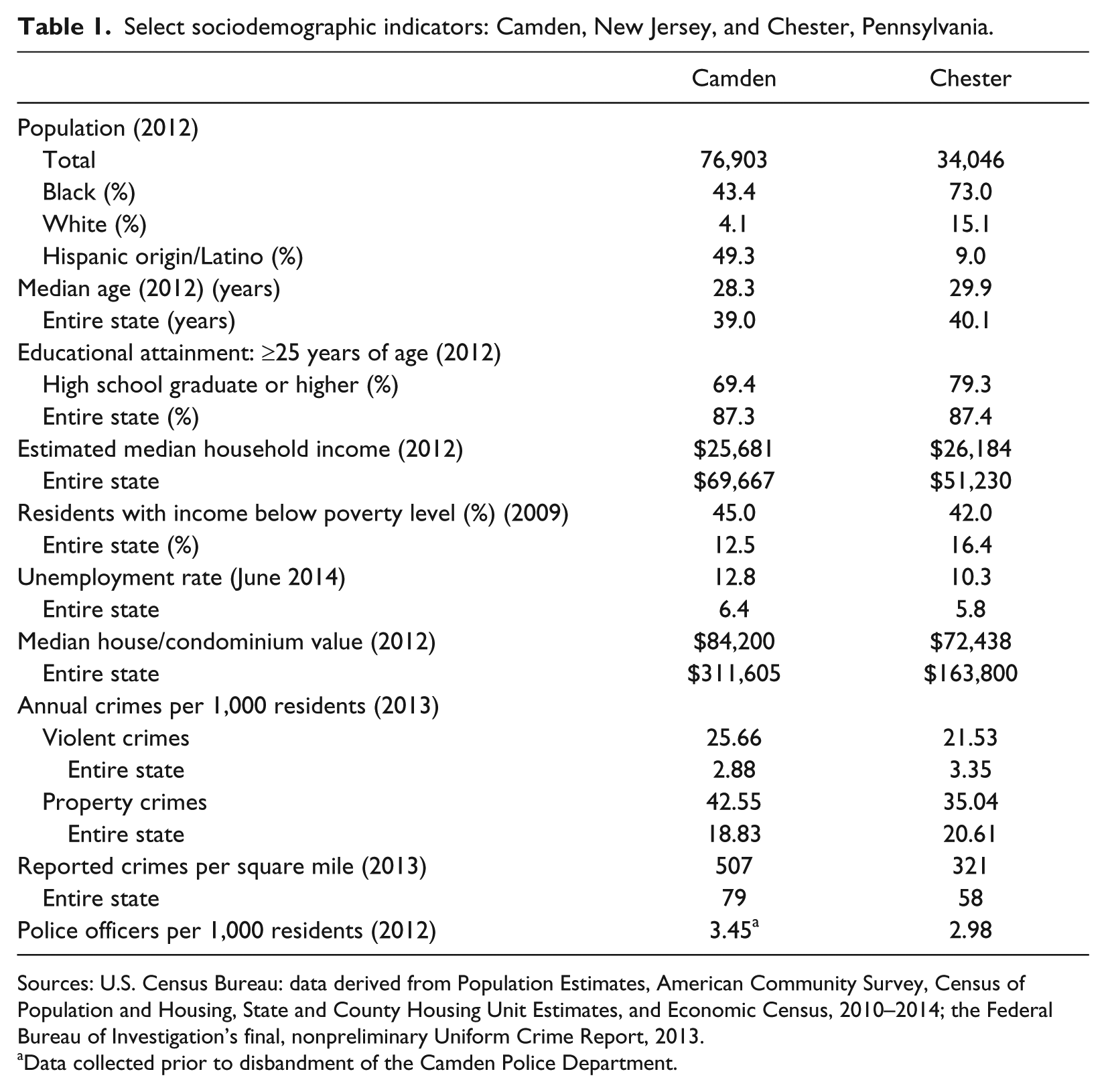
Sources: U.S. Census Bureau: data derived from Population Estimates, American Community Survey, Census of Population and Housing, State and County Housing Unit Estimates, and Economic Census, 2010–2014; the Federal Bureau of Investigation’s final, nonpreliminary Uniform Crime Report, 2013.
Data collected prior to disbandment of the Camden Police Department.
The residential cores of both cities continue to suffer the social and economic fallout of decades-long deindustrialization. The physical, social, and economic contrast between the primarily poor, minority neighborhoods and the developed projects along the waterfronts of Camden and Chester is pronounced. While the commercial waterfronts thrive, the underlying structural conditions of urban poverty, inadequate educational opportunities, and crime in the adjacent city remain largely unaddressed. These historical and contemporary similarities mean that both cities are ideal locations for exploring how developed and underdeveloped spaces are rendered legible to both residents and outsiders through the strategic use of discourses of race, poverty, and the inner city.
Legibility, as it is studied here in connection with the development of urban space, involves examining the efforts of city governments and the real estate sector to construct a coherent “read” on the city on the basis of very narrow and exclusive interests and how such efforts further exclude poor and minority communities. Using a case-study approach, as many qualitative data as possible were compiled on the process of rendering development and underdevelopment legible. Research conducted between 2009 and 2015 involved extensive fieldwork and semistructured interviews with city officials, employees of economic development authorities and public-private partnerships, leaders of community-based organizations (CBOs) of various sizes, and local residents from each city. I specifically chose these methods to access how urban power holders reworked ideas about race, poverty, and the inner city as part of the redevelopment process and how local residents and their representative organizations in each city responded to these attempts. The semistructured interviews focused on the contradictions and tensions bound up in the relationships and interactions between the developed waterfront and the adjacent neighborhoods and the policies of the economic development authorities and the public-private partnerships.
Initial research on the development narrative produced by government leaders, agencies, partnerships, development corporations, and public relations firms involved the analysis of public documents, including policy briefs, state legislation, newspaper articles, and promotional materials. I then produced a schematic of power holders and decision making from these documents, creating a map of neoliberal ties among various government agencies, partnerships, and corporations involved in waterfront development. From this I chose twelve individuals (seven from Camden, five from Chester) serving official capacities in the NJEDA, the CRA, the CFP, the CEDA, and the Camden County Police Department to interview. In addition, I interviewed six executives from large real estate development and management companies (some of the participants also serve on partnerships) in Camden and Chester. The purpose of these interviews was to elicit detailed information on the promotional aspects of the development agendas (e.g., targeted audience) as well as and first-hand accounts and descriptions of the adjacent neighborhoods and their residents, and thus assess causes and solutions to the long-standing problems poor, minority communities in both cities face.
I also conducted a total of nineteen interviews with residents and individuals affiliated with various CBOs operating in neighborhoods adjacent to the waterfront developments in both cities. The purpose was to access grounded understandings and firsthand experiences with the official development narratives and to gain a sense of how communities were or were not included in the development narrative. Both Camden and Chester have strong and active civic sectors with numerous community and block associations, neighborhood organizations, and faith-based social service providers. For introductions and eventual interviews with residents and representatives of community organizations, I used a research strategy of systematic snowball sampling across CBOs of varying sizes, beginning with citywide social service organizations, followed by CBOs operating in the neighborhoods directly adjacent to the waterfront developments, working my way down to the smaller scale block associations and, finally, individual residents themselves. My earlier research on grassroots associations engaged in activism over environmental issues in both cities facilitated my access to individuals working for CBOs. Established contacts helped with introductions and the acceptance of my research among smaller organizations, and local residents substantially increased trust relations and facilitated information gathering. Observations and interviews with a total of six members of four block associations in Camden and six members of five block associations in Chester proved most productive, because the associations are repositories of local knowledge. They are also liaisons between neighbors, city officials, and government agencies on a variety of issues relevant to community development in favor of large-scale waterfront projects. The time spent observing and interviewing individuals in Camden and Chester provided the basis for learning and understanding legibility as it played out on the ground from those who experienced firsthand the twin processes of redevelopment of the waterfront and the continued isolation of their own neighborhoods.
Race in the Legibility of Urban Development in Camden and Chester
The development of waterfront enclaves in Camden and Chester marks an accomplishment for city officials, private developers, investors, and public-private partnerships. It also marks the triumph of neoliberalism over competing visions of urban development proffered by neighborhood associations and CBOs in both cities. Organized residents have consistently argued for the waterfront to be viewed as a part of larger community development efforts geared toward improving social and economic conditions. Since the 1980s, CBOs in both cities have repeatedly resisted official efforts to treat the waterfront as a separate entity distinct from the rest of the city. After the closure of many older waterfront industries, local governments earned revenues by transforming each city’s waterfront into self-contained industrial parks for environmentally hazardous enterprises, such as waste burning, toxic soil remediation, and sewage treatment. Collective action among nearby residents ensued, with grassroots organizations mobilizing against the disproportionate impact of environmental hazards on adjacent minority neighborhoods. Two major community groups, South Camden Citizens in Action (SCCA) and Chester Residents Concerned with Quality Living (CRCQL), filed high-profile environmental racism law suits in the 1990s. Each used Title VI of the Civil Rights Act of 1964 to challenge state authorities over the disparate racial impact of facility siting along their respective waterfronts. Although the legal strategies were ultimately unsuccessful, both groups successfully mobilized residents to pressure local governments to end support for additional hazardous facilities. Collective action on environmental issues secured the next era of waterfront development (Arnold 2007; Gillette 2005; Mele 2013).
Both cities officially renounced their environmentally hazardous paths toward economic development, and the SCCA, the CRCQL, and other CBOs, citywide coalitions, and faith-based organizations lobbied for community development projects to benefit residents. After a number of past urban renewal failures and the environmental waste zone debacle, organizations proposed meaningful forms of community reinvestment in social and economic opportunities that tackle problems of chronic unemployment, inadequate affordable housing, and poorly funded public education worsened by ongoing patterns of discrimination and exclusion. The future of the waterfronts should be part of a much larger, sustained, and locally focused revitalization process that includes neighborhood facilities, recreation space, revitalization of housing stock, improvements in public transportation, and enhanced human development, such as job training programs. At minimum local organizations expected an active role and “a seat at the table” with regard to urban development decisions.
Working in partnership with the development sector, the Camden and Chester governments regarded waterfront revitalization as an opportunity for economic, not community, development. The economic success of both waterfronts is dependent on the patronage of visitors, tourists, and other nonresidents. The results have been mixed. The primary sources of visitors are the regional suburbs, and attendance steadily rises as more events, such as concerts and games, are scheduled. Camden County tourism dollars increased by 8 percent between 2013 and 2014 (Tourism Economics 2014). Revenues from Chester’s waterfront tend to be more seasonal and peak during the soccer season. Off-season visitor numbers have declined slightly since the opening of two casinos in the Philadelphia area in 2010. Camden’s aquarium and Chester’s soccer stadium are destination anchors that receive the largest share of overall visitors. In Camden, visitors’ average family income in 2014 was $75,000 (New Jersey Division of Travel and Tourism 2014). Similar data on Chester’s visitors are unavailable. Although the typical day-trip visitor to each city depends on the event and the venue, the majority I observed on several occasions were young families, couples, and groups of friends who were primarily (but by no means exclusively) white (Field notes, 2010–2015). Chester’s PPL Park routinely hosts collegiate soccer games featuring teams from suburban Villanova University and the University of Delaware. In 2015, the park hosted the Atlantic Coast Conference Men’s Lacrosse Championship. By most measures, the objective to pitch the waterfronts to outsiders has been realized. Recent infrastructural changes have enhanced the accessibility of the waterfronts to middle-class visitors from suburban communities.
Despite extensive knowledge of community needs and local expertise in posing solutions, CBOs and residents’ advocacy groups barely participated in the entire waterfront development process either officially or, of greater significance to this article’s main argument, discursively. Officially, the organizational architecture of private sector-led urban development requires minimal formal community participation (Kromer 2010). As entities intended to lead development, Camden’s CRA and Chester’s CEDA channeled the minimal legal requirements for community participation in ways conducive to their economic development agendas. In Camden, the Municipal Rehabilitation and Economic Recovery Act established statutes for urban redevelopment procedures that contained only minor provisions for public participation. For the CEDA, the Chester city council ceded authority over the decision-making process from financing to recruiting tenants, in effect turning public meetings into ad hoc informational sessions. In both Camden and Chester, waterfront public hearings were less venues for engaged community input than “rubber-stamp” presentations of already decided initiatives.
In the course of my interviews, local officials of the CRA and the CEDA repeatedly recognized the importance of CBOs in each city but viewed their roles in urban revitalization as exclusively “people centered.” Urban development differed from community development, with the former relegated to experts in planning, financing, and deal brokering; local organizations specialized in social service delivery. In Camden, organizers for citywide nonprofits repeated the CRA’s image as “economic developer” and disputed their roles as exclusively “social service providers.” The clear message was that organizations such as Camden Churches Organized for People (CCOP), a citywide, multi-denominational umbrella organization composed of large and small faith-based organizations, should stick to what they know best. In Chester, two small resident advocacy organizations that spun off from the CRCQL summarized the CEDA’s attitude as dismissive:
We were told more than once, “If we [CEDA] do our jobs right and develop and bring back Chester, you all won’t have as much work to do saving families and caring for the poor.” As if Harrah’s and the stadium are going to hire local people at a wage to raise a family. What are the jobs? Where are the training programs? (Interview no. 3, August 2011)
According to interviewees, CEDA’s comments left ambiguous whether development would make their work easier by improving current residents’ lives or by reducing their numbers because of displacement. Community organizers found the promise of a “spillover” effect of waterfront development into the surrounding communities dubious. They questioned the logic of the division of economic and community development, noting that they were well positioned to communicate how development could best meet the needs of residents in Camden and Chester.
Local residents and their representative organizations in Camden and Chester were left out of meaningful collaboration or sustained participation in the waterfront development process. Nonetheless, the residents of Camden and Chester were not completely ignored in the narrative of development. Indeed, local governments, the CRA and the CEDA, and developers in both cities addressed the poor, minority residents living adjacent to their respective waterfronts but on their terms, not those of residents. More precisely, certain behavioral aspects claimed to be associated with residents—albeit arbitrarily—are folded into the narrative of waterfront development as activities to be encouraged or excluded. The contrast between the developed waterfront and the underdeveloped inner city is made legible through the focus on consumption and security, particularly through the lens of race.
Urban Renewal as Consumption by “Outsiders”
In both Camden and Chester, waterfront promotion follows a basic development storyline in which each city’s industrial past is celebrated, followed by brief mention of urban decline and the challenges it poses, and ending with destination consumption spaces as the opportunity for sustained economic revitalization. In Chester, the casino and stadium are routinely touted as the city’s best and last chance at revival. Waterfront development in Camden reflects a “critical mass of reinvestment and an unstoppable momentum, which is transforming downtown Camden and has the power to restore the economic health and vitality to our city” (Cooper’s Ferry Partnership 2012:6). In partnership with city leaders, developers invented new place names for waterfront enclaves as a means of symbolically distancing them from the long-standing negative reputations of the cities. In Camden, the area along the Delaware River is now referred to as Cooper’s Ferry. Chester’s waterfront development is called Rivertown. Both are heavily promoted to attract specific audiences, such as sports fans or casual gamblers, who reside outside the cities and are otherwise not inclined to visit them.
In contrast to past trends, the redeveloped waterfronts are relatively underused by local Camden and Chester residents. Before redevelopment, local residents used the waterfronts for a variety of mostly ad hoc activities, ranging from “hanging out” and “meeting up” to barbecuing and fishing. The new destinations permit relatively narrow uses, e.g., gambling, seeing a concert or a soccer game, or attending a corporate-sponsored event. Waterfront esplanades and parkways are hidden away or difficult to get to from nearby neighborhoods, with indirect pathways for admittance, a list of prohibited activities, and enforced hours of operation. These architectural and design elements encourage normative consumer behaviors, and prohibit any number of undesirable activities, such as panhandling, loitering, or public drinking.
All of this ensures that such places are rarely happened upon to be used by chance or for forbidden purposes. Indeed, a very narrow range of prescribed activities is encouraged by design and policy (Beckett and Herbert 2008; Gibson 2003; Mitchell 2003). The separation of development enclaves from the city proper and their limited accessibility contribute to a sense of privilege and exclusivity that appeals to developers and intended visitors. The majority of people visiting Camden’s waterfront arrive from Philadelphia, crossing the Delaware River via ferry or bridge with off-ramps to well-marked destinations. Similarly, in Chester, new exit ramps from Interstate 95 were built expressly to deposit visitors at the waterfront so they could avoid driving though the city.
In addition, the new destinations, such as casinos and sports stadiums, endorse a particular set of normative behaviors—all involving consumption—geared toward the active inclusion of certain socioeconomic groups (but not others and certainly not all). Here exclusion is accomplished not by spatial policies that “keep certain people out” but by creating spaces with a normative focus on specific activities that make some people (those who choose not to or cannot afford to consume) feel left out. The exclusive focus of destination enclaves on consumption creates a proactive self-regulation among those who are neither consumers, sports fans, visitors, nor tourists (Ewick 1998; Merry 2001). Local residents with limited means may feel unwelcome or “out of place,” or may have no reason to visit such destinations. In the case of Chester’s waterfront development, residents reported that the casino and soccer stadium held little if any attraction or everyday utility. One older resident stated, “The casino’s for people from the suburbs . . . old people, retirees . . . nice for them but it means nothing to me” (Interview no. 5, July 2010). Residents I interviewed in both cities indicated that waterfront redevelopment has little impact on their everyday lives, economically or socially. The waterfronts have “fallen off their radar.”
In the neoliberal narrative of urban development, individuals participate as consumers, not members of social groups (with collective interests that could possibly benefit from publicly subsidized development). As such, no distinctions are made in terms of development policy or stated objectives between the waterfronts and the cities proper. Residents, stripped of their social identities formed partly by the contexts of their social and economic conditions, are welcomed and included—as consumers. But the development of destination spaces for consumption does not simply ignore or leave behind poor, minority neighborhoods in Chester and Camden. More important, it further marginalizes these spaces as economically outmoded and reinforces the conditions of the residents’ inequality. In stark contrast to revitalized enclaves, the city’s poor, minority neighborhoods now appear more than ever as a social and spatial hindrance to each city’s consumption-led renaissance.
Organizers noted the implied racial dimension of this tidy distinction between the waterfronts and the cities proper. The CRA, the CEDA, and CBOs noted that the waterfront developments were not geared toward the needs of the minority residents living nearby. A CCOP official stated,
It’s not that the waterfront tries to keep out the people of Camden. But it doesn’t offer them anything useful either—everything there costs money, provides low-paying jobs, and offers little to do for young people and especially teens. What’s missing is something, anything to address the real needs of families—many in crisis. After school programs, job training. Our members [of CCOP] can only do so much. The need is there. (Interview no. 7, March 2013)
Other organizers pointed to the lack of any real effort on the part of the city or the developers to highlight what residents have achieved through their own “sweat equity.” Neighborhood efforts to combat urban decline and improve community life have been downplayed or ignored. During decades of decline, discrimination, and official neglect, dozens of neighborhood block associations in Camden and Chester restored homes, planted trees, built playgrounds, combated crime, and provided ad hoc neighborhood-based services to underserved residents. Many members of block associations see the waterfront promotion as dismissive of local citizen action and years of hard-fought accomplishments. A resident of Camden and a former member of a community advisory committee explained,
I get the need for the [Adventure] aquarium and the [Susquehanna Bank Center] theater complex—they bring in visitors and revenues. But all we hear in the talk on new housing and future development is “building on our success here” and “bringing in outsiders” to the city. Followed up by “we need your [residents’] help in moving forward.” For whom? What about our successes. It’s as if we never did anything ourselves. Or what we have done doesn’t matter. You’re supposed to work with the community, not dictate to them. (Interview no. 3, January 2014)
Disregard for a link between residents’ accomplishments and urban renewal is not an accidental omission on the part of city officials, the CRA, the CEDA, and the developers. Contemporary redevelopment is not community development in the traditional sense of improving the lot of existing residents or recognizing local efforts to do so. In the zeal to promote both redeveloped waterfronts, the meaningful efforts of residents to improve their cities do not conform to the message of comeback destination cities. As a result, the social, economic, and cultural conditions in the poorer areas in the city are subject to the same logic of regulation on the basis of individualized consumption (or the lack of it) that applies to the new standard, the redeveloped destination enclave. The core mission of CBOs to improve the situations of minority residents is marginalized by the city-sanctioned narrative of development. Instead, citizens are individuals who either conform to the narrative of renewal—as consumers, low-wage workers in the waterfront facilities, or compliant nonusers (who are to remain disengaged and stay out of the way)—or else they are obstacles to development, typically as security threats.
If local residents of Camden and Chester feel excluded or simply left behind by the development of their waterfronts, then city leaders, developers, and economic development authorities paint a very different picture. Here the narrative of color blindness is apparent. Waterfront development has reconnected the cities to their suburbs and the larger region; both cities are more racially inclusive than before redevelopment. The new destinations in fact contribute to the city’s racial, ethnic, and class diversity, as a Camden development corporation official described:
They attract individuals and families not just from the city but from various backgrounds from across the Philadelphia region. People whose parents left the city for the suburbs decades ago are only now discovering what it has to offer. The city is no longer off-limits. Redevelopment has opened the door to everyone (Interview no. 3, July 2011).
When asked why destination-based as opposed to other types of development was chosen, the same official emphasized that regional attractions were essential to entice investors and to sustain a return on investment.
Urban Renewal and the Reduction of Fear, Not the Causes of Crime
For developers and city officials, the reputations of Chester and Camden for violent crime pose the most significant challenge to long-term efforts at renewal, especially the planned development of market-rate housing geared toward the desired influx of middle-class residents. The concern for security reflects an economic development interest in softening the prevailing images of both cities as places the middle classes are likely to fear and therefore unlikely to visit. To attract investors, tourists, and eventually middle-class residents, local authorities and developers make sure certain waterfront developments “are seen to be safe” (Raco 2003:1870).
Local governments and developers have engaged in elaborate symbolic and discursive strategies to allay fears of crime, especially among those who visit and work along the waterfront. The discursive connections between the reduction of fear and urban redevelopment reshapes the meaning of urban crime as a social problem. Crime prevention and reduction efforts are explicitly aimed at improving the public image of waterfront spaces vis-à-vis the reputations of larger cities. Fear reduction strategies are geared toward economic development, not toward the social objective of improving the lives of poor, minority residents. Any impact of such efforts for current residents, whether increased social control or a lower incidence of actual crime, is of secondary importance. In effect, crime is to be managed, not solved, as fixing the underlying causes of crime would be complicated, expensive, and long term.
Both cities have embraced sophisticated policing and surveillance tactics to tackle their reputations as crime ridden. The waterfront developments rely on the physical layout of public spaces, security personnel, and the latest surveillance technology to “design out” and reduce the fear of crime. Camden’s recent history of urban policing is indicative of the neoliberal turn in urban policing (Coleman 2003; Kaplan-Lyman 2012). The current police department is a countywide force formed in 2013 after the involuntary dissolution of the city force. Budget constraints in the wake of the 2008 financial crisis had led to widespread layoffs and labor disputes with the police union. In a union-breaking effort, the state, which oversaw all of Camden’s municipal operations, including the police, disbanded the force in 2012. Regionalization has allowed significant cost savings and increased staffing flexibility, because the new department is less constrained by municipal union rules. During the interim between the dismissal of the police force and the formation of the countywide force, Camden’s violent crime rate rose to crisis levels, earning the city the label “murder capital of the United States.” The new countywide police force is smaller (in number of officers to overall population) and relies heavily on “force multipliers”—sophisticated, military-grade surveillance and detection technologies that augment or stand in for officers on patrol. With an initial price tag of $4.5 million, the hardware mounted in targeted neighborhoods is extensive: heat detection devices that can “see” hiding suspects, 121 mounted cameras with extended zoom ranges of visibility, six listening outposts, and 35 microphones that can detect the locations of gunshots. The devices are linked to the state-of-the-art Real-Time Tactical Operations and Intelligence Center, where staff members (who are not police officers) process and comb through data and provide real-time information to police on patrol. The technology is credited with reducing incidents of crime, although levels remain high, as made clear by Camden’s ranking as the most dangerous city (Ercolani 2014; Friedersdorf 2013; Interview no. 4, June 2014; Interview no. 5, June 2014).
Given Chester’s small size, its poorest neighborhoods are in close proximity to the casino, office complex, and soccer stadium along the waterfront. Consequently, the city’s consistently high violent crime rate is a major concern of the development sector and has led to a number of policing strategies. Nearby Camden’s “success” with surveillance technology prompted waterfront businesses, developers, and city officials to call for street cameras in 2014. The Riverfront Alliance of Delaware County spearheaded a joint effort with the city, the Pennsylvania Department of Transportation, local corporations (including Harrah’s casino), and Widener University to finance the installation of cameras to blanket “several crime-ridden neighborhoods” (Heron 2015). The Riverfront Alliance plans to administer the public-private partnership that will share data from cameras owned and operated by the city, participating corporations, institutions, and interested citizen groups. In Chester, the waterfront community welcomed the acknowledgment that policing functions would be shared with the city’s conventional police force. A senior executive of the city’s economic development authority explained,
Sharing surveillance is a win-win situation for the city and the waterfront. The business community is stepping up to the challenge. We realize the city remains financially strapped, so why not pool resources to everyone’s benefit. As far as managing surveillance goes, the private sector and the university already have experience doing it, so it makes sense for us to take a senior role in the partnership with the city. If we can help the police solve the crime problem, we all stand to benefit. (Interview no. 9, January 2015)
The implementation of the high-tech strategy to fight crime comports with the goals of neoliberal urban development on multiple fronts. First, each city employs community liaisons to broker community consensus and buy-in from neighborhood and block associations, church and civic leaders, and individual residents. The veil of consensus ensures a sense of legitimacy and counters any criticism of privacy concerns and the imposition of police-state tactics. In addition, residents are invited to participate in crime prevention through social control and surveillance, amounting to what Eric Klinenberg (2001:75) called “collective policing.” The Camden County Police Department has developed a plan to work with selected block captains and community leaders, granting them access to street camera feeds to view in their own homes. Selected residents are able to watch a panorama of a specific park or intersection in their neighborhood and alert police to any problems they may see (Interview no. 2, June 2014). Community acceptance and participation in crime fighting legitimizes not only social control but also the neoliberal state’s call for the urban poor to take responsibility for social problems and their own governance in place of an interventionist welfare state.
Second, the mere presence of cameras, listening devices, and other military-grade surveillance technologies serves an effective community disciplining function. People know they are being watched and discipline themselves accordingly, effectively creating an urban environment for the “social sorting” of behaviors on the basis of imposed, external norms explicitly related to revitalization rhetoric (Monahan 2011:497). Technology assists in the imposition of a “marginalizing surveillance” targeted specifically at “populations considered to be risky, dangerous or untrustworthy [and] thereby reifying identities of suspicion and legitimizing the ongoing selective deployment of surveillance” (Monahan 2010:10). Likewise, residents with access to camera feeds are charged to discipline the activities in their immediate environs through verbal warnings to transgressors or by relating suspicious behaviors to the police. Policing technology fosters a culture of marginalizing surveillance and control within each city’s neighborhoods that comports to a sense of fear reduction. The logic of “security”—addressed in a narrow way by the private sector as essential to each city’s renewal—is applied to the both the waterfronts and the inner cities.
Finally, the technology-driven conflation of crime control and social control labels many ordinary behaviors (e.g., loitering, hanging out, congregating) as suspicious and potentially criminal behaviors, lumped together as a reputational blemish that prevents both cities from realizing their full postindustrial potentials (see Browne 2012:75). This is one of the chief complaints from residents, especially younger ones, about surveillance cameras. They are given few opportunities for structured activities because of a lack of municipal funding, and certain public behaviors become coded as suspicious. As Fyfe, Bannister, and Kearns (2006:854) warned, “Civility is to be achieved through the exclusion of incivilities; the public realm is to be secured for the respectable through the exclusion of the unrespectable; and the city becomes increasingly hostile to difference.”
The official and systematic neglect of and indifference toward issues of race and racism in each city’s fear reduction campaign are conspicuous. References to race and racism are absent from the official understanding of urban crime and means used to address and combat it. Fear reduction strategies satisfy the demands of developers and their representative organizations looking for quick, demonstrable evidence of crime reduction and prevention (rising arrests and declining incidents), not long-term solutions to the complex underlying causes of street crime. To speak directly to issues of past and present racial discrimination in relation to crime would push the discussion to more difficult and costly remedial efforts—that is, to efforts to address the underlying lack of economic and educational opportunities.
In avoiding issues of causality, no distinctions are made between the poor, minority city and the waterfront. Everyone—resident and visitor alike—is at risk of victimization. Consequently, crime-fighting strategies are not predicated explicitly on the relationship of race, class, and space regardless of how closely crime and crime prevention are correlated with structural conditions of inequality. Race or class is absent not only from the discussion of perpetrators and victims but also from any discussion of the composition of the entire community as predominantly poor and black (in the case of Chester) or black and Puerto Rican (in the case of Camden).
The elision of race is apparent in interviews with pastors, community organizers, block association members, and residents in both cities who, in speaking about crime, reject the official absence of past and present discrimination. Many of those interviewed expressed frustration in their individual and collective efforts to hold “frank discussions” with city leaders and community liaisons about crime and the lack of opportunities and jobs for young people. They listed worsening conditions of intergenerational poverty, dead-end jobs and underemployment, and limited structured leisure opportunities for young people as some of the more prominent social and economic root causes of gang violence and street crimes. In Chester, some residents were told that such problems require “long-term and expensive solutions,” while others heard that “family offered the best cure for crime” (Interviews no. 3, 5, 6, and 8, January 2015).
Poor, minority residents in Camden and Chester are rendered invisible in the narrative of development. Alternatively, they are made legible only as individual consumers who participate in development, or as individual deviants or criminals who pose a hindrance to the city’s renewal. This deraced and individual-centered understanding of poor, minority communities meshes neatly with the neoliberal distinction between “responsible” and “irresponsible” citizens (the latter include “dysfunctional” black families and especially young black men). High-tech policing and surveillance are legitimated by a purported community interest in controlling the behaviors of “rogue” individual criminals who threaten the objectives of development.
Issues of race are further implicated in fear reduction strategies by the lack of official regard for grassroots crime-fighting efforts in minority communities in the cities. Several CBOs and block associations in both cities have developed neighborhood crime prevention strategies that recognize and take on the racial and class dimensions of crime. In describing neighborhood crime prevention, a lifelong Chester resident and West Side block association member spoke to the link between racial discrimination and street crime and drug sales in her neighborhood:
I grew up on this block and up until the early [19]80s it was a mix of whites and blacks. When landlords bought up houses and whites left, the street turned. Landlords left the buildings to rot, some burned. And drug addicts and gangs came in. A group of us, we decided to board up the empty houses, plant some trees and even a vegetable garden [points to empty lot]. We asked the city to fix the empty homes, renovate them for some new families. And the banks couldn’t be bothered. We know what keeps the bad element out. More neighbors, clean streets. (Interview no. 9, December 2014)
Camden’s CCOP assisted block associations with developing lot stabilization programs to lower the incidence of opportunistic crimes. Using their own sweat equity, neighbors collectively cleared lots of debris and weeds, planted small gardens, and became stewards of lots left abandoned by landlords (including the city). The vacant lot stabilization program created positive safe community spaces and hindered the chances of criminal mischief. In contrast with official fear reduction campaigns, Camden and Chester residents view crime as a structural problem requiring community-centered solutions.
Government officials in both cities are supportive of community-based crime control efforts but do not consider them sophisticated enough or capable of realigning the images of the cities with the urban renewal geared toward attracting middle-class outsiders. Conversations with local community organizers and block association members reveal a strong commitment to local crime prevention efforts coupled with a degree of cynicism about the objectives of policing tactics that rely increasingly on technology. Camden residents claimed that surveillance cameras were “all show” for developers and the media and questioned their practicality in addressing the root causes of crime. A Chester resident complained of the city’s policing strategy:
They want all of us to disappear. Hanging out on the street is seen as a problem to the city—it could lead to criminal behavior. But it could also be supervised and channeled into something good, something beneficial to the neighborhood. (Interview no. 5, January 2015)
In both Camden and Chester, police practices are seen as discouraging residents, especially young minority men, and not encouraging them as stakeholders in their own communities. As one Camden community organizer noted, the new policing sets up a game of “cat and mouse” between police and teenagers, who spend countless hours devising ways to avoid detection (Interview no. 4, June 2014).
The notion that young black men in particular are not to be seen in the newly revitalized city was fully realized in Chester in the summer of 2010. In the span of a week before the official opening of the new soccer stadium, four Chester residents were shot and killed. In response, the mayor imposed a nighttime curfew in five high-crime neighborhoods. Dubbed “martial law” by the local and national press, the mayor’s action was intended to reassure the media, visitors, and soccer fans that the violence was concentrated in specific, “problem” neighborhoods, not near the waterfront; thus it was under control (Eckholm 2010; Moss-Coane 2010). To the dismay of public officials, waterfront development officials, and corporate sponsors, Chester’s “murder capital” reputation was revived just as another linchpin in the city’s revival was to be unveiled. Residents’ reactions were mixed. Some welcomed the mayor’s keen awareness of violent crime regardless of the underlying reason for the attention. Many others viewed the curfew as an untenable solution to a complex social problem. Still others felt that the curfew was for the benefit of outsiders, not residents. The clear majority expressed concern over the tactic itself—keeping people off the streets and rendering residents invisible. Opening day was problem free, but the phalanx of police officers lining the entry road to the soccer stadium was a clear sign to everyone that the city’s revitalization drives the need for security. Sustaining a curfew to prevent crime proved infeasible, but the police enforced a ban on public gatherings for six months.
For those outside Camden and Chester—the potential sports fans, concertgoers, gamblers, office workers, and perhaps residents—the absence of race in the solutions to urban crime ultimately reinforces a convenient collapsing of race, criminality, and the ghetto where each stands in for the other two. Color blindness provides a semiotic cover, however thin, for a message to nonresidents and developers of concerted official efforts to sort out this reputational conundrum. Recent newspaper articles and editorials equate the decline in crime with each city’s comeback, clearly asserting that lower crime increases the chances of attracting middle-class residents back to each city (Mathis 2014; Zernike 2014). Although plans for market-rate housing are far from implementation, visitor demographics suggest that waterfront developments, particularly the aquarium in Camden and the soccer stadium in Chester, are popular regional attractions.
Conclusion: Toward a Theory of Legibility and Urban Development
The rapid diffusion of neoliberal urban development policies and practices derives its legitimacy from a long-standing politicized critique of the welfare state and past urban renewal policies as ineffective and therefore failed. The expenditure of billions of public and private dollars on commercial destination developments is expected to transform cities like Chester and Camden into economically and fiscally self sustaining regional cities attractive to middle-class residents.
Neoliberalism’s ideological full embrace of the private market disconnects contemporary urban development from post-World War II notions of community development, in which structural issues facing existing poor, minority residents were addressed. Community development is not absent from neoliberal urbanism. It is dramatically redefined to conform to precepts of self-sufficiency, individual responsibility for one’s social welfare, and participation in the market economy. Poor, minority communities in Chester and Camden are subject to the neoliberal dictates of this progrowth narrative of urban development.
As indicated above, neoliberal redevelopment involves much more than private sector investment and innovative promarket governmental initiatives. It involves efforts to represent the city, to render it visible and readable on the basis of the narrow interests of powerful actors with economic interests in the immediate or long-term outcome of producing space. Reimagining the inner city as a space devoid of persistent structural problems of race and class is not epiphenomenal to contemporary urban development: it is at its core.
Racial ideologies operate in subtle but important forms in political economic processes such as urban development. Legibility involves a neat and coherent consolidation of multiple and contradictory symbols of race and space. It is a process of oversimplification in which urban diversity (as evidenced by the presence of multiple alternative and competing legibilities) is negated, transformed, or simply denied. Legibility does not simply reference issues of race; it draws upon prevailing discourses of racial color blindness which account for contemporary racial inequality as an “outcome of nonracial dynamics” (Bonilla-Silva 2006:2). A city’s current and past social and economic conditions are made discernible through a narrative retelling—in the cases of Camden and Chester, a plot of conspicuous consumption and personal safety—that feeds directly into policies and actions on the ground.
As Keith and Cross (1993:9) noted, “Race is a privileged metaphor through which the confused text of the city is rendered comprehensible.” A color-blind ideology of race provides the discursive framework in which powerful individuals and institutions disregard or deny the relevance of structural racism to conditions of inequality (Goldberg 2009). Color blindness provides a language for developers and city authorities to account for disparities between the developed waterfronts and the adjacent ghettos in individualistic and not collective or social-structural terms. The ghetto is represented as a space of confinement and limited opportunities for individuals, most of whom “just happen to not be white.” It is a way of speaking around race, invoking meanings without speaking about race directly or empirically (in the demographic sense). Instead, race is folded into a compositional explanation of ghetto spaces in which public attention is drawn to the characteristics of the individuals living in particular places and a corresponding rejection of contextual or collective explanations (of the critical sociological sort). Contextual explanations would feature the lack of local opportunity structures and organizational features and the legacy of past structural inequalities.
As a form of ideological discourse, color blindness in and of itself cannot bring about the complex political and economic conditions that result in urban development. Nor does its deployment signal the end of other, competing racial ideologies or the declining significance of race and racism to everyday interactions, institutions, and other social structures involved in advancing or resisting uneven urban development. Color-blind racial discourse does provide an underlying vocabulary useful to the planning, implementation, and promotion of neoliberal urban policies and practices that enhance sociospatial inequality. As such, the analysis here conforms to the effort to “do more than map how processes of neoliberalization have racialized results and instead focus the ways neoliberalism (its underlying philosophy) is fundamentally raced” (Roberts and Mahtani 2010:248).
Legibility adds a social and cultural dimension to the scholarly understanding of neoliberal urbanism, which tends to focus on political economic factors. However, such a focus falls short of a full picture of how cities are being transformed. The political-economic valorization of urban spaces that appear seemingly resistant to redevelopment entails much more than aggregating the requisite tax abatements, fiscal incentives, and investment capital necessary to realize urban change.
Understanding legibility as an expression of power is important to grassroots efforts to shape development to reflect community interests and needs. This is apparent in Boyd’s (2008b) work on the South Side of Chicago, in which she pointed to the representational dimensions of the struggle over space. In her analysis of racial conflict surrounding gentrification, Boyd argued that although capital movements and middle-class consumption patterns drove redevelopment, racial ordering politicized it, prompting black residents to engage in what she called “defensive development” (Boyd 2008a). This strategy aimed to protect stable black neighborhoods from control by white elites. Local communities that are vulnerable to others’ efforts to “remake” them thus need to define and shape their own forms of legibility.
The residents of Camden and Chester have shown resilience in the face of top-down development foisted on them in the past. As a result, the minority residents and their representative associations possess a wealth of knowledge that could shape the course of current urban development in ways that are informed by and reflective of locally determined needs. In both cities, the community resources of human, social, and cultural capital that would allow neighborhood concerns to be fully integrated into the urban development process are in place. Yet local capacities are not taken seriously, because of neoliberal constraints in the governance of development and a process of legibility that speaks about but not on behalf of poor, minority communities. Substantive community input into the process of development would benefit from a grassroots counternarrative to the existing development agenda.