



Abstract
Religious participation has reinforced the color line in American society for generations. Despite rising racial and ethnic diversity across U.S. communities, most Americans continue to belong to congregations composed primarily of others from their own racial/ethnic groups. Yet recent scholarship suggests that the presence of multiple racial or ethnic groups in the same congregation is increasing. The authors examine how the racial/ethnic composition of U.S. congregations is related to white attenders’ friendship networks and comfort with other racial/ethnic groups (i.e., blacks, Hispanics, and Asians). Using national survey data, the authors find that whites in multiracial congregations report more diverse friendship networks and higher levels of comfort with nonwhites than do whites in nonmultiracial congregations. However, the influence of worshipping with another race/ethnicity seems to be most pronounced for whites in congregations with Hispanics. Moreover, neighbors and friends of other races have more impact on whites’ friendship networks and attitudes than do congregations. The authors discuss implications of these findings for understanding U.S. intergroup relations and the potential of congregations to address the color line.
In 1903, W.E.B. Du Bois declared, “the problem of the twentieth century is the problem of the color line.” A century later, the color line remains a boundary of violence and controversy in the United States. In June 2015, violence against black worshipers made headlines when a white young adult shot and killed nine African American congregants at Mother Emanuel Baptist Church in Charleston, South Carolina, during a prayer meeting. Photos on social media showed the shooter draped in a Confederate flag. Controversies surrounding immigration and border control likewise evoke ethnic tensions in many communities. But the color line also operates in ways that do not make headlines. At the most intimate levels of American life, the color line still stands. Fewer than 1 in 10 U.S. marriages involve partners of different races or ethnicities, with whites being the least likely to marry outside their race (Wang 2012). For whites, more than 90 percent of their social network is composed of other whites; for blacks, other blacks make up more than 80 percent of their social network (Cox, Navarro-Rivera, and Jones 2016). The color-coding of families and friendship networks is apparent in America’s places of worship as well.
It is no secret that religion in the United States is organized significantly by race and ethnicity and has been for much of the nation’s history (Emerson and Smith 2000; Herberg 1955). It is common to hear religious leaders lament that Sunday at 11 a.m. remains one of the most segregated hours in American life. Each week millions of Americans join together to sing, pray, hear inspirational messages, and learn more about their religious traditions. Yet a majority of worshipers gather in organizations composed primarily of others from their own racial or ethnic groups (Dougherty 2003; Emerson and Kim 2003; McPherson, Popielarz, and Drobnic 1992). Reasons for the continued color-coding of congregations are multiple and complex. Religion, like most social institutions in the United States, has a long history of racial segregation extending back to the nation’s earliest days, when whites and blacks were typically separated for worship, even when they worshiped within the same congregation (George 1973). In such a context, independent black churches and ethnic religious congregations emerged as important social institutions for racial and ethnic groups that experienced marginalization and exclusion from mainstream religious groups (George 1973; Lincoln and Mamiya 1990). Despite advancements in civil rights over time, religious segregation continues. Recruitment into voluntary associations, both religious and nonreligious, remains significantly patterned by race and ethnicity (Popielarz and McPherson 1995). Scholars suggest that religious segregation, reaffirms and may even perpetuate racial division in other areas of society (Emerson and Smith 2000).
At the same time, some congregations and denominations are taking steps to increase compositional diversity and to bridge racial and ethnic divides in their communities (Emerson and Woo 2006; Hawkins and Sinitiere 2014; Kujawa-Holbrook 2002; Martí 2005, 2010). A small but growing number of local congregations gather worshipers across racial lines and tout values of multiculturalism and diversity as central components of their mission (Becker 1998; Chaves and Anderson 2014; Christerson, Edwards, and Emerson 2005; DeYoung et al. 2003; Emerson and Woo 2006). In recent years, several high-profile religious leaders have called for an end to racial and ethnic segregation in their respective traditions (Hawkins and Sinitiere 2014). Recent data confirm that, on the whole, U.S. congregations are becoming slightly less homogenous over time (Chaves 2011; Chaves and Anderson 2014; Dougherty and Emerson 2016). All of these shifts point toward the possibility of a less segregated future for U.S. religion.
For race and religion scholars, such trends raise important questions regarding the link between religious participation and intergroup relations in the United States. Do individuals who worship in diverse religious contexts have more diverse friendship networks and more comfort with other races/ethnicities than their counterparts in racially homogenous congregations? How might the racial composition of a congregation predict attitudes toward specific racial/ethnic outgroups? Using data from a 2007 national survey of American adults, we address these questions. For purposeful and pragmatic reasons, we focus our analysis on the experience of white attenders. First, we contend that in U.S. society the responsibility for moving toward greater racial integration still rests considerably with members of the majority group. As such, it is important to understand how participation in multiracial congregations is related to white attenders’ behaviors and attitudes, especially because racial diversity in congregations typically takes the form of ethnic minorities in predominantly white congregations (Edwards, Christerson, and Emerson 2013). Second, we acknowledge that although scholars would do well to examine the relationship between congregational diversity and the attitudes of minority group members, the limited number of nonwhite respondents occurring in a national random-sample survey makes subgroup comparisons challenging.
We seek to extend findings of previous scholarship on race and religion. Extant research examining the relationship between congregational composition and intergroup relations has focused primarily on the relationship between white and black Christians (Yancey 2001). In fact, the pursuit of diversity is often associated with attracting black worshippers, and the use of gospel music is a prized strategy (Martí 2012). As the U.S. population becomes increasingly diverse, it is important for social scientists, congregational researchers, and religious leaders to discern how exposure to diversity is related to worshipers’ attitudes toward a wide array of groups. Our data allow us to examine the friendship networks and attitudes of whites in relation to blacks, Hispanics, and Asians. Additionally, we include attenders affiliated with a wider array of religious traditions than have been examined in the past.
Racial Homophily in Religious Congregations
A well-established body of research reveals that people tend to form relationships with others who are socially and demographically similar to themselves (McPherson et al. 1992). As the familiar adage goes, birds of a feather flock together. Even in the twenty-first century, friendship ties and social networks remain patterned by characteristics such as race, gender, and social class (McClintock 2010; McPherson, Smith-Lovin, and Cook 2001). This, combined with the long history of religious segregation in the United States, means that membership in many community groups and voluntary associations remains relatively homogenous (McPherson and Rotolo 1996; Weisinger and Salipante 2005). This tendency is referred to as the homophily principle and has been evident in religious life for many years (McPherson et al. 2001). When individuals have the opportunity to freely choose membership in groups, as they do with U.S. congregations, they tend to select into groups that reflect their own social and demographic background. Consequently, one of the unique strengths of U.S. religious life, its voluntary nature, likely contributes to the maintenance of racial and ethnic segregation over time (Dougherty 2003; Emerson and Kim 2003; Emerson and Smith 2000).
Even when congregations or denominations make a concerted effort to counteract such trends, they are not always successful. Expanding the level of diversity within a congregation is a challenging task. Religious recruitment networks are often patterned by the same social and demographic characteristics as the organization itself. Indeed, previous research indicates that multiracial congregations tend to become less diverse over time. As multiracial congregations attract new members a niche edge effect can develop (Christerson and Emerson 2003; Emerson and Smith 2000; Popielarz and McPherson 1995). Because of the racial patterning of friendship networks, majority members will be overrepresented among recruits and new members. In turn, organizational growth contributes to a shrinking minority that experiences heightened marginalization. At this point, some minority members opt to leave a group rather than remain on its periphery, further hastening the decline of diversity (Christerson et al. 2005; McPherson et al. 1992). Considering these findings, it is not surprising that almost 9 in 10 congregations in the United States can be categorized as racially homogenous (Chaves and Anderson 2014; Dougherty and Emerson 2016; Edwards et al. 2013).
Multiracial Congregations in the United States
Despite voluntary organizations’ resistance to change, changes are under way. As the nation’s demographic profile shifts, U.S. congregations are gradually becoming less homogenous. Surveys of U.S. congregations show that the percentage of multiracial congregations increased since the 1990s and the amount of racial diversity in the average U.S. congregation increased (Chaves and Anderson 2014; Dougherty and Emerson 2016). It is important to note that these changes are occurring slowly, and they are not uniform across communities or congregations. Nevertheless, over time even a subtle shift may have positive implications for intergroup relations in society.
As a result of these changes and the promise they represent, there is growing public and scholarly interest in diverse congregations (DeYoung et al. 2003; Dougherty and Huyser 2008; Dougherty, Martinez, and Martí 2016; Dougherty and Mulder 2009; Edwards et al. 2013; Emerson and Woo 2006; Yancey 2003a). Researchers and religious leaders alike herald the potential such congregations possess for addressing racial and ethnic division. For instance, there is some evidence that successful integration of religious organizations influences the way attenders think about and interact with other groups in society (Emerson and Woo 2006; Johnson and Jacobson 2005; Tavares 2011; Yancey 1999, 2001). In one of the earliest studies to directly examine the racial attitudes of members in multiracial churches, Yancey (1999) found that non-Hispanic whites in such congregations report less racial stereotyping and less social distance with blacks than their counterparts in other congregations. Although the implications of the study are limited because of available measures of diversity and the focus on white and black Christians, Yancey (1999) highlighted the need to examine the effects of congregational composition on racial attitudes and behaviors.
Of special interest to scholars are multiracial congregations, distinguished as congregations with fewer than 80 percent of members from the same racial/ethnic group. The threshold is important because when other racial/ethnic groups represent at least 20 percent of an organization, the probability of cross-racial contact is very high (Sigelman et al. 1996). Researchers have examined participation in multiracial congregations and corresponding social attitudes and behaviors. Belonging to a multiracial congregation is related to having more progressive attitudes on such topics as interracial adoption, interracial dating, and interracial marriage among whites (Emerson and Woo 2006; Johnson and Jacobson 2005; Perry 2011, 2013a, 2013b; Yancey 2001).
Taken together, the extant research on multiracial congregations suggests that these organizations represent a unique social context that may alter race relations in significant ways. Still, there is much we do not know about the relationship of congregational composition to worshipers’ racial attitudes and actions. We advance research in this area by examining how whites in multiracial congregations relate to and feel about different racial groups in the United States. We use a well-known theory of intergroup relations to contend that even small changes in congregational composition may affect attenders’ interaction with and perceptions of other racial and ethnic groups. Building on racial stratification literature, we caution that the outcomes of congregational composition may differ depending on the racial/ethnic groups involved.
The Contact Hypothesis
Since the 1950s, the contact hypothesis has become a prominent theory of intergroup relations in the United States (Allport 1954). Scholars who use this hypothesis assert that under the right conditions, positive interaction among individuals from different social groups or categories (e.g., race, religion, sexual orientation) will lead to diminished prejudice and stereotyping (Allport 1954; Pettigrew 1998). In the years since it was first proposed, a robust literature emerged that largely supports the basic argument (Dovidio, Gaertner, and Kawakami 2003; Pettigrew and Tropp 2006, 2008). Over the years, the contact hypothesis has been applied to interactions between various types of social groups in many different settings (Barth and Parry 2009; Ellison, Shin, and Leal 2011; Herek and Capitanio 1996; Schwartz and Simmons 2001; West, Hewstone, and Lolliot 2014; Zafar and Ross 2015). Furthermore, positive intergroup contact seems to alter the way individuals view not only the group with which they are currently interacting, but also with other out-groups (Pettigrew 1997; Pettigrew and Tropp 2006).
The key conditions under which interaction is theorized to lead to positive change include groups enjoying equal status, cooperative contact between groups, development of shared goals, and a supportive authority structure (Allport 1954; Dovidio et al. 2003). Pettigrew (1998) added a fifth condition to the model: opportunity for the development of cross-group friendships. Although some studies indicate that not all of these conditions must be present to produce the desired result, one factor that seems to be particularly important is a social context that provides a supportive authority structure. Contexts such as schools, military units, and religious institutions provide structures that facilitate and nurture positive interaction between different groups (Pettigrew 1998). Indeed, researchers find that components of positive intergroup contact occurring within structured and supportive environments tend to have more significant positive effects than those occurring in less structured environments (Pettigrew and Tropp 2006).
Drawing on the basic tenets of the contact hypothesis as well as what we know about multiracial congregations, we anticipate that these unique organizations present an ideal location for fostering positive intergroup contact among different racial and ethnic groups. We expect that many of Allport’s (1954) key conditions are present in such congregations. Local congregations represent unique social spaces in U.S. society where community members come together voluntarily and regularly to pursue common goals in a structured, cooperative, supportive environment. As demonstrated in previous ethnographic research, multiracial congregations often possess authority structures supportive and encouraging of positive intergroup contact (Becker 1998; Christerson et al. 2005; DeYoung et al. 2003; Martí 2005). Hence, we expect to find that participation in multiracial congregations may be correlated with many of the positive outcomes predicted by the contact hypothesis.
Hypothesis 1: Whites who belong to multiracial congregations will report having more cross-group friendships than whites in nonmultiracial congregations.
Hypothesis 2: Whites who belong to multiracial congregations will report higher levels of comfort with other racial groups than whites in nonmultiracial congregations.
It is not only the presence of different races and ethnicities in a congregation that is necessary to challenge assumptions; the specific groups involved matter as well. A criticism of previous research on multiracial congregations is that it fails to adequately consider the significance of race, especially whiteness (Edwards 2008). The array of colors has expanded, but a racial hierarchy continues to exist in the United States with whites at the top, blacks at the bottom, and many Asians and Hispanics representing an “honorary white” category in the middle (Bonilla-Silva 2004). Residential patterns and racial attitudes reflect the multiple color lines now present in the United States. In the neighborhoods of non-Hispanic whites, blacks remain least prevalent, whereas Hispanics and Asians are successively less segregated from white neighbors (Massey and Rugh 2014). Racial attitudes concur. Whites express less favorable attitudes toward blacks than toward Hispanics or Asians (Bobo and Hutchings 1996; Yancey 2003b). The social distance separating whites and blacks still represents a wider chasm than the social distance of whites from Hispanics or Asians.
Religious congregations display a similar pattern of racial interactions. Half of nonimmigrant Hispanics and Asians who attend religious services are in multiracial congregations (Emerson and Woo 2006). The religious experience of blacks is different. In the United States, historically black Protestant congregations and denominations represent a distinct religious tradition known as the Black Church, which plays a foundational role in the lives of African Americans and African American communities (Lincoln and Mamiya 1990). Structural and cultural reasons work against the religious integration of blacks with other groups. In fact, congregations involving whites and blacks are prone to particular difficulties (Edwards 2008; Emerson and Woo 2006; Pitt 2010). Thus, although congregations can be a setting where beneficial cross-racial interactions can occur, the benefits of such interactions presumably differ depending on the racial/ethnic groups involved. Given the social distance still separating whites and blacks in the United States, we predict that whites will require a higher level of exposure to blacks than to Hispanics or Asians before the beneficial consequences of contact are observed. Two hypotheses will test this prediction:
Hypothesis 3: Whites will need to worship with a higher percentage of blacks than with Hispanics or Asians to report having more friendships with individuals in these groups.
Hypothesis 4: Whites will need to worship with a higher percentage of blacks than with Hispanics or Asians to report higher levels of comfort with individuals in these groups.
Before turning to data and methodology, we must address the issue of causation. We were careful in our hypotheses to avoid causal language. Nevertheless, the contact hypothesis assumes a causal order, that is, intergroup contact changes racial attitudes and actions. A rival hypothesis would be that persons with interracial friendships and progressive racial attitudes are attracted to racially mixed congregations. This is certainly true for some, but numerous previous studies affirm that it is more common for congregations to be the source of cross-racial friendships and inclusive attitudes (Emerson and Woo 2006; Martí 2005; Wong 2009; Yancey 2007). Our study builds upon this foundation.
Methods
To test the proposed hypotheses, we analyze data from the second wave of the Baylor Religion Survey (BRS), a repeated cross-sectional survey of U.S. adults administered every two to three years by the Gallup Organization. The BRS is one of the most comprehensive surveys of U.S. religious beliefs, attitudes, and behaviors. Wave 2 was collected in fall 2007. The survey was administered to a national random sample of English-speaking adults in the United States. A mixed-method survey design was used. Gallup identified respondents through random-digit dialing and then mailed a survey instrument. In 2007, a total of 2,460 surveys were mailed and 1,648 were returned, for a response rate of 67 percent. Gallup used the same sampling methodology in 2005 for wave 1 of the BRS, and the resulting data compared favorably with national data from the General Social Survey (Bader, Mencken, and Froese 2007). In the full 2007 sample, there were 108 Hispanic respondents, 106 black respondents, and 13 Asian respondents. The limited number of cases in these ethnic groups made it impossible to conduct comparative analyses. By necessity, our analyses focus on non-Hispanic, white respondents who report affiliation with a religious group (n = 1,143).
The second wave of the BRS included a core battery of religion and demographic items as well as a topical module on race and ethnicity with several questions designed to measure respondents’ level of comfort and interaction with individuals of other racial and ethnic groups. The dependent variables in this study are the diversity of white respondents’ friendship networks and the level of comfort white respondents feel toward individuals in other racial/ethnic groups. Many of the variables included in our analyses contained missing values. To maximize our sample, we did multiple imputation in SPSS to impute missing values for all independent and control variables. SPSS uses a Markov-chain Monte Carlo method that generates imputed values on the basis of all variables under investigation.
Perry (2013a) used the same data set in his study of attitudes toward interracial marriage. His independent variables were whites’ contact with different racial groups as neighbors, coworkers, and congregants. He found that whites who worshipped with at least 10 percent of blacks, Hispanics, or Asians were more favorable toward intermarriage with the respective group. Perry estimated his statistical models on a reduced sample because of listwise deletion. Our study extends Perry’s (2013a) research by considering a wider array of dependent variables and a more complete analytical sample.
Dependent Variables
We measure diversity in whites’ friendship networks with a survey item that asked respondents, “How many of your close friends are black, Hispanic, or Asian?” For each racial/ethnic group, respondents answered on a six-point scale ranging from 0 (none) to 5 (all). Identical to Perry (2013a), we created “amount of friends” variables for each group. We also calculated an average measure of nonwhite friends by averaging individual responses for the three racial/ethnic groups. The mean scale ranges from 0 to 5 and provides an estimate of the overall diversity of respondents’ friendship networks. 1
The second set of dependent variables is a measure of respondents’ expressed level of comfort with members of other races or ethnicities. It is a modified version of the Bogardus Social Distance Scale (Bogardus 1933). A series of survey items asked how comfortable respondents would be working with, living next door to, having in your home for dinner, and having your daughter marry someone who is black, Hispanic, or Asian, respectively. For each setting, response options ranged from 0 (not at all comfortable) to 2 (very comfortable). We created a scale to measure comfort with each racial/ethnic group, giving more weight to situations of greater intimacy (i.e., [1 × working with] + [2 × living next door to] + [3 × having in your home for dinner] + [4 × having your daughter marry]). The weighted scale for each group ranged from 0 to 20, where 0 = not at all comfortable interacting with members of this group in any of these settings and 20 = very comfortable interacting with members of this group in all of the settings. Similar to our measurement of friendship networks, we constructed a measure for respondents’ average level of comfort with nonwhites by averaging the three comfort scales for each individual. Average comfort with nonwhites ranges from 0 to 20 (see note 1).
Independent Variables
The independent variables in our analyses measure the racial composition of a respondent’s congregation. The BRS asked respondents to estimate what percentage of their fellow worshipers belong to each of five distinct racial and ethnic categories: white, Hispanic, black, Asian, and some other race or ethnicity. Respondents reported a percentage for each category. Key informant data collection is a common way to gather information about congregations but it has limitations (Frenk et al. 2014). Estimating the relative size of racial/ethnic groups in a congregation is one recognized difficulty (Schwadel and Dougherty 2009). Forty percent of BRS respondents gave values for the race categories of their congregation that failed to add to 100 percent.
To address this potential source of measurement error, we took several steps. First, we corrected reported values, keeping the relative proportions provided by respondents but setting the sum for all racial categories to 100 percent. Next, we constructed a set of categorical variables to measure congregational composition. Schwadel and Dougherty (2009) concluded that congregational key informants are better at providing interval estimates than point estimates of congregational characteristics such as race and ethnicity. Taking this into consideration, we measure the presence of blacks, Hispanics, or Asians respectively in a congregation using three dichotomous variables: 0 percent (blacks, Hispanics, or Asians) in congregation, 1 percent to 10 percent (blacks, Hispanics, or Asians) in congregation, and greater than 10 percent (blacks, Hispanics, or Asians) in congregation. We rely on these percentage categories to ensure sufficient cases for analysis across all six dichotomous variables. In multivariate models, 0 percent of the race/ethnicity is the omitted reference category. We likewise created a dichotomous variable indicating whether a respondent belongs to a multiracial congregation in which no single group represents more than 80 percent of worshipers (Emerson and Woo 2006).
Control Variables
For all analyses, we include controls for gender (0 = female, 1 = male), age (actual number in years), education (ranging from 1 = less than high school to 5 = postgraduate education), marital status (0 = not married, 1 = married), household income (ranging from 1 = $10,000 or less to 7 = $150,001 or more), religious service attendance (ranging from 0 = never to 8 = several times a week), biblical literalism (0 = not literalist, 1 = literalist), and political identification (ranging from 1 = extremely conservative to 7 = extremely liberal). Other dichotomous variables control for geographic region (East, South, Midwest, or West) and religious tradition (evangelical Protestant, mainline Protestant, Roman Catholic, Jewish, or other). Because our analysis is limited to whites, the religious tradition of black Protestant is not relevant in our models. South and evangelical Protestants serve as the comparison groups for all analyses.
Finally, because diversity in one’s neighborhood is likely to influence the composition of one’s friendship networks and level of comfort with other groups, we control for racial and ethnic diversity in a respondent’s neighborhood. Respondents reported how many people in their neighborhood were black, Hispanic, and Asian, respectively. For each ethnic group, response options were 0 = none, 1 = a few, 2 = some, 3 = about half, 4 = most, and 5 = all. Our measures of neighborhood composition include blacks in neighborhood, Hispanics in neighborhood, Asians in neighborhood, and an average measure of nonwhite neighbors providing an estimate of the overall racial and ethnic diversity in respondents’ neighborhoods. 2 Perry (2013a) used the same measures by racial/ethnic group, but he did not include an aggregate measure of neighborhood diversity.
Findings
Table 1 displays descriptive statistics for the variables in our study. 3 This information serves as a useful starting point to understand whites’ exposure to and comfort with other racial and ethnic groups. Looking first at the dependent variables, whites who identify with a religious group report having a few close friends who are black (mean = 0.91, where 1 = a few), a few close friends who are Hispanic (mean = 0.81), and less than a few close friends who are Asian (mean = .59). Interestingly, when assessing comfort, the ordering of outgroups reverses. Religious whites, on average, report the most comfort with Asians (mean = 15.41), a comparable level of comfort with Hispanics (mean = 15.29), but noticeably less comfort with blacks (mean = 14.56). Next, we consider the independent variables. Whites appear most likely to attend congregations with blacks. Sixty-five percent of whites in our sample belonged to a congregation that had at least a few black congregants (i.e., the congregation was not 0 percent black). Sixty-one percent of whites belonged to a congregation with Hispanic congregants. Forty-five percent belong to a congregation with Asian congregants. Neighborhood composition was similar. Religiously affiliated whites report that their neighborhoods, on average, contain a few blacks (mean = 0.93, where 1 = a few), a few Hispanics (mean = 0.94), and less than a few Asians (mean = 0.63).
Descriptive Statistics (Non-imputed Data).

To summarize the results in Table 1, we find that for many American whites, exposure to other races or ethnicities as neighbors or fellow congregants is fairly limited. Reflecting the relatively small percentage of Asians in the United States, whites’ contact with Asians is less than whites’ contact with blacks or Hispanics. Among the small number of nonwhite friends that whites claim to have, Asians are least common. But in terms of racial attitudes, whites’ lack of exposure to Asians does not seem to hurt their appraisals of this racial outgroup. On the contrary, whites in our sample expressed the most comfort with Asians. We now turn to multivariate analyses to test our hypotheses.
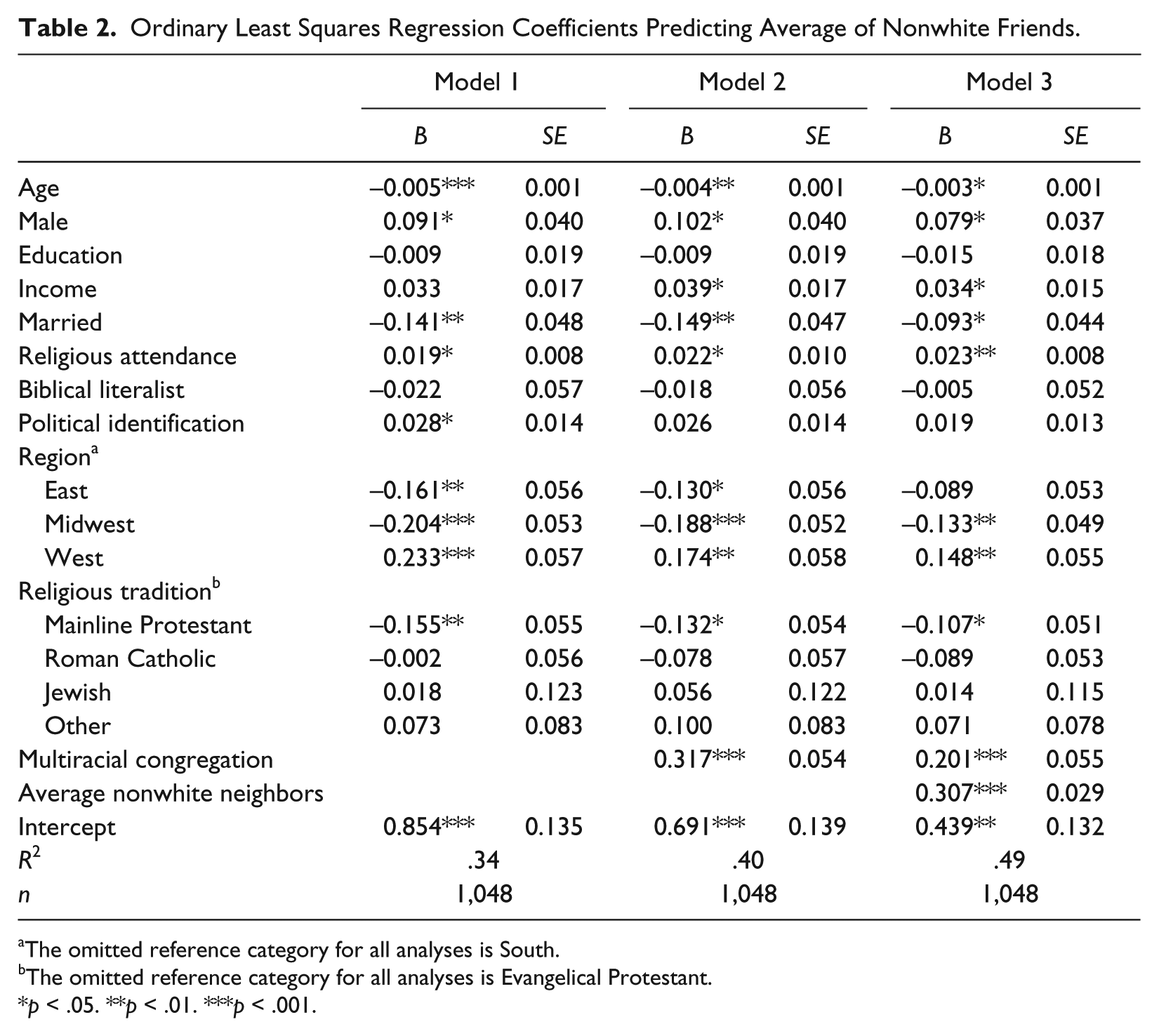
Table 2 presents unstandardized coefficients from three ordinary least squares (OLS) regression models. The dependent variable under analysis is the average number of nonwhite friends. Model 1 displays coefficients for control variables. On average, older respondents and those who are married report having fewer nonwhite friends. Men, regular religious attendees, and more liberal respondents report having more nonwhite friends. Respondents living in the East and the Midwest report having fewer nonwhite friends than those living in the South, while people living in the West report having more. Whites in mainline Protestant churches report fewer cross-racial friendships than whites in evangelical churches. In model 2, participation in a multiracial congregation is positively and significantly related to the extent of respondents’ cross-group friendships, net of controls (0.317, SE = 0.054, p < .001). Model 3 adds a measure of nonwhite neighbors. Even when controlling for exposure to other racial groups in a neighborhood, multiracial congregations stand out as statistically significant (0.201, SE = 0.055, p < .001). These findings support our first hypothesis.
Ordinary Least Squares Regression Coefficients Predicting Average of Nonwhite Friends.
The omitted reference category for all analyses is South.
The omitted reference category for all analyses is Evangelical Protestant.
p < .05. **p < .01. ***p < .001.
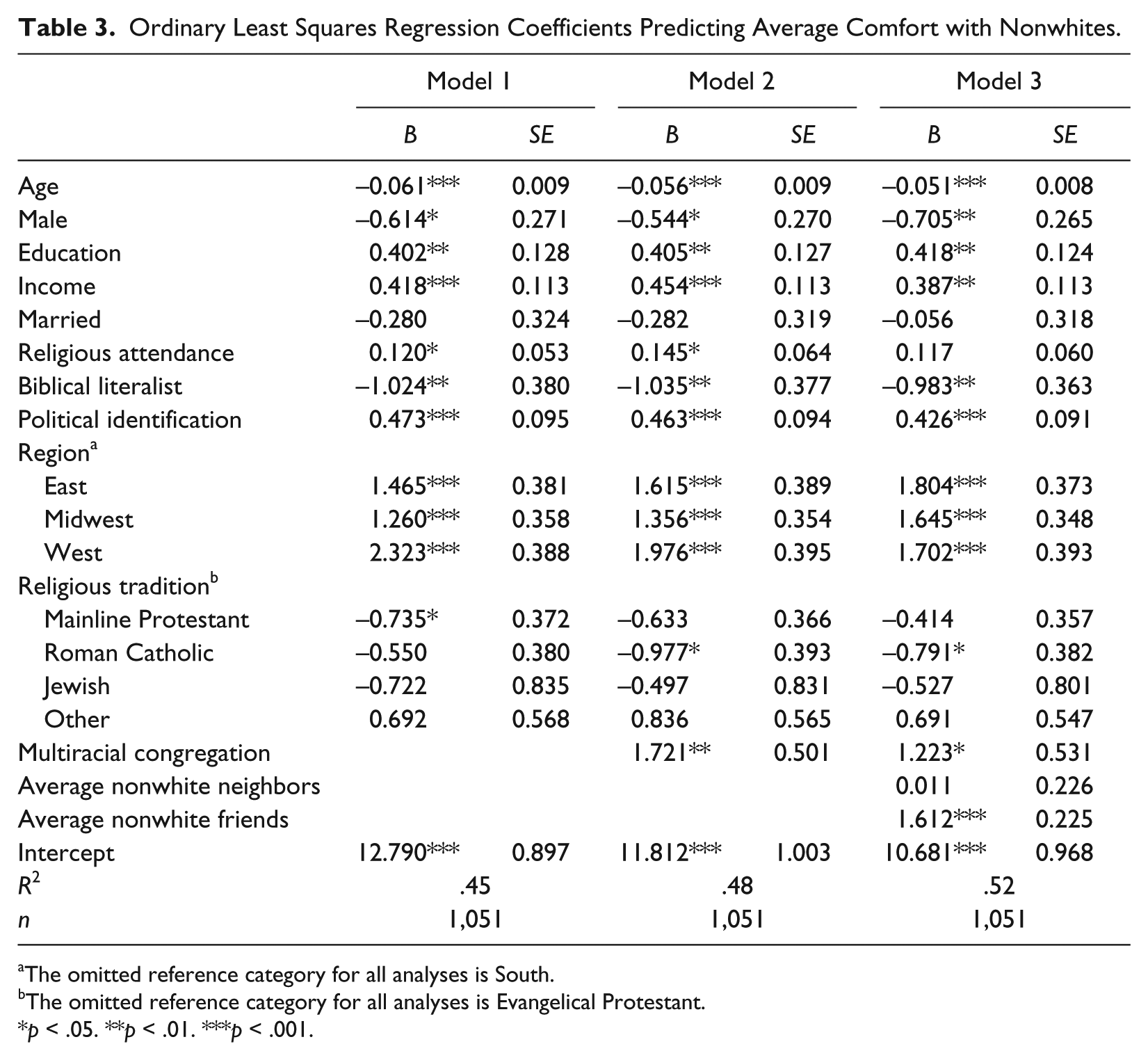
Table 3 presents results from three OLS regression models examining the relationship between participation in a multiracial congregation and whites’ average level of comfort with nonwhites. Model 1 reveals several significant control variables. Older respondents, men, and biblical literalists are less comfortable with nonwhite groups, while education, income, religious service attendance, and political liberalism are positively related to comfort with nonwhite groups. Whites in the South have significantly lower levels of comfort with nonwhites than do whites in any other region of the United States. Compared with white evangelicals, white mainline Protestants have less comfort with nonwhites. Model 2 reveals that, net of controls, participation in a multiracial congregation has a significant positive relationship with whites’ level of comfort with nonwhites (1.721, SE = 0.501, p < .01). Model 3 adds control variables for both the composition of one’s neighborhood and one’s friendship network. Once again, the coefficient for multiracial congregations remains positive and statistically significant (1.223, SE = 0.531, p < .05). This supports hypothesis 2. Furthermore, given that participation in a multiracial congregation is positively related to cross-racial friendships, these results suggest that the composition of one’s place of worship may have both a direct and an indirect relationship with racial attitudes.
Ordinary Least Squares Regression Coefficients Predicting Average Comfort with Nonwhites.
The omitted reference category for all analyses is South.
The omitted reference category for all analyses is Evangelical Protestant.
p < .05. **p < .01. ***p < .001.
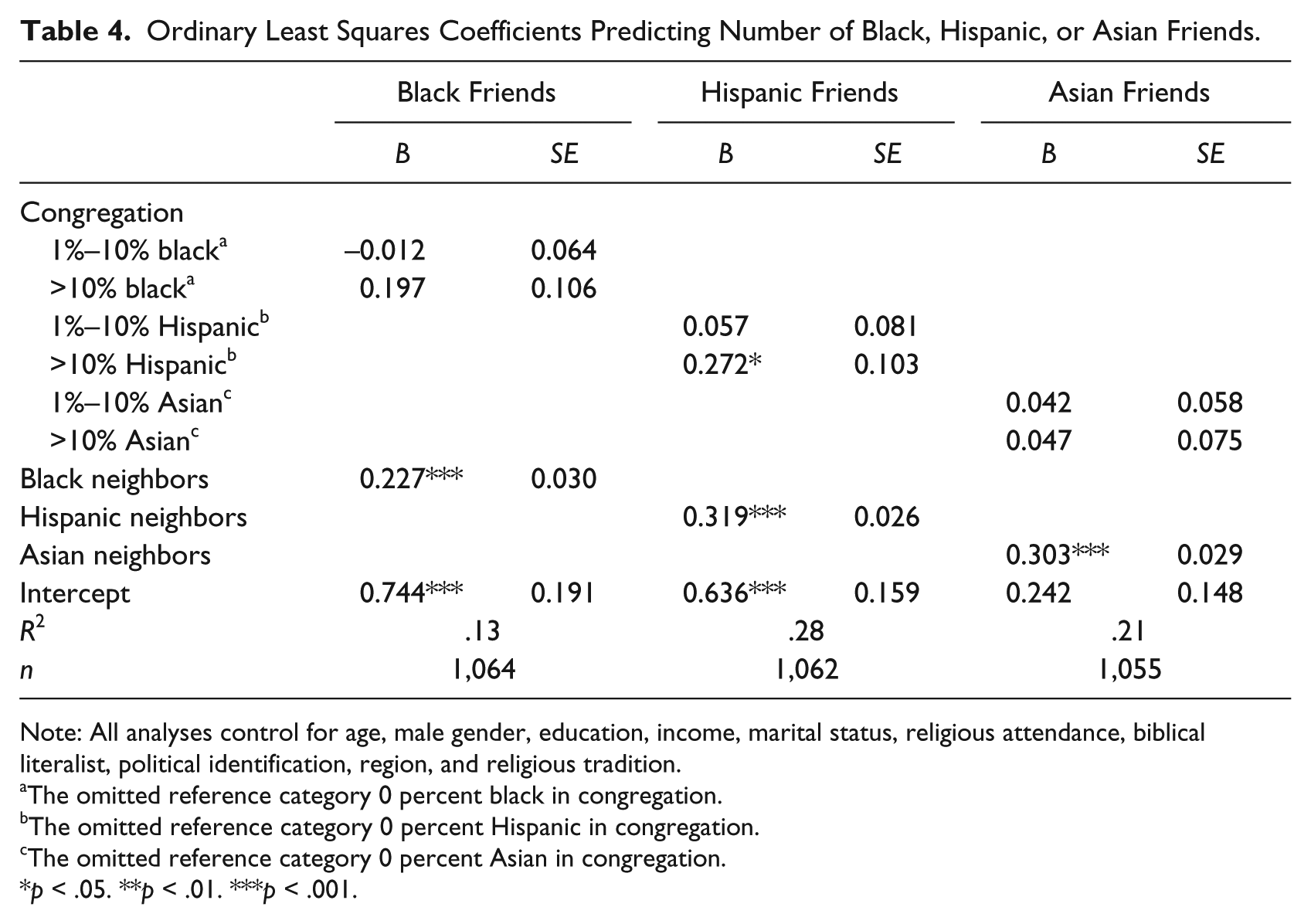
Tables 4 and 5 present selected results from a series of OLS models estimating the relationships of worshiping with different percentages of another racial group (i.e., black, Hispanic, or Asian) with white respondents’ cross-group friendships and white respondents’ level of comfort with that particular group. The tables display unstandardized coefficients only for the primary independent variables and key controls. However, all models include the same controls as shown in Tables 2 and 3. Full results are available from the authors upon request
Ordinary Least Squares Coefficients Predicting Number of Black, Hispanic, or Asian Friends.
Note: All analyses control for age, male gender, education, income, marital status, religious attendance, biblical literalist, political identification, region, and religious tradition.
The omitted reference category 0 percent black in congregation.
The omitted reference category 0 percent Hispanic in congregation.
The omitted reference category 0 percent Asian in congregation.
p < .05. **p < .01. ***p < .001.
Ordinary Least Sqaures Coefficients Predicting Comfort with Blacks, Hispanics, or Asians.

Note: All analyses control for age, male gender, education, income, marital status, religious attendance, biblical literalist, political identification, region, and religious tradition.
The omitted reference category 0 percent black in congregation.
The omitted reference category 0 percent Hispanic in congregation.
The omitted reference category 0 percent Asian in congregation.
p < .05. ** p < .01. ***p < .001.
Whites’ Friendships with Blacks, Hispanics, and Asians
Following the logic of the contact hypothesis, we expected white respondents that worship with members of another racial/ethnic group (i.e., black, Hispanic, Asian) to report having more friends in the corresponding group. Because of the significant social distance that continues to exist between whites and blacks in the United States, we anticipated that white respondents would need to be exposed to a larger percentage of black co-worshipers, compared with Hispanics or Asians, in order to report more cross-racial friends. However, results presented in Table 4 indicate that the percentage of a specific group within a congregation is only significant in relation to white congregants’ friendships with Hispanics. Increasing percentages of blacks and Asians are not significantly related to whites’ friendships with these groups. Our results suggest that the composition of whites’ neighborhoods is more influential in predicting attitudes toward specific racial/ethnic groups than congregational composition.
Model 1 (black friends) reveals that, net of all controls, white respondents who have more black neighbors also report having more black friends (0.227, SE = 0.030, p < .001). An increase in the presence of black coworshipers is not significantly related to composition of white congregants’ friendship networks. 4 Likewise, Model 2 (Hispanic friends) reveals that the amount of Hispanic neighbors is a significant predictor of white congregants’ friendships with Hispanics (0.319, SE = 0.026, p < .001). However, we do find that attending a congregation where at least 10 percent of the congregation is Hispanic is also related to an increase in Hispanic friends (0.272, SE = 0.103, p < .05). Results in model 3 (Asian friends) are similar to the results in the first model for black friends. The amount of Asian neighbors is related to an increase in white congregants’ Asian friends (0.303, SE = 0.029, p < .001), while congregation composition is not. These findings do not support our third hypothesis.
Whites’ Comfort with Blacks, Hispanics, and Asians
Similar to our expectation regarding friendships, we expected white respondents who worship with blacks, Hispanics, or Asians to report higher levels of comfort with these groups. Again, we anticipated that whites may need to be exposed to a larger percentage of black coworshipers, compared with other groups, in order to experience the positive consequences of intergroup contact. As with friendships, we found other factors tend to be more important for predicting whites’ comfort with blacks, Hispanics, and Asians than congregational composition. Results presented in Table 5 reveal that, net of all controls, congregational composition is not a significant predictor of whites’ comfort with any specific group. Rather, whites’ level of comfort with blacks is significantly related to the number of black friends that white respondents report having (1.058, SE = 0.214, p < .001). Similarly, Model 2 indicates that worshiping with a larger percentage of Hispanics has no significant relationship with white congregants’ comfort with Hispanics. In contrast, the extent of Hispanic neighbors (1.519, SE = 0.229, p < .001) predicts comfort with Hispanics. Results in model 3 reveal that both Asian neighbors (0.569, SE = 0.209, p < .01) and Asian friends (0.986, SE = 0.210, p < .001) predict white congregants’ comfort with Asians. These findings do not provide support for our fourth hypothesis.
Discussion
Religious participation has reinforced the color line in American society for generations. Despite this reality, recent evidence suggests that U.S. congregations are becoming more diverse. This trend raises important questions about the relationship between participation in racially diverse congregations and intergroup relations. We address several of these questions in the current study. Drawing on survey data from a national sample of American adults, our findings suggest that multiracial congregations are a context with unique potential for the formation of positive cross-racial contacts. These congregations represent local spaces where diverse individuals may come together and interact in ways that foster increased understanding and reduce prejudice and stereotyping. Specifically, our findings demonstrate that whites who belong to multiracial congregations are more connected to and more comfortable with nonwhites in general than are whites in nonmultiracial congregations. Whites in multiracial congregations are more likely to have nonwhite friends than their counterparts in other congregations, and they express more comfort interacting with nonwhite persons in a variety of social situations. Although our findings cannot prove causality, they clearly reveal that whites in these mixed-race congregations differ significantly from participants in more homogenous congregations. This parallels findings from previous research suggesting that multiracial congregations are inhabited by a distinct type of person. Emerson and Woo (2006) termed these individuals “Sixth Americans” (p. 99). They described them as people whose lives and social networks are not confined within any one of the five historic ethnic categories: white, black, Hispanic, Asian, or Native American. Sixth Americans are more likely to cross racial and ethnic divisions in their daily activities. They inhabit a personal world that is more multicultural than others. Garces-Foley (2007) used the term boundary crossers for this group. Whatever we call them, our findings affirm that whites in multiracial congregations are different than the general public in regard to how they perceive and experience racial diversity.
However, our findings also tell a more complicated story suggesting that cultural and structural patterns in society continue to play a more significant role in influencing cross-group relations than whether someone worships in a multiracial congregation. Racially mixed congregations are no assured solution to long-standing divisions between whites and other groups. Only for Hispanics does worshipping with whites result in a higher likelihood for intergroup friendships. Whites are already fairly favorable toward Asians. For whites, worshipping with Asians does not modify these appraisals. Nor does worshipping with blacks. The social distance separating whites and blacks represents a chasm that congregations seem unable to bridge. Long-standing patterns of residential and social segregation are likely key factors influencing cross-group relations. Congregations play a significant role in reducing the color line for some, but more significant structural, demographic, and policy changes are likely more powerful forces shaping cross-group relations.
There are several limitations of the present study. First, our analyses examine the relationship of congregational composition and white attenders’ attitudes and cross-racial friendships. Our findings provide an important perspective on the implications of diversity, but it would be helpful to know more about attitudes and behaviors of other racial and ethnic groups participating in multiracial congregations. Future surveys of religious attenders should include an oversample of ethnic minorities. It is a salient direction for research, given that the minority group in a congregation bears a heavier cost for sustaining diversity (Christerson and Emerson 2003).
Second, although our measures of congregational diversity and intergroup relations are appropriate to our hypotheses, there is room for improvement. As noted, some respondents had difficulty estimating the racial and ethnic composition of their congregations. This is not surprising, and we constructed variables to reduce measurement error. Nevertheless, future research on this topic would benefit from improved methods of capturing congregational composition. In our analyses, we rely primarily on two variables to represent the quality of respondents’ intergroup relations: the composition of friendship networks and responses on an adapted social distance scale. These well-respected measures have a significant history in the literature on intergroup relations. However, past research indicates that responses to such items are often affected by social desirability (Campbell and Herman 2015). In addition, our measures of intergroup relations do not tap into the types of structural factors (e.g., discrimination, education) that perpetuate racial inequality. Others contend that multiracial congregations do little to alter the structural thinking of whites about the causes and consequences of racial inequality (Cobb, Perry, and Dougherty 2015; Edwards 2014). Extending and improving such measures in the future may provide a more complete picture of religion’s influence on racial equality/inequality in the United States.
Third, racial attitudes are not static. Current events color perceptions. At the time of the 2007 BRS, a black U.S. senator from Illinois was on the presidential campaign trail. Barack Obama was elected the first nonwhite U.S. president in November 2008. Many Americans were hopeful that Obama’s election signaled the advent of a postracial society. A decade later, racial strife has replaced the optimism surrounding the Obama presidency. The perceptions of racial outgroups may be different in congregations today than it was in 2007. A cross-sectional survey cannot capture changing opinion. Instead, we provide a snapshot at one moment in time that we hope will be helpful to others on a similar research path.
Finally, we acknowledge again the limitation of testing causation. As American communities and congregations become more diverse over time, scholars would do well to examine the effects of these changes. Longitudinal and ethnographic research exploring the effects of increasing diversity on participants in once homogenous congregations may shed light on this issue. This leads to a final implication of the present study.
Our findings support the notion that congregations have implications for race relations. These prevalent voluntary organizations are no panacea, but they are a context for expanded social networks that can influence perceptions and attitudes. Race/ethnicity is just one of several “veils of structural inequality” still casting shadows over segments of the U.S. population (Durr 2016). What role do congregations play in addressing other social divisions, such as rich/poor, abled/disabled, gay/straight, or conservative/liberal? Each of these divisions represents a promising direction for future research. The more we learn about the bridging potential of congregations, the better we will understand the place of religion in civil society.