




Abstract
I contribute to our understanding of black–white inequality in the United States by assessing the legacy of “sundown towns.” Sundown towns are places that restricted who could live there based on ideas about race. The often-violent tactics employed to create and maintain all-white spaces reshaped dramatically the demographic and social landscape of the non-South. I extend previous research on sundown towns by examining their association with contemporary black–white economic inequality. In addition, I advance a new theoretical perspective to explain how the history associated with sundown towns contributes to contemporary inequality, namely large-scale segregation. To assess the contemporary impact of sundown history, I employ a dataset on places connected to sundown towns in the eastern Midwest and county data from the 2008–2012 American Community Survey (ACS) period estimates. In addition, I use standard ordinary least squares (OLS) and spatial data analysis techniques to provide a multifaceted assessment of the contribution of sundown towns to contemporary black–white inequality. This analysis extends our understanding of the social impact of historical legacies and emphasizes the importance of the protection of white advantage and large-scale segregation when explaining the (re)production of black–white inequality in the United States.
The contemporary legacies of history have received increasing attention within the racial inequality literature. However, this attention has been directed primarily toward the history surrounding slavery and lynching in the U.S. South (see Cunningham and Phillips 2007; Duncan 1999; Falk, Talley, and Rankin 1993; Jacobs, Carmichael, and Kent 2005; Keen and Jacobs 2009; King, Messner, and Baller 2009; Messner, Baller, and Zevenbergen 2005; O’Connell 2012; Roscigno and Bruce 1995; Ruef and Fletcher 2003; Vandiver, Giacopassi, and Lofquist 2006). The near exclusive focus on the South raises questions regarding the extent to which processes connecting history to contemporary racial inequality manifest under other conditions, namely in other regions and focusing on other historical events. Moreover, our limited view of what aspects of history matter for contemporary inequality inadvertently minimizes the history associated with the non-South. I address these limitations in the current study while extending our understanding of the processes that contribute to black–white inequality by assessing the contemporary inequality consequences of “sundown towns.”
Sundown towns are places—ranging in scale from villages to entire counties—that prohibited particular groups from living, or sometimes even just being, there (see Loewen 2005). Despite affecting multiple groups (e.g., blacks, Asians, Jews), the most often excluded group was blacks, particularly when considering areas in the Midwest. We refer to these places as “sundown towns” because sundown, or dusk, was a common temporal reference when monitoring the exclusion of identified populations. The excluded group(s) may not have been welcome at any time of day, but they were prohibited most strictly after dark. Many towns had explicit ordinances that legalized the intimidation tactics employed to maintain an all-white space. A complementary feature of these places is the presence of threatening signs at the town boundaries, which might read “Don’t let the sun set on you here, understand?” or “God help you if the sun ever sets on you here!” However, even without explicit sundown laws, other places were able to establish and maintain all-white spaces through an informal understanding of who was, and was not, allowed to be there. Formal or informal, exclusion based on ideas about race and the protection of white spaces could contribute directly to racial inequalities. Sundown towns are a key, yet often invisible, piece of our history that reshaped dramatically the social and demographic landscape of the United States.
While sundown towns are (primarily) a thing of the past, arguments regarding a persistent connection between the history of a place and contemporary inequality suggest that sundown towns remain important for understanding contemporary inequality-generating processes. Scholars have begun to discuss the persistent social impacts of sundown towns, but research has yet to explicitly examine the inequality consequences of this historical event (Crowe 2012; Crowe and Ceresola 2014; Loewen 2005). In addition, previous research has emphasized the attitudinal consequences of sundown towns (Crowe and Cresola 2014; Loewen 2005), yet the exclusion of particular groups and the subsequent isolation of whites could also support racialized inequalities through opportunity hoarding (Tilly 1999; also see DiTomaso 2012) and processes related to social closure (Weber 1968). Sundown towns represent a pronounced form of segregation that could continue to affect contemporary black–white inequality through the concentration of white advantage and/or sustained black disadvantage.
In this research, I contribute to understanding the production of black–white inequalities by assessing how the history of sundown towns in the United States remains imprinted on the contemporary inequality landscape and by evaluating the implications of this link for explaining the persistence of black–white inequality. I employ a dataset on the location of places showing evidence of black exclusion (i.e., sundown towns) in six Midwestern states, county-level American Community Survey (ACS) data, and a spatial perspective to provide a multifaceted analysis of the links between sundown history and contemporary black–white economic inequality. My focus is on how the location of historical sundown towns relates to contemporary variation across counties in the extent of black–white poverty disparities. In addition to extending our understanding of the contemporary legacies of history, this focus on sundown towns illuminates two key features of contemporary black–white inequality in the Midwest. First, it emphasizes the role of processes related to large-scale segregation rather than discriminatory actions aimed directly at disadvantaging blacks. Second, and related, identifying processes that support white advantage—in addition to black disadvantage—is critical to understanding the persistence of black–white inequality in the United States.
Developing Explanations for the Spatial Distribution of Black–White Economic Inequality: Departing from a Southern Focus
Historical events have been theoretically and empirically linked to contemporary outcomes (e.g., Duncan 1999; Falk et al. 1993; Keen and Jacobs 2009; O’Connell 2012; Reece and O’Connell 2016; Roscigno and Bruce 1995). Scholars have argued that history remains imprinted on a place and that its lingering social structural impact connects history to contemporary racial inequality (see especially O’Connell 2012; Reece and O’Connell 2016; Vandiver et al. 2006). Gaps remain in our understanding of how exactly the history of a place is perpetuated over time, but Molotch, Freudenburg, and Paulsen (2000) provide a framework for understanding this process. They suggest that history constrains the options available when making future decisions, and subsequently, history becomes embedded in a place and part of its character. Similar sequences of thought as suggested in Molotch et al. (2000) are evident in the historical legacy literature when scholars suggest that slavery has contributed to the local social structure of a place (see especially Duncan 1999; Keen and Jacobs 2009; O’Connell 2012). Critically, the emphasis of these theories on places suggests that historical consequences can be maintained over time through local custom and the socialization of newcomers despite years of distance and migration. Although previous research focuses on the legacy of slavery, I extend this premise to consider historical sundown towns.
When considering the contemporary legacy of sundown towns—places that excluded people based on ideas about race—there are clear implications for understanding the production of racial inequalities. Despite discussion of this connection (see especially Loewen 2005), research has yet to address the link between sundown towns and contemporary black–white economic inequality (for a partial exception, see Crowe and Ceresola 2014). Drawing attention to sundown towns is especially appealing because it could aid in explaining why disparities are sometimes most pronounced where the black population is smallest, and it adds to our understanding of historical legacies by addressing the extent to which history matters for inequality outside of the southern region. In addition, sundown towns offer a unique opportunity to consider the parallel components of black–white inequality—black disadvantage as well as white advantage—because both are implicated in the development of sundown towns. Specifically, antiblack attitudes have been connected to places with a sundown history (Crowe and Ceresola 2014; Loewen 2005), which suggests that any connection to contemporary inequality would operate through increased black disadvantage. However, at their roots, sundown towns were founded on the protection of white spaces (see Loewen 2005), which suggests that they may affect contemporary inequality more so by supporting enhanced white advantage rather than directly affecting the economic outcomes of blacks.
Most discussions of racial inequality focus on how the social or economic outcomes of racialized minorities are curtailed. However, inequality references the disparity between two groups’ outcomes and can therefore occur through the disproportionate benefits received by one group (i.e., whites) in addition to through the suppression of racial/ethnic minorities (also see Beeman, Glasberg, and Casey 2010; Feagin 2000; Oliver and Shapiro 1997). Advantage and disadvantage are clearly linked, but they suggest different approaches to addressing inequality. Examining both components of this inequality dynamic will supplement our understanding of any contemporary legacy of sundown towns and advance broader conceptions of how racial inequality is sustained by indicating the types of processes involved in generating black–white inequality—those that diminish the position of blacks or those that benefit whites.
A Brief Sundown History
Places from which certain populations—blacks, Asians, Jews—were forcibly removed and excluded by white residents are often referred to as “sundown towns.” Physical threats and intimidation, including the burning of crosses and the homes of minority residents, were used to initiate the dispersion of any existing minority population and to establish a precedent to warn off future potential residents. James Loewen (2005) provides an extensive history of sundown towns in the United States (for detailed descriptions of a handful of sundown town cases, see Jaspin 2007). However, it is useful to review some of that history here to emphasize the points of theoretical interest to racial inequality scholars. In my review, I focus on the emergence of sundown towns, their location, and the contemporary remnants of having been a sundown town.
Sundown towns emerged starting around the turn of the twentieth century (i.e., 1890), but white Americans continued adding to their numbers as late as 1940 (Loewen 2005). This timing is most notable for its connection to the recent end of two major institutionalized responses to black–white relations—slavery and reconstruction—and the subsequent dispersion of blacks through migration. The removal of federal expectations left norms of engagement open to local interpretation, and the interaction of whites and blacks in new places provided the opportunity for shifts in those interpretations. As Loewen (2005) argues, sundown towns were not inevitable, but they were one response to the situation of the time.
Sundown towns are scattered throughout the United States, but they are concentrated in the North, including areas in the Midwest, Northeast, as well as the Northwest. However, the groups targeted in these areas of the country often differed. For example, the Midwest is notable for its attention to excluding blacks, whereas places in the Northwest directed their attention to excluding Asian populations. In addition to being concentrated in certain parts of the country, Loewen (2005) emphasizes that sundown towns were more likely to be places that started out with small minority populations. This is a defining criterion because the mechanisms used to enforce the exclusion of blacks (and other groups) require monitoring and coordination that may be impractical when dealing with large populations (e.g., forcing the relocation of all existing minority residents and identifying new residents).
One of the most pernicious consequences of sundown towns stems from the invisibility of this history—contemporary residents of these towns are largely unaware of the history and assume that the division between whites and blacks is natural. As Loewen (2005) describes, and as has been supported by recent comparative efforts (Crowe and Ceresola 2014), sundown towns support antiblack and prowhite attitudes among local residents. Reminiscent of social contact arguments that suggest interaction with an outgroup helps reduce negative perceptions (see especially Pettigrew et al. 2011), Loewen (2005) articulates how the racially insulating nature of places that are “all-white on purpose” help breed and support negative perceptions of blacks. Simultaneously, white residents of historical sundown towns maintain a prowhite perspective when they insist that living in an all-white community is a right (see especially Crowe and Ceresola 2014).
In addition to affecting individual attitudes, historically sundown places may continue to contribute to large-scale segregation through the protection of all-white spaces. Sundown towns represent an extreme case of racial segregation, namely segregation that manifests at a large scale (e.g., exclusion from entire towns, cities, or counties; also see Lichter, Parisi, and Taquino 2015; Parisi, Lichter, and Taquino 2011). Sundown towns helped establish a specific pattern of segregation, whereby blacks are completely separated from white towns. The segregation associated with sundown towns is closely related to antiblack and prowhite attitudes, but I assert that the exclusion of blacks from certain places may be the more immediate link to contemporary economic inequalities rather than local attitudes.
Linking Sundown Towns to Contemporary Black–White Economic Inequality
Both consequences of sundown towns—antiblack attitudes and segregation—could contribute to contemporary black–white economic inequality. However, previous work has primarily focused on the former when discussing the contemporary consequences of sundown towns (Crowe 2012; Crowe and Ceresola 2014). I advance the previous conceptual framing by arguing that both the attitudinal and segregation consequences of sundown towns matter. In addition, while previous work has primarily focused on black disadvantage, contemporary inequality legacies of sundown towns could operate through the production of black disadvantage and/or the support of white advantage. While connected, examining both sides of black–white inequality may help clarify the specific processes involved in sustaining that inequality. Below, I detail both the attitudinal and segregation pathways to greater racial inequality as well as how a sundown town history affects white advantage in addition to black disadvantage. Although my empirical analysis will not be able to assess these mechanisms directly, establishing this theoretical foundation is important for enhancing our understanding of the empirical evidence and promoting future research.
First, drawing from the explanation established in previous research (Crowe 2012; Crowe and Ceresola 2014), sundown towns may provide the foundation for and/or support contemporary racially biased attitudes. The discriminatory roots of the sundown movement, and Loewen’s (2005) assertion that places that were previously sundown towns promote antiblack attitudes, suggest that counties with a sundown history would have higher contemporary levels of black economic disadvantage (i.e., higher black poverty rates) relative to otherwise similar counties. Local antiblack attitudes could affect the economic opportunities of residents through decisions regarding economic development (see Crowe 2012; Crowe and Ceresola 2014), which could disadvantage local blacks through the availability of different types of jobs. In addition, blacks could receive fewer and lower paying economic opportunities, regardless of job type, due to local antiblack discrimination. On another hand, prowhite attitudes could advantage whites in historically sundown counties relative to whites in other counties through preferential hiring. Through either mechanism—greater black disadvantage or greater white advantage—the contribution of attitudes to contemporary black–white inequality is expected to manifest locally.
Second, sundown towns may indirectly affect economic opportunities through their effects on the spatial distribution of the black and white populations. This second proposed pathway extends the perspective employed in previous sociological research on sundown towns (e.g., Crowe 2012; Crowe and Ceresola 2014) because it suggests that sundown towns influence the life chances of people beyond the boundaries of the immediate geographic area tied to the sundown town. I draw on spatial perspectives to suggest that sundown towns in other counties could indirectly influence the level of economic inequality in a neighboring county. Although published research on the link between segregation and sundown towns is currently unavailable, it stands to reason that the establishment of a sundown town serves to physically separate the black and white populations. 1 Segregation is particularly problematic for racial equality to the extent to which these populations are in differential proximity to social, economic, and natural resources (see Quillian 2014). The segregation associated with sundown towns suggests that whites were—and may continue to be—concentrated within sundown towns, whereas blacks would be relegated to the outskirts of towns, or even neighboring counties. The presence of sundown towns nearby may reduce residential options to less desirable counties and thereby contribute to the concentration of black disadvantage within counties that neighbor sundown counties. Alternatively, this large-scale segregation may promote white economic advantage by providing the ideal context for opportunity hoarding (Tilly 1999). The separation of whites and blacks could ease the concentration of resources among local whites, including resources tied to schools (also see Fiel 2013, 2015), the housing market (Beeman et al. 2010; Oliver and Shapiro 1997), and the labor market. Regardless of individual attitudes and actions, the spatial remnants of sundown towns may facilitate social closure (see especially Weber 1968) and promote white economic advantage through the concentration of resources. Critically, this benefit would extend to all whites living in the area and could occur without direct expressions of racism (also see DiTomaso 2012). This perspective builds on previous segregation and inequality research by highlighting the potential importance of large-scale segregation for understanding the production of black–white inequality (also see Lichter et al. 2015; Parisi et al. 2011).
In this research, I am primarily linking any local association between sundown towns and contemporary black–white inequality to the attitudinal explanation, whereas the large-scale segregation pathway is more closely connected to the extralocal association that considers the sundown status of places outside of the immediate county. However, I acknowledge that both explanations could be used for either association. Any local association could be the result of large-scale segregation occurring within a county, and any extralocal association could be explained by the diffusion of antiblack or prowhite attitudes to neighboring counties. While I will continue to focus on attitudes when discussing any local association and segregation for the extra-local association for simplicity, I am unable to test directly which mechanisms are involved in this foundational analysis. As a result, I will weigh both possible explanations when drawing my final conclusions.
Before proceeding to the data, I consider one additional dimension of how having a sundown history may relate to contemporary black–white inequality. I have discussed both pathways—attitudes and segregation—as being generally applicable, but it is possible that their influence on contemporary black–white inequality will differ depending on local characteristics. My review of sundown towns suggests a potentially central axis of differentiation—rurality. Given the preponderance of sundown towns among areas with smaller populations, the role of the first, attitudinal pathway may be limited to rural counties. In contrast, the indirect pathways related to large-scale segregation may be more pronounced among metropolitan counties as they were primarily influenced by sundown towns through the migration, and subsequent settlement, of the ousted black population (for research on migration destinations during the Great Migration, see White et al. 2005).
I address four specific hypotheses in my assessment of the links between sundown history and contemporary patterns of black–white economic inequality. First, I examine the association between sundown history—both local and neighboring—and inequality net of other contemporary factors. Second, drawing from Crowe’s (2012) work that shows how places with a sundown history take alternative, often less successful, routes to economic development, I test whether the link between sundown towns and contemporary black–white inequality is driven by industrial composition and economic conditions. Third, I provide initial insight into the extent to which the processes linking sundown history to contemporary inequality differs depending on rurality. Finally, I analyze black and white poverty rates separately to assess whether any sundown association is driven by the promotion of black disadvantage or white advantage.
Data
I use data from three sources: the 2008–2012 ACS period estimates (U.S. Census 2013), a database of sundown towns created using data originally collected by Crowe (2012), and the Rural-Urban Continuum created by the Economic Research Services (ERS). The ACS 5-year estimates provide information on county poverty rates for the non-Hispanic black and non-Hispanic white populations and other key county characteristics, such as industrial and racial composition (i.e., natural log of percent black; Blalock 1967) and the level of educational attainment of the local population (i.e., the proportion of the population aged 25 years old and older with less than a high school degree). I measure industrial composition using the concentration of agriculture and manufacturing employment. These are the core industries of the Midwest and have been identified as key correlates in studies of black–white inequality (e.g., Blalock 1956; Cohen 1998). I supplement this industrial focus with estimates of unemployment to account for the strength of the local labor market. I use the Rural-Urban Continuum from the ERS to identify metropolitan and nonmetropolitan counties. Consistent with previous research (e.g., O’Connell 2012; Shoff and Yang 2013), metropolitan counties include codes 1–7, and nonmetropolitan status is represented by codes 8 and 9. Results are consistent when including additional controls (i.e., local political context).
I examine inequality at the county level because I aim to assess structural causes of group disparities. The county unit is an appropriate and common unit of analysis in this literature because county boundaries are associated with social, political, and economic institutions relevant to the production of inequality (see, e.g., Roscigno 1995). Complete information on sundown towns is still forming, but data from two different sources (Crowe 2012; Loewen 2005) overlap on six central states: Illinois, Indiana, Michigan, Missouri, Ohio, and Wisconsin. Kentucky and Iowa have been included in other sundown town analyses (see especially Crowe 2012), but there is far less confidence in the accuracy of the claims to a sundown history within those states, especially when considering the history of every county in the state. Therefore, I limit my analysis to counties in the aforementioned Midwestern states (i.e., Illinois, Indiana, Michigan, Missouri, Ohio, and Wisconsin). Although not ideal, this limited geographic focus is appropriate for establishing a baseline connection between sundown towns and the spatial patterning of black–white inequality because the bulk of sundown towns that have been identified so far are located in the Midwest (Loewen 2005).
Racialized Poverty Disparities
In this analysis, I focus on economic disadvantage as represented by poverty status. Poverty is a useful outcome because it represents the culmination of disadvantage across educational, political, and economic spheres. However, the official poverty threshold has been criticized for a wide range of reasons, most centrally because it does not accurately reflect the experience of poverty and is generally considered an underestimate (see, e.g., Rossi and Curtis 2013). Despite its limitations, the official poverty threshold provides sound insight into black–white inequality especially since I focus on disparities within a county, which helps account for how differences in the cost of living might affect this estimate of poverty. Alternative outcomes were assessed in sensitivity analyses (e.g., median household income), and the results are conceptually consistent with what is presented using poverty.
To measure black–white poverty disparities, I use the black poverty rate minus the white poverty rate. An alternative approach could employ the ratio of the rates. I have chosen the disparity approach because it has a more normal statistical distribution and therefore aligns more closely with the assumptions of regression analysis than does the ratio measure. However, I note that my results concerning the role of sundown towns are consistent when employing the ratio measure, and I further reduce any concerns regarding how best to measure inequality by also examining the black and white poverty rates separately (discussed further below).
Measurement of local inequality requires, by definition, that both groups—blacks and whites—be present. This excludes 10 counties from my analysis of inequality. 2 I exclude an additional 120 counties that have a black poverty denominator below 50. 3 I made this decision based on the understanding that despite having a black population present, the black poverty estimates for these counties may be unreliable and could, therefore, negatively affect my models. The decision to exclude these additional counties does not affect my substantive conclusions regarding the role of historical sundown towns. The analyses for black poverty rely on the same set of counties as is used in the inequality analysis; however, I report results for white poverty using all counties in the study region, regardless of if a black population is present. My results are consistent when restricting the white poverty analysis to the same counties that I use in the inequality and black poverty analyses.
Sundown History Variables
I identify a county’s sundown history using the data developed by Crowe (2012) combined with information on the geographic location of identified sundown towns. In previous research, Crowe examined the historical population dynamics of a large sample of towns to determine their potential connection to a sundown history. Specifically, she identified towns in her sample that had a substantial drop in the black population from one Census to the next (for full details, see Crowe 2012). This dramatic change in the local black population to its near or complete absence is highly suggestive of restrictive practices like those employed in sundown towns.
The reliance on population changes alone means that this indication of sundown history is not definitive and may result in an overestimate if towns did not officially adopt sundown laws. However, this population-based definition is consistent with a broader understanding of why sundown towns are important, which is based on their exclusionary foundation. The creation of all-white spaces may have implications for contemporary black–white inequality regardless of whether formal sundown laws were established. A second limitation is that this measure of sundown towns omits any towns that were established as sundown prior to any blacks becoming residents. As a result, it may be an underestimate of the true number of individual sundown towns. Finally, a third limitation when using these data to inform an analysis of all counties relates to the use of a sample of towns rather than a full census. When drawing conclusions about any connection to a sundown history for all counties, reliance on only a sample of towns may lead to an underestimation of the number of counties with a sundown history. Therefore, I may provide a somewhat conservative estimate of the examined counties’ sundown attachment. Despite these limitations, this approach is consistent with previous research and is the best available for the current study.
As a check of the estimates that I derived from Crowe’s (2012) research, I have also estimated sundown history using the detailed notes generously provided by James Loewen (see Loewen 2005). My substantive conclusions are largely consistent when employing this alternative data source, yet critical limitations preclude my full reliance on them. Foremost, the estimates based on Loewen’s notes rely on reports that are differentially developed across the examined states. Most attention has been given to Illinois, which is also the state with the largest number of identified sundown towns in Loewen’s data. It is possible that the greater attention is due to the concentration of sundown towns, but it is also possible that the number of confirmed towns is higher in that state due to the greater attention. As a result, it is unclear whether the stark contrast observed across even neighboring states is a true distinction or is, instead, a reflection of differential resource allocation. Given my reliance on spatial variation in this analysis, ensuring consistency in the likelihood of identifying a town as sundown across states is paramount.
In my final estimates, I rely on Crowe’s (2012) data to code all counties based on the presence/absence of a town with evidence of a sundown history. Regardless of if a whole county went sundown, I expect that having a sundown town anywhere within the county could affect local dynamics that result in either greater black disadvantage (i.e., antiblack attitudes and restricted geographic opportunities) or greater white advantage (i.e., prowhite attitudes and resource concentration). However, I acknowledge that linking sundown towns to entire counties has its limitations. My results will represent an underestimate of the contemporary inequality legacy of sundown towns to the extent to which sundown towns primarily operate through local pathways that are confined to the cities and towns originally associated with the sundown movement. In addition, there is reason to expect that the consequences of sundown towns for black–white inequality would increase with the number of towns that went sundown, which would suggest employing a continuous rather than a binary variable. I have conducted a supplemental analysis using the count of identified sundown towns rather than a binary measure, which provides strikingly similar coefficient estimates when compared to what I present below. However, the small number of counties with more than one identified sundown town (i.e., 46 have two, 7 have three, 4 have four, and 1 has five) suggests a binary variable is statistically preferable.
I estimate the extralocal influence of sundown history on black economic disadvantage using a spatial lag measure of sundown status. Consistent with my view of the potential role of residential dispersion across counties, I use a first order queen contiguity matrix, which means that the spatial lag variable is defined using the values of all counties that touch the focal county’s boundaries. This variable is calculated in GeoDa and represents the average sundown status of the neighboring counties. 4 For example, a county with one sundown neighbor out of a total of four neighbors would be given a value of .25 on the sundown spatial lag variable.
Analytic Approach
My examination of the link between sundown history and contemporary black disadvantage relies on a cross-sectional regression analysis. The use of spatially contiguous units of analysis necessitates caution when interpreting coefficient estimates from an ordinary least squares (OLS) model because unobserved spatial processes could bias those estimates. To address this concern, I checked all of my models for residual spatial correlation using the Moran’s I statistic, which provides an average estimate of the correlation of each county’s value (e.g., the model residual) with the values of its neighboring counties. Despite initial concern regarding bias, my analysis suggests a limited role of spatially correlated residuals (I = .08, p < .01). Although statistically significant, the spatial correlation is minimal (i.e., it is below .10), and the regression results are consistent when using a spatial error model that further accounts for the spatial structure of the data. Therefore, I present the results from the more parsimonious OLS models.
In my analysis, I provide a background for examining black–white poverty inequality and its links to historical sundown towns by displaying maps of both variables. I then address my hypotheses through four steps. First, I use descriptive analyses and an analysis of the full regression model to assess the association between a county’s historical ties to sundown towns and the contemporary black–white disparity in poverty rates. Evidence of a positive association for either the local or the spatially lagged variable would support my hypothesis that sundown towns exacerbate black–white inequality within certain places. Second, I compare the sundown coefficients from the full model with one excluding industrial composition and unemployment. This step addresses the extent to which any impact of sundown history on black–white inequality is driven by differential economic development (see Crowe 2012). Third, I divide counties based on their metropolitan status to examine the extent to which the sundown associations differ depending on rurality. 5 Finally, I estimate separate models for black and white poverty to assess the extent to which sundown history relates differentially to the two components of local racialized inequality. This final component of my analysis speaks to the extent to which any contemporary inequality legacy of sundown towns operates through the production of black disadvantage (i.e., higher black poverty rates) or the support of white advantage (i.e., lower white poverty rates).
Results
Consistent with the image of black–white inequality more generally, the poverty disparities for the counties in this analysis are wide ranging and vary spatially (see Figure 1). I contribute to understanding the production of black–white inequality by explaining these differences across places. Specifically, I am concerned with how the location of towns with an implied sundown history helps us understand differences in local levels of inequality across counties and, subsequently, the broader production of black–white inequality.

Black–white county-level poverty disparities, ACS 2008–2012.
Sundown towns—as defined in this study—were not evenly represented across even the six states included in this analysis (see Figure 2). Consistent with Loewen’s (2005) research, identified sundown towns are found in two distinct areas. They were most concentrated in rural areas, indicated in Figure 2 by the concentration of shaded counties away from major cities. This pattern is evident when examining counties in northern Wisconsin, for example, which is an overwhelmingly rural area. However, sundown towns were simultaneously clustered around major cities. The latter pattern is most likely a reflection of the development of what Loewen (2005) referred to as sundown suburbs. The creation of sundown suburbs could explain why even some counties with major cities are categorized as having a sundown history.
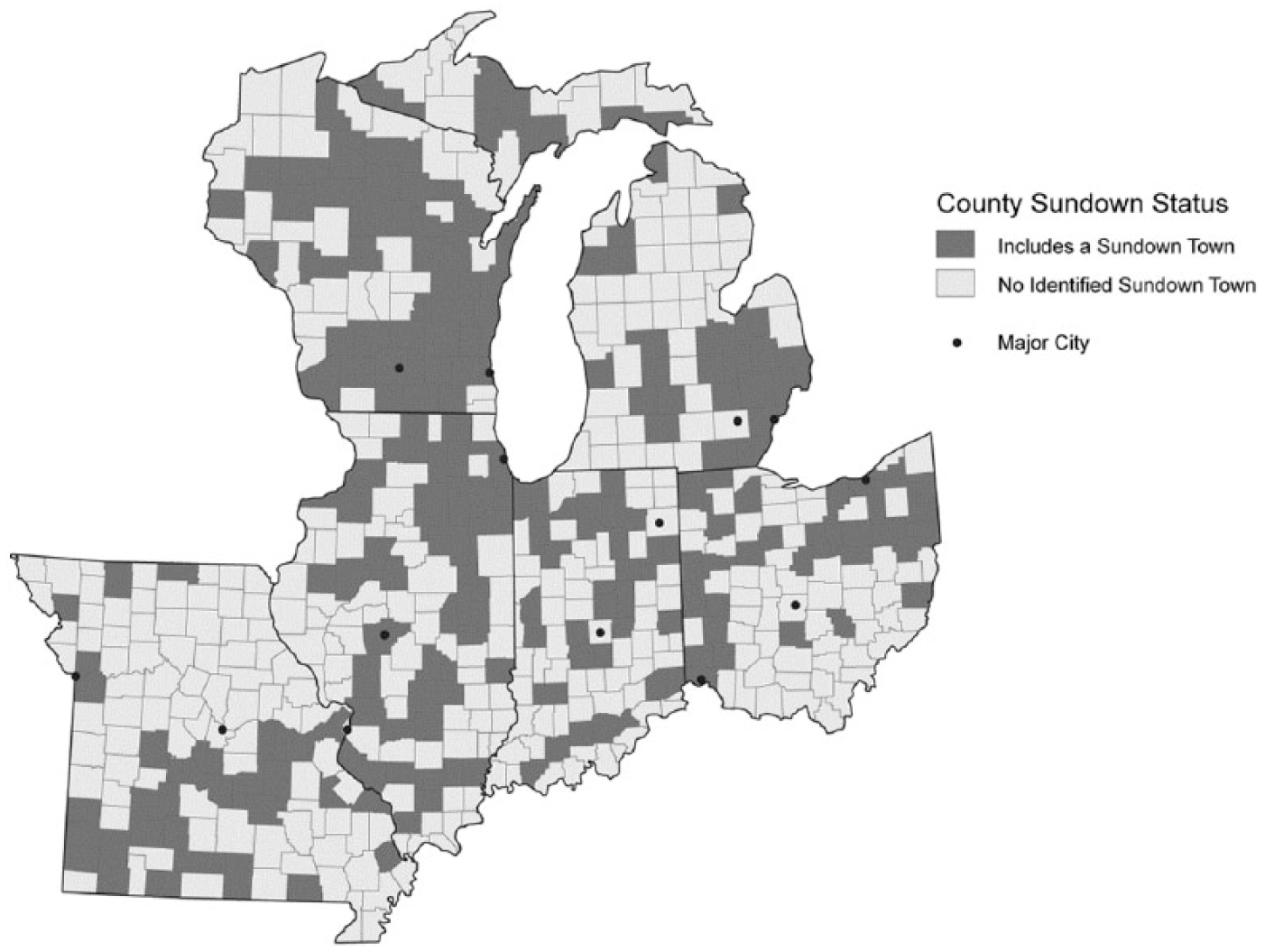
Historical ties to sundown towns: Counties that contain an identified sundown town.
This history of sundown towns continues to be reflected in contemporary patterns of black–white economic inequality. Before turning to the regression results, I provide descriptive evidence based on the average black–white poverty disparity in counties with and without a historical sundown town and counties with differing proportions of neighbors with a sundown history. Consistent with the hypothesis suggesting a direct impact of having a historical sundown town, there is a small two-percentage-point difference in the average poverty disparity for counties with a historical sundown town and counties with no such identified history (see Table 1). The average poverty disparity for the 245 counties in this analysis with no identified sundown history is 21, which suggests that the black poverty rate is, on average, 21 percentage points higher than the corresponding white poverty rate. The average for counties with evidence of a sundown history is higher—the average black–white poverty gap is 23 percentage points. We see a stronger difference in average black–white poverty disparities when looking at counties with differing proportions of sundown neighbors (i.e., different values on the spatial lag sundown variable). The values on the spatially lagged sundown variable range from 0 to 1 with a median of .25, which would indicate that a quarter of a county’s neighbors have a sundown history. I use the median as the defining threshold in this descriptive analysis to ensure a large enough number of observations in the comparison categories and because I found little difference across the counties with values above and below .25. Counties surrounded by a low proportion of neighboring counties with a sundown history (i.e., less than .25) have an average black–white poverty disparity of 16 or a poverty rate difference of 16 percentage points to the disadvantage of blacks. The corresponding average in counties with a larger proportion of sundown neighbors (i.e., greater than or equal to .25) is 24, which is 8 percentage points higher than the average for other counties. While black poverty rates remain dramatically higher than those of local whites in both types of counties, there is some evidence that black–white inequality is lower where fewer neighboring counties have a historical sundown town.
Descriptive Analysis of Average Black–White Poverty Differences in Relation to Sundown History, ACS 2008–2012.

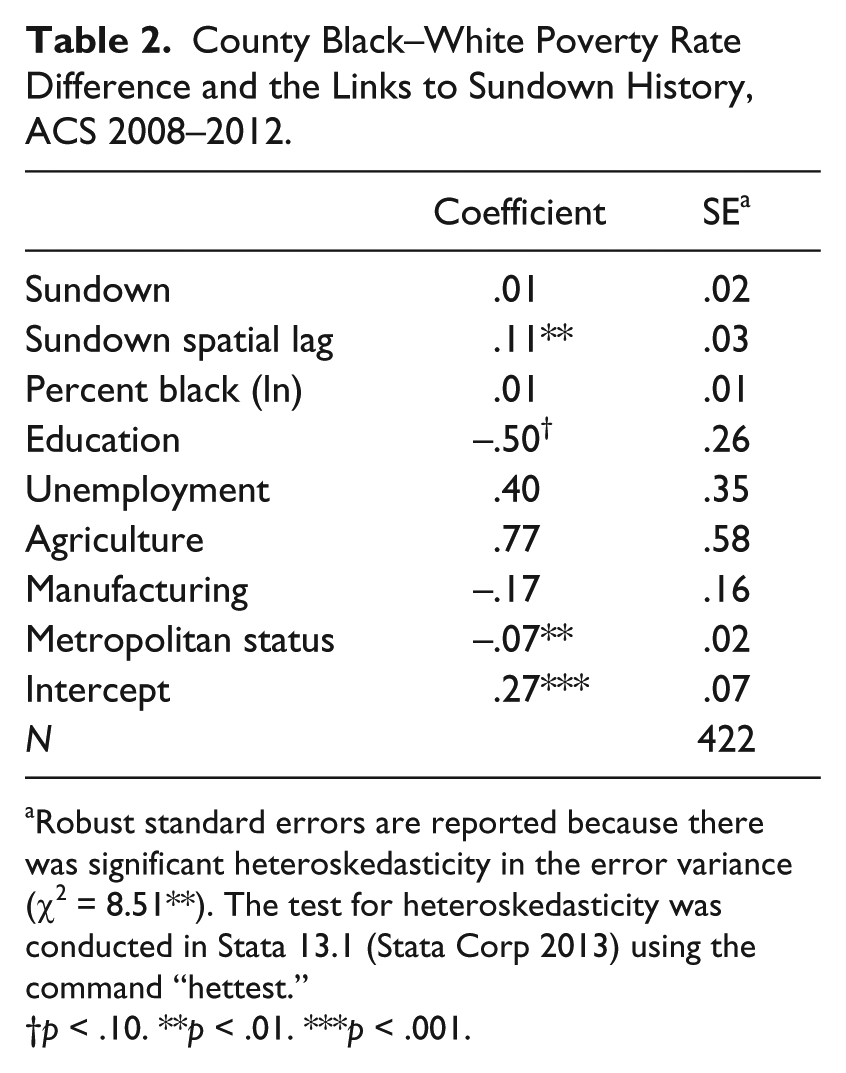
The regression analysis provides further support for the more prominent role of the sundown status of neighboring counties as compared to a county’s own sundown history. In the regression analysis, there is no evidence of a link between local sundown status and black–white poverty differences (see Table 2). This suggests that black–white poverty disparities are statistically similar regardless of local sundown status. The small difference in black–white poverty inequality found in the descriptive analysis is not robust to the inclusion of controls. These null results are consistent even when controlling for broader regional trends that may manifest at the state level, and they cannot be explained by the complete absence of the black population or even differences in the concentration of the black population. All counties in this analysis have a black population for whom poverty status is determined of at least 50, and the relative size of the black population is accounted for in the model.
County Black–White Poverty Rate Difference and the Links to Sundown History, ACS 2008–2012.
Robust standard errors are reported because there was significant heteroskedasticity in the error variance (χ2 = 8.51**). The test for heteroskedasticity was conducted in Stata 13.1 (Stata Corp 2013) using the command “hettest.”
p < .10. **p < .01. ***p < .001.
The greater explanatory power of the sundown status of a county’s neighbors, in contrast to local sundown status, is indicated by the positive and significant spatial lag sundown variable (see Table 2). Increases in the proportion of neighboring counties with a historical sundown town are associated with higher than average levels of black–white poverty inequality in the focal county. These results suggest that a sundown history primarily affects the blacks who are not living in sundown counties. The presence of sundown towns promotes inequality beyond their own town, and even county, boundaries. I argue that this is possible primarily through the large-scale segregation that accompanies the establishment of sundown towns—an argument that I consider more fully in the Discussion section.
The sundown status of a county’s neighbors is one of the few significant factors in this model. Black population concentration is often a focal variable in analyses of black–white inequality, but it plays little to no role in this analysis (see Table 2). The nonsignificance of black population concentration is not due to the inclusion of the sundown history variables. In fact, there is no association between black population concentration and local levels of black–white inequality in a model where black population concentration is the only explanatory variable. This suggests that, in contrast to other regions and times, black population concentration is of minimal importance in this portion of the Midwest when explaining outcomes from the 2008–2012 time period (for an analysis of regional variation in the percent black–inequality relationship, see Curtis and O’Connell 2017). Educational attainment, industrial composition, and unemployment have weak relationships with black–white poverty inequality in this region, but this may be due to inconsistent relationships with black and white poverty that results in a minimal impact on average levels of inequality (see Table 3) rather than these variables playing no role in explaining black or white poverty rates. Metropolitan status is the only other traditionally significant covariate, which suggests black–white inequality is lower in metropolitan as compared to nonmetropolitan counties (see Table 2).
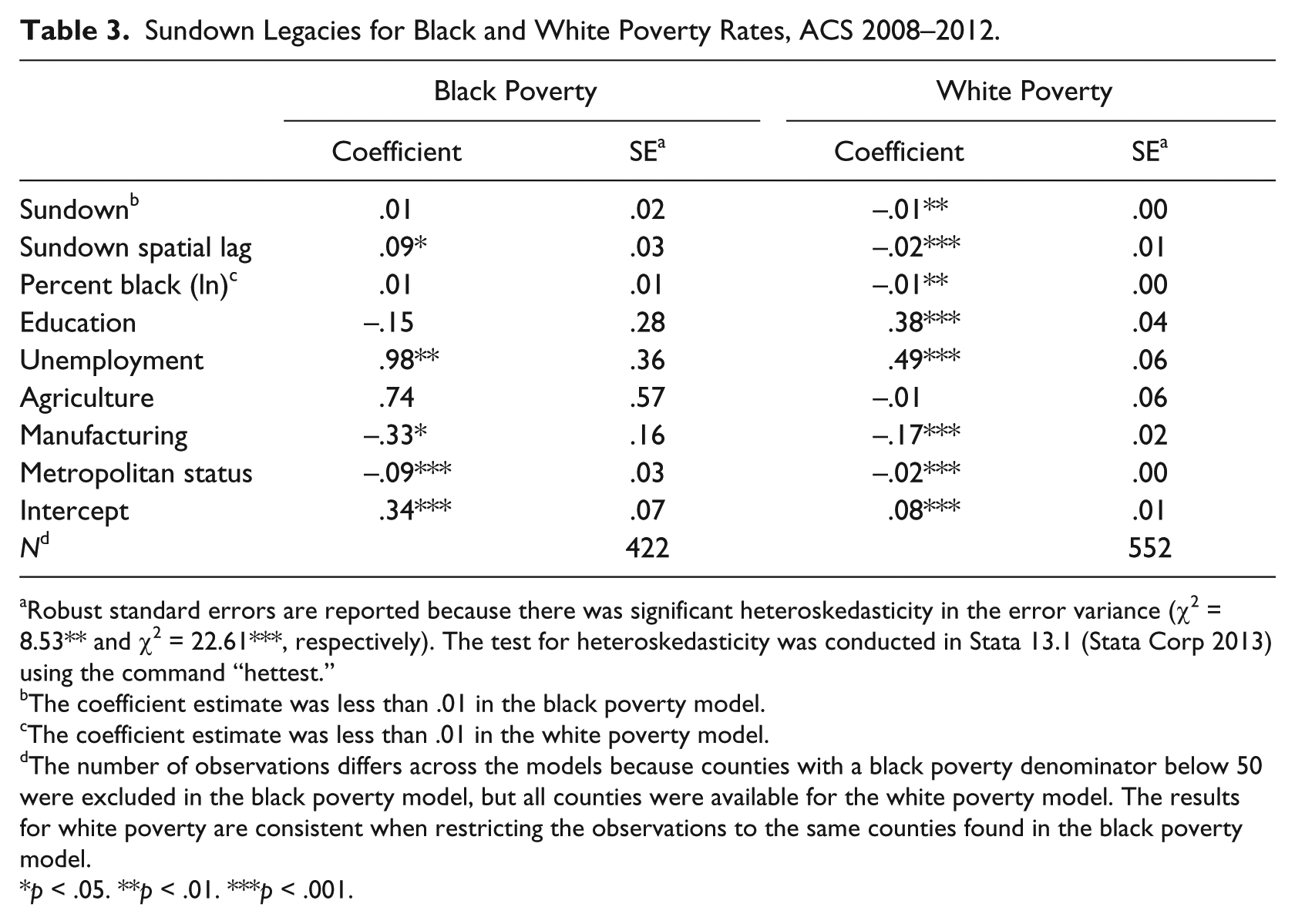
Sundown Legacies for Black and White Poverty Rates, ACS 2008–2012.
Robust standard errors are reported because there was significant heteroskedasticity in the error variance (χ2 = 8.53** and χ2 = 22.61***, respectively). The test for heteroskedasticity was conducted in Stata 13.1 (Stata Corp 2013) using the command “hettest.”
The coefficient estimate was less than .01 in the black poverty model.
The coefficient estimate was less than .01 in the white poverty model.
The number of observations differs across the models because counties with a black poverty denominator below 50 were excluded in the black poverty model, but all counties were available for the white poverty model. The results for white poverty are consistent when restricting the observations to the same counties found in the black poverty model.
p < .05. **p < .01. ***p < .001.
Understanding the Link between Sundown History and Contemporary Racial Inequality: What Is the Role of Industry, Rurality, and the Relative Importance of Black Disadvantage versus White Advantage?
The full model suggests a persistent link between sundown history and the spatial patterning of black–white poverty disparities. I elaborate on this initial association by addressing three addition questions. First, what is the role of the differential economic development and subsequent industrial composition of a county in explaining this association? Second, does this relationship differ depending on whether a county is rural or urban? Finally, is sundown history affecting contemporary inequality primarily through higher black poverty rates (i.e., black disadvantage) or lower white poverty rates (i.e., white advantage)?
First, the role of industry. Rather than local sundown status being irrelevant for explaining contemporary spatial variation in black–white poverty inequality, as suggested by the null finding discussed above, an alternative explanation would suggest differences in industrial structure and unemployment mediate any baseline association. Previous work indicates a sundown history affects local decisions related to economic development in such a way that it may restrict the economic opportunities within areas tied to a sundown history (Crowe 2012; also see Crowe and Ceresola 2014). To assess the plausibility of this explanation, I compare the reported results with those from a model excluding industrial composition and unemployment. In contrast to an economic development explanation, the results for the sundown associations are nearly identical without those variables (not shown). This comparison provides further evidence suggesting the more prominent role of sundown towns in neighboring counties rather than a county’s own sundown history in explaining contemporary black–white poverty inequality.
Second, I consider how the link between sundown history and contemporary inequality may differ depending on rurality. Based on the potential difference in how sundown towns affected these two types of counties—directly via attitudes and indirectly via migration—I anticipated that the local pathway may be more pronounced among nonmetropolitan counties, while the extralocal pathway would play a larger role in explaining black–white inequality among nonmetropolitan counties. In contrast to this expectation, the coefficients from the separate models were nearly identical (not shown). This suggests that the contemporary impact of sundown history on black–white inequality is similar across the two contexts.
Finally, to further illuminate the pathways through which sundown towns relate to contemporary inequality, I disaggregated the disparity measure to analyze black and white poverty rates separately (see Table 3). This set of results provides two key insights. First, local sundown status is significantly related to white—but not black—poverty rates, such that counties with a sundown history have lower white poverty rates than counties with no historical sundown town presence. Second, the average sundown status of neighboring counties is related to both black and white poverty rates, but the connection to lower white poverty is more robust.
A local sundown history protects white advantage, but local blacks do not fare any worse than blacks in counties without a direct, local history. Descriptive results indicate that the average white poverty rate is two percentage points lower in counties with a sundown history (no sundown history = 14 % sundown history = 12 percent). Similarly, the average black poverty rate is lower in counties with a sundown history, but there is only a one percentage-point difference across the two types of counties (no sundown history = 35 % sundown history = 34 percent). The regression models further suggest the protective role of a sundown history for whites in Table 3 through the significant sundown status coefficient for the white poverty model, but there is only a trivial association in the black poverty model. Black poverty rates may be affected by similar forces that provide an additional layer of protection to whites who live in counties with a sundown history, but any benefit to the local black population is nonsignificant.
The spatially lagged sundown variable continues to play a larger role in this analysis than the sundown status of the focal county. Black poverty is significantly higher in a county when that county is surrounded by counties with a sundown history (see Table 3). The average black poverty rate is five percentage points higher in counties with a higher proportion of neighbors with a sundown history (i.e., a value of .25 or greater on the sundown spatial lag variable) than in other counties (36 percent and 31 percent, respectively). Simultaneously, whites are at an economic advantage (i.e., lower poverty rates) in such counties when compared to whites in counties with fewer sundown neighbors, as indicated by the highly significant coefficient for the sundown spatial lag variable (see Table 3). The average white poverty rate is lower in counties surrounded by a higher proportion of sundown neighbors than it is in other counties (13 percent and 15 percent, respectively). These results suggest the spatial lag link between sundown history and contemporary black–white poverty inequality is driven primarily by greater white advantage but also exacerbated black disadvantage to a lesser degree. Combined, this analysis suggests that sundown history contributes to black–white inequality through multiple layers of white benefit—local and extralocal—as well as by supporting black economic disadvantage via processes connected to neighboring counties’ sundown statuses.
Discussion
The current research extends our understanding of the contemporary legacies of history by suggesting that this type of process, whereby the history of a place remains linked to contemporary racial inequality, extends to places and events outside of the U.S. South. Our history, broadly conceived, shapes the (re)production of racialized inequality in the United States. By understanding our history and its connections to the present, we can better address the racial inequalities that persist today despite decades of attention and change.
Sundown towns—places developed to protect white spaces (see Loewen 2005)—are a critical, yet often neglected, aspect of U.S. history. Building from research focused on slavery (e.g., Falk et al. 1993; O’Connell 2012; Vandiver et al. 2006), I bring attention to this sundown history and its contemporary consequences for black–white economic inequality. High proportions of neighboring counties with a historical sundown town are associated with higher than average black–white poverty inequality in the focal county. This association with inequality is driven by both higher black poverty and lower white poverty. There may also be some economic benefit to living in counties with direct ties to a sundown history, but that benefit is exclusive to whites. The local black population fares no worse or better in terms of poverty regardless of whether the county had a historical sundown town. The persistence of this historical legacy net of contemporary industrial structure suggests the wide reach of how sundown towns shape contemporary economic inequality. In addition to shaping local economic decisions that can ultimately affect inequality (Crowe 2012; also see Crowe and Ceresola 2014), our sundown history differentially benefits the contemporary economic outcomes of blacks and whites.
In this foundational analysis of the inequality legacy of sundown towns, I advance two explanations for the lingering impact of sundown history. In addition to the preexisting suggestion that antiblack, but also prowhite, attitudes would affect contemporary racialized outcomes (Crowe 2012; Crowe and Ceresola 2014; Loewen 2005), I posit that large-scale segregation is also involved. Both hypotheses provide plausible explanations for the significant associations found in this analysis, yet a segregation explanation may make more sense when considering the null association between local sundown status and black poverty.
Prowhite attitudes may explain the link between local sundown status and lower white poverty to the extent to which prowhite attitudes result in preferential treatment of, and therefore better economic outcomes for, whites. The diffusion, or spread, of such attitudes could also explain why white poverty is related to the sundown history of surrounding counties. Yet if racially biased attitudes fully explain how the legacy of sundown towns contributes to contemporary black–white inequality, then it is unclear why there is no association between local sundown status and greater black poverty. Based on my results, black poverty rates are statistically similar across counties regardless of their own sundown history after controlling for other factors and are only marginally higher in places surrounded by counties with implied sundown towns.
The importance of neighboring sundown status for understanding white and, to a lesser extent, black poverty seems most consistent with segregation-based explanations. The concentration of sundown towns in neighboring counties could restrict black geographic mobility and in turn limit the economic opportunities of local blacks. In this way, it is possible that sundown towns have their biggest impact on the blacks who are not allowed to live there, and therefore we see no association between local sundown status and black poverty. Simultaneously, this large-scale segregation within and across counties could directly benefit whites through the protection or hoarding of resources and could therefore help explain the negative association between the sundown status of surrounding counties and local white poverty. This understanding of the importance of “opportunity hoarding” for explaining black–white inequality in the United States is consistent with Tilly’s (1999) foundational work as well as more recent studies on contemporary school segregation (see, e.g., Fiel 2013, 2015), inequality in the housing market (Beeman et al. 2010), and racial attitudes (DiTomaso 2012).
In sum, previous research examining the historical legacy of sundown towns has focused on the concentration of antiblack attitudes and discrimination locally (Crowe 2012; Crowe and Ceresola 2014), yet my research suggests extending that focus in two ways. First, I stress that the contemporary mechanisms involved in maintaining black–white disparities need not rely on antiblack economic discrimination that results in worse outcomes for local blacks. This is certainly an important component of inequality production and one that is consistent with some of the evidence that I present. However, we should also be considering additional processes that focus on enhancing white advantages when explaining contemporary black–white inequality (also see DiTomaso 2012). Second, and relatedly, my research suggests the role of large-scale segregation processes. Research has increasingly attended to segregation manifesting at larger scales, moving beyond differences between neighborhoods, and this work suggests that racial segregation is shifting from a local phenomenon that occurs within cities to one that is characterized by large-scale separation between cities (Lichter et al. 2015; Parisi 2011). However, this macrosegregation has received limited attention within work on racial inequality. This will be an important area of future research, particularly given the growing magnitude of this scale of segregation.
Despite providing suggestive evidence, my results are limited in the extent to which they can distinguish between the attitudinal and segregation explanations. Additional research employing interviews of long-term residents, or perhaps longitudinal, historical analyses of several areas with and without historical ties to sundown towns, is needed to identify the specific underlying mechanisms (also see Crowe and Ceresola 2014). Related, future research on the legacy of sundown towns will need to further develop the relationship between sundown towns and contemporary, as well as historical, residential segregation patterns.
My research also suggests a need for additional investigation of how this legacy may differ across town and county characteristics. In contrast to the suggestion that how sundown history relates to local inequality would differ depending on county metropolitan status, my results are comparable across the metropolitan and nonmetropolitan counties (not shown). However, before moving on from the possibility of variation in the links between sundown history and contemporary racialized fortunes, future work should consider alternative means of specifying this argument. For example, it may be that we need to more specifically identify sundown towns that are suburbs and those that are independent sundown towns.
When considering the implications of the current study, my results on the role of macrosegregation and white advantage are of particular importance to ongoing conversations regarding how to address black–white inequalities in the United States. Research examining how whites explain racial disparities suggests that there are significant distinctions in the explanations provided when the question is framed in terms of white advantage rather than black disadvantage (Bunyasi 2015; Croll 2013). Building on this work and that of critical whiteness studies (e.g., Doane and Bonilla-Silva 2003), my research suggests the need to bring white advantage and its relationship with the disadvantage of others to the fore in discussions of inequality. As DiTomaso (2012) argues, how we frame discussions of racial inequality is central to understanding Americans’—particularly whites’—(in)action when it comes to addressing that inequality. We have become uncomfortable with disadvantage, but we remain unaware or less concerned about manifestations of advantage. Similarly, neighborhood segregation has received substantial negative attention, but the exclusion of racialized groups from entire towns or cities remains acceptable and often omitted from popular understandings of segregation. We need to be made uncomfortable with both if we are to address racial inequalities in the United States.
Footnotes
Acknowledgements
I would like to thank my colleagues for contributing to the inspiration for this project and providing feedback on earlier drafts of this manuscript, especially Pamela Oliver, Jim Loewen, Junia Howell, and Angelina Grigoryeva. I also thank the American Sociological Association for the opportunity to present this work at the 2015 annual meeting in Chicago.