



Abstract
Diversity has simultaneously become a pervasive goal and euphemism for racial differences in higher education. Although discourses within the postsecondary context highlight the positive impact of diversity on learning outcomes, organizational diversity efforts nevertheless warrant interrogation, given their possible obfuscation if not reification of, racial inequality and hierarchy. How do Historically Black Colleges and Universities (HBCUs)—colleges and universities that are, by their very nature, racialized organizations within higher education—express and adapt to the challenges presented by diversity imperatives? In this article, we interrogate this question through systematic content analyses of visual and narrative materials from 31 HBCUs. Results highlight how these institutions often rely on the same mechanisms that characterize diversity within predominately White institutions (PWIs)—commodification of difference and disconnection from issues of racial equity. Consequently, diversity for HBCUs reflects the more general racialized inequality regime in higher education—a regime wherein these organizations largely reinforce ideas, such as racial capitalism, which have implications for racial equity. Our results and discussion hold implications for scholarship on organizational diversity but are also informative with regard to the capacity and constraints of racialized organizations to meet the needs and interests of those they serve.
Diversity in the contemporary era is usually framed as a positive good, allowing people from different walks of life to learn from each other. Its benefits have been particularly touted in higher education where interactions with diverse peers improve learning outcomes (Gurin et al. 2002). Although there is clearly some evidence of benefits, the promotion of racial diversity, is not without drawbacks. Some scholars, for instance, have suggested that diversity programs largely obscure contemporary realities surrounding racial inequality and allow current racial hierarchies and inequalities to go unacknowledged and unchallenged (Bell and Hartmann 2007; Dovidio, Gaertner, and Saguy 2015; Embrick 2011; Herring and Henderson 2012; Ward 2008). Compositional diversity alone, in fact, is unable to deliver racial justice within organizations, especially when disconnected from pertinent power, inequality, and status dynamics (DiTomaso, Post, and Parks-Yancy 2007; Roscigno and Yavorsky 2015).
Historically Black Colleges and Universities (HBCUs) have largely been ignored in conversations about diversity (Howard-Hamilton 2015). This is probably because such schools do not fit the dominant diversity narrative—that is, bringing minority students into majority White spaces—nor do they have a history of exclusion to overcome (Wolfe 2015). Although HBCUs are publicly conceived of as only serving African Americans and people of African descent, these institutions have always been open to all students, particularly those who are underrepresented in other college settings. HBCUs have increasingly drawn students from all racial backgrounds, with non-Black students now comprising about 20 percent of their enrollments (National Center for Education Statistics [NCES], U.S. Department of Education 2016). These facts highlight HBCUs as a warranted, albeit historically neglected, organizational context within which to interrogate how diversity is represented.
In this article, we build on prior literature surrounding organizational diversity, inequality, and HBCUs drawing on qualitative content derived from HBCU websites. These websites provide rich visual depictions of student attributes and representation on a given campus as well as detailed mission and vision statements regarding organizational goals, directions, and aims when it comes to diversity. Coupling such content-coded materials with actual student enrollment data allows for systematic analyses across both public and private HBCUs. Specifically, we analytically focus on visual representations and diversity discourses. Doing so allows for insights into how HBCUs engage with the adaptive challenges presented by current and popular portrayals of diversity.
Our results suggest that representations of diversity on HBCU websites mostly reflect the same commodification of difference and disconnection from issues of racial equity that characterize diversity discourses within predominately White institutions (PWIs). This is demonstrated by (1) an overrepresentation of White students, visually, in online presence and (2) diversity discourses separate from issues of racial inequality, with the exception of more elite HBCUs. As a consequence, diversity for HBCUs has come to reflect what others have called a racialized inequality regime (Wooten and Couloute 2017)—a regime wherein organization processes and presentations tend to reinforce ideas that, by design or default, come to disproportionately disadvantage the organization’s very constituents. Through diversity discourses, HBCUs are constrained to downplay their successful point of difference at educating Black students. This is the very point of difference that is critical to the sustainability and longevity of these schools.
Diversity and Rationalization in Higher Education
The implementation of diversity programming in higher education was partially born out of a backlash against affirmative action. In the wake of civil rights victories of the 1950s and 1960s, universities created affirmative action policies to rectify earlier racial and economic barriers that prevented students from being accepted. These programs emerged when social movements met with sympathetic administrative beliefs (Stulberg and Chen 2014). While affirmative action programs were effective at bringing students of color to predominantly White campuses, they nevertheless were (and continue to be) challenged politically and legally (Green 2004).
The Powell opinion in Regents of the University of California vs. Bakke (U.S. Supreme Court 1978) allowed universities to maintain race-conscious admissions to extend the educational benefits of diversity. This influential ruling affected the policies of a number of universities. For example, Harvard was specifically praised in the Powell opinion, and schools such as the University of Michigan Law School followed their lead in designing admission policies (Gurin et al. 2004). The Powell opinion established a compelling government interest in having students from all walks of life engage with each other, even for those universities with no previous history of excluding students. To comply, universities began to alter their language from affirmative action for those previously denied opportunities to the language of “diversity,” which touts more general benefits for all.
Ideas of diversity have continued to grow in importance even as race-conscious admissions and affirmative action programs have been deinstitutionalized at less elite schools (Hirschman and Berrey 2017). Today, there is significant consensus concerning the importance of diversity signaling among university administrators—a consensus that is nearly universal (Lipson 2007) and one that is critical for universities’ reputations (Stevens 2007). This is evident in analyses of diversity signaling at Ivy League and public flagship universities (Berrey 2011; Lipson 2007; Warikoo 2016). There is some evidence that this emphasis on diversity exists across sectors; less selective universities also laud diversity in their viewbooks, have clearly designated diversity officers, and have a growing number of diversity offices (Hartley and Morphew 2008; Kwak, Gavrila, and Ramirez 2019).
Similarity with regard to the organizational diversity imperative may have to do with the convergence of university operations around economic rationalization. Increasing rationalization is characterized by a shift toward a market and managerial focus. McMillan Cottom and Tuchman (2007) theorize that this move toward rationalization occurred as the not-for-profit and the burgeoning for-profit sectors of higher education came to resemble each other through mutual mimetic isomorphism (DiMaggio and Powell 1983). Forced to change by the disinvestment of public monies in higher education, not-for-profit schools have come to look more like corporations than delivery systems for a public good. In this system, “professors become human capital, students become consumers, and education becomes a deliverable” (McMillian Cottom and Tuchman 2007:6). These changes seem to reflect broader neoliberal trends—trends within which individuals are conceived of as primarily economic actors. In the case of diversity, it would mean that diversifying colleges and universities has become a more general business principle in higher education. This however, and if true, has implications for racial equity.
Racial Capital and the Value of Diversity
The ubiquity of diversity discourse fits squarely with ideas of rationalization because diversity is something that you can sell. Ellen C. Berrey (2011), for instance, shows how universities use diversity to reframe inclusion and to market their universities to potential consumers. By using diversity language, universities can signal valued attributes, such as being global (Ahmed 2007). In other words, the more an institution reflects diversity, the greater the enrollment and financial returns. Moreover, with strong displays of diversity, universities earn reputational boosts vis-à-vis their institutional peers (Meyer and Rowan 1977). This incentivizes diversity programming that is outwardly focused, or what we call diversity displays. By consequence, marketing diversity, regardless of whether such displays or programming is effective or beneficial for those who are typically the objects of diversity, helps institutions to win the diversity game, if only in appearance.
Diversity displays manifest themselves in the appearance of activities centered around the inclusion of heterogenous groups even if such activities are, more or less, divorced from positive or desired outcomes. One form of display (and indeed, disconnect) entails the visual representation of students in university recruitment and promotion materials. In a now well-known case, the University of Wisconsin was sued for doctoring a photo to add a Black student to an all-White image (Osei-Kofi, Torres, and Lui 2013). Despite the visibility of this case and the legal settlement that Wisconsin paid, York College of Pennsylvania did something similar in 2019, adding an Asian American student and one woman (with her hair covered and who appears to be Muslim) to a billboard advertisement (Jaschik 2019).
Such cases, of course, are hardly exceptions. Timothy D. Pippert, Laura J. Essenburg, and Edward J. Matchett (2013), for instance, find that viewbooks, on average, more than double the percentage of Black students that are actually present on campus. College students themselves argue that their universities are more likely to promote diversity programs (e.g., multicultural weeks) on their websites rather than delve into issues even more pressing to minority students, such as campus climate (Lowe et al. 2013). The effect is a regime that helps to “institutionalize a benign commitment to diversity, [that] obscures, entrenches, and even intensifies existing racial inequality” (Thomas 2018a:143). The result, moreover, is one in which diversity efforts center more so on intent rather than results, celebration rather than inclusion, and commodification rather than representation (Embrick 2011; Smith and Mayorga-Gallo 2017).
Diversity displays also allow universities to appropriate the value of their students of color through racial capitalism, or “the process of gaining social or economic value from the racial identity of another person” (Leong 2013:2152). This is problematic in several regards. First, it turns underrepresented students into commodities, or living capital, for the institutions they attend (Smith and Mayorga-Gallo 2017; Thomas 2018b). Second, it adds to how “diversity” as a goal tends to crowd out, neglect, or sideline racial equity (Bell and Hartmann 2007; Dobbin 2009; Kelly and Dobbin 1998; Okuwobi 2019). Indeed, in obscuring histories and ongoing manifestations of racial inequality, diversity work, especially when largely symbolic, is perhaps best viewed as a racial project—a racial project that alters the meaning of racial equity within the social structure to symbolically signify racial integration (Omi and Winant 2014; Thomas 2018a).
Such critiques have led scholars such as Cedric Herring and Loren Henderson (2012) to push instead for what they refer to as “critical diversity.” Critical diversity would entail efforts to advocate an expansive notion of diversity, but seek out distributive justice that will serve to assist “disprivileged” groups; shift resources away from privileged groups, especially when invoking the rhetoric of diversity; and reconnect diversity to affirmative action and the need to offset historical and ongoing racial and gender discrimination, segregation, and bias. (p. 629)
Changing diversity to focus on justice, it is suggested, would explicitly address the racial inequalities that mere diversity discourses and current programming tend to overlook.
Diversity and HBCUs
HBCUs are clearly and explicitly racialized organizations (Ray 2019). Given the racial hierarchy of the United States, both historically and contemporarily, and by virtue of being connected directly with the education of Black people, HBCUs have more limited access to social and economic resources in an education field that privileges White institutions (Wooten and Couloute 2017). Racialization limits the pathways HBCUs can take to maintain viability. As a result, any analysis of their operations and/or diversity displays must be understood in tandem with racial theory and in the context of their racial history.
Although joined together by their racialized status, HBCUs are not monolithic. Previous attempts to group these schools have come up with as many as 10 categories among them (Coaxum 2001). Key factors explaining HBCU variation are public versus private status, whether the school offers advanced degrees, and enrollment levels (Simms and Bock 2014). Private HBCUs, for instance, have long been more isomorphic to PWIs in terms of course offerings and programming (Allen and Jewell 2002). Such differences make it all the more important that analyses of HBCUs focus on points of divergence as well as convergence among schools.
As one point of convergence, HBCUs have faced notable institutional-level barriers (e.g., state legislatures in the case of public institutions or boards in the case of private ones) that have had the effect of disadvantaging them relative to White institutions (Williamson 2017). Melissa E. Wooten (2015) highlights how these barriers were erected and maintained. Before Brown vs. Board of Education, HBCUs, and particularly public HBCUs subject to state funding, were underfunded to maintain separate but unequal educational systems. Only when it seemed as though segregation could be credibly challenged did investment in these schools occur. Subsequent to Brown, HBCUs ironically faced criticism as being a hindrance to integration and were seen as suspect because of their racial designation. Their requests for equal funding relative to other schools, in fact, were reframed as a means of maintaining segregation. In both instances, Black had to navigate and posture themselves relative to the hegemonic racial order: first, by supporting the segregationist, race-conscious logic that made them indispensable before Brown; second, by arguing against antisegregationist cases post-Brown that presented HBCUs in a manner that made them appear suspect.
Black colleges, within the context of a broader inequality regime, remained disadvantaged both under the specter of segregation and after it was legally ended. Inequality regimes are “interrelated practices, processes, actions, and meanings that result in and maintain class, gender, and racial inequalities” (Acker 2006:443). Such regimes are not just present within organizations but within organizational fields, especially as rewards are structured by racialization (Wooten and Couloute 2017). This left HBCUs limited in their ability to challenge the prevailing racial order without detrimental results for economic stability (Ray 2019).
Legal attempts to rectify financial differences between public HBCUs and their public White counterparts have come with unexpected diversity implications. In United States vs. Fordice (1992), the Supreme Court ruled that Mississippi’s university system continued to foster segregation via duplicate programs at PWIs and HBCUs, with the latter being grossly underfunded. Instead of simply increasing funding to HBCUs, however, the state tied increased funding to benefits for non-Black students. The state of Mississippi gave a $500M settlement to the state’s public HBCUs that would only be available if they could attract a 10 percent non-Black enrollment (Sum, Light, and King 2004). Other states, such as Maryland, followed suit, providing funds to HBCUs specifically to make their campuses appealing to non-Black students. While these settlements were designed to combat segregation, they relied on the language of diversity that prodded HBCUs to consider inclusion differently in the future (Carter and Christian 2015). Partially as a response, HBCUs have taken steps such as hiring diversity officers, joining diversity councils, and creating new offices to signal efforts in support of diversity, generally (J. Carter 2012).
As HBCUs have adapted to survive, they have been subject to paradigms that reinforce current inequalities, particularly those imbued by race and racism (Wooten 2015). The rise of diversity discourse generally, and state-enforced pressures for public HBCUs to diversify specifically, presents another adaptive challenge for HBCUs. Despite their history of inclusion, HBCUs are not viewed as “diverse” because of their association with Black students (Greenfield 2015). To date, however, insufficient attention has centered on the organizational underpinnings and strategies of HBCUs in the face of the diversity imperative. One account, based in a southern, public HBCU, suggests that the institution’s approach to diversity largely aligns with what is seen at PWIs, excluding structural accounts of inequality and commodifying the presence of difference (C. Carter 2015).
In this study, we provide a more general analysis of how HBCUs articulate diversity. Drawing on data on 31 HBCUs, we interrogate how HBCUs have adapted to diversity imperatives, and ask the following: Do diversity discourses on HBCU websites show the same commodification of difference and disconnection from issues of racial equity that characterize diversity displays in other sectors of higher education? Where are there variations among HBCUs in their representations of diversity? With data from a sample of public and private HBCUs nationwide, our analytic attention centers on both the visual representation of students on institutional websites and HBCU mission and vision statements relative to each institution’s actual compositional breakdown by race/ethnicity. Doing so offers important insights into the institutional pressures HBCUs are facing in the contemporary era, how diversity is framed, and the extent to which that framing is connected to racial histories and ongoing inequalities.
Method
Sample
A sample of 31 colleges and universities was selected from the 101 schools classified as HBCUs by the NCES. Schools were excluded if the majority of students were not at the undergraduate level, the institution had an undergraduate body of fewer than 1,000 students, and/or if the institution was not regionally accredited. The decision to exclude the 29 percent of HBCUs with fewer than 1,000 undergraduates was driven by the fact that universities below the absolute number of 1,000 may face legitimacy and communication concerns distinct from those of larger schools (Baum 1996). Of the remaining sample, average undergraduate enrollment per school is 4,400 students. As public HBCUs tend to be larger than private ones, focusing on larger colleges/universities led to an overrepresentation of public institutions, with 68 percent of our sample being publicly controlled (compared with 50 percent in the overall population) and 32 percent (or 10 schools) being private.
Following Klaus Krippendorff (2013:1), we use content analysis to examine images and text in a way “that is exploratory in process, and predictive or inferential in intent.” We draw from website images and text about diversity aims and programs to understand universities’ external displays of diversity. Within this portion of our analyses, the first source of data collected centers on the photographic representation of students as shown on HBCU websites. For each school, all images of students from their main, current students, and admission pages (or the closest equivalent) were collected for analysis in NVivo12. Images were collected between June and November 2018. This collection led to the analysis of 1,017 photographic subjects. The number of student images analyzed per school ranged from eight to 87 with 32 being the mean number of subjects per university.
Students’ images were classified into one of the 10 categories: Black Man, Black Woman, Asian Man, Asian Woman, Latino, Latina, Non-White Man-Race Unknown, Non-White Woman-Race Unknown, White Man, or White Woman. We recognize that Latino/a, like all racial/ethnic categories, is highly contested and that people who consider themselves Latino/a may be of any race. Nevertheless, the categories used align with the demographic data provided by these institutions, as well as previous examinations of diversity representation (e.g., Pippert et al. 2013). These categories preempt more nuanced understandings of race and render invisible Indigenous students, so while they are consistent with available data, we recognize them as incomplete. Primary classification was done by a research assistant. To limit researcher bias, 20 percent of the sample was later verified for agreement. In the end, 99.7 percent of images were categorized. Subjects were coded if at least half of their face was present in an image. While visual coding of students is not an exact practice, it accurately aligns with the ways in which racial categorizations are made in everyday life and how an average observer would encounter these websites.
Such data allow for comparison between official displays of diversity and the actual representation of undergraduate students enrolled. Comparisons were made based on the final 2016 enrollment data provided by the Integrated Postsecondary Education Data System (IPEDS). Comparisons were made for the aggregate representation and the representation at the school level. To capture equivalent categories, we limited our analyses to the categories of Black, Asian, Latino/a, and White. Gender categories were collapsed as there were no significant differences (see Appendix A for gender details). Statistical analyses were conducted using Stata. Here, we use t tests to compare mean representation by race and to determine the significance of difference in variance.
The second source of data from which our analyses draw reflects how diversity is discussed according to messaging and aims expressed narratively by HBCUs themselves. To this end, we analyzed each university’s mission, vision, and core value statements. When these were not present, we searched further for a current strategic plan. In the five cases where strategic plan documents were used in analysis, our focus was limited to the mission, vision, and core value portions—portions that, we expect, would be similar had they appeared directly on the university website.
Each mission/vision statement was examined to determine whether the university’s position as an HBCU was highlighted and whether diversity was considered a core value for the university as a whole. Finally, we coded the language itself to capture the approaches and possible variations in approaches that HBCUs in our sample took when portraying their commitments to diversity. Results in these regards were coded for analysis in NVivo12. These data and our analytic strategy, taken together, provide an important window into how HBCUs discuss and display diversity.
Institutional Characteristics
Among the 31 HBCUs sampled, broad variations in institutional attributes and the use of diversity language are observed. As mentioned, about one third of the sample are private HBCUs and the balance are public. In addition, the sample includes two institutions categorized as colleges, meaning that they award only undergraduate degrees or certifications. The remainder are universities that include postbaccalaureate programs. The student population size of the sample ranges from 1,400 to 10,000 students including postbaccalaureate students. Although the mean cost of attendance is approximately $17,000 per year, the range of tuition is from about $2,000 to $36,000.
Results
Visual Diversity Displays Relative to Actual HBCU Enrollment
In their website images of students, HBCUs disproportionately display White students. The average HBCU enrolls 4.4 percent (SD = 0.05) White students, yet White representation displayed on HBCU websites is approximately 10 percent (SD = 0.10). Notably, White students are the only racial group among those coded who are overrepresented, and significantly so, relative to their actual appearance on HBCU campuses. As Table 1 shows, Black students represent a sizeable majority of students pictured, as would be expected, with representation roughly in line with their presence on campus. The next largest group are White students, which at 10 percent would average around three pictures per website. While this is not a large absolute number, their presence becomes stark next to the relative absence of Latino/a and Asian students. Combined, these groups would register one picture per website.
Actual versus Photographic Representations of Students (N = 31).
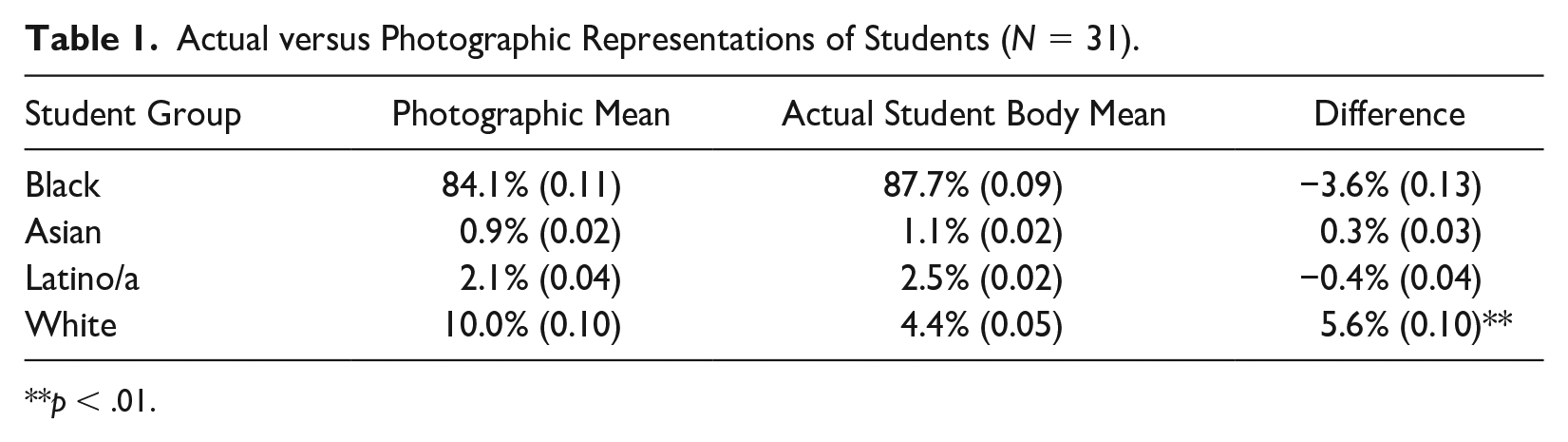
p < .01.
Student overrepresentation on HBCU websites and recruitment materials by no means indicates that this pattern is prevalent at each school analyzed. As shown in Table 2, the majority of public institutions (62 percent) and a number of private ones (40 percent) engaged in this overrepresentation. This frequency is less than that seen in analyses of PWIs, which find that more than 80 percent of schools overrepresent images of Black students (Pippert et al. 2013). Given how HBCUs show wide variation within the category, this lower level of pervasiveness is not unexpected.
Differences in Representation by HBCU Funding Source.
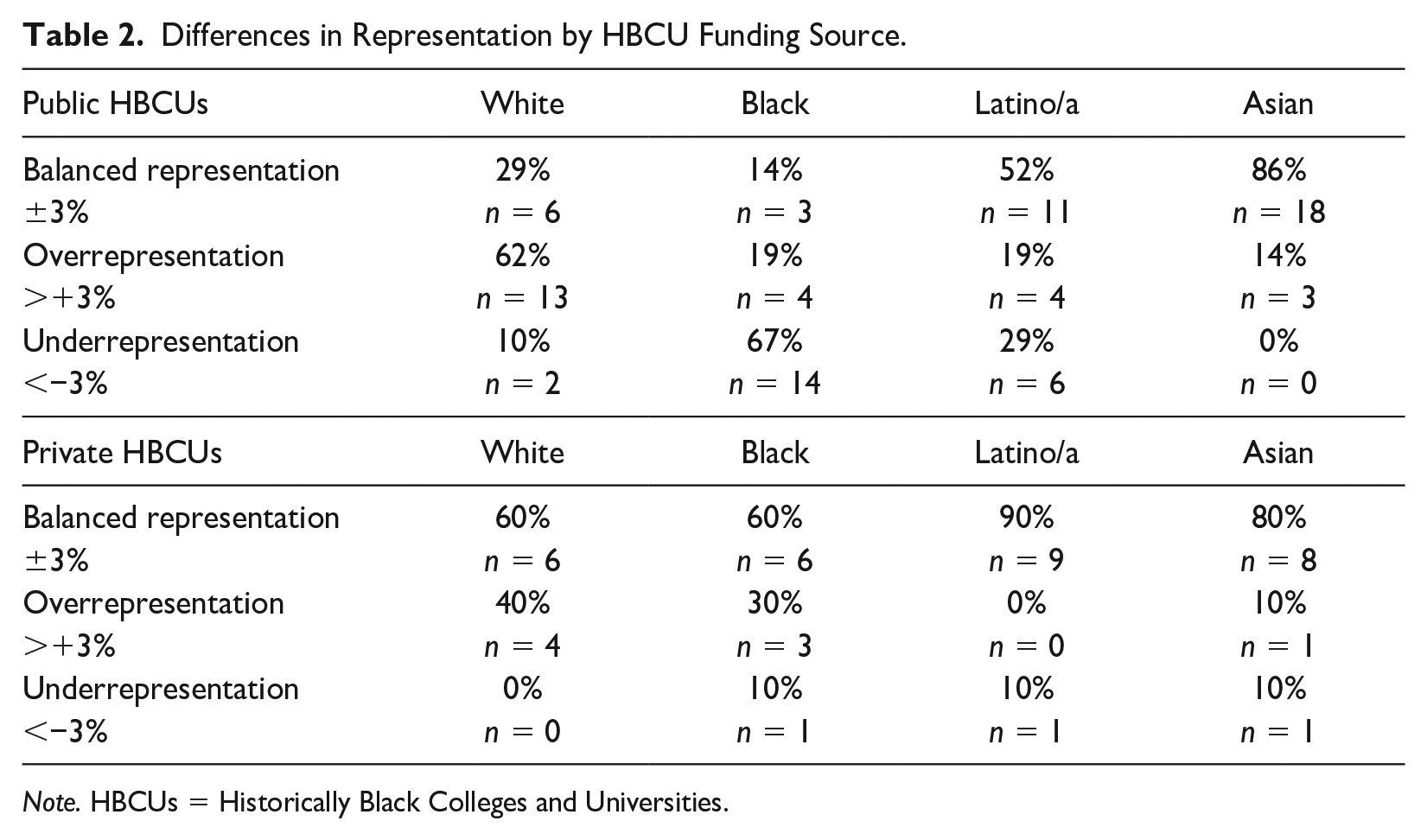
Note. HBCUs = Historically Black Colleges and Universities.
Portraying White students on websites and recruitment materials at a rate higher than their physical representation on campus represents more than a simple commitment to diversity or even desegregation in the cases of schools affected by Fordice. There are many ways for HBCUs to communicate and attract racial/ethnic numerical diversity beyond focusing on one group of students. Xavier University of Louisiana is one of the 10 HBCUs with the highest non-Black enrollment at 27 percent. The majority of its non-Black students are Asian. Still, Asian students only account for one percent of students pictured, whereas a whopping nine percent of students represented photographically are White. The actual enrollment of White students is only three percent.
University Missions and Goals: Diversity versus History and Recognition of Inequality
The amplification of general diversity discourse, above and beyond its impact on the visual overrepresentation of White students, also appears to obscure the racially conscious focus and histories of the HBCUs represented in our data. In just over a quarter of the schools sampled, nine of the 31 HBCUs in our sample, neither the mission nor the vision statement of the school identifies the student population as predominately Black or the school itself as an HBCU (See Appendix B for details). This small, but a notable number of schools embody a strategy that has been used, according to some prior work (e.g., Nazeri 2000), to enhance the recruitment of non-Black students. Elizabeth City State University, for instance, is one school that fails to mention its HBCU status. Founded in 1891 as a teacher’s college for African Americans, it simply refers to “the institution’s rich heritage and its current multicultural student-centered focus.” Notable is that nowhere in the university’s mission or vision does one find the historical circumstances and significant context of inequality and exclusion under which the school was founded.
Norfolk State University has on the mission page of its website an entire statement of its history since founding in 1935. This statement, however, does not once mention that the university was created to serve African American students, even despite its current 89 percent Black student enrollment. Instead, the university suggests that it “provided a setting in which the youth of the region could give expression to their hopes and aspirations.” This could euphemistically be referring to students without the ability to attend other schools, namely racial minorities. Still, the school chose not to say this directly.
Mission statements without reference to a given school being an HBCU correlate with an increase in diversity discourse by schools in our sample. While only 50 percent of the HBCUs in our sample have a core value dedicated to diversity, seven of the nine that fail to refer to themselves as an HBCU do. One such school is Clark Atlanta University. Clark Atlanta holds seven core values. Of these values, none explicitly focus on the success of underrepresented students or African American students—a group that comprises 86 percent of its student body. Diversity is mentioned in at least two places within its core value discussion, yet these mentions are abstract at best, suggesting that the school engages in “embracing and supporting all forms of human diversity and inclusiveness in all of our actions towards the university family and external constituents.”
The Content of Diversity Talk at HBCUs
We also cataloged and analyzed how HBCUs discuss diversity (or do not) within their mission, vision, and core values. Four specific patterns emerged: diversity as racial justice, diversity beyond race, diversity as an institutional value, and diversity as an institutional characteristic (See Appendix C for details). These categories, of course, are not mutually exclusive; most universities discuss diversity in multiple ways. Of these, only diversity as racial justice can be considered counter-hegemonic by denoting the historical and contemporary patterning of racial inequality and injustice and emphasizing racial equity.
Diversity as Racial Justice
Institutions that talk about diversity in concert with racial justice capitalize on their historical status as a Black college/university to communicate the significance of racial equity. For the most part, HBCUs within our sample acknowledge the racial mission of their college. Institutions that talk about diversity as racial justice, however, take their messaging about race much further.
Overall, private historically Black colleges are more likely to position themselves as institutions that are working for specific purposes relative to racial inequality in higher education and society generally. Not only do institutions in this category reflect their commitment to Black students but they also implore a commitment to racial knowledge creation and stimulation. These include Spelman College, Morehouse College, Howard University, Tuskegee University, and Grambling State University. Of these five, Grambling State University is the only public institution and the only one not considered an “elite” HBCU (Allen and Jewell 2002). They are all within the quadrant of schools that do talk about their HBCU status within their mission and/or vision and do not have “diversity” as a core value.
Examples of diversity as racial justice manifest in various ways on college and university websites. Howard University’s mission statement communicates that the institution is a culturally diverse, comprehensive, research-intensive and historically Black private university, provides an educational experience of exceptional quality at the undergraduate, graduate, and professional levels to students of high academic standing and potential, with particular emphasis upon educational opportunities for Black students.
While Howard’s mission also signals to cultural diversity, they include additional language that strongly centers racial messaging and in particular its interest in Black students. The language of providing “educational opportunities for Black students” speaks to the institutions’ historic founding and racial justice diversity approach. Their values further go on to say that “. . . Howard’s aim is to forward the development of scholars and professionals who drive change and engage in scholarship that provides solutions to contemporary global problems, particularly ones impacting the African Diaspora.” Here, the discourse of the institution suggests an intentional focus on matters of the African Diaspora. This language focuses on an institutional position on racial equality, particularly that of the Black race. Prospective students and other stakeholders alike can glean from these materials on their university’s website how race is a critical component of the diversity discourse at Howard University.
Together these institutions demonstrate diversity discourse heavily infused with racial language. Their ability to signal race not only as a broad concept or human attribute but also as a component of pedagogy demonstrates significant autonomy relative to how diversity is defined. The obscurity of this intent by other institutions lessens the impact of race-based messaging and therefore communicates that other forms of and ways of talking about diversity take precedent. As previously mentioned, institutional control (i.e., being privately or publicly funded) has a lot to do with how colleges and universities can conduct business at their institutions. Black colleges, regardless of funding sources, must manage expectations about institutional standards. Private Black colleges, especially those considered elite, appear to be in a better position to directly communicate the importance of race in higher education and their commitment to addressing the education of folks of African descent.
Diversity beyond Race
While some HBCUs engage in diversity discourse that integrates a racial mission and focus, many others expand the meaning of diversity in higher education. Schools that discuss “diversity beyond race” exhibit the expansiveness of diversity discourse and its many forms. This category aligns with the “condensation” found in James M. Thomas’s (2018a:145) diversity regimes in which “seemingly unrelated phenomena, or signifiers, are condensed under the sign, ‘diversity’.” This category is not without nuance. Institutions who discuss diversity as beyond race either include race as one dimension or use the term diversity broadly to leave room for interpretation.
Here, we see almost the reverse of the previous pattern. Whereas mostly private HBCUs discuss diversity in racial justice terms, diversity beyond race narratives are much more evident in public institutions. For example, Albany State University gives a laundry list of attributes under the heading of diversity: Albany State University will embrace diversity in all its forms—including age, gender identity, race and ethnicity, country of origin, religion, ability level, sexual orientation, and veteran status—and seek to foster a similar acceptance and celebration of that diversity.
Elizabeth City State University, another public institution, frames diversity as that of “. . . viewpoints, experiences, and backgrounds are critical tools of a quality education in our global marketplace” Here, the messaging by Elizabeth City State University lends itself more to an outcome-based justification. Some private institutions are equally broad in their diversity discourse. Clark Atlanta University refers to their institution “a student-centered ethos that is responsive to diverse student backgrounds, learning styles and career aspirations.”
North Carolina Central University is an example of the expansion of diversity discourse beyond race that also uses this discourse to signal their openness to non-Black students too. Their mission statement makes the point that “the university will serve its traditional clientele of African-American students; it will also expand its commitment to meet the educational needs of a student body that is diverse in race and other socioeconomic qualities.” Interestingly, in the face of the rolling back of race-based consideration, socioeconomic diversity has come to replace racial consideration in admissions at higher education. Because of the intersections of racial status and class background, signaling socioeconomic diversity mimics that of other higher education institutions trying to support racial diversity without racial language.
Diversity as an Institutional Characteristic
HBCUs experience a great deal of pressure in communicating their value and contribution to an ever-evolving higher educational landscape. HBCUs must often adapt to increasing demands placed on colleges and universities in ways made more difficult by their racialized status. Framing diversity discourse in institutional terms presents an opportunity for Black colleges and universities to demonstrate their value to higher education, generally. Given that organizations, especially those historically and predominately White, continue to find new challenges in diversifying their environments, HBCUs can and do present themselves as a solution to the diversity problem. In other words, this approach to diversity identifies HBCUs as providers of diversity, therefore, reinforcing the value of Black colleges to White institutions.
While unique to HBCUs, or at least minority-serving institutions, this type of diversity discourse still serves a White racial project. HBCUs presenting diversity in this way acquiesce to racial capitalism by offering their graduates to be commodified for the benefit of other organizations. Such commodification both provides career opportunities and produces significant harm to its objects (Mayorga-Gallo 2019). Southern A&M says that it Serves a unique and diverse population of Louisiana, the nation, and the world through the nurturing, creation and the holistic development of its students by creating leaders . . . ready to meet the needs and contribute to the success of the global workforce.
Here we see that Southern A&M is positioning itself as a university that delivers a service to the world, meeting others’ needs through the students it prepares.
Other institutions have followed suit in using diversity to describe aspects of their college and university. While some institutions like Savannah State University and North Carolina Central University refer only to the student body as being diverse, Claflin University, in Orangeburg, South Carolina, posits that diversity is a characteristic of their environment. According to Claflin’s mission statement, the university “. . . is a diverse and inclusive community of students, faculty, staff, and administrators who work to cultivate practical wisdom, judgment, knowledge, skills, and character needed for globally engaged citizenship and effective leadership.” Here, the university’s mission statement refers to the tenants of the institution as diverse, including not only students but also faculty, staff, and administrators. Clark Atlanta University describes diversity as, “embracing and supporting all forms of human diversity and inclusiveness in all of our actions toward the university family and external constituents.” Together, this particular language around diversity highlights to potential stakeholders where one can find diversity. To paraphrase Ahmed (2007), if diversity is something we are, diversity is something you can have.
Diversity as an Institutional Value
Many of the HBCUs in our sample engage diversity as a commitment to one value among many. By diversity as an institutional value, we mean that Black institutions convey messages on their websites and in their strategic plans that diversity is something that the institution recognizes, appreciates, and supports. Diversity is listed among other values and only occasionally given deeper consideration beyond a benign commitment. Here again, it remains separate from racial equity goals or actions. At Tennessee State University, a public institution, for example, they refer to the eight goals of their university diversity in addition to excellence, accountability, and integrity to name a few. Prairie View, a public university in Texas shared similar values, mentioning that “the institution’s values [include], but not limited to, access and quality, accountability, diversity, leadership, relevance, and social responsibility.”
While many institutions have a list of about five to seven values in addition to diversity, some institutions have even more. For example, Florida Agricultural and Mechanical University (FAMU), a public Black university includes diversity in a list of about 18 values. FAMU says that “the following values essential to the achievement of the university’s mission: Scholarship, Excellence, Openness, Fiscal Responsibility, Accountability, Collaboration, Diversity, Service, Fairness, Courage, Integrity, Respect, Collegiality, Freedom, Ethics, Shared Governance.”
Discussion
Diversity displays within higher education tend to minimize understandings of structural racism and commodify difference to gain institutional advantages through racial capitalism. There is evidence of this on HBCU websites. A majority of public and a smaller number of private HBCUs overstate the presence of White students on their campuses. This mirrors how PWIs increase the representation of Black students because of their outsized claims of diversity, though the practice is not as pervasive among HBCUs (Osei-Kofi et al. 2013; Pippert et al. 2013). Universities use promotional materials such as websites to promote a given image of themselves (Hite and Yearwood 2001; Klassen 2000). By privileging the appearance of White students over other non-Black students, the schools in our sample center the value of Whiteness, which has long been a status property conferring on its possessors many privileges (Harris 1993). Whiteness as an asset has a social and economic value, but also the potential for liabilities in majority Black settings (Winddance 2010). By attempting to trade on the Whiteness of a group of students, HBCUs reinforce the commodification of persons by race in ways that devalue or even dehumanize people of color (Mayorga-Gallo 2019).
Given the racialized status of HBCUs, they are at a disadvantage in leveraging racial capitalism. Power and resource differences in the organizational hierarchy will prevent HBCUs from being as successful at this form of commodification as their White counterparts because White institutions can simply offer the objects of their commodification more prestige than can HBCUs (Stinchcombe 1965). Dismantling racial capitalism would require publicly calling out and imposing penalties on commodification, not changing the direction of it (Leong 2013). By enacting their own form of racial capitalism, HBCUs reinforce rather than challenge this system, perhaps even validating the ways that their graduates will be subject to it.
The race-conscious focus of HBCUs became suspect in the aftermath of Brown and was accordingly minimized in various ways (Wooten 2015). We see evidence for this in that the mission, vision, and core values of 29 percent of HBCUs sampled do not reference their historical mission or predominantly Black student body. While it is true that PWIs also erase their history and purpose of supporting predominantly White students, they are advantaged by suppressing history. For HBCUs, long-term survival requires elevating history to show the continued need for education focused on Black students. Failing to share the value of HBCUs for Black students and other underrepresented students, such as first-generation attendees, obscures ongoing racial inequality in higher education and beyond. In the interest of short-term organizational survival, HBCUs are nevertheless compelled to undermine their necessity.
Not all HBCUs engage diversity in the same way; however In their portrayals of diversity, mostly elite, private HBCUs neither overrepresent White students nor omit their HBCU status. Their institutional discourses incorporate racial justice language alongside the language of diversity. This approach gives credence to critical diversity scholars who propose there are ways to promote diversity without discursively separating it from racial equity. This is a minority pathway in our study. Other universities’ communication strategies include portraying diversity as beyond race, as an institutional characteristic, or as an institutional value. While these strategies diverge from each other, each reflects common diversity discourses that minimally challenge the racial status quo or, at worse, reify it.
It could be argued that the pressure generated by Fordice would naturally lead HBCUs, and especially public HBCUs, to portray diversity in these ways and that the impetus is to desegregate rather than diversify. We believe that the use of diversity language in service of desegregation further proves that diversity as a goal obscures persistent racial inequality. Desegregation and diversity are two different projects. The Fordice decision highlights the historical weight of discrimination that continues to affect student and university outcomes today. Diversity neglects that context. For instance, Jackson State University, one of the Mississippi schools that was a party to Fordice and that remains 94.5 percent Black, has a mission that states it is “building on its historic mission of empowering diverse students to become leaders.” This mission statement came about as part of a strategic planning process designed in part to bring more racial/ethnic and international diversity to Jackson State (Featherstone 2011). This mission statement represents Jackson State as something it is not as regards race, and in fact, has historically been prevented from being. Fordice could have instead driven this university to justify its importance to the education system, highlight its continuing significance, and encourage prospective students to join in the mission of changing segregated enrollment patterns. These paths being largely foreclosed, the result is “happy talk” about diversity, obscuring the truth of the school’s situation (Bell and Hartmann 2007).
Diversity discourses typically cosign racial capitalism and obscure racial inequality. When used by HBCUs, these discourses become part and parcel of a larger racialized inequality regime that supports White racial projects. The conundrum faced by HBCUs in this is not unlike the adaptations forced after Brown, wherein HBCUs had to expand from a race-conscious focus and become isomorphic to White institutions in their course offerings to survive. Here too, diversity discourses largely become, “a circular pattern whereby inequality constrains the adaptive capacity of black colleges, and adaptations undertaken by black colleges challenge, yet, in the end, reify existing inequalities” (Wooten 2015:23). Elite, private HBCUs provide hope here in that they largely eschew contemporary diversity discourses in favor of social justice. If there is a path for this type of counter-hegemonic messaging to spread across the variation that characterizes HBCUs, these schools can perhaps provide the blueprint.
Conclusion
We find evidence in this article that the diversity discourses of HBCUs, particularly public HBCUs, tend to commodify difference and exist apart from issues of racial inequality. In this process, they reinforce ideas of racial capitalism that are hegemonic to the current racial order. Moreover, and as our results indicated, HBCUs undertake various strategies of incorporating diversity into their institutional discourses. While public institutions tend to lean into broad notions of diversity either as an institutional value or as an institutional characteristic, private institutions seem to have greater autonomy—autonomy that enables a committed and explicit vision toward racial justice and/or that allows for the expansion of diversity narratives that maintain race at the center.
But how much does diversity messaging matter, particularly when or if decoupled from internal activities? By all accounts, the institutions in our study use other social spaces like campus tours, first-year seminars, opening convocations, and founders’ day activities to elucidate their identity as HBCUs and communicate their institutional racial history. HBCUs continue to be effective for their core constituency, enrolling higher proportions of students that are of lower socioeconomic status, first generation, and Pell eligible (Albritton 2012; Broady, Todd, and Booth-Bell 2017). Furthermore, HBCU programming bears the hallmarks of successful education concerning racial equity including, “the integration of diversity in the curriculum, co-curricular programs such as intergroup dialogue, and integrative learning initiatives in the form of service-learning, living-learning programs, and undergraduate research programs that target underrepresented groups” (Hurtado and Guillermo-Wann 2013:3).
Despite HBCUs’ effectiveness, we believe that diversity discourses, even at the level of surface rhetoric, matter a great deal. They give credence to meanings that can and do reinforce social inequality and power dynamics (Berrey 2015). For example, when diversity is seen as but an institutional characteristic, HBCUs could very well be priming their graduates to become racial capital for majority White organizations in the future. HBCUs prepare Black students, but they are (and should be) far more than providers of diversity. Moreover, that diversity discourses are separate from conversations of racial inequality at nearly all HBCUs in our analyses validates inclusion without referring to the history that led to historical exclusion in the first place. While these diversity discourses may seem innocuous and are useful to HBCUs’ current survival, they may have a future cost that must be acknowledged.
We recognize that there are at least two key limitations to our study. First, without historical artifacts, we can say little about when these schools employed their various approaches and strategies relative to diversity and/or whether their diversity displays and identification as an HBCU has been consistent over time. Data obtained from official university/college websites and other content reflect a digital snapshot of the institutional culture, discourse, and language engaged by our sample in the contemporary era. We are constrained to examining how HBCUs, contemporarily and through imagery and messaging, position themselves vis-à-vis their counterparts and orient themselves to the outside world. Secondly, given our sample size and large variations among HBCUs, our analyses are statistically limited in terms of analyzing factors core to any divergences reported. We hope future work will be able to tackle this with a larger sample, perhaps in comparison with majority White institutions.
Despite such analytic caveats, our analyses offer an important contribution to the sociological understanding of diversity and, more specifically, how HBCUs are responding to contemporary diversity pressures. HBCUs are places where students can learn to live in a diverse community without the White normativity of other universities (Lewis, Chesler, and Forman 2000). Black colleges and universities have represented a small portion of the higher educational landscape, representing only three percent of colleges and universities. These schools, however, offer outsized results for students traditionally underrepresented in college and universities, propelling especially Black students to postgraduation opportunities. We believe current narratives of diversity will be detrimental to this agenda over the long term.
Our findings continue a line of research on what diversity does, what it means, and what it looks like in various organizational contexts (Ahmed 2012). That public articulations of diversity by HBCUs tend to reinforce racial inequality is not an indictment of HBCU leaders, but rather are more indicative of the coercive pressure that HBCUs have long been subject to (Ray 2019). Institutional scripts of diversity blur acknowledgment of racial inequality despite their implications for such matters. As mentioned, earlier investigations have also found that focusing on diversity hinders efforts to recognize/address racial inequality (i.e., Bell and Hartmann 2007; Berrey 2015; Kelly and Dobbin 1998; Okuwobi 2019; Smith and Mayorga-Gallo 2017). Given the pervasiveness of this finding, diversity seems to be getting exactly the results it is designed to get. Indeed, we are of the view that diversity as a racial project should be explicitly recognized for its costs, and that redistributive justice and equity replace it in institutional discourse. Until this occurs, diversity as a project will continue to succeed even when underrepresented people do not.
Footnotes
Appendix
Diversity Discourse by College/University.
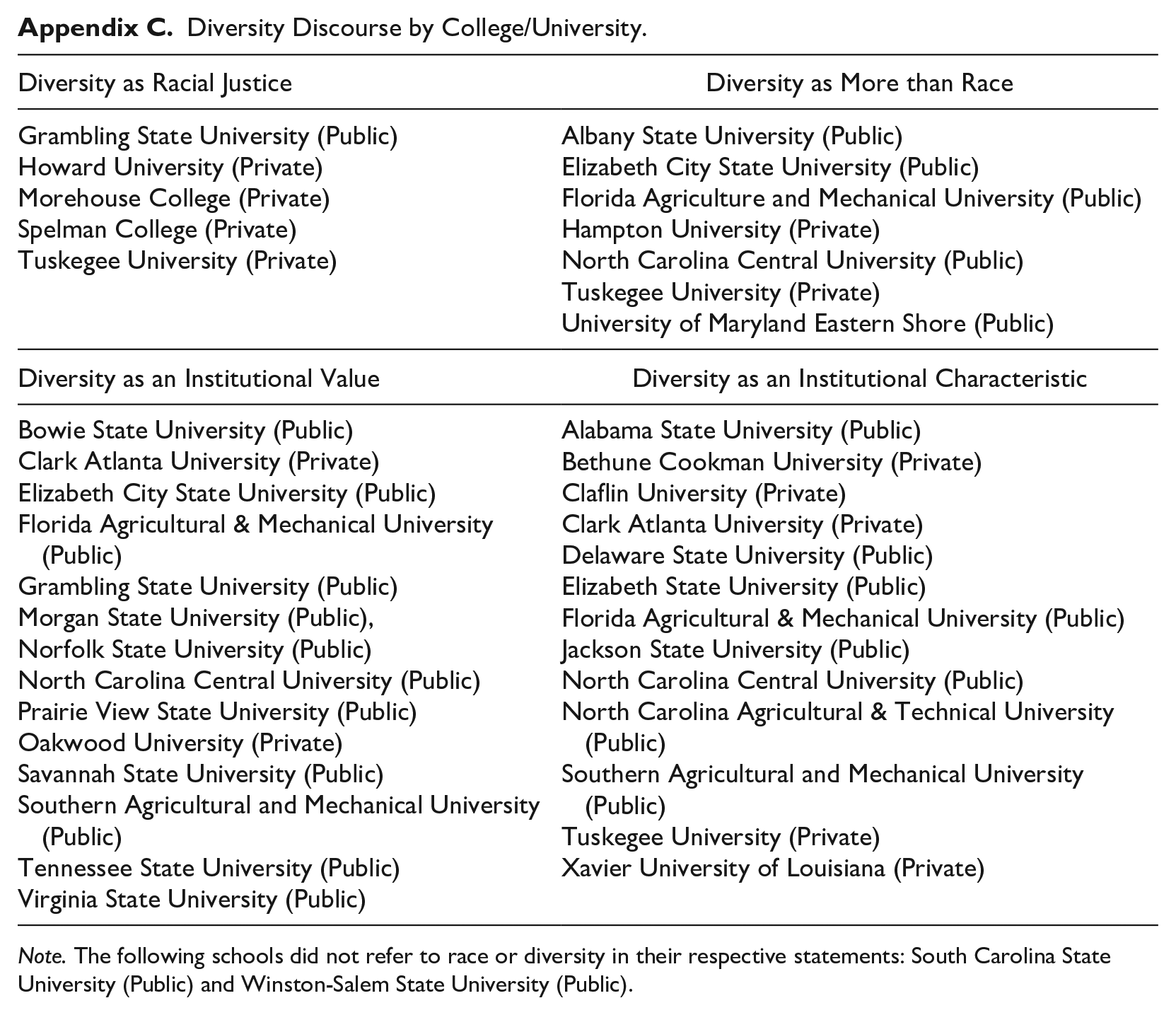
| Diversity as Racial Justice | Diversity as More than Race |
|---|---|
| Grambling State University (Public) Howard University (Private) Morehouse College (Private) Spelman College (Private) Tuskegee University (Private) |
Albany State University (Public) Elizabeth City State University (Public) Florida Agriculture and Mechanical University (Public) Hampton University (Private) North Carolina Central University (Public) Tuskegee University (Private) University of Maryland Eastern Shore (Public) |
| Diversity as an Institutional Value | Diversity as an Institutional Characteristic |
| Bowie State University (Public) Clark Atlanta University (Private) Elizabeth City State University (Public) Florida Agricultural & Mechanical University (Public) Grambling State University (Public) Morgan State University (Public), Norfolk State University (Public) North Carolina Central University (Public) Prairie View State University (Public) Oakwood University (Private) Savannah State University (Public) Southern Agricultural and Mechanical University (Public) Tennessee State University (Public) Virginia State University (Public) |
Alabama State University (Public) Bethune Cookman University (Private) Claflin University (Private) Clark Atlanta University (Private) Delaware State University (Public) Elizabeth State University (Public) Florida Agricultural & Mechanical University (Public) Jackson State University (Public) North Carolina Central University (Public) North Carolina Agricultural & Technical University (Public) Southern Agricultural and Mechanical University (Public) Tuskegee University (Private) Xavier University of Louisiana (Private) |
Note. The following schools did not refer to race or diversity in their respective statements: South Carolina State University (Public) and Winston-Salem State University (Public).
Acknowledgements
The authors would like to thank Danielle Evans and the other undergraduate research assistants who worked to gather data for this article. We would also like to thank the editors and anonymous reviewers of Sociology of Race and Ethnicity for their feedback and suggestions on previous drafts of this paper.