




Abstract
Using data from the Education Longitudinal Study, the author investigates racial disparities in high school graduation, four-year college enrollment, and bachelor’s degree completion. In addition, the author considers how conditionally relevant college and early adult variables shape bachelor’s degree completion. The results indicate that although comparable numbers of black and Hispanic students obtain bachelor’s degrees, their educational career trajectories differ substantially. Compared with white students, black students are more likely to end their educational careers after starting college without completing a bachelor’s degree, whereas Hispanic students are more likely to end their educational careers without entering a four-year college. Moreover, early adult and college-specific variables have a substantial impact on bachelor’s degree completion and explain black-white disparities in bachelor’s degree attainment. This research shows the continuing significance of race in shaping the educational outcomes of young adults at all stages of their educational careers.
Participation in education in the United States has expanded rapidly in recent decades. More Americans currently participate in education than at any other time in United States history (Kena et al. 2014). However, rather than reducing educational disparities on the basis of race and ethnicity, 1 the rapid expansion of participation in education has instead shifted these disparities to later stages in students’ educational careers. Whereas in past eras, minority students were far more likely than white students to stop their educational careers prior to high school graduation, contemporary racial disparities in educational attainment are most pronounced in college degree completion rates. For instance, in 1990, white adults (81.4 percent) significantly outpaced their black (66.2 percent) and Hispanic (50.8 percent) counterparts in high school graduation. By 2012, high school completion was more common for all groups, and disparities between white (92.5 percent) black (86.7 percent) and Hispanic Americans (65 percent) had decreased. In contrast, disparities in college completion between black and white Americans remained virtually identical during this same time span, while disparities between Hispanic and white Americans increased slightly. Specifically, 23.1 percent of white, 11.3 percent of black, and 9.2 percent of Hispanic adults held bachelor’s degrees in 1990, while 34.5 percent of white, 21.4 percent of black, and 14.5 percent of Hispanic adults held bachelor’s degrees in 2012 (U.S. Census Bureau 2014).
Understanding the reasons for racial and ethnic disparities in bachelor’s degree completion among young adults is important because college degrees have become an extraordinarily valuable credential in today’s economy. With the decline of manufacturing jobs, obtaining a bachelor’s degree is now a minimum credential for most middle-class careers. Completing a bachelor’s degree also leads to higher earnings, better health, and increased family stability over the life course (Hout 2012). Thus, although black and Hispanic Americans complete more years of education today than in past eras, they are not obtaining the most important educational credential at the conclusion of their educational careers, a pattern that likely contributes to the persistence of racial inequalities in economic standing, health, and other adult outcomes. As such, it is important for scholars to understand racial disparities when students end their educational careers, as a focus on years of education or college enrollment may obscure the most consequential educational disparities between racial groups.
To understand when students end their educational careers, it is necessary to investigate racial disparities across students’ educational career trajectories, because studies that look only at specific segments of students’ educational careers may paint an incomplete picture of the nature of racial disparities. For instance, most extant studies of racial disparities in educational careers have followed students through college enrollment, with evidence indicating that, after controlling for family and academic background, minority students are more likely to persist in their education through college enrollment (e.g., Bauman 1998; Bennett and Lutz 2009; Bennett and Xie 2003; Charles, Roscigno, and Torres 2007; Merolla 2013). However, given that a disproportionate number of minority students end their educational careers after enrolling in college but prior to completing a degree, studies using college enrollment as the most distal educational outcome likely underestimate the magnitude of racial and ethnic differences in eventual educational attainment. Conversely, studies of college completion tend to rely on samples of college students. However, such students cannot account for differential rates of college enrollment and therefore may overestimate racial and ethnic differences in (e.g., Bozick and Lauff 2007; Jacobs and Berkowitz King 2002; Zwick and Sklar 2005). To date, very few studies of students’ educational careers have investigated racial disparities in completing important educational milestones through college completion. In this research I investigate racial disparities in high school graduation, four-year college enrollment, and bachelor’s degree completion and how racial differences in eventual education attainment result from disparities at these specific milestones in students’ educational careers.
In addition, I investigate to what extent differences in college (e.g., financing, undergraduate research experience) and early adult experiences (e.g., family formation) contribute to racial gaps in college completion rates. By considering measures that capture the fundamental differences between postsecondary and secondary education, I question whether models of educational attainment that do not include such factors produce accurate conclusions about the nature of, and reasons for, contemporary racial disparities in educational attainment. To address these questions, I use nationally representative data from the Education Longitudinal Study of 2002 (ELS) and estimate generalized estimating equations (GEEs) to model high school graduation, four-year college enrollment, and bachelor’s degree completion among black, Hispanic, and white students.
Background and Literature Review
As a central organizing principle of society, race can shape individual outcomes such as educational attainment in numerous ways (Golash-Boza 2016). First, given the fundamental role socioeconomic origins play in shaping educational attainment, and the deep and obdurate disparities between racial groups in economic standing, socioeconomic disparities represent an important structural mechanism linking race to educational outcomes and disparities (Hallinan 2001). Second, minority students continue to face unequal treatment and discrimination at all levels of their educational careers. Research clearly shows that students of color continue to face both overt and subtle discrimination at all levels of schooling (Holland 2012; Rosenbloom, Rakosi, and Way 2004; Wagner 2015; Wilkins 2014). Such disparate treatment can lead to differences in early academic experiences, which follow students throughout their educational pathways. For instance, research shows that minority students are evaluated as being less academically capable and more behavioral problematic, even when their objective performance and behavior are identical (Downey and Pribesh 2004; Irizarry 2015a). Moreover, research shows that minority students often feel alienated at predominately white universities, which likely impedes their ability to connect with faculty mentors and participate in high-impact practices at comparable levels with their white counterparts. Thus, central questions in contemporary research on race and educational attainment often concern the “net difference” between racial groups that are found after controlling for confounding factors and the degree to which confounding factors explain racial differences in educational outcomes. Such net differences can be interpreted as “societal counterfactuals” or the outcomes that would occur if racism in the form of structural disadvantage and disparate treatment were eliminated (VanderWeele and Robinson 2014).
In this article I address racial disparities in the context of students’ educational careers. An educational-careers model casts eventual adult educational attainment as a series of progressive steps through the educational system, thereby conceptualizing educational attainment as a dynamic process that plays out during the early life course from childhood through the young adult years (Andrew 2014; Aschaffenburg and Maas 1997; McLeod and Fettes 2007; Merolla 2013; Mickelson 2003). An important aspect of this approach to studying educational attainment is that the educational careers approach allows an examination of whether predictors of educational attainment vary at different educational career stages. For instance, racism in the form of both socioeconomic disadvantage and unequal treatment may manifest in different ways at different stages of students’ educational careers; factors important for high school graduation (e.g., track placement) may be less consequential for college degree completion, and some factors important for college completion (e.g., working full-time) may be irrelevant for early educational transitions. Moreover, most individuals attend college during a stage in their life course when they are also transitioning into adulthood, and events that occur during this transition (e.g., marriage, parenthood) may be consequential for college completion. Thus, to fully capture the ways that race shapes educational attainment and produce accurate estimates of net racial differences, it is necessary to investigate the varied ways in which disadvantage may manifest across students’ educational career stages.
Racial Differences in Educational Careers
Research on racial disparities in educational progress indicates that although socioeconomic background and early academic experiences generally explain the bulk of racial differences in educational persistence, racial differences remain after controlling for confounding factors (Charles et al. 2007; Swail, Cabrera, and Lee 2004). Moreover, research shows that net of socioeconomic status (SES), minority students tend to continue their educational careers through college enrollment at equal or higher rates than their white counterparts after controlling for economic status. Although this pattern is often termed the net black advantage, there is evidence from national data that the pattern extends to Hispanic students as well (Alon and Tienda 2005; Bennett and Lutz 2009; Bennett and Xie 2003; Jasinski 2000; Mangino 2010; Swail et al. 2004). Most studies documenting this pattern have examined college enrollment, although some research has also shown a net advantage among black students for high school graduation (Cairns, Cairns, and Neckerman 1989; Rumberger 1995; Stearns et al. 2007). For instance, Merolla (2013) tracked a population of students from the National Educational Longitudinal Study and showed that net of SES, black students are more likely to move from 8th to 10th grade, graduate from high school, and enter college. These results indicate a consistent net advantage for black students through college enrollment.
Research on racial disparities in college degree completion is less clear. Early studies provided some evidence of a net black advantage at the college level. With nationally representative data, both Alexander et al. (1982) and Wolfle (1985) found a net black advantage in degree completion and college persistence. In contrast, more recent research indicates that black students are less likely to complete college degrees compared with their white counterparts, even after adjusting for socioeconomic background and academic variables (Attewell, Heil, and Reisel 2010; Jacobs and Berkowitz King 2002; Milesi 2010; Zwick and Sklar 2005). Similarly, research on the collegiate experiences of Hispanic students also shows that Hispanic students are also less likely to complete college degrees than similarly situated white students (Alon and Tienda 2005; Alon, Domina, and Tienda 2010; Fry 2004; Swail et al. 2005). Thus, the preponderance of recent evidence indicates that a net advantage or even net parity for minority students does not extend through college degree completion (for an exception, see Mangino 2014).
Racial Differences in Degree Completion: The Role of College and Early Adult Experiences
Research investigating the correlates of college completion has provided important evidence about the college and early adult experiences differentiate students who finish college from those who leave college without a degree. For instance, financing is perhaps the biggest difference in the structure of postsecondary compared with K–12 education. Although the vast majority of American students attend free public schools, students must find a way to pay for college. Financing may be particularly important for understanding racial differences in outcomes, because minority students are more reliant on loans and other forms of financial aid compared with their white counterparts (Hamilton 2013; Jackson and Reynolds 2013). A related aspect of the college experience that varies by race is holding significant employment (i.e., 30 hours per week or more) during college. A disproportionate number of minority students hold substantial employment during college, often to help pay for tuition. Working longer hours during college has a negative effect on bachelor’s degree completion because working significant hours interferes with the completion of assignments and makes engagement in campus life more difficult (Bound, Lovenheim, and Turner 2007).
The timing of college enrollment is also a predictor of degree attainment. Students who enter college immediately after high school are more likely to complete college degrees than students who delay entry into college (Bozick and DeLuca 2005). A related factor is transfer student status, because many contemporary college students, especially those who delay entry into college, begin their college careers at community colleges or other non-four-year-degree institutions. Research indicates that minority students are more likely to both delay entry into college and begin their careers at community colleges compared with their white counterparts (Bozick and DeLuca 2005; Jacobs and Berkowitz King 2002; Kena et al. 2014).
Educational experiences in college can also affect degree completion, and minority students likely encounter unequal treatment within university contexts. Particularly important for student success is participation in high-impact practices during the college years. A growing body of research (Kuh 2009; Kuh et al. 2010) underscores the importance of experiences such as research involvement, internships, study-abroad experiences, and mentorship. Involvement in such activities increases student engagement in college, which in turn leads to a higher chance of successfully obtaining a degree. Research indicates that minority students often feel alienated at traditionally white universities and may be less likely to be selected as protégés and research assistants by faculty members, indicating fewer opportunities to participate in these vital educational experiences (McCabe 2015, 2016).
The types of universities students attend also influence degree completion rates. Students attending highly selective universities are substantially more likely to graduate than their peers at moderately selective or open institutions (Alon and Tienda 2005; Horn 2006). According to the National Center for Educational Statistics (NCES), the graduation rate at open admission universities was 33 percent compared with 86 percent at the most selective universities in the country (Kena et al. 2014). Moreover, there is little question that lower SES students and racial minorities are less likely to attend highly selective universities (Davies and Guppy 1997; Moller et al. 2011).
Life events outside of the educational system can also shape students’ educational progress. The college years are a period in the life course when young adults begin to marry and have children. Research has consistently shown that black and Hispanic Americans tend to start families at younger ages than white Americans (Batson 2012; Rindfuss and St. John 1983). Most research also indicates that becoming married or having children during the college years has a substantial negative effect on degree completion and aspiration (Johnson and Reynolds 2013; Roksa and Velez 2014). Students in college may also experience stressful life events outside of the educational context, which can lead to increased stress that not only impairs students’ ability to perform well on required assignments and exams but may also require students to end their educational careers prior to obtaining a degree in order to provide support for their families. A large body of research demonstrates that racial minorities are at increased risk to experience traumatic life events such as significant illness, family financial difficulties, and criminal victimization (Breslau et al. 1991; Gillock and Reyes 1999; Sampson and Lauritsen 1997; Williams et al. 1997).
One aim of the present research is to understand how differences in socioeconomic background, early academic experiences, and college and early adult experiences shape population-level racial disparities in academic attainment. Most of the research cited above investigating the role of college and early adult experiences has understandably relied on college student samples. Such research can accurately show differences in college completion, but because this approach does not account for the conditional probabilities that students enter college, it may distort the role that these factors play in shaping population-level educational disparities in eventual educational attainment. For example, accounting for the greater likelihood that black students attend college is important for understanding the implications of their lower completion rates for contemporary educational disparities in educational attainment among Americans. The empirical models developed here address this existing gap in the research literature by including postsecondary and early adult experience variables in longitudinal models of students’ educational careers.
Research Questions
To understand how race structures educational attainment, this research addresses three main questions. First, after accounting for socioeconomic and academic background, as well as college-specific and early adult variables, what are net differences in high school graduation, four-year college enrollment, and bachelor’s degree completion among black, Hispanic, and white students? Second, how do differences in college-specific and early adult experiences affect racial differences in bachelor’s completion? Third, how do differences in achieving these important milestones shape racial disparities in adult educational attainment?
Data and Methods
Sample
I base my analysis on data from the public-use version ELS, a nationally representative sample of the 10th grade class of 2002. Students in the ELS panel were interviewed in 2002 (10th grade), 2004 (12th grade), 2006 (approximately age 20), and 2012 (approximately age 26). The full ELS panel has 16,197 respondents. I exclude respondents who were not black, white, or Hispanic; were 2012 nonresponders; or otherwise had missing data on their degree status in 2012. 2 Students remain in the sample until they fail to move to the next educational career stage, yielding analytic sample sizes of 11,123 10th grade students, 10,737 high school graduates, and 6,861 college attendees. To account for the complex sampling design used by the ELS, I weigh all responses using the third follow-up panel weight, which I adjusted to account for design effects stemming from the stratified cluster sample design using the approach described by Ingles et al. (2014:101). 3 This approach gives results that are generalizable to the spring 2002 10th grade class. I use multiple imputation (m = 30) to account for all items missing on independent variables, and results reported below are averaged over the 30 imputed data sets. 4
Measures
Dependent variable
The outcome for the current project is educational attainment at age 26. In the context of the educational-careers models presented below, educational attainment is captured by three binary measures. The first measure, high school graduation, is coded 1 for students who completed a high school degree or equivalent and 0 for students who did not complete a high school degree or equivalent. I include high school equivalency degrees (i.e., GED) in the 1 category because the data indicate that college attendance is not unusual among GED earners. College attendance is coded 1 for students who reported any attendance at a four-year university. The final attainment variable, finish college, is coded 1 for students who completed a four-year college degree by 2012.
Independent variables
The main independent variable is race. I specify race with dummy variables for black and Hispanic students, with white students serving as the reference group. Female is a dummy variable that compares female with male students. I expect that female students will have higher odds of completing college than their male counterparts (Buchmann, DiPrete, and McDaniel 2008). I account for socioeconomic background using measures of parental education, parental occupation, family income, and family structure. Parents’ BA degree is a dummy variable that compares students whose mother or father completed a bachelor’s degree with students who did not have at least one parent complete a bachelor’s degree. Models estimated using the ordinal ELS variable for parental education yielded substantively identical results. Family income is an ordinal measure of family income ranging from 1 (“none”) to 13 (“over $200,000”). Parent white collar is a binary measure that compares students who had at least one parent with a white-collar occupation with all other students. Occupations coded as white collar are manager, professional, owner or proprietor, and teacher. 5 Siblings is a continuous measure for number of siblings, censored at seven. Two parents compares students who lived with both of their biological parents in 2002 with students from all other household structures.
In addition to the socioeconomic background variables, I also include three time-varying measures that capture students’ educational expectations and academic preparation. In the models estimated below, each realization of the time-varying measures is used to predict the subsequent educational milestone (i.e., 10th grade measures predict high school graduation, 12th grade measures predict four-year college enrollment, and measures from 2006 predict bachelor’s degree completion). Degree expectation is a binary variable that compares student who expected to obtain a bachelor’s degree with students who did not expect a college degree. This variable was measured in the 10th grade, 12th grade, and 2006. College prep compares students who were on a college preparatory high school track with all other students; this variable was available in the 10th and 12th grade surveys. Finally, math achievement is the student’s score on the ELS standardized mathematics achievement test. Similar to college prep, math achievement was collected only in the 10th grade and 12th grade surveys. I include time-varying measures to better account for unobserved heterogeneity across the three outcomes; however, models using only the equivalent 10th grade realizations of these variables produced substantively identical results.
College and early adult experience variables
I also include conditionally relevant variables that capture college and early adult experiences of those students who enroll in college. To ensure appropriate time ordering, the life experience and college timing measures are taken from the 2006 wave, whereas college experiences were captured using measures from the 2012 survey. 6 Three binary variables capture the sources of college funding. Grants/scholarships compares students who received grants or scholarships during their time in college with all other students. Savings compares students who used personal or parental savings to help pay for college compared with those who did not. Finally, loans compares students who took out student loans with those that did not. Full-time job is a binary variable that compares students who reported working 30 hours per week or more during college. College timing is a binary variable comparing students who entered college in the fall term immediately after high school graduation with students who entered college in later semesters. Transfer student compares students who reported transferring to a four-year college from a two-year college with those that only attended four-year colleges. Three binary variables capture students experience with high-impact practices during college. Research, study abroad, and mentor each compare students who participated in these activities with those who did not. 7 Finally, two variables account for the types of colleges that students attended. Highly selective and moderately selective compare students who ever attended highly or moderately selective colleges with those who only reported attending inclusive universities on the basis of the NCES classification for college selectivity.
Two variables capture adult role transitions. Parent compares students who had at least one child prior by the 2006 survey with those who remained childless. Similarly, married compares students who were married by 2006 with those who remained single. Stressful events is a count of stressful events students experienced between 2000 and 2006; the events included are parental divorce, parental joblessness, parental death, death of close friend or relative, serious illness or disability, seriously illness or disability for a family member, and violent criminal victimization. 8
Analytic Strategy
I begin the analysis by presenting descriptive statistics for all variables by race. Next, I estimate a series of GEEs to address my research questions (Zeger and Liang 1988). GEEs elaborate on discrete time hazard models for multiple binary outcomes occurring at discrete times (Singer and Willet 1993). I use a person-period data set with the time period for each record indexed by three binary items corresponding to the three educational outcomes analyzed. For instance, the unconditional model is:
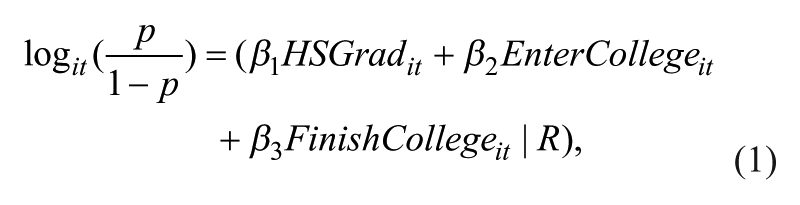
where p is the probability of student i achieving milestone t. HSGrad, EnterCollege, and FinishCollege are the three binary variables that index the three discrete outcomes (i.e., graduating high school, entering college, and finishing college) modeled. The coefficients β1, β2, and β3 are analogous to the intercept of models for each outcome and represent the log of the odds of successfully completing each educational milestone. GEEs account for within-person dependency across the outcomes by estimating the model controlling for the within-person correlation structure (R) among repeated observations. For the current analysis, I use an unstructured working correlation matrix; however, other specifications for R generated substantively identical results.
As predictors are added to the model, they are added as multiplicative terms with the indicator for each outcome. For instance, adding the dummy variables black and Hispanic gives

This strategy allows the independent variables to have different associations with the three different outcomes. For instance, β5 is the difference between black and white students in log odds of four-year college enrollment, whereas β6 is the difference between black and white students in the log odds of college completion. All fully relevant variables are added to the model in this way.
For the conditionally relevant college and young adult experience measures, I incorporate these variables in a manner similar to conditional coding (Ross and Mirowsky 1992). Specifically, I enter these variables as interactions with the FinishCollege indicator only. For instance adding the conditionally relevant variable loans gives
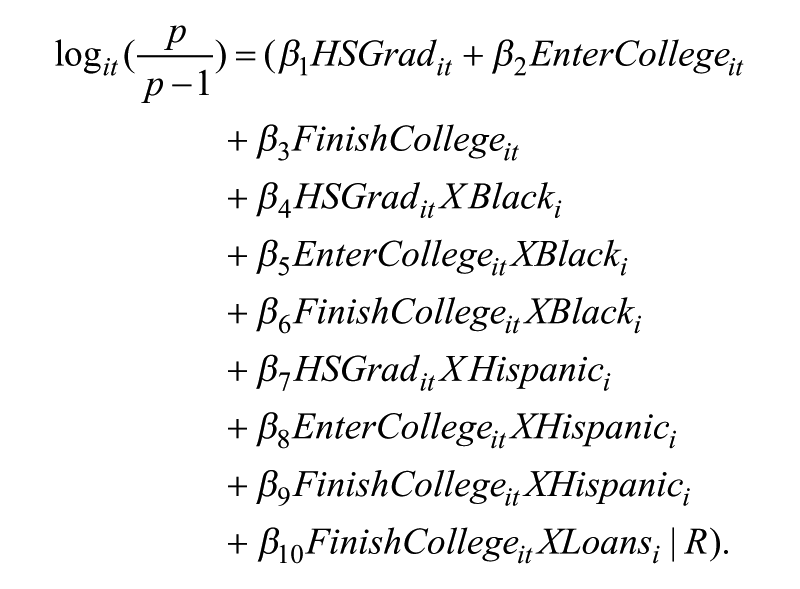
Because the final term in this equation applies only to students who enrolled in college, β10 represents the effect of loans on the log odds of finishing college among college attenders. 9 The addition of the conditionally relevant variables will only substantively alter the effects of other predictors for college completion. For instance, the coefficients β1 to β8 are nearly identical in equations 2 and 3, only potentially changing a small amount because of differences in the working correlation structure (R). Adding all of the college and early adult experience variables to the model in this manner allows me to determine how these factors shape college completion and whether the addition of these variables alters racial disparities in the likelihood of college completion. To aid in interpretation of the results of the GEEs, I use odds ratios (ORs), along with graphs of predicted probabilities of eventual educational outcomes based on the models.
Results
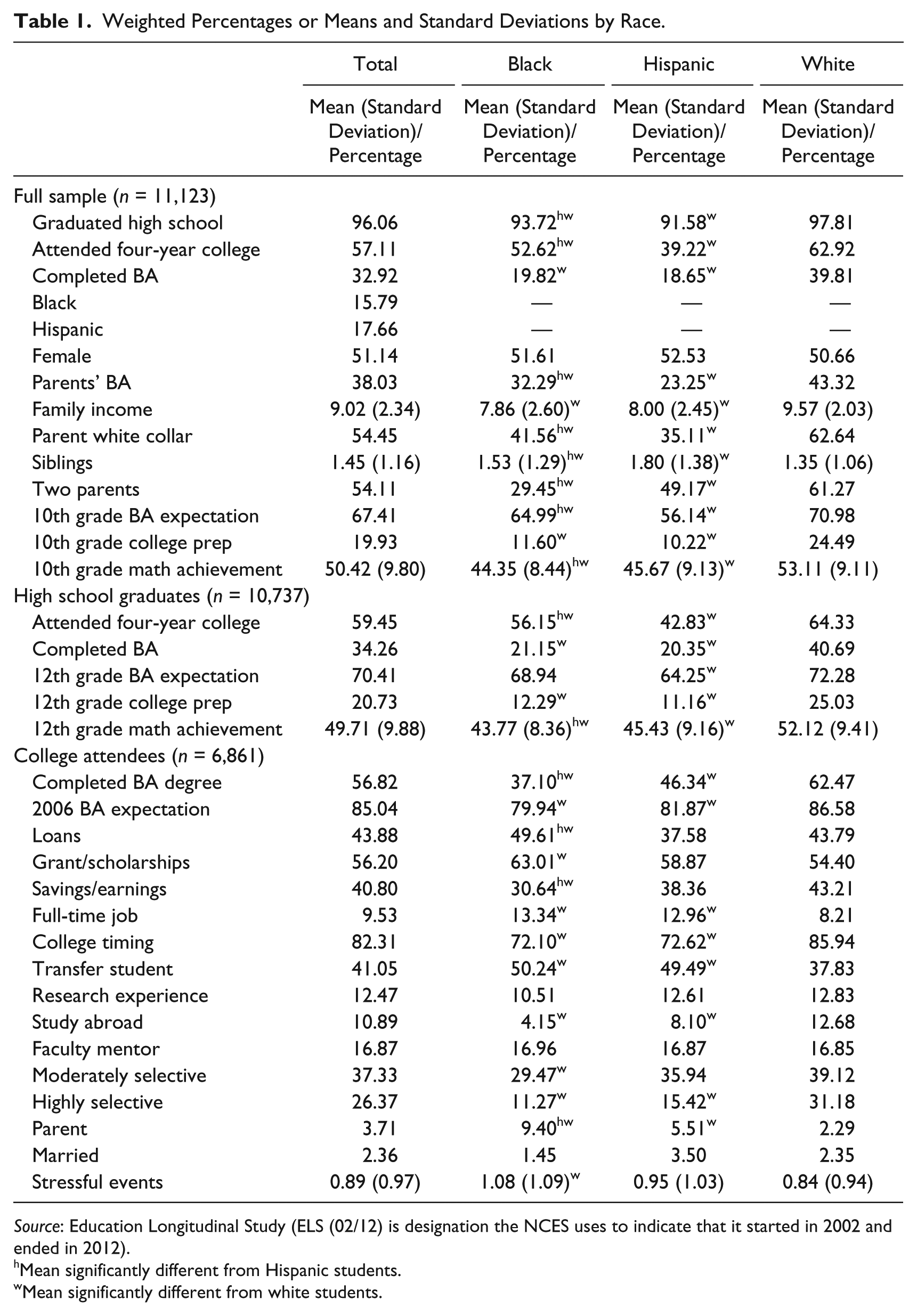
Table 1 presents the means and percentages for all analysis variables by race. The upper panel displays results for the full sample of 11,123 students, the middle panel displays results for the 10,737 high school graduates, and the lower panel displays results for the 6,861 college attendees. Table 1 shows, as expected, that white students have advantages over black and Hispanic students on all socioeconomic background and early academic experience measures. Differences between black and Hispanic students are mixed. Black students are more likely to have college-educated parents, parents with white-collar occupations, and college degree expectations compared with Hispanic students. Black students also have fewer siblings compared with Hispanic students. In contrast, Hispanic students are less likely to hail from single-parent households, have higher family incomes, and have higher math achievement scores than black students.
Weighted Percentages or Means and Standard Deviations by Race.
Source: Education Longitudinal Study (ELS (02/12) is designation the NCES uses to indicate that it started in 2002 and ended in 2012).
Mean significantly different from Hispanic students.
Mean significantly different from white students.
Turning to differences in college experience variables, white students are advantaged over their black counterparts on all variables expect married, research experience, and having a faculty mentor. There are fewer differences between Hispanic and white students. White students are more likely than Hispanic students to enter college immediately after high school and less likely to be parents, work full-time during college, or transfer to a four-year college. Additionally, white students are more likely to study abroad and attend a selective institution compared with their Hispanic counterparts. Taken as a whole, the patterns in Table 1 indicate the expected racial disparities on socioeconomic background, early academic experience, and college and early adult experiences.
Unconditional Differences in Educational Attainment
Figure 1 displays the unconditional probabilities of four possible attainment levels computed from the distribution of educational outcomes in Table 1. 10 Figure 1 shows that white students (39.81 percent) substantially outpace their black (19.82 percent) and Hispanic (18.65 percent) counterparts in bachelor’s degree completion. White students are also more likely to graduate high school, attend college after high school graduation, and complete college after enrolling than either black or Hispanic students. Moreover, Figure 1 indicates that although similar percentages of black and Hispanic students eventually obtain BA degrees, these students follow different educational career trajectories to the bachelor’s degree. Specifically, the majority of black students (52.62 percent) attend college, compared with just 39.22 percent of their Hispanic counterparts. However, among college attendees, black students (37.10 percent) are less likely to finish college than Hispanic students (46.34 percent). The resulting pattern is a very similar percentage of black (19.82 percent) and Hispanic (18.65 percent) students earning bachelor’s degree. The GEE models estimated below seek to determine how differences in socioeconomic background, early academic experience, and college and early adult experiences shape these racial disparities at different educational career stages.
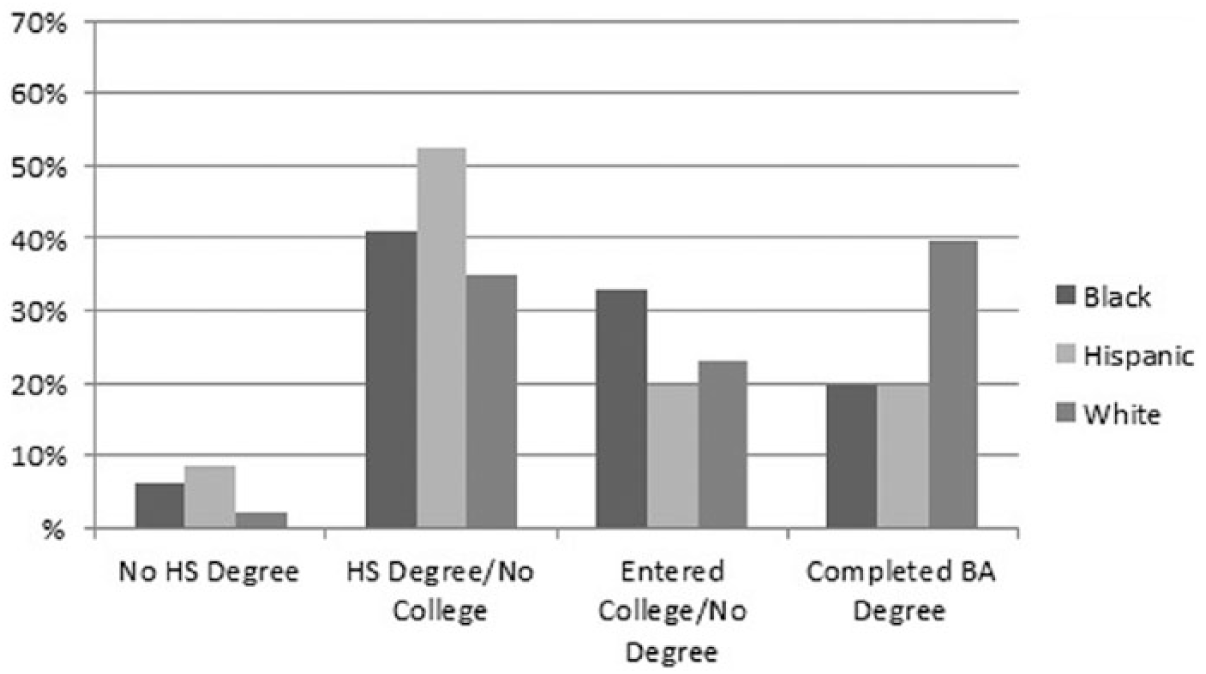
Unconditional Probabilities of Educational Attainment Levels by Race.
Multivariate Results
Table 2 presents ORs from the GEE models (Appendix A presents the logit coefficients and standard errors). Model 1 includes race, gender, and the socioeconomic background and early academic experience variables. In Model 1, the early academic experience variables are the most consistent predictors across the three educational transitions. For instance, students with an expectation for a bachelor’s degree have greater odds of graduating from high school (2.974, p < .001), entering college (OR = 3.377, p < .001), and completing a college degree (OR = 4.433, p < .001). Students on a college preparatory track (high school graduation OR = 14.761, p < .001; enter college OR = 2.886, p < .001; finish college OR = 1.545, p < .05) and those with higher math achievement (high school graduation OR = 1.075, p < .001; enter college OR = 1.077, p < .001; finish college OR = 1.069, p < .001) are similarly more likely to make each transition. 11 Socioeconomic background variables have less consistent effects across the three transitions, and only family income (high school graduation OR = 1.073, p < .05; enter college OR = 1.076, p < .001; finish college OR = 1.044, p < .05) has a positive effect at each time point. The addition of the socioeconomic background and early academic experience variables to the model markedly changes the nature of the racial differences seen in Figure 1. Including the socioeconomic background and early academic experience variables reduces the differences in high school graduate between black and white students to nonsignificance (OR = .748, p > .05). Moreover, the difference in four-year college enrollment now favors black students, as black students (OR = 1.853, p < .001) have odds of college attendance that are 85.3 percent greater than those of their white counterparts. Black students remain significantly less likely than their white counterparts to finish a college degree (OR = .776, p < .05). The only significant difference between Hispanic and white students in Model 1 is for high school graduation; Hispanic students remain less likely than white students to graduate from high school (OR = .526, p < .001) after controlling for the socioeconomic background and early educational experience variables. Differences between Hispanic and white students in both college attendance and college completion are reduced to non-significance after controlling for the socioeconomic background and early academic experience variables in Model 1.
Odds Ratios from Generalized Estimating Equation for Educational Outcomes

Source: Education Longitudinal Study (ELS (02/11) is designation the NCES uses to indicate that it started in 2002 and ended in 2011).).
Note: Weighted data; n = 11,123 (high school graduation), n = 10,737 (attend college), n = 6,861 (finish college).
p < .05. **p < .01. ***p < .001.
Models 2 to 6 add the conditionally relevant college and early adult experience variables as predictors of college completion to determine which factors are most consequential for explaining racial differences in college completion. Model 2 adds the college financing measures. Among the three financing measures, only paying for college with grants or scholarships has a significant effect on college completion (OR = 1.513, p < .001). Specifically, those students who reported receiving grants or scholarships to pay for college had odds of college completion that were 51.3 percent greater than those of students who did not report receiving this type of financial aid. Model 3 includes the full-time employment, college timing, and transfer status variables. Model 3 indicates that students working at least 30 hours per week (OR = .124, p < .001) were far less likely to complete a college degree compared with those who did not work at least 30 hours during college. Similarly, students who transferred to four-year colleges were less likely (OR = .404, p < .001) to complete a degree. In contrast, students who entered college immediately after high school (OR = 2.373, p < .001) had odds of college completion more than two times greater than students who delayed entering college. Despite the importance of these factors for explaining bachelor’s degree completion, the racial disparities observed in Model 1 are essentially unaffected by the inclusion of the additional variables in Models 2 and 3.
Model 4 adds the college experience measures. Each of the four college experience variables, research experience (OR = 1.481, p < .01) study abroad (OR = 1.775, p < .01), having a faculty mentor (OR = 1.848, p < .001), and attending a moderately (OR = 1.912, p < .001) or highly (OR = 2.951, p < .001) selective university have significant positive effects on obtaining a college degree. In addition, the inclusion of these college experience measures reduces the disparities between black and white students for bachelor’s degree completion to nonsignificance (OR = .816, p > .05). Thus, differences in the nature of universities attended and the activities and experiences at these universities are an important reason why black college students complete bachelor’s degrees at lower rates than their white counterparts. Model 5 adds the adult life events to the model. Model 5 shows that each of these variables—becoming a parent (OR = .293, p < .001), becoming married (OR = .292, p < .001), and experiencing stressful events (OR = .858, p < .01)—is negatively associated with completing a college degree. Moreover, similar to Model 4, the addition of these variables reduces the black-white disparity in college attendance to nonsignificance (OR = .801, p > .05). This pattern indicates that in addition to differences in college experiences, heterogeneity in early adult life events is an important consideration for understanding why black college students finish degrees less often than their white counterparts.
Model 6 presents the full model with all variables entered. The results in Model 6 indicate that the college and young adult experience measures operate somewhat independently. Namely, each of the college and young adult experience variables that were significant predictors in Models 2 to 5 remain significant in Model 6, and the only college and young adult experience variables that are not predictive of college completion are loans and savings/earnings. Moreover, similar to Models 5 and 6, the black–white disparity is reduced to nonsignificance when the full complement of college and young adult measures are considered. In total, only two net differences between racial groups remain significant in Model 6. First, Hispanic students remain less likely to graduate from high school (OR = .525, p < .001), and black students remain more likely to enter college (OR = 1.853, p < .001).
To illustrate how the patterns in Table 2 lead to disparities in eventual adult educational attainment, Figure 2 presents predicted probabilities of four possible educational outcomes (no high school degree, high school degree, no college, entered four-year college/no degree, BA degree completion) on the basis of Model 6. The patterns in Figure 2, which hold all variables except race constant, can be interpreted as “societal counterfactuals,” reflecting the disparities that would exist if the effects of racism in the form of structural disadvantage and unequal treatment were eliminated and black and Hispanic students had the same values on all predictors as white students. Figure 2 indicates that if all students had equal characteristics, black students would attain college degrees at a similar rate or slightly higher rate than white students, and the relative proportions of Hispanic and white students reaching each educational outcome would also be very similar.
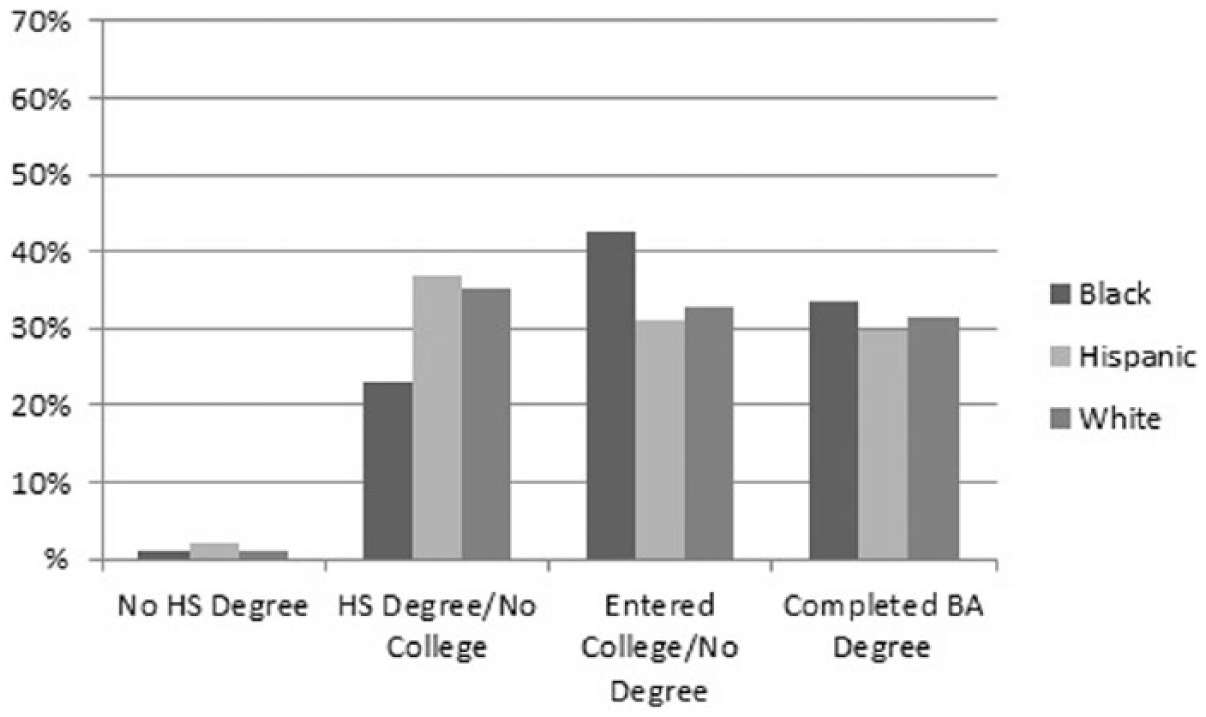
Predicted Probabilities of Educational Outcomes on the Basis of Model 6.
The differences between Figure 2 and Figure 1, which used each student’s observed scores, underscore the role that a social system that distributes educational opportunity unequally by race continues to play in the reproduction of racial disparities in educational attainment. These results clearly show that if students of all backgrounds started with equal resources and had similar educational experiences, overall racial differences in educational attainment would be far smaller than those observed today.
Discussion
This examination of racial differences in educational careers adds several new findings to extant understandings of how race structures educational attainment. First, this research shows that black and Hispanic students tend to end their educational careers at different stages. For Hispanic students, inequality in educational attainment is due mainly to a lower probability of completing high school and attending college compared with black and white students. In contrast, black students lag behind white students mainly because they end their educational careers after entering college but prior to obtaining a degree. Thus, although nearly identical proportions of black and Hispanic students obtain college degrees by age 26, these students follow distinct educational career trajectories. These disparate patterns for black and Hispanic students underscore the utility of an educational careers approach to understanding racial differences among American students; static models of years of education or college completion obscure these important patterns regarding the nature of racial inequality in educational attainment.
First, results here also extend research showing a net advantage in four-year college enrollment for black and Hispanic students (Bennet and Lutz 2009; Bennet and Xie 2003; Merolla 2013; Merolla and Jackson 2014). The present findings indicate that the net advantage pattern is specific to black students in the recent cohort of students analyzed here, whereas net parity is observed for Hispanic students. Moreover, the findings here show that the net black advantage for four-year college enrollment remains after controlling for a relatively complete set of background factors. This pattern contrasts with evidence that the net black advantage is explained by higher educational aspirations among black students (Merolla 2013), a difference that is likely due to the use of more recent data compared with past studies. In addition, results suggest that Hispanic students remain more likely to drop out of high school compared with their white counterparts.
Moreover, extending the view of educational careers through the college years shows the impact of the net black advantage for shaping racial differences in eventual educational attainment. Among college attendees, black students are the least likely to complete their degrees; however, the disproportionate number of black students attending college mitigates this disadvantage to some degree; thus, if not for the net black advantage in four-year college enrollment, the overall educational level of black Americans would be substantially lower. In other words, the net difference between black and white students’ educational attainment favors black students because of the high percentage of black students enrolling in college.
Despite the net advantage for black students, the picture is not wholly positive. The higher probability of attending college also leads more black students to end their educational careers after attending college without a degree. Given the increasing expense of a college education and evidence suggesting that black students are the most likely to rely on loans to finance their education (National Center for Educational Statistics 2014; Price 2004), this pattern likely leads to many black students’ leaving college without a degree but instead with a substantial debt burden that can hamstring young adults’ efforts to achieve financial independence.
Extending the purview of educational-careers models to college completion also required examining additional variables that are specific to the college experience, which proved to be important predictors of completing a four-year degree. In addition, the inclusion of variables reflecting experience with high-impact practices in college and early adult experiences to models of college completion fully explained black students’ lower probabilities of completing college. This finding shows that models of educational attainment that do not include college and early adult experiences may not fully identify the net difference between racial groups and therefore may not provide a full account for racial disparities in educational attainment. The omission of these factors from models of educational careers fails to capture the manner in which racism continues to affect students in their college years through mechanisms that are irrelevant for early educational career stages.
It is notable that the variables reflecting high-impact practices, college selectivity, and early adult life experiences served to eliminate the difference between black and white students for college completion. These patterns suggest that racial disadvantage follows students into their college years by structuring both the types of colleges students attended and the experiences they have in these colleges. Thus, despite the fundamental differences between high school and college, one constant is that educational opportunity remains unequally distributed by race at all levels of the education system, and this unequal distribution has important consequences for population-level racial disparities in educational attainment. Given the increasing importance of college degrees for today’s young adults, research should continue to investigate manifestations of racism specific to college experiences that lead to disparities in college completion.
Limitations
In addition to numerous strengths, the present study also has important limitations. First, the ELS data collection in 2012 occurred when students were 26 years old. Indeed, some 9 percent of all students were still in college at this time, and it is unknown whether these students will eventually complete a college degree. In addition, given that black students in particular were likely to remain in college at age 26, some of the disparities reported above could be overestimated. A related point is that some of the students who left college without a degree could in fact “drop in” and return to college at a later point in life. However, research indicates that students who obtain degrees earlier in life are much more likely to enjoy the economic benefits of postsecondary education (Elman and O’Rand 2004).
Second, the use of the broad category of Hispanic in this research could obscure important differences between subgroups of students categorized as Hispanic. Research has shown that there are important differences between Hispanic groups on the basis of their country of origin, language status, and skin tone (Aud, Fox, and KewalRamani 2010; Gomez 2000; Irizarry 2015b). Given that the final models presented here suggested a net disadvantage among Hispanic students after controlling for a relatively robust set of control variables, it is likely that there are factors in play among Hispanics that were not included here (e.g., nativity, religiosity). As the Hispanic population continues to grow in the United States, it is important that future research consider the heterogeneity of the Hispanic population in order to paint an accurate portrait of ethnic variation in educational experiences. Along these lines, research that continues to move beyond binary constructions of race by including groups such as Asian and Native American students would further advance knowledge on racial stratification in education. Finally, it is likely that there are important gender differences in how race shapes educational attainment, and future research should investigate whether some of the patterns documented in this article may vary for men and women.
Conclusions
This research underscores the role of racism in the form of unequal distribution of SES and unequal treatment as fundamental to racial disparities in educational attainment. Some scholars have argued that the importance of socioeconomic disparities for explaining racial disparities in educational outcomes indicates that racial disparities in educational attainment have been eclipsed by class-based disparities in the twenty-first century, and the significance of race for educational disparities is declining (Gamoran 2001). This approach is characteristic of scholarship that attempts to disentangle race from class when interpreting statistical models (Bonilla-Silva and Baiocchi 2001). In contrast, I argue that large scale racial inequalities in educational attainment of the kind shown here are best understood as result of a fundamentally racist social system that manifests in different ways across students’ educational careers. It remains impossible to decouple the effects of socioeconomic factors from the effects of race, because the central role race plays in allocating SES cannot be overstated. The students in the ELS data were born around 1980, just 26 years after all Americans were given putative equality under the law. Thus, the differences in socioeconomic background shown here are due in large part to a legacy of unequal treatment and exclusion from full participation in society. This legacy of racism continues to shape racial disparities in education for today’s young adults because they did not begin on an even playing field with their white counterparts, and they continue to face disparate treatment at all levels of education. Given that racial disparities in SES have increased in the wake of the great recession, a failure to acknowledge and address the role played by persistent inequality in educational opportunities between racial groups will likely lead to these patterns’ being reproduced in the next generation.
Footnotes
Acknowledgements
I acknowledge Zachary W. Brewster, Michelle R. Jacobs, and the anonymous Sociology of Race and Ethnicity reviewers for their insightful comments on earlier versions of this article.
Notes
Author Biography
References
Supplementary Material
Please find the following supplemental material available below.
For Open Access articles published under a Creative Commons License, all supplemental material carries the same license as the article it is associated with.
For non-Open Access articles published, all supplemental material carries a non-exclusive license, and permission requests for re-use of supplemental material or any part of supplemental material shall be sent directly to the copyright owner as specified in the copyright notice associated with the article.
