



Abstract
Rezoning public school attendance boundaries offers important possibilities for promoting school integration; however, it tends to generate contentious debates, often with white, middle-class parents furiously opposing school reassignments. In this paper, we ask: what logics and discourses do race and class-privileged parents draw on to justify educational inequities, and how are such discourses employed? To explore these questions we analyze a high school rezoning controversy in the Williamsburg-James City County School Division in Eastern Virginia. We conducted a content analysis of public commentary collected from school board meetings, two district-administered surveys, and social media and local news outlets. We bring together Critical Race and Settler Colonial theoretical perspectives to argue that white, middle-class parents and residents mobilized the intertwined logics of private property and whiteness to claim entitlement to the highly ranked Jamestown High School. They did so by combining well-worn colorblind, deficiency frameworks with argumentative logics that leveraged their position as property owners in affluent neighborhoods. First, they linked home ownership in expensive, residential subdivisions to “responsible parenting,” “freedom,” and “choice.” Second, they constructed the social bonds and “community” forged in overwhelmingly white, high-cost, residential sub-divisions as valuable to schools, making residents deserving of assignment to “the best school.” This analysis sheds crucial light on the discursive linkages between color-blind racism and white private property and how white, class-privileged parents mobilize these deeply intertwined logics to defend entitlement to educational resources.
The genius of segregation as a tool of oppression is in the signal it sends to the oppressors-that their monopoly on resources is legitimate, that there is no need for sharing, no moral requirement of empathy and care. Charles R. Lawrence, III. “Forbidden Conversations: On Race, Privacy, and Community.”
Introduction
In rapidly growing and diversifying communities in the United States, decision-making regarding public school attendance zones offers important possibilities for promoting school integration or, alternatively, maintaining, or even intensifying, racial and/or socio-economic segregation (Richards and Stroub 2015; Saporito and van Riper 2016; Siegel-Hawley 2013). Rezoning involves drawing boundaries around residential areas assigned to particular schools. In the context of residential and school segregation, rezoning school attendance boundaries tends to generate contentious debates, often with white, middle-class parents furiously opposing school reassignments and successfully resisting changes that would reduce racial and socioeconomic segregation (Bartels and Donato 2009; Castro, Parry, and Siegel-Hawley 2022; Castro, Siegel-Hawley, et al. 2022; Richards 2017; Wells and Serna 1996). In this context, we ask: what logics and discourses do race- and class-privileged parents draw on to justify a status quo of educational inequities? And how do privileged parents and residents employ such discourses to defend continued entitlement to educational resources?
Scholars in education have fruitfully applied Critical Race approaches to understand school inequities, demonstrating how widely held ideologies of legal neutrality, color blindness, and meritocracy—“the belief that one will be rewarded for hard work, being a good person, and playing by the rules”— act as “camouflages” of the self-interest of the privileged (Ladson-Billings and Tate 1995; Patel 2015:664; Tate 1997:235). We build on these insights by following Leigh Patel (2015) and others who have urged greater attention to the material property relations undergirding colorblind racism. To this end, we return to the foundational work of Cheryl I. Harris (1993) to explore how white private property regimes make use of colorblind, meritocratic discourses to legitimate white “possession” of preferred schools.
We explore these dynamics through a school rezoning controversy in the Williamsburg-James City County (WJCC) School Division, a district composed of 16 schools serving ~11,000 students in a non-metropolitan community in eastern Virginia (pop. ~91,500). Rezoning was proposed in 2017–2018 as a solution to overcrowding in the division’s three high schools. It would require, however, reassigning some of the white, affluent students concentrated at the highly rated Jamestown High to the other schools, including Lafayette High, which served the greatest numbers of students of color, English learners, and economically disadvantaged students. After a highly contentious public debate in which parents and residents of neighborhoods zoned for Jamestown High mobilized to oppose “redistricting,” the school board voted against rezoning the high schools and instead opted to expand the capacity of Jamestown High by adding trailers, incurring a substantial cost (LaRoue 2017). 1 We conducted a content analysis of public comments at 10 school board meetings, anonymous responses to two community surveys, and debates occurring on social media and in local news outlets.
Through this analysis, we argue that white (and, in a very few cases, non-white) middle-class parents and residents employed well-worn colorblind, meritocratic frameworks to paint economically disadvantaged parents and those of color as deficient—and, thus, to dismiss claims that rezoning could address racial disparities by balancing resources and opportunities across schools. 2 However, they also used their position as homeowners to bolster their claims that their children were entitled to remain assigned to a highly ranked school through the employment of two sets of discourses. First, parents frequently linked high-value property ownership in affluent, residential subdivisions to “responsible parenting,” “freedom,” and “choice.” Second, they constructed the social bonds and forms of community engagement forged in overwhelmingly white, often high-value, residential sub-divisions as valuable to schools, making those who reside there deserving of assignment to preferred schools.
Education as White Property and Settler Colonial Projects
Scholars in education have drawn on Critical Race perspectives to illuminate the dynamics of white privilege in educational settings and the effects of these dynamics on educational inequities. Color blindness and “myths of neutrality and meritocracy” serve to mask and perpetuate white advantage, construct students and parents of color as “deficient,” and allow white people to maintain their “possessive investment” in the status quo (Donnor 2012; Ladson-Billings and Tate 1995; Lewis and Diamond 2017; Lipsitz 2018). For example, Jamel K. Donnor (2013) demonstrates how policies undergirded by color-blind discourses of individualism and choice function to “obfuscat[e] entrenched ideological practices, ontological meanings, and structural arrangements that advance the self-interests and racial privileges of whites over the educational needs of non-whites, especially African Americans” (p. 196). Critical Race theorists argue that public school integration is problematic for white people as it “disrupts the durability of white supremacy” and threatens the ability of white people to preserve economic and social superiority over people of color (Patterson 2001:88). In the twenty-first century, white peoples’ challenges to desegregation efforts continue to draw on discourses that emphasize their right to exclude people of color (Castro, Parry, and Siegel-Hawley 2022; Donnor 2012). For example, scholars have found that, in debates over school attendance boundary rezoning, white, affluent parents use technical arguments (e.g., class size, school safety), colorblind racism, and meritocratic claims to justify access to the perceived “best” school (Bartels and Donato 2009; Castro, Siegel-Hawley, et al. 2022). These “common sense” ideas about race and rezoning are rooted in a long history of post-Brown v. Board struggles over integration (Castro, Siegel-Hawley, et al. 2022; Dumas, Dixson, and Mayorga 2016). Such exclusion is bolstered by “the political, economic, and educational status of superiority that has been historically assigned to Whites by White people,” which naturalizes inequities and masks white people’s responsibility for creating and recreating inequities (Donnor 2013: 200).
Critical Race theorists in education have productively drawn on the work of legal scholar Cheryl Harris (1993) to argue that “education is and represents property, and more specifically, white property” (Patel 2015:660). In a now classic article, Harris (1993) demonstrates how, in the United States, property rights are historically rooted in white supremacy and economic hegemony over Black and Native peoples, and thus, “are contingent on, intertwined with, and conflated with race” (p. 1714). Harris cogently argues that whiteness was rendered valuable—indeed, made property itself—as it came to represent access to land, power, privilege, and economic benefit. For her, “whiteness and property share a common premise—a conceptual nucleus—of a right to exclude,” and in order to maintain the rights and interests of possessors, whiteness as property must be continually “affirmed, legitimated, and protected” (pp. 1713, 1714).
Following Harris (1993), Critical Race theorists in education argue that colorblind, meritocratic discourses used by white parents and policymakers to legitimate existing educational inequities must be understood as part of an ongoing project of racial subordination and exclusion in which education is continuously fortified as white property within social institutions and structural interactions (Tate 1997). In school rezoning debates, for example, white, affluent parents assert their “rights” to choose what neighborhood they live in and what school their children attend (Bartels and Donato 2009; Castro, Siegel-Hawley, et al. 2022). As Gloria Ladson-Billings and William I. Tate (1995:60) assert, whiteness as property rights further extends to include school reputation and identity, since “to identify a school or program as nonwhite in any way is to diminish its reputation or status” (see also Evans 2007).
We build on this work by revisiting one of Harris’ foundational insights. For Harris (1993), it was not simply the idea of race that was wielded to dispossess and eliminate Indigenous people and to exclude Black people; rather, it was “the interaction between conceptions of race and property that played a critical role in establishing and maintaining racial and economic subordination” (p. 1716, original emphasis). As scholars of settler colonialism have also argued, to create “property for whites” and facilitate the permanent white occupation of a territory, colonizers wielded “logics of extermination” through the eradication of Indigenous people and the seizure of their lands (Wolfe 2006). For white settlers to live on and profit from land, it further had to be cultivated, privatized, and made profitable through labor extractions that necessitated the import of enslaved people, who had to be “kept landless, and who also bec[ame] property, to be used, abused, and managed” (Bonds and Inwood 2016; Tuck and Gaztambide-Fernández 2013:74). Thus, the elimination of Indigenous people and the exclusion of Black people operate as distinct logics that are nonetheless “consonant with the goals of increasing white property” (Glenn 2015:60).
Importantly, defining property rights as exclusive to white people not only constructed “property for whites,” it also “facilitated the merger of white identity and property” (Harris 1993:1721). As white people excluded others from control of property (i.e., land, jobs, education, opportunity, etc.), they made whiteness more valuable; as white people continued to exclude Others (i.e., racialized groups, their cultural practices, etc.) from whiteness, they strengthened their claim to property. Moreover, the possession of—and thus rights to—property was defined in terms of the cultural practices of white people. While Indigenous people first inhabited the land, their rights to it were erased as their distinct cultural uses of the land were racialized as inferior and not constitutive of possession. This rendered their land always available to white infringement and marked white people’s cultural practices as deserving of property (Bonds and Inwood 2016). In this way, “property for whites” and “whiteness as property” became deeply interdependent (Harris 1993). In returning to this insight, we are building on recent work that brings together Critical Race theory with Settler Colonial studies (Day 2016; Fong 2019; Patel 2015) to attend to the material property relations that intertwine with whiteness and which, we argue, underlie public controversies over school attendance zones in racially diverse schools.
Changes to school attendance zones can pose a threat to white property—both in terms of the property values of white residents’ homes and their access to highly regarded schools. We identify two sets of discourses through which white parents and homeowners protected their claims to a particular school as their property. These discourses mobilized the interaction between “property for whites” and “whiteness as property” to reinforce privileged access to Jamestown High School, the most highly ranked of the three high schools in WJCC. Both sets of discourses take as their starting point the myth of meritocracy, which has long legitimated educational opportunities as white property while ignoring “how property relations shape access” (Patel 2015:664; see McNamee and Miller 2009).
The first set of discourses extended colorblind, meritocratic frameworks to include homeownership. According to this logic, white parents deserve access to their preferred school because of their superior cultural practices (e.g., hard work, careful research) which enabled them to buy homes in the “right” neighborhood, ignoring the structural relations that have produced “property for whites,” such as redlining and the contemporary reverse redlining (see Rheingold, Fitzpatrick, and Hofeld 2001). The second set of discourses construct white, middle-class homeowners’ cultural practices of community engagement and close-knit, social bonds within their racially and socio-economically homogenous subdivision as valuable to schools, thereby legitimating the entitlement of neighborhood residents to a school, while implicitly devaluing the engagement and social bonds of those who live in low-income and minority neighborhoods.
Background: Williamsburg-James City County, Virginia
Greater Williamsburg brands itself as the “birthplace of a nation” and occupies a significant place in nationalist, settler narratives about the country’s foundation. The area is the site of the first English settlement in the United States at Jamestown and the capital of colonial Virginia, Williamsburg. In Jamestown in 1607, white settlers and the original inhabitants of the Tidewater region of Virginia—among them the Powhatan, Pumunkey, Paspahegh, Kiskiack, Mattoponi, and Chickohominy peoples—first came into contact (Schmidt 2015). Twelve years later and some 30 miles away at Point Comfort in Hampton, the first enslaved Africans landed in English Virginia, an arrival often credited with marking the beginning of chattel slavery in the United States. These foundational moments in the construction of “property for whites” and “whiteness as property” continue to reverberate.
Today, the Williamsburg area is a popular historical tourist and retirement destination. Expanding residential and commercial development and double-digit population growth over the last 30 years have transformed it from a small town to a low-density “suburb without a city.” 3 Such non-urban “gentrification” has produced a bifurcated, service-driven labor market with accompanying stark inequalities between wealthy, white retirees and professionals and more racially diverse service workers, including the most recent arrivals—immigrant laborers from Latin America (Bickham Mendez and Nelson 2016).
WJCC schools serve the children of families across this wide socio-economic spectrum, including unprecedented and growing numbers of English Learners (Sampson 2014). Between 2008–2009 and 2019 the percentage of white students at WJCC schools fell from 69 to 63 percent. That same year, in 2019, 74 percent of the general population of the area was white. Meanwhile the number of “economically disadvantaged” students rose from 23 percent in 2008–2009 to 36 percent in 2019 (Virginia Department of Education 2022). In 2019, overall poverty levels in Williamsburg-James City County were estimated to be approximately 7 percent (U.S. Census Bureau 2019).
At the same time, over the last 15 years, as enrollments at WJCC schools have increasingly diversified, the schools in the division have also undergone a process of racial and socio-economic segregation. This has resulted in high concentrations of economically and racially disadvantaged students at particular schools (e.g., Lafayette High) and markedly white and affluent student populations at others (e.g., Jamestown High). 4 This process was fueled by two school rezonings in the 2000s (2007, 2010) as well as disproportionate growth in areas of James City County zoned for highly rated schools, like Jamestown High. This latter trend suggests that the housing choices of (largely white), affluent families—and the inability of many families of color to use property ownership as a means to choose schools—have contributed to this segregation process (Doiron 2018). It is in this context that we interrogate the logics and discourses employed by race and class-privileged parents to justify the reproduction of educational inequities and legitimate their continued entitlement to educational resources.
The Rezoning Debate at WJCC Schools
In the 2017–2018 school year as a new middle school entered its last phase of construction, the WJCC school board began a process to propose new school attendance boundaries both to incorporate the new school and to address overcrowding and near or over-capacity enrollment levels in the district’s three high schools. Early in the process, a camp of pro-rezoning advocates was spear-headed by The Village Initiative, a community organization dedicated to addressing issues of equity and racial justice in WJCC schools and whose leadership came from the Black community. This organization and its supporters argued for more balanced racial and socio-economic diversity across the schools, called attention to the educational inequities between Jamestown High School and the other high schools, and argued for the benefit of diverse learning environments for all students. The Village Initiative (2018) highlighted a prominent “opportunity gap” reflected in the greater number of advanced placement courses offered at Jamestown High, as well as the gap between students’ academic performance and 4-year college enrollment rates at Jamestown versus Lafayette High School. As a former WJCC teacher put it, “We have no place for a “private” public high school in this city/county” (high school map survey).
The advocacy and outspoken presence of rezoning advocates at the school board meetings were eventually met by opposition from white (and a few non-white), middle-class parents whose children attended or were zoned to attend Jamestown High. While this group of parents and residents spoke less frequently at school board meetings, they mobilized on social media, wrote opinion pieces for the local newspaper, and in a coordinated effort voiced their objections in the surveys that the school division administered. A small group of parents whose children attended Jamestown founded an organization and Facebook group called “WJCC Parents for Educational Progress,” and another group, “Say No To WJCC High School Redistricting,” produced a website, which advocates used to coordinate opposition to school rezoning. In the weeks leading up to the school board’s vote, some neighborhood homeowner associations (HOAs), including one in a prominent gated community, hosted school board representatives to discuss the possible “loss” of Jamestown High School (private communication with the authors).
At the onset of the process, school officials proposed a set of criteria to guide rezoning and solicited community feedback through a public survey. These criteria effectively set the parameters for the community debate that ensued. The superintendent proposed three criteria: capacity, or enrollment levels; longevity, or the length of time before rezoning would again be required; and proximity, the required travel distance between home and school. However, community advocacy and public commentary quickly focused the school board’s attention on two additional criteria: diversity across the schools (officially termed “socio-economic balance”) and what school officials dubbed, “neighborhood concept,” or the idea that school attendance zones should encompass entire neighborhoods so that all children attend the same school. In the case of the former the WJCC School Board drew on the terminology employed in previous rezonings to define “balance” as the ratio of students who received free and reduced school lunches, using it as a proxy for “diversity.” 5 The addition of the criterion “neighborhood concept” also showed deference to previous, highly unpopular rezoning decisions, which had caused “heartache and tumult” by “splitting” neighborhoods (Fearing 2017). The tension between “diversity” and “neighborhood concept” came to dominate much of the rezoning debate.
Data and Methods
To analyze patterns in the discursive strategies that opponents to high school rezoning employed, we compiled a dataset of publicly available archival materials published or posted during the 13 months of the public discussions surrounding school rezoning (February 2017 to February 2018). The data-set includes anonymous responses to two surveys administered by the WJCC School Division—one to elicit community feedback on the decision-making criteria and the rezoning process as a whole (626 responses) and another seeking comments on five maps of proposed high school attendance zones, including a map that left the original boundaries unchanged (677 responses). 6 In addition, we collected 10 op-eds and letters to the editor from the Virginia Gazette and 20 entries in the paper’s anonymous community forum, “The Last Word.” We compiled transcripts of the “citizen comments” of 81 members of the public at 10 school board meetings. We also analyzed published content from the website “Say NO to WJCC High School Redistricting” and social media posts related to rezoning from two public Facebook groups—381 posts on the “WJCC Parents and Community” page and 50 posts on that of “Parents for Educational Progress,” a group dedicated to opposing high school rezoning.
We coded this archival data using the software program Dedoose. We individually coded a sub-set of the data, composed of approximately 10 percent of the archival materials. First, we completed independent, open coding of this sub-set through which we identified the most salient themes and developed a preliminary coding guide. Next, we met to discuss the conceptualization of codes and their application, and we refined our coding guide by adding new codes and splitting or collapsing existing ones. To address inter-coder reliability, we then used the refined coding instrument to conduct focused coding of the same sub-set of data and compared the results. After achieving an acceptable level of reliability, we coded the remainder of the dataset in pairs. 7
Descriptive codes included the demographic characteristics (the perceived or stated race and gender) of participants in the public debate; whether they identified as a parent, community member, current or former WJCC staff member, or student; and their articulated stance regarding rezoning (pro, anti, or neutral). We narrowed our code book to 11 conceptual codes. These included the five official criteria adopted by the school board: capacity, longevity, proximity, “neighborhood concept,” and diversity/equity. Additional codes that emerged from our open coding process included “alternative solutions” (proposed ways to address capacity and other issues while leaving high school attendance zones unchanged), “contesting school board process and data” (critiques of the fairness, objectivity, and quality of school officials’ decision-making or the data that they used), “financial concerns” (references to costs to the school division and tax-payers), “property ownership” (references to participants’ status as homeowners in a particular neighborhood), “redistricting history” (references to past school rezonings), and the most prevalent code in our data set, “student well-being” (references to students’ emotional, academic, social, and physical well-being).
Our positions as “observing participants” in the public debates surrounding the proposed school rezoning also inform our analysis (Stuesse 2016). At the time of this research the first author’s two children attended Lafayette High, the second author’s child was about to start kindergarten at a WJCC school, and the third author was an undergraduate student, majoring in sociology. We were all active members of the Village Initiative, the community organization that spear-headed advocacy efforts to include equity and diversity as criteria in the rezoning process, and we participated in the public debate by speaking at school board meetings in favor of rezoning for diversification and equity. At least one of us attended the “community dialogues” where proposed maps were presented to the public and the 10 school board meetings where we took detailed fieldnotes.
Findings
Code Frequencies
The two most prevalent codes in the data-set of 1876 excerpts were Student Well-being (643 applications) and Diversity/Equity (625 applications). Both these concepts operated as highly versatile “master frames” in this public debate, and participants employed them to articulate varied and, even opposing, arguments (Best 2013). Members of the public employed Diversity/Equity as a frame to advocate for using rezoning to diversify schools and address inequities as well as to contest the idea that “socioeconomic balance” should be used as a criterion at all. Participants also employed Diversity/Equity to argue for addressing issues of equity across the three high schools without changing school assignments.
Likewise, participants employed the notion of “doing no harm” to students and safeguarding their well-being to frame diverse positions and arguments. Parents and residents who opposed school rezoning frequently advocated for the criterion of “proximity,” 8 arguing that student safety and general well-being would be compromised by added transportation time resulting from school transfers. Opponents often cited concerns about their children’s safety, academic progress, and social and emotional well-being which would be negatively impacted by the “turmoil” and “disruption” that school reassignments would cause. Many advocated for waiting until the construction of a new high school to rezone attendance boundaries to minimize “harm.” On the other hand, those advocating for equity and diversification also drew on the idea of student well-being, citing the “disruptive” harm that arises from school inequities and arguing there were “multiple ways [that] integration of schools can be beneficial for all students” (Parent, citizens’ comments, school board meeting).
Unsurprisingly, given our method, five of the most frequently applied codes in our dataset corresponded with the official criteria for rezoning adopted by school officials. These include Diversity/Equity (625 applications), Capacity (549 applications), Longevity (379 applications), Proximity (379 applications), and “Neighborhood Concept” (284 applications) [See Figure 1]. While the code “Property Ownership” (175 applications) did not appear as frequently as those that captured official criteria, participants in the public debate used it alongside other concepts and frameworks to oppose rezoning or to argue for their continued assignment to Jamestown High. For example, they frequently drew on the official criterion of “neighborhood concept” alongside the idea of students’ well-being. In doing so, they leveraged their status as property-holders to extoll the benefits of residence, in particular high-status, racially homogenous neighborhoods. Thus, Property Ownership co-occurred 60 percent of the time with the code “Student Well-being,” and 39 percent of the time with the official criterion of “Neighborhood Concept.” Below we illustrate how the idea of property rights figured into white, middle-class residents’ discursive strategies to argue for their entitlement to the “best” schools and how these strategies are reflective of the interaction between “property for whites” and “whiteness as property.”
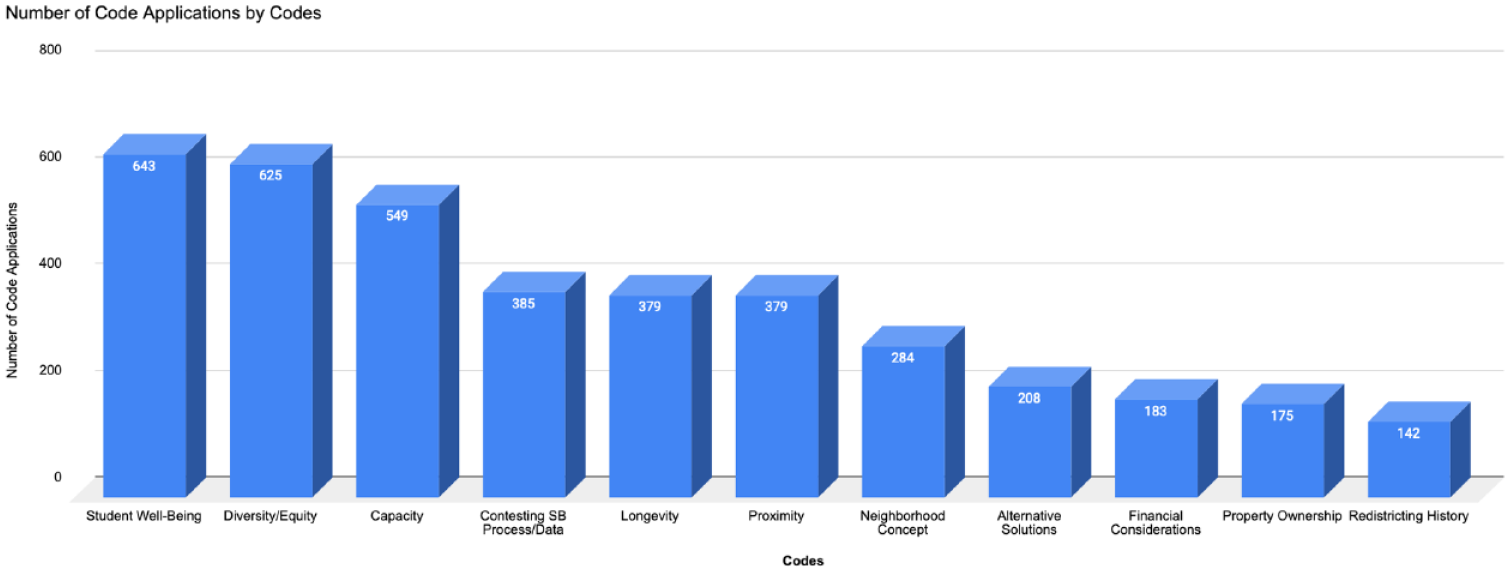
Number of Code Applications by Codes
Diversity as “Social Engineering”: Meritocratic and Deficiency Frameworks
As noted above, due to public advocacy for rezoning for diversification and equity, as well as the school board’s adoption of “socio-economic balance” as one of the rezoning criteria, even those opposed to high school rezoning were compelled to engage the idea of “diversity” in their arguments. Opponents to rezoning frequently employed color-blind logics to deny the existence of inequities across the schools. For example, at a school board meeting, one mother objected to comparing students’ test scores by race since “all students’ brains are gray.” Others drew on school-level performance measures, like college matriculation and degree completion rates, glossing over data disaggregated by “sub-group” that would reveal racial and socio-economic differences, to argue that “[w]e do not have a crisis that needs to be solved” and “equalizing free and reduced-price lunch rates” was an unnecessary and disruptive effort “to fix a problem that does not exist” (Chew 2017).
Some opponents challenged pro-rezoning arguments about academic achievement disparities between Lafayette and Jamestown High Schools. Critical education scholars have asserted that discourses associated with the “achievement gap” racialize school achievement, privilege a majoritarian narrative of school success, and overlook historical implications and societal forces that impact students of color (Carey 2014; Horsford and Grosland 2013). To defend current attendance boundaries, parents tied academic performance to individual student merit and parental involvement, arguing that “social equity and parity do not contribute to performance” (resident, high school map survey). One parent’s survey response is typifying: Whether you are rich, poor, black, or white all students have equal opportunity at all of our schools to excel. It does not matter what building you learn in. [. . .] The real problem with academic discrepancies lies in parental indifference which will not be corrected by redistricting. Unfortunately, underachieving students will underachieve no matter what school they are in.
Similarly, during the citizens’ comment session at a school board meeting, a father argued that it was unfair to transfer his children because of the lack of parental involvement and resulting low school achievement of other students. He explained that his children’s academic performance was the result of his investment of time and support. If asked about the “achievement gap,” he insisted that his children would say: “To be honest, Dad, I learned how to read at home. The reason I’m at the top of my class in math is because you drilled me in my multiplication tables after second grade [. . .] And I hated you for it that summer, but I came out on top.”
Parents, like this one, drew on meritocratic frameworks and deficiency logics to construct enrollment in high-performing schools as an entitlement—indeed, as property—earned through responsible parenting and involvement in students’ education. According to this logic, students who are achieving at lower rates do not deserve more support and resources, but rather, less opportunity. That is, if students’ lack of academic success is the result of parental indifference, then these children do not deserve to attend a high-performing school—as they will fail regardless of the school that they attend.
Some anti-rezoning advocates expressed explicit opposition to the use of “socio-economic balance” as a criterion at all. The web site “Say NO to WJCC High School Redistricting” explained that the organization was formed by “concerned parents who don’t want WJCC high school students used as pawns by our School Board in their game of balancing achievement and diversity using socio-economic criteria.” Opponents dubbed the use of these criteria as “forced relocation,” “social engineering,” or “social experiments” and likened them to “failed busing” initiatives. On social media and in their anonymous survey responses, parents lashed out at the school board, claiming that for them “looking political correct” mattered more than “our children,” and accused them of having on “free lunch blinders.” In Facebook threads and on the surveys, some parents equated the concern for racial and economic diversity with the unjust prioritization of the education of economically disadvantaged students, and students of color over others. For example, a Jamestown parent commented on the criteria survey, “I am for diversity but why is my son’s school experience less important than another student just because of his socioeconomic background?” Critical race theorists have noted how colorblind logics such as those applied here undermine policies or measures intended to promote racial equality because they are “framed as unfair and discriminatory toward whites” (Donnor 2012:544).
Another pattern was for parents to advocate for addressing academic disparities while leaving attendance boundaries (and levels of racial and socio-economic segregation) untouched. As one parent explained in their response on the rezoning criteria survey: . . . it is clear that FRL students at the high school require more resources from WJCC to reduce the achievement gap. Please provide these additional resources to these students, and STOP funding the schools on a per student basis. As a Jamestown districted family, we KNOW that Lafayette needs more resources than it is currently receiving . . . [. . .] Please fix this problem by allocating MORE resources to FRL [free or reduced lunch] students, NOT by moving them across town to a new school . . . [emphasis in original].
Another parent commented, Playing with the numbers at a macro level (e.g., free and reduced lunch ratios) only serves to normalize all schools to the same level instead of elevating all schools to a higher level. Meet the schools where they are! If some need more resources than others, then so-be-it.
For these parents and residents providing additional funding to the schools with higher numbers of students of color and poor students was preferable to “shuffl[ing] low performing students to a high performing school,” which would “only turn the high performing school into a mediocre one” (parent, high school map survey). In these arguments, despite the expressed concern for resource disparities, parents leverage a racialized achievement gap and deficiency narratives regarding “low performing” schools and students. Thus, even these seemingly more sympathetic arguments drew on and reinforced deficiency logics that constructed Black, Brown and economically disadvantaged students and their parents as “flawed” and in need of “fixing,” while simultaneously justifying white students’ entitled, exclusive access to a “good” school (Montalva Barba 2020).
Meritocracy, Property Rights, and the Responsible Parent
Opponents of school reassignments, however, further extended this narrative that explained racial and socioeconomic disparities in academic achievement as deriving from levels of “parental involvement” by constructing property ownership in particular neighborhoods as a manifestation of “responsible parenting.” Parents, such as those who owned homes in Governor’s Land (a gated community), repeatedly made mention of the “careful research” and “effort” that went into selecting “neighborhoods where we would like for our children to attend school” (parent, high school map survey). The time and effort to purchase a home in the “right” school zone was depicted as evidence of “responsible” parenting decisions—free choices that should not be constrained by unfair policy interventions. As a Jamestown parent and advocate from Parents for Educational Progress explained at a school board meeting: You see, people in this community they’ve bought, or they’ve rented in places, it’s by their own choice. A great amount of research went into it. They have chosen to live where they want to live based upon a whole variety of factors, schools being one of them. But what you’re talking about here is [. . .] forced relocation and I believe that that is fundamentally wrong.
Framing residential “choice” as responsible parenting denies both the history of other “forced relocations”—those of displaced Native and Black people and Latin American migrants—as well as the ensuing racial wealth inequalities that shape who can make these parenting “choices.”
Moreover, this construction naturalizes the idea that carefully weighed decisions to purchase private property also buy the exclusive right to a high-performing school (Donnor 2021). Parents’ survey responses were often explicit in deploying this logic: “We pay a lot of money to live in Kingsmill (a gated community) and that’s because we wanted our kids to go to Jamestown” (parent, criteria survey). In another survey response, a parent expressly employed this meritocratic framework and linked the inability to purchase homes in the “right” neighborhood with a lack of work ethic: “Enough with you people screwing around with maps in the name of equality. It’s NEVER GOING TO BE EQUAL. Want a better school for your kid? WORK HARDER and achieve it!” [emphasis in original]. In this manner, as Donnor (2013) argues, the deployment of discourses of individualism and choice “evoke a set of mythic beliefs” that enable white people to oppose efforts to equitably expand social opportunity and to justify an inequitable educational status quo (p. 195).
Relatedly, numerous residents cited the potential damage to their property values that rezoning would cause, if their neighborhood “goes elsewhere other than JHS.” One parent explained, “This [rezoning] will adversely impact our children, our property value, and our way of life” (criteria survey). The response of one father on the high school rezoning map survey was quite explicit in tying school attendance zones to property values: We are in the midst of having the wonks on the school board decide the lottery of school districting, and by extension, property values (because, gasp, property values and schools with the fewest number of low lifes are directly related to one another) [. . .] It seems to this taxpayer that by having two “good” high school zones and one “bad” one, property values are maximized. And yes, morons on the school board, maximizing value should be your ONLY priority [. . .] [emphasis in original].
This response is worth quoting at length for its candid linking of class and racial privilege to property ownership and entitlement to socioeconomically and racially segregated schools: Moreover, I just want to say, at the risk of being labelled a “bad white man” (or worse) that people move to certain areas of Williamsburg (and, oh, everywhere else), and pay top dollar for the privilege, to GET AWAY FROM the RIFRAFF that the school board is trying to redistribute. Read that again . . . I DON’T WANT MY KIDS WITH ANY MORE THUGS than they already have surrounding them. I feel bad enough already that I can’t afford to send them to a private school. [. . .] So, note to the school board—busing doesn’t “work!” People still will try to get away from the “free shit army” no matter how many times you try to force people to embrace the underclass. It’s called white flight. Look it up. The take home message is clear—Most people don’t want fair. They want unfair . . . because I and others earned unfair and chose unfair [. . .] [emphasis in original].
This parent uses color-blindness and meritocratic frameworks (“earned” unfairness) to justify the status quo. We also see reflected in his comments the perceived threat to both “property for whites” (property values) and white property—the potential loss of the right to exclude. The mention (and perhaps veiled threat) of white flight is consistent with what other scholars have noted in the cases of racially shifting schools and white parents’ position within them. Racial and class-based codes (thugs and riffraff) are tied to explicit claims to entitlement to absolute exclusion through property rights.
Neighborhoods and Property Rights: Constructing Valuable and Exclusive Communities
White, middle-class parents and residents also championed “neighborhood concept” as the most important criterion to guide the rezoning process, and they often explicitly did so to counter arguments about diversity and equity. Parents frequently advocated strongly against rezoning that would “split” neighborhoods. In a typical response to the criteria survey a parent commented, [. . .] There is no good reason to split a neighborhood. [. . .] I kept hearing about “diversity,” and well, I really don’t believe that should be a driving factor. Kids will gravitate to those they like. [. . .] I do believe that funding should be dispersed to those who need extra assistance, but to shake up a school district in the name of diversity is insane.
Importantly, in public debates about WJCC rezoning, parents and community members, and indeed, even most school officials, overwhelmingly defined “neighborhood” as a residential sub-division, which in the context of WJCC are highly segregated by race and class. Particularly in James City County, such subdivisions are composed overwhelmingly of single-family homes, almost always regulated by HOAs. Indeed, after a meeting in which two school board members raised questions about the best way to operationalize “neighborhood” as a criterion for rezoning attendance boundaries, one resident wrote in a survey response, “I don’t really feel it should be that difficult to define a neighborhood. One HOA equals one neighborhood.”
In advocating for “neighborhood concept,” parents accorded specific meanings to “community” and “neighborhood,” which naturalized white private property ownership as a crucial source of long-term relationships and identities, critical to both students’ school success and social advancement. Homeownership and HOA’s figured centrally in parents’ descriptions of neighborhoods as the source of valuable community bonds: “many relationships are built through the normal neighborhood interactions (kids playing/pool/HOA meetings and events/etc.) that transfer to school and PTA involvement” (criteria survey, emphasis added). Parents from the subdivisions zoned for Jamestown maintained that “our schools are an extension of our homes and family” (high school map survey), arguing that “[b]reaking up neighborhoods weaken [. . .] those natural ties” (criteria survey). Another parent commented, “Neighborhoods should be kept together. It takes a village to educate a child. . .The most robust educational support will come from those supporting individuals that reside closest to our schools and those that have the vested interest as family, as neighbors and as friends” (criteria survey). For these parents and residents cohesive (read: white, upper-class) neighborhoods give “parents the opportunity to rely on friends and neighbors” and encourage “participation and involvement,” including volunteering in the school and carpooling with neighbors (parent, citizen comment at school board meeting).
The social bonds forged within these neighborhoods were framed as a precious asset that benefited both students and school communities. One parent explained, Powhatan Secondary (a sub-division in James City County) has always attended the “best” schools, simply because the schools they are districted for become the “best.” This is because they have the most parental involvement of any neighborhood in WJCC. Keep Powhatan Secondary together, and they can come together to make a very strong school, regardless of FRL levels. Break Powhatan Secondary apart [. . .] and everyone loses. (Criteria survey)
Here, schools reap the benefits of cohesive communities if the “natural” ties among homeowners in racially and socio-economically homogenous neighborhoods are preserved. Such arguments naturalize an idea of community bonds as rooted in homeownership in white, upper-class neighborhoods, while denying the alternative possibility of building community ties across race/class lines. Extolling the value of the community bonds forged in segregated neighborhoods also masks the ways in which race and class homogenous social ties yield differential levels of social capital that reproduce racial (and class-based) inequalities. As Nancy Di Tomaso (2013) notes, white privilege is most often reproduced through the sharing of social resources with other white people, and close-knit, segregated neighborhoods are community spaces that can perpetuate white advantage through resource hoarding. Finally, as Miguel Montalva Barba (2020) explains, within settler colonial logics the settler invests in a white-only, segregated version of “community” as justification for the emplacement of white people.
Conclusions
A substantial body of work demonstrates how, particularly in rapidly changing suburbs and urban areas, white, affluent families have exerted considerable influence in public school settings, which can affect policy decisions and marginalize the concerns, voices and perspectives of minority families (Cucchiara and Horvat 2009; Kimelberg 2014; Kimelberg and Billingham 2012; Turner 2018). In many cases, the efforts of such influential parents can exacerbate levels of racial and socioeconomic segregation and undermine reform efforts to address school inequities (Lewis and Diamond 2017; Wells and Serna 1996). Employing an analytical lens that combines Critical Race and Settler Colonial theoretical perspectives extends these findings by revealing how debates about school attendance zones and composition reflect legacies of racial dispossession and exclusion as well as powerful ideologies tied to private property regimes which serve to justify and sustain these systems.
We identified two sets of discourses that racially and class-privileged parents and residents mobilized, which leveraged the interaction between “property for whites” and “whiteness as property” in order to legitimate the educational inequities stemming from existing school attendance zones. The first set of discourses builds on colorblind, meritocratic frameworks to dismiss inequities across the schools and legitimate white entitlement to the most highly ranked school. In this case, parents and residents drew on typical meritocratic discourses that constructed white, middle-class parents as responsible supporters of their children’s education and cast parents of color and economically disadvantaged parents as deficient.
However, by invoking the interaction between “property for whites” and “whiteness as property,” parents and residents who opposed rezoning also extended this colorblind logic in distinct ways. White parents claimed that their property ownership in high-value, economically and racially segregated sub-divisions reflected their hard work, careful research, and sound decision-making. Parents of color and economically disadvantaged parents, in contrast, were assumed to again be deficient, irresponsible parents who had not worked hard enough or made good decisions to ensure their children’s success. In this manner, white parents’ equation of homeownership in the “right” neighborhoods with superior cultural practices of whiteness excluded economically disadvantaged families as well as those of color from this definition of “whiteness as property,” while masking the structural processes that have produced “property for whites.”
In the second set of discourses, parents and residents made claims based on “neighborhood” and associated property rights to argue against changing school assignments. White parents claimed that their property rights as homeowners in a particular residential sub-division should extend to a specific school, using “white property” to reinforce the value of “whiteness as property.” The logic invoked was that everyone who owned homes in the same neighborhood should be entitled to enroll in the same school. White parents legitimated their entitlement to the “best” school by casting the cultural practices of community engagement and social bonding among homeowners in white, upper-class neighborhoods as valuable to schools. In turn, this implicitly devalued community-building and social connections in low-income and minority neighborhoods. This discourse reinforced claims to certain schools as “property for whites,” as minority and low-income neighborhoods were assumed incapable of producing the kind of community that not only “deserves” a high-performing school but, in fact, increases the value (i.e., ranking) of the school. Such discourses also dismiss the possibility of other forms of cross-racial, cross-class social connections and community that could develop in more diverse school settings.
Our analysis sheds crucial light on the ways in which white parents and residents mobilized deeply intertwined logics of color-blind racism and white private property to justify educational inequities. In so doing, our research renders legible the linkages between the racialized deficiency frameworks identified by Critical Race theorists and constructions of entitlements based on property rights, which undergird continuing projects of white control over both land and opportunities. Following Settler Colonial perspectives, we demonstrate that the production of “property for whites” is an ongoing project that both sustains schools as white property and is strategically invoked to maintain “whiteness as property” by marking white practices of property ownership and school engagement as valuable. One limitation of our study is its reliance on public discourse. Future research that draws on interviews with parents and residents could explore the meanings that those in favor of and opposed to equity-based reforms ascribe to these measures. It could also offer deeper understandings of these parents’ perspectives and the role that color-blind racism and white private property play in framing their worldviews.
Current national mobilizations of conservative, white activists bring increased urgency to issues at the heart of this study. Such activists, including some white parents, have waged virulent attacks on school boards, accusing schools of teaching Critical Race theory and other “divisive” content. Indeed, the WJCC School Board made national news in April 2022 as it decided against replacing 12-year-old social studies textbooks in response to a handful of white activists raising concerns about CRT and a textbook cover that featured a Black Lives Matter protest, a decision that was later reversed (Associated Press 2022). A slew of states have proposed bills that, while often framed as protecting “parents’ rights,” are aimed at banning curricula that present critical perspectives on race in schools as well as teachers’ and administrators’ inclusion of language regarding racial equity. Tellingly, a Florida bill prohibits teachers’ saying that “colorblindness” is a form of racism. These growing attacks underscore the urgency of understanding the material property relations that contribute to the construction of textbooks, curricula, and schools as white property, which perpetuate ideologies of the superiority of white cultural practices and, in doing so, sustain and support practices of race and class inequity.
Footnotes
Acknowledgements
The authors wish to thank the anonymous reviewers at Sociology of Race and Ethnicity for their insightful comments on an earlier version of this article. We dedicate this work to the Village Initiative and especially to its leaders, Jacqueline Bridgeforth Williams and Philip Canady, who are a continual source of inspiration to us and whose wisdom has greatly deepened our understandings of racial justice.
