



Abstract
Recent studies on political attitude formations have developed the ethnoracialization framework, which emphasizes the roles of racial hierarchies and ethnic identities interconnected with national origins. However, existing research has not established analytical strategies to incorporate this framework, leaving a gap between theory and practice. We propose an alternative analytical model to examine ethnoracialized political attitudes using the case of Asian Americans’ support for race-conscious college admissions. Using data from the 2016 National Asian American Survey, our effect coding reveals how Asian Americans’ race-conscious admissions attitudes vary by ethnicity. Then, we investigate whether this variation can be attributed to theoretical predictors of such attitudes, including the mention of previously supportive Supreme Court decisions on race-conscious admissions, through regression modeling. Most ethnic groups’ mean support scores significantly vary from the grand mean of Asian Americans, and those gaps remain significant even after controlling for socioeconomic backgrounds and general predictors. As an exception, redistributionism accounted for some ethnic variations. Certain predictors such as individual experiences of the U.S. opportunity structure and the racial justice frame shaped overall race-conscious admissions attitudes but did not reduce ethnic variations. These findings highlight the need for increased attention to the analysis of ethnic communities when studying ethnoracialized political attitudes, as our current theories appear insufficient in explaining variations observed between ethnic groups. Thus, conducting research that explores the interplay between Asian Americans, racialization, and ethnic communities will provide a more comprehensive understanding of Asian Americans and potentially other ethnoracialized groups.
Keywords
In the past decade, sociologists of race and ethnicity encouraged scholars to explore the multidimensionality of how race and ethnicity intertwine to form individuals’ group identities and experiences (Bonilla-Silva 2017; Irizarry 2015; Valdez and Golash-Boza 2017). This approach can be particularly instrumental to understanding groups like Asian Americans, which require researchers to solve the “diversity-convergence paradox” (Lee and Ramakrishnan 2021)—a set of converging and diverging patterns of social and political views and behaviors exhibiting the tensions of racialization of ethnic communities in the United States. However, previous sociological studies either examining race and ethnicity or focusing on Asian Americans have not yet fully captured the complex mechanisms of ethnoracialization (Brown and Jones 2015) that can influence Asian American political attitudes, as they only present ethnic variations in political attitudes, rather than explaining them. Against this backdrop, we propose an alternative analytical model to examine ethnoracialization using the case of Asian Americans’ support for race-conscious college admissions.
The conflict around race-conscious college admissions policies (often grouped with and referred to as affirmative action; see Harper and Reskin 2005) is a good example of how ethnoracialization unfolds as Asian Americans are interpellated as important stakeholders, and their views diverge by ethnic belongings (Lee 2021a). Recently, Students for Fair Admissions claimed in lawsuits against Harvard and the University of North Carolina that the institutions discriminated against Asian American applicants by giving an unfair advantage to Black and Latinx applicants in college admissions reviews. While these cases are not the first to mention Asian Americans in an anti-affirmative action lawsuit (Kim 2018), the recently closed litigation about the legality of race-conscious admissions that further circumscribed such policies and practices has garnered significant media attention, which stems from the fact that the plaintiffs have framed Asian Americans as primarily victims of such policies alongside white Americans (Lee 2021a). In light of this recent wave of legal cases around race-conscious college admissions, Asian Americans are generally supportive of affirmative action (Ramakrishnan and Wong 2018), but also have diverse perspectives on these policies (Lee and Tran 2019b; Poon and Segoshi 2018; Poon et al. 2019; Wong, Lee, and Tran 2018). However, while this discussion has mostly focused on ideological diversity within Asian Americans, the ethnic heterogeneity of Asian Americans’ affirmative action attitudes has yet to be sufficiently explored.
This study employs the 2016 post-election National Asian American Survey (NAAS) to test a model of ethnoracialization on Asian Americans’ race-conscious admissions attitudes. We found most ethnic groups’ mean level of support for race-conscious admissions varies from the grand mean of Asian Americans even after controlling for socioeconomic backgrounds and general predictors of race-conscious admissions support. As an exception, redistributionism accounted for some ethnic variations. Certain predictors such as individual experiences of the U.S. opportunity structure, and the racial justice frame overall race-conscious admissions attitudes but did not reduce ethnic variation. These findings highlight the need for increased attention to the analysis of ethnic communities when studying ethnoracialized political attitudes, as our current theories appear insufficient in explaining variations observed between ethnic groups. Thus, conducting research that explores the interplay between Asian Americans, racialization, and ethnic communities will provide a more comprehensive understanding of Asian Americans and potentially other ethnoracialized groups.
Ethnicity, race, and asian american political perspectives
Scholars studying Asian Americans have identified the challenge of understanding how this population’s dual placement within the U.S. racial hierarchy and ethnic communities shapes their group identities (Espiritu 1992; Lee and Ramakrishnan 2021; Okamoto and Cristina Mora 2014) and political attitudes (Drouhot and Garip 2021; Kim 2021; Wong et al. 2011). On one hand, Asian Americans are likely to develop common political attitudes as they were exposed to similar opportunity structures (Alba and Nee 2005), racialization (Chou and Feagin 2015), or a mixture of both (Lee and Kye 2016). Among them, racialization particularly matters in shaping political attitudes as it is the imparting of racial meaning and relationships on bodies, cultural objects, emotions, organizations, and resources (Ray 2019). At the same time, researchers document that the role of ethnic identities and communities connected to national origin do not disappear easily. Many Asian immigrants do not identify themselves as “Asian” Americans due to factors such as the international conflicts between countries, relative underrepresentation of their national or regional origin in the public sphere, or differential racialization faced by their ethnic group (Baluran 2023; Shams 2020; Tsuda 2022; Yamashita 2022). Beyond panethnic identification, ethnic variation exists across a range of political attitudes and behaviors (Kim 2021; Lee 2021a; Ramakrishnan et al. 2009; Tran and Warikoo 2021; Wong et al. 2011).
The seemingly contradictory patterns in political attitudes reflect the “diversity-convergence paradox” (Lee and Ramakrishnan 2021) in studying Asian Americans due to the heterogeneity among Asian American experiences and histories. In addressing this issue, scholars have argued that we should cautiously trace both inter- and intra-group trends and variations instead of assuming that either one of them will necessarily provide better representations of Asian American experiences and perspectives (Kim 2021). Rather, they called for examining how the racializing forces under the U.S. racial order interact with ethnic belongings, and how this interaction shapes Asian Americans’ political attitudes. This is a critical issue because racialization processes related to the U.S. census, citizenship rules, and immigration policy, perceive Asian immigrants differently and shape differential immigration trajectories (Tran and Warikoo 2021; Wong et al. 2011). Attention to the interaction between racial hierarchies and ethnic identities and communities is also needed to overcome “multiple Asian national-origin exceptionalisms” (Wong et al. 2011:66) and avoid treating such memberships as mere control variables and utilizing deterministic interpretations of those groupings, dismissing broader racial contexts speaking to ethnic variations (see Drouhot and Garip 2021). Going beyond the race-or-ethnicity dichotomy, these ongoing discussions have revealed the theoretical importance of fully examining mechanisms of ethnoracialization in Asian Americans’ political attitude formation. However, scholars have not yet established analytical strategies to incorporate the theoretical innovation into empirical studies (for a notable exception, see Drouhot and Garip 2021). It has been a more challenging task for quantitative studies, as their data sets usually do not include specific variables fitting the ethnoracialization framework.
This study proposes an analytical model (see Figure 1) to measure multiple mechanisms of ethnoracialization that can harmonize the theoretical importance of ethnic identities while attending to concerns about “ethnic exceptionalism.” Our proposed model reflects calls to better meld theoretical approaches of racialization and ethnicity to highlight interconnected processes shaping the U.S. racial order and people’s experiences within it without relegating this intricate and complex story to only one set of “panethnic” or “racial” mechanisms (Brown and Jones 2015; Valdez and Golash-Boza 2017). Our analysis explores how the U.S. racial hierarchy and ethnic community connections are associated with the formation of Asian American political attitudes (see b and c in Figure 1). Unlike previous studies, we examine how the U.S. racial hierarchy also shapes ethnic communities and identities simultaneously (see a in Figure 1) as racial hierarchies can indirectly influence Asian Americans’ political views. By examining the intersections of racial and ethnic related processes, the proposed model provides a more comprehensive understanding of forces shaping Asian American political views (see d in Figure 1). Finally, there is also a lingering external force of legal legitimation of policies by U.S. courts that may impact Asian Americans’ support for such policies (see e in Figure 1).
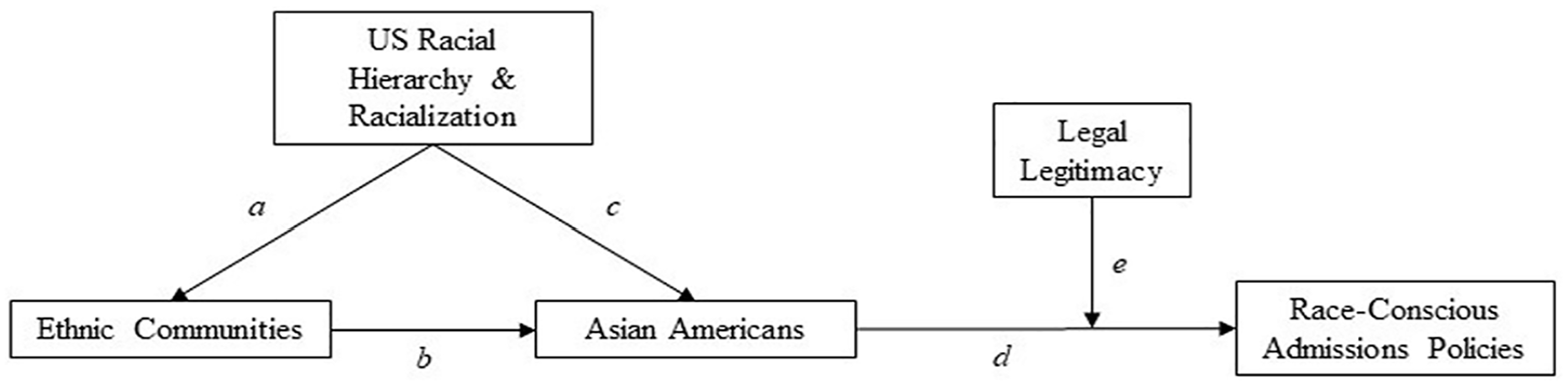
The analytical model for identifying components shaping Asian Americans’ attitudes toward race-conscious college admissions.
Diversity in asian americans’ affirmative action attitudes
To identify how the U.S. racial order and racialization shapes Asian Americans’ political attitudes, we use the case of Asian Americans’ attitudes toward race-conscious college admissions as the past decade has witnessed a more visible and increasing presence of Asian American activism and political engagement around the legal struggles of affirmative action (Kim 2018; Lee 2021b). Against homogenizing narratives such as the model minority myth, research highlights the diversity in Asian Americans’ views of affirmative action policies (Lee and Tran 2019b; Poon and Segoshi 2018; Poon et al. 2019; Yi and Todd 2021). For example, OiYan Poon and colleagues found Asian Americans’ differential understanding of the racial order in the United States, not only their socioeconomic backgrounds, played a crucial role in shaping their contrasting attitudes (Poon and Segoshi 2018; Poon et al. 2019). Jennifer Lee and Van C. Tran’s (2019b) foundational study of Asian Americans’ affirmative action attitudes of the hiring and promotion context revealed that Asian Americans’ general policy attitudes regarding federal government interventions and personal experiences, such as benefiting from the policy or being discriminated against, are consistently associated with affirmative action support across all models while racial identification was not significant in one of three models. These findings led Lee and Tran to argue that Asian Americans understood affirmative action slightly more in relation to the support for the government actions and their personal experiences than their racial identities, while all were meaningful predictors.
Ethnic variation in affirmative action attitudes often does not draw systematic attention with the exception of the least supportive attitudes of Chinese Americans compared to other Asian Americans (Lee 2021a, 2021b; Lee, Wong, and Ramakrishnan 2021; Ramakrishnan and Wong 2018). Liliana M. Garces and OiYan A. Poon (2018) suggest Chinese Americans’ lower support may originate from immigrant generational differences with recent immigration of well-educated and wealthy Chinese. Limited research examines these possible generational differences for Asian ethnic groups (Lee and Tran 2019a). Extending this literature, we examine how ethnoracialization as a combination of ethnicity- and race-related processes at individual and group levels shape variation in Asian Americans’ attitudes toward race-conscious college admissions.
How the u.s. racial order shapes affirmative action attitudes
Studying the development of Asian American political views through the case of race-conscious college admissions also can build on and extend previous research on affirmative action attitudes focused mostly on White and African Americans’ views. Initial inquiries into affirmative action attitudes found White Americans, who increasingly supported racial equality in principle, but continued to oppose policies aimed at achieving those goals, forming the “principle-policy paradox” (Bobo and Kluegel 1993; Bobo and Tuan 2006; Krysan 2000). To comprehend this paradox, several predictors of general affirmative action attitudes crystallized.
Although these predictors were to explain the overall population-level support or opposition toward affirmative action instead of within-population ethnic variations, these predictors are useful because, as far as they represent multiple possibilities that racializing forces are interwoven with people’s affirmative action attitudes, examining whether they work through ethnic communities or not can offer insights to understand the mechanisms of ethnoracialization. We will explain our analytical strategy in the methods section. Yet, at this point, we briefly summarize five groups of theoretical predictors to examine Asian Americans’ support for race-conscious admissions: individual experiences of the U.S. opportunity structure; general views toward government-led redistribution policies; ethnic group identity and position; racial and immigrant contexts and attitudes; and perceptions of policy legality and legitimacy.
Individual Experiences
Asian Americans’ individual experiences of the U.S. opportunity structure may influence their race-conscious admissions attitudes. A simple self-interest model predicts that some Asian Americans may oppose these policies as they have not benefited from them, while the opposite situation is also plausible. Troubling a common assumption that Asian Americans are likely to be victims of race-conscious admissions because they are framed as “model minorities” and/or “honorary whites,” pro-affirmative action activists have shown that despite Asian American representation among high-achieving students, Asian Americans—especially, Southeast Asian Americans—continue to benefit from these policies in a racialized and unequal society (Poon and Segoshi 2018). Building on previous research, we include a measure of individual experiences in personally knowing someone who benefited from affirmative action, expecting such experiences to correspond to more policy support (Crosby, Iyer, and Sincharoen 2006; Harrison et al. 2006; Lee and Tran 2019b). We also include a measure of discrimination experiences, which is not necessarily specified as racial discrimination. Despite changing rationales justifying affirmative action (Harper and Reskin 2005; Kim 2018; Poon and Segoshi 2018), such policies were intended to tackle racial discrimination in society, and many Asian Americans continue to hold a similar view of what these policies should redress (Wong et al. 2018). We speculate that experiencing any form of discrimination will correspond to more race-conscious admissions support, presuming it could decrease discrimination experiences and maximize social mobility chances for Asian Americans (see Harrison et al. 2006).
Beliefs in the Government’s Role for Equality
Previous studies on White Americans’ opposition to affirmative action identified their “principled objection,” whereby one could oppose social policies benefiting a specific racial group exclusively based on the belief that the federal government should not intervene in resource distribution among individuals based on one’s racial status (Krysan 2000). Past research exploring the association between such views and affirmative action suggests it is a key predictor of White Americans’ affirmative action attitudes (Bobo and Kluegel 1993; Crosby et al. 2006; Harrison et al. 2006; Hunt and Smith 2022; Petts 2022). Thus, we also explore the relevance of this perspective among Asian Americans.
Ethnoracialized Group Identity and Position
Jennifer Lee and Van C. Tran (2019b) elaborate how senses of group identity and position correspond to varying affirmative action support among Asian Americans. Moreover, diverging perspectives around feelings of “linked fate,” or the consideration of what happens to a group someone closely identifies with could impact their life as well (Dawson 1995; Hochschild and Weaver 2015; Monk 2020), may exist among Asian Americans based on their positioning within a racialized society. The relationships with other racially marginalized and minoritized communities, including within the Asian American panethnicity, may shape how one’s identity centrality and sense of linked fate contribute to policy views. Notably, like other groups, Asian Americans “can feel threatened by not only the dominant majority, but other subordinate minority groups” (Inkelas 2003:640), allowing us to test contrasting hypotheses about how affirmative action in college admissions is viewed as a resource influencing group positioning (Samson 2013).
Other Racial and Immigration Contexts and Attitudes
Perceptions of race-conscious admissions relate to views of other ethnoracialized groups, broader racial inequalities, and particular policies and systems such as immigration. Specifically, researchers point out that out-group prejudices toward White and African Americans are important because of the purported middle position of many Asian American communities in U.S. racialized society (Bonilla-Silva 2004; Kim 1999, 2018; Xu and Lee 2013). Based on this theoretical discussion and the consideration of the common racialized notion that race-conscious admissions are for African Americans and unfairly penalizes White Americans, we expect Asian Americans who feel White Americans share more political commonality with Asian Americans and less with African Americans will be less supportive of race-conscious admissions. Racial justice movements are also important to this conversation. Asian American activism and connections to racial justice movements such as Black Lives Matter (BLM) suggest a fruitful exploration would include clarifying how collective marginalization may be mobilized and break down group threat perceptions. In other words, we expect Asian Americans’ acceptance or resistance to an “honorary whites” frame, which assumes Asian Americans are closer to White Americans and farther from Black Americans, will shape their attitudes toward race-conscious college admissions.
Immigration is a critical policy realm to consider as a large proportion of Asian Americans are foreign-born due to the relatively recent history of mass immigration. Given its demographic composition, Asian Americans are likely to take an immigrant identity as a core group identity, assuming their interests are aligned with pro-immigration policies (Tran and Warikoo 2021). Therefore, if Asian Americans support race-conscious admissions, they may do so upon the belief that this policy will allow more chances for themselves and other immigrants who share similar structural positions. We expect that this tendency will become more salient for more recent immigrants and those who experience a language barrier.
Perception of Policy Legality and Legitimacy
Previous literature about law and society notes that the SCOTUS confirmation of a policy as legal or constitutional shapes Americans’ policy perceptions in contrasting ways. On one hand, this authoritative institution’s rulings can increase Asian Americans’ general support by confirming the legal authority of endorsed policies (Clawson, Kegler, and Waltenburg 2001; Gibson and Nelson 2014). On the other hand, the SCOTUS rulings may lead some Asian Americans to be less supportive of a policy as this institution is viewed as a sectarian authority defending particular social groups’ interests in U.S. ethnoracial and immigration politics (Clawson, Kegler, and Waltenburg 2003; Clawson and Waltenburg 2003). Although the mention of past SCOTUS rulings upholding race-conscious admissions decreased Asian Americans’ overall support (Wong et al. 2018), scholars have not yet explained why such variations exist. We examine the possible legal legitimacy effect in our analyses, particularly paying attention to how ethnic groups react differently.
Methods
Data and Analytical Sample
This study analyzed data from the 2016 NAAS post-election survey, led by Karthick Ramakrishnan, Jennifer Lee, Taeku Lee, and Janelle Wong, and funded by the James Irvine Foundation, Carnegie Corporation of New York, Ford Foundation, California Immigration Research Initiative, and Wallace H. Coulter Foundation (Ramakrishnan et al. 2020). The NAAS post-election survey was collected through telephone interviews between November 10, 2016, and March 2, 2017, resulting in a sample of 4,362 respondents. This study examines 3,728 respondents who answered questions about support for race-conscious admission policies. Our analyses focus on 1,860 respondents who were asked their views on race-conscious college admissions (the control subsample). We also examined 1,868 respondents who were informed about the legality of race-conscious admissions (the SCOTUS subsample) to identify the impact of the SCOTUS authority on respondents’ views.
Ethnic Identification
Ten ethnicities were represented in the data: Chinese, Korean, Japanese, Indian, Pakistani, Bangladeshi, Filipino, Vietnamese, Cambodian, and Hmong. The NAAS survey team gathered nationally representative samples from each ethnic group resulting in nearly even amounts of respondents for each ethnic group in both analytic samples (Lee and Ramakrishnan 2021). For example, Bangladeshi Americans represented 7.2 percent of the control subsample and Japanese Americans represented 12 percent, despite composing approximately 1 and 4 percent of all Asian Americans, respectively (USA Facts 2021). While this sampling method may have certain disadvantages in assessing Asian Americans’ overall attitudes, it is a suitable data set for investigating ethnic variation within the Asian American population.
Affirmative Action Support
Two NAAS questions were employed as the dependent variables. First, we examined changes in responses to the following question: “Thinking about colleges and universities. Do you favor, oppose, or neither favor nor oppose allowing universities to increase the number of Black and some Asian American students studying at their schools by considering race along with other factors when choosing students.” Second, we examined changes in responses to a similar question noting the support of the SCOTUS for race-conscious college admission policies: “The U.S. Supreme Court has ruled that it is legal for universities to consider race along with other factors in choosing students.” Responses to both questions ranged from “strongly oppose” (1) to “strongly favor” (5). We used the first question for our descriptive analysis and most of our regression models. The second question was used for an additional analysis to examine how legal authority may affect Asian American support for race-conscious admissions policies. In our analytical sample, these two questions were asked to two distinct, similar size subsamples (each n = 1,860 and 1,868), resulting in comparable descriptive statistics for each affirmative action frame.
Immigration Experiences
Two variables included in our models explore the possible relationships between respondents’ immigration experiences with their views of race-conscious admissions. Generation was based on respondents’ place of birth and their parents’ countries of birth. First generation covers foreign-born respondents, and the third-and-higher generation contains respondents who, both they and their parents, were born in the United States. Second generation includes respondents born in the United States, and either one or both parents are foreign-born (first generation served as the reference in our models). A dichotomous measure was also included that indicated whether English was the respondent’s first language (1 = no).
Racialization
Building on previous studies, we included five groups of racialization variables, which could work directly or indirectly through ethnic communities.
Acknowledgment of policy benefits and discrimination experiences
Related to personal connections to affirmative action beneficiaries, respondents were asked, “Have you, a close relative or close personal friend ever benefited by being admitted to a selective college or university due to an affirmative action program?” (1 = yes). While we cannot assume that respondents had correct information about the relationship between an affirmative action program and their close relatives’ or friends’ admissions results, we suppose that respondents’ beliefs would shape their attitudes toward race-conscious college admissions. Similar to the study by Lee and Tran (2019b), a discrimination index was constructed using principal component analysis to find the underlying component among related measures. This index included Asian American experiences of discrimination (i.e., treated poorly or unfairly) such as being denied a promotion; fired from a job; not hired for a job; being stopped, searched, questioned, physically threatened, or abused by police; prevented from moving into a neighborhood; and residents of a neighborhood made life difficult for you and your family (1 = yes for each item; α = .70). We included these variables as we expected they measured Asian Americans’ individual experiences of the U.S. opportunity structure.
Redistributionism
Again, building on the study by Lee and Tran (2019b), principal component analysis was used to construct a scale measuring respondents’ views of equity policy support. Respondents were asked whether the federal government should do more to reduce income differences between the rich and poor; regulate banks; raise minimum wage; increase taxes on people earning a million dollars or more a year; discourage big American companies from hiring foreign workers; and increase funding for undergraduate education at public universities (1 = strongly disagree; 5 = strongly agree for each item; α = .69). Thus, this variable signifies Asian individuals’ ideological beliefs in the government’s role in redistributing unequally allocated resources, which we call redistributionism.
Ethnoracialized group identities
Two variables measuring how individuals perceive their group identity were included in models. Respondents were asked “How important is being [an Asian/specific ethnicity] to you?” (1 = not at all important; 4 = extremely important). Instead of choosing either the panethnic or ethnic identity variable, we created an ethnoracial identity centrality measure that was the average of those two items (α = .72) based on literature arguing that Americans shape their group identity as interacting with the U.S. racial order and their ethnic communities (Brown and Jones 2015; Valdez and Golash-Boza 2017). A second variable corresponding to “linked fate” was created from questions asking, “Do you think what generally happens to [other Asians/your ethnicity] in this country affects your life?” and “Will it affect you a lot, some, or not very much?” (1 = no; 2 = yes, but not very much, don’t know, or refused”; 3 = yes, some; 4 = yes, a lot). The average of these two items formed an ethnoracial linked fate measure (α = .82).
Attitudes toward an “Honorary Whites” frame
Two survey questions asked how close respondents felt toward White Americans and Black Americans related to government services, political power, and representation (1 = nothing at all in common; 2 = little; 3 = some; 4 = a lot in common). We created a White-Black proximity measure, similar to the study by Karthick Ramakrishnan et al. (2009), by summing the commonality with White Americans and the reverse-coded commonality with Black Americans. Higher scores indicated the respondents perceived themselves as closer to White Americans than Black Americans, while lower scores indicated the opposite. We also included a variable measuring support for BLM whereby respondents were asked how favorable they felt toward “the Black Lives Matter Movement, which seeks racial equality, and campaigns against violence and systemic racism against Black people” (1 = very unfavorable; 4 = very favorable). These measures allow for the exploration of how Asian American support for or resistance to an “honorary whites” frame may influence their understanding of affirmative action.
Attitudes toward immigrants
Our models included an immigration support index. This principal components–constructed scale measures respondents’ support for immigration with statements including: undocumented or illegal immigrants should be allowed to have an opportunity to eventually become U.S. citizens; Congress needs to increase the number of work visas it issues every year; Congress needs to increase the number of family visas it issues every year; and states should provide driver’s licenses to all residents, regardless of their immigration status (1 = strongly disagree; 5 = strongly agree for each item; α = .77).
Social Background Characteristics
Several measures corresponded to other aspects of respondents’ backgrounds. These variables were: age (continuous variable); gender (1 = woman; 0 = man); respondent income (1 = less than $20,000; 2 = $20,000–49,999; 3 = $50,000–74,999; 4 = $75,000–99,999; 5 = $100,000–124,999; 6 = $125,000–249,999; 7 = $250,000 or more; converted as a continuous variable); whether the respondent owned their home (1 = yes); whether they were a California resident (1 = yes); respondent education (1 = no school completed; 2 = some schooling, no high school degree/General Education Development (Hereafter, GED); 3 = high school degree/GED; 4 = some college, but no degree; 5 = college/BA degree; 6 = graduate/professional degree); relationship status (dichotomous variables for in a serious relationship, married, not in a serious relationship); party affiliation (dichotomous variables for Independent; Democrat; Republican). Reference categories included men, not owning a home, not a California resident, attaining less than a high school diploma, married, identifying as an Independent politically.
We divide the analytic sample into control and SCOTUS-primed subsamples depending on the outcome variable. Table 1 provides descriptive statistics calculated with the non-imputed data set for the control subsample, which was used for our main analyses. 1
Descriptive Statistics of All Variables.
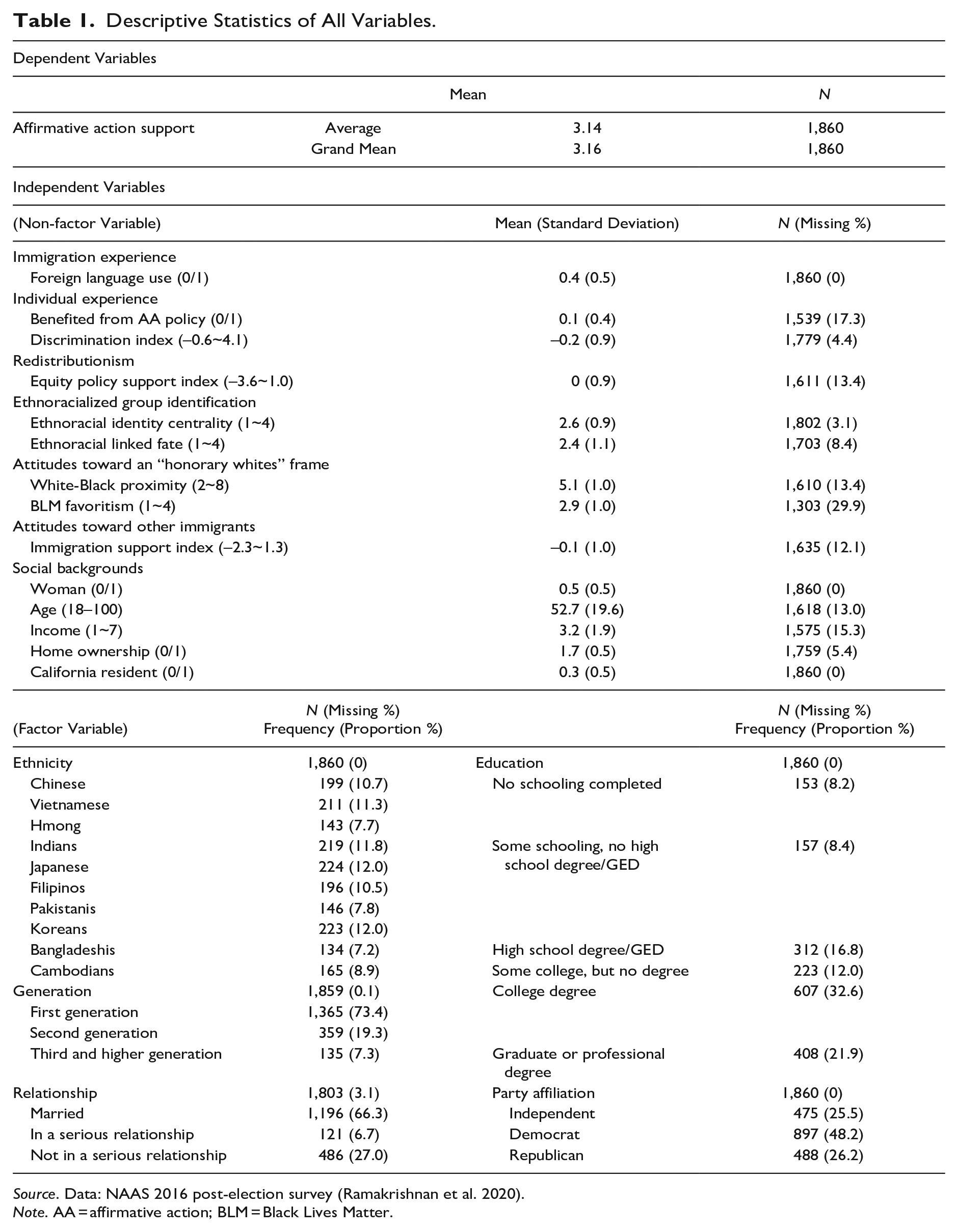
Source. Data: NAAS 2016 post-election survey (Ramakrishnan et al. 2020).
Note. AA = affirmative action; BLM = Black Lives Matter.
Analytic Strategy
Missing values and multiple imputation
Our analytic sample had 10 percent missing data, on average, with missing values unevenly distributed across variables, ranging from less than 1 to 31.53 percent of values for a variable (see the last column of Table 1). Using multiple imputation techniques, we created 20 data sets that further consider the variation between the imputed data sets, which takes uncertainty into account and allows researchers to obtain pooled regression results using Donald B. Rubin’s (2004) rule. The control subsample (n = 1,860) and the SCOTUS-primed subsample (n = 1,868) were imputed separately. We used the “mice” package in R, drawing on Kernel density plots to diagnose the imputation result to the non-imputed data set (Buuren 2018; Buuren and Groothuis-Oudshoorn 2011). Most plots indicate similar Kernel density scores distributions between imputed and original data sets.
Modeling strategy
Our primary analytic objectives are to estimate ethnic variation in support for race-conscious admissions among Asian Americans (see d in Figure 1), deconstruct it into pathways through which the U.S. racial hierarchy may be associated with this variation (see a → b and c in Figure 1), and assess whether any residual ethnic variation remains, indicating the potential for lesser-theorized ethnic factors beyond the influence of the U.S. racial hierarchy. To do so, we first calculate the grand mean value of how people feel about race-conscious admissions by taking the mean of the mean scores for each ethnic group. The grand mean represents the central tendency of our outcome variables better than the average of Asian American individuals if we consider the sampling approach of the 2016 NAAS data. Then, we compared the grand mean and all ethnic groups by using the effect coding approach (Johfre and Freese 2021) and noted which ethnic group’s mean was significantly varied from the grand mean (see b in Figure 1). At this stage, we used the non-imputed original data.
In turn, this research employed ordinary least squares regression with imputed data sets to estimate how ethnic communities, racialization, and their interactions narrow ethnic variation in Asian American support for race-conscious college admissions or fail to do so. To identify which type of racializing force constructed Asian Americans’ attitudes directly (see c → d in Figure 1) or indirectly through ethnic communities (see a → b → d in Figure 1), we took a stepwise approach to including additional variables to the model. We first included background measures and then incorporated immigration experience variables based on the assumption that these consistently informed respondent attitudes. Taking the second model as a base model, we added racialization variable groups individually, and constructed the full model. Regarding the SCOTUS effect (see e in Figure 1), we compared the results from the two full models, one with the general outcome and another with the SCOTUS-framed outcome, to identify possible differences.
We hypothesize the following results when we add predictors:
H1: As a predictor works as a mechanism through which both ethnic communities and the U.S. racial hierarchy influence Asian Americans’ political attitudes, it will reduce ethnic group disparities in Asian Americans’ support for race-conscious college admissions. (see a → b → d in Figure 1)
H2: As a predictor works as a mechanism through which the U.S. racial hierarchy solely influences Asian Americans’ political attitudes, it will not reduce ethnic group disparities in Asian Americans’ support for race-conscious college admissions. (see c → d in Figure 1)
H3: Predictors linked to affirmative action support will not entirely reduce ethnic group disparities in Asian Americans’ support because the influence of ethnic communities cannot be fully explained by the predictors.
H4: Ethnic groups will react to the mention of past SCOTUS rulings differently as their perceptions of the SCOTUS are diverse. Therefore, changes in ethnic variation in support for race-conscious admissions reflects their divergent understanding of the SCOTUS and its role in shaping resources and opportunities in an unequal society. (see e → d in Figure 1).
Findings
Exploring Ethnic Variation in Asian American Support for Race-conscious Admissions
The distribution of Asian Americans’ support for race-conscious admissions by ethnicity using non-imputed data from the NAAS is shown in Figure 2. The figure presents the distribution of respondents of each ethnic group favoring (strongly favor and favor), on the fence (neither favor nor oppose), and opposing (strongly oppose and oppose) race-conscious admissions, without information about the SCOTUS rulings given. There exist substantial variations in race-conscious admissions attitudes by ethnicity. For instance, while only 24.6 percent of Chinese Americans were supportive of considering race in college admissions, 60.5 percent of Korean Americans were in favor.
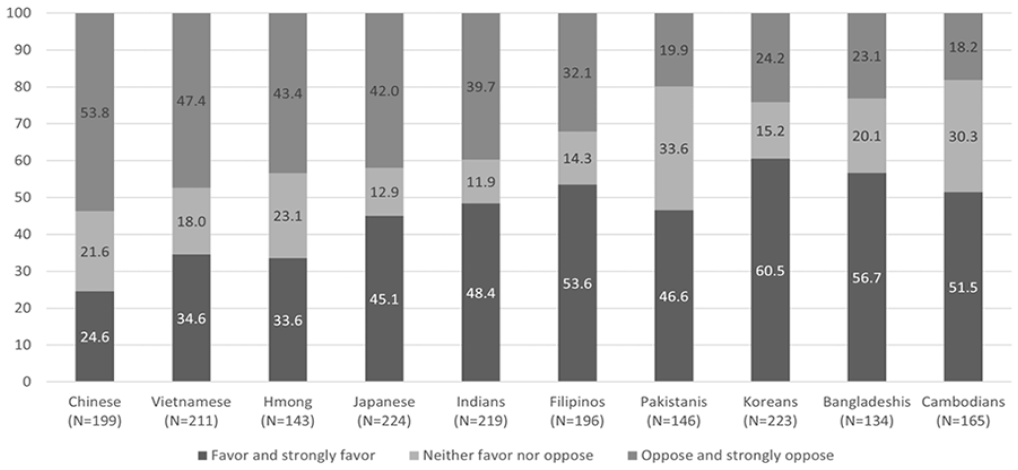
Descriptive statistics of attitudes on race-conscious college admission by ethnicity.
The mean values of affirmative action in college admissions attitudes by ethnicity using imputed data are lined up from the lowest (Chinese) to the highest (Cambodians) in Figure 3. A score of three on the vertical axis of the figure means “neither support nor oppose,” while scores below three represent opposing race-conscious admissions, and scores above three represent supporting such policies. As the dotted line shows, the grand mean value of Asian Americans is 3.16, which slightly leans toward “favoring” the policy. The figure also shows that the sample mean values of Japanese, Indian, and Filipino Americans do not statistically differ from Asian Americans overall. Chinese, Vietnamese, and Hmong Americans tend toward opposing race-conscious admissions, while Pakistani, Korean, Bangladesh, and Cambodian Americans favor the policy more than average Asian Americans do. In sum, our descriptive analyses identify ethnic variations meaningfully exist. Our following regression analyses reveal whether such variations originated solely from ethnic communities or were the result of racializing pressures working through ethnic communities.
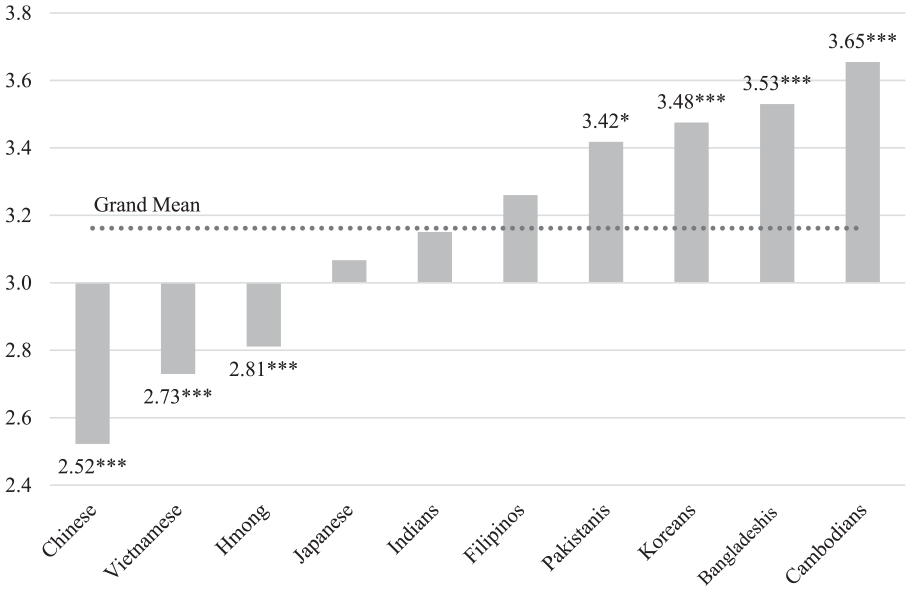
Descriptive statistics of mean values of attitudes on race-conscious college admission by ethnicity.
Explaining Ethnic Variation in Asian American Support for Race-conscious Admissions
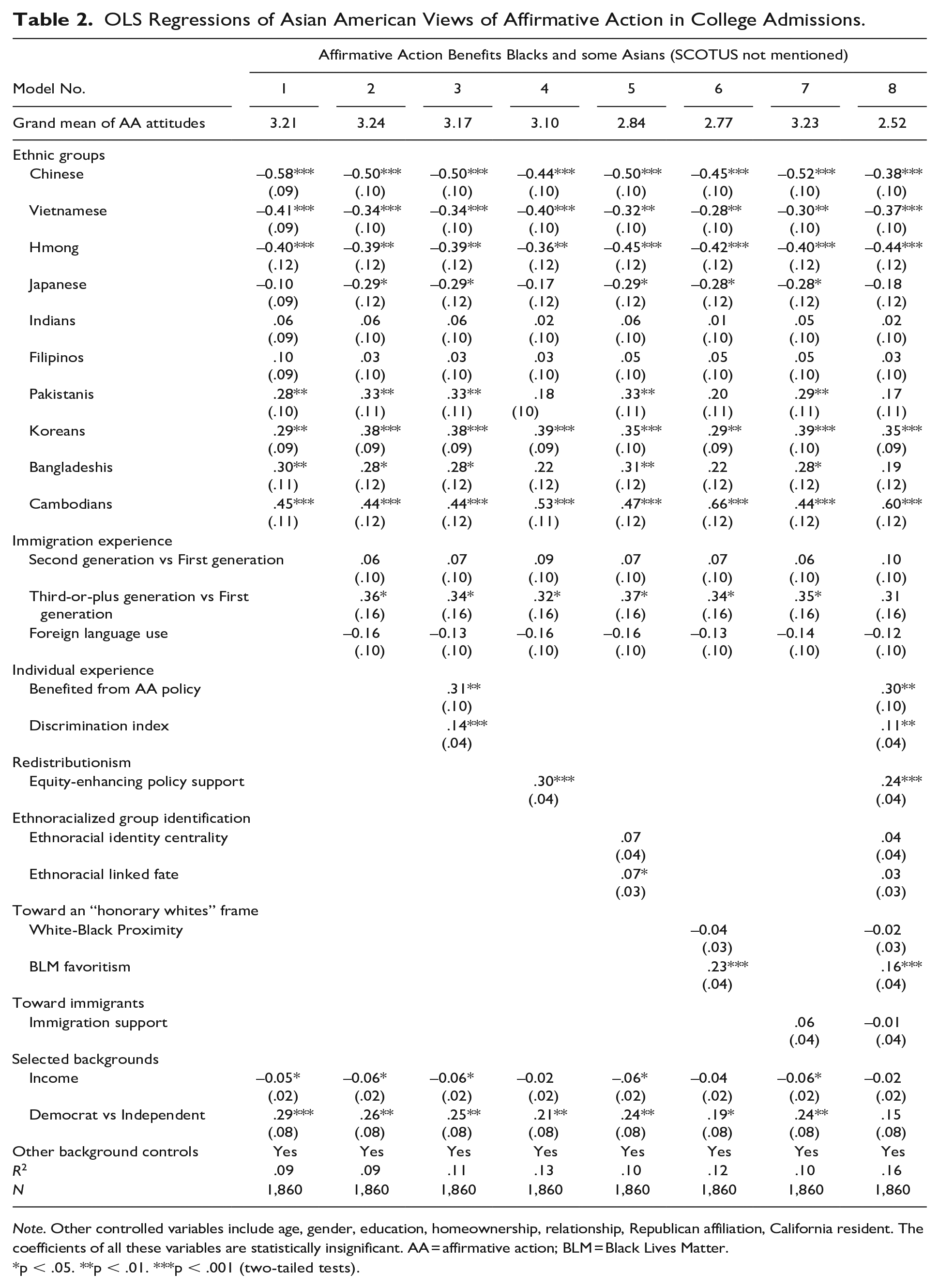
Our first set of regression models presented in Table 2 use a subset with the control-framed outcome to explore contributions to ethnic variation in Asian Americans’ race-conscious admissions attitudes. Model 1 includes only ethnicity and socioeconomic backgrounds as independent variables, producing similar ethnic variations as found in Figure 3. From these results, we can conclude that general socioeconomic backgrounds are unlikely to contribute to ethnic variation. Although income and Democrat affiliation have significant associations with Asian American affirmative action in college admissions attitudes, adding them to the regression model does not meaningfully narrow ethnic variation. Model 2 includes generation and non-English language usage relating to general life experiences as U.S. immigrants. Notably, Japanese Americans’ support for race-conscious admissions falls, suggesting their support is partly related to immigration experiences.
OLS Regressions of Asian American Views of Affirmative Action in College Admissions.
Note. Other controlled variables include age, gender, education, homeownership, relationship, Republican affiliation, California resident. The coefficients of all these variables are statistically insignificant. AA = affirmative action; BLM = Black Lives Matter.
p < .05. **p < .01. ***p < .001 (two-tailed tests).
Models 3–7 individually added one of five theoretical predictor groups aligned with aspects of racialization. People’s beliefs in redistributionism decreased the number of significantly varied ethnic groups most, from eight in Model 2 to five in Model 4. Asian Americans’ acceptance or resistance to an “honorary whites” framing of Asian Americans within the U.S. racial hierarchy also effectively decreased the number of varied groups to six (Model 6). It is notable that only BLM favoritism was significant, implying beliefs in racial justice matter more to Asian Americans than conforming to an honorary Whites frame. However, the full model (Model 8) has a similar number of varied groups as Model 4. Results suggest that, while both redistributionism and the racial justice frame may work as mechanisms through which both ethnic communities and the U.S. racial hierarchy shape Asian Americans’ political attitudes, the former explain ethnic variation more than the latter.
The other three groups of predictors do not narrow ethnic variations. Yet acknowledging benefiting from affirmative action programs and being discriminated against, which measure self-interest, are significantly associated with overall Asian American support for race-conscious admissions (Model 3). Although having a sense of linked fate was associated with race-conscious admissions attitudes (Model 5), its significance disappears in the full model. In addition, despite the multiple theoretical predictors included in the full model, not all variations in ethnic group attitudes were explained, supporting our third hypothesis that other lesser- or not-yet known factors may be at play.
Legal legitimacy
Our second set of models using the SCOTUS-primed outcome variable allows us to examine the impact of respondents learning that a legal authority supports race-conscious admissions. Table 3 presents the comparison of the full models between the control framed and the SCOTUS framed subsets. Interestingly, Asian American support for race-conscious admissions in the full regression model drops from 2.52 to 2.20 under the SCOTUS-primed framing. Among social background characteristics, Asian Americans who have not completed any schooling and are Democrats come to significantly support race-conscious college admissions compared to the reference groups: some schooling experiences without a high school degree or GED and independents, respectively.
The Comparison of the Full OLS Linear Regressions of Asian American Views of Affirmative Action in College Admissions Between Two Frames.

Note. Other controlled variables include age, income, education, homeownership, relationship, Republican affiliation, California resident. The coefficients of all these variables are statistically insignificant. AA = affirmative action; BLM = Black Lives Matter.
p < .05. **p < .01. ***p < .001 (two-tailed tests).
While the number of significantly varied ethnic groups from the grand mean has not changed, Vietnamese Americans no longer significantly opposed affirmative action in college admissions compared to Asian Americans overall. Therefore, the mention of the SCOTUS rulings might increase Vietnamese Americans’ trust in the legal grounding of race-conscious college admissions. Another notable shift was found among Indian Americans, who became significantly less supportive of affirmative action in college admissions when the SCOTUS frame was employed. This finding suggests that Indian Americans arguably view past SCOTUS support of race-conscious college admissions as possible threats to their group interests.
Although not related to ethnic variations, other notable findings differing between the general outcome model (Model 8) and the SCOTUS-primed model (Model 9) include variables indicating self-interests became less significant, while measures representing ideologies relevant to group interests turned into significant predictors. Acknowledgment of personal connections to policy benefits is no longer significant. However, both ethnoracial identity centrality and immigration support index became significant. Finally, redistributionism, the racial justice frame, and Democratic affiliation were still significant.
Discussion
Our study elaborates on the ethnic diversity in political views among Asian Americans, focused on race-conscious admissions. While some of this variation can be explained by beliefs in redistributionism, a substantial portion of the variation remains even after accounting for the broadly employed predictors of race-conscious college admissions. These findings imply that Asian Americans may form their views on affirmative action in college admissions based on the distinct racialization contexts for their ethnic groups, although these views are partly influenced by the broader racialization in the United States.
Cautious interpretation of our findings is necessary regarding the full contexts of group experiences and memberships, specifically as “national origin is ideally conceptualized as a multidimensional construct” (Wong et al. 2011:326). Although most scholars studying Asian Americans’ attitudes included ethnicity as a control variable, little agreement exists regarding what this category measures. One interpretation refers to a unique set of values, beliefs, or cultural notions of a group originating from an Asian nation passed down through intergenerational socialization within the host society and/or through new waves of immigrants from that nation. However, this interpretation is exposed to the danger of cultural determinism, ignoring the multidimensional realities of Asian American experiences. A second interpretation recognizes that national origin categories reflect different immigration pathways imposed on Asian-origin ethnic groups by U.S. immigration policies (Wong et al. 2011). While we included some immigration-related variables in our models, it remains challenging to capture the heterogeneity of Asian Americans’ immigration experiences. The third interpretation argues that ethnic variation in affirmative action attitudes relates to rapidly changing contemporary racial climates, rather than only located in deep historical roots. For instance, Chinese American support for race-conscious college admissions fell dramatically between 2012 and 2016, which may reflect the rise of anti-affirmative action activism targeting conservative Chinese Americans specifically (Lee 2021a, 2021b) Our examination of ethnoracialization provides a fuller account of multiple contexts that differentially impact Asian ethnic communities separately and in conjunction with the broader Asian American community under the pressures of racial hierarchy and racialization that shape pathways to and within the United States across generations and sociopolitical eras that inform individual policy attitudes. Additional insights could be garnered from future research exploring the explanations for contradictory views of race-conscious college admissions within the same Asian ethnic group.
Further considering the dynamism of ethnoracialization also benefits from overcoming a tendency for national origin exceptionalism arguments (Drouhot and Garip 2021; Wong et al. 2011), which can stereotype a specific ethnic group as a friend or foe of affirmative action (Garces and Poon 2018; Lee 2021a; Lee and Ramakrishnan 2021). Recently, pro-affirmative action groups have emphasized that some Chinese and Indian Americans are overrepresented in this policy discussion, and anti-affirmative action activists also tend to come from one of those ethnic groups while disregarding socioeconomic disadvantages that less-privileged Asian ethnic groups experience (Poon and Segoshi 2018). This research notes that assuming current ethnic differences stem from a group’s cultural orientation based on national origin without considering other contexts of history and experience can reinforce stereotypes and perpetuate flawed theoretical considerations of ethnoracial dynamics and their importance to policy attitudes. Furthermore, Ellen Wu’s (2022) work describes contexts that led to some Asian ethnic groups supporting or opposing affirmative action and their shifting positions over time that would be dismissed under ahistorical and decontextualized arguments such as national origin exceptionalism.
Predictors such as acknowledgment of affirmative action policy benefits, discrimination experiences, and support for racial justice movements were important in shaping Asian Americans’ overall affirmative action attitudes without reducing ethnic variation. Those variables represent ways that Asian Americans navigate the U.S. racial hierarchy without the mediation of their ethnic communities and identities. At the same time, none of the ethnoracialized group identification variables were significant without the SCOTUS frame. This result somewhat contrasts with Lee and Tran (2019b), who found that racial group identification meaningfully predicts affirmative action support in employment. In our study, ethnoracial identity centrality was only significant when the SCOTUS rulings were mentioned. While this difference may come from our somewhat different modeling strategies, we speculate it is more likely originating from Asian Americans’ paradoxical socioeconomic positions referred to as the “Bamboo Ceiling”—high educational achievement and comparably lower success in labor markets (Chin 2020). As Asian Americans face more status disadvantages in employment than education, they may view affirmative action in the workplace as a chance to enhance both group and personal or self-interests.
Finally, our findings related to the SCOTUS-primed model highlights the multidimensionality of Asian Americans’ race-conscious admissions attitudes. The SCOTUS framing corresponded to decreased overall support for such policies. In the context of the SCOTUS affirming its legality, Asian Americans’ positions about affirmative action in college admissions are situated around their ethnoracial identities and political support for immigrants. In contrast, when Asian Americans were not asked to connect affirmative action to SCOTUS rulings, their opinions toward affirmative action mostly reflected personal awareness of benefiting from this policy and experiencing discrimination. In other words, the mention of SCOTUS rulings may discourage support from some Asian Americans who believe that race-conscious admissions help to maximize individual benefits, but also aligns with broader group interests from those who oppose generous immigration policies. A similar group-centric shift among African Americans is noted by Rosalee A. Clawson et al. (2003). The SCOTUS framing may signal to Asian Americans that the policy can shape group access to resources and opportunities, of which they may perceive themselves as possible victims rather than beneficiaries of such admissions policies. Here, identity-related processes of group positions shape how people consider their associations with other marginalized and minoritized groups in a racialized society (Bobo 1999; Bobo and Tuan 2006).
Future Research and Implication
Although this study provides new insights into Asian Americans’ policy views, additional examinations could expand these findings. For example, we could not thoroughly examine the framing of who is a victim of discrimination and benefits from affirmative action policies. Each question framing presumed “Blacks and some Asians” are beneficiaries of such policies. Further disentangling how support may vary when only Black students are framed as beneficiaries would be helpful, which are available in the 2016 NAAS post-election survey but with much smaller sample sizes (see Lee and Tran 2019b).
Also, we do not know the impact of unfavorable rulings of SCOTUS against race-conscious admissions because the survey experiment in this data set was based on past general confirmation of the legality of affirmative action in college admissions of previous court rulings. Yet, we must also ask what the impact of an unfavorable frame will be, as the recent SCOTUS rulings in the Harvard and UNC cases further restrict considering race and racism in college admissions to essay responses. Building on our findings, we speculate that it may not reduce Asian Americans’ support substantially and paradoxically have a positive impact on Indian Americans’ policy views, as their support decreased when the SCOTUS ruling confirmed race-conscious college admissions’ legality. Such tentative predictions could and should be empirically examined with future survey data that also include ample numbers for each Asian ethnic group, as the NAAS 2016 survey did.
Our finding that most ethnic variations survived in the full model suggests that we need to develop frameworks to explain Asian ethnic groups first, instead of bypassing them, if we want to build a reasonably plausible explanation for Asian Americans as a whole. From this vantage point, qualitative inquiries into ethnic communities’ political attitudes around race-conscious admissions would provide added depth to how group positions operate depending on their perception of other ethnoracialized groups and authoritative institutions, such as the SCOTUS. More methodologically diverse approaches could shed light on the dynamics of racial triangulation and ethnoracialization at play.
Our study underscores the need for more refined theories and data to capture ethnoracialization mechanisms. This research urges an empathetic understanding of why Asian Americans take such diverse positions toward race-conscious admissions rather than a truncated view of Asian ethnic communities as friends or foes of race-conscious admissions that does not fully grapple with how their policy attitudes reflect the complex processes of ethnoracialization. Our research provides an example of how researchers can continue to debunk homogenizing views of Asian American communities and their experiences as they navigate a racialized society. Acknowledging such differential trajectories shaping the commonalities and differences among Asian Americans around political issues provides crucial insights into exploring obstacles for coalitional politics across marginalized and minoritized communities that can assist with pursuing the ideals of a diverse democracy.
Footnotes
Acknowledgements
The authors express gratitude to Tse-Chuan Yang, Hyeyoung Kwon, Amaka Okechukwu, Megan Segoshi, Francisco Vieyra, Yongjin Choi, Eun Hye Lee, Jina Lee, Yena Lee, and Youngshin Lim, as well as the Draft Feedback Group led by Elizabeth Popp Berman, for their contributions to this draft. We also appreciate the thoughtful, critical, and empathetic questions, comments, and suggestions provided by anonymous reviewers on previous versions of this manuscript.
Correction (September 2023):
Article updated to add the label “Bangladeshis” which corresponds to the mean value “3.53***” in Figure 3.
