



Abstract
The relevance of the research in this article is conditioned upon the problems of introducing environment-oriented education in the field of chemical discipline for the development of an important component of the information part of this science among students, based on its application in the framework of restoration and conservation of ecology. The purpose of the article is to develop a model of ecologization of the organic chemistry course for the development of knowledge in the discipline with the establishment of ecological culture. The leading method to study this problem is a combination of the Schwartz value questionnaire to determine the level of personal manifestations in the field of various behavioural reactions and decision-making, based on value motivational aspirations, which will affect social life and many of its components. The article presents the developed model of ecologization of the course of study within the framework of organic chemistry, which allows students to form an ecological culture and present the information part in the form of special knowledge based on the selective structure, which carries the factor of restoration and preservation of ecology.
Introduction
Most spheres of human activities are connected with industries that use chemicals as an essential structural element. The ecological impact of these chemicals requires the revision of their components and the development of eco-friendly technologies that can maintain a high standard of life while positively impacting the environment (Dzyatkovskaya et al., 2020; Silva & Topf, 2020). Considering the problem from this part of the practical component of the discipline, it identifies the need to strengthen environmental awareness and consider the possibilities of the subject, considering the improvement, restoration and preservation of the environmental component in the world (Baranova, 2019; Ferguson, 2019).
When considering the problem in the future, pedagogical changes in methodological terms will help the younger generation, based on their training in organic chemistry from the position of improving the ecological balance, to develop as a person for whom the restoration and preservation of nature, ecology will be a value motivation (Kemper & Becker, 2016). This will become a qualitative indicator of the development of their ecological culture, conditioned upon which they will make their future new discoveries, improve chemical technologies and carry out their professional activities within the framework of environmental conservation, which will have a beneficial effect on life, in general, creating conditions for the ecological restoration of the planet and contributing to the prosperity of the future life of mankind (Pavlik, 2019; Rustempasic & Livancic, 2020).
Considering that students are greatly influenced by the teachers themselves, initially the ecologization of the course of organic chemistry should take place at the level of training of specialists of chemical teachers, and as part of their professional development as professional workers in this field, who will have to make adjustments to their activities in an environmental orientation to create a system of application of chemical knowledge, influencing beneficially in all areas controlled by a person. So ecologization should be at all levels of application of the chemical discipline, considering the pedagogical component forming the ecological knowledge of the discipline and the education of a significant ecological culture.
Materials and Methods
This study was conducted using the method of diagnostic testing according to the Schwartz value questionnaire (2004), which allows for identifying the internal structure with value motivations based on their behavioural preferences. The prerequisites for the results of decisions are taken on the basis of various life situations, including their influential component based on the social factor, where the criteria of benefits will be reflected in the component of the well-being of the surrounding people and nature with its ecological parameters. The basis of arising emotions, spheres of interests, character traits and aspirations for self-realization determined by personal perception on the basis of self-determination of one’s role in life and attitude to its natural components from the standpoint of its perception at the personal level are revealed.
This study employed the Rogers-Diamond methodology (1954) to determine the personal characteristics and specific features of the test subjects. This approach aimed to assess the level of social and psychological adaptation of the subjects to new environments, their conditions and the rules of human behaviour within them. By combining different methods of personality test assessment, we were able to identify the personal volitional preferences of the subjects, including their desires to improve their well-being and achieve success while preserving the ecological component of life. By considering these categories in mutual relation, we were able to gain a more comprehensive understanding of the test subjects’ personalities.
The diagnostic testing procedure using the Schwartz value questionnaire (2004) involves taking into account both individual and social preferences regarding various parameters, which are expressed in the form of 57 criteria based on value orientations. By analysing the responses, internal aspirations can be identified based on priority values in life that are of particular importance to the subject. These values can influence the subject’s actions in different life situations and can be used to draw conclusions about the possible outcomes of these actions. This process helps the subject to accept the impact of their actions on the well-being of society and ecology. The questionnaire is useful in determining the attitude towards nature, safety and the preservation of a prosperous component of life, which is relevant to the restoration of ecology and preservation of natural heritage and is essential for the entire ecosystem. The diagnostic testing using the Rogers-Diamond methodology (1954) involves respondents answering 101 impersonal statements that express their agreement or disagreement. The survey results are assessed based on several integral indicators, including adaptability, ability to accept the position of others, integrality, self-perception, emotional comfort and tendency to dominate. This methodology is useful in assessing various personality traits and can provide insight into the respondent’s adaptability, interpersonal skills and emotional tendencies.
Empirical formulas were utilized to compute each of the presented indicators in the study. The analysis of the obtained answers allowed for identifying the individual characteristics of the test takers and their level of social adaptation. When combined with the Schwartz value questionnaire (2004) testing methodology, these findings provided a basis for drawing conclusions about the potential for creating a model of ecologization for the organic chemistry course to enhance knowledge development in the discipline and establish ecological culture. The data collected during the diagnostic testing were computed using established keys and formulas, allowing for the determination of the level of value motivations in consideration of personal aspirations and attitudes towards preserving a peaceful line, prosperous life and the safety of the results of one’s activities. The overall results of the study were calculated using standard mathematical methods and graphically represented. The pedagogical experiment was conducted at Abai Kazakh National Pedagogical University and K. Zhubanov Aktobe Regional University, and diagnostic testing covered 143 students of 2–4 courses, ranging in age from 18 to 20 years. The study revealed that the majority of the participants lack awareness and respect towards nature and fail to recognize the significance of implementing knowledge from the field of chemical discipline, which has an active influence on the ecological component of life on the planet. Through these findings, the researchers identified personal aspirations towards the social sphere, which also reflects an individual’s attitude towards natural objects and the ecological component as a whole.
All procedures performed in studies involving human participants were in accordance with the ethical standards of the institutional and national research committee and with the 1964 Helsinki Declaration and its later amendments or comparable ethical standards. A study was approved by the National Ethics Commission of the Ministry of Health of the Republic of Kazakhstan, No. 1899-A. Informed consent was obtained from all individuals included in this study.
The study presented in this research article was carried out in three main stages. In the first stage, the authors conducted a thorough theoretical analysis of the available scientific and methodological literature related to environment-friendly practices in organic chemistry education. This involved defining the research problem, goals and methodology, as well as developing a work plan to guide the subsequent stages of the study. The second stage of the research involved conducting experiments and testing respondents, followed by the analysis of results and formulation of conclusions. This stage allowed the authors to collect data and test their hypotheses, as well as to evaluate the effectiveness of the environment-friendly practices that were being studied. The data collected during this stage were then analysed and interpreted, leading to the formulation of key conclusions. In the third and final stage of the study, the results of the research were systematized and the conclusions were further clarified. This involved organizing and synthesizing the data collected in the previous stage, as well as providing a more in-depth analysis of the key findings and implications of the study. The authors also discussed the limitations of their research and suggested areas for future research in this field. Three stages of the study allowed the authors to fully complete their research and provide a comprehensive analysis of the topic at hand. The authors were able to develop a deeper understanding of the impact of environment-friendly practices on organic chemistry education.
Analysis and Experiments
Knowledge and education based on ecologization go together and complement each other, and the concept is based on the notion that carbon, being a very important element, depending on its shape, structure, in fact, the alteration in its model of geometric structure, will change both its properties and physical capabilities that a person can use, but it is considering this from the standpoint of conservation and restoration of ecology will limit this area to the ecological framework, behind which there is destruction and disruption of the ecological balance, which leads to a climate catastrophe that threatens all life on the planet (Karolcik et al., 2016). So, the knowledge at the level of teaching in the chemistry course will be adapted to an environment-oriented education, which is based on the demonstration of the positive side of the use of the field of disciplines, which will have a beneficial effect on the further development of the restoration of ecology (Borges et al., 2020; Traverse & Chunikhina, 2020).
The study covered 143 students, and as the results showed, most do not have a conscious respect for nature and do not realize the importance of applying knowledge in the field of chemical discipline with its active influence on the ecological component of life on the planet. These studies allowed determining personal aspirations aimed at the social sphere, in which there is also a personal attitude to natural objects and the ecological component as a whole. Thus, only 39 respondents, which is 27%, believe that their personal and professional activities should be built from a position of safe influence on the surrounding world and the environment; for 65 (45%) of respondents social stability is important, and they are ready to participate in a certain framework of caring for the surrounding world of nature; for 72 (50%), it is important to have beautiful nature nearby and they understand the importance of restoring it. The rest of the respondents, which made up half of them, showed themselves from the unmanifested side from a positive standpoint in relation to nature, success in their activities and research is important for them from a position that does not depend on the level of what damage this will bring to the environment, which can be seen in Figure 1.
The Distribution of Students Depending on Their Personal Attitude to the Components in Maintaining the Ecological Balance After the Analysis of Testing.
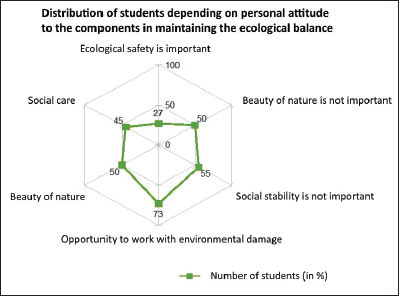
Data analysis allowed us to say that the majority of respondents do not have the qualities, which shows the presence of internal aspirations characterizing the psychological environmental culture, so their actions in the framework, both household and professional activities, are aimed at environmental conservation, and the majority of the studied students of the pedagogical clarification said that the scientific and research part is more important than ecology and someone’s life, and that they will conduct their future work based on personal, professional interests (Karolcik & Cipková, 2017). Even if they cause damage to nature and disrupt the ecological balance, they will continue their professional research activities, and, in their opinion, the problems of ecology are overblown, which shows their low level of the integrated teaching and learning and the development of intelligent component (Canbazoglu Bilici et al., 2016).
A step-by-step and structured analysis of the results obtained allowed identifying the main components of this process and determining the main ones depending on the development of the ecological worldview of students, which will be the basis for the establishment of their ecological culture, which is the main task of the considered ecologization of the discipline course, which teaches a deep understanding of the importance of preserving the natural sphere with its natural ecological balance that currently needs emergency restoration, as shown by various natural disasters threatening the lives of entire regions, continents, changing climatic conditions and threatening life in general (Aithal & Aithal, 2019). Students should study organic chemistry to develop an understanding of nature’s care, the significance of ecology, and the need for restoration and preservation. These fundamental values are cultivated during the study of the discipline, fostering the establishment of an ecological culture. Through the educational process, students gain insights into the interconnections between organic chemistry, ecology, and the entire ecosystem. This holistic perspective recognizes the crucial role of scientific knowledge and practical application in ensuring the well-being of all living components of the biosphere, including humans, flora, and fauna. By comprehending the comprehensive impact of organic chemistry’s informational aspect on life’s development, students can grasp the global and intricate influence of this field (Balcin & Ergun, 2017; Ozdilek & Robeck, 2019).
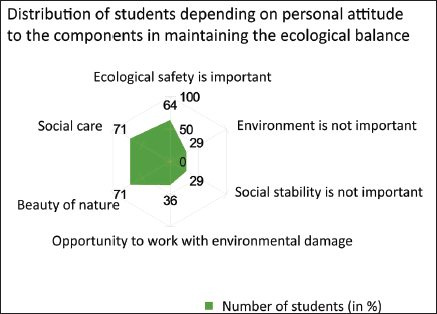
The analysis of the results revealed that a majority of the respondents (64%) recognized the importance of incorporating ecological conservation and restoration into their professional activities and the application of chemical knowledge. This component of ecology, which emphasizes the responsibility for nature and forms the foundation of ecological culture, was identified as a significant characteristic contributing to positive attitudes. Furthermore, the respondents demonstrated a clear understanding of the role of social well-being stability in the overall well-being of society (increased to 71%). They expressed readiness to actively engage in initiatives aimed at restoring ecological balance and acknowledged the significance of the natural environment. The results obtained during the study with its dynamics are shown in Figure 2.
The Distribution of Students Depending on Their Personal Attitude to the Components in Maintaining the Ecological Balance at the Control Stage of the Study.
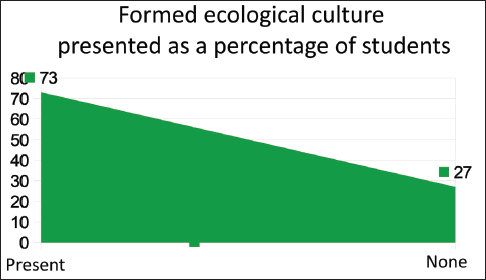
The effectiveness of the developed model with its significance at the level of using the global capabilities of organic chemistry against the background of the created ecological culture as an indicator of the success of the ecologization of the educational process of this discipline is shown in Figure 3.
Distribution of Students based on the Formed Ecological Culture at the Control Stage of the Experiment.
The application of the Rogers-Diamond methodology (1954) involves providing the interviewed students with 101 statements describing their lifestyle, psychological state, lifestyle and behaviour, and the answers of the subjects correlated with the specific features of the development of their ecological culture, determined through the use of the Schwartz value questionnaire (2004). A total of 143 students who took part in the study were asked to answer pre-prepared statements. The following results were obtained:
Forty-two respondents (29.4%) showed a high degree of adaptation to changing external conditions, which in the future is of significant importance in the context of further use of the knowledge gained in the course of organic chemistry in the field of energy conservation.
Sixty-eight respondents (47.6%) showed a high degree of acceptance of themselves, the changes around them, including their place in a changing world.
Thirty-three respondents (23%) showed a high level of ability to integrate into changing environmental conditions and feel comfortable in them.
Fifty-five respondents (38.5%) showed a high level of self-perception, which is a confirmation of their ability to perceive themselves in conditions of external changes.
Sixty-two respondents (43.3%) showed a high level of comfort in the emotional sphere, which means in practice the ability to form an ecological culture.
Twenty-six respondents (18.2%) showed a high level of predisposition to dominance, which confirms the ability to use the acquired knowledge in the field of environmental conservation and the development of environmental knowledge and education.
The results obtained using the Rogers-Diamond methodology (1954) showed a high level of social adaptability in the majority of students taken as respondents for research. In combination with the results obtained using the Schwartz value questionnaire (2004), the data of this diagnosis emphasize the fact that the majority of respondents studying organic chemistry in the framework of the programme course are considering the prospect of further practical application of their knowledge in the field of preserving the ecological balance, which indicates a high level of their emerging ecological culture. According to the results of using the Rogers-Diamond methodology (1954) to diagnose the selected group of subjects, the highest indicators were found in the area of self-acceptance (47.6%) and comfort in the emotional sphere (43.3%). This is in line with the data obtained using the Schwartz value questionnaire (2004), according to which 65 respondents (45%) prioritize social stability and express their willingness to participate in social initiatives for environmental protection. In addition, 72 respondents (50%) surveyed using the Schwartz value questionnaire (2004) found an understanding of the importance of restoring nature as one of the key priorities. The results of the two methods were found to correspond in the field of students’ readiness to actively participate in restoring the ecological balance, as evidenced by the presence of a high level of self-perception in 38.5% of respondents using the Rogers-Diamond methodology (1954), which confirms their readiness to actively participate in the implementation of external changes and the perception of themselves in them.
Comparison of the Results of the Schwartz Value Questionnaire (2004) And Rogers-Diamond Methodology (1954)
In the sphere of respondents’ readiness to restore the ecological balance and preserve the ecology, almost complete compliance with the test results was identified. This indicates the real readiness of students to work in this direction. Fundamental coincidences in the perception of the beauty of nature, including their place in it, are identified. This indicates the willingness of the respondents to practice in the field of conservation and development of ecology. Thus, the methods of the Schwartz value questionnaire (2004) and Rogers-Diamond methodology (1954) showed almost identical results, which indicate the acceptability of such a combination when conducting research in the field of studying the principles of development of ecological knowledge of students studying the organic chemistry course. Based on the data obtained, it can be talked about the success of the application of the developed model of ecologization of the organic chemistry course, which allows methodologically changing the pedagogical approach to the discipline taught. This will create conditions for obtaining knowledge at the level of their ecological application, which in turn carries environmental education, allowing students to understand the importance of building their work based on professional knowledge of the discipline. This discipline significantly affects the results in many areas of production and life support based on maintaining the restoration of ecological balance contributing to the prosperity of life.
In this study, its correctness was ensured, since the characteristics and these parameters of diagnostic testing and the developed parameters of the ecologization model of the organic chemistry course were comparable in the study correctly, and the analysis of its results allowed determining that the developed model allows us to successfully improve the educational process and will train specialists with a formed ecological culture, which will be successfully applied in their future professional activities, conducting and using chemical developments considering the preservation of the natural structure of natural objects, and thus preserving and restoring the ecological balance of the planet’s biosphere (Maryati et al., 2019; Sawant & Sankpal, 2021).
The ecologization of the educational environment of organic chemistry at the level of personal perception of information will only emphasize the importance of the discipline and possible future high achievements of science, which will contribute to the development of a cognitive and active environment for students in the educational environmentally competent learning process, which will raise the level of quality of teaching in educational organizations within the chemical field of cognition (Trenova et al., 2020).
Nature’s Science
The article emphasizes the importance of developing an ecological culture among students and using the foundations of organic chemistry to maintain the natural structure of natural objects while keeping ecological balance. The presented model of ecologization allows for the presentation of information in the form of special knowledge based on the selective structure, which carries the factor of restoration and preservation of ecology. The methods of ecologization include a step-by-step study of the discipline, beginning with the consideration of existing environmental standards in the spheres of life where the knowledge of the discipline is applicable. This approach aims to create value motivations and ecological culture among students and to identify areas of production that require structural corrections based on chemical knowledge to exclude their negative impact on natural objects and ecology, which is of practical importance for the education system and the well-being of society. This article refers to the integration of ecological considerations into the teaching of organic chemistry, with the aim of promoting the restoration and conservation of ecology.
Extrapolation
In the context of this article, extrapolation refers to the potential for the methods and principles of ecologization presented in the study to be applied beyond the specific context of organic chemistry education. The article highlights the importance of integrating ecological perspectives into scientific education and research. It suggests that the principles and methods of ecologization could be applied to other scientific disciplines and fields. For example, considering existing environmental standards and identifying areas where structural corrections are needed based on scientific knowledge could be applied to other industries and sectors to promote more sustainable practices. The article thus suggests that the insights gained from the study have broader implications for promoting ecological knowledge and education in a range of contexts beyond organic chemistry.
Conclusion
In the modern world, there is a visible need to improve the pedagogical environment for the development of an ecological approach in the study of various disciplines, among which organic chemistry is of particular importance, as one of their main components in creating conditions for environmental safety in industrial and other areas, which will create conditions for restoring and preserving the ecological balance on the planet. An ecological approach to incorporating special knowledge should be established from the very beginning, starting with the acquisition of foundational knowledge. This foundational knowledge should include an informational component that emphasizes the ecological aspects of the discipline. Therefore, the developed model of ecologizing the organic chemistry course, which is based on a methodological approach with an ecological perspective on the application of chemical knowledge, enables the cultivation of moral parameters and values at the intellectual level.
The developed model of ecological orientation of the educational course of organic chemistry includes the study of various fields of application of chemical technologies developed based on organic chemistry, followed by the study of purposeful knowledge within the framework of ecological orientation from the cognitive part of the special information of the discipline, considering its positive impact on environmental safety, which will help compensate for many parallel processes, directing their action neutralizing chemical factors for the restoration and preservation of the natural structure of the structure of natural objects. This is the basis for maintaining the ecological balance in the world, and allows creating moral aspects of personal respect for nature. Thus, the model under consideration can be applied at the level of a methodological approach in conducting both lessons individually and in the whole organization of an educational course in organic chemistry based on qualitative criteria, such as value-semantic, need-motivational, intellectual, which will strengthen the cognitive field of the educational environment with the competent presentation of the necessary theoretical and practical knowledge with the acquisition of skills in the field of organic chemistry. The materials of this article will be useful for employees of the field of education, research chemical organizations and laboratories, methodologists, and can also be applied in the field of practical education to improve its effectiveness and quality.
Footnotes
Declaration of Conflicting Interests
The authors declared no potential conflicts of interest with respect to the research, authorship and/or publication of this article.
Funding
The authors received no financial support for the research, authorship and/or publication of this article.
