




Abstract
The first direct presidential election in Turkey is remarkable because of the thin margin with which Prime Minister Recep Tayyip Erdoğan was elected against the expectations of a massive support. It marks beginning of a new era in Turkish politics indicating widespread discontentment and fear regarding the policies of the Justice and Development Party (AKP). On the other hand, the ruling party has retained its support among conservatives, business, and middle classes, especially in Anatolia region. However, the rise of new political forces in the 2015 general elections that failed to give a clear majority to any group should force the AKP to rethink over its policies, particularly the rising concern of authoritarian behavior and appropriation of power. Further, concerns over crackdown of media and dissent and growing instances of violation of human rights may lead to a backlash from the electorate. The AKP government has also come in from criticism for its handling of the Syrian crisis and its action against Syrian Kurds may turn the fragile peace achieved with its own Kurdish population.
Introduction
Its geographic position at the crossroads of Asia and Europe makes Turkey the boiling pot of cultures and civilizations and puts it at the forefront of political transformation coming to the East from the West. The August 2014 presidential elections further underscored this situation when the incumbent Prime Minister Recep Tayyip Erdoğan was elected with a simple majority of 51.79 percent of the popular votes. Erdoğan who was first democratically elected prime minister in Turkish history became the first directly elected president under the October 2007 constitutional referendum that replaced the previous practice of the National Assembly electing the president with a popular national vote. The victory of Erdoğan was not phenomenal against expectations and this together with the substantial fall in vote share in the June 2015 general elections has dampened chances of actualizing his dream of becoming the new Sultan of Turkey while keeping the hopes for a democratic Turkey alive.
Turkey under the AKP led by Erdoğan has been increasingly moving toward Islamization that puts the secular Kemalist republic under threat (Taşpınar, 2012). On the other hand, the increasing tendency of the ruling party toward centralization of power, curbs on media, and instances of human rights violations have led analysts to believe that the state is moving away from democracy (Gurhanli, 2014; Rabasa & Larrabee, 2008). It has led some to argue that the Turkish state is heading toward an Islamist dictatorship (Taşpınar, 2005). One should, however, not ignore that free and fair elections constitute an important aspect of democratic transition and Turkey has followed this tradition underlining participatory nature of the political system. This article assesses the August 2014 presidential elections within the context of the evolution of the Turkish political system, its Ottoman past, establishment of the republic, role of military and the rise of the Islamists.
AKP’s Hold on Power
The reason behind the success of AKP indicates its popularity among the rural, middle classes, and conservative sections and is largely rooted in its calls for Islamization and economic development (Ünal, 2013). Another important factor is its ability to deliver on making peace with the Kurds. Though it lost the majority, AKP maintained its leading position in the June 2015 parliamentary elections despite anti-government demonstrations in the Gezi Park, allegations of human rights violations and the strict code of conduct, which indicates its popularity, at least among its loyal constituencies. The basic tenet of the AKP is to rule the country based on Islamic laws and also revive the Millet system or the unique secularization process of the Ottomans.
The AKP won its first election in 2002 with astounding majority gaining votes across all sections. It came to power through a prudent approach of favoring democratic and modern values rather than radical Islamic ones. The AKP devised a new ideological strand and called Turkey as a “Muslim Democracy” (Demiralp, 2004). To mitigate the doubts and fears within the Turkish public and amongst the secularists and militarists its leaders argued that their politics would not be based on religion but demonstrate the capabilities of Muslims as democrats. They assured that their objective was not to throw out the democratic regime in Turkey but to make an alliance with it and open up opportunities for practicing Muslims within the democratic paradigms (Demiralp, 2004) and once in power, they promoted reforms, pro-business and pro-EU policies (Cagaptay, 2009).
The AKP’s period can be divided into three phases—first, 2002–2007, when the party AKP was trying to convince the people and Europeans of its commitment to democracy; second, 2007–2012, when Erdoğan government dominated key arms of the state and third began with the 2012 elections and the Gezi Park protests. Conservatism started from the second phase with the help of the conservative religious the Fethullah Gülen Movement that took control of major state agencies, intimidated those who resisted, and cowed all dissenting voices into submission (Tolunay, 2014). Toward the end of this period, legislative, executive, and judicial powers were concentrated at the hands of AKP. The Ergenekon and Balyoz police operations involving the arrests of scores of military officers accused of planning a coup were carried out in the name of overcoming the military domination and eliminating the deep state.
The second phase was also witness to the suppression of media. Dissenting journalists, academics, students, and intellectuals were imprisoned. The government intervened directly in the editorial policies of newspapers and television and through heavy handedness proceeded to redesign the social and cultural life of Turkey. With the third term win, the government’s conservative policies became strong which was seen during the Gezi Park protests (Tolunay, 2014). Since April 2014, several laws either submitted to or pushed through parliament by Prime Minister Erdoğan and AKP undermines the central pillars of democracy, namely, separation of powers, checks and balances, government accountability to voters, freedom of speech and have put Turkey on the road to authoritarianism. The graft scandal that came to light on December 2013 has further led Erdoğan and his party to resort to heavy-handed measures such as quashing the corruption charges and public opposition. It has undertaken a legislative campaign to vastly increase the state’s power and insulate it from accountability. It is also trying to fundamentally transform the functioning of critical state institutions such as the structure and functioning of the judiciary, government control over the Internet, and the mandate and powers of the intelligence service into law (Bipartisan Policy Center, 2014, pp. 5–6).
Turkey although underwent reforms and modernization especially under the father of modern Turkey Mustafa Kemal Atatürk, the advent of AKP and it coming into power through democratic elections has made dramatic impacts on the political system. From an overtly secular system, it has been slowly introduced to Islamism bringing back the memories of its Ottoman past. The rise of Islamists to power goes back to the 1990s, even though, Islamist ideology existed despite the prevailing secularization.
The Ottoman Past
Turkey, before becoming a Republic, was the seat of Islamic Caliphate under the Ottoman Empire and was a theocratic state and religion was a major component in ensuring the legitimacy of the state (Köni, 2013, p. 11). The state structure incorporated a large number of bureaucrats from the ulema who enjoyed substantial power and authority. Despite a slew of reformist intellectuals such as Ibrahim Müteferrika who championed reforms, it was slow and directionless leading to stagnation and a gradual decline. It was not until the nineteenth century when some strong reform measures were taken due to a process of military, economic, and political decline experienced and reverses against rising European powers (Köni, 2013, p. 14).
Due to the influence of rise of secular West, during the nineteenth century the Ottoman Empire introduced a process of reforms in various domains leading to the adoption of secular ways, practices and institutions in state and social structures. The Millet system was introduced for smooth running of administration based on religion and ethnicity in the multicultural Empire. With time the Millet system proved to be the precursor to the fall of the Empire rather than consolidation and reforms. In the nineteenth and twentieth century, intellectuals and political chambers saw Islam as a hindrance to modernization and proposed the removal of the dominant nature of religion in social and cultural life in addition to administrative and legal domains as part of a successful reform process (Köni, 2013).
The genesis of the Republic in 1921 was laid during the Tanzimat era (1839–1876) (Landau, 1984; Shaw & Shaw, 1977). The elites had strong centralist tendencies and a great desire to break away from the dynastic and religious past, with the intention of creating a country based on national and secular values, letting them to legitimize their position as the new ruling elite. This intention of disassociation from the past became the elite group’s main policy, allowing them to see the Turkish people as an entity ready to be shaped in consistent with their vision of what a society and nation should be (Kayan, 2009). The opportunity came with the rise of Young Turks and the fall of Ottoman Empire in 1918–1919. The abolishment of the Sultanate took place in 1922. Atatürk, a military officer who gained popularity for his leadership role in the Turkish National Movement, declared Turkey to be a republic and dissolved the Ottoman Empire in November 1922.
The new government took control over all religious institutions and their financial resources. This was, in a way, nationalization and appropriation of religion for the purpose of creating national unity among different ethnic Muslim groups whose commonality was Islam (Kayan, 2009). The elite believed that the new Turkish identity would make ethnic and cultural differences disappear and all groups would become alike under the same secular laws. Islam was appropriated for creating unity among Turkish citizens including minorities because Turkish nationalism was not accepted by all the ethnic groups in the country. Turkish national identity was modeled on the Islamic conception of community and was disseminated through Islamic terms (Kayan, 2009). The new state claimed a secular Turkish identity; it did not hesitate to fit Islam as the glue for forming unity among its peoples with different ethnic backgrounds. Secularism in Turkey was laicism (Karakas, 2007).
Under Kemalism, political project represented a Western-modeled political agenda based on establishing a secular Turkish nation-state. It was not of liberalism but of a secularist–nationalist political project aimed at nation-building, modernization, and Westernization. At the same time, it represents a defensive political reaction against the “perceived enemies” of the secular Turkish republic: the Kurdish nationalism and political Islam (Kayan, 2009). For the guardians of Kemalism, any assertion of the Kurdish—both political and ethnical—became a security threat to both the country’s territorial and national integrity. Similarly, an alarmist attitude was adopted by the secularists toward political Islam. Islamic sociopolitical and cultural symbols in the public domain were seen as harbingers of a fundamentalist revolution. This alarmist approach to Kurdish and Islamic identity has been counterproductive for Turkey’s democracy and Kurdish and Islam dissent developed in reaction to Turkish nation-building and secularism.
Multi-party System
The development of Turkey’s multi-party system began with the foundation of the Society of Self-sacrifice in 1859, at the time of the Ottoman Empire. Under the reformist Sultan Selim III (1789–1807), a package of reforms were introduced named New Order which was further taken forward by Mahmut II (Tröndle, 2007). A strong follower of Westernization he understood the importance of separating the power of Janisarry (army nobles) and ulema, who were running the administration and introduced a central bureaucratic system and transfer of the powers and authority of the ulema to various ministries and directorates (Köni, 2013). These reforms were further strengthened by the introduction of Tanzimat reforms such as the introduction of constitutionalism, ideas of citizenship rights, freedom of expression, public opinion, liberal ideas, national consciousness and liberty.
The Constitutionalist period, starting with the declaration of the Ottoman Constitution in 1876 and the opening of the parliament, had many implications for secular politics. It led to beginning of a reform era but the Empire experienced major difficulties in adapting to the new paradigm without compromising self-esteem and Islamic pride (Taşpınar, 2005). However, for the later day republicans these reforms became advantageous in turning the country into a nation-state based on Western notions of politics. The end of Second World War laid the foundations of a new era started in Turkish politics with the external dynamics of the Cold War and transition to a multi-party democracy. The next four decades witnessed the polarization of left-wing and right-wing parties and the Kurdish and Islamic dissents were absorbed in the new political divisions (Taşpınar, 2005). Kurdish discontentment found its place within radical left-wing politics and Islam became a part of the anti-communist struggle. Although in the wake of the Cold War, left-wing and right-wing ideological positions became irrelevant the Kurdish nationalism and Islamic dissent became stronger.
Indeed since the beginning of transition to the multiparty period in the late 1940s, almost all endeavors toward democratization were stopped by the bureaucratic and military tutelage (Bilecen, 2015) through the coup d’états. Despite the turbulence in the Turkish politics, the country saw the emergence of many parties. Even though there are 61 political parties, the major political parties (Table 1) which have had representation in the parliament are fewer.
Political Parties in Turkey

Role of Military
The Turkish military emerged as the custodian of the republic and forcefully asserted Kemalist nationalism and secularism which posed to be detrimental for Turkey’s democracy. It was a clash between Turkish and Kurdish polarizations on the one hand, and Islamic and secularist polarizations on the other, revealing an acute sense of identity problem (Taşpınar, 2005). This created disharmony in the country leading to an unstable political system. An important institute which is attached with the Kemalist order is the Turkish General Staff or TSK which is formed by the former military officers. The military’s political role has been more overt, although with varied degree and form. The more explicit political engagement has coincided with the advent of multiparty democracy from 1950. They act as the “guardian” of Turkey (Burak, 2011; Koonings & Krujits, 2002). Their rigid guardianship (though intention was to keep Turkey secular and Western) had destructive repercussions on Turkey.
Meanwhile, despite the drive for political, legal, and cultural reforms based on Westernization and modernization, Kemalist regime achieved limited penetration in the Turkish society at large, especially the rural parts of Anatolia. It was because modernization and Westernization has been “top-down” supported by the elite creating a sociocultural gap between this group and the rural/poor segments (Taşpınar, 2005, p. 2). In fact, the understanding of democracy was different; democracy in Turkey meant maintaining the six arrows of Attaturk (republicanism, nationalism, populism, etatism, secularism, and reformism) especially by the military who were the “guardians.” In preserving these principles military coups became frequent and were seen as an anathema to democracy and liberalism. It led to banning of many political parties by military regimes including the 1980 ban on Turkey’s first political party, the People’s Republican Party (CHP) that was formed by Atatürk in 1923.
Political and Electoral Systems
Turkey is a parliamentary democracy with multiparty system since 1950 (Figure 1) and elections were held in municipal and parliamentary levels. There are presidential elections after every 5 years, Grand National Assembly after 4 years and local elections after 5 years. Elections are administered by a four-tier structure overseen by the Supreme Board of Elections composed of seven senior judges. A second election tier exists at the provincial level and is composed of judges. A third tier at the country level exists where the highest judge of the country along with civil servants and political party appointees look after the procedure. And the fourth tier is the Ballot Box Committees appointed by the county board (Harding, 2009). Under Turkey’s election law, parties obtaining 10 percent of the votes throughout the country in general elections enters the parliament. The revenue resources of the political parties are the membership dues, donations of corporate or legal bodies within the limits specified in the Political Parties Law, and state aid set forth in the same code (Turkish Elections, n.d.).

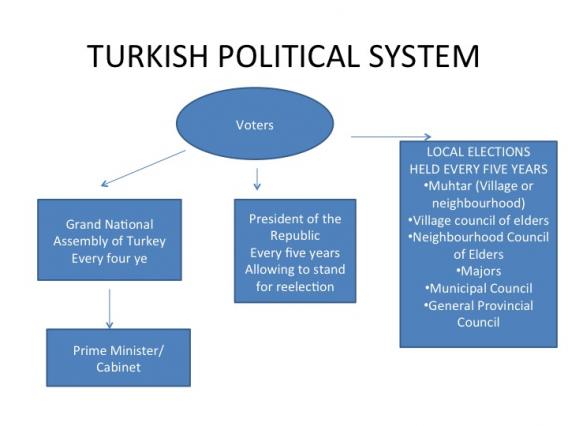
Political parties present lists of candidates; these must be submitted in at least half the provinces. Electors cast a ballot for a single list or an independent candidate. Constituency seats are apportioned according to the largest average method of proportional representation (PR), conceived by the Belgian mathematician Victor D’Hondt in 1899. However, in order to participate in the distribution of TGNA (Turkish General National Assembly) seats, a political party must obtain at least 10 percent of the nationwide vote (Álvarez-Rivera, 2015). Turkey’s oldest party is CHP or Republican People’s Party which was founded by Kemal Ataturk was the dominant party during the largely one-party period up until 1950. Although it is ardently a Kemalist upholder and central to Turkey’s political, social, and economic evolution it has never emerged victorious in its own right in a free election. The reason behind it was that the CHP was not able to win over the trust of the common people because of its rigidity based on the six arrows of arrows of Attaturk, especially the Anatolians who felt suppressed.
In 1930, the Democratic Party (DP) was formed which became the main opposition party whose members opposed the authoritarian tendencies and especially the statist economic policies of the CHP leadership. During the 1946 elections, the governing CHP won an overwhelming victory, capturing 390 seats as against 65 won by the DP. Despite the lopsided result, the RPP was shaken by the inauguration of a legal opposition. An internal party struggle ensued, pitting liberalizers who sought to strengthen the development of a competitive political system against authoritarians who favored suppressing the opposition and continuing one-party rule. The liberalizers ultimately won (Tachau, 2000, p. 129).
Past Elections
In 1950, the DP broke the political monopoly of the CHP party by winning Turkey’s first competitive elections. The DP won 53 percent of the popular vote and 84 percent of the parliamentary seats, in contrast to the CHP’s 40 percent of the vote and 14 percent of the seats (Figure 2) (Tachau, 2000, p. 129). The DP fought the elections and came to power as a result of using Islamic discourses with the masses. The main differences in platform between the two lay in economic policy; while the CHP was guided by statism, the DP was more interested in privatizing state industries that had helped jump-start the Turkish Republic after the First World War. The DP did not repudiate the CHP’s policy of Westernization, but did not pursue it with the same vigor. It was also less militantly secular than the CHP, and championed populism which gained it wide support among Turkey’s intelligentsia.

The 1950 elections are called as a “greening” election, typical of developing countries, in which rural interests take control of the political system. Another explanation is the drawing upon the paradigm of the center–periphery cleavage to explain the outcome of the election, suggesting that the CHP spoke for the social and political center of the society, while the DP represented the periphery. Prior to 1950, Turkish parties tended to be “official,” meaning they were instruments of the regime designed to enhance political control rather than represent the electorate (Tachau, 2000, p. 130).
Meanwhile, in 1948 the Nation Party was formed. The main reason behind the formation of this party was that that the DP was ineffective as opposition and believed that the Turkish people were trapped between the two political alternatives. Hence, a third alternative with a nationalistic ideology was necessary. This party split in 1963 due to the differences within them but was rejuvenated in 1992.
During this time, Islamic trends began at 1950s and with the power of Welfare party (Refah Partisi), political Islam culminated. They started to gain ground because of their rhetoric radicalizing in parallel with their popularity in the country increased. Party officials stated continuously that their final purpose is the transition of Turkey into an Islamic state which caused their overthrown by military coup on 1997. Policies of this party were against the EU and NATO and instead of they supported Islamic common market and an Islamic NATO. Furthermore, they tried to build close ties with Iran, Libya, and Syria which was opposite to the attitudes of secular political elite, military, and public (Aliyev, 2014).
During the 1960s, leftist movements shaped politics for the following two decades as they pushed for more freedoms. Although the state held strong control over politics, there was also a rise of populist nationalism and religious revivalism during this period. Religious organizations grew rapidly in the 1970s as they helped those of lesser means cope with the problems of modernization and became clubs for excluded groups seeking solidarity in a changing world. These were also times when the Nationalist Action Party, with an emphasis on Turkish nationalism, and the Nationalist Order Party, with its Islamist emphasis, came into existence to play a role in Turkish politics (Kayan, 2009).
The Nationalist Action Party (MHP) founded in 1969 was also known as the Grey Wolves. They embraced Turkish nationalism but to counter their opponents they used to violence like assassination. The Revolutionary People’s Liberation Party–Front which was founded in 1978 has a Marxist–Leninist ideology and holds anti-US and anti-NATO positions. It viewed the Turkish government to be under the control of Western imperialism and sought to destroy this control by violent and democratic means. This Party and the Marxist–Leninist Communist Party are leftist parties with a leaning toward political violence.
For Turkey’s parliamentarianism, the years between 1960 and 1980 were a period of instability: 20 governments came and went, and the military intervened on three occasions, in 1960, in 1970, and in 1980. Ever since the constitution of 1961 was adopted, the first to mention political parties as necessary elements of a democratic state, the country saw the foundation of numerous new parties. When the DP was banned, it was succeeded by the Justice Party (AP) which obtained 34.8 percent of the vote in the October 1961 elections (Figure 3). Its rise coincided with the first Turkish coalition government. In fact, both DP and AP were mass parties with a center-right orientation in politics and economics (Landau, 1982). After the AP left the government, it was replaced by the New Turkey Party (YTP) and the Republican Peasant Nation Party (CKMP). Under Süleyman Demirel, the AP again won more than half the votes in 1964 and remained in power until 1974 (Tröndle, 2007).

Political life in Turkey during the 1960s and 1970s appeared to have evolved in the level where a struggle for power and influence were pursued by various groups such as extra-parliamentary groupings, business circles and the various trade union organizations, students and youth associations and various political groups. Although many of these were allied with the extreme left, several could be defined as close to the extreme right (Landau, 1982).
With the religiously oriented parties becoming part of the political system and participating in elections since 1970, Turkey’s Islamic character in the political system was becoming prominent. At the beginning of the 1970s, new parties emerged which were more radical. The Islamic National Order Party (MNP) under Necmettin Erbakan was considered the mouthpiece of the “Anatolian hinterland” and explicitly criticized the secular nature of the republic and presented an alternative ideology to the secular conception of the modernity project. Since then, the ideology of political Islam has been represented in the Turkish political scene through successive parties under the leadership of Erbakan and his associates. This Party was banned in 1970 and in 1972 was succeeded by the National Salvation Party (MSP) which obtained less than 12 percent of the votes in 1973 (Figure 4). This party was also banned, together with the socialist Turkish Workers Party (Altunisik, 2005).

Throughout the 1970s and despite its limited share of votes, the MSP was able to wield extensive influence in the political system because of its participation in various coalition governments. The party developed an ideology called the “national view” (milli goriis), which emphasized a moral and just order. The MSP was critical of Turkey’s Western orientation and its membership in Western institutions and instead called for the establishment of and membership in their Islamic counterparts. The MSP was closed down by the military along with all the other political parties as a result of 1980 coup (Altunisik, 2005). In the wake of the coup, all political parties were banned and in the following years, the head of the Turkish military became president and new parties were established (Kayan, 2009). In 1983, the Welfare Party (Refah Partisi-RP) was founded as a continuation of the MNP and MSP tradition. Nevertheless, its influence in the political system remained limited throughout the 1980s largely due to the successes of the newly established Motherland Party (Anavatan Partisi-ANAP) in 1983 (Table 2). ANAP under the leadership of its charismatic leader Turgut Özal succeeded in dominating the politics of the 1980s (Altunisik, 2005).
Result of General Elections, November 1983

The elections which place after the 1980 coup were to restore democracy in the Republic and witnessed a leaning toward the religious and far-rightist ideology. There was polarization and frustration in the country. In the November 1983 elections, the ANAP won 45 percent of the vote, the military-backed Nationalist Democracy Party (MDP) received 23 percent and the People’s Party (HP) 30 percent as the representative of left-wing politics (Table 2). Party leader Ozal was able to revolutionize the economy, turning it away from traditional reliance on state control and toward deregulation, privatization, and openness to foreign investment. Politically, he avoided ideological or partisan rhetoric and instead, emphasized on pragmatism. It was a welcome relief to the people as the 1970s was dominated by partisan polarization, fragmentation, and violence (Sayari & Esmer, 2002).
With the victory of ANAP under Ozal, Turkey witnessed the formation of a single-party government. Amalgamating quite different ideological currents, the Özal “dynasty” had a lasting effect on the country. However, in the elections of 1987, the ANAP suffered some losses even though it was able to retain most of its MPs (Table 3). Meanwhile, Demirel founded a new party called the True Path Party which won 20 percent of the votes (Tröndle, 2007). The decline in support for the ruling ANAP was attributed to an increase in the number of right-wing parties and electoral alliance between left-wing parties (Today’s Zaman, 2009).
General Elections, November 1987

Although the ANAP was able to retain its power its popularity was declining. That made to call for another election in 1989 in which it suffered a “striking defeat” (Figure 5). “The SHP increased its share of the vote to 28.7 percent and won the election in a number of cities and districts. The DYP also increased its votes from 19 to 25 percent, whereas ANAVATAN’s votes declined from 36 to 21 percent” (Today’s Zaman, 2009).

The 1990s were marked by ideological battles and rivalry between Mesut Yilmaz, a member of the ANAP, and Tansu Ciller, a representative of the DYP (Tröndle, 2007). In the October 1991 elections, DYP emerged victorious (Table 4). The ANAP lost the elections because of high rate of inflation, unemployment, increased inequalities, and a widened income gap (Delibas, 2015).
General Elections, 1991

However, DYP could not sustain the government and under Tansu Ciller, the Turkish lira dived almost 20 percent, the stock market crashed to half its dollar value, interest rates shot up and an inflation rate of 70 percent seems set to rise sharply. Police beat demonstrating civil servants, and the US State Department criticized its human rights record, citing torture and excessive use of force by officials (Pope, 1995). The party which benefited from this dispute was the Islamic party, RP, who fetched more than 20 percent of the vote in 1995. The party head, Erbakan became prime minister in 1996 (Tröndle, 2007).
Rise of Islamists
Since 1990s strengthening of Islamic political parties could be witnessed in Turkey due to economic depression, violation of rights, security concerns, political chaos, and conflicts. It was a period in which the bureaucratic oligarchy ruled the sphere of politics as searches for an identity-based social justice came to the foreground. Meanwhile, Turkey lost its prestige in the region and was perceived as the spokesperson of the American interests. Its foreign policy was identified with the fight with the Kurdistan Workers’ Party (PKK) and had failed to recover from the Cold War psychology. This period was shaped by the essentialist identity politics. The RP sought a government based on “party politics” in one hand and on the other it was attributing to democracy and the power of the Islamic identity in Turkey. This period marked the rise of religious communities who were involved in community service by ascribing to the power of the Islamic identity (Altun, 2014) leading to the platform for victory of RP and future Islamic political parties in Turkey.
The RP with its victory turned its focus in garnering votes from the urban poor. It radicalized its discourse and framed itself as an anti-system party and got the protest votes in the turbulent 1990s. Successfully diversifying its constituency, the RP increased its votes and eventually emerged as the leader in the December 1995 elections with 21.1 percent of the votes and coming to power in a coalition government (Table 5). Their organizational capabilities along with the challenges Turkey was facing contributed to the Islamic parties’ popularity. The March 1994 municipal elections and the December 1995 general elections witnessed the rise of the RP. In January 1996, the RP formed a coalition government with the center-right DYP under the premiership of Erbakan (Altunisik, 2005).
General Elections, 1995

In 1996, RP in coalition with DYP formed the government with Erbakan as the prime minister. The RP’s electoral successes were especially astounding in central and eastern Anatolia, regions long neglected by the country’s other political parties, thus giving resonance and a measure of justification to the party’s popular image and its rhetoric as “champion of Eastern Turkey.” With the addition of the offices of the mayors of Ankara and Istanbul, as well as 12 out of the eighteen major predominantly Kurdish municipalities in the southeast, it was able to refute all suppositions about the RP’s alleged regionalism. Success of the RP could be also contributed because of the diminishing confidence in the ability of most politicians to resuscitate the economy and rescue the nation from a seemingly intractable economic and political deadlock. It shifted the country’s traditional political “center” by aggressively mobilizing voters from the eastern parts of the country and the lower rungs of the socioeconomic scale (Kamrava, 1998).
Erbakan became the first Islamist prime minister to be legitimately elected in 1995. However, his desire to distance Turkey from the West and develop closer ties with Middle Eastern countries such as Syria and Iran, combined with his party’s call for a return to traditional values—taken by many as code words for Islamic morals and behavior—put him on a collision course with Turkey’s staunchly secular establishment. The armed forces kept mounting pressure on Erbakan, and ultimately forced him to step down in 1997 after only a year in office. In early 1998, the Constitutional Court ordered the dissolution of the Welfare Party, while Erbakan and most of his followers were banned from politics for 5 years. Meanwhile, following Erbakan’s fall in the so-called “postmodern coup,” (Hale, 1999) Mesut Yilmaz formed a minority ANAP-DSP coalition government that also included DYP dissidents and subsequently secured CHP support as well (Álvarez-Rivera, 2015). However, Turkey was reeling under instability and pressure from every area.
During 1999–2000, Turkey witnessed severe economic crisis, continuing tension between the secularists and the Islamists, capture of the PKK leader Abdullah Ocalan, and growing allegations of political corruption involving officials and politicians. Along with the ouster of the Islamist-coalition government in 1997 under pressures from secular forces led by the military marked the high point of secularist-Islamist polarization, leaving the common people disillusioned (Sayari & Esmer, 2002).
However, the DSP did not last long and in the April 1999 elections, CHP the largest party suffered a huge defeat (Table 6). In this election both national and local were held for the first time in Turkish electoral history. The election were held against the background of continuing tension between secularists and Islamists, pressure from the European Union for a civilian government without the shadow of the military, economic woes such as rapid inflation, unemployment, and consumer desperation among the marginalized. These contributed to the defeat of the DSP. The disillusionment of Turkish people with the parliamentary deadlocks, embedded inequitable patronage networks, and personalized battles among the incumbents provided strong incentives for a change in vote. Along with these, the grassroots organizational strength of the Islamic political parties also led to the coming of Justice and Development Party (AKP) to the power in 2002 (Kumbaracibasi, 2009).
General Elections, 1999

The AKP founded in 2001 was created from the remains of the prohibited Islamist movement of the RP. It achieved an unexpected breakthrough in the November 2002 elections, taking 34.3 percent of the votes cast, that is, well above the required threshold of 10 percent (Table 7). It had the absolute majority in parliament by taking 363 seats (Deloy, 2002). There was rising acceptance of Islamic politics in Turkish political system due to the demonstration of the Islamic parties toward modern values and practices such as economic liberalism, consumptionism, and women’s entrance into the labor force as well as democratic values like freedom of thought and expression (Demiralp, 2004).
General Elections, 2002

The elections of July 2007 and June 2011 showed a continued dominance of the AKP. It popularity rose and in 2007 it saw a rise of 12 percent in its vote share compared to the 2002 general elections (Table 8). It increased its electoral support in all the seven regions of the country. The most important increases of support occurred in the predominantly Kurdish areas of southeastern Anatolia and in the five largest cities in Turkey. For example, Istanbul which is the hub of being a secular and European city, the party received almost as many votes as all its opponents combined. This suggests that the AKP has been gradually extending its hold from the periphery toward the city centers. The party’s main support, however, comes from the poorer and less developed parts of the cities. It managed to blend cultural preferences typical of the right with social–economic policies that are generally associated with the left and that are favored by the electorate as a whole. Economic stability was a primary concern of the voters and a key factor in the AKP’s electoral success. The military’s so-called “midnight memorandum” on April 27, 2007, which contained a veiled threat of possible military intervention, seems to have contributed to the increase in the AKP’s popular support (Rabasa & Larrabee, 2008).
General Elections, 2007

The AKP’s strong grassroots work and successful economic growth and development have been reasons behind their success from 2002. Since the AKP took office, the Turkish economy has experienced an average annual growth rate of 7.5 percent, a drop in the rate of inflation from 60 percent to about 9 percent, almost doubling of per capita income, and unprecedentedly high foreign investment (more than $20 billion in 2006) (Migdalovitz, 2007). The GDP per capita has improved dramatically and from US$3492 in 2002 it rose to US$10,067 in 2010. The rate of poverty also decreased from 27 percent in 2002 to 18 percent in 2009. The AKP follows a neoliberal style of redistribution which emphasizes private compassion and informal networks. This is styled against the expense of formal, state-based forms of redistribution as the primary mechanism for helping the poor and the underprivileged segments of society (Öniş, 2012).
The success in maintaining Turkey’s economic growth despite the global crisis of 2008–2009 and other developmental policies catering to the Turkish people helped the AKP to secure its victory in the next general election in June 2011 (Figure 6). It maintained its power with an increase in the margin (Table 9). The 2011 election saw an affirmation of Turkish people’s faith in the AKP because of the country’s booming economy and increased international profile (Hassan, 2014). Meanwhile, Turkey has witnessed a decline in the power of the military and the changing context of civil–military relations in the post-2007 period. This change rules out the possibility of a direct military challenge to the AKP’s electoral hegemony which has proved advantageous for the party and its agenda to be implemented over the country. The fact that Turkey did not suffer a typical old-style economic crisis in the context of the global turmoil of 2008–2009 was important for the AKP’s electoral fortunes (Öniş, 2012).

General Elections, 2011

In the 2011 elections, although it dominated the electoral results but its seats in the General Assembly dropped from 336 to 326. Winning more seats was important for the party as it were trying to change the military-influenced constitution. The Turkish electoral law is a mix of the majority and proportional representation systems and for a change in the constitution, the contending parties must have a two-thirds majority which the AKP was lacking (Guidi, 2011). One of the main pledges during the AKP’s 2007 election campaign was on reforming the Constitution which was introduced following the 1980 military coup. The package included measures to proscribe gender discrimination, bolster civil liberties and protect personal privacy. It makes it possible for coup plotters to be tried henceforth in civilian courts which were seen as a huge relief by the people who were antagonized by the military’s repressive methods. The core of the package is a major overhaul of the judiciary as it would give the president and parliament greater say over the appointments of senior judges and prosecutors, and expand the size of the constitutional court and that of the judicial body in charge of appointments (The Economist, 2014). The AKP was able to garner a support of 58 percent from the Turkish people in a referendum on the constitution.
Since 2012 serious democratic shortcomings of the AKP have been exposed. It had increasingly cracked down on its critics, especially those in the media. After a decade in power, Erdoğan also failed to follow through on promises of a new constitution and reforms that would address pivotal issues facing the country—the Kurdish question, human rights, and freedom of expression (Taşpınar, 2012). With the strengthening of the party’s hold on the country it is demonstrating its conservative Islamic values and their short-sightedness such as reconstructing the Gezi Park into a commercial mall, prohibition of alcohol in the public, banning of abortion, increase in religious schools and crackdown on the protesters during the demonstration in Gezi Park of 2013. All these have antagonized some sections of the society.
The effective elimination of military and court pressures against the AKP has hastened the party’s return to its core values. The AKP began abandoning its displays of pluralism, dismissing dissent, ignoring checks and balances, and condemning the media for daring to criticize them. The AKP is shaping the Turkish society in its own image, promoting orthopraxy through administrative acts. Accordingly, it is not religiosity that is on the rise in Turkey, that is, the number of people attending mosque services or praying but rather government-infused social conservatism (Cagaptay, 2009). The functioning of civil society under the AKP rule has been affected due to state hegemony, instability, bureaucratic centralization, intolerance of political opposition and a lack of respect for civil rights and freedoms, and the ideological structure of state control (Karaman & Aras, 2000).
The 2014 Presidential Elections
In August 2014, Turkey held its first presidential election based on popular vote and Erdoğan came out as the winner with 51.79 percent against the other two candidates—Ekmeleddin İhsanoğlu, the joint candidate of the Republican People’s Party (CHP) and the Nationalist Movement Party (MHP), who garnered 38.44 percent, and Selahattin Demirtaş, the Kurdish Democracy Party of Peoples (HDP) candidate who secured 9.78 percent (Figure 7). This was the first time Turkey elected a president through direct vote as previous presidents were elected by the Grand National Assembly. The decision to go for a direct presidential election was taken after the 2007 presidential election controversy (Migdalovitz, 2007).

In 2007, Turkey witnessed tension over AKP’s desire to elect one of its members as president. The issue against the nominee Foreign Minister Abdullah Gül was that he had roots in Turkey’s Islamist movement and his wife wore a head scarf, which some secularists considered a symbol of both Islamism and backwardness. Another reason for the apprehension was that that AKP already controlled the prime ministry and parliament and hence the balance of political power would be disturbed if the party also assumed the presidency. The opposition CHP asked the Constitutional Court to annul the vote and after the invalidation of it, Prime Minister Erdoğan called for early national elections and proposed a package of constitutional amendments, including one that called for the direct election of president through popular vote (Migdalovitz, 2007).
A constitutional referendum was conducted in October 2007 leading to a change in the presidential election law. The AKP’s agenda attracted a resounding support from the electorate and nearly 69 percent voted in favor of the proposed amendments. The success came due to the proposed package of constitutional amendments, especially the introduction of the popular election for president, reduction in president’s term of office from 7 to 5 years, reduction in parliament’s term of office from 5 to 4 years and a clarification of the quorum of the Grand National Assembly. In the meanwhile, Abdullah Gül was elected president in August 2007. The election of Erdoğan under the 2007 constitutional amendment has changed the character of the government from parliamentary to parliamentary with president system (Uran, 2010).
On August 2014, Turkey held its first presidential election based on popular vote and Erdoğan came out as the winner with 51.79 percent against the other two candidates—Ekmeleddin İhsanoğlu, the joint candidate of the Republican People’s Party (CHP) and the Nationalist Movement Party (MHP), and Selahattin Demirtaş of the People’s Democratic Party (Ozbudun, 2014). The main reason behind Erdoğan’s desire to run for the presidential election and become the president was to stay in power. Under the internal rules of the AKP he was no longer eligible to apply for a fourth term as prime minister (Kostev, 2014).
During the elections, there were two political approaches to the future of governance in Turkey. The first approach, represented by Erdoğan, called for a narrow and majoritarian understanding of democracy based on the notion of the “will of the people” at the expense of constitutional checks and balances and separation of powers. In return for such an authoritarian form of governance, Erdoğan promised a “New Turkey” which is prosperous and would grow to be the 10th largest economy by 2023 and become a major regional, if not global power (Kirişci, 2014).
Turkey experienced an average 5.2 percent growth per year between 2002 and 2011, falling slightly to 4.0 percent in 2012, and the government has pumped up the economy with dozens of infrastructure projects (Cross, 2014). Despite this fall, Erdoğan still had strong support because of the party’s pro-business policies, employment and rising living standards of the middle and low class sections of the population. His popularity was, according to his supporters, was also because as a prime minister, he has put Turkey on the world’s diplomatic map, declared support for the Palestinians, backed revolt against Bashar al-Assad in Syria and proposed a model of democratic Islamism for the Muslim world (Cross, 2014). He and his government lifted the country’s conservative, religious majority out of poverty and gave it a political voice (Kazim & Popp, 2014).
The second approach that was pushed for by İhsanoğlu, advocated the maintenance of the existing parliamentary system and warned that a hybrid system where both the prime minister and the president is elected directly by the people, risks creating instability, tension and polarization within the country. He advocated for a president who would be above party politics and who would focus on protecting freedoms and the rule of law (Kirişci, 2014). However, Erdoğan won in majority.
Reasons behind Erdoğan’s victory despite the growing Islamic conservatism and the Gezi Park protests were the greater self-confidence gained by the AKP’s successive electoral victories under his leadership, each time with a larger share of votes; disappearance of the threat of military’s intervention in politics, a scenario achieved during the AKP’s first two terms in power and growing sense of mission (read ambition) by the AKP leadership to make Turkey a leading country in the Islamic world through the development of some kind of a populist Muslim democracy (Ozbudun, 2014). Another reason for the victory of Erdoğan was the weak opposition candidates, excluding Demirtas. İhsanoğlu’s candidature which was backed by both the CHP and MHP, both the parties are from different ideological stands, could not appeal for support within the parties itself because of his Islamic leanings. (Assessment Report, 2014). He was less popular in comparison to Erdoğan. İhsanoğlu’s rhetorical style and his polarizing stances on Middle Eastern issues were other factors that did not build a strong candidature (Seymour, 2014). He could not garner wider support because people were already unhappy with their previous policies against Kurds and other groups. Although during the election, they tried to win the support the opposition could not strike a chord (Ovur, 2014). The HDP candidate was a first-timer. Meanwhile, despite Erdoğan’s policies which are authoritarian, his core support which comes from the “new Muslim bourgeoisie” (Seymour, 2014), rural and middle class people were strong.
Another plus point for Erdoğan was his stand on the Kurdish issue. Under his administration, negotiations were opened between the government and the Kurdish separatist group, PKK, which the CHP and MHP had continued to resist. For the secular nationalists, the Kurdish issue is a threat to Turkey’s nationalism and identity and for the rising Muslim bourgeoisie, relations with the Kurdish region is commercially lucrative 1 (Seymour, 2014).
The success of AKP marks continuity in its control over political power in Turkey since its ascendance in 2002. However, some of the recent events indicate a decline in popularity of the party and its leadership due to its increasing intolerance toward any form of dissent. Despite the fact, the victory indicates the self-confidence gained by the AKP due to its successive electoral victories and its achievements leading to disappearance of the threat of the military intervention in politics and the resonance among the electorate of Erdoğan’s ambition to regain the lost Ottoman pride at least in the Islamic world through developing a populist “Muslim democracy” (Ozbudun, 2014).
Conclusion
Turkey’s political system has been full of paradox. There has been a tussle between secularism and Islamism where the secularists have played the cards of religious ideology for garnering votes. Although military and political elites adopted the secularist ideology the acceptance of Kemalism in societal level has not been successful, especially in the rural and underdeveloped areas. Majority of the Turkish society has strong Islamic characteristics and underestimation of Islam in the country has naturally caused reactions and consequently, people adopted Islam strongly. Turkey since it adopted the multiparty system has seen ingredients of a vibrant democracy although the shadow of the “guardians” loomed large till the reelection of AKP in 2007. However, since the rise of AKP the issue of turning the democracy into a totalitarian or authoritarian state has been a major concern. Erdoğan has been gathering personal power while eliminating critics and rivals. It is becoming apparent that his grand designs are to refashion Turkey’s political institutions, while envisioning creating a presidential system and imbuing the presidential position with unprecedented powers.
Footnotes
Acknowledgements
This article is a part of the project on Elections and Democratization in the Arab World supported by Middle East Institute, New Delhi and Jawaharlal Nehru University, New Delhi and the author acknowledges the support.
1.
The situation currently has changed between the government and the Kurds due to the complicacies of the Syrian issue. The appeasement policy which the AKP government had started has been reverted back to the old policy of suppressing the militant insurgency.