



Abstract
The Turkish referendum has exposed the fault lines of the Turkish polity pitching the ruling Islamist AKP and its new-found ally MHP against the Kemalist CHP and pro-Kurdish HDP. The sharp divisions in the run up to the referendum was reflected in the results that registered a narrow victory margin for the “Yes” vote. The victory effectively means that Turkey would be shifting to a presidential form of government from 2019. It is not just the transition from one form to another but the way in which the process has been pursued and the overwhelming powers the amendment enjoins in one man that has alarmed many leading observers who fear Turkey sliding to autocracy.
Turkey is at the crossroads of a historical transition. On 16 April 2017, the people voted in a referendum to approve a constitutional amendment bill that proposes to change the current parliamentary form of government into a presidential one. The official results announced on 27 April confirmed that the amendment bill has been approved by a 51.41 percent vote in favor (Cakmak & Celikbas, 2017). The referendum effectively changes the historical parliamentary form of government that Turkey has followed since its proclamation as a republic in 1923. The arguments in favor of the amendment proposed and strongly backed by the ruling Adalet ve Kalkınma Partisi (Justice and Development Party; AKP) and its ultra-nationalist ally the Milliyetçi Hareket Partisi (Nationalist Movement Party; MHP) was that Turkey needs a strong and decisive presidency for effective governance and a lack thereof has hampered rapid development. On the other hand, the “No” camp led by the main opposition Cumhuriyet Halk Partisi (Republican People’s Party; CHP) and supported by the third largest parliamentary group the Halkların Demokratik Partisi (People’s Democratic Party; HDP) was arguing that it effectively pushes the country toward one-person rule or authoritarianism.
There are several issues that are important as far as the referendum is concerned; most significantly are the amendment bill and its provisions, process followed for the amendment, political atmosphere in which the referendum was held, and the sharp divisions it espoused in the polity and society. Notably, the amendment will be effective from 2019 when the next presidential election is due, allows the incumbent Recep Tayyip Erdoğan to run for two fresh terms raising the likelihood of him continuing in power until 2029 (Akyol, 2016). Practically, it means that Erdoğan will rule the country for more than quarter of a century after he became prime minister in 2003. Notwithstanding the possibility of him continuing in power, what has bothered the domestic opposition and international observers was the way Erdoğan has gone about pursuing the constitutional amendment to change the system disregarding the opposition and quelling all voices of dissent. It has led to fears that the Turkish democracy is facing a slide and the AKP led by Erdoğan is squandering the democratic consolidation that ironically had brought the Islamist-leaning group to power in 2002.
The Constitutional Amendment Bill
The amendment package that ultimately was approved in the referendum in effect incorporates 18 changes in the constitution. The most important are related to the duties and powers of the parliament and president. The Grand National Assembly’s power accorded under Article 87 to “scrutinize the Council of Ministers and the Ministers; to authorize the Council of Ministers; to issue decrees having the force of law on certain matters” has been scrapped and as per the amendment, the National Assembly will have power to “enact, amend, and repeal laws; to debate and adopt the proposed budget bills and final account bills; to decide to issue currency and declare war; to approve the ratification of international treaties” (Cetin et al., 2017, p. 20). This means that the executive powers of the parliament has been scrapped while the legislative powers have been retained.
Further the strength of the parliament has been increased to 600 from the current 550 members and the minimum age for eligibility to be elected as member has been reduced from 25 to 18 years. The parliament has also been accorded the right to call for election with a three-fifth majority while the president can also call for fresh elections. In matters related to laws, the parliament will have the power to overrule presidential decrees and according to the amendment bill “If the Grand National Assembly issues a law on the same topic, the presidential decree becomes obsolete” (ibid., p. 21).
While the parliament’s executive powers have been curtailed, the president has been accorded executive powers. Thus, the president, to be directly elected, will be the head of state as well as head of government and shall exercise executive powers. The amendment proposes to change the Article 104 of the constitution and bestows some extra-ordinary powers to the president. For example, the president will have the power to appoint and dismiss vice president/s, ministers and senior public executives. In case of bureaucrats, the president will also have the power to regulate “the procedures and principles of their appointment” (ibid.). Further, the president retains the power to appoint four of the judges to the highest court, 1 whose strength is to be reduced from 22 to 13. Effectively, it will mean that the president will have a strong control of the highest judicial body with four direct appointments and through ex-officio membership of minster of justice who will head the council and undersecretary who will again be a presidential appointee. The president will have the power to impose emergency without consulting the council of ministers or parliament.
Another significant aspect of the amendment is that the president can retain his/her links with a political party and can even be its head. By this provision, the president can control the parliament if his/her party gains absolute majority in the National Assembly. It is because of such extraordinary powers that it bestows on the president to control the executive, judiciary (through appointment of judges) and legislative (through majority in parliament) that the amendment package has invited criticism from within Turkey and outside. The opposition CHP has termed the amendment bill as a system that will “demolish democracy” and its leader Kemal Kılıçdaroğlu has objected to the president having the power to dissolve parliament and call for fresh election (Hurriyet Daily News, 2017). Turkish political commentator Ali Bayramoglu (2017) wrote that the amendment “contains all the elements that would move Turkey away from the core norms of a pluralist, democratic state of law—separation of powers and a system of checks and balances—and transform it into a majoritarian authoritarian system.”
The Road to Referendum
It is not only the provisions of the constitutional amendment bill that alarmed many in Turkey and outside but the prevailing political condition and the belligerent behavior of Erdoğan that has caused serious concerns. The Turkish society has been deeply polarized and the political atmosphere is sharply divided. Since the July 2016 failed coup, the country is under emergency laws and has witnessed unprecedented crackdown on the media, civil society, and opposition leaders. Media reports suggest that thousands of civil servants, security personnel, diplomats, and academics have been put under suspension or were summarily dismissed without trial (Daily Sabah, 2017b). Pro-Kurdish HDP leader Selahattin Demitras, who has emerged as a strong contender during the June 2015 parliamentary elections, has been put under arrest since November 2016 and faces charges of supporting and aiding the banned Kurdish Worker’s Party (PKK) (Hurtas, 2017). In fact, Turkey has witnessed serious political problems since the Gezi Park protests that erupted in May 2013 and attracted severe action by the security forces.
The political fortunes of AKP has since oscillated with many of its traditional supporters growing skeptical of its ability to steer the economy and stabilize the polity. Hence, despite Erdoğan winning the presidential election in August 2014 by a sleek margin (51.7 percent), the AKP could not gain a parliamentary majority in June 2015 elections getting only 40.8 percent votes and 258 seats in the 550-member house. It necessitated snap elections held in November in which AKP surprisingly gained clear majority with 49.5 percent votes and 316 seats. The quick turnaround of AKP’s fortunes was largely attributed to shift of nationalist votes in favor of AKP due to the polarized debate regarding the Kurdish insurgency, break down of the peace talks between government and PKK and tough action against Kurdish networks inside and in Iraq’s Sinjar. The coup in July 2016 was used by Erdoğan to tighten his grip and rather than working toward national reconciliation, he settled for divisive action and crackdown on any sign of dissent (Arango, Yeginsu, & Hubbard, 2016).
Amidst such political situation, the constitutional amendment bill was forced through the parliament despite strong opposition and amidst compendium and fist fights between the government and opposition members (BBC News, 2016). Eventually, the parliament passed the amendment bill with the required three-fifth majority on January 21, 2017. However, this was not free from controversy as the opposition alleged that the government has thwarted debate and pushed through amendment clauses despite a lack of consensus (Shaheen, 2017). AKP on the other hand was determined to push through the amendment and accepted changes after the first round of debates and got it approved by a parliamentary committee in December 2016 leading to the second round of debates in the parliament in January 2017 and its eventual approval. Though the parliament debated and discussed specific articles and clauses, the ruling AKP was not ready to yield any ground to the opposition and action was taken against those who opposed the amendment bill in entirety, including HDP leader Demitras who in March 2015 had said in the parliament that the HDP would never allow executive presidency to become a reality (Hurriyet Daily News, 2015).
The parliamentary divisions over the amendment bill spilled over the streets in the run up to the referendum. The campaign witnessed vicious personal attacks on opposition leaders and accusations of foreign conspiracies to destabilize Turkey were leveled by the “Yes” supporters (Lowen, 2017). Turkish society was polarized and Erdoğan evoked nationalist sentiments and forged an alliance with the ultra-nationalist MHP to gain votes. Differences with European countries over the right to campaign among the Turkish Diaspora in Germany and the Netherlands were projected as conspiracy against the Turkish people (Wintour, 2017). Erdoğan also used action against Kurds and Turkish intervention in Syria and Iraq to prop up his support base with significant results. Notably, the entire campaign was conducted amidst emergency laws that gave the government extraordinary powers to take action against opposition. The press was regulated to confine the “No” campaign many media outlets were closed down for questioning the need for an executive presidency (Pamuk, 2016). Clearly, the road to referendum was tilted in favor of the “Yes” vote to the extent that in one of the campaigns, those supporting “No” were projected as siding with the ISIS as well as Gülen—who has been squarely blamed for the attempted coup in 2016 (Tremblay, 2017).
Referendum Results
The sharp divisions that the amendment bill evoked were reflected in the results with the “Yes” side claiming victory with a wafer thin margin. Given the divisive and one-sided campaign during the last two months, the small margin of victory was unexpected and evoked serious allegations about rigging. The opposition CHP and HDP demanded annulment of the referendum alleging large-scale manipulation and criticizing the last-minute decision of the Supreme Electoral Council (YSK) to declare the unstamped ballots as legal but their demand was turned down (Daily Sabah, 2017a). Several international observers have slammed the government for not allowing free and fair referendum. The team from Organization for Security and Cooperation in Europe (OSCE) which monitored the election, said that the referendum was held in “extraordinary state of emergency” and amidst curbs on “freedom of assembly and expression” denying a level playing field (OSCE, 2017).
Notably the referendum witnessed an overwhelming turnout of more than 85 percent and of the total 58.3 million registered voters, 49.8 million cast their votes. Of the total 48,936,604 valid votes, the “Yes” received 25,157,463 votes while 23,779,141 people voted against the amendment bill. Hence, as confirmed by the YSK on 27 April, 51.41 percent voters supported the amendment while 48.59 percent opposed (Table 1). Notably, an overwhelming 60 percent of the overseas voters voted for the amendment, underlining the significance of the overseas support for Erdoğan and the scramble for campaign among the Turkish voters that led to sharp verbal exchanges between the Turkish leaders and the far-right Dutch leader (BBC News, 2017).
Result of the Turkish Referendum held on 16 April 2017
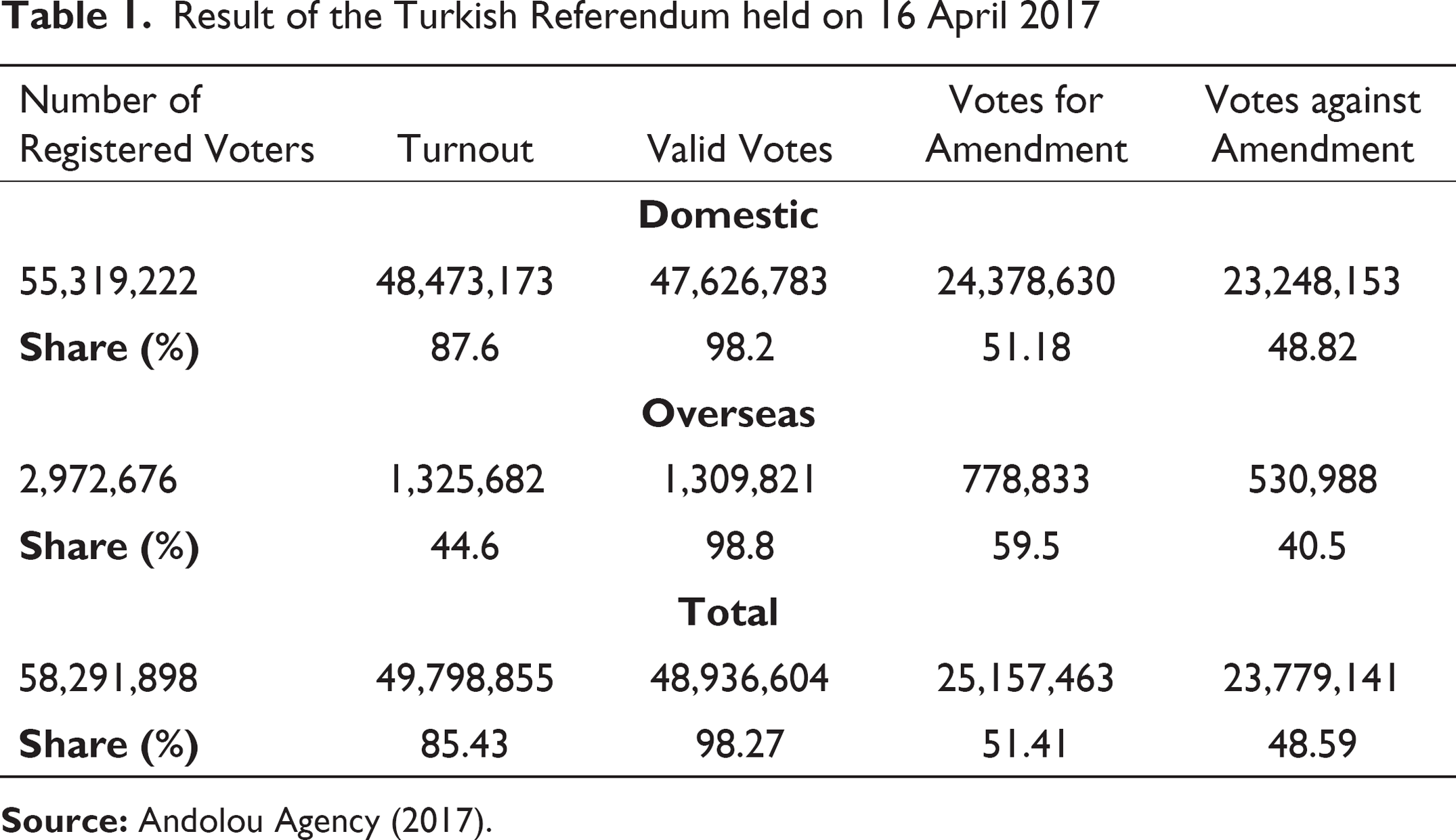
The results evoked sharp reactions in Turkey leading to eruption of protests in cities, such as Izmir and Istanbul, that overwhelmingly voted against the amendment while many AKP supporters were seen celebrating the victory wishing that a strong government can bring end to economic stagnation. The division among voters was visible with all bigger cities including Izmir, Adana, Antalya, and Kurd-dominated Diyarbakir which rejected the amendment with more than 60 percent votes. On the other hand, it was the agriculture-dominated hinterland of Anatolia, a strong support base of the ruling AKP, that voted overwhelmingly for the amendment (Çandar, 2017). Analysts believe that the small margin of victory, especially when the entire state machinery and overwhelming monopoly of the ruling AKP over the media, should lead Erdoğan to reflect on the “controversial” amendment bill (Kayaoglu, 2017).
If one looks at the campaign that preceded the referendum, the AKP had nearly monopolized the public sphere through the state machinery. As per one estimate, the primetime media space was overwhelmingly leaned in favor of the “Yes” supporters to the ratio of one-tenth prime hours on television and other mass media networks (Çandar, 2017). Following the victory, Erdoğan did not look triumphant and was “unusually brief and uncharacteristically muted” as the opposition gained significant number of votes (ibid.). However, he refused to back down from the idea of not pursuing the amendment and argued that a victory is a victory even if it is by a small margin and said that those casting aspersion on the transparency and fairness of the referendum results are enemies of the Turkish people (Harvey, 2017). Indeed, the results clearly shows a significant mass of Turkish population is against the constitutional amendment and coupled with allegations of rigging and misappropriation, one could wish that Erdoğan would have taken a pragmatic view and work toward reconciliation.
Historically, debates on changing the form of government in Turkey are not new and in the past many leaders have unsuccessfully toyed with the idea. For example, in the 1970s, the National Order Party and the National Salvation Party proposed a change. Later, MHP leader Alparslan Turkes (1979), Prime Minister Turgut Ozal in the 1980s and center-right leader Suleyman Demirel (1990s) had supported the idea of a transition from parliamentary to presidential executive (Cetin et al., 2017). While many Turkish and international observers do not see a link between the past examples and the current quest of Erdoğan to become a lifetime president, some see it as part of a historic need for shift to avoid the chronic political instabilities that have afflicted Turkey in the past (Usluer, 2017).
Nevertheless, the proposed changes would have far reaching implications on the future of Turkey. Significantly, it would not only change the character of the republic from parliamentary to presidential but would allow consolidation of one-person rule as the amendment provides overwhelming powers to the president over the judiciary and bureaucracy. Given the power the constitutional amendment enjoins upon the presidency and does away with some of the previous checks and balances on the executive especially from legislature and judiciary, the chances of Turkey sliding into authoritarianism increases. Democratic consolidation that had led to coming into power of an Islamist leaning AKP is also under danger because of the policies pursued by Erdoğan who has been holding emergency powers since the failed coup in July 2016. It would also change the character of the presidency who as per the current constitution is considered as the symbol for unity and neutrality.
Conclusion
The referendum results have exposed the sharp political divisions within the country and underline the dangers of a Turkish slide toward autocracy. The proposed change which comes into force in the next presidential election, that is due in 2019, acquires extraordinary importance because of the current political situation and continued stifling of opposition voices. President Erdoğan has been running the country under emergency laws since July 2016 and has not shied away from cracking down on dissent and opposition. The way constitutional amendment has been pursued has come under question and the parliament was unable to debate many clauses of the proposed amendment due to the unwillingness of the ruling party to heed to any of the opposition demands and resultant commotion. The run up to the referendum was mired in controversies with action against many political leaders and civil society figures because they held different views. The process of referendum and validity of the final results too have been questioned by both Turkish and international observers. The country is at a crucial juncture in history with a shift to an executive presidency but the way the process has been pursued so far raises troubling questions about the future of democracy in Turkey.
Footnotes
1.
The name of the court has to be changed from The High Council of Judges and Prosecutors to The Council of Judges and Prosecutors.