




Abstract
Several international and local studies have indicated that Arab students face specific difficulties in adapting to and integrating into Israeli colleges. This research aims to identify and analyze the adaptation difficulties faced by Palestinian students in academic colleges in Israel. The research sample consists of Palestinian freshmen from different schools and neighborhoods in East Jerusalem who are studying at a college in West Jerusalem. In-depth interviews were used to document and analyze the experiences and challenges of these students on campus. The interviews revealed a number of factors that impede students’ adaptation and their academic success, and they can be grouped under the concepts of culture shock, language barriers, isolation, and transportation. To deal with these difficulties, students used different strategies such as piety, withdrawal, dependency, and distancing. Implementing specific programs to consider and address specific social and cultural aspects of Palestinian students’ difficulties may contribute to reducing the alienation and culture shock they face in college, such as introducing programs on life skills and treatment of others, hiring faculty who are capable of understanding the Palestinian cultural context and introducing qualified Arab staff in the administrative and service departments.
Arab Education System in Israel
The Palestinian Arab population in Israel amounts to 1.7146 million, 20.2 percent of the total population, and includes Muslims (1.4203 million), Christians (160.900) and Druze (133.400) (Central Bureau For Statistics, 2015). The Arab population resides mainly in separate communities, in rural regions affected by economic scarcity, with the exception of some mixed cities. It is a heterogeneous society and consists of a variety of cultures, religions, ideologies, and geographical areas. In addition, the Arab population differs from the Jewish population in culture, norms, and values and is influenced by the norms and values of neighboring countries.
The Jewish and Arab educational systems are separated and unequal resources are invested in them. Literature has dealt extensively with the discrimination of Arab education by Israeli educational systems. The Statistical Yearbook of the Taub Institute (2014) indicates that in 2012, the percentage of students eligible for enrollment in the Hebrew education system was 73.6 percent versus 50.7 percent in the Arab education system. As a result, the Arab educational system suffers from lower physical infrastructures, formal budget inequality, fewer school hours allocated to the class or student, quality of teaching staff, and quality of support services and, as a result, lower outcomes (Mizel, 2018).
Therefore, it is expected that the education system will adopt a policy that ensures essential equality in case of low starting points for certain social groups, as do other populations in the country.
The Education System in East Jerusalem
The education sector in East Jerusalem is not supervised and governed by one body. There is no single authority that is responsible for the implementation of public education policy and is responsible for any deficiencies in the education sector.
Just as there is a political conflict over the sovereignty of the city, there is a conflict over who takes over the education sector. The triad of public education (consumption, government, a period of service) (Besley & Ghatak, 2003) is dysfunctional in East Jerusalem. There are four different triads. The first triad consists of the Palestinian consumer, the Israeli government and Manchi as a service provider; the second triad consists of the Palestinian consumer, the Palestinian Authority and the Jerusalem Education Directorate as a service provider (Awqaf School); the third triad is the Palestinian consumer, the United Nations and the United Nations Relief and Works Agency (UNRWA), which is a system of schools; and the fourth triad comprises of by private schools, which are not governed by a supervisory body. It could be assumed that because there are several service providers, there will be a wide range of services. By contrast, according to the 2009 State Comptroller’s Report, there was a shortage of more than 1,000 classrooms in East Jerusalem (Nusibeh, 2013). This shortage has led to overpopulation in existing schools, in all systems including private schools, with a slight variation between systems.
The Four Different Supervising Bodies
Manchi, Jerusalem Education Administration is a joint body of the Israeli Municipality of Jerusalem and the Israeli Ministry of Education.
Awqaf or Muslim Endowment, in collaboration with the Palestinian Ministry of Education, but according to the Oslo Accords the latter is prohibited from operating in Jerusalem and hence, these schools are governed by the Palestinian Education Directorate of Jerusalem. They are called Awqaf schools.
United Nations Relief and Works Agency (UNRWA), which oversees primary and elementary schools for the Palestinian refugees.
Local charities and other private schools.
Three systems in East Jerusalem offer free education to Palestinian students, Israeli-controlled municipal schools, Palestine-controlled Awqaf, and UNRWA, which seek to fill gaps in municipal provisions. However, they do not have full control over their schools in Jerusalem and are not recognized by the Israeli Municipality. There is no cooperation between the Israeli municipal system and the other two systems, which means that it is difficult to measure how many children are cared for, who, where, and how well.
Supervising Bodies of the Education Sector in East Jerusalem (2012–2013)

In the current political situation, Israel is controlling East Jerusalem and accordingly the strongest education system in the city is the Israeli system. This system provides education to a greater number of students and is connected to the social service, the ministry of the interior, and the police. It also enjoys higher budgets and has recently expanded to subsidies and control of private schools in Jerusalem. On the other hand, the Palestinian Ministry of Education provides education to 14 percent of the student population of Jerusalem. It does not have full control of its school buildings because those buildings are located in Jerusalem, which is under Israeli control. So, Palestinian schools cannot renovate school buildings or extend those buildings without Israel’s permission. The provision of educational services and struggles between the Palestinian Authority and the Israeli Municipality is a mirror of the political conflict over the city (Nusibeh, 2013).
The problem of access to educational institutions is not just limited to the primary and secondary levels. Palestinian Jerusalemite students also go through massive restrictions in enrolling in higher education. If they want to enroll in Israeli universities, they have to pass an array of exams and spend an additional preparatory year to master the Hebrew language. They also have to pay the steep prices of Israeli universities, because they are excluded from all the scholarships and support granted to Israeli students, based on their participation in the Israeli army (Cook, 2010). Their poor schooling also does not prepare them to compete with Israeli students for places in Israeli universities. This explains why they are dramatically underrepresented in Israel’s institutes of higher education. Enrollment in Palestinian Universities is also a problem because it means the students have to go through checkpoints at the separation barrier gates, on a daily basis, and change transportations several times to get to their universities in the West Bank.
Some students who come from wealthier backgrounds can afford to study abroad, but when they come back to the city, they must obtain official Israeli certification or licensing, which is given after taking additional courses and passing supplementary examinations. Therefore, many choose to either take low-income professions that do not require Israeli certification, or they look for employment in the West Bank. Another societal practice used by ethnocratic states to control the weaker ethnicities and curb their educational motivation is placing job ceilings and related employment barriers on them, thus forcing them to seek self-advancement through nonacademic routes. Palestinian Jerusalemites’ employment mobility has an exceptionally low ceiling in the Israeli Jewish society. Palestinians find it hard to penetrate the Israeli labor market. This forces the Palestinian Jerusalemites to find jobs in underdeveloped East Jerusalem or go to the West Bank. All those problems have resulted in high unemployment rates in East Jerusalem
Numerous Palestinian students study at Israeli colleges. The majority study together with Jewish students where the language of instruction is Hebrew. Orientation days at universities are often the first encounter between Jews and Palestinians, and they provide an opportunity for students to be introduced to one another on an equal footing. Often, this meeting is a shock for the Arab students. At the same time, Israeli colleges provide a space of freedom for students, especially in comparison to the social context from which they come. Thus, many students prefer to study at Israeli colleges, despite the difficulties they face (Tutery, 2009).
Definitions of Adaptation and Adjustment
In this article, the terms adjustment and adaptation are used synonymously. Although some scholars maintain that adaptation is more linked to biological processes, for example, helping a living thing to survive and reproduce (Michael, 1996, p. 245), while adjustment is related to psychological process, the current research adopts Chelliah and Yusoff’s (2010) stance that these terms represent different perspectives of the same concept. Adaptation and adjustment, therefore, are used to refer to a person’s involvement with their environment (Arkoff, 1968). Arkoff adds that adaptation is mostly measured by students’ academic performance and emotional growth when this environment is a university. Gharaibeh et al. (2011, p. 251) state that adjustment is “a psychological process of adapting to, coping with, managing problems, challenges, tasks and requirements of daily life.”
Adaptation at Universities
For international students who come from different cultures, entry into universities and colleges in Western countries, and foreign countries generally, is challenging, and presents serious adjustment difficulties. The difficulties shown by researchers (Erichsen & Bolliger, 2011) include language difficulties, adjusting to the academic culture, culture shock, and communications difficulties in both the public and the academic spaces.
These difficulties cause feelings of frustration, isolation, and culture shock and lead to social difficulties. These issues can stay with the students over time and can influence their achievements and their academic paths. These claims are supported by empirical research carried out by many researchers throughout the world. For example, researchers such as Russell et al. (2010) and others discovered that 22 percent of the 900 students they investigated experienced various levels of adjustment difficulties. Another study (Yi et al., 2003) carried out in Texas found that international students experienced adjustment difficulties, and that despite the fact that the university offered advisory and support services, very few students used these services.
Language is considered the central component of adjustment difficulties. Galloway and Jenkins (2005) claimed that in meetings of students with academic staff, the staff were not friendly, did not understand the needs of the students, and did not understand them due to their lack of ability to communicate in the language of academic institutions. Moreover, the academic staff criticized the students, saying that they arrived insufficiently prepared in terms of language, and that they should have taken responsibility for learning the language before arriving at the academic institution.
Because of the limited capacity to communicate, contacts with academic staff both inside and outside the classroom caused international students to develop low self-esteem and a sense of shame. Terui (2011) says that many students claimed that they understood the material, while, in fact, they only pretended to understand. They did so because of the shame and low self-esteem that could develop. They worried that they would be seen as less accomplished if they were caught. When academic staff members meet students with language difficulties they doubt their capacity to complete the academic requirements (Beoku-Betters, 2004). The researchers recommended to academic institutions to encourage these students and to recognize their needs and their cultures.
Beoku-Betters (2004) emphasized that the communication problem is rooted in the prejudice that the academic staff have toward the students. This prejudice toward international students exists not only among the academic staff but it also characterizes the attitudes of local students. Research that tested the views of American students toward international students found that the local students saw them as a threat to the culture and values of American society. The explanation for this prejudice lies in the lack of interaction between the two communities (Beoku-Betters, 2004).
The educational future of foreign college students is affected by the degree of their social and cultural adjustment to the new cultural setting they find themselves in when they start their higher education. The educational process reflects a new lifestyle and the culture of the society in which the education is offered. It is also an opportunity to attain scientific, academic, and technical expertise and qualifications. Since humans are sociable by nature and capable of coping with different circumstances and responding to life developments, the process of social adjustment is of vital importance for university students. The most significant processes of adjustment are those that take place following the transition from one sociocultural environment to another. The difference in cultural environments means a difference in the elements of culture, namely customs, traditions, language, values, and social norms.
When foreign university students leave their cultural environment to pursue their education, they move to another cultural environment and thus are exposed to a number of social impediments, difficulties, and pressures. They are forced to adjust and to balance the process of absorbing a new culture with the pursuit of a college degree in foreign culture.
Israeli universities attract Palestinian students, and the number of students holding a Tawjihi (matriculation certificate, issued by the Palestinian Ministry of Education) has recently increased in Israeli colleges and universities. This is happening in the context of the Israeli-Palestinian conflict, which creates additional social, political, and cultural conflicts and estrangement. In addition, the Israeli university community is distinguished for being a cultural environment where most of the students have already experienced a period of social interaction in the army, and thus most of them are also a few years older than the Palestinian students who come directly from high school. As a result, Palestinian students experience additional psychological difficulties not experienced by other foreign students who leave their previous social networks (Archer, 2004).
Social and cultural adjustment requires a great deal of knowledge, concepts, and information to facilitate students’ integration and help them overcome the problems they face, thereby enabling them to benefit from their educational journey (Abdallah-Pretceille, 2006; Qatham, 1984). Therefore, the adjustment of university students, especially foreign students, to the university’s social and cultural environment is a critical manifestation of this adjustment; students’ feeling of satisfaction with the quality of their university life will reflect on their performance, achievement, and productivity (Abu Laban, 1989; Baker & Siryk, 1984).
Good adjustment enables individuals to control their emotions, react responsibly, understand objectives, and accept others. It distances them from self-centeredness and allows them to achieve harmony between the self and the members of the group to which they belong. This requires a great deal of personal and social maturity on the part of the individual (Abu Laban, 1989; Good, 1973). Accordingly, sociocultural adjustment helps individuals to properly interact with the social and cultural environment and to become a productive element within this environment. The individual will not experience the harshness of the new customs, norms, and traditions; rather, these will become part of their makeup and personality (Nassir & Ganini, 1998). Since the adjustment of university students to the new cultural environment is a crucial factor for the success and continuity of the educational process, and to fulfill their educational role, universities should provide an appropriate study atmosphere to address students’ needs on campus (Al Lil, 1993; Gaddis, 2013).
Undoubtedly, the specific cultural context of the foreign student plays a vital role in the problems of adjustment and maladjustment in many countries (Abdallah-Pretceille, 2006; Archer, 2004). According to Arab students, the systems of higher education in Western universities represent high standards and offer high quality education. They also contribute to the development of democratic practices and critical thinking (Abualkhair, 2013).
Mostafa (2006) indicated that there are attraction factors that influence Arab students’ decision to study in foreign universities. These include students’ dissatisfaction with their domestic environment such as economic resources, number of educational institutions, unavailability of specializations, and negative political and social conditions. Mostafa indicated that reasons why Arab students were attracted to foreign universities included availability of financial support, better work conditions, varied cultural life, better employment opportunities, and employers’ preference to hire graduates of foreign universities.
Ono Academic College
Ono Academic College (OAC) is a private college located in Kiryat Ono, Israel. With over 14,000 students, the college is among Israel’s fastest growing institutions of higher education. In addition to promoting academic excellence, OAC emphasizes inclusivity by utilizing higher education to foster social integration by way of decreased economic and cultural gaps in Israeli society. As a result, populations that are otherwise underrepresented in Israeli higher education, including Druze, Arabs, Palestinians, Ethiopian-Israelis, ultra-Orthodox Jews, and students with special needs, gravitate to OAC. A new branch of this Israeli academic college recently opened in Jerusalem, admitting graduates from Palestinian schools in Jerusalem and the surrounding areas. In addition to the regular difficulties of foreign students, within the special environment created by the political situation, these students face several unique difficulties. They have noticeable weaknesses in both Hebrew and English. The majority of these students come from single gender schools where males and females are educated separately. In addition, the majority of these students hold a Palestinian Tawjihi certificate and not an Israeli Bagrut (matriculation) certificate. These factors create many difficulties in the integration of these students into the college and lead to serious problems in adjustment and to feelings of alienation, which produce behaviors that hinder their academic and educational achievement. Accordingly, this research will address the difficulties and problems faced in the college by Palestinian students from East Jerusalem, specifically freshmen enrolled in the faculty of education.
Palestinian Jerusalem students opt for learning in certain higher education institutes in Israel, especially at Israeli academic colleges, since these institutions provide opportunities that are not available at Palestinian universities or other Israeli universities. Furthermore, the prestige that a foreign certificate enjoys qualifies the holders of such degrees to improve their living standard and obtain better-paying jobs than those provided by degrees in their original country (Ali, 2013; Mostafa, 2006).
Arab Palestinian students in general, and Jerusalemites in particular, face a number of unique challenges when they attend an Israeli institution. The most challenging of these are learning and exercising self-expression in Hebrew within a new cultural context, leading to culture shock.
Culture Shock
In general, studying in a foreign country with a different cultural setting presents difficulties and challenges for Arab students. Culture, language, religion, and geography are all factors that may be new to an Arab student (Ryan & Twibell, 2000). These factors collectively and individually influence adaptation and constitute an obstacle to academic education and represent a culture shock.
Macionis and Gerber (2010) defined culture shock as follows: “The personal disorientation a person may feel when experiencing an unfamiliar way of life due to immigration or a visit to a new country, a move between social environments or simply when traveling to another type of life” (p. 54). Rajasekar and Renand (2013) similarly described culture shock as the anxiety or stress that is caused by being in a new and foreign environment and the absence of familiar signs and symbols of the home country. They identified 14 factors that contribute to culture shock, namely communication, dress ethics, individualism/collectivism, food, language, structure, perception, power, distance, religion, time, orientation, traditions, and weather.
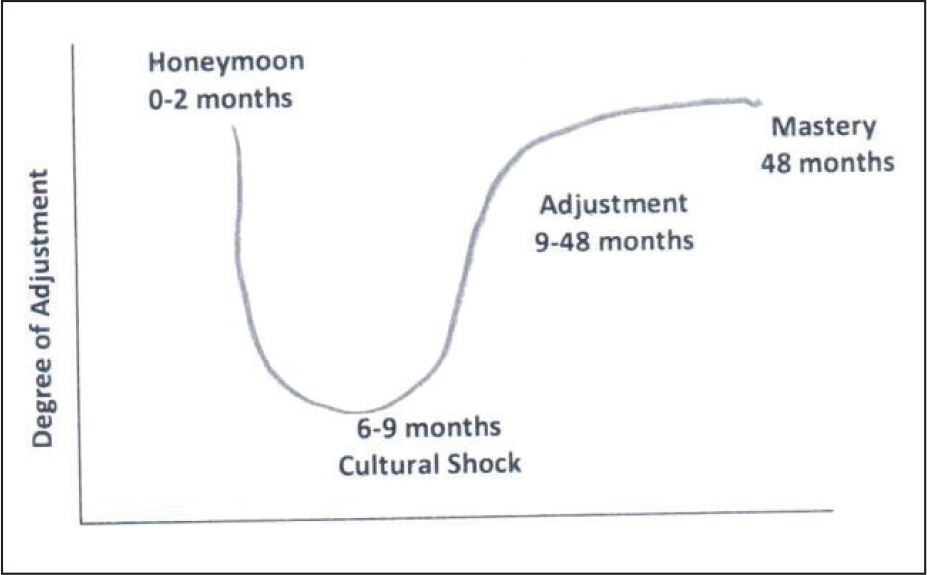
Lysgaard (1995) believes that students usually experience the culture bump over four stages which is portrayed in Figure 1:
Honeymoon; culture shock; adjustment; and mastery.
Lysgaard noted that acculturation is a process that takes place overtime and usually follows a U-shaped curve. In other words, the different stages are experienced more than once in an adjustment process that is rarely linear. He stressed that adjustment which may seem easy at the beginning is usually followed by a crisis felt by the person who is poorly adjusted, lonely, and unhappy. Eventually, the individual starts to feel the need for more adjustment, leading him/her to become more integrated. Some studies (Smith & Khawaja, 2011) have indicated that Arab students studying at foreign universities faced similar challenges regarding their ability to adapt to a new environment. However, in the absence of support networks, the culture shock experienced by Palestinian students studying in Israel is likely to be more extreme and leads to greater feelings of incapability.
Culture shock and the resulting feeling of isolation can lead to the development of a set of emotions and feelings such as anxiety, worry, confusion, and loneliness. People suffering from these feelings may later develop a number of social and psychological symptoms such as feelings of homesickness, loneliness, frustration, excessive sleeping, compulsory eating, loss of appetite, drop in energy, and disassociation from social activities, as well as stereotyping of, or hostility toward, local people (Komiya & Eells, 2001).
Mehdizadeh and Scott (2005) indicated that the closer the students’ culture was to the local host culture, the easier the interaction as well as the overcoming of difficulties. Some studies of Arab international students in Western countries indicate that these students face enormous cultural differences, which contribute to the creation of isolation, shock, and maladjustment. Mehdizadeh and Scott (2005) found that cultural differences had a huge impact on creating difficulties that contributed to maladjustment of Arab students with the local community.
Many studies indicate that the challenges and difficulties faced by Arab students are related to the academic side, especially limited knowledge of English, as well as to educational practices of foreign institutions, which vary greatly from what Arab students are used to in their home countries (Ahmed & Mahrus, 2010). For example, foreign universities, especially American universities, practice active learning, which is not practiced in Arab institutions (Kuo, 2011). Arab students indicated that they were also not used to the teaching methods in American institutions; for example, to faculty expectations with regard to note-taking and summarizing. In a research conducted among a sample of Arab students studying in Canada, Mostafa (2006) found that Arab students experienced difficulties in adapting to Canadian universities due to their poor English language skills. These students were forced to practice restraint in their contacts with classmates and the local community.
Adaptation of Arab Students in Academic Institutions in Israel
Several studies (Ali, 2013; Al-Hajj, 1996, 2002; Rslan & Rilage, 2003) were conducted on the degree of Arab students’ adaptation to Israeli academic institutions. These studies indicated the presence of specific difficulties covering the majority of academic and social aspects of the students’ lives.
In a study (Rslan & Rilage, 2003) conducted on a sample from Oranim College in the Haifa area, it was found that Arab students faced huge adaptation difficulties in studying at the college. The study revealed that the first year was a shock for these students. It recommended that the college adopt a policy to facilitate the integration of Arab students into the college and ease the cultural shock by increasing the number of Arabic-speaking staff and faculty and having an Arab representative on the students’ senate.
In another study, Davitovitch et al. (2006) found that the majority of Arab students in Israeli institutions faced difficulties in learning and studying. It was found that 50 percent of Arab students faced more difficulties in completing tasks than their Jewish classmates. The study indicated that many of the Arab students were cautious not to express their personal political views for fear of punishment taken by the college administration against them. In a study conducted in Haifa University, Al-Hajj (1996) found that Arab students faced adaptation difficulties. One-third of these students changed their major or dropped out of university compared to only 12 percent of the Jewish students. It was found that teaching methods, language, and cultural context contributed to the non-integration of Arab students into the university.
Another study by Al-Hajj (2002) found that Arab students faced adaptation difficulties due to the university’s social and cultural atmosphere, which is distinguished for being liberal. Such an atmosphere conflicts with the beliefs of these students, the majority of whom, especially the female students, came from a conservative and traditional environment.
Role of the Academic Leadership
Academic policymakers and the leadership have a central role in dealing with adjustment difficulties in the universities. They can help students overcome the difficulties. But to respond to the needs of international students who come from different cultures, the academic leadership should have multicultural and communications capacities and skills (Pope & Mueller, 2011).
Engaging staff from minority groups, or staff who have knowledge about multiculturalism can help solve social and cultural problems. Most importantly, the staff should be aware of the cultural diversity of international students. Kuh et al. (2010) argues that the academic leadership and decision-makers can assist the international students in the adjustment process by encouraging a just and inclusive educational climate that would assist students to succeed and continue with their studies. Northouse (2015) adds that equality consciousness among staff members and academic leadership can reduce adjustment problems. Applying pedagogic approaches suitable to the cultural context of international students, mixing local and foreign students in leading community projects, and extending a warm welcome to new students help them to get over culture shock. In addition, the pedagogic leadership should ensure that lecturers include multicultural perspectives in their teaching.
One of the difficulties faced by foreign students is language difficulty, as they are not proficient in the language of the institution (Jamaludin et al., 2018). Normally, academic leadership requires that language learning should take place within the university. This causes the foreign students difficulties such as low self-image and difficulties in communication. Accordingly, it is important that the academic leadership ensures language learning in informal structures, which would bring the students into contact with the local communities which are less threatening than the academic community. In the local community, there is less concern about tests and value judgment, and this makes it easier for the foreign students to learn the language (Liu et al., 2011).
Design and Conduct of the Present Study
Throughout the present researcher’s academic teaching experience, when talking with students and teachers, especially teachers of Hebrew and English who teach Palestinian students in the college, he noticed that students faced problems and difficulties that prevented them from being integrated into the new cultural environment. This issue engaged the attention of the researcher and led him to study the degree of adjustment of these students to the cultural environment in the college, to identify their problems and assist them in finding solutions that would help in their integration and adaptation to the academic community of the college.
Methodology of Study
This research uses qualitative methodology, since this kind of methodology contributes significantly to understanding human phenomena. It gives a full picture of the reality since the research takes place in the natural environment of the students (Shkadi, 2004). Furthermore, qualitative research contributes to collecting new data to answer the research questions. This kind of research contributes to an understanding of the cultural context to understand matters as they stand through speaking directly with the individuals and allowing them to narrate their life stories (Creswell, 2007, p. 110).
Categorical analysis was used, whereby primary categories were identified at the start, in which the researcher identified repetitions. In the second stage, the researcher defined the categories and defined the criteria for the categories. The last stage was the definition of the final set of categories.
Study Objective
This study aims to identify the degree of adaptation of Palestinian students (especially freshmen) to the college, and their integration into the new cultural and social environment. Moreover, the study aims to examine the role of the academic leadership of the college in dealing with these difficulties.
Study Population and Sample: The study population is composed of 120 male and female freshmen in the Education Department (80% females), and the sample includes 30 students (15 males and 15 females) chosen randomly from this population. It was decided to focus on first-year students since they are the most vulnerable to culture shock and nonadjustment.
Study Significance
The significance of the study lies in the fact that it could reveal the difficulties and problems faced by Palestinian freshmen during their studies at an Israeli college. This will enable Students Affairs officials to deal more effectively with problems and find the means and techniques to integrate these students in the learning community.
It should be noted that this study can become the basis for additional research, as well as give rise to a conceptual framework arising out of the students’ stories. Such a framework could be useful to universities around the world, which are dealing with similar difficulties. In particular, it could help Western countries that are taking in Arab students who are forced to immigrate to Western countries.
Study Questions
The study was designed to explore the following questions:
What are the difficulties Palestinian freshmen face while studying at the college? What are the strategies used by students to adjust to this new culture? From the perspective of the students themselves, how does the college staff contribute to assisting students to adjust to their new academic environment?
Study Tool
The research used (Grand Theory) the theoretical approach based in the field, which makes sure to collect information from students, lecturers, and policymakers in the college concerning the difficulties faces by students as they arrive in the college. This theoretical approach answers the research questions on the basis of the interaction between the researchers and the research subjects.
The research questions were shaped by the research literature, as well as by the difficulties experienced by the students in their initial meetings with the college. Many complaints and conflicts were raised by the students in their conversations with the college leadership. The students were asked to write down their difficulties on paper without identifying themselves, and these pages were given to the researcher. Many of these difficulties were repeated by various students including language difficulties and late arrival due to transportation difficulties and police checkpoints (the research was conducted in Jerusalem where there is significant tension between Palestinians and Israelis and significant presence of police and military personnel). The students were also asked to write down how, despite the difficulties, they manage to survive academic life.
Semi-structured interviews were used to collect data. Semi-structured interview is defined as “a tool, the purpose of which is to obtain an objective description of the person’s life and to allow him to give meaning to the investigated phenomenon” (Kvale, 1996). Audio interviews were not used, in light of the sensitivity of Arab society to this kind of interview. The answers were written down. After finishing the interviews, the interviewer spoke to the subjects once again and read their answers to them. Students agreed on the content of what was written. In three cases, additions were made to the interviews at the students’ request. One student asked to delete a piece of information related to the relationship between male and female students.
The questions for the interview were prepared in advance and focused on the following aspects:
What are the difficulties faced by students upon enrollment at the college? Does the new cultural context influence their adaptation? Do students think that faculty members understand their needs and help them to adjust? Has the thought of dropping out of college due to adaptation problems ever come up? To support the findings from the interviews, the researcher conducted observations during lectures and on the college campus during breaks.
Study Ethics
Since the researcher holds an administrative position which might influence the responses, he did not conduct the interviews himself, to avoid ethical issues. Four of the interviews were conducted by a student representative, and 25 interviews were conducted by the Department’s secretary, with whom the students feel at ease. The students were informed about the importance of the research, which will identify their problems and assist their integration into the college. Students were promised that their responses would be kept in full confidentiality and only used for research purposes. They were also told that they could withdraw from the research at any time.
Results
Categorical analysis was used, whereby primary categories were identified in the first stage, and in which the researcher identified repetitions. In the second stage, the researcher defined the categories and defined the criteria for the categories. The last stage was the definition of the final set of categories.
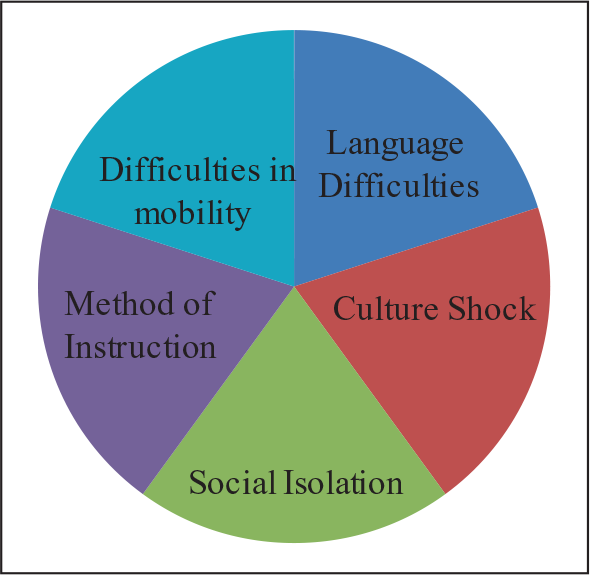
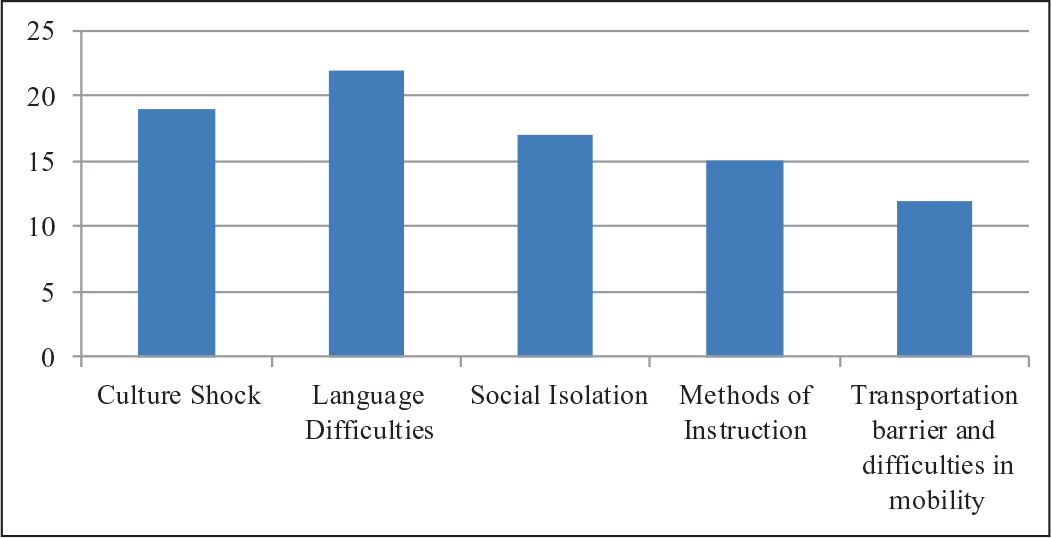
The data were analyzed based on the information from the interviews and the observations according to specific aspects, after which they were coded (Shkadi, 2004) and classified into diverse aspects. Sorting of responses showed five main difficulties faced by students: culture shock, linguistic difficulties, isolation, method of instruction and transportation. The main difficulties of students were shown in the graph below, (See Figure 2), and a summary of the survey findings was shown in Figure 4 below.
Culture Shock
Nineteen of 30 students reported that they experienced culture shock, with adjustment to the new environment being the biggest trigger of culture shock. The process of culture shock experienced by freshmen Palestinian students was in line with the first part of the U-shaped curve shown by Lysgaard (1995). The students’ experience began with a “honeymoon” followed by culture shock. As all the students interviewed were in the first year, the process of adjustment was in its early stages. One student said:
I started to talk more with my family. Although I used to return home in the evening, I felt that I was outside the country. In the first weeks, I was so happy because I was in a new environment. However, I soon experienced a culture shock due to differences and the different cultural atmosphere.
Another student said:
A day before the beginning of classes, I felt extremely happy about being admitted to the College. A few weeks later, I was in shock. I saw the mixing between boys and girls. In the Medicine School plaza, I saw a male student hugging a girl from the Jewish community. Since I am a pious student, I thought of dropping out of the college.
Students expressed difficulties in social relationships since they did not know the majority of students. For example, “I used to feel jealous of Sur Bahir and Jabal Mukabir students since they were engaged and knew each other. I was not their friend.” A female student said “During the first week, I cried a lot and wanted to drop out of college; however, the sum of money I paid was huge, so I was obliged to stay in college.”
Linguistic Difficulties
Twenty-two of the 30 students said that language difficulties were a central impediment to their academic integration at the college, so language barriers were the most prominent difficulty. One of the main obstacles to adaptation was reading, writing, and communication with teachers who did not speak Arabic. One student claimed that:
We learned Hebrew at school. However, the teaching of Hebrew at school was not serious. The school did not attach any importance to teaching Hebrew. Studying Hebrew at school was a total mess. We studied for five years without mastering writing skills. On most occasions, we spent the Hebrew language classes outside the classroom.
Language problems lead to students’ inability to communicate and interact with others.
Students reported that during Hebrew classes, they spoke in Arabic. One female student said “It happened once that I asked my classmate a question about a word the teacher used in Hebrew, but I did not understand it. Unfortunately, the teacher made me leave the classroom thinking that I was naughty.” Another student said:
The problem is not only with the Hebrew language, but we also face difficulties with the English language. The majority of our classes in freshmen year are classes to learn Hebrew and English. So, we study almost nothing in our specialization. This in itself caused a shock for us, making us lose the desire to learn.
Students reported that they were in shock when they studied general subjects like marketing, law, and physical education (the college offers these courses in freshmen year as enrichment). However, the terminology, especially in marketing and law, is far from the students’ comprehension. One student said “I came to study education but found myself studying Hebrew, Marketing, and Law. This is what I did not want.”
One student indicated that:
The lecturer would have a PowerPoint presentation in Hebrew and his language of instruction would be Arabic. This is distracting. We look at the PowerPoint, but we do not understand the terms and the language. We try to connect between what the teacher says in Arabic and what is written on the PowerPoint in Hebrew, but we do not succeed, and it distracts us.
Another student indicated that:
In the marketing course, there are two lecturers; one is an Arab and the other lectures in Hebrew with simultaneous interpretation. When the lecturer speaks Hebrew, many students don’t understand because they do not know the language very well. Some of the students are extremely interested in understanding Hebrew and want to follow the lecturer, but most of the students wait for the Arabic translation. This system does not give the students an opportunity to pay attention to the lecture and this distracts others. Sometimes the translation is word for word, so it is difficult for us to understand the material, especially economics terms. This system does not allow us to ask questions during the lecture. This means that we always just receive information.
One student mentioned that:
many of his classmates did not wish to go to lectures, and sometimes due to checkpoints and traffic jams, we would be late by 10-15 minutes. This is allowed, but when the teacher inquiries about the reason, he would ask in Hebrew. On several occasions, the students were unable to express themselves in Hebrew. Thus, they opted for not going to the lecture so as not to feel embarrassed before the teacher and other students since they did not speak Hebrew well. They consider this a scandal for them.
A female student stressed that she was 20 min late once since she had to go with her mother to the clinic, but she could not express herself in Hebrew, so she preferred to stay outside for fear of embarrassment in front of her classmates. When the Hebrew language teacher asked another student why he was late, he said, yishazama. The first word is Hebrew [meaning “there is”] while the second word is Arabic [meaning “traffic jam”]. “So, the students laughed at me for mixing the languages, and this does not encourage me to communicate in Hebrew.”
Hebrew uses quite a few slang words borrowed from Arabic, but the Hebrew usage is at times different from the original Arabic meaning. An oft-used Arabic slang word in current Hebrew is “basa,” which is used to express disappointment, essentially like “a bummer” in English. However, in its original meaning in Arabic, it is a fairly dirty swear word. When a teacher speaking Hebrew uses the term, Arab students feel extremely uncomfortable and respond negatively. This is another type of language barrier.
Many students expressed their language difficulties (Hebrew and English) and how these create problems in their communication with their teachers. A female student expressed this well: “I do not feel comfortable to ask questions when the lecturer speaks. He speaks non-stop and has no time for questions, and because of language difficulties we do not dare to ask.” With respect to language, another student said “I cannot understand many words in the language, especially because of pronunciation and speed. This causes me to escape from the room and to ask myself why I went there in the first place.”
Another student emphasized the conflict he feels with respect to Hebrew.
I understand the Hebrew when I cross the checkpoint and the security zone in East Jerusalem. The soldiers’ Hebrew is different from the Hebrew used in the College. For example, I am familiar with Hebrew words for “move aside,” “checkpoint,” “open your bag,” and “where are you from,” because I hear them every day. But it is different in the College where I learn new words every day.
Similarly, a student talked about the Hebrew of the public space, which is not like the College Hebrew: “I work in a supermarket and I know certain standard Hebrew words like ‘cart’, ‘tomatoes’, ‘cash register’, and ‘bread’; words that are repeated every day.”
Another student claimed that learning Hebrew made him lose his friends. He described this situation as follows:
We had a test, and most of my friends remained at a low level. I was moved to the upper level, and there I have no friends. I asked the teacher to return to study with my friends at the lower level, but she refused. These causes me frustration, so once I sneaked into the classroom of my friends, but the teacher was angry with me and expelled me from the room.
One student said that his father is always interested in his studies, especially the language studies. “This is very stressful. It is important to my father that I meet his expectations, but on the other hand my knowledge of the language is still very limited, and this causes me anxiety.”

It is possible to conclude that learning Hebrew has many different meanings for the Palestinian students: military/security terminology, terminology in the public space versus terminology in the academic space. Figure 3 portrays the three encounters of Arab Palestinian students with the Hebrew language.
Encounters within each of the terminologies offer a different type of Hebrew.
Interaction with the security forces is their first encounter with Hebrew, because of the security situation in East Jerusalem and the Israeli-Palestinian conflict. They encounter security-related Hebrew before they come to the academic institutions. For example, expressions like “stand aside,” “open your bag,” “where are you from,” and “identity card” are familiar to the students from their daily passage through the checkpoint, where they deal with the security forces. Students know the Hebrew of the public space. For example, in encounters in public spaces such as banks, post office, municipal services, and supermarkets, the students know Hebrew. In the supermarket, for example, they know the terminology related to their work such as cash register, milk, tomato, and cheese. In terms of academic terminology, colleges and universities, they know less Hebrew and it is the most difficult for them.
Thus, it is possible to say that the Jerusalem Palestinian students experience at least three different types of Hebrew terminologies. Moreover, Hebrew is identified with the occupier but on the other hand, Hebrew is necessary to operate within the Israeli labor market and academic institutions.
Methods of Instruction
Fifteen of the 30 students said that the instruction methods at the college make it difficult for them to integrate. Arab schools continue to reflect the society they serve, so most schools lack a climate of democracy and the relations between the teachers and students are based on obedience and on the teacher always being right. The prevailing method of instruction in Arab schools is the traditional monologic method (Mizel & Caldwell, 2012).
Upon their arrival at the college, the students began to experience the dialogic method of instruction and cultivation of independent learning, as well as digital instruction, all of which they were unaccustomed to. One interviewee remarked that:
I feel lost. The lecturer throws out all kinds of phrases and asks that we discuss them in depth and voice our opinion and I don’t understand; I never voiced my opinion in school or even in the family; no one asked my opinion. I bought a large notebook and thought that I’d fill it with material but when I come home and look at the notebook, I just see all kinds of scattered phrases and I can’t connect them to each other. At that moment I missed our teacher in high school; he would dictate all the material so that we could write it down in our notebooks.
Another student said:
There are teachers who bombard us with reading materials in Hebrew and English, even though they know that we can’t read Hebrew or English. Also, he doesn’t talk about the essays we read (and most students don’t read), which affects our motivation and therefore we fail the examinations.
One female student said that:
There is one teacher that is considerate of us and writes the material on the board. I felt that I understood better because he organizes the material. All teachers should teach this way…We have a course in law studies, in the context of education studies, and we have two lecturers that teach the groups separately. In our group, students find it difficult to succeed because the teacher conducts a dialogue with us and asks us to give our opinion and many students are afraid to do so and do not cooperate. The lecturer then explains some of the topics himself, though not all, and many students remain frustrated. On the other hand, the other lecturer dictates the material to the students, and they learn it by heart and therefore enjoy greater success.
The students attributed their success in their studies to external factors such as luck, type of the test, teacher, and even superstitions. One student said, “Many students pass the examinations due to luck and especially so in the multiple-choice tests.” Another student said that “Before a test I read a lot from the Koran and pray, and in most cases the Koran protects me, and I succeed.” Seven students remarked that “Everything depends on the lecturer, and with some lecturers you’ll never succeed, so there is no point in studying.”
Social Isolation and Relations between the Sexes
Seventeen of the 30 interviewees claimed that the mixed classes make it difficult for them to integrate in the college. Most schools in East Jerusalem are not mixed, though male teachers usually teach in female schools and vice versa. One student said that it was difficult for her to be with males, but she somehow got used to this in class. But she said “After the teacher leaves the lecture hall, the male students stay in the room, but I don’t wish to stay with them, so I go out to the corridor.”
Students explained that as a result of isolation, they spent most of their time in the library, rather than interacting and mingling with other students. They stayed in the library not to study but to avoid mingling with the opposite sex. One student said:
I isolated myself from the community and dedicated my time to studying. I do not have friends in the college. I find it difficult to make friends with students from the same culture. I am from Beit Hanina, and I don’t wish to make friendships with students from other places. The number of students who come from Beit Hanina is small, but I prefer that my friends come from Beit Hanina and not from other places in Jerusalem. (Beit Hanina is seen by Jerusalemites as a wealthy, high-class residential area.)
Religious students (two males and one female) said that the college did not provide separate facilities for them. The college does provide for separation between males and females for religious considerations, but only for ultra-orthodox Jews, as they are recognized by Israeli society.
Transportation: Barriers and Difficulties in Mobility Due to the Security Situation in Jerusalem
Twelve of the 30 participants claimed that transportation problems and security situation make it difficult for them to arrive at the college on time, hindering their integration in the institution. A number of students indicated that the lack of public transportation and military checkpoints between East and West Jerusalem constituted obstacles to reaching the college. Consequently, they are late for class and are not allowed to enter into the classroom. This makes them feel bitter; some who arrive late just do not attend classes. A student explained:
I have to cross the Qalandia military checkpoint; then, I take the bus to Jerusalem, and then another bus to the college. This takes a lot of time. When I arrive at the college, I am tense, stressed, and nervous. I sometimes run into confrontations with the lecturer who refuses to let me enter the classroom, so I leave the college and do not attend the rest of the lectures.
Another student indicated that:
It is true that the college provides bus service for us on Fridays, but the problem is with morning classes. When we are late and not allowed to enter the classroom, we just go to the nearby mall or go to work, because we no longer want to study.
A female student stressed: “The first lecture is important. If we are not allowed in, we no longer wish to attend other lectures, especially the Hebrew language classes.”
Survival Strategies
To deal with these problems, students developed survival strategies. Some students resort to sitting in the library not to study but in an attempt to avoid mingling with other students. Other strategies include excessive absence, dependent behavior, and isolation. Some students resort to God and piety.
The research shows that some students used avoidance and escape strategy. This strategy is used especially by students who do not have enough inner strength to deal with the difficulties, so they attempt to avoid the problems. A study by Endler and Parker (1990) stressed that this strategy includes distraction, withdrawal, and smoking, especially smoking hookah on campus.
Some students used the strategy of seeking support and assistance. This strategy represented an important aspect upon which students relied on for adaptation. Endler and Parker (1990) argue that social support is crucial in times of stress. Students and academic secretaries indicated that students would ask silly questions such as “Where is my classroom? How can I use the college website? Who is my teacher?” A female student claimed that the strategy she used a number of times was self-control for fear of having an argument with others just because of the problems for which she did not have an appropriate solution. Three students claimed that they became more religious, thinking that this would help them to succeed in the college.
The majority of students explained that most of the teachers did not help them to adapt and did not understand their psychological and social needs. Their only concern was to teach and nothing else. Five students who studied Hebrew indicated that one of the teachers cared for and helped them. He understood their needs, so many students wished to study Hebrew with this teacher.
The majority indicated that they liked teachers who talked about their social problems and not teachers who just taught. A student said:
There is a teacher who dedicates a big portion of his class to talking about our social conditions, so we like this teacher more than the other teacher who is very serious and focuses only on the material while ignoring the psychological and social aspects. We were very touched when this teacher said, “Tomorrow, guys, if you don’t complete your education, no girl will agree to marry you.”
To conclude, when asked who could help them in the college, some students indicated that the Hebrew teachers were the only ones capable of helping them. However, a large number of the students indicated that they did not know who would be able to help them. There is clearly some kind of confusion. One said:
Every secretary and every office say something different. For example, I wanted to change the teacher because I did not understand, so I went to the Marketing Department in the college. After they told me go to the academic secretaries, I had to alternate between three secretaries; then they said go to the department head. Then I got what I wanted, but many students do not know where to go and they face numerous problems, and there is always tension between the officials and the students.
Other students face difficulties with the finance office. They sometimes go to the Marketing Department in the college, which says to them one thing, and when they go to the finance office, they say something else. This causes a lot of stress and confusion for the students.
Conclusions and Discussion
International students make up a significant population in universities in the West and in the world. According to an OECD report (2014, p. 32), nearly 4.5 million students were registered in universities outside of their home countries. To this should be added many Arab students, especially from the Middle East, who have changed their place of study due to wars, geopolitical changes, and immigration and have moved to the West. They brought with them social norms and cultures that do not fit with their new educational institutions, and as a result, they have adjustment difficulties. To deal with these difficulties requires significant efforts and energies from the policymakers and the leadership of educational institutions.
Similarly, in Israel, the percentage of Israeli Arab students is growing significantly in the Israeli academic institutions, and they are recently joined by Palestinian students. This increase brings with it adjustment problems which are challenging the policymakers and leaders in Israeli institutions to deal with this phenomenon. It should be noted that adjustment issues are more complex in Israel than in the Western world because of the Israeli-Palestinian conflict. The significance of this research is to help policymakers and leaders in academic institutions in Israel and the rest of the world to understand the adjustment phenomenon and to develop tools to deal with it.
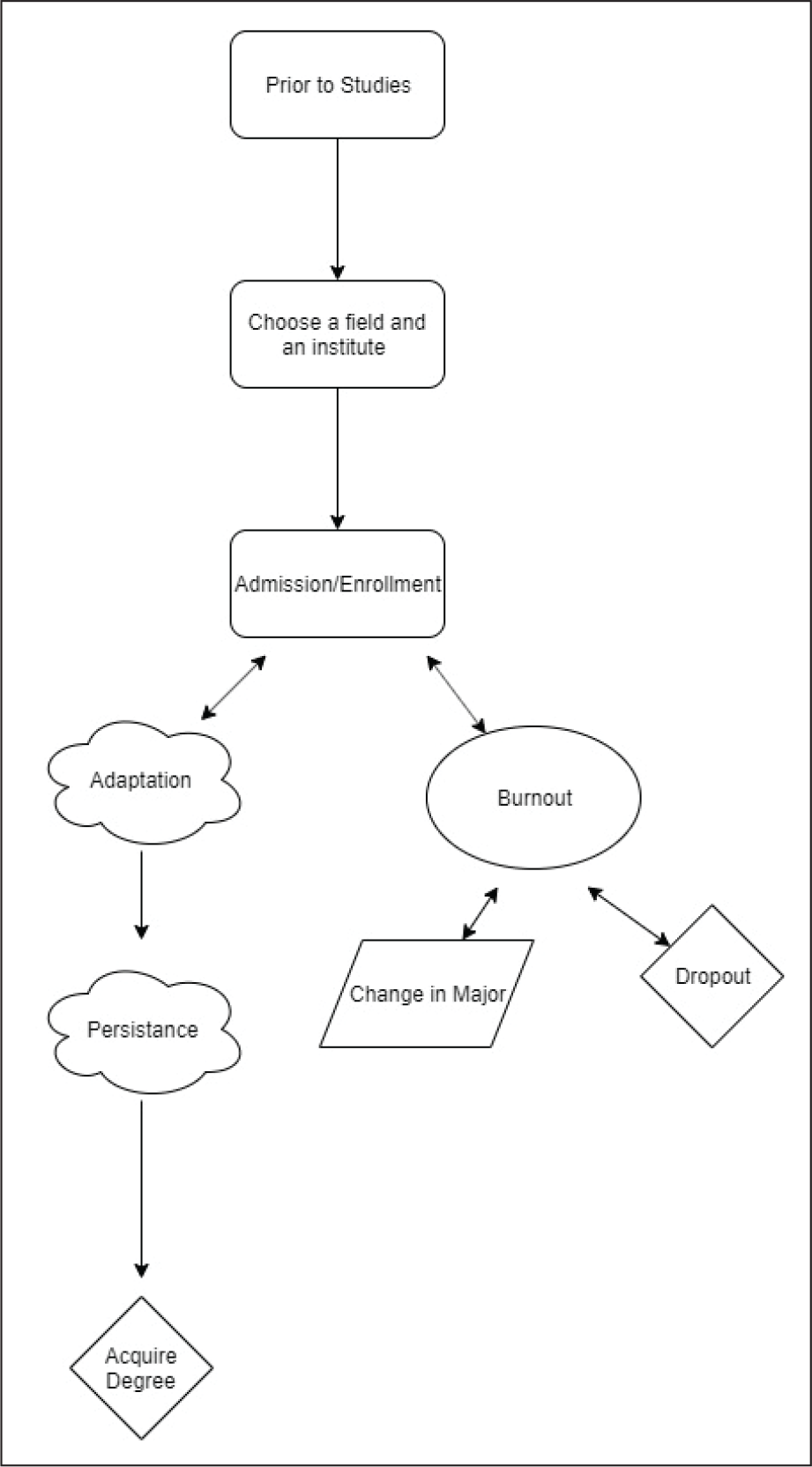
Figure 5 provides the path of integration into Academia. Admission is the first stage in the process of adjustment of the freshmen Palestinian students. These students live in East Jerusalem and in the surrounding villages. Most do not have Israeli citizenship, are from a low socioeconomic class, and live in traditional, patriarchal organizational systems of family and education. Their high schools are entirely gender-separated, and most teaching focuses on rote learning, with the teacher being the central figure while the students exhibit diffidence. This is why digital learning threatens the students and cause frustrations, at least initially.
The Palestinian students are ambivalent toward the Hebrew language: some of them perceive it as the language of the occupier, because in their encounters with security personnel and at the security barriers, the language of power and obedience is usually Hebrew. On the other hand, it is also seen as a more tolerant language, one that is similar to Arabic, and that facilitates their access to the labor market. The exclusion of Hebrew from the curriculum in the East Jerusalem schools, and especially its exclusion from the Tawjihi (matriculation) exams, causes the students to believe that it is an unimportant and marginal subject. All of these factors combine to affect their adjustment the moment they start learning Hebrew in Israeli colleges.
The learning skills bestowed by Arab schools do not suffice for the Israeli academy, as they do not encourage critical and independent thinking. The students, especially in the first stage of their studies, expect assistance from their teachers to address their learning difficulties (Roer-Strier & Haj-Yehia, 1998); these expectations are for the most part ignored by the academy.
External loci of control (luck, religion, teachers, and superstitions) mean that their lives are controlled by factors outside their control. An internal locus of control reflects the belief that the individual controls his or her life. In collectivist cultures, an external locus of control is prevalent, while individualistic cultures are characterized by an internal locus of control (Muller & Thomas, 2001). Furthermore, there is evidence linking locus of control with academic roles and achievements (Richardson et al., 2012). In this research, we found that most students have an external locus of control, low academic self-efficacy, and low emotional intelligence, which affect academic integration and achievement. These findings correspond to those of Cheng et al. (2013). Most Palestinian students begin their academic career at a young age; yet, their conceptions and attitudes have already been shaped, and now, they must adapt to the demands of an organizational environment with prominent individualistic characteristics.
The limitations of this research are that it was an initial study among Jerusalemite Palestinian students, most of whom are not Israeli citizens. Naturally, the sample is limited and may not be representative. Notably, the participants were admitted to the academic framework without requiring psychometric tests, which are standard admission criteria in all other universities in Israel.
First-year Palestinian students studying in Israeli universities and colleges face culture shock due to the differences in lifestyle, beliefs, politics, and language. Consequently, the students might not accept the traditions of the host culture, and this in turn hinders their integration into the college. To deal with the culture shock and adaptation difficulties, students used strategies such as isolation, piety, self-control, and requesting assistance. Undoubtedly, these strategies can be used only for a limited time, so the adaptation difficulties might continue to negatively affect academic achievement.
University teachers and officials should consider the issue of culture shock with regard to Palestinian students and implement the recommendations as detailed below.
Recommendations
In light of the conclusions of this research, we recommend that the academic institution establish cultural adaptations for this target group to make the institution friendlier for the Arab Jerusalem population. Such adaptation depends on providing real and accessible information during the registration process, particularly regarding the program offered to the students, and a more detailed explanation regarding the nature of the curriculum. Accordingly, we believe that the following recommendations may facilitate the integration of the students:
Study days should be conducted for all the lecturers on how to teach students from another culture. The dialogic method of instruction cannot be applied immediately, as it threatens learning habits that have been formed during many years of schooling. Therefore, instruction must initially be in the form of rote learning. Longitudinal studies must be conducted to examine the effect of the Israeli academy on the students throughout the entire period of their studies—this research examined only the first year. The university leadership should implement orientation by expert faculty members to let students understand university requirements. This should be done in a way that is clearly distinguished from the marketing efforts of the college. The university policymakers should appoint an Arabic-speaking specialist to address and solve students’ problems. The university should hire Arabic-speaking employees in the library and finance office. The university should offer academic programs that teach Arab and Jewish cultures, as well as organize joint educational and cultural forums for Arab and Jewish students. The university should examine the issue of communication between different departments and Arab students. It should clarify the authority and power of each department and make sure that students know about these powers and authorities. The Hebrew-language syllabus should include texts that take into consideration the Arabic culture. These texts should be in line with the students’ current environment and should encourage students to study and learn.
Footnotes
Declaration of Conflicting Interests
The author declared no potential conflicts of interest with respect to the research, authorship and/or publication of this article.
Funding
The author received no financial support for the research, authorship and/or publication of this article.