




Abstract
The article studies how Indian shipping in late sixteenth and the entire seventeenth century was subjected to forcible despoliation by the Portuguese and later by the English and Dutch, and to attacks by European privateers as also communities of Indian pirates. To some extent the imposition of ‘protection costs’ provided some safety to the licensed ships, and the Mughal Empire could hold at least the English and Dutch companies hostage in view of their large trade with the Empire. Finally, there was the system of insurance, which provided some safeguards for individual merchants and vessels.
Before the coming of the English and Dutch East India Companies, Portugal was the only European country trading with India on a large scale. After much conflict with Indian powers, stability of a kind had been established in the Indian Ocean by the closing years of the sixteenth century, with Indian ships trading across the Arabian Sea with Portuguese ‘cartazes’ or passes. This stability was greatly disturbed with the arrival of the English and the Dutch. In 1610, Jahāngīr, perhaps under the supposed influence of the Portuguese, denied full trading privileges to the English East India Company that it had sought, in retaliation for which the English Company’s ships plundered a number of Indian ships in the Red Sea in 1612. Sir Henry Middleton, the General of the Sixth Voyage, and Nicholas Downton and Captain Saris of the Eighth Voyage plundered at least 11 ships belonging to Surat, Diu, Dabhol, Cannanore and other Indian ports. 1 Then, when the sought-for permission was given by the Emperor to the English, the Portuguese sacked the Surat-based ship Ah[sanī in 1613 in the vicinity of that port, making its passengers captive, and possessing themselves of all that was found in it, to the great indignation of Jahāngīr. 2 Besides the European ‘official’ marauders, there appeared very early other European privateers such as pirates under Captain Quail, Captain Cobb, Ayers, Every, etc.
I
Indian merchants not only had to face acts of piracies from the Europeans but they had also indigenous pirates on the Indian coasts.
The pirates of Malabar were the most notorious and dreaded by ships in the Arabian Sea. The coast from Goa southward, to the Cape de Comorin, was commonly called the Coast of Malabar.
3
Before the coming of the Europeans in India, the Malabaris used to trade mostly with Red Sea ports. After their arrival, the Portuguese compelled the Malabaris to trade under restrictions imposed by them and forced them to buy their passes. Shay
In the Mughal period, the Malabaris’ piracies were widely reported. Linschoten speaks of Calicut and other ports as their main bases. 6 Fitch blamed the Zamorin of Calicut for the patronage of the Malabar pirates. 7 In 1608–09, Withington described the Malabaris ‘beeing at this time masters of these seas’ as ‘good souldiers [who] carry in each frigats one hundred souldiers, and in their galiots two hundred’. Out of 25 frigates of a fleet from Cochin, 16 were burnt by them and the rest escaped ‘if miserable spoile be an escape’. 8 In 1623, Petro Della Valle found it dangerous to travel by sea from Cambay to Goa ‘by reason of the continual incursions of the Malabar pirates’. 9
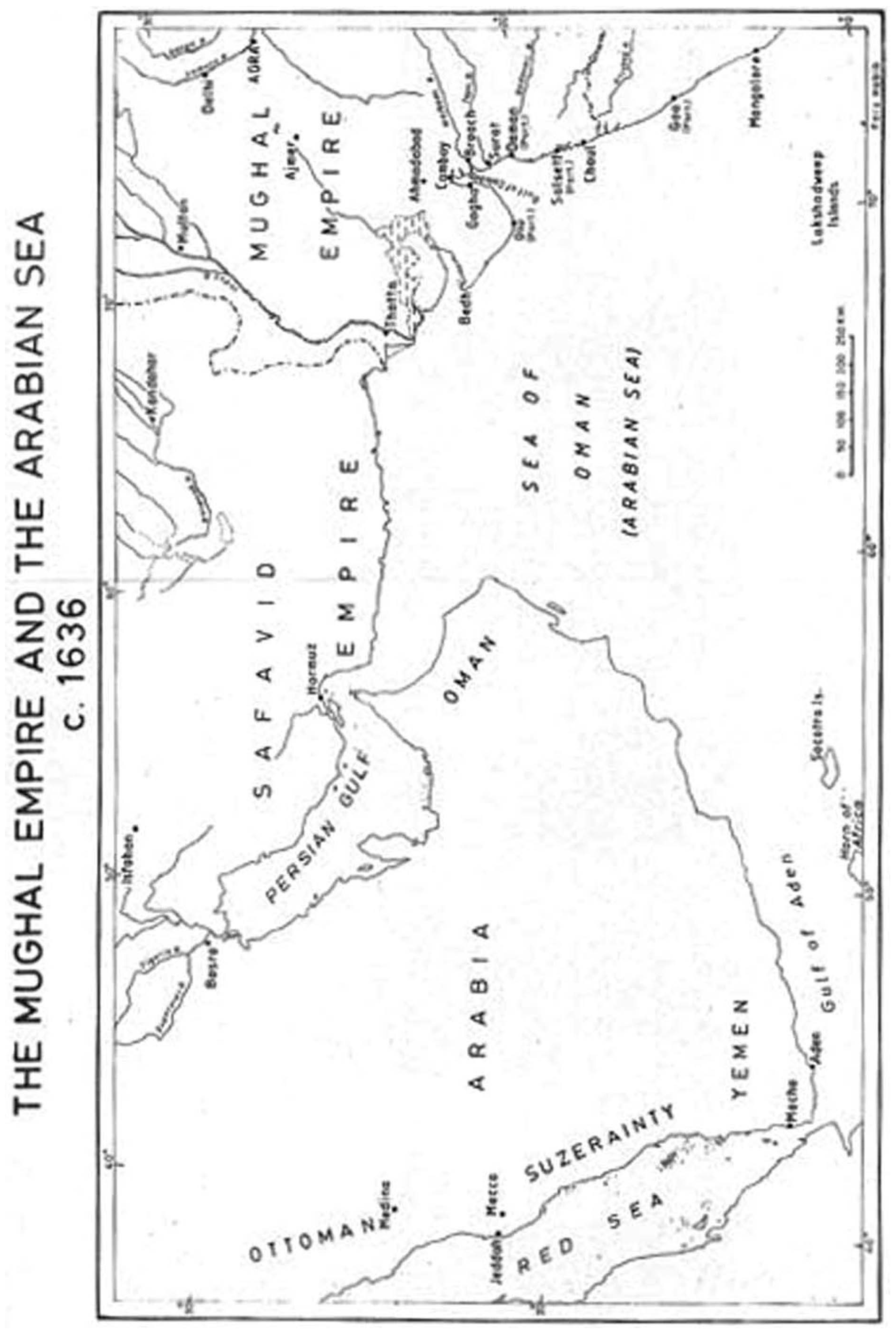
Another community of pirates were called Sanganians, ‘Sakna’ or Sagna, called so by the Sanganians lived at the port of Baet, [at northwestern tip of Saurashtra] very commodious and secure. They admit no Trade but practise Piracy. They give Protection to all Criminals, who deserve Punishment from the Hand of Justice … I have several Skirmishes with them. They, being confident of their Numbers, strive to board all Ships.
They had ships as big as 500 tons and used to attack in groups. ‘They are very cruel to those they can master, if they make Resistance; but to those that yield without fighting, they are pretty civil.’
11
Earlier
Warals whom Which is about 30 Leagues along Shore, admits no Traffick, being inhabited by Freebooters, called Warrels, [who] often associate with the Sanganians, in exercising Piracies and Depredations. They confide much in their Numbers, as the others do, and strive to board their Prizes…. They have no Cities, and their Villages are small. The Warrels occupy all the Sea-coast as high as Goga [Gogha], which lies about 12 Leagues within the Gulf of Cambay.
13
Warrels were also apparently called Vaddellas. In 1668, in Surat, instruction were given on 29th August, to Captain Barker to protect ‘the King’s junks’ (returning from the Red Sea) from the ‘Vaddellas’ and ‘Sangannas’. 14 In 1656, we encounter a reference to ‘Vaddels’ when they plundered the Dutch in Thatta. 15
On the eastern coast, Portuguese pirates mostly under the protection of the King of Arakan, were notorious for their plundering raids on Mughal territory. They carried out their depredations mostly in the coastal area by capturing people for sale as slaves, but were not averse to plundering vessels on the coast. Bernier and Manucci have described the cruel practices of these pirates at length. 16 One of the reasons behind purchasing or building small vessels of 80 or 120 tons by the English and the Dutch in the Bay of Bengal was to use them against the boats of these Arakanese pirates. 17
From the Red Sea episode of 1612, two types of spoils obtained through piracy can be distinguished. The first one was outright plunder and the other a formally hidden one, when the traders were compelled to sell their merchandise on the price fixed by the captors or exchange their merchandise with what the captors were pleased to offer in return. 18 The latter was resorted to possibly to avoid claims for compensation. From the European as well as Indian accounts, it is clear that the pirates inflicted much damage not only monetarily but also physically especially with respect to women found on the ships. In 1576, Akbar, was reluctant to allow royal ladies to go on hajj to Mokha, from such apprehension. He ultimately allowed them to sail for Mokha after receiving a pass from the Portuguese. 19 In 1695, the English pirate Every looted the imperial ship Ganj-i-Sawāī. During its seizure the pirates striped the men and dishonoured the women, owing to which several women ended their lives by jumping into the sea or by stabbing themselves. 20 And if we are to believe Hamilton, a princess was also carried away by Every. 21
II
Since piracy was a continual menace on the ocean, one way to avoid it was to pay ‘protection costs’ to possible plunderers in advance.
The Portuguese specialised in this practice by selling cartazes (from Arabic qart]ās meaning paper) or passes for safe passage to the ships, in the absence of which they claimed their right to seize and plunder the delinquent vessel. The official Portuguese chronicle justified such a policy thus:
It is true that there does exist a common right to all to navigate the sea and in Europe we recognise the rights which others hold against us; but this right does not extend beyond Europe and therefore the Portuguese as Lords of the Sea are justified in confiscating the goods of those who navigate the seas without their permission.
22
A Malabar chronicler of late sixteenth century noted that, the Portuguese started to issue passes to the ships of Kochi and Kannur, just after settling in those ports.
23
According to Gaspar Correia, cartazes were first issued in 1502 to ships from the Malabar ports of Kollam, Cochin and Cannanore.
24
Initially, only Portuguese used to issue passes to Indian ships, but, later on, after the entry of the European Companies especially English and the Dutch, they too started issuing such passes. In most of the passes not only the destination of the ships was stated, but also the kinds of merchandise, types of arms, persons it carried and ports at which it could stay on the route, etc., were also mentioned; and these specifications had to be followed strictly. In 1613, a pass was issued by the Portuguese to a ship of the King of Bijapur for a voyage from Dabhol to Jiddah, and it laid down in detail what weapons could be carried by it and forbade it to transport Turks, Abyssinians, cinnamon, pepper, ginger, iron, steel, copper, lead, tin, brass, timber, tabado, coir, saltpetre, sulphur or bamboo, or anything else forbidden. Nor could this ship transport any Portuguese, or horses unless they were licenced, or slaves, unless they were natives of Bijapur and not Christians. The ship was to be searched by the Portuguese Royal Factor at Dabhol before it left port.
25
A Dutch letter contains an extract from a passport issued by the Viceroy of Goa in favour of the Mutaṣaddī of Surat for a ship going to Mocha. It required that ‘the vessel would not carry to Mocha lead, tin, cloves, cinnamon, pepper, nuts and iron planks. It would not carry back from Mocha any blacks, Turks or Christians. The vessel would not drop anchor at places other than those mentioned’.
26
Passes were generally valid for a trip or one year, and for that period the issuing authority undertook to send instructions to all commanders, merchants, etc., under its control not only to forbear all manner of seizure or disturbance to the bearers of the pass, with their men, vessel, merchandise or whatsoever therein, but to correspond courteously with them during their sailing.
27
However, voyaging with a pass from any company was not a foolproof guarantee of safety in open sea. From a farmān of Akbar to Qulich
The Portuguese used to issue passes to the master of the ship against a fixed fee.
32
Later they issued the pass only after the inspection of the ship’s hold and thereafter fixing the price of the pass. The procedure of issuing passes from the Indian point of view has been described by Bāyazīd Bayāt, who went for ḥajj in 1580, on the ship Muḥammadī. The price of the pass was taken on behalf of the Portuguese authorities of Diu by the ‘tax farmers of port of Daman’. As the Portuguese arrived to board the ship, they took a son of Bāyazīd as hostage. The elder son of Bāyazīd, Sa‘ādat Yār, who, as Bāyazīd informs us, had learnt both Indian as well Portuguese languages, negotiated with the inspectors. The Portuguese demanded 10,000 maḥmūdis in cash, to be paid by the passengers. Since the passengers had only goods, Bāyazīd paid the sum on their behalf, they promising to reimburse him at Jedda, after they had sold their goods. The agreement was registered with the ‘captain of the Surat ships’, Hasan Channu, whereupon the ‘Caudhuri of the port’, Tajpāl, left the ship. Bāyazīd’s own son returned from the ‘Portuguese galliot’ (
One of the important results of having a pass was that, if a ship was molested on the sea by the power which issued the pass or by pirates of the issuing nation, it was the liability of the issuing authority to compensate the victims. However, it was not easy to get compensation without great exertions by the victims. Generally, the pass issuers rejected the claim and put forward various excuses, such as wrong identification on part of victims, blaming the act of plunder on their rivals, doubting the genuineness of the pass, alleging the victims of being in league with their enemies or carrying goods or people prohibited by the pass, etc. The victims on their part used to complain to the Shāhbandar (port master) of the port or to the Governor of the S[ūba, who could only help the complainants to get compensation from the alleged plunderers, by using various means such as arranging meetings with their factors, or confiscating some merchandise or arresting the factors or putting embargo on their trade. It was possible for the Mughal authorities to put pressure on the English and Dutch companies who had established their factories in the interior of the empire, and so could lose their privileges, trade or possessions there.
38
Such an option was not however, available in case of Portuguese who largely confined themselves only to the coastal regions. The situation of the English, in such a case, is best described by Methwold (after describing an act of piracy by Captain Cobb in 1636 in the Red Sea):
Do not know what will result from Cobb’s latest act of piracy. The best wee can expect is the seizure of our persons and goods in all places, for the interested parties are departed, many of them, towards the court, where their clamour will prevaile to get the King’s order, and then wee must expect no favour, since the very name of an Englishman is become an abomination in all places of this vast kingdome.
39
There are several instances which illustrate how compensation was sought to be secured. 40 One incident that happened in 1635 will perhaps, show in sufficient detail how matters could proceed in such cases.
In 1635, there arose a claim upon the English company, for compensation from merchants on two ships, Taufīqī, from Surat and Maḥmūdi from Diu. The merchants complained to the Governor of Surat, who accordingly called Methwold, the President of the Surat Council, to listen to the complains as well as to compensate the victims. Methwold ‘found a sadde assembly of dejected merchants, some looking thorough mee with eyes sparkling with indignation, others half dead in the sense of their losses; …’ However, as usual, the English President denied that any act of piracy had been committed by any of the company’s ships, but after the testimony of nā
One of the important measures adopted to protect vessels from privateers’ attacks was to avoid sailings of single or unaccompanied vessels. The Portuguese used to organise flotillas (‘kafilas’) to check piracies as well as seize ships that evaded their cartazes. 45 The Portuguese came every year to Cambay with their ‘Kafila’ consisting of a large number of ‘fusts’, single-masted oared boats with about 40 oarsmen and usually of about 40 tons, from Goa, Cochin, Chaul, Bassein, Daman and Diu, bringing a large variety of goods from Europe, China, Malacca and other places and taking back various kinds of textiles for Portugal, Malacca, Ormuz, Mozambique, etc. 46
In case of imperial families and high officials the European companies used to provide an escort for their ships. This was done to appease the Indian authorities often to win some concessions. In 1628, Pieter van den Broecke records that, on the request of the Governor of Surat he sent Mauritius to the mouth of the river to protect some Muslim ships against the Portuguese and the Malabaris. 47 In March 1629, when Shāhī the imperial ship was returning from the Red Sea ports, the local authorities asked the Dutch and the English to seek her, protect her against the Portuguese, and escort her to Surat. 48 However, the Shāhī could not reach Surat Bar, till November 1632. 49 In 1643, the English President Fremlen, at Swally Marine, complained to the company that, ‘...we are upon sundry occasions enforced in a manner to convoy the Kings and other eminent merchants shipping free of the Mallavars danger…’ Recently, ‘as there was no other Christian vessel left to convoy her (the King’s ship) free of the Mallavars danger’, the Governor and other officials prevailed upon Fremlen to order the Discovery to accompany the junk. Accordingly, they departed together on March 12, and kept company until they were out of sight of land. 50 In 1668, in Surat, the Governor and the shāhbandar requested the English to send Bantam to bring in ‘the King’s junks’ expected from the Red Sea, and to protect them against, the pirates, said to be lying in wait for them. 51 In the last decade of the century, when the incidents of piracy were on the rise, the Governor of Surat made agreements with the English, Dutch and French companies to escort Indian ships to their respective destinations. However, due to disputes over demands of the Indian merchants for compensations on certain plundered ships, the agreement was abandoned in March 1704. 52
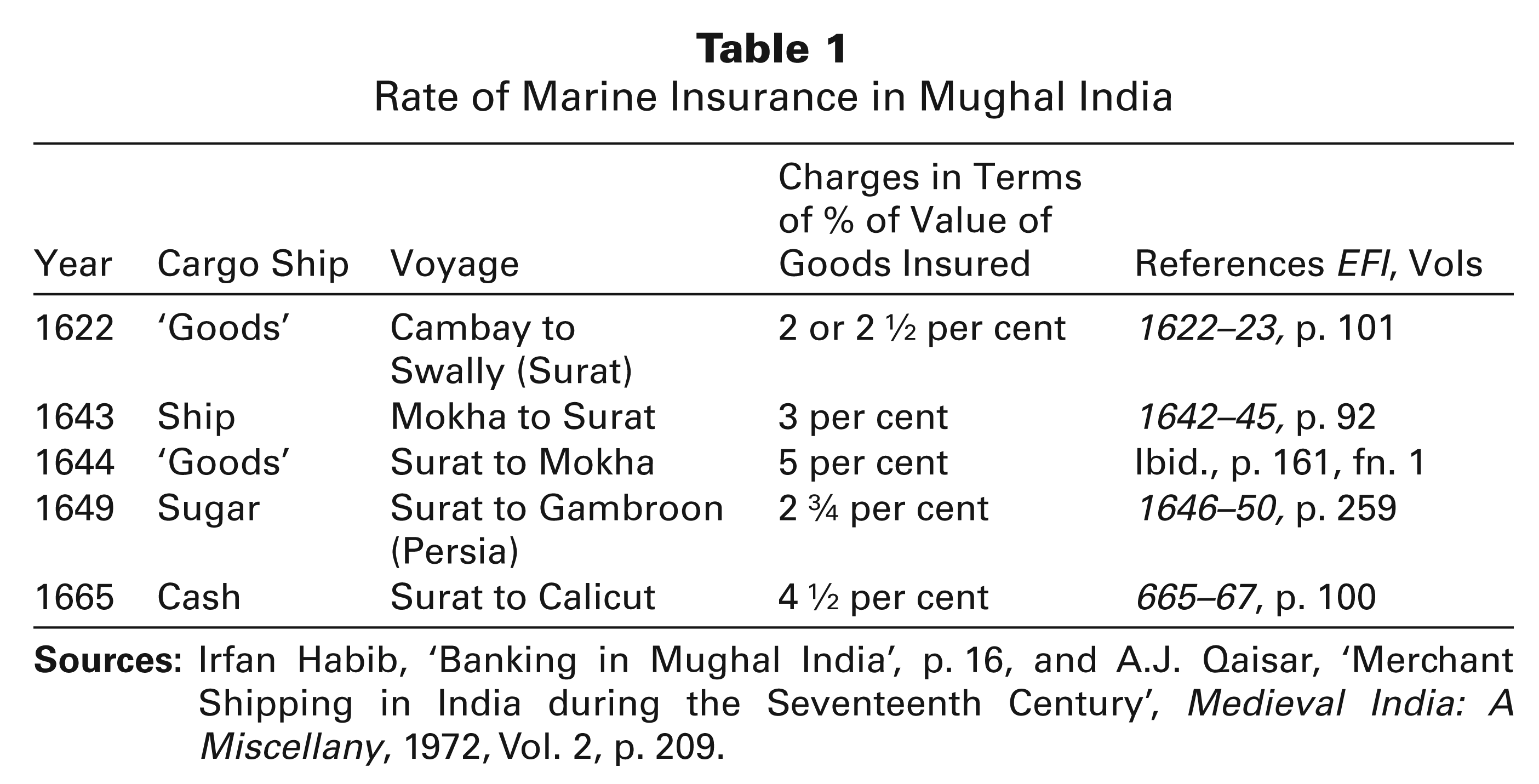
Such insecurity over the sea, in addition to danger from forces of nature, created the basis for a system of insurance of which we find well established in the seventeenth century. This function was generally carried out by ṣarrāfs or bankers. 53 It was availed of by both Indians and Europeans. 54 Not only were goods insured but sometimes also whole vessels. 55
The insurance rates in Table 1 suggest that the lack of security on the routes was rather high, but not so high as to be forbidding.
The insurers also expected the ships to defend themselves.
56
And so ships needed to be armed and Abu’l Fazl includes a topandāz (gunner) among the twelve categories of crew in a ship, and the number of gunners could vary according to the size of the ship.
57
Ralph Croft in 1613 in found that an Indian ship of 300 tons, which had come from Mokha to Surat, had 12 great pieces of artillery on each side.
58
In 1616, Terry observed that the pilgrim ships going from Surat to Mokha had ‘good ordnance’.
59
In 1646, 12 guns were removed from the ships Shukohī and
Rate of Marine Insurance in Mughal India
Foreign travellers often pointed out that despite their guns the Indian ships ‘cannot well defend themselves’. 63 Van Twist, in 1638, observed, regarding the ships plying between Surat and Mokha that ‘though they carry many guns, they are not protected by them, for [the guns] are on the top orlop without defence, while they do not know how to handle them’. 64 There are indeed several examples of the weakness shown by Indians in handling ships’ guns. In 1612, in the Red Sea, at least 11 Indian ships were plundered with ease by the English East India Company’s servants. 65 In 1623, again the English captured two imperial ships, Shāhī and Ganjāwar, doubtless armed, without resistance. 66 But the most alarming example was the English pirates’ capture of the biggest ship of Surat, the imperial Ganj-i-Sawāī, in 1695, which despite 80 pieces of cannon and 400 matchlocks surrendered to English pirates almost without any resistance. 67 In fact, Indian vessels used to be so overcrowded that it was found difficult for guns to be moved to firing positions on the deck. 68
The degree of success of Mughal administration in securing the ocean and coast from piracy varied. Initially the Mughals were fully dependent far the ships’ security on the Portuguese passes. But even after getting the pass, a ship remained in fear of plunder by pirates against whom the Portuguese offered no protection as was reported to Akbar some time before 1576–77.
69
After the arrival of the English and the Dutch, Indian ships had additionally to seek passes from them; but still there occurred some change. This change was due to the accumulation of considerable assets within the Empire by the English and the Dutch, for unlike the Portuguese they established their ‘factories’ in the imperial territories, both in ports and further inland. The Mughals were, therefore, in a position to counter the strength of the European companies on the ocean by threat of seizure of their men and merchandise on the land. This ‘balance of blackmail’ made it easy for them to secure compensation from the companies in the event of the plunder or sacking of Mughal–Indian ships. And here in putting pressure on the companies and making arrangements for safely of vessels, the Mughal administration was able to act fairly effectively. It is, however, obvious that the Mughals failed to develop any effective naval power for the purpose. According to Abū’l Faz[l, Akbar planned to fit out strong boats, capable of carrying elephants and some of them in such a manner as to be of use in siege and for the conquest of strong forts.
70
Akbar indeed had some designs against the Portuguese who constituted a ‘stumbling block in the way of pilgrims to Hijāz’. In 1580, he appointed an army to capture their ports under the leadership of Qut]buddīn