



Abstract
West Bengal, in 1951, was ranked second in the country, with a literacy level of 24.0 per cent, though far behind Kerala with a literacy level of 47.18 per cent. From the very beginning there was an elitist bias in educational planning, so that primary education was badly neglected, and so subsequently West Bengal began to slide in relation to states like Kerala, Maharashtra, Mizoram or Goa. Unfortunately, the elitist bias also persisted during the Left Front rule. As a result, by the time of Census 2011, the literacy level of West Bengal had slid down so far that it was barely above the national average. At the same time, the small state of Tripura, also ruled by a Left Front government, coming up from far behind had caught up with and then had overtaken West Bengal, and was only a little behind Kerala, the most literate state in India. Although this article is supposed to be an account of the state of education in West Bengal since independence it concentrates essentially on the primary school sector, because that is the foundation of all further education. It refers to the Bhabatosh Datta Commission on higher education whose recommendations still remain valid and unfortunately unimplemented.
At the time of Independence, India was an overwhelmingly illiterate society. According to the Census of 1951, the all-India literacy level was only 18.33 per cent: Kerala was far ahead of others with a literacy level of 47.18 per cent and West Bengal was in the second place with a literacy level of 24.0 per cent. As in most other states in India, the elite ruling West Bengal neglected primary education and concentrated on higher education which their children would take up. Three new universities were set up under Congress rule. The engineering college, hitherto run by the National Council of Education, was raised to the status of a university and became Jadavpur University, with a full complement of humanities and science departments. The North Bengal University was founded in Siliguri. Rabindra Bharati University was established at Rabindranath Tagore’s ancestral home. (It was later shifted to Emerald Bower, the home of Pradyotnath Tagore.) The government also founded the University of Burdwan and the University of Kalyani and Bidhan Chandra Krishi Vishwavidalaya at Mohanpur. The central government established the Indian Institute of Management, Calcutta, and the Indian Institute of Technology at Kharagpur. Tagore’s Visva-Bharati was converted into a typical Central University, largely subverting its original purpose. Besides these the Indian Statistical Institute gained the status of a Central University. Recently, the Ramakrishna Mission’s Vivekananda University has been recognised as a Deemed university.
Unfortunately, the same elitist bias continued under the Left Front government. Three new universities were founded, one in Medinipur (Vidyasagar University), one in Malda (Gour Banga University) and one in Purulia (Sidho Kanho Birsha University), and Aliah University (which was the new avatar of the Calcutta Madrasah) and Maulana Abul Kalam Azad Engineering University in Bidhan Nagar, Kolkata. It also established Netaji Subhas Open University in Kolkata. During the fag-end of Left Front rule, Sibpur Engineering College was upgraded to Bengal Engineering and Science University (which has now become a Central University with the name Indian Institute of Science and Technology), and Presidency College, Calcutta, to Presidency University. It established the National University of Juridical Sciences, brought all medical colleges under the umbrella of WB (West Bengal) University of Health Sciences and converted the Bengal Veterinary College to West Bengal Fishery University. The Trinamool Congress (TMC) government, which came to power in 2011, has already established five new universities—West Bengal State University in Barasat, Bankura University, Cooch Behar Panchanan Barma University, Raiganj University and the Kazi Nazrul University in Asansol. Besides these state-run universities, there has been a mushroom growth of private universities: There are already seven such universities—one of them founded by a cement manufacturer and another by a man who used to run a huge coaching class business. The privatisation of education has its own problems (Tilak 2014) to which we shall turn later.
But there is far more to university or college education than the physical infrastructure, as the Bhabatosh Datta Commission on higher education pointed out, although in many cases the physical infrastructure was awfully inadequate.
Although the Bhabatosh Datta Commission (1984) was supposed to examine only the aspects of higher education and make recommendations for improving it, it in fact examined all aspects of education from the primary to the PhD level, and produced a veritable document on education in Bengal from colonial to modern times. It referred to the downgrading of vernacular education in accordance with Macaulay’s Minute of 1835, despite the evidence produced in William Adam’s Report that vernacular education in pathsalas or education through the medium of Persian and Arabic in maktabs and madrasas had performed a valuable function in providing literacy. The Commission contrasted the attitude of the Indian middle class (which was keen to collaborate with the British) with that of the middle class in Vietnam (then part of French Indo-China) which rose up in the famous ‘Scholars’ Revolt’ in Hue against the demolition of vernacular education by the imperialist power.
Among the important recommendations of the Bhabatosh Datta Commission were the following:
‘1. The teaching community and the teachers’ associations should devote some attention to the problem of education and help to find out ways to arrest the deterioration in the quality of education and to improve its quality …’ (p. 314). ‘5. The Department of Education, Government of West Bengal and the Vice-Chancellors of the eight universities should join forces to find out the factors that are responsible for the relative retrogression of West Bengal in the field of Higher Education….’ (ibid.). ‘16. North Bengal districts as a whole suffer from an inadequacy of facilities of professional education. This inadequacy should be removed. Specifically, there is a strong case (i) for one or two polytechnics in West Dinajpur, (ii) for one or two under-graduate institutes of technology in the districts of North Bengal, excluding Jalpaiguri, (iii) an undergraduate institute of technology in one of three districts—Bankura, Midnapore and Purulia’ (p. 315). ‘39. The present facilities available for research to college teachers should be increased by providing grants to deserving cases and such grants should be available both for postdoctoral work and for research work that the scholar does not intend to submit for a degree’ (p. 317). ‘40. The Government and the universities should firmly resist any attempt to admit students under local pressure and under the reported systems of “Quota”—for the relatives or nominees of teachers, non-teaching staff, governing body members and the like’ (ibid.).
Unfortunately, for higher education of West Bengal, most of these recommendations were observed only in the breach. In particular, the teachers’ movement only concerned itself with salaries, transfers and monetary benefits of teachers. There were dedicated teachers among the leaders of the teachers’ movement, but many others were just free riders on the work of the dedicated teachers.
In 1992, the Government of West Bengal appointed another Commission to examine the educational sector as a whole (Ashok Mitra Commission 1992). The Ashok Mitra Commission, while recording achievements in the educational sector, did not leave any doubt that it needed urgent improvement in many directions. Thus, we read in its Chapter 19, ‘Conclusions and Recommendations’:
‘19.1 The changes that have taken place in the educational scene in West Bengal since 1977 are striking in more ways than one. Turbulence in schools, colleges and universities has disappeared, examinations arc held more or less according to schedule, the practice of unfair means in examinations has been largely checked, the payment of salaries and retirement benefits has been regularised to a considerable extent, the recommendations of two successive Pay Commissions and the University Grants Commission have paved the way for generous increases in the levels of emoluments and other benefits for the teaching and the non-teaching staff of educational institutions’ (para 2.3). ‘19.2 The outlay on education registered a ten-fold increase between 1976–77 and 1991–92 in absolute terms; the real rate of increase is more than 300 per cent. This has been accompanied by a pronounced shift in overall allocation in favour of primary and secondary education’ (Para 2.4). ‘19.3 However, an overwhelmingly large proportion of the educational outlay is earmarked to meet the commitment of salary and wages for the teaching and the non-teaching staff. In the case of both primary and secondary education, as much as 95 per cent of the total outlay goes to pay the emoluments; in higher education, the proportion is nearly 80 per cent, and, in medical education, about 70 per cent’ (para 2.5). ‘19.4 Between 1976–77 and 1991–92, the number of primary schools has increased by 10,080, of secondary schools by 569, of higher secondary schools by 879, and colleges by 87. The number of students at the primary level increased by more than 80 per cent, at the secondary level by 17 per cent, in the higher secondary level by more than 37 per cent and in the colleges by 50 percent’ (paras 2.9 and 2.10). ‘19.5 While school attendance has generally improved in town and country, for both boys and girls the phenomenon of drop-outs persists, and a lot of ground still needs to be covered to remedy the situation’ (paras 2.16 and 2.30). ‘19.6 There is a serious lack of minimum infrastructural facilities in schools. The number of one-room schools is high; so also the number of one-or two-teacher schools. The quality and the method of teaching leave much to be desired’ (para 2.32). ‘19.7 One of the most significant decisions in the post-1977 period is the abolition of teaching of English as a second language. Another important change is the abandonment, at the primary stage, of the system of promoting students from one class to the next higher one on the basis of results of annual examinations’ (para 2.22). ‘19.8 While the growth of secondary education is significant, school inspection has thinned out, and no alternative procedure of evaluating teaching has yet evolved’ (para 2.38). ‘19.9 Quality has not kept pace with quantity in higher education too. The problem that most attracts attention is the unplanned growth of colleges’ (para 2.41). ‘19.10 The stress in primary education should henceforth be on an across-the-board improvement in school buildings and in other basic facilities such as the supply of meals and apparels, and equipment like books, maps, globes, black-boards, etc.’ (ibid.: 314).
The Ashok Mitra Commission also recommended in para 19.21 that
[s]tudents in schools, colleges, engineering, medical and other technical institutions as well as universities should be actively associated with the universal literacy campaign. Each student may be asked to participate in the campaign for a fortnight during an academic year, and the final award of a diploma or degree could, by statute, be made contingent upon such participation. Colleges with a large contingent of Pass course students may be encouraged to adopt a nearby slum or village, and a group of students under the leadership of a teacher could take up literacy and post-literacy programmes there, and, if possible, link these up with sanitation and public health programmes.
This recommendation was also ignored by the teachers and the government. The Commission’s Report was in line with what Rabindranath Tagore had started at Santiniketan and Sriniketan. But unfortunately for West Bengal no government chose to follow the example he had set.
We shall have occasion later to compare the failures of West Bengal with the achievements of Tripura, another Left Front-ruled state. Here we note that according to census data, the literacy rate in West Bengal had climbed from 68.08 per cent in 2001 to 77.08 in 2011: It was ranked 20th among 36 states, just above Punjab, and way below Kerala and Tripura. In 2001, for India as a whole, the literacy rate of males was 75.26 per cent as against 53.87 per cent for females. In 1951, the corresponding rates had been 27.16 and 8.86, respectively. In 2001, the literacy rates in Tripura were 81.02 per cent for males and 64.91 per cent for females; the corresponding figures for West Bengal were 77.02 and 59.61 per cent, respectively. By 2011, in Tripura, the literacy rates for males and females had climbed to 91.53 and 82.3 per cent, respectively, and the total literacy rate had become 87.22 per cent. Tripura displayed the highest rate of growth in literacy among all the states, and this was especially true for female literacy.
It is true that the government in West Bengal had increased the emoluments of teaching and non-teaching staff substantially, and that was nothing more than a measure of justice. But as in the case of college and university teachers, many of the primary and secondary schoolteachers had paid back the public by bunking classes and using schools for catching students for private tuition and other lucrative business. Moreover, as para 19.8 of the Ashok Mitra Commission pointed out, the practice of school inspection had practically ceased, partly because the number of school inspectors was low, compared with the increase in the number of schools, and partly because the inspectors were overburdened with election duties and other tasks unconnected with school inspection.
In para 3.18 (p. 315), the Commission recommended that ‘[p]anchayats should be invited to participate in an intensive, time-bound programme of building low-cost school structures with the help of local resources’. This recommendation became infructuous because many school teachers themselves became Panchayat members and were burdened with so many tasks that they had little time for supervising low-cost buildings. Two of the recommendations were later reversed by the Left Front government. English was again introduced as a second language from Class II under middle-class pressure and imitative pressure from the underprivileged sections of the community. The second recommendation, namely abolishing the pass-fail system at the primary stage, was also reversed because of corruption in internal assessment and the absence of an alternative system of evaluation.
How little the advice to equip schools with adequate equipment was heeded is shown by West Bengal HDR (2004, Table 7.3; see Table 1).
Facilities Available in West Bengal Primary Schools
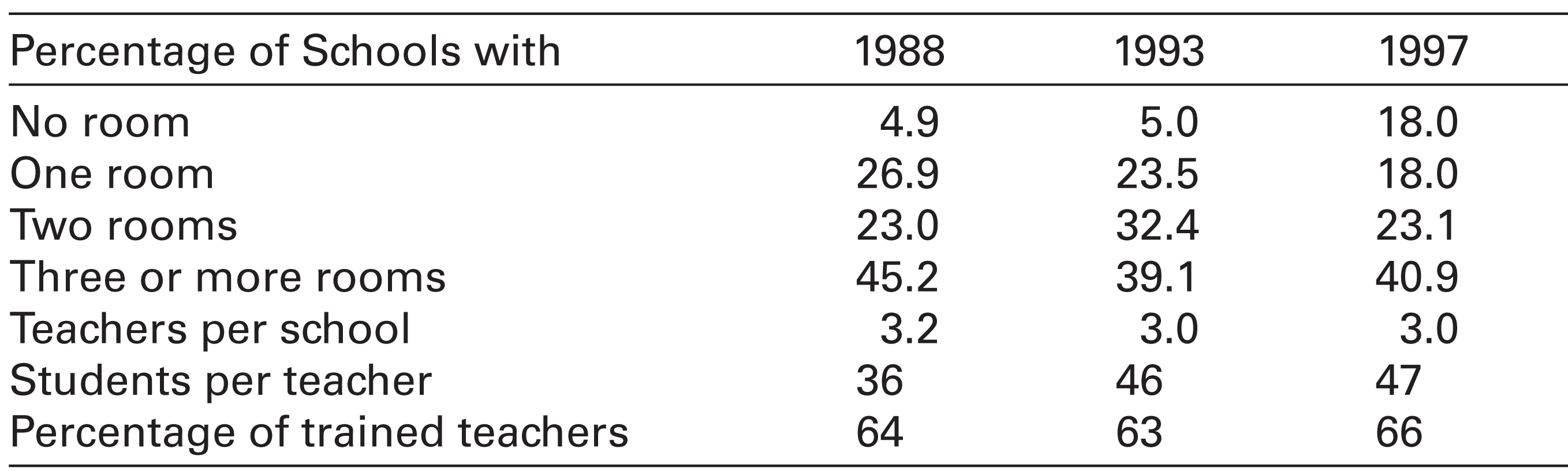
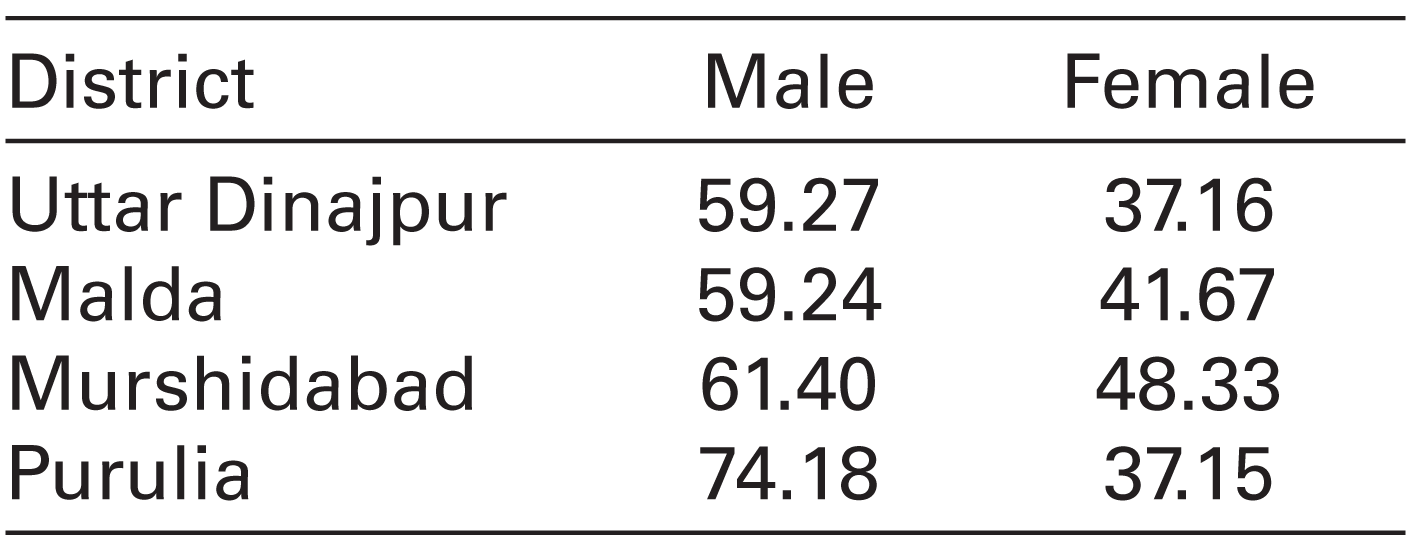
If a school has no building at all, how can classes be held in the rainy season, or how can quality be maintained with four different classes being taught in a single room? That little attempt was made to remedy the situation is shown by the fact that schools with no rooms went up phenomenally between 1993 and 1997. The outcome of all this non-performance was a very slow growth in literacy, as we will show later. Not only was the overall literacy rate low in West Bengal, it remained particularly low in districts distant from or badly connected with Kolkata. Thus in 2001, while the aggregate literacy rate for the state was 68.2 per cent, it was 48.6 per cent in Uttar Dinajpur, 50.7 per cent in Malda, 55 per cent in Murshidabad and 56.1 per cent in Purulia (West Bengal HDR 2004, Table 7.1). By and large, the lower the literacy rate for a district the higher was the gender gap between males and females. This is shown by Table 2.
Male–Female Literacy Rates in the most Illiterate Districts in West Bengal, 2001 (in Percentages)
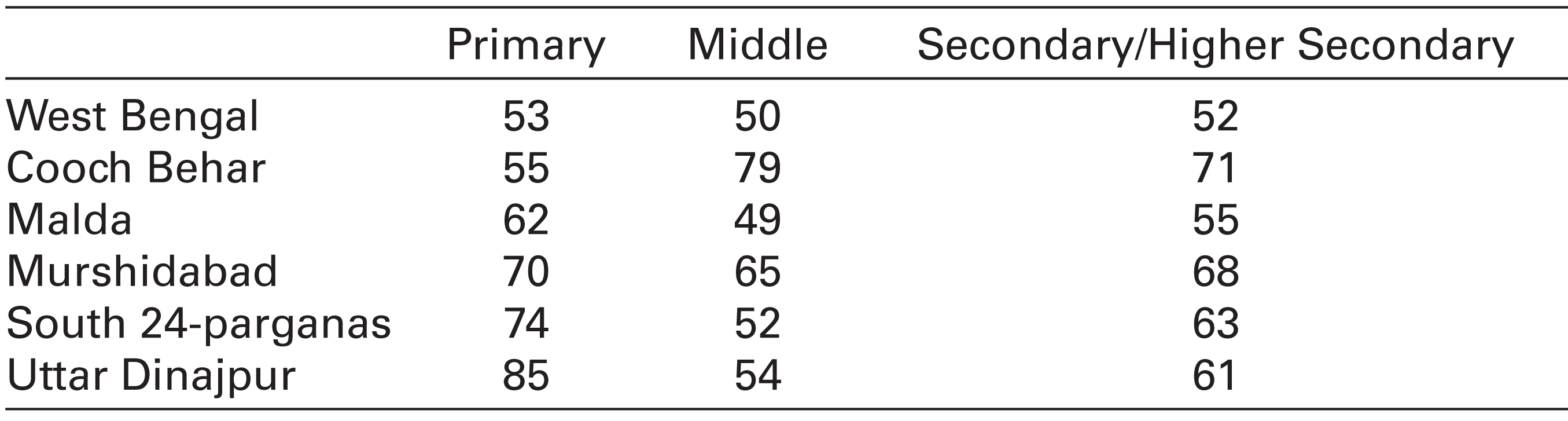
Pupil–Teacher Ratio in West Bengal and Selected Districts, c. 2010
The same table of HDR also shows that not only is the aggregate rate of literacy much lower among the scheduled tribe population but the gender gap is also much higher. In Uttar Dinajpur, for the scheduled tribe population, the literacy rates of males and females (in percentage terms) were 28.42 and 9.10, respectively, in Malda 25.07 and 6.42, in Murshidabad 25.95 and 10.60, and in Purulia 43.91 and 10.55. The situation was a little, but not much better, for scheduled castes.
Table 3 shows that the more distant or more ill-connected a district was the worse was the pupil–teacher ratio, reaching the extreme point of 85/1 which is more than double the accepted norm of 40/1.
In a fairly favourable but critical assessment of the Ashok Mitra Commission report, Majumdar (1993) pointed out that the Commission had praised the government of West Bengal ‘for ensuring at last that examinations are held regularly again in West Bengal and mass copying had been dealt with’.
Majumdar also said that Tables 1 and 2 (showing budgeted expenditure per capita on education in eight selected major states, 1990–91, and two indicators of educational attainment in eight selected major states respectively constructed by him) bear out the Mitra Commission’s claim that
West Bengal spends proportionately more of its revenue budget on education than all other well-performing states (8 in total). Even Kerala spends less. But it does not bear out the out the Commission’s claim that the share of its expenditure on higher education is low: it is higher than the all-India average and the corresponding figure in case of Assam, Gujarat, Maharashtra and Tamil Nadu….
Majumdar also asked whether West Bengal, spending a larger proportion of its revenue budget on education or spending a larger amount per capita on education than most of the other states, was getting value for its money. For, as his Table 2 shows, in several of those states the literacy rates and proportions of children in school had gone up faster than in West Bengal.
Majumdar (1993) concluded by saying:
In fact, the Mitra Commission has, by implication at least, left us in no doubt about what it thought of the state of education in West Bengal. In calling for substantially higher college fees, in insisting that the teachers be forced to teach—ensuring their accountability through inspection and other ways—and in demanding the widespread malpractice of using school hours and school children for extracting money in the form of private tuition be ended, the Commission had indeed bared the ugly face of education in India in a way that no other previous commission had dared to do.
In a report by Pratichi Trust on education in West Bengal (Rana, Rafique and Sengupta 2002: 14), it was pointed out that
almost 15% of the population was out of school in 1997–98. The gross enrolment for the period was 85.6% and the net enrolment was 40.2%. More alarming was the reported rate of drop-outs which was 38.4%. While the male drop-out rate was 35.8%, the female drop-out rate was for the same period 41.3%. Reported net attendance was also far from satisfactory. It was 77% in 1997–98.
Quoting an article by Vimala Ramchandran in The Times of India, 7 June 2001, the Report goes on to say that ‘in West Bengal … quality of schooling, overall school environment and other imbalances are no less responsible for the non-realization of the goal of universalization of primary education’ (ibid.: 16). Further,
A report published in the Anandabazar Patrika (25 March 2001), quoting a DPEP (District Primary Education Programme) report states that that 80% of the school children have to go in for private tuition. In an editorial the same newspaper said that 44% of the total cost of education per child was spent on private tuition. Even ministers admitted that degradation in the quality of school education forces children to opt for private tuition. (ibid.)
Obviously, the non-affordability of private tuition on the part of the poorer classes deepens inequality in society.
As we have seen earlier, politics of the wrong kind pollutes the educational environment and makes it difficult to impart quality education. This is confirmed by the Pratichi Report: ‘Not only the rural residents in our study areas but also many political leaders admitted that primary teachers had amassed immense power to govern and determine rural politics.’ It went on to add:
Satya Ranjan Mahato, a minister in the fifth Left Front government, held the primary school teachers responsible for his defeat in the last assembly elections. He had reportedly made the teachers angry by taking a strong view of their functioning and warning them to resume teaching instead of dabbling in politics.
The Sabhapati of a Panchayat Samiti admitted that teachers’ absenteeism has grown quite high in rural areas and no political leader dares touch them as they play a decisive role in elections. ‘Not only are they politically active, many of them are also Panchayat members,’ he said. A Zonal Committee Secretary of the Communist Party of India (Marxist) went on to say that ‘teachers who are not sincere in their jobs are also not sincere in their political commitment’ (ibid.: 17).
The two major Education Commission reports on West Bengal had said virtually nothing on the gender aspect of education. Jasodhara Bagchi, the then chairperson of the West Bengal Women’s Commission, proceeded to remedy that omission.
In a stratified society like ours, education, we must remember, has been a reinforcing agent of privilege. In a state like West Bengal, where partition saw a large-scale migration of the Muslim middle-class, the spread of mainstream education entrenched the divide between the Hindu majority and the Muslim minority. Compared to the elite aspirations about the efficiency of education as a transforming agent that might lead to windows opening out to the world, the ground-level reality of spreading education among the masses ran into rough weather…. (Bagchi and Guha 2005: 49–50)
Further, ‘That West Bengal, under the Left Front government, which implemented a programme of land reforms, could not break this stranglehold got reflected in the ways in which it has affected the access of the toiling and deprived section to education …’ (ibid.: 50).
As far as the all-India average goes, West Bengal has lagged far behind. Chart 3.1 [not reproduced here] shows that in the enrolment to Class VIII there has been a sharp decline in the female-to-male ratio from 78.3 per cent in 1973, when the state ranked third in the whole of India to 55.8 per cent in 1993 when it ranked last among the 15 major states…. (ibid.: 53)
Rampant absenteeism and black marketeering in education in the form of private tuition or teachers’ using their posts for activities like contesting panchayat elections have further vitiated the educational atmosphere and affected the quality of education imparted. In terms of externalities, the poor infrastructure of the schools for the rural and urban poor, the ‘slowness’ in access to school textbooks and school dresses, and the inability to provide edible, cooked midday meals show a sluggishness and bureaucratic indifference to educating the poor. (ibid.: 56)
As a study conducted by Jadavpur University brought out, ‘[C]ontinuing with schooling [of girls] is perceived as going against the interests of marriage’ (Bagchi, Guha and Sengupta 1993).
Education has to open out opportunities that are beyond marriage and motherhood. Being the only weapon available for stemming the tide of child abuse through exploitation in the labour market and through trafficking, one cannot exaggerate the importance of creating a demand for educating girls. (ibid.: 56)
In another study (Bagchi, Guha and Sengupta 1997) on why girls are never enrolled in school, poverty emerged as the major reason followed by parents’ addiction to liquor and gambling, burden of household work, lack of interest in girls’ education and belief in their traditional role in life. Thus, we see that socio-cultural, familial and infrastructural factors far outweigh the merely economic in the failure to enrol. Table 3.5 of this study (based on NSS 52nd Round 1995–96 data, Table 17R) shows us the reasons for the non-enrolment of rural children. The topmost reason in West Bengal seems to be that parents are not interested in the studies of their children. The female-to-male ratio is also adverse for girls (ibid.).
We are not concerned here with comparing Kerala with West Bengal, since Kerala was far ahead of West Bengal at the time of independence, and under E.M.S. Namboodiripad’s leadership had been following pro-people policies, while subsequent leaders have followed his policies. But as Table 4 shows, Tripura, which has been ruled by a Left Front government since the 1980s, has been able to catch up with and surpass West Bengal in the last three decades.
In 1994, the State Government declared its commitment to making Tripura fully literate. To this end a Total Literacy Campaign was begun in January–February 1995 that aimed to reach 4,90,000 illiterate persons in the age-group 15–45 years …. The Total Literacy Campaign came to an end in 1996–97. An evaluation study conducted at the end of the campaign found that about 79 per cent of the target group had become literate. As many as 62 per cent of the neo-literates were women, 44 per cent belonged to Scheduled Tribes (STs) and about 19 per cent to Scheduled Castes (SCs). (Tripura HDR 2007: 73)
It is obvious that there were large disparities in adult literacy (and almost certainly in child literacy) as between different communities. But Tripura did not give up. Through continuous mobilisation and monitoring it made further progress.
As a later report by Chakraborty, Mukherjee and Chowdhury (2011: 28) put it:
Tripura made substantial progress in literacy over the past decades. In 2001 the percentage of literates among the persons aged 7 years and above was 73.2, which was about 8 percentage points above the national average (64.8 per cent). Even among the North Eastern states, Tripura ranked second, next to Mizoram, in terms of literacy. However, there are variations across the districts. In terms of the percentage of literate persons, the gap between the least literate Dhalai and the most literate West Tripura is as large as 16.4 percentage points. This gap has in fact increased slightly between 1991 and 2001. In terms of female literacy, the gap is even wider, as Dhalai has the highest gender gap in literacy (Table 2.1 [not reproduced here]). Although the gender gap in literacy narrowed down in all four districts between 1991 and 2001, in Dhalai district it declined the least. It seems that special attention to this district is needed to promote overall literacy and female literacy in particular. Tripura’s remarkable performance in spreading literacy among the masses to great extent can be attributed to literacy campaigns that the State spearheaded since 1995. After a successful Total Literacy Campaign in 1995–97, a Post-Literacy Campaign was launched in 1997–98 to provide continuing support to the neo-literates. In 2001 Tripura launched the third phase of the campaign, that is, the Continuing Education Programme, to provide further learning opportunities to neo-literates. A survey conducted in 2003 found that there still remained 1,60,000 residual illiterates in the age group 15–45 years. In 2003, the Chief Minister of Tripura launched a Nine Point Programme which aimed to achieve total literacy by 2005. The levels of literacy today are much higher than what they were at the time of Census 2001. But very little hard data can one provide in support. Data from the National Family Health Survey (NFHS-3) conducted in 2005–06 show an overall literacy rate of 80.2 per cent for the population of Tripura age 6 years and above, with literacy rates of 90.3 per cent and 78.3 per cent in urban and rural areas, respectively. (ibid.: 28–29) The latest available data from the District Information System for Education (DISE) show that Tripura has registered a secular improvement in the indicators of primary education, namely, percentage of primary graduates, percentage of repeaters and drop-out rate. While the percentage of primary graduates increased, that of repeaters and drop-outs successively declined between the cohort for 2006 (base year: 2001–02) and that for 2008 (base year: 2003). However, for most indicators as obtained from the DISE data, progress was more impressive between the 2006 cohort (base year: 2001–02) and the 2007 cohort (base year: 2002). (ibid.: 29) Tripura has also made very good progress in terms of providing infrastructure for primary education. Even in 2005–06 the percentage of single classroom schools was more than 20 per cent in North district and close to 20 per cent in Dhalai. By 2007–08 it was brought down to zero in North and below 2 per cent in Dhalai. There was no single-teacher school in South and West districts in 2007–08, only in Dhalai the percentage of single-teacher schools was close to 5 per cent. The pupil-teacher ratio in all the four districts is far less than the norm 40:1. This should be the case given the smaller number of enrolment in many rural schools because of the hilly terrain and small habitats scattered around the rural areas. All the primary schools now have blackboards, and a very high percentage of them have at least a common toilet. (ibid.: 33)
Literacy Level in Kerala, Tripura, and West Bengal 1951–2011 (in Percentages)
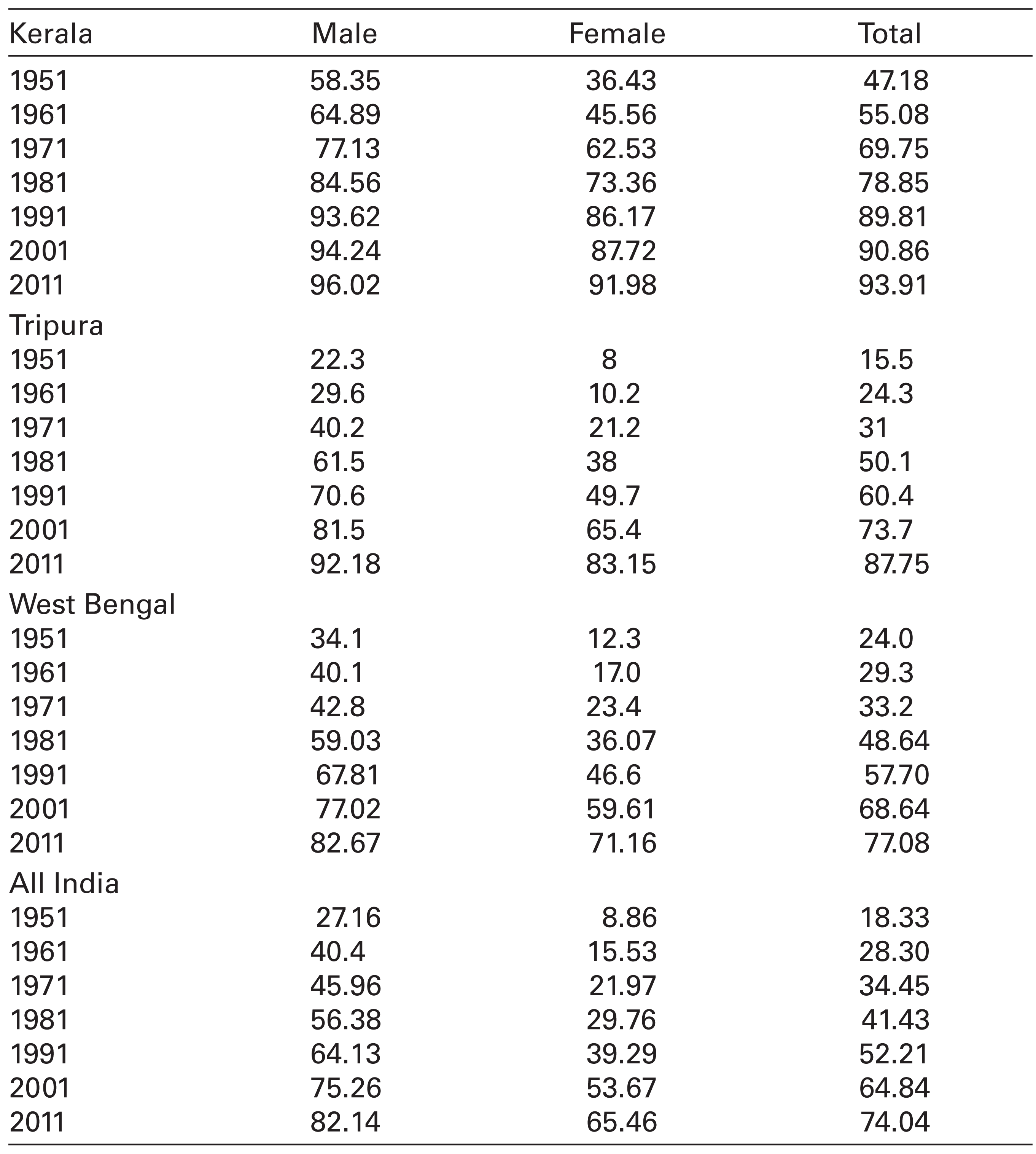
These brief indicators of Tripura’s performance show that the contrast with West Bengal could not be starker. The government has continuously been monitors what is happening on the ground and ensures that the schools are properly equipped. There are no schools with no rooms, and the proportion of single room schools has continually come down, in contrast to West Bengal. The pupil–teacher ratio is lower than the norm of 40/1, again in stark contrast to West Bengal.
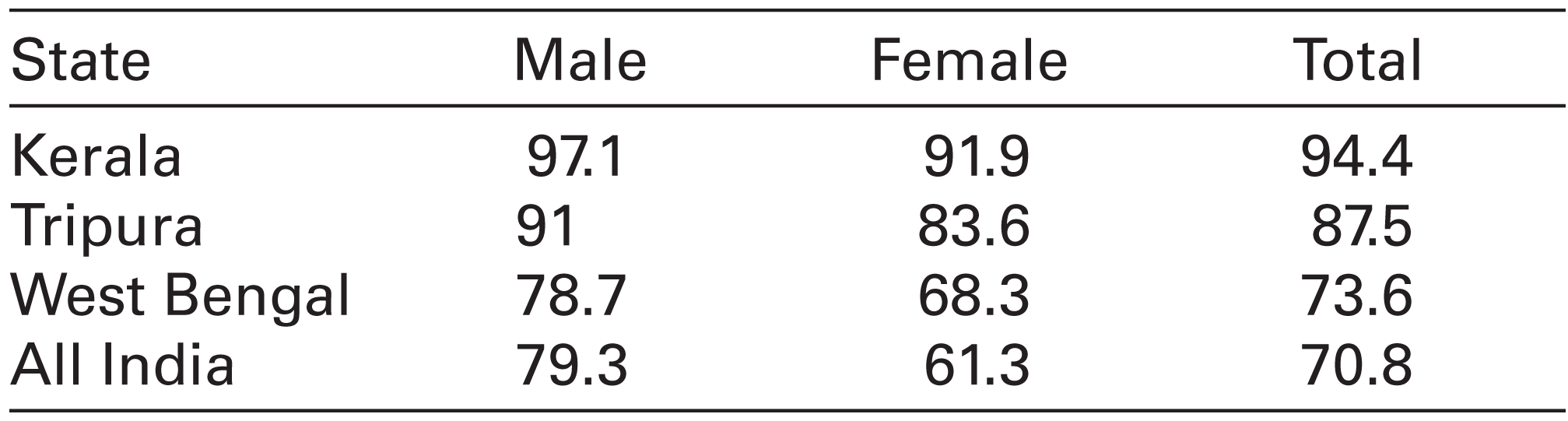
What has been happening to education in West Bengal under the regime of TMC? Table 5 gives an indication of the developments during the first three years of its rule (2011–14).
West Bengal has almost certainly the unique distinction among all the states in experiencing a decline in literacy between 2011 and 2014. We have already seen how under Left Front rule the political role played by school teachers had badly affected the quality of education and increased the burden on parents through the proliferation of private coaching. The recommendation of the Ashok Mitra Commission that Panchayats should play an active role in ensuring the proper functioning of schools had been rendered farcical.
Literacy Rates (per cent) for Persons of Seven Years of Age and Above in 2014
These strictures apply a fortiori to the current state of education in West Bengal now that under the TMC regime it has become a football to be kicked around in the political game. Newspapers daily report new scandals: how schools are controlled by persons who have not themselves passed the school final examination, how such a person throws a jug of water at the principal of a school, how most students regard mass copying as their birth right, how admissions to educational institutions is determined by student leaders of the ruling party, often with financial side-payments into the bargain, how a college principal is beaten up because he had prevented the wife of a leader of the ruling party from adopting unfair means, and so on and so forth. If teachers’ politicisation was one bane of the educational system in West Bengal under the Left Front, lawlessness has become its hallmark under the TMC regime.
In contrast, Tripura’s literacy achievement is directly linked with the state’s insistence on improving literacy among the Adibasis or Janajatis. By doing so, it has even gone ahead of Kerala in terms of Scheduled Tribe (ST) literacy rate. In 2011, Kerala’s literacy rate among the STs was 75.6 (male 80.8, female 71.1). The corresponding Tripura figure was 79.1 (male 86.4, female 71.6). (This, however, corroborates one’s anxiety about gender gap in literacy.) Also, Tripura is perhaps the only state in India which has a higher level of literacy among the Scheduled Castes (SCs; 89.5 per cent) than the state average (87.5 per cent). One reason for this success is that the Communist movement in Tripura started from among the Adivasis, with Dasarath Debbarma and Birendranath Datta in the leadership.
In West Bengal, the issue of social exclusion as the issue of class has gone off the radar. In every state of India, the SCs, the STs and the minority community require special attention because they are overrepresented among the disadvantaged —in literacy, in health and nutrition (Rana 2010). There are central government programmes relating to them, the ICDS for providing nutrition and elementary education to children up to the age of six, the Kanyashree Prakalpa for girl children and so on. In West Bengal, they are not either implemented at all (e.g., the Anganwadi workers do not receive their meagre salaries for months on end), or they are reduced to tokenism: the current Chief Minister of West Bengal has distributed gold bangles to a few thousand girls under the Kanyashree Prakalpa and then has washed her hands off it. The pity is that these are only a few programmes under which the underprivileged communities could have received some benefits from the state.
Finally, we turn to the issue of privatisation of education. Informal privatisation of education had already taken place under the Left Front government through the burgeoning of private tuition and coaching centres. But under the Trinamool regime, most decisions have been left to the market, as is partly indicated by the rapid growth of private universities. However, as Tilak (2014) has pointed out, privatisation of education affects not only its equity but also its efficiency. It affects equity because access to education, especially in its higher reaches is confined to the rich: it affects efficiency because there is little accountability, especially given the poor quality of monitoring and inspection. The privatisation of education affects all sectors of society. If a medical student has to pay a crore of rupees for getting a degree from a medical college, it is unrealistic to expect him to treat his patients in conformity with the articles of the Hippocratic oath. Similarly, a civil engineer receiving poor-quality training, endangers human lives through faulty construction of houses, bridges and roads.
West Bengal’s education today is awash with wilful ignorance, corruption and intimidation. In the middle of that gloom, however, there are excellent teachers and researchers who teach students with dedication and carry out research with an eye to the truth, without any regard for monetary reward or instant recognition. That is why the state still turns out excellent students, most of whom, unfortunately, have to look for jobs elsewhere. It will be invidious to cite particular examples. Worthy of mention still is the case of a couple who received their PhD from the Saha Institute of Nuclear Technology but chose voluntarily to teach in two undergraduate colleges in Howrah, producing literate students.
Footnotes
Acknowledgements
The help of Achin Chakraborty and Kumar Rana is gratefully acknowledged. They are, however, not responsible for any remaining errors.