




Abstract
When the states’ reorganisation took place in 1956, Andhra Pradesh, enlarged by inclusion of Telangana, faced two contrary pulls. On the one hand, there was widespread pride in the Telugu language and culture, prevailing over the whole state, and, on the other, there was the legacy of the different histories of its two major parts, namely, coastal Andhra, long held under direct British administration, and Telangana, which had been a part for over two centuries of the largest princely state of India, Hyderabad. The paper examines how owing to this divergent legacy of the past, a union lasting for over half a century (1956–2014) proved unworkable, and separation became inevitable.
Andhra Pradesh, of which Telangana formed a part till recently, was in 1956 the first ever new state in free India to be formed on linguistic lines. Ironically, the new Telangana state, separated from Andhra, and established on 2 June 2014, after a protracted popular struggle, once again proved (such as Jharkhand, Uttarakhand and Chhattisgarh) that language is not necessarily a factor in binding people to a state. The Telangana State formation was the culmination of a long-cherished desire of the majority of the people of the region who took to agitations at different periods of time and finally achieved their object through the requisite constitutional processes.
With an area of 114,840 sq. km and a total population of 35,286,757 (as per 2011 census) the Telangana State, is India’s 29th (and the latest) state to be formed. Although landlocked, the new state possesses minerals that include extensive coal deposits available for power generation and industrial use, as well as limestone deposits which are utilised by cement factories. Telangana is also well known for bauxite and mica. The state has thirty-one districts. 1
India’s long political history has witnessed its internal boundaries changing frequently according to the decision of its rulers, patterns of conquests, transfer of its parts as per treaties and convenience of revenue collection. The Mughals, for example, created Subas while the British carved out presidencies and provinces. But during the freedom movement after the Nagpur session of the Congress in December 1920, the Congress organised its ‘Provincial Congress Committees’ largely on linguistic lines. 2
Indeed, the idea that states should be organised on linguistic lines is almost a century old. The Andhras were the first to launch a movement for a separate state for the Telugu-speaking people during the freedom movement. The Indian National Congress supported the demand in principle by forming a separate Andhra Provincial Congress Committee for the Telugu-speaking area in the then Madras Presidency in 1917. 3 This probably was the forerunner of the formation of the linguistic states after independence. We will examine below how Telangana region formed a core part in the successive kingdoms with multilingual nature from historical times and remained a cohesive cultural unit. The Telugu-speaking parts of coastal Andhra and Rayalaseema were separated from the Hyderabad dominions in 1766 when they were ceded to the British. But when these regions were again merged with the Telugu-speaking parts of the former Hyderabad state to form a united Andhra Pradesh later, the distinct cultural identities of the two parts and political and economic disparities between them gave rise to the separatist movement in Telangana.
Telangana through the Ages
Telangana, as an economic, social, cultural and historical entity, has had a rich past from early times. Politically, the region formed part of the Satavahana kingdom called ‘Andhra’ by the Puråµas that came into being around first century
The Kakatiyas united all the Telugu-speaking areas and the kingdom with all its glory lasted for more than three and half centuries. It saw powerful kings such as Ganapathi Deva, Rudra Deva, Prathaparudra and, the first ever woman ruler in the region, Rudrama Devi. Kakatiyas who ruled from Warangal, are known for their irrigation works, for evolving a distinct architecture and development of fine arts. In 1323, the Kakatiya kingdom was invaded by the forces of Ala’uddðn Khalji, under the command of Malik Kafur. The contributions made by the Kakatiyas to the region’s cultural development were such that even now Warangal is considered as Telangana’s major cultural centre. 5 It is interesting that medieval historians writing in Persian called the Kakatiya kingdom of Warangal by the name of ‘Telang’, the original form of Telangana. 6
The Extent of Satavåhana Dominions
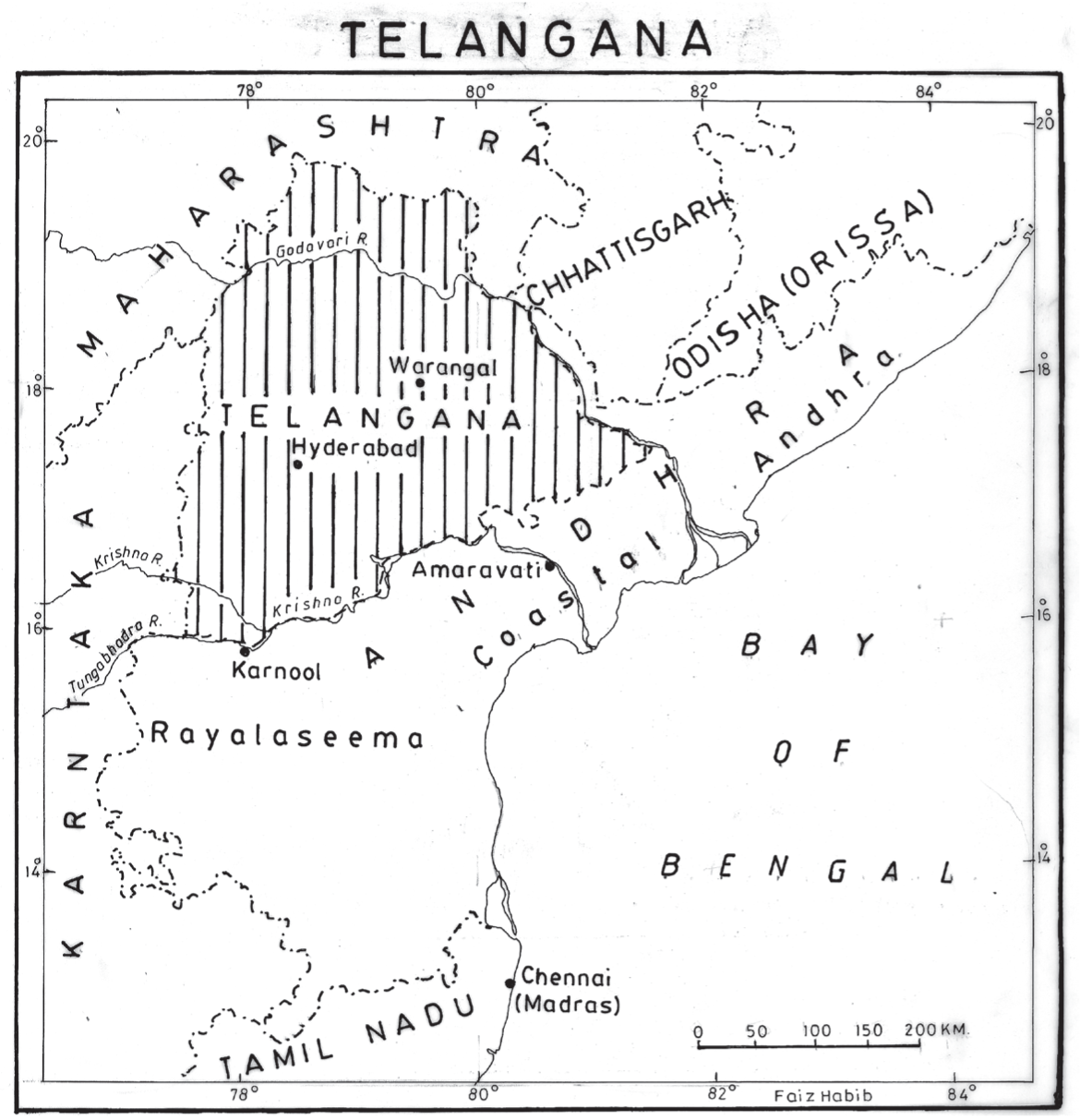
Source: Work of Faiz Habib.
After the fall of the Kakatiyas, the area came nominally under the control of the Delhi stultans until after 1347 it passed under the rule of the Bahmanis. Sultan Quli Qutb Shah, the governor of the Telangana region under the Bahamnis, declared his independence in 1518
Under the Rule of Nizams
Golkunda, one of India’s great forts, fell to the arms of the Mughal emperor Aurangzeb in 1687 after an eight-month-long siege during which Aurangzeb’s general Qilich Khan died in battle. 8 His grandson, Qamar-ud-din Khan was appointed as Viceroy for the Deccan by Emperor Farrukh Siyar in 1712 with the title of Nizam-ul-Mulk. But later, when Qamaruddin was recalled to Delhi and Mubariz Khan was named in his place by emperor Muhammad Shah, Qamaruddin decided to defy the emperor’s orders. He collected armies and defeated Mubariz Khan in October 1724 in the battle of Shaker Khadla, in Berar. 9 After the battle, the position of Nizam-ul-Mulk as Viceroy of the Deccan was confirmed by Muhammad Shah as fait accompli and he even conferred on him the title of Asaf Jah. The dynasty Qamaruddin founded in 1724 therefore came to be known as Asaf Jahi dynasty and it ruled Hyderabad till 1948.
During the rule of the early Nizams, large parts of the Telugu-speaking areas, namely coastal Andhra and Rayalaseema, which later formed the Andhra State, were separated from the Nizam’s dominions being acquired by the British in stages during the reign of Nizam Ali Khan (1761–1803), who had come to power after dethroning his brother, Salabat Jang. 10 Coastal Andhra, then known as the Northern Circars, was the first to be acquired by the British in 1766. 11 Earlier, Salabat Jang who had become the Nizam in 1751 with the support of the French forces under the command of Bussy, had assigned the revenue of some districts in Northern Circars for the maintenance of the French troops in Hyderabad. 12 But with the recall of Bussy to help Count De Lally in the attack of Madras in1758, the French influence in Hyderabad declined. Taking advantage of this, the British entered into a treaty with Nizam Ali Khan.
The treaty concluded between Nizam Ali and General John Calliaud, on behalf of the East India Company, on 12 November 1766 assigned the entire Northern Circars to the East India Company. It was agreed that Guntur which at that time was under the possession of Basalat Jang, the brother of the Nizam, would be handed over to the British after the death of Basalat Jang. Accordingly, after his death (in 1782), Guntur also came under the British in 1788. 13
The next major split of the Telugu-speaking area in the Nizam’s territory came when the Rayalaseema area was given away to the British by Nizam Ali Khan. When Wellesley, as Governor General, initiated the system of Subsidiary Alliances and imposed it on Hyderabad, then for the maintenance of a subsidiary army stationed at Hyderabad, the Nizam by a treaty with the British on 12 October 1800, ceded them the territories he had got earlier as his share from out of territories given up by Tipu Sultan in 1792 after the Third Mysore War and those gained after his destruction in 1799 after the Fourth Mysore War, besides his other possessions to the south of Tungabhadra and Krishna rivers. 14 Thus the Districts of Bellary, Anantapur, Cuddapah and Kurnool were ceded to the British, whence they came to be known as Ceded Districts, now called Rayalaseema. Large parts of the Chittoor and Nellore districts in the present Andhra Pradesh were acquired by the British after dispossessing the Nawab of Arcot, Azim-ul-umra and annexing his territories in 1801. 15 Thus coastal Andhra and Rayalaseema were taken away from the Nizam’s dominions and remained within the Madras Presidency until all the three areas were merged to form Andhra Pradesh on linguistic lines after about a century and half.
From Monarchy to Democracy
The existence of Hyderabad state as a separate entity and the rule of the Nizam came to an end with the incorporation of Hyderabad state in the Indian union after a military campaign officially called ‘Police Action’, on 17 September 1948. The Hyderabad state then consisted of nine Telugu-speaking districts (Telangana), four Kannada-speaking districts in Gulbarga division and four Marathi-speaking districts in Aurangabad division known as Marathawada. 16 After 16 months of military rule by Gen. J.N. Chowdhury, the Government of India appointed a civil servant M.K. Vellodi as the first Chief Minister of Hyderabad State on 26 January 1950, when the Indian Constitution came into force. The Nizam, Mir Osman Ali Khan was named as the Rajpramukh. In 1952, Dr B. Ramakrishna Rao took over as Chief Minister of Hyderabad State after the first democratic election.
This was the time when the Telugu-speaking people in Madras Presidency began to demand a separate Andhra state. The central government conceded the demand after Potti Sriramulu sacrificed his life on 16 December 1952 while undertaking a fast unto death. As a result, Andhra State was carved out of the Madras Presidency. It comprised coastal Andhra and Rayalaseema with Kurnool as the capital. The new state came into effect on 1 October 1953. The formation of Andhra Pradesh, a common state for all the Telugu-speaking people on linguistic lines, was the next major step.
Merger of Telangana with Andhra
The States Reorganization Commission (SRC) was appointed by the Government of India in December 1953 to make suggestions on the creation of states on linguistic lines. While appointing the Commission, Prime Minister Nehru highlighted three important criteria in the formation of new states: unity of India, national security and preservation of India’s federal structure. It should be said to the credit of the SRC that it travelled extensively in the country and heard the voices of the people on the creation of new states. Though the Commission recommended the creation of new states such as Kerala and Karnataka on a linguistic basis, it did not favour the immediate merger of Telangana with Andhra state, though both were Telugu-speaking regions. 17
The SRC recommended division of erstwhile Hyderabad state into three parts on the basis of language and suggested the merger of the Marathi-speaking Aurangabad Division with Bombay state (renamed later as Maharashtra) and the Kannada-speaking Gulbarga Division with Mysore State (renamed later as Karnataka). But the SRC for the reasons it elaborated, did not favour for the merger of the Telugu-speaking Telangana region with Andhra state. During the later separatist Telangana movement, the stand taken by the SRC in not favouring the immediate merger, was cited by Telangana leaders to support their stand.
It is interesting to note that the SRC in their report pointed out that
Important leaders of public opinion in Andhra themselves seem to appreciate that the unification of Telangana with Andhra, though desirable, should be based on a voluntary and willing association of the people and that it is primarily for the people of Telangana to take a decision about their future.
18
Taking cognizance of the opposition in several quarters in Telangana against such a merger, the SRC in its report noted: ‘One of the principal causes of opposition of Vishalandhra also seems to be the apprehension felt by the educationally backward people of Telangana that they may be swamped and exploited by the more advanced people of the coastal areas’. 19
The SRC in its conclusion pointed out:
After taking all these factors into consideration, we have come to the conclusion that it will be in the interests of Andhra as well as Telangana, if for the present, the Telangana area is to constitute into a separate state, which may be known as the Hyderabad state with provision for its unification with Andhra after the general elections to be held in or about 1961, if by a two thirds majority the residuary of Hyderabad state expresses itself in favour of such unification.
20
The people of Telangana also had several concerns in respect of the merger. The region as the SRC felt had a less developed economy than Andhra, though with a larger revenue base which people of Telangana apprehended might be diverted for use in Andhra. 21 There was also the fear that the proposed irrigation projects on Krishna and Godavari would not benefit Telangana proportionately though the upper reaches of those rivers flow through Telangana. It was also feared that the people of Andhra who had better access to education under British rule, would have an unfair edge over the Telangana people in government service.
The Andhra State Assembly passed a unanimous resolution on 25 November 1955 to provide ‘safeguards’ to Telangana and assured the people of Telangana that the development of that area would receive special attention and that certain priorities and special protection would be given for improvement of that area, such as reservation in services and educational institutions on the basis of population and irrigational development. 22 The Pradesh Congress Committee of Andhra, expressing its desire for a united state with Hyderabad as the capital, had as early as 1950, assured ‘our brethren in Telangana that it will be the special concern of the future government of Vishalandhra to pay special attention to their legitimate interests and rights and their effective share in the administration of that government’. 23
The chief minister of Hyderabad state, B. Ramakrishna Rao, in a detailed letter to the then Congress President, U.N. Dhebar, stated that a majority of the people of Telangana were against the merger, through he himself supported the Congress party‘s central leadership’s decision to merge Telangana with Andhra in order to create a unified Andhra Pradesh. 24
Telangana leaders had their own apprehensions on the assured safeguards. The Andhra Congress leaders then reached an agreement with the Telangana leaders on 20 February 1956 to merge Telangana and Andhra with a few specific promises to safeguard Telangana interests. This came to be known as the ‘Gentlemen’s Agreement’. 25 Following the agreement, the central government formed the unified state of Andhra Pradesh, Vishalandhra, with all the three Telugu-speaking regions—Coastal Andhra, Rayalaseema and Telangana on 1 November 1956 with Hyderabad as the capital. The germs of the Telangana, movement thus were to be found in the very manner the united Andhra Pradesh, came into being in 1956.
The Telangana Movement
The Telangana Movement refers to the peoples’ movement for the creation of the new state by separation from Andhra Pradesh. The state corresponds to the Telugu-speaking areas in the erstwhile Hyderabad state that existed for eight years after its accession to the Indian union in 1948 till its merger with Andhra Pradesh in 1956. After several decades of protests and agitations, the UPA government at the centre decided to bifurcate Andhra Pradesh and in June 2014 the Telangana state was at last formed.
There were several concrete reasons for the demand of separate statehood of Telangana from almost immediately after the formation of Vishalandhra, viz. non-implementation of the Gentlemen’s Agreement that was agreed upon at the time of merger, and perceived discrimination against the Telangana region in matters of government jobs, educational opportunities and expenditure of public funds. The understanding that if the chief minister was from one region, the other region should be given the position of deputy chief minister was kept only in its breach.
Another reason was the way the different regions in Andhra Pradesh had evolved over one hundred and fifty years since Nizam Ali gave away the Coastal Andhra and Rayalaseema to the British. After the construction of large irrigation projects like the Dhawleswaram Anicut on Godavari and the Krishna Barrage near Vijayawada by the middle of the nineteenth century, significant agrarian changes occurred in the Andhra region. The introduction of railway net work brought marked improvements in transport and communications. Establishment of industries, trade and commerce also changed the economic and social profile of the middle classes in coastal Andhra. Such development was obviously absent in the Hyderabad state under the successive Nizams.
Even in matters of language, on closer observation, we find slight variations in the way Telugu is spoken in the two regions, though there has been no difference in matters of written form. Telugu as spoken in Andhra region is referred to as Andhramu and it has greater Sanskrit influence than Telangana’s Tenugu. This unique characteristic Telangana slang came handy in facilitating the needed oratory for the quick tongued leaders in swaying public opinion during the Telangana agitation.
Another significant cause of the cleavage was the ‘Telangana Sentiment’ which the political leaders emphasised when the movement gained momentum. The dissatisfaction among the people was not merely for the jobs, river waters and funds for development, but for the preservation of the cultural identity of the people of the region. The unique fairs and festivals associated with Telangana that had evolved over centuries, the distinct food habits and Telangana cuisine, etc., gave substance to the region’s distinct cultural identity. 26 Added to it, the ballads and various folk forms through song and dance eulogising Telangana’s heritage and culture, greatly promoted separatist sentiment. 27
The agitation during its course did not remain the same in matters of its methods, participating social groups, political parties and the leadership. The earliest agitation in Telangana region began in 1969 as people protested over the failure to implement the Gentlemen’s Agreement and other safeguards in letter and spirit. Marri Chenna Reddy launched Telangana Praja Samithi (TPS), a separate political party espousing the cause of a separate state. The agitation intensified with a large number of students joining the struggle. A number of students were killed in violence and police firing that followed. 28 However, after Parliamentary elections in 1971, in which the TPS made an impressive show, several dissident leaders rejoined the Congress. In September 1971, P.V. Narasimha Rao, a Congress leader from Telangana, was made the Chief Minister of Andhra Pradesh. 29
In 1972, Jai Andhra movement was started in Andhra and Rayalaseema as a counter to the Telangana movement. 30 But with the intervention of the then Prime Minister Indira Gandhi, a political settlement was reached with a ‘Six-point formula’ to placate the people of both the regions. 31
After a comparative lull for decades, the Telangana movement came to the fore again at the turn of the present century, but with greater intensity. When the possibility of the formation of new states in the north was coming up under the NDA-1 rule and when the Telangana leaders were trying to garner support for a separate Telangana, a prominent leader of the Telugu Desam Party, K. Chandrasekhar Rao (K.C.R.) left the party and launched the Telangana Rastra Samithi (TRS) in April 2001. A new chapter opened in the struggle for Telangana state with the arrival of K.C.R. and his TRS on the political scene. A gifted speaker and an able organiser, K.C.R. could rally the masses, the youth and the educated for the cause of separate state based on the slogan of self-respect of the Telangana people and the injustice caused to the area in the combined state.
The stunning electoral successes of TRS under K.C.R. for Panchyaths, State Assembly and Parliament since then showed the growing power of the party as well as the strength of the movement for a separate state. The centre constituted a five-member committee in February 2010 under former Supreme Court judge, B.N. Srikrishna and the committee submitted its report on 30 December 2010. 32 Under the auspices of the all-party Joint Action Committee (JAC) that was formed, the Telangana region witnessed a series of widespread agitations, such as the Million March, Challo Assembly, Sakala Janula Samme (general strike), etc., leading almost to a non-cooperation movement with no signs of a let-up.
In December 2013, the Union Cabinet approved a bill for the creation of the Telangana state paving the way for the bifurcation of Andhra Pradesh. In February 2014, the Telangana Bill was passed by both Houses of Parliament and on 4 March the Government of India notified that the states Telangana and residual Andhra Pradesh would come into effect on 2 June 2014. In the general elections held in April–May 2014, TRS emerged victorious and K.C.R. was sworn as the first Chief Minister of Telangana state on 2 June. For the residual Andhra Pradesh, Amaravati in Guntur district is being built as the new capital city and the shifting of the capital of Andhra Pradesh from Hyderabad is now under way. Hyderabad, of course, remains the capital of Telangana.
The division of Andhra Pradesh and the formation of Telangana state has proved that the linguistic considerations do not serve as the only basis in matters of state formation. If the merger of Telangana with Andhra to form Andhra Pradesh became an example for others in the formation of linguistic states, its division now, it is feared, may become a precedent for similar regional movements elsewhere for subdividing the existing linguistic states for reasons other than a common language.