



Abstract
Community colleges educate a substantial proportion of future health professionals. In particular, they provide an important incubator for health education specialists who may pursue their foundational courses in a 2-year degree setting, with an opportunity to articulate to a 4-year degree program in health education. Community colleges also have strong connections to the communities they serve, a foundational element shared with health education, and enroll many students from underserved communities who could enhance the diversity of the future health education workforce. This article describes the development of three foundational courses in health education by the Society for Public Health Education, Inc. (SOPHE), working as part of The Framing the Future: The Second 100 Years of Public Health Task Force under the aegis of the Association of Schools and Programs in Public Health and the League for Innovation in Community College in the United States. Using the latest available competencies for the health education profession, three prototype curricular outlines were created in 2014, including an introduction to health education, accessing and analyzing health information, and advocacy and leadership in public health (a service-learning course). The course content outlines are presented herein, and their relationship to the 2010 health education competencies. We outline next steps in linking SOPHE health education faculty and practitioners with community college representatives to develop quality associate degree course offerings that articulate to baccalaureate degree programs in health education.
In 2012, the Association of Schools and Programs in Public Health (ASPPH) in the United States launched a 3-year initiative to rethink education in public health, in anticipation of the 100-year anniversary of the Welch–Rose Report (Welsh & Rose, 1915). Since this first blueprint for schools of public health was published, the landscapes of health care, public health, education, and other major public service areas have changed dramatically. The Society for Public Health Education, Inc. (SOPHE) was one of some 20 organizations invited to join The Framing the Future: The Second 100 Years of Public Health Task Force, which was organized into six expert panels and one advisory board (ASPPH, 2014). The Expert Panel on Community Colleges was of special interest to SOPHE, given that many SOPHE members work in 4-year colleges and universities that have existing course requirements and/or degree program articulations with community colleges or have expressed interest in strengthening connections between junior colleges and universities in the United States. Community colleges educate nearly half of all undergraduate students, including a substantial proportion of future health professionals; have strong connections to the communities they serve, a foundational element shared with health education; and enroll many students from underserved communities who could enhance the diversity of the future health education workforce (ASPPH & League for Innovation in the Community College, 2014).
In fall 2013, SOPHE officially joined Phase 2 of the Community Colleges and Public Health (CC&PH) project, which was led by ASPPH and the League for Innovation in the Community College in the United States. Building on CC&PH’s initial consensus statements, the second phase aimed to develop prototype curricular models designed for associate degrees and academic certificate programs in community colleges. Such efforts would serve as the foundation for 4-year academic institutions to develop articulation agreements with community colleges through which students could complete 2 years of course work before matriculating to a bachelor’s degree program. The purpose of this article is to describe SOPHE’s involvement with the CC&PH Expert Panel, the process used to identify and develop three prototype health education courses, and major features of the courses that could be offered in community colleges and articulate to 4-year institutions offering a bachelor’s degree in health education.
Background
When SOPHE joined this project, the CC&PH Expert Panel had already designed a 60-credit public health generalist associate degree curriculum, which was intended to assure that graduates develop basic skills and knowledge consistent with the Critical Component Elements of an Undergraduate Major in Public Health (ASPPH, 2012a). Following this prototype curriculum, students could complete an associate degree program in public health, or they would have the foundation for entry into public health or related programs at the bachelor’s degree level (e.g., public health generalist, health education, health administration, or environmental health programs). Of the 60-semester credit hour program, 24 to 30 credit hours were designed to be completed in specialization areas:
Core Content (9 credits): To include courses in human health or personal health and wellness (3 credits); overview of public health (3 credits); and health communications (3 credits).
Required Professional Courses (9 credits): To include one overview course each in health education (3 credits); health administration (3 credits); and environmental health (3 credits). Alternately, a sequence of three courses (9 credits) in either health education or health administration or environmental health may be substituted for the three general professional courses, provided that the three coordinated courses are endorsed by the corresponding academic association for transfer to a bachelor’s degree in their discipline.
One of these three required professional courses could involve a major experiential learning focus or an additional course wherein an experiential learning component could be added.
Electives (3-9 credits): To include one to three courses (3 credits each) in topics broadly relevant to public health such as Public Health Preparedness; Prevention and Community Health; or Health, Culture, Economics, and Diversity.
Within this CC&PH framework, SOPHE was charged to provide detailed curricular outlines for three sequential health education courses totaling nine credit hours, including an introductory survey course plus two additional professional courses. Collectively, the three courses would constitute the health education concentration of the public health degree program. As envisioned, the introductory survey health education course would be required of all students who elect to complete the public health generalist associate degree program of study. Additionally, this course would serve as the foundational course for students who elect to complete the alternate sequence of three health education courses. Furthermore, the introductory survey course would constitute the social/behavioral core course that is required in programs leading to a 4-year public health degree. Optimally, students would have completed an “Overview of Public Health” course and, possibly, a personal health and wellness course, prior to enrolling in the introductory course in health education.
Prototype Curriculum Development Process
SOPHE convened a Community Colleges Taskforce in late 2013, comprising SOPHE volunteers from higher education who were already involved in coordination and articulation agreements with community colleges or expressed a keen interest in this initiative. An open call to join the Taskforce was disseminated through SOPHE’s electronic newsletter, yielding a total of 15 members primarily affiliated with colleges or universities. As Taskforce deliberations evolved, additional SOPHE members were recruited to assure inclusion of professionals with expertise in other areas, for example, library science.
Given the health education profession’s strong foundations in quality assurance, SOPHE’s Taskforce agreed on several guiding principles for its work: (a) curricula outlines should be rooted in the latest Areas of Responsibilities, Competencies, and Subcompetencies for Health Education Specialists (National Commission for Health Education Credentialing, Inc., SOPHE, & American Association for Health Education, 2010)
1
; (b) health education courses recommended for the community college level must contain content that could be applicable within a 4-year degree program (i.e., the courses should be transferrable) and must be provided at a commensurate level of rigor and complexity expected in a 4-year program; and (c) course instructors should hold a minimum of a master’s degree in health education and/or be certified as an entry-level or advanced-level health education specialist (i.e., CHES/MCHES). The Taskforce also confirmed that completion of three health education courses at the community college level would not qualify students to take the health education certification exam offered by the National Commission for Health Education Credentialing, Inc. Furthermore, a student taking the three health education courses would not confer the formal titles of “health educator,” or “health education specialist,” which are reserved for a professional with a 4-year degree in health education. The U.S. Department of Labor Standard Occupational Classification (SOC 21-1091) defines health educators as those with a baccalaureate degree who promote, maintain, and improve individual and community health by assisting individuals and communities to adopt healthy behaviors; collect and analyze data to identify community needs prior to planning, implementing, monitoring, and evaluating programs designed to encourage healthy lifestyles, policies and environments; and serve as a resource to assist individuals, other professionals, or the community, and may administer fiscal resources for health education programs. (U.S. Department of Labor, Bureau of Labor Statistics, 2015).
In addition to an introductory health education course, SOPHE’s Taskforce selected two other topic areas they consider as foundational health education subjects: (a) accessing and analyzing health information and (b) health advocacy and leadership. Three SOPHE subcommittees were then empaneled to develop each of the curricular content outlines, with opportunities for feedback and presentation to the overall SOPHE Taskforce. The background and content of these three prototype curricula—Introduction to Health Education, Accessing and Analyzing Health Information, and Public Health Advocacy and Leadership in Action—are described below.
Introduction to Health Education Prototype Curricular Model
An introductory course in health education is essential for any entry-level health professional who aims to engage individuals, groups, or communities in primary, secondary, or tertiary prevention. Such a course provides a basic foundation for further knowledge and skills of a health provider, whether practicing in a community or clinical setting. The World Health Organization’s (2015) definition of health education is “any combination of learning experiences designed to help individuals and communities improve their health, by increasing their knowledge or influencing attitudes.”
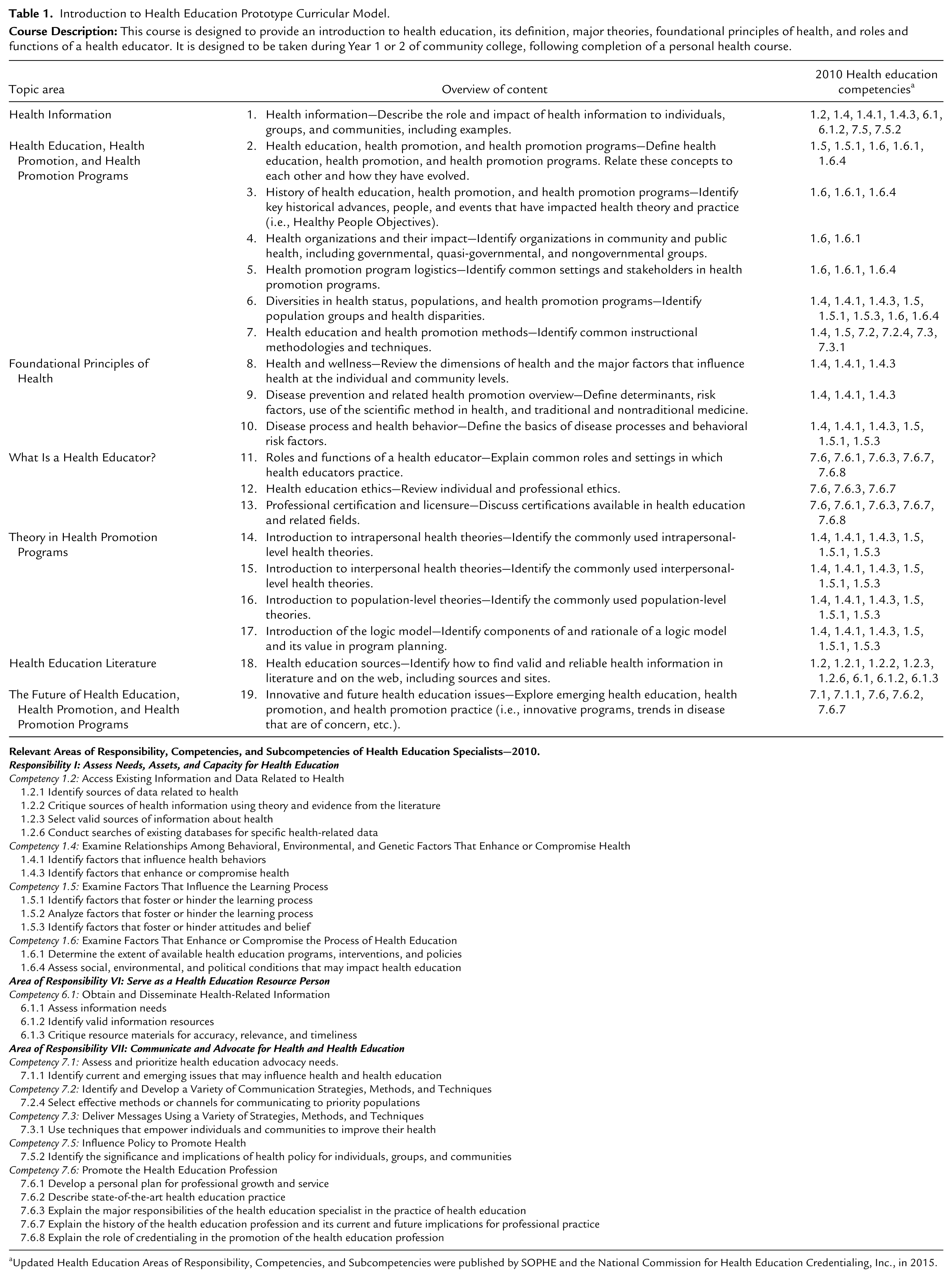
To develop the prototype Introduction to Health Education course, existing college and university course syllabi and rubrics were collected from Taskforce members and analyzed for common themes that aligned with the entry-level health education competencies. The course outline is designed to provide an introduction to health education, health promotion, and health promotion programming including the importance, impact, history, foundations, theories, and professional and future implications of these concepts (see Table 1).
Introduction to Health Education Prototype Curricular Model.
Updated Health Education Areas of Responsibility, Competencies, and Subcompetencies were published by SOPHE and the National Commission for Health Education Credentialing, Inc., in 2015.
The course is intended to be taken during Year 1 or 2 of community college, preferably after completion of a personal health course. Included are an introduction to health education as a discipline, a clear concise definition of health education, an introduction to major behavioral and health education theories and foundational principles, health education ethics, and an overview of professional roles in health education. Course content is presented in two primary categories: (a) basic concepts the student should know about health education (e.g., distinctions between health information, health education, health promotion, and health promotion programs) and foundational principles of health and (b) how the student can apply the concepts in terms of his or her role as a health educator, theory in health promotion programs, health education literature, and the future of health education, health promotion, and health promotion practice.
Assessing and Analyzing Health Information Prototype Curricular Model
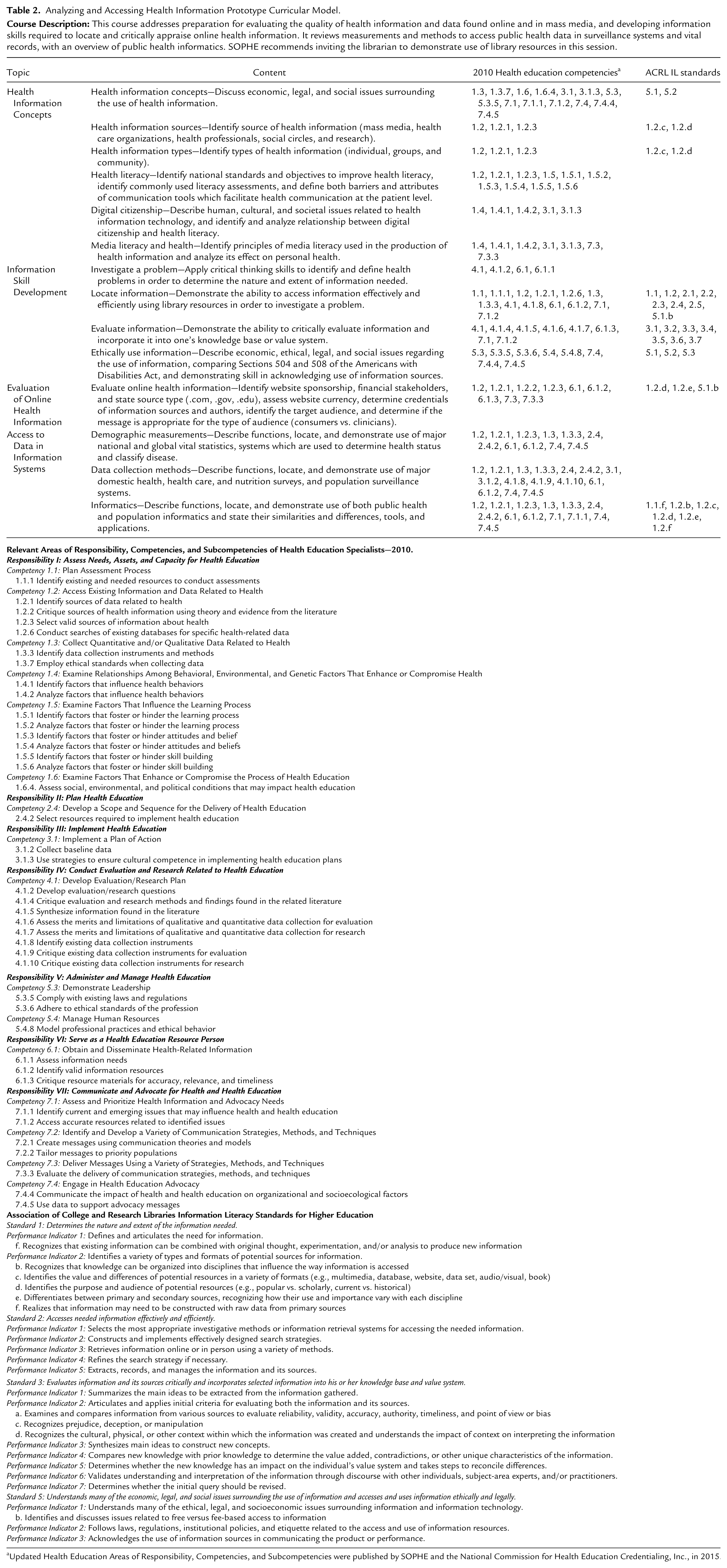
This course is designed to help community college students find, retrieve, analyze, and use authoritative health information and data systems. It excludes basic health communication concepts, which are addressed in the public health generalist curriculum. In developing the course, SOPHE’s subcommittee used an innovative approach of combining two distinct professional disciplines of health educators and instruction health science librarians. The Information Literacy Competency Standards for Higher Education, developed by the Association of College and Research Libraries (i.e., a division of the American Library Association), were used as a foundational reference. Representatives from the two disciplines cross-walked relevant content contained in the health education and information literacy sets. This emerging research methodology, referred to as e-Science, provides a powerful opportunity such that, “Instead of conducting research to collect and analyze data, a typical e-Science scenario mines existing data in search of patterns or correlations” (Rambo, 2009, p. 159).
Based on the blended competency sets, the SOPHE subcommittee selected the following content areas for inclusion in the course: gathering and accessing information, assessing credibility of sources, scanning for professional literature, media literacy (both deconstructing and constructing sources of information), and health information (i.e., a definition and statement about its importance at the individual, group, and community levels). Additional input was obtained from health science librarians with teaching responsibilities and a SOPHE board member with expertise in media literacy.
Of the 74 competencies from the health education and library competency sets that could be potentially included in the course outline, 70% (52) of all competencies eventually selected were health education competencies, while 30% (22) were information literacy standards. The Subcommittee then segmented the course into four parts: health information concepts, information skill development, evaluation of online health information, and access to data in health information systems. The final curricular outline is shown in Table 2.
Analyzing and Accessing Health Information Prototype Curricular Model.
Updated Health Education Areas of Responsibility, Competencies, and Subcompetencies were published by SOPHE and the National Commission for Health Education Credentialing, Inc., in 2015.
Public Health Advocacy and Leadership in Action Prototype Curricular Model
This course is designed to equip community college students with the essential advocacy and leadership skills, as demonstrated by health education professionals who conduct service-learning in their communities. Using the 2010 entry-level competencies for health education specialists, the course development process included (a) a review of the health education standards for high school students to determine what the students “should” already know about advocacy on completion of high school (Joint Committee on National Health Education Standards, 2007; see Figure 1); (b) a textbook search to identify crucial topics related to advocacy and leadership; and (c) development of a course outline that was reviewed by SOPHE’s Community Colleges Taskforce, revised, and submitted for final approval.
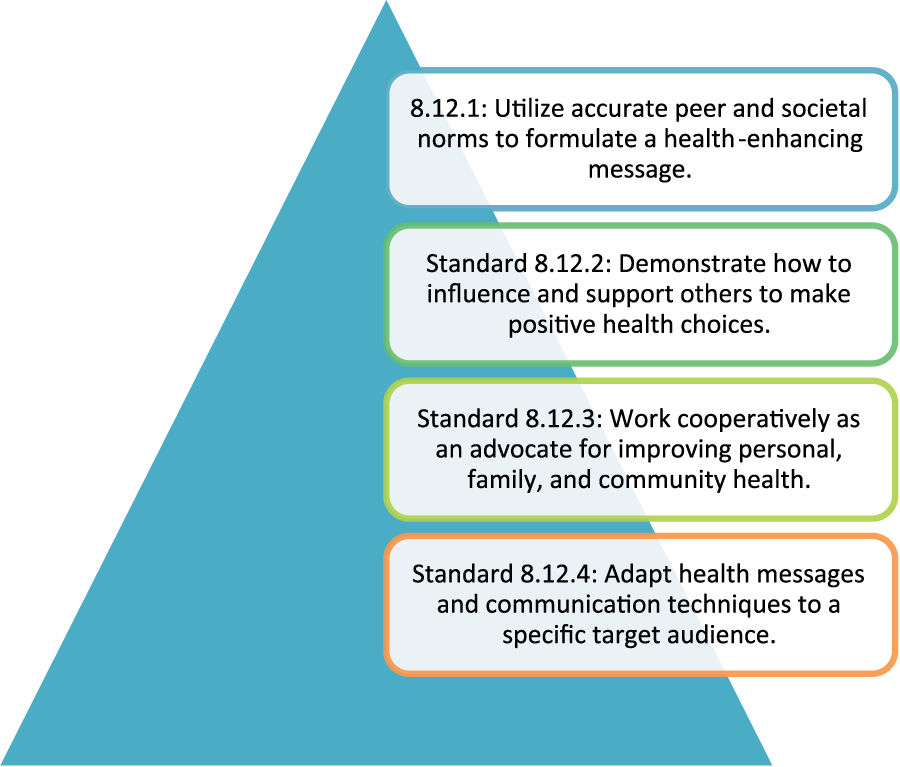
National Health Education Standard 8 and performance indicators for high school students.
Although there are existing textbooks on public health advocacy as well as leadership, no single text adequately addressed both areas. Therefore, the course topics were developed based on a combination of textbooks and technical reports to address the overview and purpose of advocacy, levels of advocacy, gathering the evidence, developing a message, developing a strategy, and implementing and evaluating the advocacy methods. Leadership topics address personal integrity and respect, leadership models, preparing others for leadership, personal leadership styles, and health policy development (see Table 3).
Public Health Advocacy and Leadership in Action Prototype Curricular Model.

This course also aims to develop students’ experiences in applying the classroom concepts to a “real-life” setting. A service-learning assignment is included that requires instructor-determined service hours in a community health agency. For example, in a potential Service-Learning Assignment students are required to (a) select a health issue that is of interest to them and addresses a community need; (b) apply the basic skills of advocacy and leadership taught through this course within this agency or organization; (c) submit a reflection paper that describes their processes in becoming advocates, addresses the entry-level health education competencies in advocacy and leadership, and provides an assessment of knowledge gained and a connection to the field; and (d) develop a personal leadership portfolio, which reflects personal leadership accomplishments as well as aspirations for professional growth in health education competencies.
Dissemination and Moving Forward
The three health education curricular prototypes were reviewed and approved by the SOPHE Board of Trustees in spring 2014 and, subsequently, submitted for inclusion in the Community Colleges and Public Health Project final report. In addition, the Taskforce reviewed an earlier draft of the latter report and provided extensive input regarding the roles of 2-year associate degree–prepared “health navigators” (i.e., a term adopted by ASPPH) and 4-year bachelor degree–prepared health educators.
To disseminate the curricular outlines, SOPHE conducted a three-part webinar series from December 2014 through February 2015, in part sponsored by the National Library of Medicine’s Southeast Regional Library, and provided a presentation at SOPHE’s 2015 Annual Meeting. In addition to this special journal issue, SOPHE is pursuing funding opportunities to fully develop and pilot each health education course. Some 90 SOPHE members have volunteered to work with local community colleges in developing and delivering health education courses and/or preparing articulation agreements. A sample articulation agreement included in this journal issue is intended to further the collaboration and connection between community colleges and 4-year programs offering a baccalaureate degree in health education (Hodges & Salis, 2016).
Footnotes
Acknowledgements
Members of SOPHE’s Community College Taskforce that contributed to the development of the prototype curricular courses in health education include the following: Elaine Auld (staff), David Birch, Randy Cottrell, Maria Deborba-Silva, Sue Forster-Cox, Deb Getz, Adrian Hanlon, Mary Hawkins, Elaine Hicks, Bonni Hodges, Laurencia Hutton-Rogers, Chuck Kozel, Cynthia Kratzke, Laura Linnan, David Lohrmann (chair), Amber Loos, Kathleen Miner, Kirsten Rodgers, Andrea Salis, Caile Spear, Rachel Torres, and Laura Zeigen. The contributions of Stacy Robison are also greatly appreciated.
Declaration of Conflicting Interests
The authors declared no potential conflicts of interest with respect to the research, authorship, and/or publication of this article.
Funding
The authors disclosed receipt of the following financial support for the research, authorship, and/or publication of this article: Support was provided to the Society for Public Health Education (SOPHE) for development of the prototype curricula by the League for Innovation of Community College and for the webinar series for dissemination of the curricula outlines by the National Network of Libraries of Medicine Southeastern/Atlantic Region.