




Abstract
Students preparing for helping professions who understand the influences of income on health are better equipped to address health challenges in communities and in their future careers. Universities have a responsibility to bolster and provide a safe environment for students to build and practice their 21st-century skills. When implemented as a pedagogical tool, photovoice projects have the potential to provide authentic learning experiences for students to engage in advocacy and civil discourse. Undergraduate students (n = 37) learning about the influence of low income on health engaged in a photovoice assignment, demonstrating their own understanding of the course content while effectively advocating for issues related to the health of low-income community members. Community members attending the exhibit (n = 32) completed surveys designed to capture their reactions to the students’ work. As a result of attending the students’ photovoice exhibit, community members reported increased awareness about issues of concern in the community as well as an affective response to the community concerns documented.
Keywords
To the extent that we as a society can recognize, the connection between health and poverty is reciprocal—poor health outcomes lead to decreased economic productivity and lowered economic power, which in turn leaves people unable to invest in their own health care (Adena & Myck, 2014). Good health, in turn, often leads to increased economic ability by facilitating increased employment opportunities and productivity and requiring less money be spent on health care (Y. C. Wang, McPherson, Marsh, Gortmaker, & Brown, 2011). People who lack material resources are unable to reliably seek medical treatment or preventive care as needed.
Students preparing for helping professions who understand the influences of income on health are better equipped to address health challenges in communities and in their future careers. Knowledge of the link between income and health prepares students for civic engagement and to promote policies capable of reducing health disparities and improving overall health across the nation (Braveman, Egerter, & Barclay, 2011). Teaching students to understand the connection between health and poverty also increases their likeliness of both interacting with people whose socioeconomic backgrounds differ from their own and engaging others with greater compassion and empathy (Strasser, Smith, Pendrick, Jackson, & Buckmaster, 2013).
Student Advocacy
Advocacy implies individuals taking a position based on beliefs and acting to persuade others to address a situation to the benefit of self and others (Shields, 2012). Applied to public health, advocacy is the combination of individual and social actions designed to gain political commitment, policy support, and social acceptance to change community conditions related to health (Goodhart, 2002). Educational systems have been called on to integrate into curricula the 21st-century skills that students will need in order to successfully contribute to workforce needs (Casner-Lotto & Benner, 2006). Specific skills cited include the ability to demonstrate ethical behaviors and take actions “with the interests of the larger community in mind” (Casner-Lotto & Benner, 2006, p. 16). Moving students to expand their empathetic understanding of others is often a challenge and frequently a novel task for young college students. Universities often encourage students to expand their understanding of others, build empathy, and engage in advocacy because it is mutually beneficial. Students and alumni who have strong advocacy skills represent the institutions positively because they are more civically active and more engaged in their communities (Goodhart, 2002). Moreover, the Council for the Advancement of Standards in Higher Education (2009), a consortium of professional associations that promotes the improvement of higher education programs and services, requires institutions of higher learning to identify student learning and development outcomes in the areas of humanitarianism and civic engagement. Universities bolster students’ advocacy skills by providing a safe environment for students to practice their skills and gain guided experience. Methods of teaching advocacy skills vary between universities and disciplines. One nursing program found that the best way to teach their students about advocacy was through community immersion (Wold, Brown, Chastain, Griffis, & Wingate, 2008). Once the students felt more familiar with the community and its health issues, they felt empowered to learn about and engage with the policy landscape (Wold et al., 2008). Course assignments that provide undergraduate students the opportunity to practice advocacy have proven effective at increasing students’ positive beliefs about advocacy (Goodhart, 2002; Massengale, Childers-McKee, & Benavides, 2014).
Photovoice
Photovoice is a methodology based in Freirean philosophy, feminist theory, and documentary photography that groups may use to advocate for positive change in their communities. It was first introduced to the field of health education in the 1990s (C. Wang & Burris, 1994) and is ideally suited for participatory needs assessment because it engages community members to identify, represent, and improve their community (Strack, Lovelace, Jordan, & Holmes, 2010). The photovoice process usually includes the following steps: conceptualize the issue, define goals and objectives, take photos of scenes in the community that represent the issue, facilitate group discussion about the photos, write captions for the photos, select photos that strongly represent the issue, make a public community presentation of the photos to which decision makers are invited, and advocate for policy change to make positive change around the issues of concern. Many photovoice projects have dual purposes or outcomes, such as raising participants’ levels of consciousness about a community issue as a necessary prerequisite for addressing root causes through policy and systems changes (Strack, Orsini, Massengale, & Herget, 2016). While some photovoice projects began with the primary goal of exposing the link between health and poverty (Freedman, Pitner, Powers, & Anderson, 2014; Hodgetts, Radley, Chamberlain, & Hodgetts, 2007), many photovoice projects that depict this link did not begin with this as their theme but found that it emerged once the projects were underway (Hennessy et al., 2010; Mosavel & Sanders, 2010).
Photovoice is frequently used in activities with college students. Its use has a variety of purposes, including pedagogical uses in the classroom (Cook & Quigley, 2013) and in online learning (Janzen, Perry, & Edwards, 2011), evaluation of curriculums (Mulder, 2014) and of educational programs (Jackson, 2013; Langdon, Walker, Colquitt, & Pritchard, 2014), strengthening critical thinking skills (Robinson-Keilig, Hamill, Gwin-Vinsant, & Dashner, 2014), teaching about health models and theories (Gast & Whitney, 2014), and gathering data about campus health (Goodhart et al., 2006). While most so-called photovoice projects on college campuses offer benefit to the student participants and provide research material to faculty and the campus community, few projects are designed for authentic learning experiences (Great Schools Partnership, 2013) that go beyond photo elicitation or evaluation and do not share the photographs and captions with the larger community outside the campus. With the exception of a few published projects (Seitz et al., 2012; Seitz, Reese, Strack, Frantz, & West, 2014), most do not include any community exhibit or advocacy for community or systems changes. However, when college students do create exhibits or events that open their projects to the community they have opportunities to engage in public dialogue and authentic learning through the experience of presenting their work to community members and local leaders. This gives educators a vehicle to build their students’ communication skills, allows the students to practice civic engagement, and gives them an opportunity to have conversations with people to whom they have never spoken (Adams, Berquist, Dillon, & Galanes, 2007).
The photovoice process can be instrumental for students in transforming the lessons they learn about the connection between health and poverty into positive changes that they would like to see in the community (Goodhart et al., 2006). Photovoice allows students to bring visibility to the issue and to engage community members in active listening and dialogue while in a safe environment (Carlson, Engebretson, & Chamberlain, 2006). By employing documentary photography techniques, student photovoice exhibits evoke an emotional response in attendees while the attendees are developing awareness and deeper understanding about the issue in a community (Szto, 2008). Emotional engagement is a necessary component in successful advocacy because it moves people from passivity into potential agents of positive social change (Carlson, Engebretson, & Chamberlain, 2006; Freire, 1970; Thomas, McGarty, & Mavor, 2009).
Method
Photovoice Participants
All students enrolled in a course titled “Health Problems of Low-Income Groups” (N = 37) participated in the photovoice assignment as one of the course learning activities. The average age of students was 23 years (range 19-44 years). Most students were pursuing their first bachelor’s degree (83%) and were pursuing Public Health Education as either a degree major or a minor (56%). The majority of students were female (86%).
Students had lived in the community where the university was located for varying amounts of time. While the average was 47 months, the range was 0 to 252 months with a median of 24 months. Some students had been born in the community and lived there their entire lives, while 14% were born outside the United States. Some students did not live in the community but commuted from other towns.
Exhibit Attendees
To determine the utility of photovoice for enabling college students to raise community awareness about issues related to the impact of low income on health, photo exhibit attendees were the focus of data collection. Based on the frequency of paper surveys picked up at the door, it is estimated that 120 individuals attended the photovoice exhibit. In the end, 32 exhibit attendees (27%) agreed to complete the pencil-and-paper questionnaire. Most data collection participants identified themselves as college or university students (53%), while others identified as follows: college or university faculty or staff (22%), municipal employees (9%), medical community employees (6%), K-12 educator (3%), nonprofit organization employee (3%), and private citizen (3%).
Procedures
Learning photovoice
As an introduction to photovoice, lectures early in the semester deployed historical photographs depicting images of health and poverty to engage students in conversations about the roles and ethics of documentary photography. Students next participated in a classroom discussion about advocacy and the ways community members could advocate for the health of people in low-income groups. Employees from a local housing coalition delivered a follow-up guest lecture to describe the ways they advocate daily for healthy housing for low-income people in the local community. Another class meeting began with a presentation of photovoice history and methodology then included an activity that required students to work in small groups to decide how they might respond to ethical dilemmas they could encounter while participating in the photovoice project. In the same activity, students were challenged to decide how they could best document topics on the theme of health and income while staying true to the intent of photovoice by documenting collective concerns rather an individual’s opinion.
Instructional strategy
To challenge students to reflect on and critically evaluate the responsibility of providing accurate context when representing their concerns via photovoice, the instructor shared with the students a photograph she had taken of a carbonated beverage truck parked in front of an elementary school. In discussing this image, students shared the following assumptions of why the truck was parked at the school: carbonated beverages were being served in the elementary school, school vending machines to which the students had access were stocked with carbonated beverages, vending machines accessible only by teachers and staff were stocked with carbonated beverages, or a parent whose child attended the school drove the truck for work. When asked how to best research their assumptions, students offered the following ideas: walk into the school and look in the cafeteria, hallways, and teachers’ lounge; telephone the carbonated beverage company; or call the school directly. Further discussion of these assumptions and research suggestions led to a discussion about the importance of research and informed advocacy when participating in photovoice or other advocacy activities. C. Wang and Burris (1997) described the value of contextualizing photographs in a similar manner, through group discussion and storytelling, to accurately present individual and group experiences.
The policy from the local school district was shared that stated that elementary school students would have no access to carbonated beverages at school. Products could be sold in the school to teachers and staff only. Review of the policy led to a class discussion about what could have happened if the instructor had not done appropriate research and presented this photo at the community exhibit with a caption describing how serving the carbonated beverages in the school was promoting childhood obesity among local elementary school students (a conclusion made by a student upon initially seeing the photograph). Students recognized that inaccurately representing their photographs through captions that were not well researched could misrepresent and possibly harm community members affected by the concerns documented in the photographs as well as misrepresent the university who was hosting the exhibit. Time after subsequent lectures was allotted for students who had taken photographs in the community to elicit peer feedback on their work. Peer feedback included suggestions of local resources that might be helpful in researching the topic(s) of concern. Students in the class represented a wide range of socioeconomic backgrounds. Via dialogue in class about each other’s photographs and captions, students learned from the lived experiences of their classmates.
Photovoice assignment
The purpose of the photovoice assignment was for students to have the opportunity to advocate on behalf of community concerns discussed during the course to local community members in power. Photovoice methodology allowed students to use photography to tell the story of a health-related issue affecting low-income groups in the local community and then provided students with the opportunity to advocate for change on behalf of the concerns documented. Students’ photographs were exhibited for public display on the university campus at the end of the semester.
Usually, photovoice participants are advocating on behalf of their own concerns. In the context of our class, some students were advocating on behalf of concerns that did not directly affect them; rather, class participation provided the students an increased awareness of how the issues affected other community members in their daily lives. In this way, photovoice projects such as ours present challenges when students are advocating for concerns as part of a class assignment, a situation quite different from the typical application of photovoice. Generally, photovoice projects would empower low-income people to advocate for themselves. The intent of geographically limiting students to document concerns within a defined area of the local community was to ensure the appropriate community leaders had a reasonable opportunity to attend the exhibit. To honor the spirit of photovoice and maintain ethical boundaries, students were instructed to speak for themselves by documenting concerns from the experiences of their own daily lives. The assignment guidelines, which were reiterated in class frequently, emphasized that students should not go out into neighborhoods and parts of the community they had not previously visited with the intent of taking photographs for the assignment.
Each student was assigned to take two photographs that documented aspects of the local community that affected the health of low-income people in the city. The influences on health could have been positive, negative, or both. Students were instructed that the subject matter could have been the same in both photographs or could represent two very different concerns. Students wrote captions for each photograph using the mnemonic SHOWED to describe the context and suggest steps for further action (Hergenrather, Rhodes, Cowan, Bardhoshi, & Pula, 2009). Students described the following: what was SEEN in the photo, what was really HAPPENING, how the issue related to OUR lives, WHY the concern or strength was present, how the viewer could be EMPOWERED through a new understanding of the issue, and what the viewer could DO to address the concern or strength.
In order to extend their understanding of the issues being represented and challenge students to engage in higher levels of thinking beyond memorization of facts related to health and poverty, students were assigned to write a problem statement to demonstrate their research about one of the concerns documented in their photographs. The problem statement assignment required students to pretend they were writing to explain the issue to someone who knew nothing about it and did not understand why it was worth documenting or advocating about. Students were to explain how and in what ways the issue affected the health of low-income groups in the local community, explain what the local community was already doing to address the issue, and suggest why more attention or a different approach was needed. Citation of both local resources and academic sources was required. Students were encouraged to evaluate local or county statistics and relevant historical facts that supported their statements. A further purpose of the problem statement was to ensure students had conducted in-depth research about their photograph topics so that they could write effective and accurate captions and discuss the issues appropriately with photovoice exhibit attendees.
Selection of photographs for community exhibit
The exhibit space allowed for the inclusion of 30 photographs and captions. To determine which photographs to include in the exhibit, one class meeting was devoted to the sharing of photographs and captions. Each student submitted to the instructor his or her two photographs and captions in a PowerPoint presentation. The instructor created one PowerPoint presentation that included all the photographs and numbered each image so that students could easily refer to individual photographs. Each student was allotted a few minutes to share aloud the caption he or she had written as his or her photograph was displayed on a screen in the classroom. Students were provided with a worksheet to record notes on the images they thought should be included in the exhibit as well as encouraged to consider whether an individual caption was adequate as presented or if the presenter could improve the caption with additional research or a more detailed explanation. When evaluating the content of captions, students were reminded to consider the mnemonic SHOWED (Hergenrather et al., 2009). Additionally, students were asked to consider the range of topics presented during the exhibit and to note any themes among the presented photographs and captions. Each student voted via his or her worksheet for up to 15 photographs and captions to be included in the exhibit.
After tallying all the votes from the entire class, the instructor shared at the start of the next class meeting a presentation of the 30 most popular photographs and captions. These images and captions were included in the exhibit. As part of the participatory analysis (C. Wang & Burris, 1997), the instructor asked the class to identify any additional images that were not among the 30 selected that students felt needed to be included in the exhibit. Students advocated for the inclusion of three additional photographs and captions. Thus, 33 total photographs and captions were exhibited. Students felt the photographs represented a wide range of topics that affected the health of low-income groups in the community and that the exhibit should include a range of topics rather than limit the exhibit to a specific theme among the broad topic of health and low-income groups.
Among the 33 images the students chose to include in the exhibit, 4 represented community strengths for addressing the health of low-income groups in the local community. A community garden, a gas station advertising the sale of home grown tomatoes, and a local neighborhood market selling fresh fruits and vegetables in an area with nine fast-food restaurants in a radius just over 1 mile were all positive community influences working to increase access to healthy foods in the community food desert. Additionally, a photograph of a pediatric clinic in a predominately low-income neighborhood that advertised Saturday and walk-in appointments, a Spanish-language interpreter, and the acceptance of Medicaid and all insurances, was also included as a community strength. The remaining 29 images shed light on challenges in the local community that may influence the health of low-income community members: access to affordable healthy foods, access to affordable child care, the lack of bus shelters at bus stops, unsafe or unhealthy housing, the lack of walkable sidewalks along busy streets, proposed changes to reduce local bus routes, homelessness, the relationship between health care providers and patients enrolled in Medicaid, a local factory known for its pollution, the absence of working street lights in a residential area, human trafficking, and community parks with broken recreational equipment. The four photographs (Figures 1-4) and captions included in this article were selected because they demonstrate the range of concerns documented by the students.

We can see what inclement weather may entail. Weather is happening and there is no protection. For those of us that ride the bus, these are uncontrollable, frequent circumstances that can affect our health if we are not protected from them. Many people of low income rely on the local bus system as their main form of transportation and therefore are exposed to the elements because of lack of bus stop shelters. I feel empowerment comes from putting in time and effort into something. By working on this project I have become more aware and feel more responsible to do something about it: empowered. I’d hope the photos would do the same in others. By knowing that it exists we have the power to advocate for change and help those in power to make appropriate decisions to address issues of importance to its citizens, like protecting them from the elements that cause a slue of health problems.
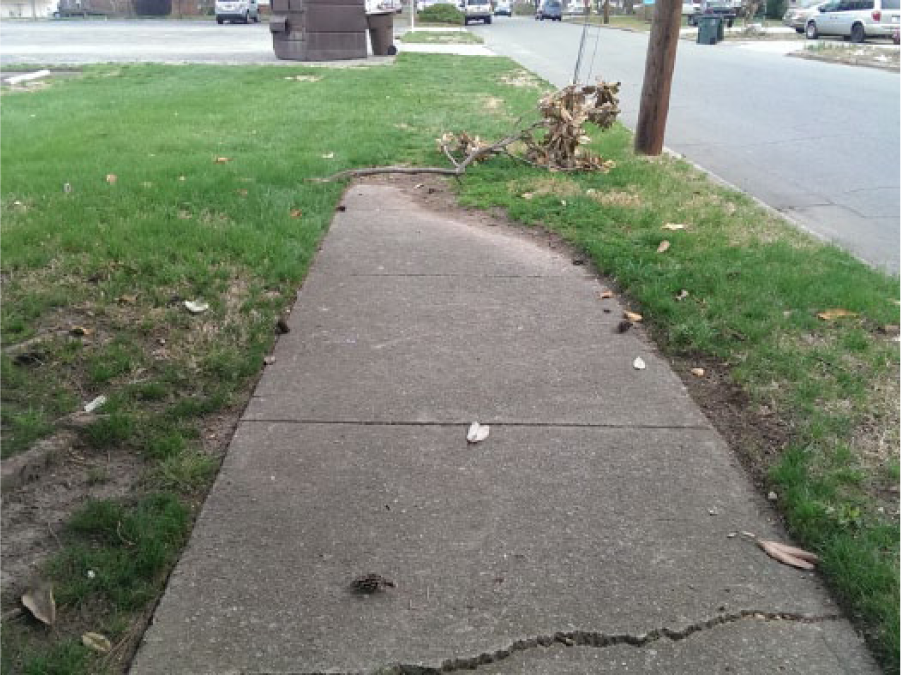
This sidewalk abruptly ends. This is one block over from an area that is largely commercial. Here there are still small businesses as the area transitions to residential housing. Some customers park along this street to frequent the small businesses, while other customers were walking up to them. Sidewalks keep pedestrians safe by giving them their own space. They’re important for health and safety. They reduce risk of pedestrian injury, increase the number of people who feel safe walking rather than driving to places close by, and increase social contact in communities, strengthening neighborhood ties. This is the city’s domain; I know of no reason why this should exist. We can advocate for sidewalks to improve the health of communities in our city and ask the city to take charge of things that lie in the realm of their responsibility.

Is this the type of establishment we want our SNAP (Supplemental Nutrition Assistance Program) budget to support? This store advertises lottery, cigarettes, and beer. However, all this store owner has to carry is dairy, bread, canned fruit or vegetables, and canned meat, and they qualify to take EBT (electronic benefit transfer), which can be used on any food or beverages that are not alcoholic or prepared. Due to food deserts these types of businesses are all some neighborhoods have. If we don’t lower the number of food deserts in our community, this is all some will have.
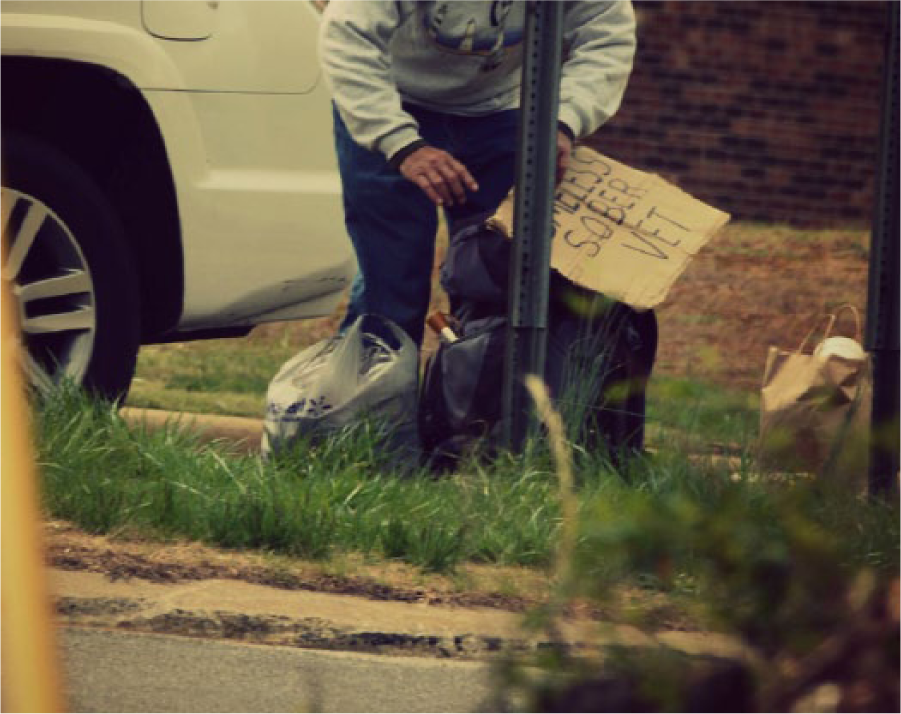
A homeless man with a sign “Homeless sober vet.” He is standing on a main road panhandling. This man has found himself in a circumstance where he is without a home and unable to receive income. He seems to know the stigma associated with homelessness so he wrote that he was sober. This represents people who are homeless for circumstances other than addiction. Rates of homelessness affect our taxes; it also affects the economy. This shows that there is a chance of ordinary people like us or our friends and family to be in the same situation. This situation exists because of life circumstances. Sometimes unexpected things happen that can lead to homelessness and also sometimes people fall through the poverty hole because of lack of jobs or due to government policies or recessions. We can become aware that people need help and that sometimes they don’t end up in poverty because of bad habits or addiction and we need to understand that it can happen to anyone and that we can help even if it’s in a small way. We can help advocate for the homeless, donate food or volunteer our time to help those who are without shelter.
Community exhibit
In preparation for the community exhibit, students volunteered to complete various tasks before, during, and after the event. Students promoted the event by posting a student-created flyer around both the university campus and the surrounding community and by contacting the local and campus newspapers, the alumni network, and various campus e-mail Listservs. Several students worked to mount the printed photos and captions and to assemble easels before the exhibit. During the exhibit some students directed visitors to the event location. After the conclusion of the exhibit others disassembled the easels. Completion of these tasks instilled in the students a sense of ownership of the project and demonstrated the necessity of teamwork, a 21st-century skill (Casner-Lotto & Benner, 2006), to host the exhibit.
In order to inform local community leaders with power to make changes on behalf of the issues documented by the students’ photographs, each student invited four community members to attend the exhibit. As part of their research about the issues they documented, students identified leaders in the local community they felt either would benefit from viewing the exhibit or could potentially make changes to improve or celebrate the subjects of their photographs. No procedures were enacted to prevent students from inviting a community leader who may have already received an invitation. Contacting community leaders provided students the opportunity to practice written professional communication, another 21st-century skill (Casner-Lotto & Benner, 2006). Each person who attended the community exhibit was invited to participate in a survey about his or her experience viewing the photographs.
Instrument
The survey instrument was adapted from Seitz et al. (2012). First, exhibit attendees were asked to identify their role in the community as: a college/university student, college/university faculty, college/university staff, medical community member, municipal employee, private citizen, K-12 educator, or nonprofit organization employee. Afterward, participants were presented with Likert-type scale items and open-ended questions assessing their feelings about health and poverty, their awareness of health and poverty, perceptions of responsibility for addressing the connections between health and poverty in their community before and after attending the exhibit, and lessons learned. Finally, participants were presented with questions that directly assessed the utility of photovoice for advocating for health issues affecting low-income members of the community.
Findings are presented as frequencies and report the percentage of exhibit attendees that agreed or disagreed with each particular statement. Results from contingency table analyses using the chi-square statistic determined whether the thoughts and feelings of exhibit attendees were independent of their roles in the community and preawareness of the issues presented by student photographers. Only findings in which there was a significant chi-square result (p < .05) are reported.
Qualitative data analysis was collaboratively conducted by three researchers. Interpretation of responses and findings were established by consensus. Following is a description of the process:
Review qualitative data and identify common or important themes or categories of responses.
Select a statement or phrase to be used as a descriptive label for the themes or categories.
Sort statements into one or more of the themes or categories.
Select statements that exemplify the themes or categories.
Results
Feelings About Health and Poverty Among Attendees
Exhibit attendees were asked to describe, “Before coming to this exhibit, what feelings did you have about health and income.” In response, 28% reported that they knew health and poverty were related. For example, one attendee said, “Low-income individuals generally have limited access to good health care and opportunities to improve their health through multiple options.” Additionally, 21% reported that the issue needs to be addressed and 17% reported personal concern about the problem. An attendee wrote that he or she was concerned about the connection between poverty and health because the city itself has a large low-income population and is located in a food desert.
When asked to rate their agreement with the statement, “The photo exhibit gave me feelings of frustration/concern over the issues presented about health issues affecting low-income members of our community,” 81% of exhibit attendees agreed or strongly agreed. Likewise, 84% of exhibit attendees agreed or strongly agreed, “The photo exhibit gave me feelings of sadness over the issues and concerns presented about health issues affecting low-income members of our community.” However, 88% of exhibit attendees agreed or strongly agreed that “The photo exhibit gave me feelings of confidence in the students,” and 66% of exhibit attendees agreed or strongly agreed that “the photo exhibit gave me feelings of hopefulness about future generations.”
Increased Awareness of Health and Poverty Among Attendees
Exhibit attendees were asked to indicate the degree of their agreement with the statement, “Before coming to this exhibit, I was unaware of the issues presented by the student photographers.” In response, 63% reported being aware of the issues beforehand. For example, one attendee said the exhibit “raised awareness of the issues present in our community.” When asked to explain why or why not, “the photo event was valuable to the community,” 89% of exhibit attendees reported that the photo event succeeded in raising awareness about health and poverty. For example, attendees believed that the photo event “called attention to things we tend to overlook every day,” gave them insights “from college students who don’t currently have a big impact on the community at this time,” and “should be a good way to provoke some interesting discussion and action.”
Exhibit attendees were also asked to report the degree to which they agreed or disagreed that “seeing the students’ perspectives in this exhibit changed my understanding of health issues affecting low-income members of our community”; 56% agreed or strongly agreed. However, there were significant differences between the responses of participants that identified themselves as students and those that did not, χ2(4, N = 32) = 2.71, p = .008. Although 77% of student attendees agreed or strongly agreed that seeing the students’ perspectives in the exhibit changed their understanding of health issues affecting low-income members of our community, only 33% of other attendees agreed or strongly agreed with the statement. Additionally, there were significant differences between the responses of participants that reported they were aware of the issues presented by the student photographers before coming to the exhibit and those that did not, χ2(4, N = 32) = 2.74, p = .007. Although 92% of participants that reported they were unaware of the issues agreed or strongly agreed that seeing the students’ perspectives in the exhibit changed their understanding of health issues affecting low-income members of our community, only 35% of other participants agreed or strongly agreed with the statement.
Assessing Perceptions of Responsibility Among Attendees
Exhibit attendees were asked to report the degree to which they agreed or disagreed that “each person in our community controls his or her own destiny for addressing his or her health and income status”; 81% disagreed or strongly disagreed. However, there were significant differences between the responses of participants that reported they were aware of the issues presented by the student photographers before coming to the exhibit and those that did not, χ2 (4, N = 31) = 2.83, p = .006. Although 46% of participants that reported they were unaware of the issues agreed or strongly agreed that individuals were each responsible for his or her own destiny, only 5% of other participants agreed or strongly agreed with the statement.
When asked to report the degree to which they agreed or disagreed that “there are things I can begin to do to address the issues presented by the student photographers,” 72% of exhibit attendees agreed or strongly agreed. Likewise, 77% agreed or strongly agreed that “attending this exhibit has caused me to think about the ways I can help to address some of the issues identified by the student photographers.” However, there were significant differences between the responses of participants that identified themselves as students and those that did not, χ2 (4, N = 30) = 2.75, p = .01. Although 100% of student attendees agreed or strongly agreed that seeing the students’ perspectives in the exhibit changed their understanding of health issues affecting low-income members of our community, only 50% of other participants agreed or strongly agreed with the statement.
Exhibit attendees were asked to report the degree to which they agreed or disagreed that “the issues presented by the students are beyond the control of the students and the campus community”; 84% of exhibit attendees disagreed or strongly disagreed. Additionally, 94% agreed or strongly agreed that “members of our community can work together to change the causes of the issues identified by the students in this exhibit.”
Discussion
Emotional Reactions
While two thirds of exhibit attendees indicated prior knowledge of the influence of income on health, few described an emotional response to that link. When asked to describe their feelings about the connection between health and poverty prior to attending the exhibit, most participants described their prior knowledge of the topic instead while only some described an emotional response to that knowledge. Responses that specifically addressed feelings included words to describe despair, concern, and neutrality.
By contrast, when asked about their feelings about the influence of low income on health after seeing the photovoice exhibit, most participants expressed feelings of frustration or concern, and/or sadness. Seeing the visual representations of the connection between health and poverty was effective at evoking an emotional reaction to the topic in participants who previously did not describe an affective response. In addition, the photovoice exhibit instilled in the attendees a sense of confidence in the students whose work was presented and left most attendees hopeful about the future generations of community members. By demonstrating their understanding of the lives of low-income community members, students instilled in exhibit attendees a general sense of optimism, presumably about students’ abilities to address these concerns in their future careers and as informed community members. While an emotional response alone does not heed a call to action, photovoice projects have engaged others emotionally as a step toward achieving the Freirean level of critical consciousness that compels one to act (Carlson et al., 2006). Emotional engagement of the students may also be a step toward demonstrating the 21st-century skill of acting on behalf of the community’s greater good.
Community Learning
Exhibit attendees expressed positive beliefs about the effectiveness of the photovoice exhibit at raising awareness in the community of the impact of income on health. However, a number of written comments specifically mentioned the student presenters and the value of the exhibit to the students themselves. Some comments expressed thoughts about the students’ limited opportunities for addressing issues of health and poverty while they were still students and saw the exhibit as one such opportunity. When stratifying responses to questions about increased awareness about health and poverty after attending the exhibit, the student attendees were most likely to have increased their knowledge on the topic. Nonstudent attendees with prior knowledge of the issues presented gained little awareness compared to the student attendees. While many student attendees increased their awareness of the topics, many nonstudents became hopeful about the students as a result of attending the exhibit. Although one of the goals of the project was for students to communicate their concerns to community leaders with power to address the issues, the student attendees seemed to have gained the most from the exhibit according to the constructs measured.
Responsibility
The expressions of hopefulness about future generations by nonstudent community member attendees mirrored the student attendees’ acknowledgments that the exhibit left them thinking of how they could address issues of health and poverty. However, the exhibit was not as effective at inspiring nonstudent attendees to consider how they could address the same issues. Nonstudent attendees may have felt they were already doing all they could to address the issues documented, may have felt addressing the issues was beyond the scope of what they could accomplish, or may have lived experiences that jaded their outlook toward community change. Some nonstudent attendees may feel their generation is not capable of solving the multifaceted issues documented while the students who have not yet begun their careers expressed optimism. Fortunately, respondents from all generations agreed the entire community could work together to change the causes of the concerns documented.
Impact on Local Community
As a result of attending the exhibit, a community leader from the local government transportation office further researched the subjects of five of the students’ photographs. A year after the exhibit, one of the concerns shared, a large gap in a sidewalk, had been addressed by filling the missing sidewalk. However, no action had been taken to address the other four concerns. The community leader did, however, express appreciation for the students’ photovoice exhibit, describing the important role the students had in noticing and reflecting on community concerns then sharing the concerns with the city leaders who were able act on them. Additionally, the student whose photograph documented an unlit street light in a residential neighborhood at night reported that after the exhibit the light was working. However, it is unknown whether the street light was repaired as a result of the photovoice exhibit.
Student Learning
The ability of the students to effectively document issues of health and poverty such that exhibit attendees not only became more aware of the issues but also began to think about how they could address the concerns documented suggests the photovoice assignment was meaningful at increasing students’ understanding of the course content if they were in turn able to engage others in these ways. The problem statement essays written in preparation for the exhibit demonstrated students’ abilities to conduct research on community concerns using credible local sources then contrast their findings to literature published in academic sources. During a class discussion immediately following the exhibit, one student shared that while our course made her aware of the many challenges people living with low income experience, it was not until she saw all the photographs at the exhibit that she truly grasped the reality that families who experience one challenge also experience many others. Seeing a variety of community concerns documented at the same time made her realize just how challenging day-to-day life could be for a low-income family. The fact that exhibit attendees expressed a sense of hopefulness about future generations may be attributed to attendees’ recognition of the critical thinking, a 21st-century skill (Casner-Lotto & Benner, 2006), the students expressed in their photovoice work. Hence, the attendees felt the depths of the students’ new understanding of the link between health and poverty that will lead the students to develop strategies to address the concerns documented at the exhibit. Feedback from exhibit attendees overwhelmingly indicated the exhibit was valuable to the community, further positing the photovoice project as a pedagogical strategy meaningful for the students and others.
Conclusion
Photovoice projects integrated into undergraduate courses are meaningful assignments for engaging students as they learn about and demonstrate their understanding of course material. Additionally, photovoice provides an opportunity for students to advocate on behalf of issues explored in class by increasing awareness among local community members about the impact of low income on health. After attending a photovoice exhibit, community members are more likely to describe an emotional reaction to the concerns documented than before attending the exhibit.
Footnotes
Acknowledgements
The authors thank Christina Bailey, Joel Bartz, Ashelyn Myers, and Tea Petrovic for their dedication to this project and the contribution of their photographs and captions to this article.
Declaration of Conflicting Interests
The authors declared no potential conflicts of interest with respect to the research, authorship, and/or publication of this article.
Funding
The authors received no financial support for the research, authorship, and/or publication of this article.