



Abstract
There are underrepresented fields in both undergraduate-level (UG) and graduate-level public health (PH) professional preparation in the United States. Demand for employment and a diversified work force in PH is growing. To understand how well UG students are aware of and knowledgeable about PH, a survey was conducted at a large urban statewide public university in the Northeastern United States. Students solicited to participate in the anonymous online survey conducted in PsychData were first- and second-year undeclared major UG students during March to April 2015 (spring semester). Of 138 consenting respondents, there were 101 validated, complete sets of responses. Variables included student course enrollment, whether parental occupation influences student choice of majors, and perceived quality of available curricula. More UG students were enrolled in introductory statistics among the PH-related courses asked about; those courses fulfilled multiple UG major requirements and could play greater roles in student awareness of PH, that is, opportunities via PH faculty/staff/guest lectures. Implications of findings include providing students hands-on experiences late in high school and early UG years, and advisors mentioning PH to students interested in basic sciences.
Introduction
There is a growing demand of employment and a diversified work force in U.S. public health (PH), particularly for entry- to mid-level positions as the current workforce ages and retires. Over 100,000 (23%) of this workforce is expected to retire, with a projected shortage of 250,000 by 2020 (Rosenstock et al., 2008). To meet this societal need, U.S. graduation rate would need to triple (Rosenstock et al., 2008). Also, there is a lack of trained personnel, that is, not every health care and PH professional is prepared to treat a diverse U.S. population, and inadequate federal funding to promote the amount of available opportunities for students (Rosenstock et al., 2008).
PH is a growing profession increasingly important to modern society. This is notable given PH was traditionally a graduate field of study—there have been more graduate PH school admissions than undergraduate (UG) admissions. In addition, in general, certain PH fields such as biostatistics, environmental and occupational health and safety, and chronic disease epidemiology including injury prevention and control are underrepresented at both UG and graduate levels of PH training (DiNicolantonio, 2014; Leider et al., 2015).
Currently, obtaining a Bachelor of Arts (BA) and/or of Sciences (BS) in PH (sometimes called BSPH) may not always be sufficient to enter the PH workforce (Holsinger, Lewis, & Chen, 2015). Universities have variations in programs. While some schools focus on educating students, other programs are designed for professional development and direct entry into the workforce. For example, breadth and depth of faculty expertise and credit hours obtained may vary. One study focused on available PH curricula of 28 U.S. schools with BA and BS degree programs—60.7% offered UG PH programs, and their BA’s PH courses required an average of 34.5 semester credit hours, whereas BS’s PH courses were an average of 36 semester credit hours (Holsinger et al., 2015). For comparison, BSPH content contributed to almost half of total credit hours, suggesting a disparity existed regarding student preparedness in PH in the workforce (Holsinger et al., 2015).
Numbers of UG PH programs have increased rapidly in the 21st century; this developed as a result of the Institute of Medicine recommendation that UG deserve access to PH education, and due to the Educated Citizen and Public Health Initiative, which promotes both a global and community-level focus, experiential learning, and evidence-based thinking, for example, increasing apprenticeship opportunities, capstone projects, and integrating curricula. Also, schools may promote professional degree programs designed for students to obtain job-related skills, for example, certification for registered environmental health specialist/sanitary health inspections or certified health education specialists (Institute of Medicine, 2003; Leider et al., 2015; Riegelman & Albertine, 2011).
Health and PH agency offices have also partnered with UG schools/programs to enhance student hands-on experience and applying knowledge, including satisfying an internship requirement. For example, within an environmental health program in Georgia (Zimeri, 2015) a Professional Training Agreement (PTA) was required as a contract.
UG PH education is also a priority of Healthy People 2020, including an objective of a 15% increase in PH courses offered, for example, UG PH core classes for majors and minors such as introductory public health and epidemiology (Healthy People 2020, 2016; Riegelman & Albertine, 2011). Available data documented numbers of PH majors nationwide have already increased substantially over 20 years (1992-2012), with an apparent demographic trend—the growing student population pursuing PH majors is more ethnically diverse than the overall U.S. UG population: females, African Americans, Asian Americans, Pacific Islanders, and Hispanics now comprise more of the UG PH student body (Leider et al., 2015).
Similarly, at Rutgers, The State University of New Jersey (Rutgers), the student population has changed over time, and remained diverse for UG and graduate student enrollment during fall semesters in recent academic years (Rutgers, The State University of New Jersey, 2016a, 2016b). More specifically, Rutgers E. J. Bloustein School of Planning & Public Policy (EJB; data not presented, as of winter 2015 to 2014-2015) suggested an over fourfold increase in both enrollment in the UG PH major and in students graduating with PH majors in the past decade (Weston, 2014). Many of these UG PH students are female minorities, though non-Hispanic Whites and non-Hispanic Blacks of both genders also comprise UG PH students. Additionally, it must be noted Rutgers School of Public Health (SPH) offers master’s and doctoral degrees and certificates through its multiple departments and joint degree programs with other Rutgers schools, as well as an articulated program allowing EJB students to complete their bachelors and master’s degrees consecutively in 5 to 6 years.
Prior studies explored factors influencing how students in general chose majors (Bernheim & Peake, 2009; Currie, 2012; Galotti, 1999; Leppel, Williams, & Waldauer, 2001; McAuliffe & Barnett, 2009; Montmarquette, Cannings, & Mahseredjian, 2002; Robert & Mosher-Ashley, 2000; Villarejo, Barlow, Kogan, Veazey, & Sweeney, 2008). These included socioeconomic status indicators, including occupational status of parents by gender; decision-making skills of students; student’s expected earnings after graduation; participation in enrichment and intervention programs; mentorship opportunities; extracurricular activities; and courses taken in high school. Despite some successful attempts to increase awareness and enrollment in UG PH (Riegelman, Albertine, & Wykoff, 2015), few studies have attempted to understand why or how the PH field may be underrepresented or why there might be a lack of awareness and interest, especially at the UG level among underclass students—typically first- and second-year students—choosing majors and minors.
To understand how well Rutgers UG students are aware of PH, an anonymous online survey was created and distributed to those students with nondeclared majors during the 2014-2015 academic year.
Methodology
An anonymous online survey in PsychData (State College, PA) was conducted. This study was approved by the Rutgers University New Brunswick Arts and Sciences Institutional Review Board (#15-424M) with informed consent without written documentation.
Survey questions were either adopted as worded or adapted with wording only slightly modified to suit the targeted population subgroup of young adults from existing publically available sources, for example, federal population-based surveys such as the U.S. Census or U.S. National Health and Nutrition Examination Survey. The examined variables of interest for the targeted population subgroup included demographic (multiple questions), student course enrollments, whether parental occupation influenced student choice of major, and societal views of health.
First- and second-year Rutgers UG students who had not declared majors and who were enrolled in PH-related courses (courses related to statistics, environmental and occupational health, epidemiology, health education and behavioral science, health systems and policy) in spring 2015 semester were targeted. One hundred and thirty-eight Rutgers underclassmen undeclared majors (of about 1,000) students, potentially ages of 18 to 25, consented to participate. They were recruited through e-mails sent via Rutgers EJB administrative staff. Of 138 participants, 101 respondents (73.2%) had complete records of the survey for analysis.
Microsoft Excel and SPSS Version 22 were used for data management and analysis, respectively; in SPSS, crosstab analyses examined two to three variables at a time. For each analysis, two variables were demographics (i.e., class year and gender) while the third variable was a numerically coded response to a question. Nine variables were examined in detail, based on the aforementioned literature review: gender, age, class year, course enrollment, occupation of parent(s), the importance of PH, considering a field in PH, student’s perception of the importance of cultural awareness, and faculty promotion, that is, did faculty encourage and inform students about PH.
Findings
Of 101 respondents with complete data records from the 138 participants, 71 (70%) identified as freshmen while 28 (28%) identified as sophomores. By gender, 65 (64%) identified as female while 35 (35%) identified as male. Of freshmen, 46 (65%) were female while 25 (35%) were male. Of sophomores, 18 were females while 10 were males. By race, 53 (53%) were Caucasian (White), 13 (13%) were Black, and 33 (33%) were Asian. Results were then stratified by class year and race. Of 53 participants who were White, 41% were freshmen while 12% were sophomores. Of 13 Blacks, 10% were freshmen while 3% were sophomores. Out of 33 Asians, 21% were freshmen while 12% were sophomores. For race/ethnicity, other subgroups were not presented because of small numbers. Additionally, participants were stratified by gender, class year, and race. Fifty percent of participants were White females (41% freshmen and 9% sophomores). Seventeen percent of participants were Black females (12% freshmen and 5% sophomores). Twenty-nine percent were Asian females (20% freshmen and 9% sophomores). Out of males, 56% were White (39% freshmen and 17% sophomores), 6% of males were Black (6% freshmen), and 39% of males were Asian (22% freshmen and 17% sophomores; Table 1).
Summary of Demographics of Survey Respondents.
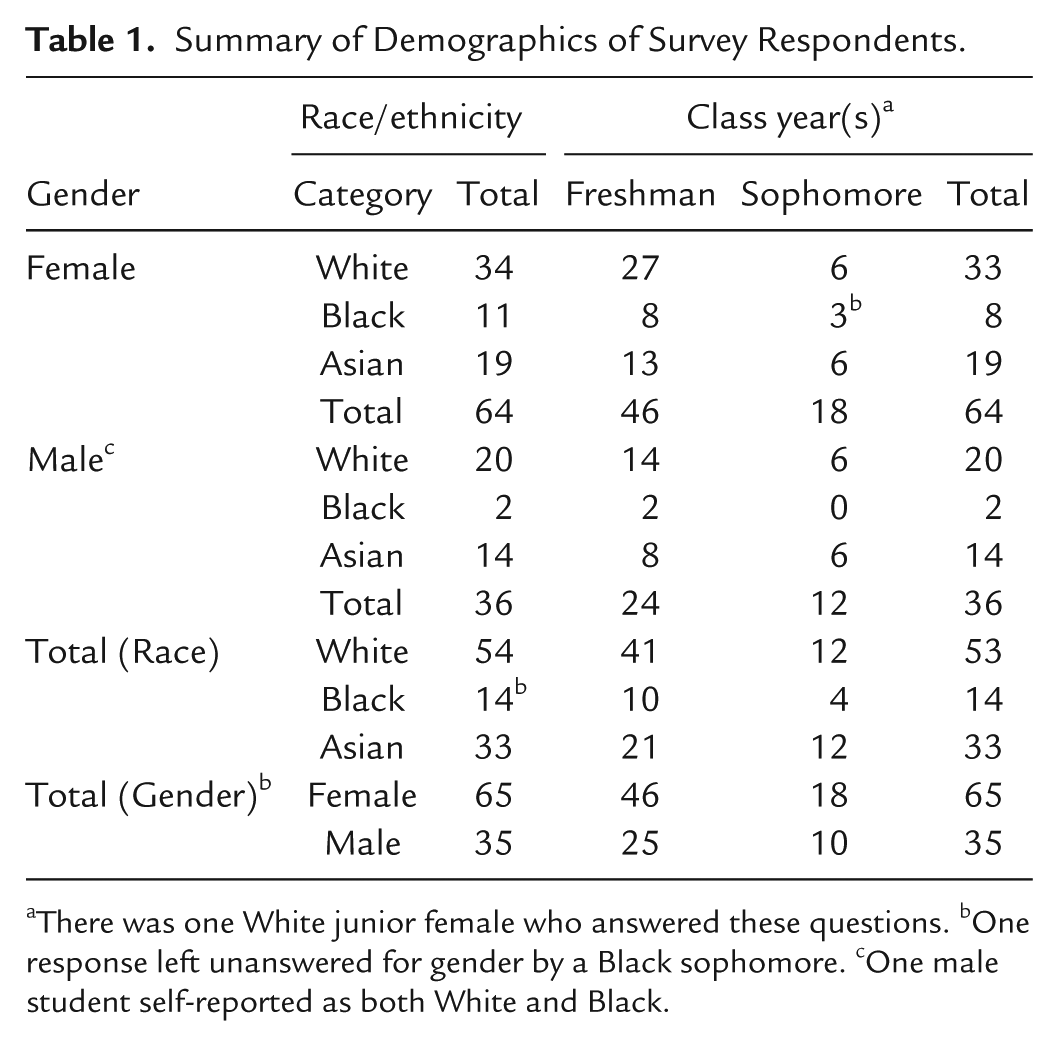
There was one White junior female who answered these questions. bOne response left unanswered for gender by a Black sophomore. cOne male student self-reported as both White and Black.
Regarding course enrollment, more students (30% overall) were enrolled in Introductory Statistics than other PH-related courses (0% to 11% overall). Most participants enrolled in PH-related courses (Statistics, Intro to Public Policy, Principles of Public Health) were freshmen. Table 2 presents course enrollment results by gender.
Undergraduate Undeclared Major Student Participant Responses on Current Academics.
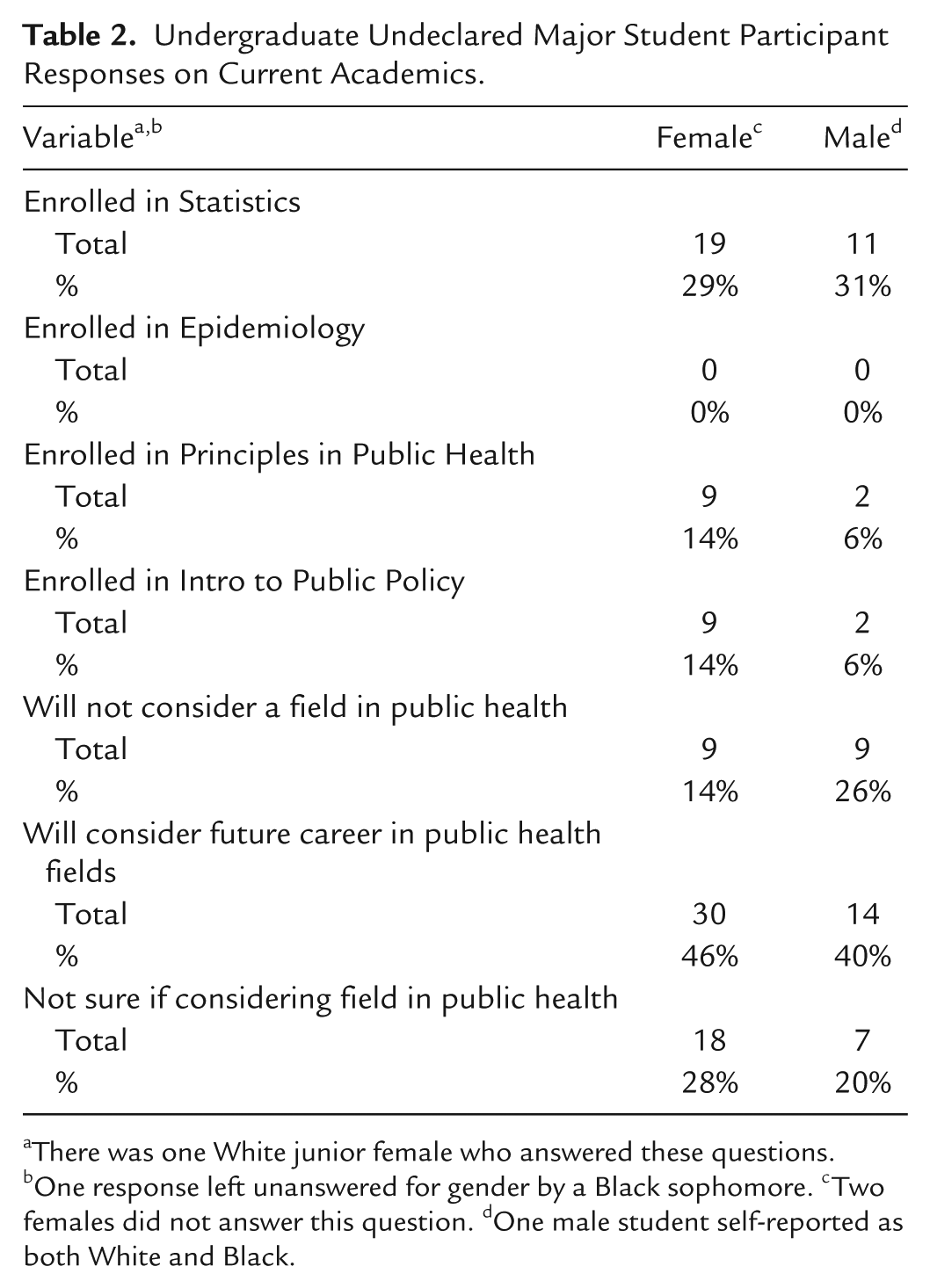
There was one White junior female who answered these questions. bOne response left unanswered for gender by a Black sophomore. cTwo females did not answer this question. dOne male student self-reported as both White and Black.
Twelve of 14 Blacks (85%), 25 of 33 Asians (76%), and 38 of 54 Whites (70%) believed cultural awareness of different population groups in the society will be beneficial in educating the population about their health (Table 3).
Undergraduate Undeclared Major Student Participant Responses About Awareness and Importance of Public Health.
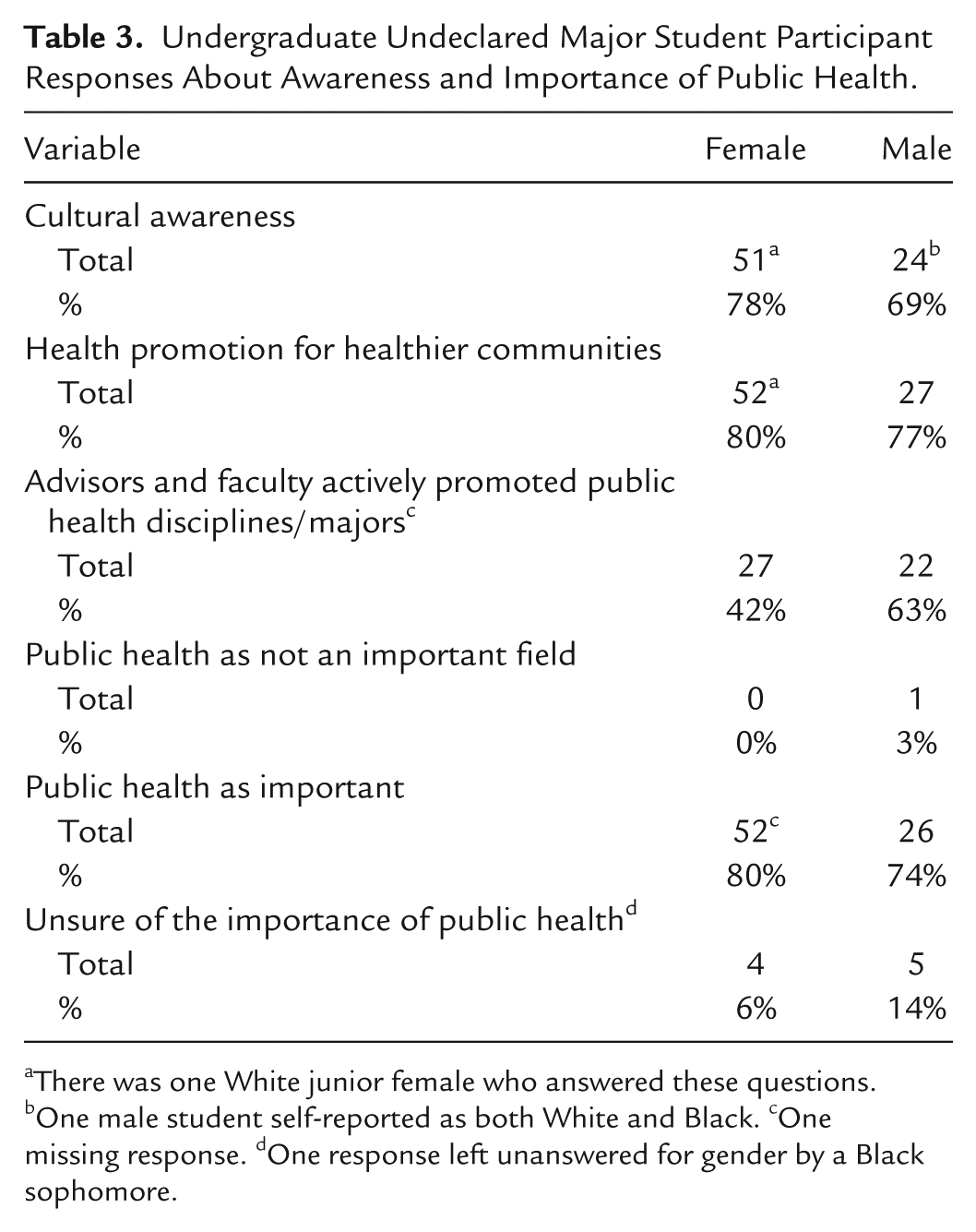
There was one White junior female who answered these questions. bOne male student self-reported as both White and Black. cOne missing response. dOne response left unanswered for gender by a Black sophomore.
Regarding views of PH, 77% of participants viewed PH as an important field, 9% were unsure of its importance, and 15 (14%) did not view it as important. By class year, 53% of freshmen view PH as an important field compared to 23% of sophomores. Males and females were about equally likely to view PH as important (74% and 80%, respectively; Table 3).
Another outcome of interest is if students will consider a field in PH (Table 2). The majority of participants (44%) stated they will consider a field in PH, compared to those who were unsure (25%) and those who will not (18%). Females and males were similarly as likely to consider a field in PH in the future, though fewer than half of them at the time of the survey will (46% females and 40% males). By race, 71% of Blacks would consider a field in PH compared to 36% of Asians and 43% of Whites.
Regarding parental occupation, out of 48 participants who have fathers with a professional occupation, eight (17%) have a father in a health occupation. Out of 38 participants who have mothers with a professional occupation, nine (24%) have mothers in a health occupation. For both parents, 20 participants claimed to have both parents in a professional occupation. Out of 20 participants who had parents in a professional field, only two of them (10%) had parents who were both health professionals.
Discussion
Given cultural awareness was an important and valued factor among participants, these data may suggest Rutgers promotes quality global education and an academic environment conducive to learning for UG students in PH. Also, as some PH-related courses fulfill multiple Rutgers School of Arts and Sciences major requirements, the courses reported taken by participating students at the time of this survey could play a role in student awareness of PH and may present the greatest opportunity of raising awareness of the PH profession through specific examples and/or guest lectures.
Furthermore, other colleges and universities may have accredited UG majors and minors in community health and/or in population health instead of in PH, and/or departments in their graduate schools of PH or of medicine named community health or community health sciences or similar. Therefore, the promotion of the PH profession could occur even more broadly in the United States. Recent papers (Gambescia, 2017; Kiviniemi & Mackenzie, 2017) discussed how PH—and arguably community and population health though some differences exist in curricula—has a basis in a liberal arts education, that is, to allow for the most opportunities for student awareness, growth in academic knowledge, and skills including communication, professional development, and options for careers/jobs and/or further graduate education as adults. The present study’s data as well as another recent article on preparing health education specialists during UG years (Rodgers, Funke, Rhodes, Brown, & Cox, 2017) support this view of liberal arts education, and can apply to PH, community health, and population health.
Limitations and Strengths
No Rutgers administrators consented to allowing the survey to be directly sent to students across four Rutgers University–New Brunswick campuses, which could have potentially increased numbers of participants. There was no financial incentive for survey completion, potentially limiting numbers of respondents. Another potential limitation was the inherent possibility of self-report response bias. The sample size of 101 completed surveys, of 138 total responses, was also smaller than the goal anticipated (700 replies of about 1,000 recipients). The survey did not include additional options for sexual identity beyond male or female; we have no details about individual who chose not to respond or “other.” Correlations between parental health occupations and student PH interest could not be statistically confirmed. Finally, personal salary goal/financial incentive after earning UG degree(s) was not examined, and could be an important factor for students to pursue a major, given a majority of participants valued finance as “very important.”
This study also had strengths. This approved survey generated enough media interest around campus to be in the Rutgers and EJB multisection e-newsletter. Also, it is possible to modify or expand and repeat this survey in future without a need to pilot-test new questions, just survey access/interface.
Recommendations
In conclusion, it may be worth further exploring certain topics/question(s) for future surveys to better assess PH interests of UG students and/or reach out to transfers from community colleges—they would enter Rutgers (or another nearby college/university) after their first two years. It would be of benefit to assess interests of students in at least a PH minor who matriculate into various majors in the basic and social sciences. Future research can also examine the residential areas in which students come from and how diverse they are, as this may be a factor in how much students value PH in terms of the cultural importance of health. There is also a potential to better educate people about health disparities and cultural competency based on how much they value culture. Results also suggested providing UG students with hands-on experiences late in high school and/or in the early UG years, and high school and college advisors mentioning PH to students interested in basic sciences.
Footnotes
Acknowledgements
Dr. Steven Weston, Dr. Michael Greenberg, and Dr. Dona Schneider of the E. J. Bloustein School of Planning and Public Policy at Rutgers University are acknowledged for their support of the original idea and facilitation of the online survey with consent without written documentation. Ms. Lindsey J. Milich, MPH, is acknowledged for intra-office support, that is, final internal review and formatting of this article.
Authors’ Note
AG and MY were Rutgers Aresty Undergraduate Research Program students working with DGS.
Declaration of Conflicting Interests
The author(s) declared no potential conflicts of interest with respect to the research, authorship, and/or publication of this article.
Funding
The author(s) disclosed receipt of the following financial support for the research, authorship, and/or publication of this article: This project was made possible by the Aresty Undergraduate Research Program at Rutgers University–New Brunswick (financial support/stipend to AG and MY).