




Abstract
The flipped classroom approach, used for many years in the humanities and the basic sciences, is becoming increasingly popular in public health education. This article describes the implementation and evaluation of a master’s-level Environmental and Occupational Health course, a required course in a Master of Public Health program at a mid-sized Canadian university. The course was designed using a flipped classroom approach and delivered online using a learning management system and interactive web-conferencing technology. Using a pre- and postsurvey design, we assessed improvements in student’s self-reported knowledge and skills, student learning experiences in the course, and the impact of specific course components on critical thinking and student engagement. Our results suggest that this approach enabled the achievement of course learning outcomes and provided positive learning experiences overall. Additionally, we find that the course promoted critical thinking and enabled student engagement in the context of online education for this small group of graduate-level public health students. We conclude by discussing key lessons learned for providing optimal learning experiences and outcomes in online graduate-level public health education.
Introduction
Teaching and learning in higher education are being flipped on its head—quite literally. The increasing demand for online and distributed learning has led many programs to develop innovative blended learning approaches where place and pace are more student-directed (Fink, 2013). The flipped classroom is an approach that falls within the larger umbrella of blended learning that has become increasingly widespread in higher education over the past decade (O’Flaherty & Phillips, 2015). “Flipping” the classroom refers to a pedagogical approach where content is delivered passively outside of class, often using video-recorded lectures, while face-to-face time is “re-purposed” to apply content and concepts and to engage students in active learning. Compared with the conventional lecture-based approach that is most commonly applied in higher education, the flipped class-room approach requires students to engage with materials independently at their own pace and then actively apply and engage with course content and each other during face-to-face sessions (O’Flaherty & Phillips, 2015). The conventional lecture-based approach “reduces education to a transfer of information” (Mazur, 2009, p. 50), while the flipped classroom approach employs active learning and problem-solving and prioritizes higher-order cognitive work (i.e., analysis and synthesis) and engagement (Kas-Osoka, Bradley, Coffman, & Orpinas, 2018).
The flipped classroom approach, though used for years in the humanities and the basic sciences, is gaining popularity in other fields, including health professional education (Hew & Lo, 2018). Several recent reviews focusing on the use of the flipped classroom in health professional education indicate that flipped courses can have positive impacts on student learning outcomes and students and instructor satisfaction while providing more opportunities for engagement (Chen, Lui, & Martinelli, 2017; Hew & Lo, 2018; Ramnanan & Pound, 2017). Specifically, a meta-analysis by Hew and Lo (2018) examined the pedagogical impacts of the flipped classroom approach in the context of health professional education and “showed an overall significant effect in favor of flipped classrooms over traditional classrooms for health professional education” (Hew & Lo, 2018, p. 1). A systematic review by Chen et al. (2017) reviewed 82 articles to assess the effectiveness of flipped classrooms in medical education specifically. Chen et al. (2017) concluded that the flipped classroom approach is promising in terms of positive impacts on student experiences, motivation, and engagement but argue that additional research is needed to more fully understand the impacts on knowledge retention and skills development (Chen et al., 2017). With regard to public health education, recent evidence (e.g., Freeman et al., 2007; Frenk, Hunter, & Lapp, 2015; Galway, Corbett, Takaro, Tairyan, & Frank, 2014; Howard, Scharff, & Loux, 2017) has shown that the flipped classroom approach can advance critical thinking and problem-solving skills; skills that are particularly important in the health sciences and public health practice.
While the body of literature examining flipped classroom pedagogies in public health education is growing (Frenk et al., 2015; Galway et al., 2014; Howard et al., 2017; Shiau et al., 2018), its effectiveness and impacts are currently understudied. Given that universities are increasingly taking advantage of emerging technologies and widespread internet access and offering public health education courses and programs online, additional evaluation and research is needed to better understand the academic and practical implications of flipping online teaching and learning in public health education.
Purpose of Study
This article is informed and motivated by the aforementioned knowledge gaps and the recognition that online education is likely to become increasingly common in the landscape of public health higher education. The overall aim of this study was to examine the pedagogical impacts of a graduate-level public health course designed using a flipped classroom approach and delivered online. Our specific objectives included (1) designing and implementing an Environmental and Occupational Public Health (EOPH) course for graduate-level public health students integrating the flipped classroom approach and online delivery; (2) assessing improvements in student’s self-reported knowledge and skills after participating in the EOPH course; (3) examining student’s learning experiences in the EOPH course; and (4) examining the impact of specific course components on critical thinking and student engagement. Drawing on our experience designing, delivering, and evaluating the EOPH course, we also discuss key lessons learned for providing optimal learning experiences and outcomes in online graduate-level public health education.
Method
Course Development and Implementation
The defining characteristic of the flipped classroom model as applied in higher education is exposing students to new concepts and materials prior to face-to-face time, taking advantage of online technologies, followed by deeper and more active learning during face-to-face time (Talbert, 2017). Typically, online technologies such as prerecorded video lectures (i.e., Vodcasts) are created and assigned as homework, which frees up face-to-face class time for deepening understanding and applying content alongside peers and the instructor (O’Flaherty & Phillips, 2015). The flipped classroom model prioritizes discussion, problem solving, and active learning activities that engage students in the learning process in meaningful ways (Kas-Osoka et al., 2018).
The EOPH course designed and evaluated here was delivered online integrating self-directed online learning, where students were exposed to new content and materials using prerecorded vodcasts and other learning materials, followed by the use of real-time synchronous web-conferencing sessions in place of face-to-face class time. The web-conferencing sessions were interactive and focused on peer-to-peer learning and the application of knowledge through active learning activities. Importantly, the web-conferencing sessions were developed to maximize student engagement and provide opportunities for the development of critical thinking skills. The course design and implementation draw on the experiences of the first author experimenting with and evaluating public health courses and the second author’s scholarly background in pedagogy and expertise in medical education and curriculum development (Cameron & Russell, 2016; Galway, Berry, & Takaro, 2015; Galway et al., 2014).
The online flipped EOPH course was offered in the winter term of 2018 and was a required course in the Master of Public Health (MPH) program at a small publicly funded Canadian university. The MPH program is primarily delivered online using the University’s distance education course management system (Desire to Learn—D2L) and web-conferencing technology (WebEx). Most courses in the MPH program use the web-conferencing technology to deliver weekly 3-hour lectures; mimicking conventional lecture-based courses design and delivery in other words.
The content and learning outcomes for the 2018 EOPH course were guided by the public health core competencies developed by the Association of Schools of Public Health (2006; Calhoun, Ramiah, Weist, & Shortell, 2008) and the Canadian Public Health Association. Public health core competencies “delineate fundamental knowledge, attitudes, and skills that every MPH student, regardless of their major field, should possess upon graduation” (Moser, 2008). An overview of the course is provided in Table 1.
Overview of the Course.
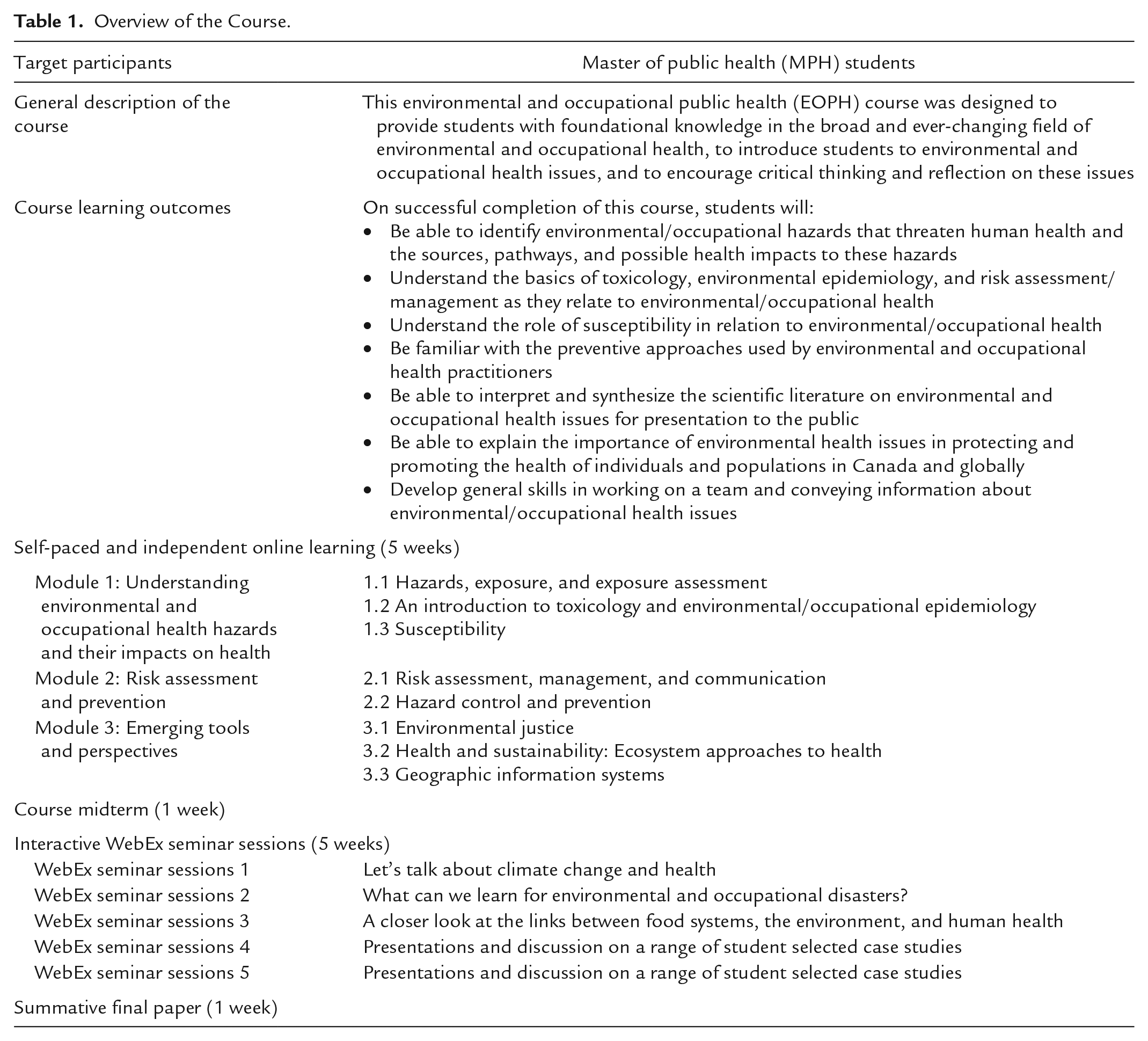
The first phase of the EOPH course used self-paced and independent online learning. This part of the course included three modules focusing on foundational knowledge in the field of environmental and occupational health such as exposure assessment, toxicology, and risk assessment (see Table 1). Each module contained prerecoded vodcasts and complementary learning resources from reputable sources (i.e., universities, governments, professional societies, and peer-reviewed publications). An effort was made to use a diversity of learning materials including videos, policy briefs, and scientific articles to complement the vodcasts. Vodcasts, learning materials, and discussion boards were available and organized on a course D2L site. Students had a total of 5-weeks to engage with all content at their own pace. This 5-week period was followed by a course midterm. Throughout the independent learning part of the course, students were encouraged to use discussion boards in the D2L site to discuss course content with their peers and to pose questions to the instructor. The instructor managed the discussion boards and responded to questions on a daily basis.
During the independent learning phase of the course, students also completed three reflective response papers. Students were instructed to reflect on their learning and the relevance of course materials and to make links between course content to other aspects of their lives (e.g., personal lives, work lives, work aspirations). An explicit aim of the reflective response papers was to offer a medium for student–instructor relationship building during the independent learning phase of the course. The reflective writing assignments were also used as a tool to provide students with the opportunity for developing critical thinking skills; an objective that was made clear to the students. Specifically, students were encouraged to use the What? So what? Now what? framework to guide their reflective practice (Mezirow, 1990). The instructor provided in-depth feedback on the reflective response papers to encourage deeper reflection and inviting students to engage in critical thinking. For example, the instructor used probing questions to encourage critical thinking, suggested additional learning resources to deepen student knowledge, and offered general comments on the writing and thinking. Importantly, the reflective responses enabled the instructor to assess student learning.
The second phase of the course, also a total of 5 weeks in length, focused on applying the content learned in the independent learning phase during real time WebEx sessions. There were a total of five 1.5-hour long WebEx sessions during. The class of 34 students was divided into three smaller “WebEx Seminar Groups” consisting of 8 to 12 students in total; the instructor to run the session with each group at separate times. Conducting the WebEx sessions with smaller groups was an important strategy to allow for meaningful discussion and student engagement during the WebEx sessions. Active learning activities were implemented during the WebEx sessions alongside instructor facilitated discussion. Students were not required to engage with each other outside of the context of the WebEx seminars in order to complete the active learning activities. The active learning activities and facilitated discussion explicitly aimed to advance critical thinking skills. Examples of two active learning activities used in the WebEx sessions are provided in Table 2.
Description of Two Active Learning Activities Used During WebEx Sessions.

Assessment components of the course included an online midterm exam, three reflective response papers, a final group project, and overall course engagement. The midterm exam, a mix of multiple choice and short-answer application questions, was conducted after the independent learning component of the course was completed and before starting the WebEx seminar sessions phase of the course. For the final group project, students selected a specific environmental or occupational health issue and analyzed that issue using a population health framework of their choice to identify feasible solutions.
Evaluation and Analysis
A pre- and postsurvey design was used to evaluate the EOPH course. Specifically, a survey instrument was used to measure change in self-perceived knowledge attainment and skills before and after participating in the course. Students were provided a unique identification number to enable the linkage of pre- and postcourse survey data and to maintain confidentiality. To measure self-perceived knowledge attainment, students assessed their knowledge relating to 7 course learning outcomes on a 4-point Likert-type scale (where 1 = strongly agree; 4 = strongly disagree). For example, students reported the degree to which they agreed or disagreed with statements such as “I understand the basics of toxicology, environmental epidemiology, and risk assessment/management as they relate to environmental/occupational health.” Students were also asked to rate their knowledge of the field of environmental and occupational health in general, their interest in the field of environmental and occupational health, and their skills in reflective practice and critical thinking on a scale of 0 to 5 (where 0 = no knowledge/interest/skill and 5 = very knowledgeable/interested/skill). The postcourse survey instrument contained 14 additional items pertaining to perceived learning experiences in the course overall and with regard to specific educational elements of the course (i.e., reflective response papers, WebEx seminars D2L discussion boards). Students also rated their overall learning and the development of critical thinking skills and student engagement with classmates and their instructor. Three open-ended questions were also included in the postcourse survey in which students were asked for general feedback regarding the course design and which aspects of the course they found the least and the most engaging. The pre-and post-course survey included several demographic questions, including gender, age, primary area of interest in the field of public health, and program of study.
The pre- and post-course survey instruments were developed by the authors and pilot tested with other graduate-level students in the MPH program, but not registered in the EOPH course. The precourse survey was implemented during the 1st week of the course and the postcourse survey was implemented 1 week following the completion of the course; both were administered electronically. Prior to the start of the course and prior to data collection, an application was submitted and approved by the Research Ethics Board at the relevant university (REB # 098 17-18).
To determine whether there was a statistically significant change in self-perceived knowledge following participation in the class, we used the Wilcoxon signed-rank test for paired data (5% significance level). This nonparametric test was selected because the data were nonnormally distributed and ranked and due to the small sample size. Descriptive statistics were used to report items pertaining to learning experiences and student perceptions of the course as measured in the postcourse survey. For reporting of learning objective outcomes, agreement (strongly agree and agree) and disagreement (strongly disagree and disagree) were combined where appropriate. Statistical analyses were conducted using R statistical software version 2.13.0. (Ryan, 2004).
Results
Study participants were MPH students enrolled in the 2018 winter term session of the EOPH course (N = 34) who completed both the pre- and postsurvey. Students were sent an email by a member of the research team not involved in the MPH program to ensure anonymity and confidentiality was maintained. A total of 18 students completed both the pre- and postcourse survey. Therefore, the response rate was 55%. Although a higher response rate would have been desirable, we are confident that the results are adequately representative and reliable. Six (33%) of the participants were male and 12 (67%) were female, 2 (11%) were older than 35 years of age and 16 (89%) were less than 35 years of age. Primary areas of interest among the students within public health ranged from epidemiology to maternal health; none of the study participants were focused on environmental or occupational health as their primary area of interest. Half of the students who participated in the study had previously worked in the field of public health. There was no missing data aside from some students choosing not to add comments in the open-ended questions.
Self-Perceived Knowledge Assessment
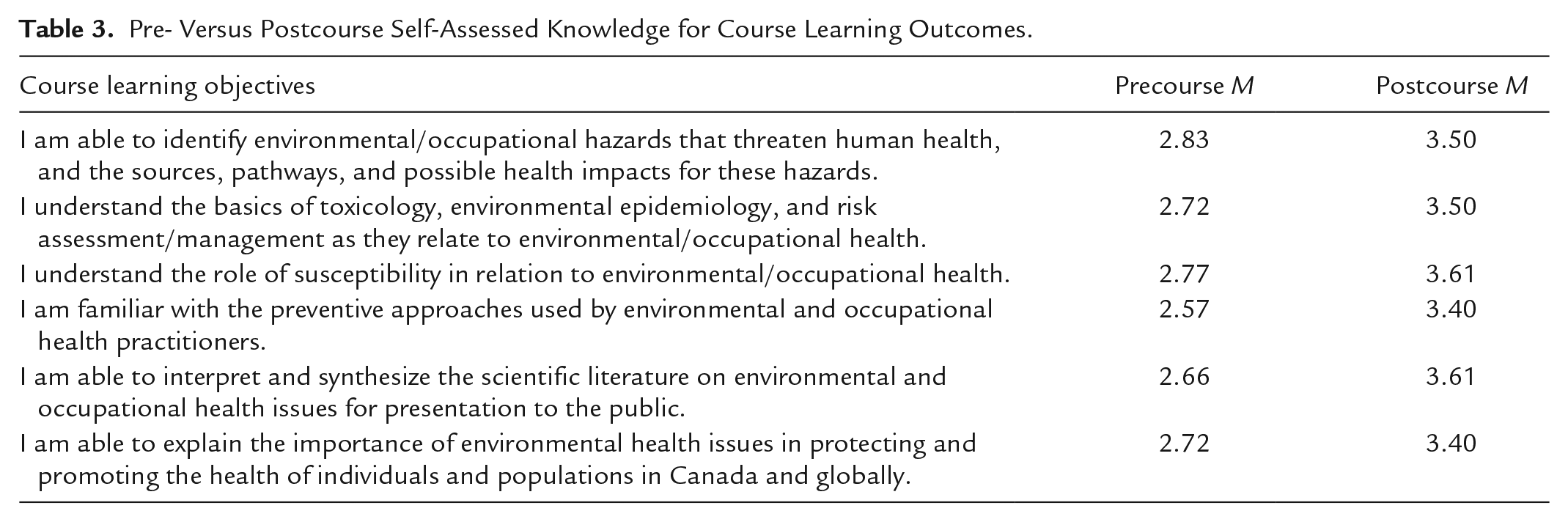
A comparison of self-assessed knowledge in relation to the course learning outcomes before and after completing the EOPH course is presented in Table 3. For all learning outcomes, a statistically significant increase in self-perceived knowledge occurred after participating in the course (p < .05). A statistically significant increase in general knowledge of the field environmental and occupational health issues and reflective practice skills was found.
Pre- Versus Postcourse Self-Assessed Knowledge for Course Learning Outcomes.
Student Learning Experiences
Results indicate that student experiences within the EOPH course designed using a flipped online learning approach were highly favorable overall. Nearly all study participants (94%) agreed or strongly agreed with the following statements “The pre-recorded vodcasts were an effective means of ‘lecturing’ (delivering content)” and “The WebEx seminar sessions complemented the independent online learning component of the course.” In the open-ended questions in the post-course survey, students were asked to share any additional comments about the course in general and/or to provide suggestions for improving the course overall. Students provided generally positive feedback. One student wrote: “. . . awesome course, content was informative.”
Student feedback highlight that part of the overall success of the course can be attributed to the integration of independent online learning with complementary real-time and interactive WebEx sessions. The following feedback from students supports this finding: [I liked] . . . the mixed delivery between self-paced lectures, interactive lectures and [WebEx] seminars. This really helped keep the course and associated material engaging and interesting while removing the typical monotony that comes with online courses. I think the chance to have discussions about the material was really helpful as well.
However, not all student feedback was entirely positive. For example, one student provided the following comment: “The structure of the class felt very progressive, but with that came the trade-off that it was so confusing. In every other class, we know what is expected of us.” It may be that the unique and unfamiliar course structure and design was confusing and unwelcome for this student, and possibly others, compared with a traditional lecture-based course with a familiar weekly lecture format.
Impacts of Course Components on Critical Thinking and Student Engagement
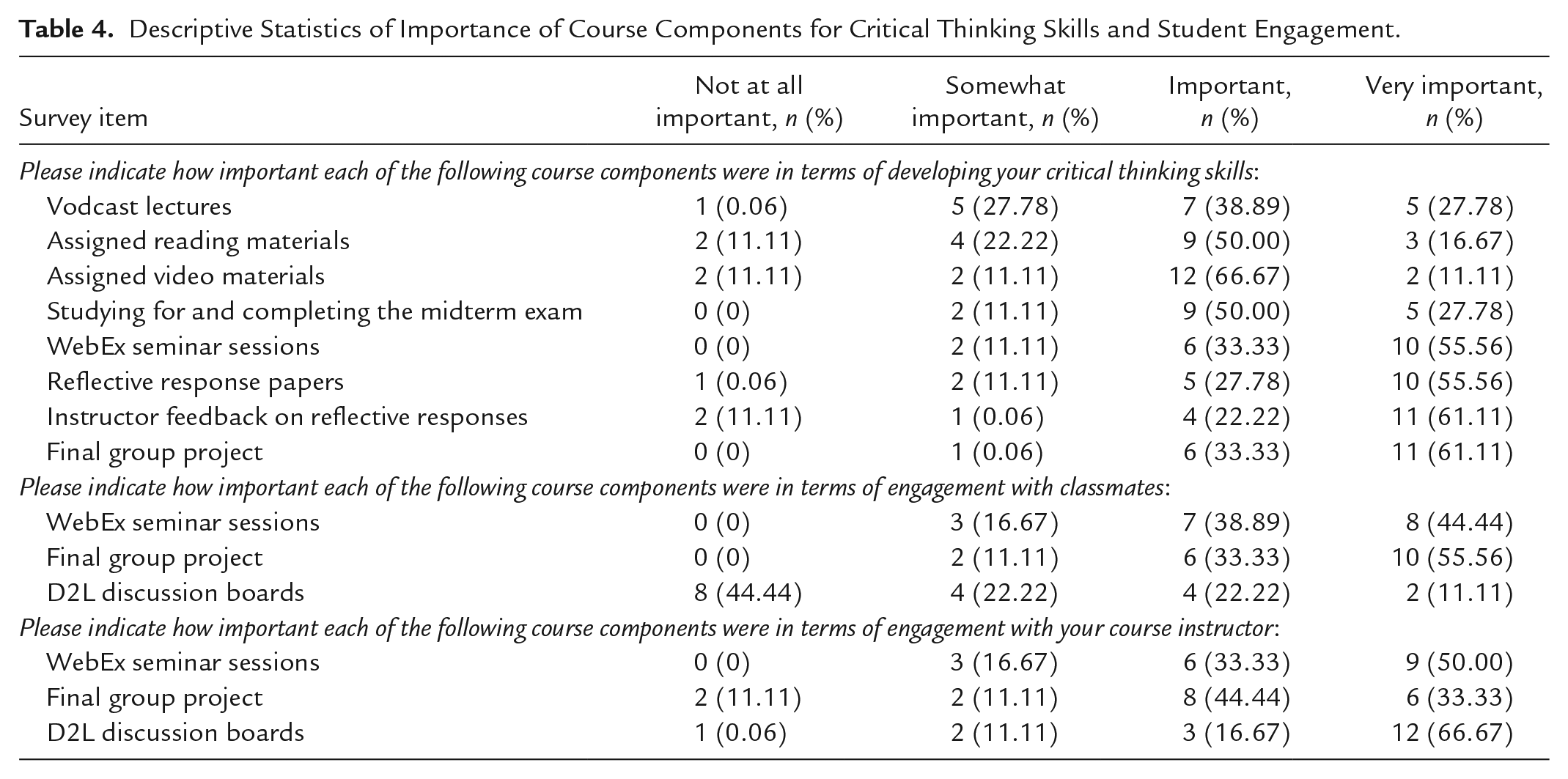
The course was designed and implemented with the explicit aim of fostering meaningful student engagement and building skills in critical thinking. In the postcourse survey, students rated how important specific components of the course (e.g., prerecorded vodcasts, WebEx seminars, reflective response papers) were for their overall learning. The interactive WebEx seminars and the final group project were identified as the most important course components for overall learning; 94% agreed that both the WebEx seminars and the final group project were important or very important for their overall learning. These results indicate the importance of real-time engaged, knowledge application, and active learning (achieved during the WebEx seminars) for overall learning. Interestingly, 33% of students did not think that assigned learning materials were important for their overall learning.
Descriptive statistics of the reported importance of specific course components on the development of critical thinking skills and engagement are summarized in Table 4. The WebEx seminar sessions, reflective response papers, instructor feedback on reflective response papers, and the final group project were identified as the most important course components in terms of the development of critical thinking skills and engagement. Importantly, most students who participated in the study indicated that the WebEx seminar sessions were important or very important for engagement with classmates (83%) and the instructor (83%).
Descriptive Statistics of Importance of Course Components for Critical Thinking Skills and Student Engagement.
In the open-ended feedback, several students commented that reflective writing assignments promoted meaningful student engagement and contributed to student–instructor relationship building. For example, one student wrote, . . . Being an introvert, I participated more in this online course than I ever did in an in-person course so I think the format really created a space for students to feel engaged even if they aren’t usually willing to participate. I also found that the reflection papers were a useful learning tool because they allowed you to really check-in on your knowledge and apply it to relevant situations and [the instructor] gave constructive feedback that made taking the time to write the reflections seem meaningful.
Lastly, student feedback also highlighted the importance of diversity in terms of learning material and course components: The diversity in types of assignments was also beneficial-balance between real time learning, pre-recorded lectures, written assignments, presentations, multiple choice tests, and reflective feedback—is beneficial. With such diversity the prof is ensuring everyone has the opportunity to succeed and their learning style is met, this also allows mastery of the materials.
There are limitations that should be noted when interpreting the findings reported here. We cannot exclude the possibility that participants answered questions in a socially desirable way. Another limitation of this study is the small sample size. Eighteen students completed both the pre- and post-course survey (55% response rate). It is possible that the 45% of students who did not complete the survey, and whose experiences and opinions were not captured in our data, had different experiences than those that did participate in the study. Future research using larger sample sizes is warranted, using a controlled study design whenever possible. Additionally, the survey instruments utilized here, although based on examples from the literature, were created for this study and had not been tested for reliability. Future research, aimed at testing survey and scale validity and reliability for application in studies exploring the pedagogical impacts of flipped classroom models specifically would help advance this emerging field of research. An additional limitation is that we did not collect qualitative data from students that participated in the course. Qualitative data would be helpful to gain a more in-depth understanding of student learning experiences and to identify best practices for course design and implementation. Future work would benefit from applying a mixed-method approach and integrating quantitative survey data and interview or focus group data.
Discussion
This study findings reported here indicate that the flipped classroom approach, which is increasingly advocated for in medical education, can have positive impact on learning outcomes and experiences in the context of online graduate-level public health education (Jesurasa, Mackenzie, Jordan, & Goyder, 2017; Merzel, Halkitis, & Healton, 2017). To quote one of the students, “THIS [emphasis original] is how a graduate level course should be taught.” Perhaps most importantly, given the challenges of promoting critical thinking and student engagement in the online teaching and learning environment (Baran, Correia, & Thompson, 2011), we find that the integration of the flipped course design and online course delivery as applied here can offer opportunities for students to develop their critical thinking skills while providing space for peer-to-peer and student–instructor engagement and relationship building. Our findings suggest that the flipped course design, and the use of interactive WebEx seminars and reflective writing in particular, were key to the overall success of the course and essential in terms of enhancing meaningful student engagement and critical thinking skills. These findings support the growing body of literature illustrating that the flipped classroom approach can promote student–teacher interactions that are often absent from online teaching and learning (Frenk et al., 2015; Moravec, Williams, Aguilar-Roca, & O’Dowd, 2010). We see this as particularly relevant given that existing literature emphasizing that effective teaching online requires meaningful instructor presence and activities that reduce the perceived distance between instructors and their students (D’Alba, 2014; Dennen, 2011; Richardson et al., 2015). When instructors effectively project themselves as real and enhance the perceived closeness in online spaces, research has found positive impacts on learning outcomes and reduced student anxiety and isolation (Brinkerhoff & Koroghlanian, 2007; Creasey, Jarvis, & Knapcik, 2009).
By and large, the lecture-based teaching model continues to dominate higher education despite massive advances in online access and technology and developments in pedagogical theory (Eapen, Vavalle, & Harrington, 2012; Pierce & Fox, 2012). We argue that the flipped classroom approach should be considered for more widespread experimentation and application in the context of online public health education. Instructors who struggle with how to promote meaningful student engagement in their online teaching, in particular, should consider redesigning their course(s) using the flipped classroom approach. We emphasize that there is no single or standard way to design and implement the flipped classroom model in practice, “. . . nor should there be” (Herreid & Schiller, 2013). Instructors considering the application of the flipped classroom model in the context of online public health education must also consider their student body and the course learning outcomes, while acknowledging that the delivery of content is “just one small piece of the overall learning experience . . .” (Davies, 2013, p. 346). Redesigning a course using the flipped classroom approach also requires a shift in thinking by instructors in terms of their own role in the learning process and a shift in expectations in terms of course preparation and planning.
Below, we share specific lessons learned that we feel will be relevant to the advancement of the application of the flipped classroom design in online public health education more broadly:
Develop creative and diverse learning activities: Central to the flipped classroom approach in higher education is providing students with opportunities to problem-solve, apply their knowledge, and engage in collaborative learning and meaningful discussion with peers and their instructor. The flipped classroom model therefore involves more than simply shifting content delivery outside of class time (Herreid & Schiller, 2013). It represents a broader shift in how we think about the learning process with a focus on the application of knowledge through active learning and student engagement. The explicit attention to interactive and collaborative learning draws on Piaget’s theory of active learning which highlights that learning occurs when we act on and apply new ideas and concepts (Piaget, 1971) as well as Bloom’s influential taxonomy of thinking and learning. Instructors must therefore put the time and effort into the development of active learning activities during the course design phase to effectively apply the flipped classroom approach for positive impacts on learning outcomes and experiences. In the context of higher education specifically, Fink (2013) argues that reflection and reflective practice are key components of the successful implementation of active learning.
Focus on mechanisms that foster student–instructor relationships: While it has been established that positive student–instructor relationships are beneficial to student learning, research focused on relational pedagogies in blended online learning is in its infancy (Reeves & Le Mare, 2017). Within the research that does exist, there is evidence that timely and thought-provoking responses to written assignments/projects by the instructor can help to establish rapport between instructors and students and may also assist student learning processes (King, 2014; Martin, Wang, & Sadaf, 2018). Within the EOPH course, the use of reflective writing assignments early in the course provided an opportunity to offer in-depth feedback to students and a mechanism to build student–instructor relationships. We believe that this was an important aspect of the course described here and a strategy that others should experiment with.
Acknowledge unfamiliar and potentially discomforting experiences: At the outset of the course, we suggest that instructors are clear and explicit about the possibly of experiencing “discomfort” with innovative and perhaps unfamiliar course design and delivery. The importance of addressing this emotion is in fact a teaching practice that is articulated through the “pedagogy of discomfort” literature. This literature highlights that encouraging students to move outside their “comfort zones” is pedagogically valuable for learning (Boler & Zembylas, 2002). This is premised on the idea that discomforting emotions are valuable for challenging dominant beliefs, social habits, and normative practices. Recent writing on the topic has identified the need for educators to be strategic about how and when they enact and discuss this discomfort (Zembylas, 2017). When implementing course design that may be unfamiliar to students, we suggest that instructors take the time to acknowledge and discuss the potential to experience discomfort at the outset of the course.
Apply reflective practice as instructors: We have argued that the use of reflective writing by students, alongside the provision of meaningful feedback by the instructor, is an excellent tool to advance critical thinking and build student–instructor relationships in online higher education. Similarly, we urge instructors to apply reflective practice to their teaching. According to Brookfield (2017), this involves “the sustained and intentional process of identifying and checking the accuracy and validity of our teaching assumptions” (Brookfield, 2017, p. 3). When experimenting with novel course design and new technologies, instructors will benefit from engaging in reflective practice.
Conclusion
This article reported on a master’s-level EOPH course that was designed using a flipped classroom model and delivered online using D2L and Web conferencing technology. Our results suggest that this approach enabled the achievement of course learning outcomes and provided positive learning experiences. We also find that this approach had important implications for the promotion of critical thinking and student engagement for this small group of graduate-level public health students. In addition to the generally positive feedback from students, the course instructor also had positive experiences regarding the design, implementation, and overall outcomes of the course. Frenk et al. (2015) argue that “the way we educate public health professionals falls short of the needs of a changing world” (Frenk et al., 2015, p. 109). Although additional experimentation, evaluation, and knowledge sharing are warranted, the integration of the flipped classroom design with online teaching and learning may be an underutilized opportunity to better address the rapidly changing priorities and student expectations in public health higher education.
Footnotes
Declaration of Conflicting Interests
The authors declared no potential conflicts of interest with respect to the research, authorship, and/or publication of this article.
Funding
The authors received no financial support for the research, authorship, and/or publication of this article.
