




Abstract
Many female health education pioneers made seminal contributions to public health and social justice, yet these examples are not well documented in textbooks or integrated into public health curricula as pedagogical learning opportunities. Providing biographies and lessons learned from the past leaders within undergraduate health education curricula can help develop students’ skills as future leaders and address gender inequities in the field. Gender inequities in higher education as well as many public health practice settings result in lower salaries, slower career advancement opportunities, fewer supervisory positions, increased work-life conflicts, and heavier workloads. Developing women’s competencies in leadership and professionalism early in their careers is critical to meeting public health challenges such as COVID-19. We present four female health education trailblazers from different historical eras and various workforce sectors who exemplify leadership attributes (i.e., courage/risk taking, vision, advocacy, mentorship) and can be highlighted as a part of future health education curriculum. Innovative methods and approaches are provided for integrating these leadership lessons into undergraduate public health courses, in alignment with the HESPA II 2020 competencies. Learning from the past to inform the future is critical to inspiring and shaping the careers of emerging health educators.
Background
Incorporating history, including learning from former trailblazers within the field, can be critical in preparing the next generation of public health professionals to tackle contemporary public health challenges and become leaders (Perdiguero et al., 2001). Despite significant focus on equity and social justice, gender inequities in leadership persist in the academic and practice environments in public health. Female public health professionals experience lower salaries, slower career advancement opportunities, fewer supervisory positions, increased work-life conflicts, heavier workloads, and other disparities compared to their U.S. male counterparts (Yassine et al., 2022). Women in social and other sciences are granted fewer professorships or endowed chairs, are less likely to receive top-tier grant funding and hold fewer editor-in-chief or editorial board appointments of scientific journals (Khan et al., 2019).
Women also constitute most of the public health workforce yet are less likely to hold supervisory positions and earn less compensation than their male peers in state/local public health agencies (Chapple-McGruder et al., 2020). Those earning higher salaries in a state health agency or a large local health department are more likely to be males, have white non-Hispanic race/ethnicity, and work in a supervisory or clinical/laboratory/other scientific position (Sellers et al., 2019). More than 75% of all health educators are women, yet few have advanced to leadership positions in state/local health departments (Cinnick et al., 2023). Moreover, gender inequalities in public health are more pronounced among women of underrepresented races, ethnicities, or other identities (Yassine et al., 2022).
This suggests a critical need to address gender and diversity gaps in the field early in the career trajectory of health educators, in part by enhancing their leadership competencies. Currently, the development of leadership knowledge and skills is typically emphasized in graduate public health curricula or public health institutes for working public health professionals (Grimm et al., 2018). We recommend including leadership skills in professional preparation curriculum at the undergraduate level. This article provides pedagogical strategies for baccalaureate leadership development utilizing the examples of four female health education trailblazers who overcame gender bias, advocated for racial and social justice, and advanced to prominent academic and/or practice positions. Utilizing biographies as a pedagogical approach, as has been done in other fields such as medical education, can help students explore the trials and challenges of key figures and inspire their reflection on “deeper questions regarding their professional identity and role in society.” (Fagiolo, 2021, p. 512). We offer innovative teaching strategies to develop baccalaureate students’ intra- and inter-personal leadership knowledge and skills.
Leadership Competencies and Female Health Education Trailblazers
Various characteristics of effective health education leadership are reflected in the Health Education Specialist and Practice Analysis II 2020 Areas of Responsibility, Competencies, and Sub-Competencies (HESPA II 2020), which form the basis for the Certified Health Education Specialist (CHES): specifically, Area V - Advocacy, Area VII - Leadership & Management, and Area VIII - Ethics and Professionalism (Knowlden et al., 2020; See Table 1).
HESPA II 2020 Areas of Responsibility Reflecting Entry-Level Leadership Skills.

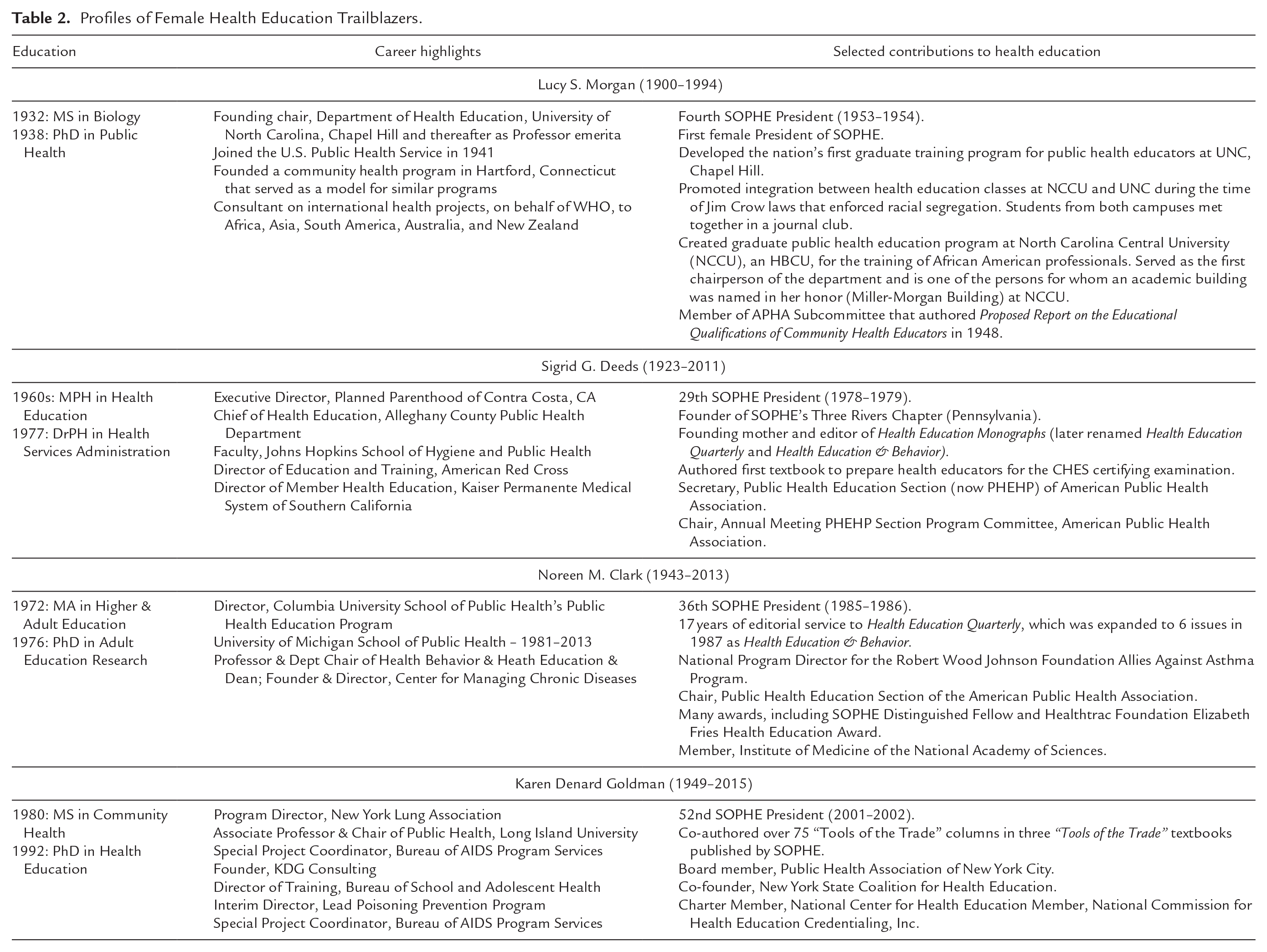
We profile four female health education trailblazers who served as president of the Society for Public Health Education (SOPHE) from 1953 through 2001: Drs. Lucy S. Morgan, Sigrid G. Deeds, Noreen M. Clark, and Karen Denard Goldman. These women were selected because they: (1) addressed serious and contentious public health issues of their eras that are relevant to contemporary public health issues (e.g., social justice, gender bias, women’s reproductive rights, climate change); (2) worked as leaders in multiple public health sectors; (3) advanced health education scholarship and practice; and (4) provided substantial volunteer service to the health education profession (See Table 2). Additionally, only females who had served as SOPHE presidents and were deceased were considered for this paper as a way to incorporate important health education history.
Profiles of Female Health Education Trailblazers.
The female SOPHE trailblazers exemplified
Lucy S. Morgan
Of the many attributes associated with great leaders,
Dr. Lucy Morgan exemplified the characteristics of a courageous and risk-taking leader. Between the late 1800s until the civil rights movement in the 1950s, Jim Crow laws required racial segregation of Southern schools and public transportation. Dr. Morgan risked integrating her public health education classes in the 1940s at the University of North Carolina (UNC) with students from North Carolina Central University (formerly North Carolina College for Negroes). She recognized African American health educators were needed to effectively reach Southern communities affected by tuberculosis, venereal disease, inadequate environmental sanitation, and other health conditions.
UNC President Emeritus William C. Friday referred to Dr. Morgan as a “pioneering integrationist with a depth of soul that was instructive and remarkable; a revolutionary, in the best sense of that word” (Kastleman, 2006). Dr. Morgan also has been credited for creating the first graduate health education program as a discipline in a school of public health and an early advocate for codifying the distinct training of health educators (Eriksen, 1990).
Sigrid G. Deeds
Dr. Sigrid Deeds demonstrated
At the Johns Hopkins School of Hygiene and Public Health, Dr. Deeds mentored numerous students, one of whom wrote, “Sigrid appreciated, communicated, taught and demonstrated the interrelationship and synergy of theory, research and practice” (Dorfman, 2022).
With research funding from the National Institutes of Health, Dr. Deeds demonstrated the effectiveness of educational interventions in improving patient outcomes. Later in her career, she directed education and training at the American Red Cross, applying health education interventions to hypertension control and then later at the Kaiser Permanente Medical System of Southern California with the advent of health maintenance organizations. An unflappable leader, Dr. Deeds delivered her final SOPHE Presidential address at a New York City Chinese restaurant with poor acoustics and no microphone by standing on a table in full formal attire (Gielen, 2011). She envisioned trends that would impact the health education profession over subsequent decades, such as lack of involvement in federal decision-making, chapter relations, and membership challenges (Eriksen, 1990).
Noreen M. Clark
Dr. Noreen Clark was a formidable
Dr. Clark also was a staunch advocate for the role of behavioral sciences in the management of chronic disease, publishing more than 150 scholarly articles in collaboration with many experts outside her discipline. As SOPHE president, she spearheaded efforts to eliminate specific requirements for membership, helped negotiate a lucrative publishing contract for the organization’s fledgling journal, and catalyzed the development of the first health education research agenda.
Building on the work of other behavioral scientists, Dr. Clark challenged health educators to work across at least three levels: governmental, organizational, and individual. “We have to consciously target ‘key’ government and community leaders, organizational decision makers, individuals at risk. . . . We need organizations that enact healthful policies, maintain healthful facilities, implement healthful programs. We need individuals who are healthful in their behavior, and in the physical and psychological aspects of their life” (Clark, 1994, p. 496).
Karen Denard Goldman
Dr. Karen Denard Goldman embodied what it is to be a
Dr. Denard Goldman’s dedication to scholarship, mentorship and volunteerism is reflected in the more than 75 “Tools of the Trade” that she co-authored (K. D. Goldman & Schmalz, 2005, 2009, 2015). These tools, including one entitled “Follow the Leader: Mentoring,” served as practical guides to health education professionals and followed her KISS Rule of keeping it simple (K. D. Goldman & Schmalz, 2005). An effervescent, energetic speaker, she shared practical ways of connecting research and practice at many SOPHE chapter conferences and local workshops.
In 2005, New Jersey SOPHE created the Karen Denard Goldman Scholarship Award (NJ SOPHE & K. Goldman, n.d.) to memorialize her contributions to the field and dedication to promoting student success. National SOPHE’s Karen Denard Goldman Health Education Mentor Award recognizes a professional who exemplifies mentorship and effectively interweaves research and practice.
Recommendations for Strengthening Leadership in Professional Preparation
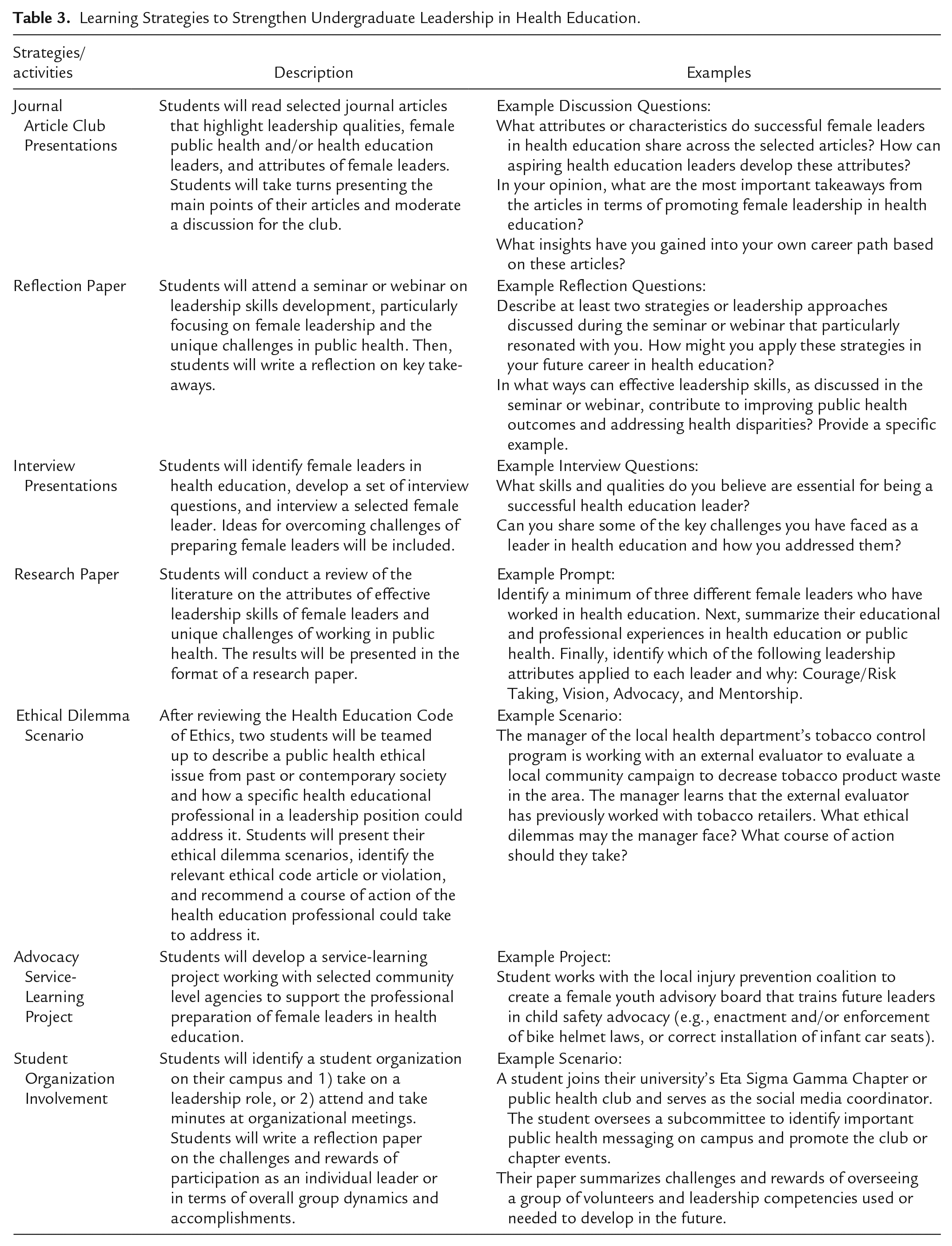
One approach to closing the gender gap in public health is to begin addressing leadership in students’ formative undergraduate years. Using examples of female health education trailblazers can instruct and inspire students. Table 3 provides teaching/learning strategies that are integrated, bidirectional and can be used to develop baccalaureate students’ inter- and intra-leadership competencies that align with HESPA II 2020. These strategies can be implemented in person or online, in team-based and individual assignments, and integrated with various media tools for increasing student engagement. Studying these female archetypes also can motivate students to plan their professional volunteer journey and anticipated contributions to the profession. The activities outlined in Table 3 can be applied to all four of the leadership attributes. Pre- and post-tests about students’ knowledge, skills and self-efficacy as future leaders may serve as one evaluation approach for measuring learning outcomes.
Learning Strategies to Strengthen Undergraduate Leadership in Health Education.
Conclusion
Learning from public health history is important to the development of future public health leaders. Incorporating biographies and various pedagogical strategies to help students explore female archetypes and the historical challenges they overcame can help them develop leadership competencies and influence their future career growth in various practice settings. This article profiles four female health education trailblazers whose contributions reverberate throughout the years and across work settings. Their courage/risk taking, vision, advocacy, and mentorship have changed the field of health education and helped pave the way for future generations of women to overcome gender bias, promote social justice, and improve population health. They serve as examples of other female public health leaders who could be highlighted in undergraduate health education courses, and the need for increasing the diversity of future health education leaders. Learning from the past to inform the present and future is a vital component of an agile health education curriculum.
Supplemental Material
sj-pdf-1-php-10.1177_23733799241235924 – Supplemental material for Strategies for Preparing Future Public Health Leaders: Learning from Trailblazing Women in Health Education
Supplemental material, sj-pdf-1-php-10.1177_23733799241235924 for Strategies for Preparing Future Public Health Leaders: Learning from Trailblazing Women in Health Education by M. Elaine Auld, Deborah Fortune, Julia M. Alber and Angela D. Mickalide in Pedagogy in Health Promotion
Footnotes
Declaration of Conflicting Interests
The author(s) declared no potential conflicts of interest with respect to the research, authorship, and/or publication of this article.
Funding
The author(s) received no financial support for the research, authorship, and/or publication of this article.

References
Supplementary Material
Please find the following supplemental material available below.
For Open Access articles published under a Creative Commons License, all supplemental material carries the same license as the article it is associated with.
For non-Open Access articles published, all supplemental material carries a non-exclusive license, and permission requests for re-use of supplemental material or any part of supplemental material shall be sent directly to the copyright owner as specified in the copyright notice associated with the article.
