




Abstract
This visualization shows a systematic misperception in how workers judge automation risk. Drawing on the 2026 Measuring Employment Sentiments and Social Inequality study, the authors compare paired measures of perceived automation likelihood for self and most others, using nationally representative samples of American and Canadian workers. Approximately three quarters of study participants in both countries rated their own jobs as at low risk of automation in the next few years, yet more than 70 percent believed that most other workers face at least some likelihood of automation. The pattern aligns with pluralistic ignorance: most workers hold one view of their own automation risk while assuming that most others hold a different one. The self-other gap is invariant across occupational categories and across two distinct national contexts, consistent with an informational asymmetry in which beliefs about others’ risk reflect prevailing public narratives about artificial intelligence rather than workers’ direct experience.
Recent polls show that although Americans express substantial pessimism about the impact of artificial intelligence (AI) on the labor market, far fewer expect it to affect their own jobs (Quinnipiac University Poll 2026). A similar asymmetry appears in workers’ perceptions of robotic displacement, with workers overestimating how many others have lost jobs to robots (Dahlin 2022).
To examine this asymmetry directly, the 2026 Measuring Employment Sentiments and Social Inequality (MESSI) study asked American and Canadian workers paired questions about perceived automation risk: workers’ expectations of near-term automation of their job tasks. MESSI was fielded in spring 2026, using nationally representative samples of employed adults in the United States (n = 2,000; YouGov) and Canada (n = 2,012; Angus Reid Group). We first asked respondents, “How likely is it that in the next few years machines or computers will be doing a lot of the things you now do on your job?” We then asked them to estimate how most other workers in their country would answer the same question about their own jobs. Both items used a four-point scale from “not at all likely” to “very likely.”
Because workers’ estimates of others refer to the population they themselves belong to, the overall distributions should be roughly the same if workers are accurately perceiving others’ risk assessments. A sizable gap between the two distributions implies a systematic misperception of others’ risk assessments.
Figure 1 plots the distribution of responses for both measures in each country. Two patterns stand out. First, workers in both countries assess their own automation risk as low to moderate. Roughly three quarters in each country see automation as not at all or only somewhat likely to affect their jobs, with only about 8 percent saying that it is very likely (8.1 percent in the United States, 7.9 percent in Canada).
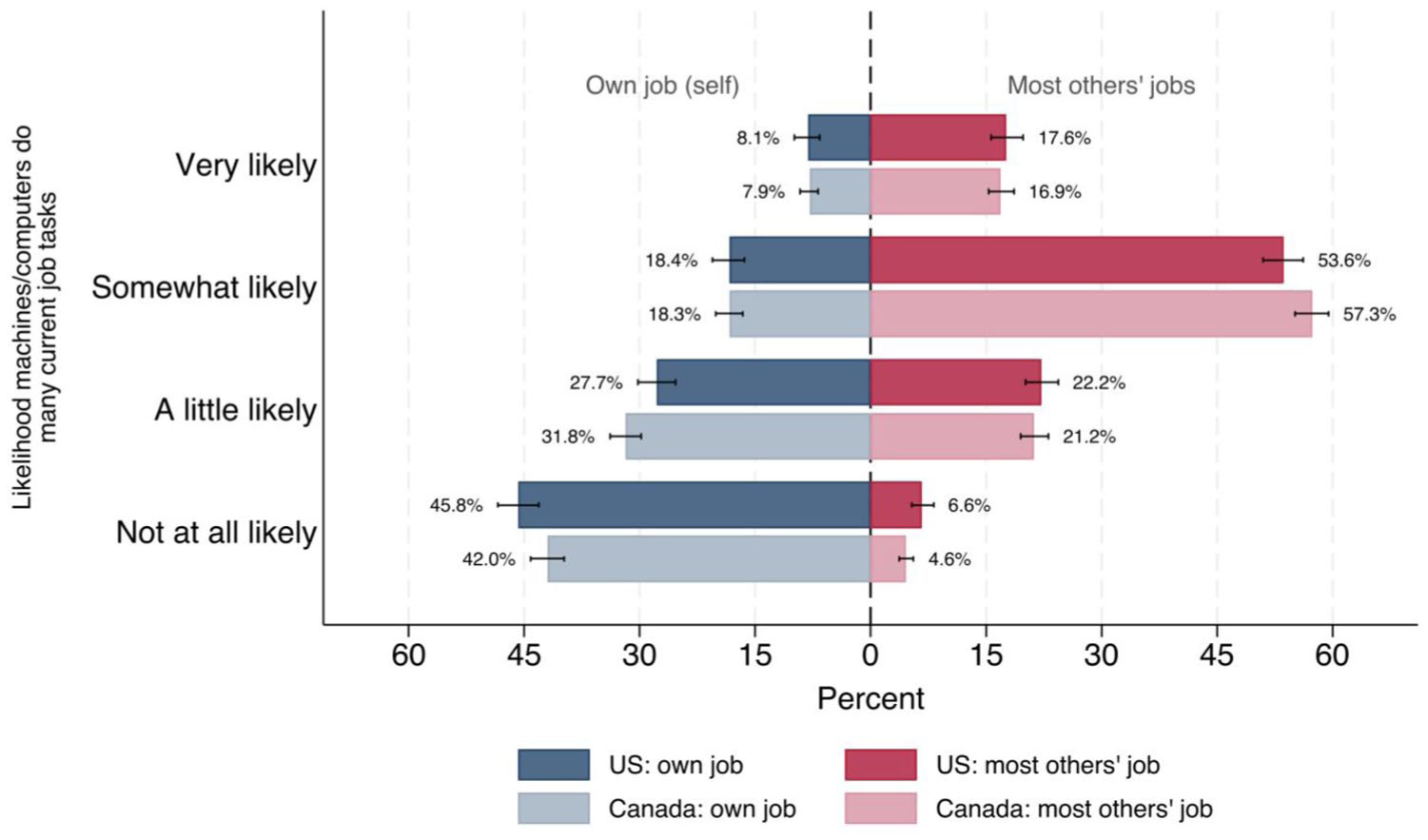
Perceived likelihood of automation displacing job tasks within the next few years, by subject of the question and country.
Second, workers’ beliefs about others’ risk deviate considerably from their personal automation beliefs. More than 70 percent of workers in both countries see others’ jobs as at least somewhat likely to be automated, producing a self-other gap of roughly 45 percentage points in the United States and 48 percentage points in Canada. Additional analyses reveal that workers’ occupational background has little impact on the direction or magnitude of the self-other gap (see Supplementary Figure A1).
We see these patterns as illustrative of pluralistic ignorance, in which most members of a group personally hold one view but assume others hold another (Prentice and Miller 1993). This could be the result of a self-enhancement bias in which workers view their own skills and situation as more automation resistant than the “typical” job (Sedikides and Alicke 2012). Alternatively, the self-other gap could reflect an informational asymmetry, where workers know their own jobs from direct experience but draw on media narratives about AI displacement when assessing other workers’ risk (Dahlin 2024).
We think two features of the data favor the informational asymmetry account over self-enhancement. If self-enhancement were operating, the gap should be largest among workers personally facing the most credible threat, since motivated self-views are most useful where the threat is real (Alicke and Sedikides 2009). Yet the gap is no larger among workers in the cognitive and knowledge-work occupations Dahlin (2024) identifies as most exposed to AI (see Supplementary Figure A1). The gap is also stable across two national contexts, suggesting that it does not depend on the local conditions a self-protective bias should respond to. Instead, we argue that workers’ overestimation of others’ risk reflects a public narrative about AI-driven automation that is currently running ahead of what the evidence shows (Dahlin 2019, 2022).
Understanding how generalized perceptions of automation risk form is important because people often act on what they think others believe (Prentice and Miller 1993). If workers wrongly assume that most others see AI-driven displacement as inevitable, this misperception may weaken collective responses to workplace change. This may be especially consequential in contexts where employers have incentives to use automation narratives to legitimize restructuring or layoffs, and where information environments shape workers’ perceptions of collective sentiment (Wiggin 2025). Workers’ beliefs about general AI risk, not just the technology itself, may therefore shape labor responses to automation.
Supplemental Material
sj-docx-1-srd-10.1177_23780231261453968 – Supplemental material for The Self-Other Gap in Perceived Automation Risk: Evidence from the United States and Canada
Supplemental material, sj-docx-1-srd-10.1177_23780231261453968 for The Self-Other Gap in Perceived Automation Risk: Evidence from the United States and Canada by Paul Glavin, Scott Schieman and Alexander Wilson in Socius
Footnotes

Funding
The authors disclosed receipt of the following financial support for the research, authorship, and/or publication of this article: This research is funded by the Social Science and Humanities Research Council (435-2020-1125) (Scott Schieman, principal investigator).
Declaration of Conflicting Interests
The authors declared no potential conflicts of interest with respect to the research, authorship, and/or publication of this article.
Supplemental Material
Supplemental material for this article is available online.
Author Biographies
References
Supplementary Material
Please find the following supplemental material available below.
For Open Access articles published under a Creative Commons License, all supplemental material carries the same license as the article it is associated with.
For non-Open Access articles published, all supplemental material carries a non-exclusive license, and permission requests for re-use of supplemental material or any part of supplemental material shall be sent directly to the copyright owner as specified in the copyright notice associated with the article.
