



Abstract
This exercise aims to familiarize students with the underdiscussed topic of the role of context in coaching through a physical activity. It consists of a group sculpture—a combination of socio-drama, systemic constellation, and social presencing theater—drawing from a coaching case of an ethical dilemma, using the placement and arrangement of participants to represent the stakeholders and context (economic, legal, sociological, etc.). The visual and embodied representation aims to raise awareness and develop understanding of the invisible—but often felt—contextual factors at play in coaching, to generate reflection about their influence, and to offer insights on how to identify and embrace them. This activity is primarily aimed for coaching educators and supervisors, but a slightly adapted version could expand its benefits to a more general audience of managers and leaders.
Keywords
When educating coaching participants on the critical factors of a successful coaching intervention, most programs restrict their scope to the issues pertaining to the dyad formed by the coach and the recipient of the coaching service, that is, the coachee. Topics typically range from the coach’s attitudes, methods, and tools for building effective rapport with the coachee to the factors supportive of coachee’s engagement in the process (Rogers, 2012). What often gets overlooked and unattended in this predominately humanistic view (Du Toit & Sim, 2010) are the multiple stakeholders involved, and the role of the context in which coaching takes place (Western, 2012; Shoukry & Cox, 2018). Rather, such elements are treated as abstract, static, and given entities. The resulting naturalization of contexts overrides their dynamic role, running the risk of not only diminishing the effectiveness of the coaching intervention but also of leading to incorrect problem identification and formulation. Indeed, problems framed as “people issues” to be “solved” with a coach often reveal a neglect of root causes (Tobias, 1996) with potential phenomena such as scapegoating or even manipulation and coercive control (Du Toit & Sim, 2010; Louis & Fatien Diochon, 2018).
Against this backdrop, this experiential physical activity aims to familiarize students with the importance and multiple influences of context in coaching. What we refer to as context in coaching encompasses the broader system—beyond the coaching dyad—including the people, the multiple stakeholders, the team, the organization and its culture, explicit and implicit norms and values, the professional coaching associations, and the broader cultural, economic, sociological, and political environment (see the Theoretical Foundation section below for further development).
The learning method is experiential through the physical activity of a group sculpture. Drawing from a coaching case of an ethical dilemma experienced by a coach, this exercise consists in using the placement and arrangement of participants to represent the stakeholders and contextual factors present.
Group sculptures are a mixture of principles and practices from socio-drama (Sternberg & Garcia, 2000), systemic constellation (Cohen, 2005), and social presencing theater (Presencing Institute, n.d.) with a focus on the spatial configuration of actors in the system. The physical and spatial elements of sculptures include placing (localization), facing (orientation), spacing (distance), level, and posture. Group sculptures, or some variant, have been used in therapeutic, educational, and organizational settings to make visible and explicit the felt sense of the relational dynamics of families and groups. We introduce them in the specific context of coaching education to make visible the dynamics of a systemic entanglement of different actors involved in a coaching engagement and to explore new possibilities in the future in physical, spatial, somatic, and affective ways.
Such embodied learning presents several characteristics and advantages. It is one strand of a multistrand whole-person approach to learning that engages various dimensions of experience or intelligences through an experiential embodied learning cycle—from experience to reflection, meaning-making, and action (Heron, 2000; Taylor & Marienau, 2016). The felt evocative experience from which to reflect and develop actionable insights supports a direct empathic experience of context in play that facilitates remembering and recalling in future coaching events.
In the group sculpture, we represent the case in its current form and then allow some kind of future possibility to emerge, upon which we then reflect, seeking possible insights. The activity is primarily aimed at coaching educators and supervisors, but a slightly adapted version could expand its benefits to a more general audience of managers and leaders (see Appendix A).
Theoretical Foundation
Arguing that coaching theory is, itself, in need of a meta-theoretical framework to help position it, Garvey, Stokes, and Megginson (2018) call for a heuristic—rather than a comprehensive model of practice—likely to support reflexivity and critical thinking on practice. Central to this heuristic is the concept of context. Indeed, context (economic, technological, legal, sociological, political) appears key to mitigate and understand the influence of the core disciplines or lenses of coaching: psychology, sociology, and philosophy.
For example, the influence of the access to technologies on the nature, depth, and frequency of interactions between coaches and their clients represents the technological context. The formality and specificity of contracting between coach and client is part of the legal context, while cultural expectations about what constitute appropriate personal boundaries between coaches and coachees represent the cultural context. Figure 1 provides further details. It is important to recognize the context as an additional actor or set of actors to raise awareness on their roles in driving behavior and outcomes.
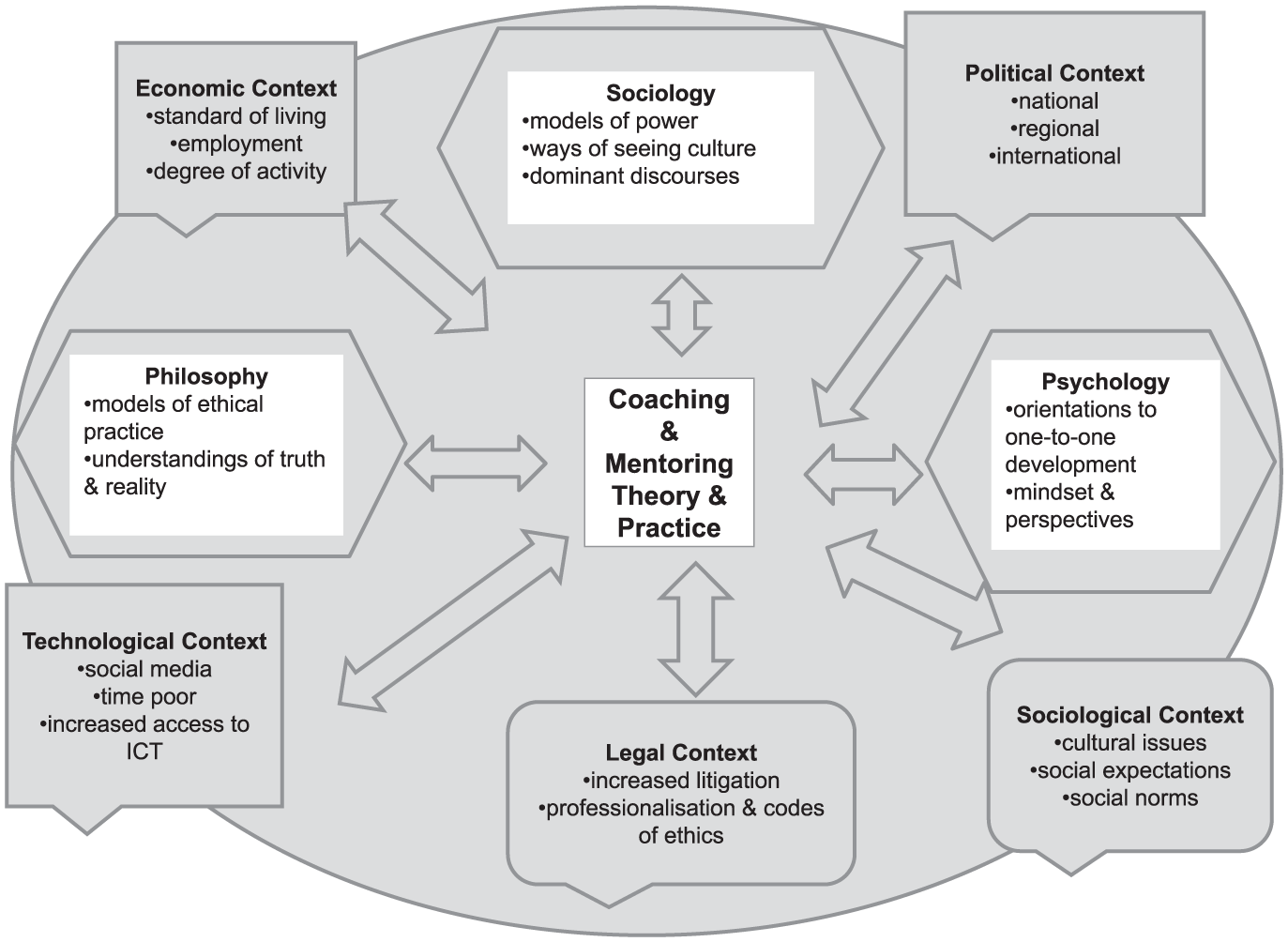
The influence of contexts and lenses in coaching.
Learning Objectives
By completing this exercise, students will be able to:
Develop understanding of the underdiscussed role of context in coaching through embodied learning (physical experimentation)
Acquire conceptual tools to analyze the role of context in coaching
Transform external elements—which are either overlooked or experienced as obstacles—into dynamic supports and levers of a coaching intervention
Increase the impact of coaching interventions by leveraging context in coaching
Instructions for Running the Exercise
Overview
This exercise consists of a group sculpture experiential activity where the placement and arrangements of participants allow for the visual and embodied representation of stakeholders and contextual factors. It uses the case study “White Horse Coaching” (see Appendix B) depicting the ethical conflict of Brigitte, torn between satisfying the pressing request of a director for speedy results on the part of the coachee, and Brigitte’s natural reaction to protect this employee who seems victim of a hostile work environment.
The group sculpture follows a sequence of 60 to 80 minutes composed of an introduction, case reading, sculpture forming, debriefing with theoretical articulation, and wrap-up.
Logistics
Preparation
While no specific preparation is required from students, they can read the case study (Appendix B) in advance. The instructor should have read the case prior to the session and be familiar with the steps.
Group Size
Ideal group size is 20 to 25. About eight people will be directly involved in the group sculpture, the other being observers. For larger groups, please refer to variations displayed in Appendix A.
Suggested Timing
We suggest using this activity in a 60- to 80-minute session, with 5 minutes for introduction, 10 minutes for case reading, 30 minutes for the actual group sculpture performance, 20 to 40 minutes for debriefing with observers and actors, and 5 minutes for wrap-up (see Appendix C combining timing and step-by-step instructions, as presented next).
Step-by-Step Instructions
Steps 1 and 2
After introducing the rationale for the experiential activity (Step 1), ask students to read the case study “White Horse Coaching” (see Appendix B; Step 2), which exposes a situation that will be the basis for the group sculpture activity.
Step 3
Provide a short overview of the principles and intentions of group sculpture as presented in the introduction. Then we suggest one or more short warm-up activities (see Appendix D) to prepare participants who might be unfamiliar with group sculptures.
Next, get volunteers to represent the actors in the system present in the case. As displayed in Appendix E, we suggest eight actors. Then provide the following instructions step by step as the actors—each representing a stakeholder and/or context factor in the case—perform the group sculpture activity.
a. Silently and without explanation for now, assume a place and position in the room. One after the other, choose where in the space allocated for the sculpture you want to be, which direction you want to face, which level to take, how close or far you stand from one another, and which body posture to take. Each of these elements exemplifies people’s own sense of how their particular presence informs and influences the system described in the case.
b. Once all actors have entered the sculpture, take some time to rearrange yourselves in a configuration, which as an ensemble will make visible your intuitive perception of the current dynamics present in the case.
c. Share a word or phrase of what it feels like to be part of the sculpture.
d. Then as an ensemble reflect on and express the sculpture’s envisioned future; respond to the question: “What wants to come?” Physically move into the envisioned and aspired future possibility, repeating Steps a to c.
After 15 minutes, ask actors to leave the sculpture.
Step 4
Open the floor for discussion. Involve actors and observers to reflect and discuss any insights into the case, especially as they pertain to the identification and role of contextual factors in coaching. It is recommended that the reflection and discussions begin with description—what one saw or felt—followed by the accompanying interpretation and meaning making. Identifying observed actions and felt experience opens up more possibilities for multiple interpretations and meanings present in the room. Garvey et al.’s (2018) model of contextual factors (see the exercise debriefing below) can be used as a framework for generating a range of possible interpretations that link the information in the sculpture with one’s own experience and practice.
Step 5
Wrap-up. Reinforce the learning objectives, sum up the importance of context, ask for final questions, and so on.
Debriefing of the Exercise
The debrief aims primarily at allowing participants to name and differentiate between different sorts of contextual influencers. We suggest using the model developed by Garvey et al. (2018, p. 305) to identify the source of different contextual sources as well as the many lenses (sociological, philosophical, psychological) informing practice (see Figure 2).
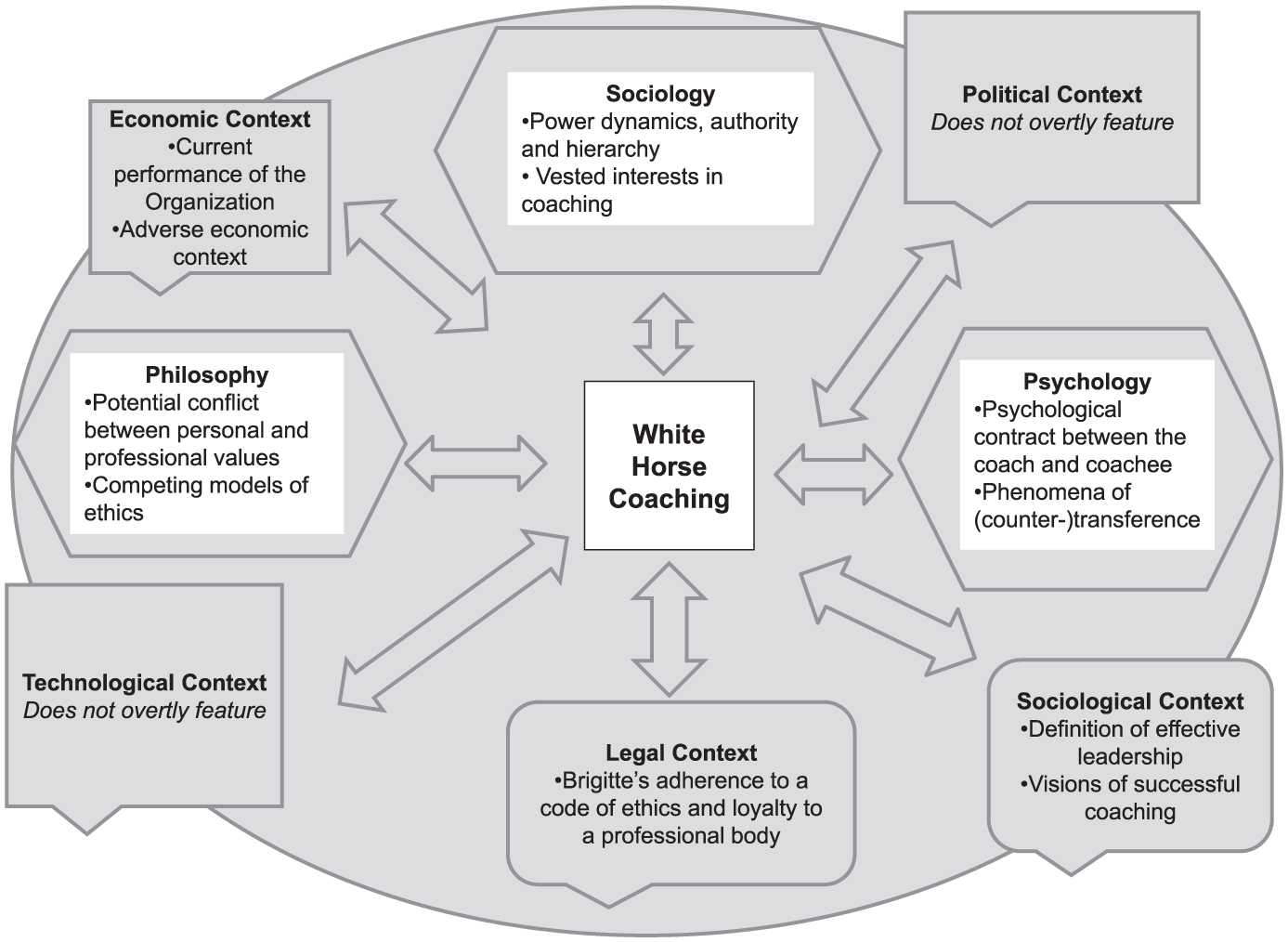
The influence of contexts and lenses in coaching—Applied to the White Horse Coaching Case.
We start with the Economic context. In the sculpture, it may have been personified by the person being the organization in terms of its current performance in the external market in which it operates. An adverse economic context may be influencing the boss, Will to push the coach, Brigitte, to deal with Bob, the coachee, more quickly. In terms of helping people raise their awareness of its impact, the stance of that person might signify something about how difficult or benign the current market context might be.
The Legal context can play a role in Brigitte’s adherence to a specific code of ethics or loyalty to a professional body.
The Sociological context refers to the social and organizational norms at play. Those norms might, for example, inform what “effective leadership” looks like, as well as what “successful coaching” “should” be. There could be an assumption that “being swamped in detail” is not good leadership but rather is associated with management.
Assuming that the audience is large enough, it may be useful to invite groups of participants to take one of the three lenses (psychological, philosophical, and sociological) each and interpret the sculpture through these.
For example, applying the psychological lens encourages focus of the impact of context on the dyad itself and the psychological contract (Rousseau, 1995) between coach and coachee. It can also allow discussions on Will’s transference with Brigitte and Bob, and their countertransference.
A philosophical lens draws attention to how the context influences personal and organizational values and ethics. It also encourages discussion on the different and competing models of ethics informing decisions in this coaching situation.
A sociological lens will favor discussions about power and vested interest for example. Thus, it is often accepted in organizations that a subordinate like Bob should not challenge Will given their hierarchical relationships. Also what are Brigitte’s interests in the success of the intervention, and the effective “transformation” of Bob?
Ultimately, it is important that participants understand the reciprocal nature of context (see the double direction arrows). In the White Horse Case, it can be argued that context both constitutes the case and is constituted by the case. For example, the political context and policy in which the organization is located contributes to the political climate within the organization but, at the same time, the political climate in the organization has an influence on the external political context. Also make sure to debate the dynamic nature of the sculpture, particularly using the criteria the participants chose as relevant to the future they envisioned. By this token, a parallel can be drawn with the dynamic and iterative nature of context itself.
Footnotes
Appendix A
Appendix B
Appendix C
Appendix D
Appendix E
Declaration of Conflicting Interests
The authors declared no potential conflicts of interest with respect to the research, authorship, and/or publication of this article.
Funding
The authors received no financial support for the research, authorship, and/or publication of this article.
