



Abstract
Workplace conflict, with its potential to be either highly beneficial or highly damaging, is best handled with thoughtful, deliberate care. This article presents two classroom exercises that demonstrate the value of carefully weighing both parties’ interests in a conflict, as suggested by the well-known “dual concern” model of conflict management. In the first exercise, students identify potential responses to a conflict over a “date night” restaurant choice. Discussion focuses on aligning these responses with the conflict management strategies inherent in the dual concern model and on identifying the potential for mutually beneficial outcomes. The second exercise then demonstrates how situational characteristics contribute to the choice of conflict management strategy. In it, student teams debate the importance of meeting their own, versus another party’s, interests in three realistic, hypothetical conflicts. Teaching tips, exercise variations, and summary information on the effective use of different conflict management strategies are provided.
Keywords
Conflict in work organizations has long been recognized as common, inevitable, and potentially beneficial (Steen & Shinkai, 2020; Thomas, 1992). Such conflicts may be rooted in substantive disagreements over matters such as goals, strategies, resources, and workload expectations, but they can also result from personality clashes, cultural differences, and power struggles (e.g., Alper et al., 2000; Jameson, 1999; Rahim, 2002; Wall & Callister, 1995). Managed poorly, conflict can create tension, distrust, and hostility and ultimately affect health, relationships, and work motivation (e.g., Guerrero, 2020; Hussain & Zaman, 2018; Ilies et al., 2011; Jameson, 1999; Yang, 2020). But managed well, conflict can spur positive change, improve decisions, increase engagement, and contribute to satisfying relationships (Alper et al., 2000; Amason et al., 1995; Garner & Poole, 2013; Guerrero, 2020; Rahim, 2002).
Rahim (2011) has argued that focusing on the interests, rather than the positions, held by parties to a conflict is fundamental to more effective conflict management. Doing so encourages parties to consider a broader range of options, seek creative solutions, and explore the potential for mutual gain. This article presents two exercises (for use separately or together) that train students to frame conflicts in terms of the parties’ interests. The first exercise helps students distinguish among five strategies commonly used to manage conflict, recognize the pros and cons of each, and explore ways to improve outcomes. The second, an update of an exercise from Whetten and Cameron (2016), directs attention to situational characteristics that affect the weight to be placed on each party’s interests. The exercises can be used in undergraduate or graduate organizational behavior and management skills classes of any size.
The Dual Concern Model of Conflict Management
Early writing saw approaches to conflict management as falling on a single continuum from competitive to cooperative (see Ruble & Thomas, 1976). But conceptual developments (e.g., Rahim, 1983; Thomas & Kilmann, 1978) led to the unidimensional perspective being supplanted by the dual concern model (Rahim & Katz, 2020; Thomas, 1992). This model locates conflict management choices on two independent, rather than mutually exclusive, dimensions: concern for satisfying one’s own interests (assertiveness) and concern with meeting the other party’s interests (cooperativeness). Accordingly, conflict management strategies are viewed as falling into five categories: forcing (high assertiveness, low cooperativeness), accommodating (low assertiveness, high cooperativeness), avoiding (low on both), collaborating (high on both), and compromising (medium on both).
Rahim and Katz (2020) recommended that conflict management training should both encourage the effective use of cooperative strategies (accommodating, compromising, and collaborating) and provide guidance for situations that call for uncooperative strategies (forcing and avoiding). The exercises in this article thus focus on training students to use the dual concern model, not merely as a descriptive taxonomy of different conflict management strategies, but also as a framework for making better decisions when selecting and implementing them.
Some earlier teaching exercises applied the dual concern model by having students identify their dominant conflict management tendencies (e.g., Brown, 2012; Shell, 2001); unfortunately, such exercises disregard how frequently people alter their conflict strategies (Callanan et al., 2006; Marin et al., 1994). Other exercises, including the well-known Ugli Orange case, focus more narrowly on demonstrating the importance of searching for mutually beneficial outcomes (House, 1998; Seltzer & Smither, 2007). While it is hoped that one takeaway from the exercises presented here will be that seeking win-win outcomes can be worthwhile, the broader goal is to help students see that effective conflict management calls for weighing the pros and cons of multiple strategies and considering how best to implement the chosen strategy.
Learning Objectives
Upon completion of the first exercise, students will be able to:
1. Specify how different strategies for resolving the same conflict align with the dual concern model, and
2. Identify ways to minimize negative consequences of uncooperative strategies.
Upon completion of the second exercise, students will be able to:
3. Select appropriate conflict management strategies to fit different situations, and
4. Recognize that, even if an uncooperative approach is wholly justified, cooperative strategies are sometimes still applicable.
Materials and Logistics
Allow a minimum of 50 minutes for both exercises: 15 minutes for Exercise 1 (a large group discussion), 20 minutes for teams (of 2–5 students) to meet for Exercise 2, and 15 minutes for debriefing Exercise 2.
Prepare a slide to project Appendix A and make copies of Appendix B for distribution; both appendices are also available as supplemental materials. Note that Appendix C (“Variations”) offers insights for using either exercise alone, an alternative two-person role-play version of Exercise 1, and suggestions for online instruction.
Conducting and Debriefing Exercise 1: “Friday Date Night”
Conduct Exercise 1 as a large group discussion of the Appendix A scenario. Students are asked to imagine that they have arrived home craving Mexican food after a trying day, but their Significant Other has been hoping for an Italian dinner to celebrate a promotion. Project the scenario and ask students to jot down multiple ideas for resolving this conflict. As students consider their ideas, draw a graph on the whiteboard with two axes, labeling the X-axis as “concern for other’s interests” and the Y-axis as “concern for own interests.” Mark off high, medium, and low on each (see Figure 1). 1
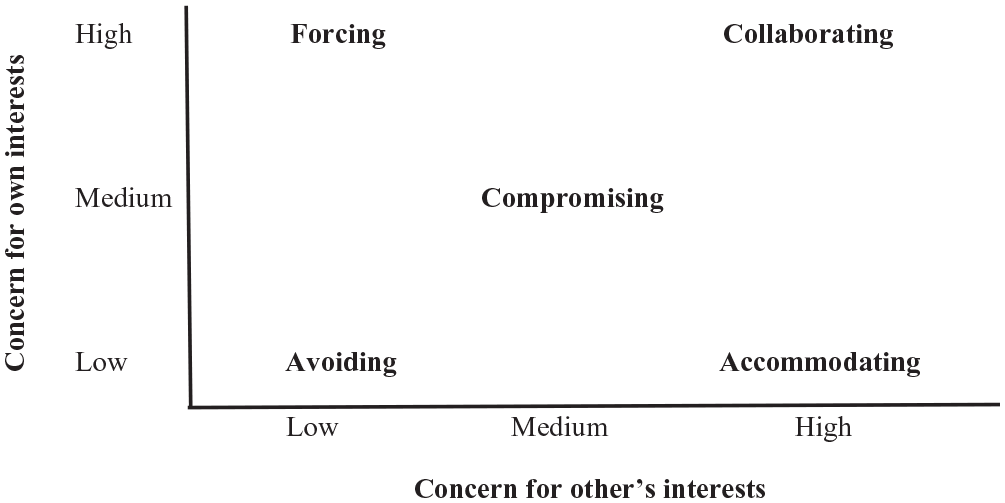
Dual Concern Model.
Conduct the discussion by asking students to volunteer suggestions. Depending on the responses, debrief as below:
Accommodating. Accommodating approaches are often suggested early (“I’ve had such a lousy day, I might as well just keep my partner happy” or, jokingly, “It’s always good to keep your girlfriend happy”). Follow with a question about where that strategy would fall on the graph. Students generally recognize that this strategy falls at the intersection of “high concern for other’s interests” and “low concern for own interests.” Write the word “accommodating” at that location. Ask students to give some reasons that accommodating others’ interests can be a good idea (see Appendix D for reasons that one might choose each of the strategies).
Compromising and Collaborating. Students often suggest creative solutions, such as going to a restaurant or food court that has both Mexican and Italian offerings, ordering takeout from both restaurants, or choosing a different restaurant that both parties like. After the first such creative suggestion is offered, ask whether other students can suggest similarly creative options, perhaps listing them off to the side on the board. Then, after writing the words “collaborating” and “compromising” in the appropriate places on the graph, ask whether each creative idea would fully satisfy each party (collaborating) or merely be acceptable to both (compromising). This step is important because students sometimes use the words “compromising” and “collaborating” interchangeably (often because compromising can involve collaborative effort).
A key point to convey is that true collaboration often takes extra effort; press students for ideas on how to turn some of their suggested compromises into collaborative resolutions. Rather than settle on a restaurant that is merely “acceptable” to both parties, perhaps the couple can identify a restaurant that delights both (e.g., a new seafood restaurant both partners want to try). Or, as eating takeout from both restaurants would lack the ambience of dining out, perhaps the couple could enhance the experience by watching a movie, splurging on a great dessert, or taking the food to a romantic picnic spot.
Forcing. If students neglect, as they sometimes do, to suggest a forcing strategy (i.e., insisting on going to the Mexican restaurant), write the word “forcing” on the graph and ask students to volunteer what they might say to implement this strategy. The first suggestion is often an assertive approach (e.g., “If we can’t go to the Mexican restaurant, I don’t want to go out at all”). Stress the idea that how one expresses “uncooperative” approaches matters and ask for ideas about what would make a forcing strategy more acceptable to the other party. If necessary, ask specifically what they could say to explain their insistence (e.g., “I’ve had such a lousy day that I won’t be much fun if we go anywhere else”) or to acknowledge the other person’s disappointment (e.g., “I promise I’ll make it up to you”).
Avoiding. Avoiding is the least frequently suggested solution; one needs to eat, after all. But ask students to suggest a possible avoidance response for this scenario. Their suggestions will likely provide an opportunity to distinguish between avoiding and accommodating. Because accommodating the other party can “avoid” an argument, students frequently mislabel accommodation as avoidance. Emphasize that, in the dual concern model, “avoiding” is a lose-lose strategy in which neither party’s needs are met. For the “date night” scenario, this might be an unhappy outcome in which the couple eats leftovers. The instructor can discuss not only the damage that can result from avoidance, but also why it is sometimes needed (see Appendix D).
Conducting and Debriefing Exercise 2: “How Can We Resolve This?”
Begin Exercise 2 by distributing copies of Appendix B, which asks students to assume the role of a party in each of three conflicts. 2 Meeting in small teams, the students should select the most appropriate conflict management strategy for each. The instructions suggest that students not only consider the dual concerns of one’s own and the other party’s interests but also time pressures and the relative power of each party. Debrief as follows:
Hard Hats. This conflict concerns employees’ reluctance to comply with a safety mandate to wear hard hats on a commercial construction site. (It is common to find that a few students in class have encountered this conflict.) Begin debriefing by asking teams which strategy they chose and why. Most will choose forcing, recognizing that employers have a duty to enforce Occupational Safety and Health Administration (OSHA) requirements; time pressures and the supervisor’s power further support this strategy. However, teams sometimes suggest a collaborative approach that not only enforces hard hat requirements but also attempts to meet employee concerns with more frequent breaks, work schedules that avoid the heat of the day, or better ventilated hard hats. If collaborative solutions are not offered, ask for some. But emphasize that urgent matters of health and safety warrant a forcing strategy in the short run; collaborative solutions can be implemented later. Ask for suggestions on maintaining good relationships despite the edict; explaining the reasons and showing sympathy to workers can help.
Business Diversity Project. This scenario involves a conflict between two student leaders who both have good ideas for a campus event. Most teams will volunteer that the situation calls for collaborating, given the importance of the issue and the friendship. Ask who has more power (neither leader does) and whether a decision must be made immediately (it does not); these factors further support collaboration. Students will sometimes suggest extending the scope and time frame of the event as collaborative ways to satisfy both parties. Some groups may choose a compromising strategy; ask whether it makes sense to at least try for a collaborative resolution.
The Kickstand. This scenario concerns a customer who refuses to purchase a bicycle unless the salesperson adds a kickstand; the salesperson stubbornly resists. Here, accommodating and forcing (i.e., consenting or not consenting to provide a kickstand) are the only likely options; collaboration, compromise, and avoidance are probably not feasible. Most teams will argue for accommodation on the grounds that the salesperson would otherwise lose a sale. Some teams, though, may choose a forcing strategy, noting that it is within the salesperson’s power to decline the request. In these cases, invite others to respond; classmates will undoubtedly point out that there is more to be gained by accommodating the customer on this trivial matter. 3
Conclusion
Skillful conflict management can be challenging. One must identify the underlying interests of both parties, explore multiple options (including potential win-wins), and recognize when one party’s interests should be given greater weight than the other’s. Although mastering these competencies can be difficult, a useful takeaway from the exercises presented here is that the dual concern model—which directs attention to the importance of weighing both parties’ interests—provides a simple conceptual tool for use in selecting and implementing conflict management strategies.
Supplemental Material
sj-docx-1-mtr-10.1177_23792981221096852 – Supplemental material for How Can We Resolve This? Two Classroom Exercises on Conflict Management
Supplemental material, sj-docx-1-mtr-10.1177_23792981221096852 for How Can We Resolve This? Two Classroom Exercises on Conflict Management by Lynn E. Miller in Management Teaching Review
Supplemental Material
sj-pptx-2-mtr-10.1177_23792981221096852 – Supplemental material for How Can We Resolve This? Two Classroom Exercises on Conflict Management
Supplemental material, sj-pptx-2-mtr-10.1177_23792981221096852 for How Can We Resolve This? Two Classroom Exercises on Conflict Management by Lynn E. Miller in Management Teaching Review
Footnotes
Appendix A
Appendix B
Appendix C
Appendix D
Declaration of Conflicting Interests
The author declared no potential conflicts of interest with respect to the research, authorship, and/or publication of this article.
Funding
The author received no financial support for the research, authorship, and/or publication of this article.

Notes
References
Supplementary Material
Please find the following supplemental material available below.
For Open Access articles published under a Creative Commons License, all supplemental material carries the same license as the article it is associated with.
For non-Open Access articles published, all supplemental material carries a non-exclusive license, and permission requests for re-use of supplemental material or any part of supplemental material shall be sent directly to the copyright owner as specified in the copyright notice associated with the article.
