



Abstract
Extant research has consistently indicated that personality and cultural variables are important predictors of entrepreneurial behaviour and outcomes. Using a longitudinal approach, the article examines the effects of risk aversion on general entrepreneurial attitudes, entrepreneurial intentions and entry into self-employment, as well as how these effects differ according to gender and country contexts. Study 1 (T1) assessed risk aversion, entrepreneurial attitude and intentions among 573 students in the final year of their studies (284 at a German university and 289 at a Ugandan university). Study 2 (T2) established participants’ employment status 6–24 months after graduation. We were able to match 104 valid responses. Our results revealed negative effects of risk aversion on both general entrepreneurial attitude and intention. A moderated mediation effects model suggesting that risk aversion predicts entrepreneurial intention through general entrepreneurial attitude shaped by gender and country was confirmed. Moreover, risk aversion and entrepreneurial intentions had substantial effects on the likelihood of being self-employed while country differences were also observed.
Keywords
Introduction
Many economies around the world need more entrepreneurs, given the important role of entrepreneurship to economic resilience and growth (Huggins & Thompson, 2014; Valliere & Peterson, 2009; williams et al., 2013) and tackling unemployment (Falco & Haywood, 2016). Some parts of the world and industrial sectors have recently experienced economic slowdown (Fuglie, 2018; Herkenhoff et al., 2018; Tonetti, 2018), while there is also heightened unemployment among certain populations and regions (Ackah-Baidoo, 2016; Awad, 2019; Vogel, 2015b). The situation is projected to get worse during and in the aftermath of Coronavirus disease (COVID-19) pandemic (Khan & Faisal, 2020; Ruiz Estrada et al., 2020), with a possibility of another global economic crisis. This will necessitate further efforts to promote entrepreneurship in a bid for economic recovery and for creating employment for formerly employed and new entrants into the labour market.
In this direction, many governments and development partners have been engaged in several actions to bolster entrepreneurship development. Important to mention are provision of subsidies and incentives to entrepreneurs (Sohn, 2017) as well as entrepreneurship education (Nabi & Holden, 2008; Nabi et al., 2017). These efforts are reinforced by emerging opportunities; particularly, the industrial revolution has given rise to several prospects for start-ups, in line with Holmes and Schmitz’s (1990) observation that technological breakthroughs provide opportunities that entrepreneurs can exploit. However, entrepreneurship is appealing only to a few individuals and not to others. It has been suggested that entrepreneurship is primarily an issue of personal agency (Obschonka et al., 2018). Consequently, research mostly based on the theory of planned behaviour (TPB) (Ajzen, 1991) and individual differences has focused on understanding who becomes an entrepreneur and who is likely to succeed and persist in entrepreneurship.
Within the domain of individual differences psychology, the present study focuses on risk aversion as a distal determinant of entrepreneurial intention and entry. Existing research generally shows that risk aversion is negatively associated with engagement in entrepreneurship while risk tolerance or risk-taking propensity is related to preference for an entrepreneurial career (Boudreaux et al., 2017; Douglas & Shepherd, 2002; Sohn, 2017) and the likelihoods of persisting in an entrepreneurial career (Brachert et al., 2017). In the conceptualisation of the TPB, risk aversion could be an important factor in perceived behavioural control, hence influencing the development of entrepreneurial intentions and implementation of the intentions. However, Zhang and Cain (2017) noted that risk aversion does not affect entrepreneurial intentions directly, suggesting that there are underlying mediating mechanisms that transmit the effects of risk aversion on entrepreneurial behaviour. Based on the TPB, we proposed that entrepreneurial attitude could be the mediating mechanism in the relationship between risk aversion and entrepreneurial intention.
Whereas personal attributes are important antecedents of entrepreneurial behaviour, it has been suggested that entrepreneurship occurs in a given context; hence, context factors play a critical role in understanding entrepreneurial behaviour (Welter, 2011). Similarly, the context can help understand better the effects of personal attributes on entrepreneurial outcomes, in line with Obschonka et al.’s (2018) suggestion that there could be group differences in the effects of risk aversion on entrepreneurial outcomes based on cultural and socio-economic situations. There are different contextual influences that could affect entrepreneurial outcome variables. Particularly, there are spatial differences in entrepreneurial outcomes, which differences are a function of whether the culture of a given place supports or discourages entrepreneurship (Welter, 2011). Previous research has highlighted that culture is among the major factors that are responsible for individual differences in entrepreneurial intentions and behaviour (e.g., Dana, 1995; García-Cabrera & García-Soto, 2008; Mueller & Thomas, 2001). Similarly, the economic context contributes to entrepreneurship and entrepreneurial behaviour (Razin, 2002; Welter, 2011; Welter & Smallbone, 2011). However, this also contributes to is part of the spatial context. Although there is a plethora of cross-country or cross-cultural studies on entrepreneurial intention and entry, there is paucity of research focusing on differences between developed and low-income contexts. Moreover, there are gender aspects that are useful in understanding the effects of the spatial context (Welter, 2011). We therefore examine country and gender differences in entrepreneurial attitude and intention.

The central assumption in TPB is that a behavioural intention is an indication of whether the individual will engage in the behaviour or not (Ng et al., 2007). However, there is limited research up to now, which has examined the movement from intentions to action (Liñán & Fayolle, 2015; Nabi et al., 2017). Therefore, the present study contributes to the understanding of the factors that are important in transitioning entrepreneurial intentions into actual entrepreneurial start-ups. Given the essential role of the context, we examine country and gender differences in the likelihood of being self-employed in a longitudinal study as illustrated in Figure 1.
Risk Aversion and the Planned Behaviour Model
The theory of planned behaviour (Ajzen, 1991) is generally a model for predicting human behaviour via intentions. The assumption is that having high intention to engage in a behaviour will likely result in performing that behaviour. TPB posits that behavioural intentions are determined by three antecedents including attitudes towards the behaviour, subjective norm and perceived behavioural control (Ajzen, 1991; Tornikoski & Maalaoui, 2019). Given the agentic nature of entrepreneurial behaviour (Obschonka et al., 2018) and the complex processes involved in entrepreneurship (Tornikoski & Maalaoui, 2019), TPB has emerged as one of the important theories in entrepreneurship research. It has so far been instrumental in research on entrepreneurial intentions. Still, inspired by this model, scholars are starting to focus more on the implementation of intentions into actual start-up behaviours and outcomes (e.g., Baluku et al., 2019; Joensuu-Salo et al., 2015; Kautonen et al., 2013; Premand et al., 2016; Shinnar et al., 2018; van gelderen et al., 2018).
All the concepts in the TPB model are important to the present study but especially intentions, attitudes, perceived behaviour control and action. Entrepreneurial intentions refer to the desire or motivation to engage in entrepreneurial activities (Tornikoski & Maalaoui, 2019), expressed in terms of readiness to exert effort to perform the behaviour. Entrepreneurial attitudes represent the faith or belief that establishing one’s own business is feasible and suitable (Davidsson, 1995). Entrepreneurship is a process involving planned steps and activities (Davidsson, 1995; Tornikoski & Maalaoui, 2019), which depicts the agency in entrepreneurial actions (Obschonka et al., 2018). Engaging in such complex processes and activities that are pre-planned is never by accident but rather proceeds from an intention (Davidsson, 1995).
We conceptualise risk aversion as a proxy indicator of perceived behavioural control. When individuals perceive limited control, the likelihoods of risk may be seen as high, hence discouraging engagement in the target behaviour. It is posited that this aspect of the TPB model does not only have direct effects on behavioural intentions but also direct effects on actual behaviour (Ajzen, 2002) and also conditions the effects of determinants of intentions and behaviour (Fishbein & Ajzen, 2010; Tornikoski & Maalaoui, 2019). This is because perceived control can depict the actual level of control (Ajzen, 2002), which then determines whether the individual engages in the behaviour or not. Perceived behavioural control concerns the perceived ease or difficulty in performing the target behaviour (Ajzen, 1991, 2002). In this direction, we interrogate the direct and indirect effects of risk aversion on entrepreneurial intention and entry into self-employment.
The importance of risk aversion and its effects is reflected in how it has been variously applied in entrepreneurship research. Extant literature largely presents risk aversion as a personality trait, and sometimes its antonym, that is, risk tolerance or risk-taking ability is studied (e.g., Chan et al., 2015; Fairlie & Holleran, 2012; Hao et al., 2010; Nga & Ken Yien, 2013; Obschonka et al., 2018). In entrepreneurship research, the construct has also been studied as an attitude in form of a risk-taking attitude (e.g., Brachert et al., 2014; Caliendo et al., 2009; Verheul et al., 2012). Some studies treat risk aversion as a cultural construct (e.g., Bozeman & Kingsley, 1998; Sharma, 2010; Suárez-Álvarez et al., 2014; Wennekers et al., 2010), hence portraying it as part of the context for entrepreneurial behaviour. The measurement of risk aversion in this study is in line with the later perspective, given that Sharma (2010) develops the scale based on Hofstede’s dimensions of national culture. Nonetheless, we base our hypothesis on literature from all the three perspectives.
In personality terms, risk propensity is defined as an individual predisposition to take or avoid risks (Sitkin & Weingart, 1995), that is, whether an individual is risk-averse or risk-tolerant, and determines how individuals handle situations involving uncertainty and risk. Risk aversion is the tendency to prefer certainty rather than the uncertainty of outcomes (Link et al., 2017). However, it is a trait that changes over time (Sitkin & Weingart, 1995), with evidence suggesting that the ability to take risks tends to decline as one advances in age (Josef et al., 2016; Mata et al., 2016). In the entrepreneurship domain, risk-taking or risk averseness concerns the perception of likelihoods of rewards of success or consequences of failure of a business venture (Brockhaus, 1980). A critical look strikes that risk averseness and risk-taking ability have a paradoxical influence on entrepreneurship. Although high risk-taking seems to be an important factor to start one’s own business, entrepreneurs have to make decisions to manage risks. Hence, the level of risk-taking behaviour is important to the long-term survival and outcomes of an enterprise (Caliendo et al., 2010, 2014; Obschonka et al., 2015). But most importantly, in line with the aim of the present study, risk aversion is useful in making a decision and actions to establish a business or to become self-employed (Brandstätter, 2011; Obschonka & Stuetzer, 2017).
In terms of culture, Hofstede’s six dimensions of national culture (Hofstede, 1980; Hofstede et al., 2010; Hofstede & Hofstede, 2005) is the most known taxonomy of culture that explains risk-taking behaviour. The dimension of uncertainty avoidance particularly highlights the degree of threat felt when people are faced with uncertain or unknown situations (Hofstede, 2001, 2011). In this direction, entrepreneurship is characterised by uncertainties and hence demands persistence and a high level of creativity (Baron et al., 2016; Newman et al., 2019; Patel & Thatcher, 2014), and in some cases, it is regarded as precarious employment (Kottwitz et al., 2017). Hence, such a profession is only well suited for individuals who have high uncertainty tolerance. Uncertainty-tolerant individuals also have a high tolerance for risk and tend to seek control over situations (Sharma, 2010; Yoo et al., 2011). This cultural dimension is comprised of two different aspects. Important to this study is the dimension of risk avoidance or risk aversion, which concerns the extent of easiness with which people take risks (Sharma, 2010), that is, the readiness or reluctance to make risky decisions or engage in risk-taking behaviours (Sharma, 2010).
Entrepreneurs are daily confronted with uncertainty and risks; they are required to be innovative, their earnings are highly variable, they invest a significant amount of money, and they venture in new and untested markets, even though the business environment is competitive and has a high rate of failure of start-ups. Such realities of doing entrepreneurship are not appealing to individuals who are high on risk aversion. In this direction, previous research, whether based on cultural or personality or attitude notions, has shown that risk propensity or risk tolerance is positively, while risk aversion is negatively, related to entrepreneurial intentions (Altinay et al., 2012; Brachert et al., 2014, 2017; Nicholson et al., 2005; Schwarz et al., 2009; Skriabikova et al., 2014; Zhao et al., 2010). Moreover, risk-taking propensity has been found to be related to psychological resources, such as entrepreneurial self-efficacy (Bacq et al., 2017; Barbosa et al., 2007), which are essential to engaging and persisting in entrepreneurial activities, suggesting that risk aversion may lower such resources. In addition, individuals with risk aversion values or predisposition prefer to have stable incomes (Di Mauro & Musumeci, 2011), which is less likely in entrepreneurship or self-employment. According to Di Mauro and Musumeci (2011), it is expected that risk aversion is negatively associated with entrepreneurial intentions and eventual implementation of entrepreneurial intentions, although the effects could vary with the context. We discuss this later in the next section. In general, we hypothesise that
The Role of Entrepreneurial Attitudes
Among the three determinants of intentions in the TPB model, entrepreneurial attitude tends to be the most proximal to entrepreneurial intentions. In comparison to other predictors of entrepreneurial behaviour, it has been suggested that attitudes have a greater effect than personality or demographic variables (Robinson et al., 1991). However, the strength of the effects of attitudes on entrepreneurial intentions and behaviour derives from the compatibility principle, whereby behaviour is better predicted by specific attitudes towards the behaviour (Tornikoski & Maalaoui, 2019).
Behavioural attitudes are a function of possible outcomes of the target behaviour (Ajzen, 1991). Hence, individuals are likely to engage in behaviour if the envisaged outcomes are positive and of value to them. This is congruent with the utility assumptions that individuals chose decisions or behaviours that are perceived to offer the highest value. When an individual perceives entrepreneurship to offer good outcomes, then the individual will have a more positive entrepreneurial attitude, which results in stronger entrepreneurial intentions (Tornikoski & Maalaoui, 2019). Moreover, an entrepreneurial attitude influences outcome expectations and consequently interest or disinterest in entrepreneurship (Baluku, 2017). This is supported by extant research linking entrepreneurial attitude to the choice of a career in entrepreneurship or self-employment (Baluku et al., 2018; Brachert et al., 2017; Douglas & Shepherd, 2002; Harris & Gibson, 2008; Hu, 2014). Attitudes not only predict intentions but also immediate and future entrepreneurial behaviours (Jones et al., 2011), including intention implementation, start-up actions as well as persistence in entrepreneurial activities.
In this article, we propose that a general entrepreneurial attitude mediates the effects of risk aversion on the formation of an entrepreneurial intention. Individuals who are high on risk aversion are reluctant to make risky decisions (Sharma, 2010; Sitkin & Weingart, 1995) because the probability of negative outcomes is perceived to be high (Brockhaus, 1980). In contrast to that, entrepreneurs tend to show less aversion towards loss (Koudstaal et al., 2016), which can facilitate intentions to invest even in what might be perceived as risky ventures.
Given the high level of risks and uncertainty in entrepreneurship, it is expected that individuals with high risk aversion tendency also exhibit unfavourable attitudes towards entrepreneurship, consequently lowering entrepreneurial intentions. In a related study, Zhang and Cain (2017) found that risk aversion only indirectly affects intentions through the antecedent variables specified in the TPB. Since risk aversion can modify when conditions change, such modifications would also cause a change in entrepreneurial attitudes and intentions (Zhang & Cain, 2017). Similarly, entrepreneurial attitudes are a part of the entrepreneurial process, which generally is dependent on the conditions in a given context (Hytti, 2010; Shepherd et al., 2019; Welter, 2011). Consequently, the effect of risk aversion on entrepreneurial attitudes could be contextualised. Given the limited salary-employment opportunities (Baluku, 2017; Falco & Haywood, 2016; Gindling & Newhouse, 2014), it would be expected that individuals in less developed countries exhibit high entrepreneurial attitudes. This is discussed further in the ensuing subsection. Overall, however, we hypothesise that
Contextual Influences
Risk is regarded as a contextual issue (Ray, 1994) whereby the performance or entrepreneurial roles are embedded within the given context (Shepherd et al., 2019). Therefore, the understanding of effects of risk aversion on entrepreneurial outcomes, including intentions and entry, can be boosted by applying the contextual lens. Based on Welter’s (2011) conceptualisation of the context in which entrepreneurship occurs, we focus on spatial aspects of particularly country and gender differences. It is possible that aspects of the country context including culture, socio-economic situation and gender influence perceptions of risk, risk assessment and how individuals react to perceived risks.
First, the level of risk aversion and its effects on entrepreneurial intentions and behaviour could be influenced by different aspects of the geographical context. Of particular interest to our research is the social-economic context. Whereas risk propensity is related to entrepreneurial intentions and also boosts psychological resources necessary for forming intentions and enacting them, its effects are stronger in a supportive environment (Bacq et al., 2017). A major part of this environment is a supportive entrepreneurial culture and communities (Shepherd et al., 2019). Such cultures or communities encourage individuals to develop their entrepreneurial competencies. Moreover, the cultural implications of risk-taking or risk aversion could be a major factor influencing the impact of risk aversion on entrepreneurial intention and other entrepreneurship outcome variables (Obschonka et al., 2018). In this direction, Germany is reported to be high on uncertainty avoidance cultural dimension (Reimann et al., 2008), hence higher likelihoods of risk aversion, and higher effects of risk aversion on entrepreneurial attitudes and intention.
Economic circumstances are also important to understanding the effects of risk aversion (Obschonka et al., 2018), whereby hardships are associated with lower levels of risk aversion (Mata et al., 2016). However, there is paucity of research explaining how risk aversion could affect entrepreneurial intentions and other entrepreneurial outcomes differentially for developed and less countries. The present study was conducted in two countries (Germany and Uganda) with different economic realities. In low-income countries like Uganda, self-employment is the most available form of employment (Baluku, 2017) and by far the largest employing sector (Gindling & Newhouse, 2014). In addition, the resources context, that is, the differences in environments in which resources are mobilised or acquired (Shepherd et al., 2019), is an essential consideration in understanding not only entrepreneurship but how risk aversion influences entrepreneurial behaviour. The challenge of limited resources to pursue entrepreneurial opportunities in less developed countries (Pasillas et al., 2017) makes individuals sensitive to risk because individuals would less likely prefer to invest their small resources into business where profits are not guaranteed. However, Germany is considered to be a risk-averse country; hence, individuals have a low preference for self-employment (Constant & Zimmermann, 2006). Hence, the effects of risk aversion for both countries could be quite similar.
Second, there are noticeable gender differences in risk aversion and entrepreneurship. Although there are significant increases in the number of women engaged in entrepreneurship, the gender gap in entrepreneurship remains wide (Link et al., 2017), with women twice less likely than men to be involved in an entrepreneurial activity (Link et al., 2017). Women also report lower entrepreneurial intentions compared to men (Bloemen-Bekx et al., 2019; Shinnar et al., 2018; Westhead & Solesvik, 2016). In the context of the present study, it is noted that women are also generally more risk- and loss-averse than men (Borghans et al., 2009; Dohmen et al., 2011; Link et al., 2017; Sapienza et al., 2009), which affects their career choices and decisions (Fossen, 2012; Sapienza et al., 2009). Accordingly, women tend to be less interested in entering self-employment and underrepresented in the entrepreneurial environment (Fossen, 2012; Koellinger et al., 2013; Verheul et al., 2012; Zeffane, 2015). Different analyses have revealed that gender differences in entrepreneurship are significantly explained by gender differences in psychological concepts (Borghans et al., 2009; Link et al., 2017; Zeffane, 2015).
Gender is socially and culturally constructed. Therefore, examination of its effects on entrepreneurship and its antecedents and outcomes should consider the wider context. Extant research shows that the socio-economic factors influence the gender differences in risk aversion as well as the gender gaps in entrepreneurship (Ackah et al., 2019; Araar et al., 2019). In the context of the present study, it is noted that both Germany and Uganda vary in the gender gap in entrepreneurship activity; for example, Ugandan women are found among the most entrepreneurial women in the world (ranking number 3), with 33.8 per cent of entrepreneurs being women, in comparison to 25.3 per cent in Germany (Mastercard Index of Women Entrepreneurs, 2018). Moreover, the motives for starting a business also seem to differ across the two countries, with Ugandan women much more often being driven to start their own company out of necessity or the need to survive, caused by the unfavourable social, economic and financial conditions (Benzing & Chu, 2009; Langevang et al., 2012). In the context of high unemployment levels, entrepreneurship becomes more accessible and feasible to more groups of people including women (Hytti, 2010). Hence, it is likely that risk aversion could have lower impact on entrepreneurial intention and entry for Ugandan women. In addition, there are differences in entrepreneurship ecosystems and legitimisation as well as stigmatisations surrounding business and business failure (Santos et al., 2016; Simmons et al., 2018), which have an impact on the way risk aversion could influence entrepreneurial behaviour of women. We hypothesise that
From Intentions to Entry into Self-employment
The central idea of TPB is that an intention is the best predictor of an actual behaviour (Ajzen, 1991; Fishbein & Ajzen, 2010; Tornikoski & Maalaoui, 2019). If the intentions for a given behaviour are to be meaningful, the individuals should engage in some actions to realise the behavioural goals. Few studies that have so far tested the link between entrepreneurial intention and entrepreneurial action confirm the strong predictive power of intentions (Baluku et al., 2019; Kautonen et al., 2015; Neneh, 2019; van Gelderen et al., 2018). Therefore, in addition to assessing the link between risk aversion, entrepreneurial attitudes and intentions and the moderating effects of gender and country differences, we further examine the link between intentions and the likelihood of going into self-employment after graduation from university. We also examine whether risk aversion influences the likelihoods of being self-employed, as well as the country and gender differences.
Not all individuals who develop entrepreneurial intentions will go on to establish their own business ventures. Several factors come to play when individuals consider implementing their entrepreneurial intentions. TPB posits that perceived behavioural control, for example, moderates the movement from intention to behaviour (Ajzen, 2002; Tornikoski & Maalaoui, 2019), while the implementation intention is also increasingly attracting attention as a possible mediating mechanism (Ajzen et al., 2009; Esfandiar et al., 2019; van Gelderen et al., 2018). We have argued earlier that risk aversion may symbolise an individual’s perceived ability to exercise control over a given behaviour, since risk avoidance or risk-taking is based on an individual’s evaluation of the likelihood of positive or negative outcomes. There is evidence indicating that traits exert direct influence on translating entrepreneurial intentions into actions, as well as moderating the link between intentions and behaviour (e.g., Neneh, 2019). We further propose that risk aversion or risk-taking ability is not only important for the formation of intentions but also for the implementation of the intentions. Specifically, risk aversion could be detrimental to the implementation of entrepreneurial intentions as it may discourage investment into start-up activities. In this regard, extant research has indicated that risk-taking has substantial positive effects on entry into self-employment (Obschonka & Stuetzer, 2017).
Personal factors such as gender, as well as contextual factors such as culture also play a substantial role in entrepreneurial behaviour (Shirokova et al., 2016). Concerning gender, previous research has shown that it moderates the relationship between entrepreneurial intentions and start-up (Shinnar et al., 2018). We specifically posit that women have lower likelihoods to be self-employed compared to men. Our assumption is based on previous analyses indicating that women tend to be more behaviourally inhibited than men (Link et al., 2017). It is argued that women experience more psychological and emotional distress when they achieve bad outcomes, which increases their fear of failure and the tendency to avoid the risks involved in self-employment (Hayduk & Williams, 2019). Hence, it is less likely for them to choose a career in entrepreneurship (Bloemen-Bekx et al., 2019).
Although women may generally have lower likelihoods to become self-employed even in countries with high female entrepreneurship potential such as Uganda, the effects of gender are likely to vary across geographical or economic and cultural contexts. Unfortunately, our sample at T2 was quite small to allow for appropriate testing of this assumption. However, the general variations between countries in relation to likelihoods of being self-employed are possible. In particular, we assume self-employment to be higher in a less developed country, given that self-employment is the most common form of employment in such economies (Gindling & Newhouse, 2014), especially in the context of high youth unemployment (Falco & Haywood, 2016; Langevang et al., 2012). On the other hand, Germany has one of lowest unemployment rates (Dietrich & Möller, 2016) and a high preference for stable incomes offered by salaried employment. We, therefore, expect the likelihoods of self-employment to be higher in Uganda. We, therefore, hypothesise that
Methods
The Sample
To test our hypotheses, we conducted a longitudinal survey of undergraduate university students in their final year before entering their professional life. The study was conducted at two universities, Philipps-University (Germany) and Makerere University (Uganda). For the baseline survey (T1), participants were invited through different ways. At Philipps University, a web-based questionnaire was administered through the students’ mailing list. This resulted in 289 completed data sets, of which 284 (118 Male, 166 Female) responses were included in the analysis. The sample included students from psychology, natural sciences, business and economics, social sciences and engineering. At Makerere University, students were invited to participate in a paper-and-pencil administered survey through their lecture room. Students of psychology, social sciences and teacher education were invited. This process result2ed in 345 responses; however, only 289 (133 male, 156 female) were complete and included in the analysis. Therefore, the final sample size was 573, with an age range from 18 to 48 years (M = 24.06, SD = 2.89).
The follow-up survey (T2) was conducted 2 years later through a web-based survey for both German and Ugandan participants. At this point, most of the participants had already graduated and were active in the labour market. Only those who had indicated willingness to participate in the follow-up survey and had provided valid email IDs were contacted (124 German and 275 Ugandan). After 3 months, 135 complete responses were obtained. However, we were only able to match 104 responses. These included 50 German (27 female and 23 male) and 54 Ugandan participants (29 female and 25 male), with an average age of 25.95 years (SD = 3.05, range = 17). Although the response rate could be considered low (18.15%), it has been suggested that low response rates do not affect relationships in entrepreneurship research (Rutherford et al., 2017). Concerning the employment status of participants, 33 were self-employed (5 German and 28 Ugandan), 36 were in salaried employment (20 German and 16 Ugandan), 14 were unemployed (5 German and 9 Ugandan), while 21 were still in school (20 German and 1 Ugandan).
Measures
Risk aversion (T1): It was measured using items from the personal cultural orientation scale (Sharma, 2010). This scale operationalises Hofstede’s 5 cultural dimensions on the individual level in the form of 10 personal cultural orientations and consists of 40 items rated on a 7-point Likert scale from ‘strongly disagree’ to ‘strongly agree’. Only four (4) items measuring risk aversion orientation were adopted. A sample item is ‘I would not describe myself as a risk-taker’. The personal cultural orientation scale has satisfactory psychometric properties (Sharma, 2010). In the present study, the scale measuring risk aversion had an acceptable level of internal consistency (α = 0.76).
General entrepreneurial attitude (T1): It was assessed using two items from Schwarz et al. (2009) questionnaire on a 5-point Likert scale (1—strongly disagree to 5—strongly agree). A sample item is ‘I would rather found a new company than be the manager of an existing one’. Whereas such short measures are likely to result in an underestimation of the complexity or broadness of constructs (Credé et al., 2012), the questionnaire had an acceptable level of internal consistency (α = 0.70) in the present study.
Entrepreneurial intention (T1): It was measured using the entrepreneurial intention questionnaire (Liñán & Chen, 2009). Participants were asked to indicate the level of agreement with six statements on a 7-point Likert scale ranging from ‘I strongly disagree’ to ‘I strongly agree’. A sample item is ‘I’m ready to make anything to be an entrepreneur’. The questionnaire is reported to have impressive convergent and discriminant validities (Liñán & Chen, 2009). Cronbach’s alpha of the questionnaire in the present study is 0.97, which is considered very high. High reliability might indicate a potential problem of redundant items within the questionnaire (McCrae et al., 2011). Nonetheless, the entrepreneurial intention questionnaire has been validated using various approaches (Liñán & Chen, 2009) and is widely used in contemporary research on entrepreneurial intentions.
Descriptive Statistics and Correlations Among Study Variables (T1).
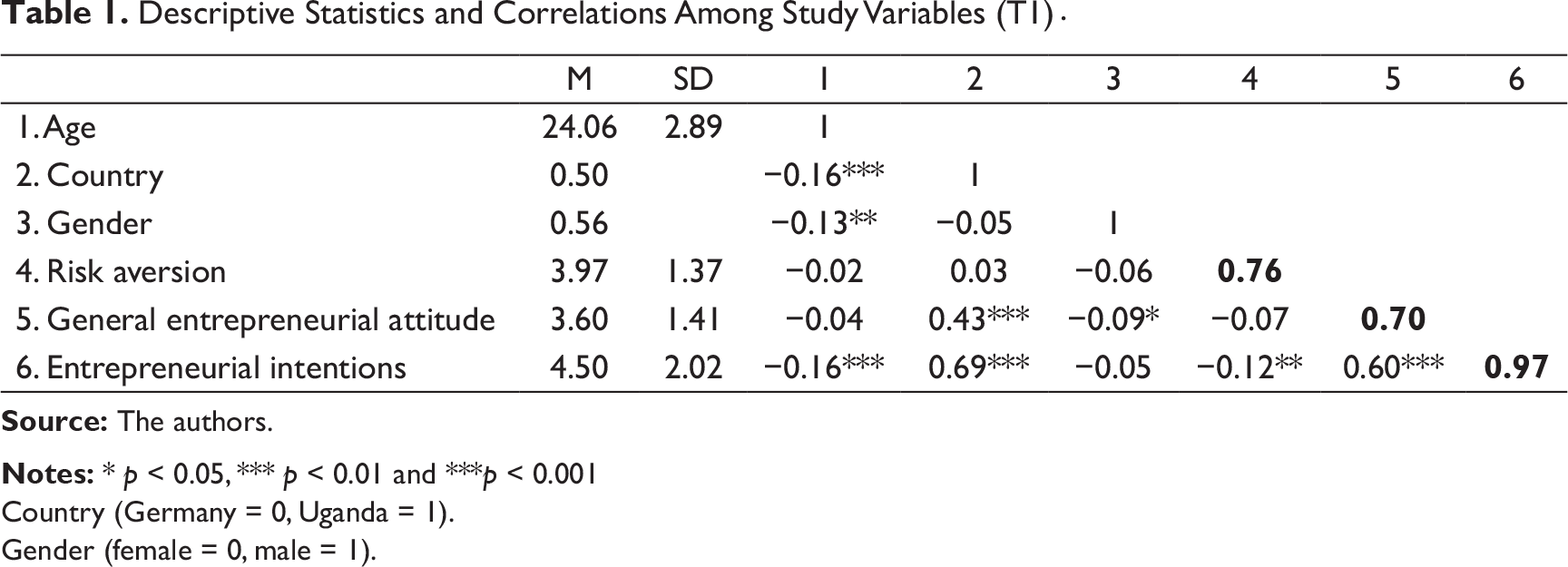
Country (Germany = 0, Uganda = 1).
Gender (female = 0, male = 1).
Moderated Mediation Regression Results for the Effects of Risk Aversion on Entrepreneurial Intention (T1).

Country (Germany = 0, Uganda = 1).
Gender (female = 0, male = 1).
Data Analysis Strategy
For study 1 (T1), we used the PROCESS Macro (Hayes, 2013, 2017) to test our hypotheses. Our conceptual model, Figure 1, indicates that we were interested in exploring the conditional direct and indirect effects of risk aversion on entrepreneurial intentions at T1, mediated by general entrepreneurial attitude and moderated by gender and country. To achieve this, we employed model 12 of the PROCESS Macro version 3.4 (Hayes, 2017), which tests for conditional and indirect effects with one mediator (general entrepreneurial attitude) and two moderators (gender and country) controlling for age. Sample bootstrapping at 5,000 was applied as recommended by Hayes (2013). We applied Harman’s single factor score to rule out the effect of common methods bias on our findings. The total variance of the single factor was 50 per cent, which is the threshold beyond which there would be a concern for common methods bias. However, this method has been criticised as insufficient (Chang et al., 2010; Podsakoff et al., 2003). Given the high correlations between some of the study variables, we tested for multicollinearity. The variance inflation factors ranged from 1.26 to 2.02, suggesting that there were no collinearity concerns in our data (Hair et al., 2011; Thompson et al., 2017).
Our conceptual model further shows that we were interested in investigating whether entrepreneurial intentions (at T1) and other factors (from T1 including risk aversion, gender and country differences) predict the likelihoods of being self-employed (at T2). To test these assumptions, we used multinomial logistic regressions in SPSS. We particularly examined whether these variables predicted the likelihoods of being in salaried employment or being employed or still enrolled in school against the likelihoods of being self-employed.
Results
The descriptive and correlational findings for the survey variables are presented in Table 1. We used the moderated mediation regression model to test our first three hypotheses, with risk aversion as the main predictor, general entrepreneurial attitude as the mediator, entrepreneurial intentions as the outcome and gender and country as the moderators. Our results indicate that the model substantially predicted general entrepreneurial attitudes (R2 = 0.22) and intentions (R2 = 0.62). The results show support for our hypotheses. First risk aversion had significant negative effects on both general entrepreneurial attitudes (B = −0.22, p < 0.01) and entrepreneurial intention (B = −0.19, p < 0.001), confirming H1 and H2a, respectively. Whereas we do not find substantial effects of gender, the effects of country were very strong for both general entrepreneurial attitudes (B = 1.20, p < 0.001) and intentions (B = 2.16, p < 0.001), suggesting country differences in entrepreneurial attitudes and entrepreneurial intention.
Multinomial Regression for Likelihood of Other Employment Statuses as Compared to Self-employment.
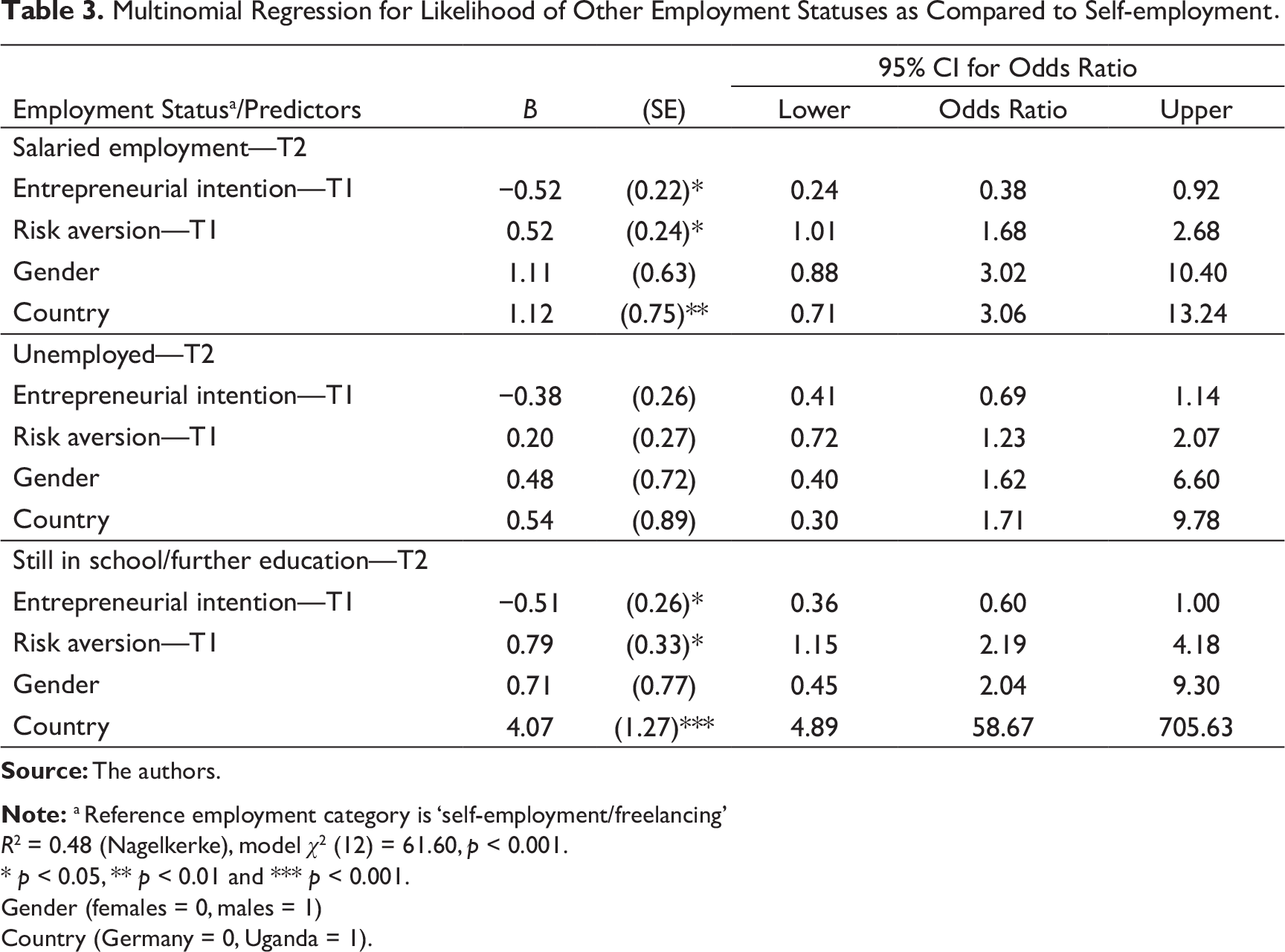
R2 = 0.48 (Nagelkerke), model χ2 (12) = 61.60, p < 0.001.
* p < 0.05, ** p < 0.01 and *** p < 0.001.
Gender (females = 0, males = 1)
Country (Germany = 0, Uganda = 1).
Our results also show substantial three-way moderation effects. Looking at gender alone, it had non-significant moderation effects on the relationship between risk aversion and both entrepreneurial attitudes and intentions. These results suggest that there are only marginal differences between male and female students in the effect of risk aversion on the outcomes. However, the three-way interaction results suggest that the moderation effects of gender on the relationship between risk aversion and general entrepreneurial attitude as well as intentions vary among countries. First, the results revealed significant moderation effects of country on the relationship between risk aversion and general entrepreneurial attitude (B = 0.26, p < 0.01), suggesting country differences in the effects of risk aversion on entrepreneurial attitude. The moderation effects of country on the relationship between risk aversion and entrepreneurial intention was nearly significant (B = 0.16, CI ≤ −0.001, 0.31).
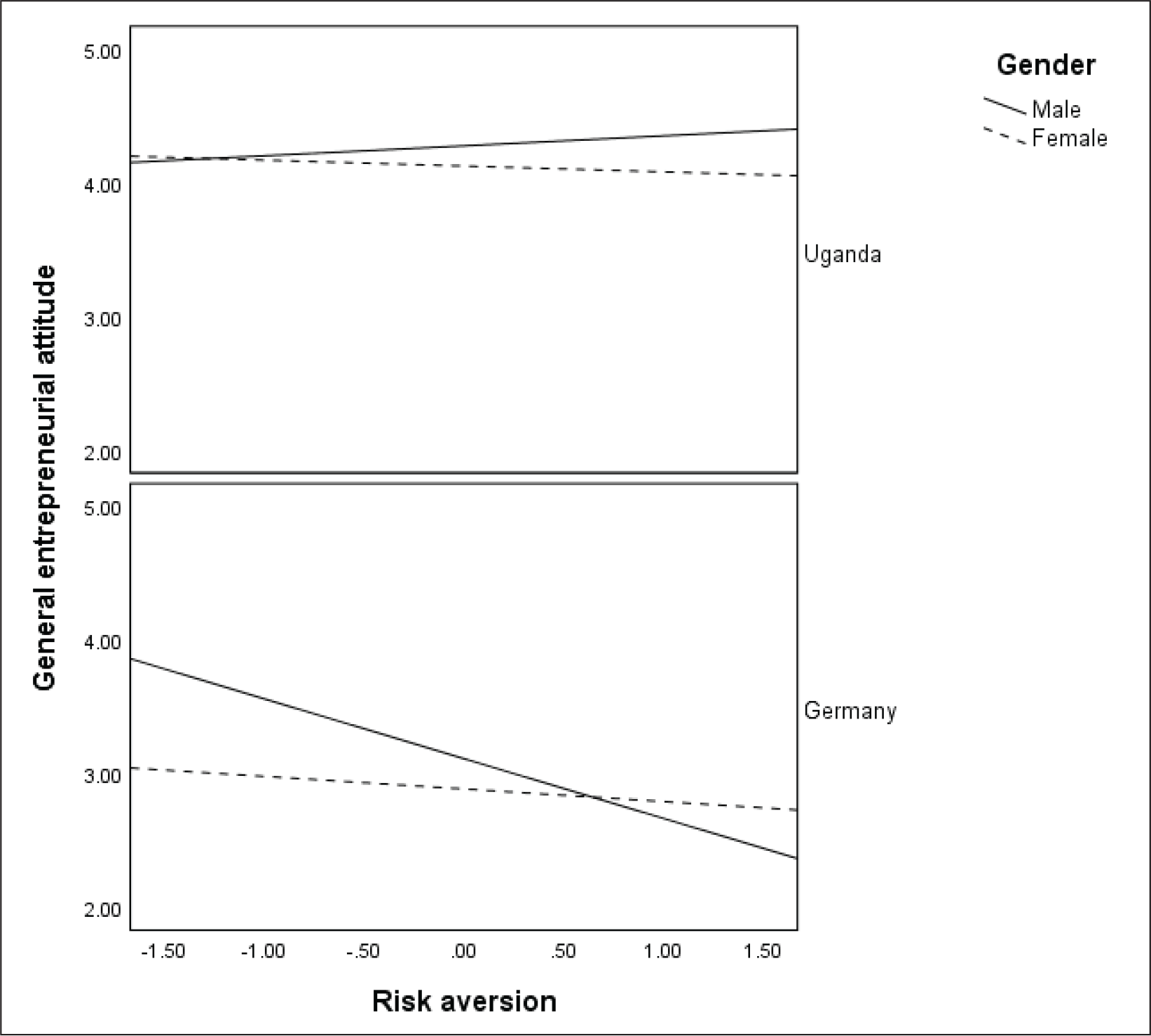
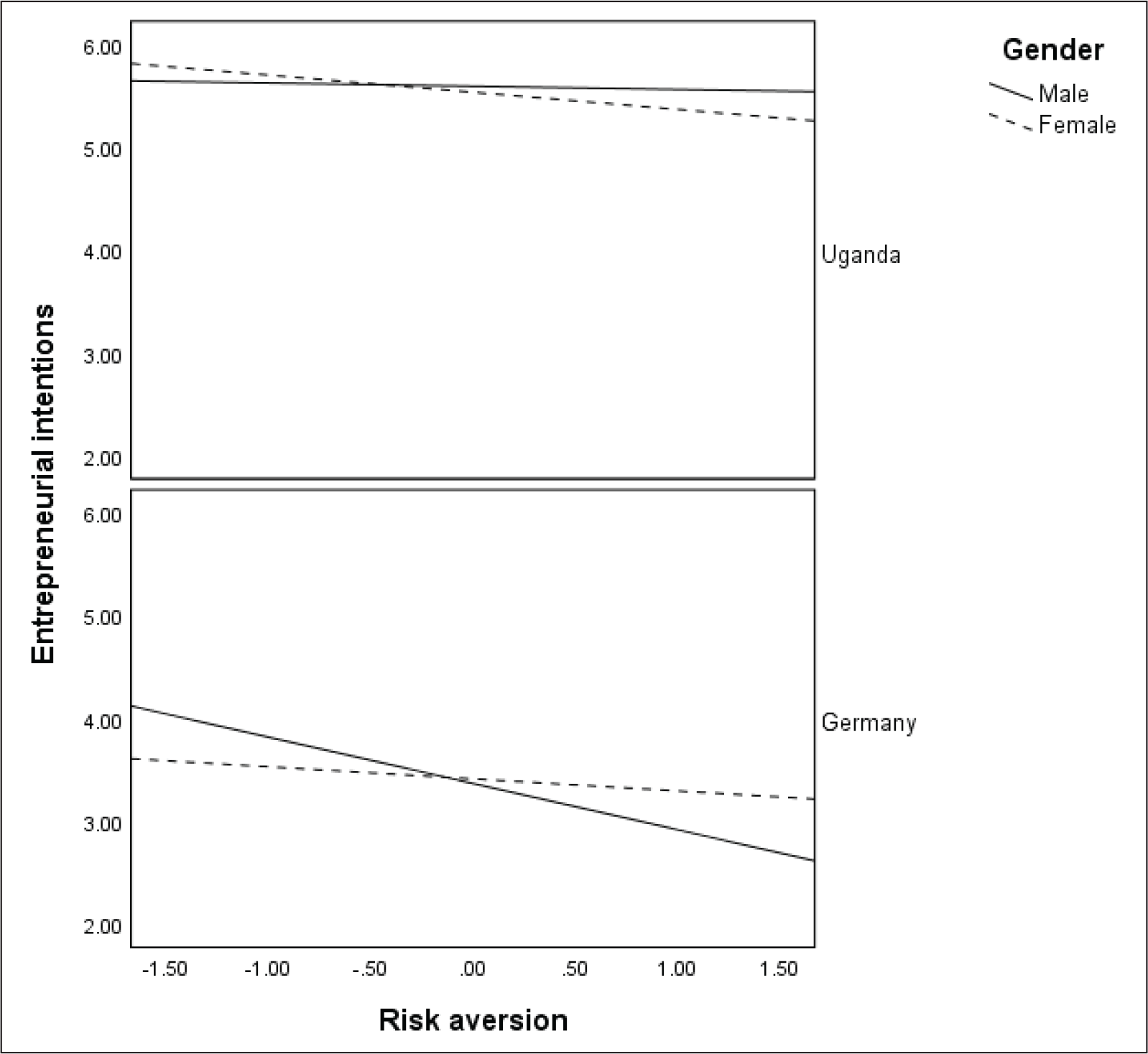
The three-way interaction effects (interaction of risk aversion, gender and country) were strong and similar for both general entrepreneurial attitude (B = 47, p < 0.01) and entrepreneurial intentions (B = 47, p < 0.01). These interaction effects resulted in significant changes in the explained variance of general entrepreneurial attitude (∆R2 = 0.01, p < 0.01) and entrepreneurial intention (∆R2 = 0.01, p < 0.01). Importantly, the effects of risk aversion on general entrepreneurial attitude and intention were similar and stronger for German male participants at B = −0.45, CI = −0.64, −0.26 and B = −0.45, CI = −0.65, −0.26, respectively. These findings confirm H3 and H3b. However, the effects on entrepreneurial intention were also significant for Ugandan female participants (B = −0.17, CI = −0.30, −0.04). The regression plots in Figure 2 show that the general entrepreneurial attitude for male students was higher than female students at high levels of risk aversion in Uganda. For German participants, however, the general entrepreneurial attitude for male students was substantially lower than for female students at high levels of risk aversion. A similar trend is observed for entrepreneurial intentions (Figure 3). The index of moderated mediation (index = −0.23, boot CI = −0.41, −0.06) confirms that gender and country moderated the indirect effects of risk aversion on entrepreneurial intentions via general entrepreneurial attitudes. Hence, H3c is also confirmed.
To test whether entrepreneurial intentions lead to entry into self-employment, we asked participants about their employment status at T2. We used multinomial logistic regression to examine the effects of intentions on the likelihoods of being self-employed in comparison to other employment statuses (employed in a salaried position, unemployed or still enrolled for further education). In the regression model, we added risk aversion, gender and country as possible predictors of the likelihoods of being self-employed as well. Our results support (Table 3) H4a, H4b and H4d, indicating that entrepreneurial intentions, risk aversion and country shape the likelihoods of being self-employed, in comparison with salaried employment or being enrolled in further education. However, the comparison with unemployment is not significant. It is also noted that risk aversion had negative effects while entrepreneurial intentions had positive effects on the likelihoods of being self-employed in comparison to likelihoods of being employed in a salaried position or being enrolled for further education. We did not find substantial effects of gender on the likelihoods of being self-employed; hence, H4c is not supported.
Discussion
Research on risk aversion or risk tolerance or risk attitude is prominent in the study of entrepreneurial personality, entrepreneurial culture and entrepreneurial attitudes. This article adds to the robust theoretical and empirical literature by investigating the differential impact of risk aversion on entrepreneurial attitudes and intentions among males and females in different geographical contexts (with varying cultures and levels of economic development). We further examine, basing on the assumptions of TPB (Ajzen, 1991, 2011; Tornikoski & Maalaoui, 2019), whether entrepreneurial intentions of students translate into entry into self-employment after graduation rather than being employed in a salaried position and the effects of risk aversion and context on the likelihoods of being self-employed.
Our findings confirm extant research that risk aversion is negatively associated with engagement in an entrepreneurial activity while risk-taking ability is associated with entrepreneurship (e.g., Boudreaux et al., 2017; Brachert et al., 2017; Douglas & Shepherd, 2002; Obschonka & Stuetzer, 2017; Sohn, 2017). Risk aversion negatively predicted general entrepreneurial attitude and intentions. Hence, a risk-taking ability seems to be an important requirement of prospecting entrepreneurs, which is also important in the process of manoeuvring through the entrepreneurial process (Koudstaal et al., 2016; Van Praag & Cramer, 2001). Because entrepreneurs earn residual income, their earnings are less secure and unstable, making it unappealing to the individuals with a high preference for certainty. Given that risk aversion is concerned with the evaluation of the consequences of success or of failure (Brockhaus, 1980), success in entrepreneurship is not guaranteed. On the contrary, failure and exit rates tend to be high among entrepreneurial start-ups (Artinger & Powell, 2016; Shinnar et al., 2018). The slim chances of success and insecurity of income diminish the general entrepreneurial attitude of people high on risk aversion who prefer certainty over uncertainty, consequently lowering their intentions to start their own business ventures.
Given that the context has been theorised to be important to understand entrepreneurship and entrepreneurial behaviour (Shepherd et al., 2019; Welter, 2011), we posited that the effects of risk aversion could be dependent on the context (in terms of country and gender differences). Our results revealed substantial country differences in the effect of risk aversion on general entrepreneurial attitudes and entrepreneurial intention. The positive effects of country signify that Ugandan students reported higher general entrepreneurial attitudes and intentions than their German counterparts. Similarly, the positive moderation effects of country also signify that risk aversion has stronger negative effects on general entrepreneurial attitude in Germany than in Uganda. A closer look at the additional plots in Appendix A indicates that risk aversion had minimal effects on entrepreneurial attitudes and intentions among Ugandan participants.
These findings highlight the role of two contextual aspects as already highlighted in the literature review. One possible explanation is the economic context. Germany is one of the developed countries with extremely low unemployment rates (Dietrich & Möller, 2016), implying employment is guaranteed for most graduates. In such context, only those with exceptional passion for entrepreneurship may have the intention to start their own business. On the contrary, Uganda is one of the less developed countries with high unemployment rates (Lakuma et al., 2016; Magelah & Ntambirweki-Karugonjo, 2014). In such circumstances, self-employment is the most available employment alternative and solution to unemployment (Baluku et al., 2019; Chigunta, 2017; Vogel, 2015a). Hence, regardless of the level of risk aversion, individuals are pulled into liking self-employment and consequently establishing their own businesses. This could explain why most of business owners in such contexts are necessity entrepreneurs (Langevang et al., 2012). Such labour market conditions have been found to make entrepreneurship a very important form of work for certain populations (Falco & Haywood, 2016; Lofstrom, 2004, 2013; Vogel, 2015a). The second possible explanation for these country differences in the effects of risk aversion could be the differences in culture. Germany tends to be high on uncertainty and risk avoidance (Reimann et al., 2008), suggesting a high level of risk aversion. In the context of good odds in the labour market, risk aversion should affect entrepreneurial attitudes and intentions substantially.
Our findings revealed no substantial gender differences in the effects of risk aversion on entrepreneurial attitudes and intention. However, considering the combined impact of gender and country, we found that risk aversion had strong negative effects on the general entrepreneurial attitudes; and intentions among German male students were lower than those for their female and Ugandan counterparts. Previous research indicated that women tend to be generally more risk-averse than men (Eckel & Grossman, 2008; Hartog et al., 2002; Jianakoplos & Bernasek, 1998); hence, it was expected that their entrepreneurial attitude and intention would be lower than for men at high levels of risk aversion. This was found not to be true in the present study, particularly for German participants. Concerning entrepreneurial intention, we found that risk aversion had significant negative effects for German males and Ugandan females; that is, at high levels of risk aversion, Ugandan women and German men would exhibit low entrepreneurial intentions. For the German males, this finding is not surprising given the high level of uncertainty avoidance (Reimann et al., 2008) that increases sensitivity to risk. Germany also has low unemployment rates (Dietrich & Möller, 2016) implying existence of alternatives to self-employment. The substantial negative effects of risk aversion on entrepreneurial intentions of Ugandan females, yet the same effects are not observed among males, may be indicative of the fear women may have in investing their small resources in an uncertain business environment even when self-employment is the most available employment option. It is also possible that there are deeper underlying gender dynamics rooted in culture that are at play in the entrepreneurial processes for women.
Given these interesting gender and cross-country differences, it would be interesting for future research to employ qualitative techniques to discover why female students in Germany have a stronger entrepreneurial attitude and intention than their male counterparts at high levels of risk aversion. In the direction of our findings, Maxfield et al. (2010) argued that women’s risk-taking potency and behaviour is rather invisible. Hence, it is possible that in some contexts, women may (even) have a higher preference for risk than men.
Congruent to the central assumption of TPB that intention precedes behaviour (Ajzen, 1991; Tornikoski & Maalaoui, 2019), the study further aimed at establishing whether entrepreneurial attitudes predict the likelihoods of being self-employed. We compared the likelihoods of being self-employed to the likelihoods of being in salaried employment, being unemployed and being enrolled in further education. The assumption that intentions predict likelihoods of being self-employed was confirmed. Hence, our study reaffirms previous findings, indicating that intentions predict large variances in entrepreneurial behaviour (e.g., Baluku et al., 2019; Kautonen et al., 2015; Neneh, 2019; Shinnar et al., 2018; Shirokova et al., 2016). In addition, our findings reveal that risk aversion is negatively associated with likelihoods of being self-employed after graduating from university. As highlighted in the literature, risk-averse individuals may prefer the certainty of income that is associated with salaried employment (Di Mauro & Musumeci, 2011). We also found substantial country differences in the likelihoods of being self-employed, but gender differences were not significant.
The significant cross-country differences in likelihoods of being self-employed again reflect the impact of the economic context, especially the labour market dynamics in a given country. Our findings reveal that chances of being self-employed after graduating from university are higher in Uganda graduates, where there are high levels of unemployment indicating fewer chances of succeeding in finding a salaried job. On a closer look at the odds of self-employment in relation to likelihoods of being unemployed, our findings suggest that there is a high number of graduates in Uganda with high entrepreneurial intentions, yet they remain unemployed. This could particularly be because they lack start-up capital (Baluku et al., 2019). The finding that odds of being self-employed are not influenced by gender contradicts the findings of Shinnar et al. (2018) that men are more likely to implement their intentions. This calls for further research into the conditions that facilitate the implementation of intentions for both men and women.
Limitations
There are a number of limitations of our study that should be taken into consideration when applying our findings. However, some of the limitations provide directions for future studies on the subject of entrepreneurial intentions and actions. First, our study involved a comparison of Germany and Uganda. Thus, only one developed country and one less developed country were considered. This does not provide robust comparisons between developed and less developed countries in regard to the role of gender differences in the effect of risk aversion on entrepreneurial attitudes and intentions. In line with the suggestion of Shinnar et al. (2018), future research should include a good number of countries to provide a bigger picture of how the impact of risk on entrepreneurial attitudes and intentions varies in the context of developed versus less developed countries, and the role of gender in these relationships.
Second, our study investigates the movement from intentions to entry into self-employment after graduation focusing on the contribution of risk aversion, gender and country differences. However, the sample size in the follow-up study (T2) was too small to allow for the analysis of the moderating effects of these variables. Hence, we only tested for their linear associations with likelihoods of being self-employed. We believe that a study establishing the moderating effects of these factors would be important for theory and practice. Again, a multicountry study with relatively large samples at both measurement points would be helpful in this direction. Another challenge with our longitudinal data is that we conducted the follow-up survey 6–24 months after graduation. Given that the implementation of entrepreneurial intentions requires time, the association between intentions and entry is best predicted after a long period of time (Liñán & Fayolle, 2015). It has also been noted that there are high number of exits immediately after start-up (Shinnar et al., 2018). We did not consider that some of the participants who were unemployed or in salaried employment could have tried self-employment and exited within the duration between T1 and T2. This also has implications for the association between intentions as well as other predictor variables and self-employment entry. Therefore, future studies could consider the impact of such dynamics when studying the link between entrepreneurial intentions and behaviour.
Theoretical and Practical Implications
Our study has a number of implications for entrepreneurship theory and practice. First, our study contributes to the application of TPB not only in explaining intentions but also in understanding the link between entrepreneurial intentions and entry. Understanding the link between intentions and behaviour is one of the major gaps in entrepreneurial intentions research (Liñán & Fayolle, 2015; Nabi et al., 2017). Recently, researchers have started to address this gap (e.g., Adam & Fayolle, 2015; Baluku et al., 2019; Kautonen et al., 2013, 2015; Shinnar et al., 2018; van Gelderen et al., 2018). More research efforts are needed in this direction to further the understanding of underlying mechanisms and factors that influence or trigger the moment from intentions to entry into self-employment. Our study also makes a contribution to the understanding of the association between risk aversion and entrepreneurial attitudes and intentions by examining gender and country differences. However, further research is needed to generate a wider understanding of how the effects of risk aversion at different stages of the start-up process vary among different populations and contexts.
In practical terms, the results of our study show that gender matters in understanding the role of risk aversion or risk tolerance in the entrepreneurship process. This is important for designing interventions to promote entrepreneurship; for example, training content for enhancing risk-taking behaviour should be tailored to the specific context of the target group. In addition, by showing that risk aversion matters at the stages of attitude formation, intention development and action, the study findings suggest that interventions targeted for any of these phases should include paying attention to risk-taking ability and behaviour of the target groups. Moreover, it could be necessary that risk-taking ability enhancement interventions to take care of the unique needs of women in a given cultural and economic context. Whereas intentions predict behaviour, it is not automatic that behaviour will follow intentions (Tornikoski & Maalaoui, 2019). Therefore, it is important not only to focus on interventions aimed at increasing entrepreneurial intentions but also on strengthening the implementation intention and potential for actual action. In places like Uganda where entrepreneurial potential and intentions are already high (Baluku et al., 2019), interventions focusing on the implementation of intentions can achieve better outcomes than focusing on enhancing intentions. Again, such interventions should be tailored to the specific group context.
Conclusion
The study moves beyond the collinear effects of risk aversion on entrepreneurial intentions by examining its indirect as well as conditional direct and conditional indirect effects. In addition, the study attempts to explain the influence of intentions, risk aversion, gender and country differences on odds of going into self-employment after graduating from university. Our findings indicate substantial three-way interaction effects of risk aversion, gender and country on both entrepreneurial attitudes and intentions. Moreover, the indirect effects via general entrepreneurial attitudes are also conditioned by gender and country. Although risk aversion is generally associated with lower entrepreneurial attitudes and intentions, we find that intentions remain high even at high levels of risk aversion for Ugandan students, especially for males. On the contrary, entrepreneurial attitudes and intentions tend to be significantly lower for German students at higher level of risk aversion. Surprisingly, at a high level of risk aversion, male German students reported lower intentions than their female counterparts. The factors underlying these dynamics need to be explored. Although we were not able to replicate the impact of gender when it comes to the link between entrepreneurial intentions and entry into self-employment, we do find country differences in the likelihoods of being self-employed. Studying the contextual influences on the relationship between entrepreneurial intentions and entry, however, requires further attention.
Footnotes
Declaration of Conflicting Interests
Funding
The authors received no financial support for the research, authorship and/or publication of this article.