



Abstract
In the wave of globalisation and the neo-classical economic doctrine of ‘market expansion and state compression’, the footprints of women street entrepreneurs are fast disappearing from our economy. The women street entrepreneurship provided a wonderful opportunity for inclusive growth narratives in rural areas among the economically and socially challenged sections. The advent liberalisation–privatisation–globalisation (LPG) process robbed even the public space available to the women street entrepreneurs in Goa 1 especially, the women and their death-knell became louder and clearer with every passing day.
Introduction
The globalisation process guided by the neo-classical eco- nomic philosophy of ‘market expansion and state compression’ is slowly impacting the footfalls of street entrepreneurs in our economy. The street entrepreneurship provided a wonderful ecosystem for inclusive growth narratives especially among the economically and socially challenged sections. The advent liberalisation–privatisation–globalisation (LPG) process along with the financialisaton’(Foster, 2007) and ‘Doughnut Economy’(Raworth, 2017) robbed the public space available to street entrepreneurs in India especially, the women. Even in Goa, the death-knell of such business model is becoming became louder and clearer with every passing day.
Goa is an Indian state with outstanding socio-economic and demographic indices. The Raghuram Rajan expert committee (Rajan et al., 2013) developed ‘Composite Development Index’ 2 (CDI) for identifying the backwardness of states, which has placed Goa as the highly developed state with a score of 0.045 on the underdevelopment/need index. The Eleventh Finance Commission ranked Goa as the leading state with respect to social and economic infrastructure (Finance Commission, 2005). The India Human Development Report 3 calculated the Human Development Index. Goa was ranked fourth with HDI value of 0.617 (Gandhi, 2011).
Many of the street entrepreneurs belong to the category of survivalist enterprises (Berner et al., 2012) because their activity fails to generate sufficient earning for decent standard of living, constantly harassed and evicted by public authorities, minimal capital assets and investment, no special skilling and training, doing business out of makeshift arrangements, no facilities for meeting basic human needs, dealing with customers with over specialised expertise in bargaining and so on. Many a time the temporary public space acquired by them for their sales bottlenecks their scale of business and the level of investment (De Soto, 1989). The scene is mostly dominated by women street entrepreneurs and such entrepreneurships are poverty induced. The massive protests, debates and court litigations and Supreme Court judgements resulted in the enactment of Street Vendors Act, 2014 (Kumar, 2014). The ultimate objective of the Act was to regulate and safeguard the interest of street vendors and their private usage of public places like roads. According to the Act, a street vendor refers to those selling goods of everyday usage and services to citizens on roads, footpaths, streets or other open private or public spaces with high footfalls from makeshift temporary structures. 4
It is estimated that 10 million people in India eke their livelihood from street entrepreneurship which works out to be 2% of urban population (Bhowmik, 2005; Chandra & Jain, 2015). Street vending entrepreneurs are a very convenient way of being self-employed on a boot strap budget. In Mumbai alone, the city corporation annually collects about ₹12 crore as license fee (Sharma, 2000). According to the report of NCEUS, 75% of self-employed belongs to economically and socially disadvantaged sections (NCEUS, & Academic Foundation, 2008). Out of the total vendors, 40% are women and about 30% of them are the only source for sustaining the family 5 (Singh & Gupta, 2011). Large number of women street vendors sells local fruits vegetables and flowers which are highly putrescible (Channamma & Mutharayappa, 2018).
The ensuring of ‘decent work’ (Somavia & General, 1999) for street entrepreneurs will enhance their productivity, standard of living and will upscale their quality of life. Once the citizens accept street entrepreneurs as beneficial segment of their neighbourhood, they will command respect, enjoy equality and will become part and parcel of socio-economic life the local catchment society (Sharma, 2016).
An entrepreneur with his/her risk-taking appetite will venture into activities which lead either to maximisation or minimisation of their business goals under conditions of constraint optimisation. The street vendors are basically entrepreneurs who undertake risk in a very hostile environment with a bootstrap budget either to protect his/her family from the vicious circle of poverty or to ensure that his/her family slips into the poverty trap. Hence, in the present study, we have designated street vendors as street entrepreneurs.
The street entrepreneurs play an important role in the informal livelihood dynamics in Goa’s highly urbanised ecosystem. According to Bhowmik, urban public spaces are very valuable for the self-employed entrepreneurs in seeking a livelihood in emerging economies like India (Bhowmik, 2012). The same national scenario is also true with regards to Goa.
As in other cities and towns, informal street entrepreneurs and their informal economy are also found in the urban landscape of Goa. Even in Goa, the females dominate the street vegetable and flower enterprises. According to the Street Vendors Act Compliance Index (SVACI), Goa is ranked 11th with a score of 48.42 whereas Delhi tops the list with the score of 71.00 (Narang & Yugank, 2017). The Ministry of Housing and Urban Affairs (MoHUA) has reworked SVACI ranking and placed Goa at 16th position.
Objectives
The objectives of this study are as follows:
Identify the sustainability challenges of street vegetable and flower entrepreneurs Construct a sustainability index model based on the factors affecting sustainability Identify geospatial clusters of selling location of street vegetable and flower entrepreneurs List the areas for state intervention for improving their ease of doing business
Literature Review
There are no major research studies on the sustainability challenges of street vegetable and flower entrepreneurs, construction of their sustainability index model and their geo-spatial selling clusters. El Fayoumi (2017), in his study, argues for the rehabilitation of street vendors in public places and squares through a properly executed plan rather than merely evicting them. The author used Google Earth Screen shots to depict the situation before and after eviction from Ramsen Square. The present study has used a GPS-based software to identify geo-spatial selling destinations of street vegetable and flower entrepreneurs in Goa.
Channamma and Mutharayappa (2018), in their study, identify the factors influencing the women street vendors in Bangalore city. The study also makes suggested ways and means to improve their ease of doing business.
Methodology
A survey was conducted on a sample of 277 women street entrepreneurs selling fruits, vegetables and flower grown locally in Goa. As most of them are illiterate and not tech- savvy the survey was conducted by personally visiting and interacting with them. The interactions were held in Konkani language.
The survey is aimed to inquire about the reason to opt the business, their place of stay, assets they possess, the type of cultivations, the crop seasons, details about sources of seeds, manure, water supply, the difficulties encountered by them, their requirements for increasing profitability and so on.
Major Findings and Observations
Reasons for Being into Business
It was observed that almost all the street entrepreneurs selling vegetables and fruits opted for this business as their means of livelihood. Whereas those selling flowers cited two reasons: first as a means of livelihood and second to have some extra income due to easy availability of flowers and time.
Place of Selling
More than 98% of the street entrepreneurs were observed to display the items for selling on the sides of roads joining major towns in Goa. Flower vendors were found along the highway joining Margao and Ponda in Borim village and along the highway joining Margao and Panaji in Cortalim village before on the approach road to Zuari bridge.
The selling places are categorised into two types. The first selling place is within their village or within the locality and the second selling place is outside their village/locality. The street entrepreneurs selling within their village have their locations fixed.
It was observed that the street entrepreneurs selling outside their village had problems in identifying and moreover using the place to display their items. Some even mentioned that they were required to pay fees to authorities in order to display and sell their items. Most of them could not afford it. Their display of items was considered illegal. As a result of which their items were confiscated by the local authorities. The state of these confiscated items was not known thereafter. While this problem was not encountered by vendors selling in their own village/locality.
It was also observed that the authorities were collecting unauthorised fine in terms of cash and items to escape from the eviction.
Assets
The street entrepreneurs had no sophisticated assets. All the vendors were having a bag to carry their items and belongings, a plastic sheet to lay the items. The street entrepreneurs selling in their locality had a temporary shed made out from wood and plastic as their locations are fixed.
The display and presentation of items by some women street entrepreneurs is shown in Figure 1.
Challenges and Requirements for Increasing Profitability
The study discovered the following challenges faced by the women street entrepreneurs.
The major challenge faced by the women street entrepreneurs is the availability of place to display their items for selling. Although they were observed to be selling their item at locations identified by them, they always had a fear that the authorities would seize their items as selling of items in such places is illegal. The fear of their items getting seized prevented many women street entrepreneurs from selling their items outside their villages. Besides this, the other reason which prevents the entrepreneurs from selling their items in outside villages is the inability to pay the transportation and travelling costs. As far as the prices are concerned, there is no system to decide the standard price of the items across the state. In fact, it was observed that prices of same items vary according to time and location. The repercussion being very low-priced items do not yield any profit to them, whereas high prices prevent customers form buying their items. Both the situations are detrimental to their sustenance. Perishable items pose a huge challenge to the street entrepreneurs. The vendors are forced to discard highly perishable items. The items are either wasted or the street entrepreneurs are forced to sell them at very low prices causing a distress sale. The study reveals that customers are quick enough to learn this fact about perishable items and wisely approach the street entrepreneurs to buy the items at the time when the they have no option but to sell them at low prices less the perishable items are wasted.
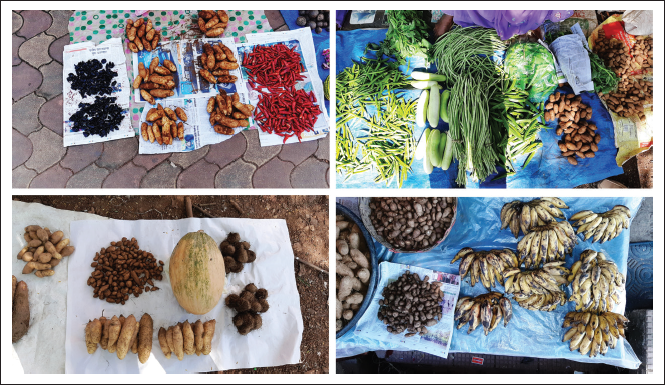
Flower Vending Women Street Entrepreneurs
The observations about flower selling women street entrepreneurs are a bit different than the other two. Most of them chose this profession not for livelihood but to earn extra money. The flowers were sold in two different periods
It was interesting to note that women street entrepreneurs are hardly seen at these two locations from November to February, as this is the time for the Church Feasts and Temple Zatras 6 and they prefer selling flowers at the Feast and Zatra venues.
Other Observations
Almost all the women street entrepreneurs used organic manure to grow their crops due to two reasons. First reason is that they could not afford fertilisers. Second reason is that they were also aware of the fact that customers prefer to buy their items because they are organically grown. Not only in the year. The first period is March–May, during which they sold Jasmine flowers, locally known as Mogra.
The second period is from July to October, during which they sold Spanish Jasmine flowers, locally known as Zaayo. Both flowers are sold as neatly woven string. In both cases, the flowers are locally grown, and their customers are ladies applying these flowers on their hairs. These entrepreneurs are observed to sell their flowers at two prominent locations: Borim village and Cortalim village.
The sellers in Borim village are locals of Borim while the ones in Cortalim are from Madkai, Durbhaat, Gaunem, Talaulim and Kundaim villages in Ponda Taluka. The vendors in Cortalim prefer the location because of available customers, primarily the travellers on National Highway 66, and the availability of free ferry service from the local places to Cortalim.
Sustainability Index Model for Women Street Entrepreneurs
The entrepreneurs were asked to mention the factors which affect their sustainability in this profession. It was observed that sustainability in the profession was directly proportional to profitability. Hence the sustainability model presented in this study is based also on the factors which affect the profitability of the business.
Normalisation of Weights of Factors
Normalised Weights of Factors Affecting Sustainability Weight Value.

Let the factors—land availability, transport service, promotion, standard pricing and storage facilities—be denoted as l, t, p, sp and sf, respectively. These factors can be assigned either value 1 if is it available and 0 otherwise.
Let wl, w
t
, w
p
, w
sp
and w
sf
denote the weights of the factors denoted by their respective suffices. For each factor, the observed weight w
f
is normalised

where w fn is the normalised weight for the weight w f .
Applying Equation 1 to all the factors, the normalised weights of the factors are displayed in Table 1.
Sustainability Index Model
Let the Sustainability Index be denoted as SI. Let F = {f
i
/fi is a factor affecting Sustainability Index} and {W = wi/wi is the normalized weight of factor fi}. In general, for n number of factors, we describe Sustainability Model using the expression

The model in Equation 2 is applicable to n factors. According to this study, the numbers of factors applicable to the local entrepreneurs in Goa is 5. Applying the model in Equation 2 to the factors considered in this study, the resultant model for sustainability index is given as

Substituting the values of the weights as described in Table 1 in Equation 3 the resultant expression is

The variables in Equation 4 can take values 1, if the factors are available/present, and 0, otherwise.
The model described in Equation 4 can be used to find out the sustainability index of women street entrepreneurs individually, as a cluster (market) or as the entire state.
Geo-tagging of Selling Locations
The locations of all the women street entrepreneurs under study are geo-tagged using a GPS software. 7
The benefits of geo-tagging the locations is to help consumers, especially the tourists, to identify the locations where local items are available.
To the best of our knowledge, this is the first kind of study done on local entrepreneurs. The geo-tagged data will be useful to researchers especially from outside Goa.
The screenshots of the geo-tagged locations are shown in Figures 3–7.
An algorithm was executed on the locations to identify clusters as shown in figures. There are 29 clusters identified. 8 A snapshot of the cluster locations identified along the highway joining Margao and Sanvordem towns is shown in the Figure 2.


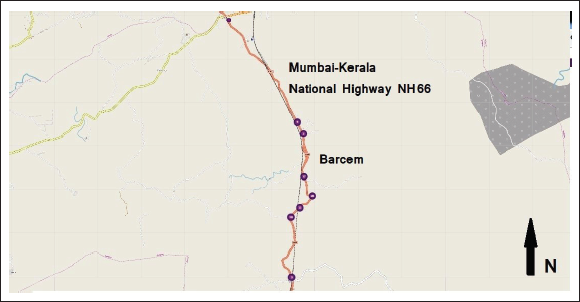

The obtained clusters can be used to identify locations which may be allotted as places for selling the items to the women street entrepreneurs belonging to the clusters.
Recommendations
Based on the study the following recommendations are suggested:
The Horticulture Corporation of Goa should have some facility to procure the vegetables from local women entrepreneurs and sell them. This will reduce the efforts required in the travelling and identifying places for selling. As a part of their CSR activities, the corporate sector can help the self-help groups of women vegetable and fruit street entrepreneurs in expanding their market. In all the government colleges a provision can be made to open outlets through students consumer co-operative stores for creating a market for the local entrepreneurs. The local entrepreneurs selling their products outside their villages can be given travel vouchers which they can use for meeting the travelling expenses. A state-level database can be created to register the local street entrepreneurs. The self-help groups of street entrepreneurs can be supported to take up contract farming of vegetables and fruits to reduce the dependence on other states which will scale up organic farming in the state. The local street entrepreneurs should be provided with training in storage, grading, packaging and marketing of their item. Collaboration with academia and government departments to up-skill the expertise in organic farming. The clusters identified in this study may be used to identify the market locations
9
by the state government for making necessary interventions. The marketplaces to be provided at the cluster locations should have basic facilities such as shed, civic amenities, drinking water and so on. Government departments and NGOs can be roped in to promote locally available vegetables and fruits along with the benefits of their nutritional value and taste.
Conclusion
The study identified 277 women street entrepreneurs selling locally grown vegetables and flowers in 29 clusters. The study identified the factors influencing the sustainability of women street entrepreneurs and developed a model to measure the sustainability index.
The study also involved geo-tagging of locations of the street entrepreneurs across the state of Goa for improving the ease of state intervention. Minor state interventions can ensure that these entrepreneurs do not slip down below the poverty line, thereby ensuring the achieving the Sustainable Development Goals.
