



Abstract
Abstract
This article examines the dimensions of land acquisition with respect to establishment of economic zones across India. The enactment of Special Economic Zone (SEZ) Act 2005 allows the government to transfer the land acquired for public purpose under the Land Acquisition Act to the private companies for development. For private firms, land turning into most significant incentive for being part of SEZ scheme and profit maximization. It has been observed that large part of acquired land ends up in the hands of the real estate companies rather than intended productive sectors of industry and infrastructure. Land is the principal source of livelihood in an agrarian economy. Forcible acquisition and transfer of land to corporates leads to large-scale unemployment and displacement, especially when large part of tract remains unutilized. It raises many questions on objective and process of establishment of SEZs. The absence of land use the policy is primarily culprit for faulty diversion of land agriculture along with underutilization of available land. The extreme nature of these SEZs needs to be analyzed through proper policy making.
Introduction
Land, the basic and long-lasting source for production as well as for human inhabitation, is one of the most disputed issues in the public policies in India. Decisions concerning land allocation and land use pattern comprise diverse array of issues that can go beyond the considerations of economic growth. The matter of land use is predominantly important due to large agrarian population in economies such as India, where access to land, in absence of alternative employment-income opportunities and social security, provide economic security, and therefore, is rendered high in terms of social status (Bhagwati & Panagariya, 2013; Patnaik, 2008). Ideally, diversion of land from agricultural to non-agricultural sectors should be preceded by a considerable shift of workforce and local population (National Commission to Review the Working of the Constitution, 2001; Shah, Nandani, & Joshi, 2012). In the absence such provision, diversion to non-agriculture use is most likely to invite resistance from farmers and local communities.
The situation gets further stressed when the government, being a custodian of land, tends to play the role of a trader as it has come out from the real on ground practices under the Land Acquisition Act (LAA) LAA has been used to take away the land for public use without the owner’s consent has been practiced since the colonial rule. Growing spatial inequality with economic growth same time only few livelihood opportunities for the rural poor likely to turn issue of land more concerning (Pasinetti, 1981).
The enactment of Special Economic Zone (SEZ) Act 2005 goes a few steps ahead by allowing the government to transfer the land acquired for public purpose under LAA to the private companies for development. Application of LAA to acquire land often go along with various kinds of pressure tactics by the corporate and by the state to get consent of the land owner, because of the low bargaining power of the later. It has been observed that the process of land acquisition and conversion of agricultural land reflects failure of the state and the market; in fact largely both of these form a nexus to indulge in “primitive accumulation” by the state (Chandrashekhar, 2006; Patnaik, 2008).
Question is being asked on processes of obtaining the land rather than the need of acquiring agricultural to promote industrial economic activities such as manufacturing units and infrastructure (Shah et al., 2012; World Bank, 2008). It is also evident from the experience that ambiguous implementation processes generally result in diversion of large tract of land, often more fertile, than what is actually required. It has been also observed that large part of acquired land ends up in the hands of the real estate companies rather than intended productive sectors of industry and infrastructure. The absence of inclusive land use, the policy and federal structure of governance where land is primarily a state subject has been the main culprit for faulty conversion or diversion of land from the agricultural and allied sector. The most critical issue is that of the nexus between the state and the private sector (Patnaik, 2008).
Objective of the article is to assess the SEZ inspired land acquisition and utilization pattern to evaluate that the gravity of issue. This article is based on literature review and analysis of secondary data and information. Data have been collected from reports of the Government of India, international agencies, and journals with repute.
Special Economic Zone, Land Acquisition, and Dynamics
The socio-legal issues of land with dimensions such as acquisition, displacement, resettlement and rehabilitation, and compensation2 have been the complex subject to deal with. Same time real estate development and land speculation has been the threat along with apprehension that already established units from other parts of country may move to SEZ to take advantage of taxation policy and incentives will result in loss of income and rise in regional inequality (Kurian, 2000; World Bank, 2008).
Gifting the thousands of acres of valuable land to developers in insignificant amount to conduct business by relaxing the laws of the land, including those meant for welfare of labor, environmental protection, taxation, and so on, in the hope that it will automatically encourage industrialization and solve the prevailing problem of unemployment.
It has been extensively reported that the farmers are protesting against the forced acquisition of agricultural land in the name of public purposes. Farmers and peasants in various states such as West Bengal, Uttar Pradesh, Maharashtra, Uttarakhand, Odhisa, Punjab, and many more have opposed to the land acquisition for establishment of SEZ is a major growing issue across the country (Aggarwal, 2006; Ghosh, 2006). Literature also suggests that the establishment of SEZs countrywide may lead to livelihood losses for farmers and dependent. In reality little job may be created as use of advanced technology can impact negatively (Aggarwal, 2006).
Land is the principal source of livelihood in any agrarian economy. Land acquisition via LAA has become the most obvious medium for forcible acquisition and then transfer of resources from average and poor people to private business corporations could destroy livelihood and lead to large-scale displacement of local population. In this kind of developmental process, always the beneficiaries are the big corporations and losers are the ordinary people and farmer community dependent to land in several ways, the peasants and tenants, agricultural laborers, tribals, and fishing community.
SEZ is fast becoming and representing the most outrageous symbol of pro-corporate, anti-people, anti-labor establishment as model of industrialization (Banerjee, 2006; Nielsen, 2010; Roy, 2007; Shah et al., 2012). Suppression from government and corporate houses has created a perception that only popular and mass resistance could make the government to re-think and to have a moderate stand in this regard. Difference between acquisition of land for setting up production industry, and land for mining is very little, so far it is evident that due to inadequate industrial policy and land reform has led to destruction of social auditing, people’s livelihoods and displacement (Banerjee, 2006; Patnaik, 2008).
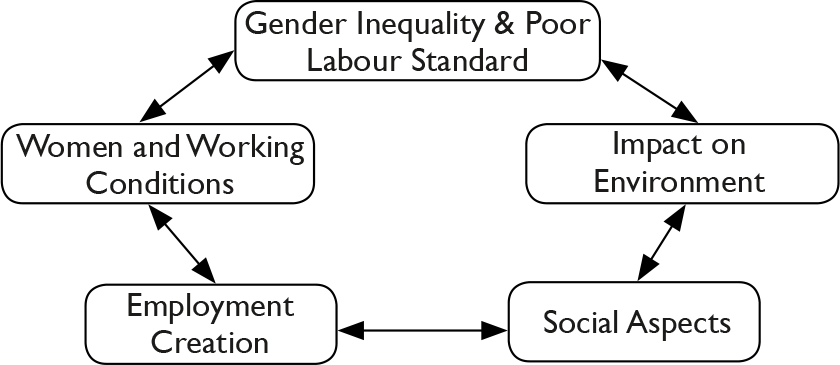
To understand the impact of SEZ on society and environment following Figure 1 reflects the five different types of impact SEZ can cause at various level and how all these effects are interacting with each other and creating overall impact.
Criticality of the situation can be understood from that fact that SEZs regulations and guidelines say that a multi-product SEZ is needed to have 1,000 hectares while the single product SEZ can be established in as little 100 hectares of land. Thus, SEZs may incorporate a single manufacturing unit, or a cluster of multi-product industrial units. Guidelines also suggest that 35 percent of land have to be assigned for the industrial or processing purposes; rest of land can be used for housing purpose, services, institutions, parks, and so on. Only units approved under the SEZ scheme are to establish units in premises of SEZ (Department of Commerce, GoI, 2015). The question is that from where land will come for hundreds (more than 500) of SEZ are being established and in future many more to come with requirement of unprecedented amount of land across India.
There are guidelines by the central government to the state governments for peaceful land acquisition process for setting up of SEZs, the first targeted land for acquisition should be of waste and barren and, if necessary, single-crop agricultural land could be acquired for the SEZs through lawful acquisition machinery but forceful land acquisition is reality. It has been said that only if essential, than a portion of double-cropped agricultural land can to be taken to fulfill the minimum land requirements, especially for the setting up of multi-product SEZ, and acquired land area should not be more than 10 percent of the total land required for the establishment of SEZ (Dev, 2008).
The Supreme Court (SC) of India recently ruled, “If the project taken as a whole is an attempt in the direction of bringing in foreign exchange, generating employment opportunities and securing economic benefits to the state and public at large, it will serve public purpose.” However, in a still another judgment (May 2010), the SC of India sternly criticized the abuse of the LAA and proposed for development of pro-people land acquisition policy (International Labour Office, 2012). It has clearly stated that the state must act as a benevolent trustee of people’s land. It directed the government to develop laws supporting those whose land is being taken.
Situation is critical and it can be observed from the assessment of International Labour Office (Mansingh et al., 2012), the number of people likely to be displaced by the land acquisition for already notified SEZs is approximately 1.14 million, which is 18 times higher than the number of people officially claimed to get direct employment in these notified zones. Additionally, the Department of Commerce (Government of India) estimates suggest that 1 million new direct jobs and while 1.4 million persons get indirect employment by creation of an SEZ. This estimate lead us to the conclusive numbers as total employment created from SEZs to be just about one-eighth of the loss signified by displacement for land acquisition. It raises many questions on objective and process of land acquisition for establishment of SEZs.
Land Acquisition Act
Since inception SEZs has been versed with various kind of controversies which has put question mark on the SEZ Act and the government policy. Land emerged as the most important element of SEZs policy as it is evident by the ambiguous use of the LAA 1894, diversion of land for other purposes and impact on stockholders.
The aspect of land acquisition has been core to the controversies on SEZs. Though, SEZs were not the first instances which became base of land acquisitions by central and state governments for establishment of industries. India’s public sector enterprise has been acquiring land for expansion of production since independence. The expansion venture of several central and state public units, as well as the development of new townships (e.g., Chandigarh, Bhubaneswar, Bokaro, Bhilai, and Durgapur) based on large-scale land acquisitions and rehabilitation of local populations. Several past and present land acquisitions have been done under the umbrage of “public purpose” clause of the LAA of 1894.
What is “Public Purpose”?
The LAA 1894 has been criticized from long time for being an outdated legislation in modern India even with recent amendments. This is, nevertheless, a relatively recent criticism emerging in response to establishment of SEZs. There is no clear explanation why the LAA 1894 was not controversial topic when India’s public sector enterprise was on an acquiring splurge. One clarification could be that “public purpose”—the apparent basis of land acquisition for government agencies is sanctified by the LAA—was never controversial as long as the land remained with the public sector firms. The same “public purpose” became point of contention when land being allocated to private firms for development of SEZs. As state agencies acquired large tract of contiguous land under the clause of “public purpose” and being allocated to private developers, the debate created a critical question that “can states acquire land in ‘public purpose’ for use of private firms.”
The SEZ policy of the Government of India has two apparently irreconcilable facets. It depends largely on the active involvement of private enterprises for development zones. The SEZ policy empowers state governments to be “facilitators” in land acquisitions on behalf of developers. Implication of such expectation is based on realization that land markets suffer from inefficient market-based transactions due to information asymmetry. Thus, state governments are expected to play role of mediator between landowners and SEZ developers.
The LAA defines “public purpose” in an extensive modus. An amendment made in 1984 (68th amendment of 1984) prolonged the original definition to accommodate the requirements of industrial projects of private firms. While central and state governments have been traditionally employing “public purpose” clause of LAA to acquire land for social welfare and public sector purposes. But the utilization of state machinery to acquire land for SEZs has provoked the criticism that “public purpose” is being misused for the benefit of private companies at the expense of actual owner of land (Levien, 2011; Sarkar, 2007).
The inclusion of infrastructure projects in list of public purposes in 2007 amendment is understood for justifying SEZs development. The main criticism is mainly due to the government’s “overtly” proactive role in the land acquisition process (Chandrashekhar, 2006; Patnaik, 2008). Indeed, contentious cases of land acquisition occur when some small number of landowner offer resistance and prevent developers from acquiring large contiguous land.
Until 2013, the land acquisition in India was governed by The LAA1984. In 2013, the government passed the Right to Fair Compensation and Transparency in Land Acquisition, Resettlement and Rehabilitation (RFCTLARR) Act to repeal the nineteenth century act. The government was aiming at ensure the land acquisition limited to public welfare projects and land owners are adequately compensated and rehabilitated. The concerns were raised after new government in 2015 decided to introduce following amendments to the RFCTLARR Act (Madhavan, 2015).
Removal of “consent” clause: The new Act in 2013 says that land could be acquired only with approval of 70 percent of land owners for PPP projects and 80 percent for private entities. However, the amendment, brought in by government recently removed this provision of “consent” for acquiring lands for five purposes—Industrial corridors, Public Private Partnership projects, Rural Infrastructure, Affordable housing and Defence. Return of unutilized land: According to the Act 2013, if the land remains unutilized for five years, then it needs to be returned to the owner. But according to the ordinance promulgated by the government, the period after which unutilized land needs to be returned will be five years, or any period specified at the time of setting up the project. According to the 2013 Act, land can be acquired by any private company. But according the recent ordinance, land can be acquired by any private entity which does not define it properly and allow scope of misuse. As per the new law, if any government official commits an offence during the process of acquisition, he/she cannot be prosecuted without prior sanction from the government. The amendments propose to include 13 legislations that are currently exempted under the purview of the Act in the compensation, rehabilitation and resettlement provisions. This is, however, seen as a pro-farmer move as there was no uniform central policy of rehabilitation and resettlement.
Present government has been vigorously campaigning for the “Make in India” vision which aims to boost the domestic manufacturing. Though government is trying to woo the foreign companies to invest in India, land acquisition is a major problem for these firms with many of them dropping their investment plan over the past few years (Madhavan, 2015).
Though there are suggestions from some corners that the industrial enterprises should purchase land directly from farmers, it does not seem feasible in India as the records of land holding cannot be easily verified in the country. This may open the possibility of disputes after the purchase. However, the government mediation in the transfer of land has not proved fully successful to compensate and rehabilitate the displace people. The draft of the government’s National Policy for Rehabilitation states that figures around 75 percent of the displaced people since 1951 are still awaiting rehabilitation.
The Land Acquisition Issues
Land is the most significant natural resource, upon which almost all human activities are based since ancient time. Land continues to have enormous social, economic, and symbolic relevance, particularly in case of India where affiliation with land is not only source of livelihood and same time emotional one too. Access to land, ownership of land and its documentation are issues essential to the livelihoods of the large population of India, particularly in the rural and tribal areas (Levien, 2011; Pandey & Tewari, 1996). Land policy and management are serious determinants of the transactions costs connected with accessing and transferring land, both for commercial and residential purpose. Land continues to be a major source of the government revenue and is a key element in implementation of wide range of government schemes. Land policies and institutions restructuring is going to have far-reaching effect on the country’s capability to sustain economic growth and development, on the degree that it will benefits the poor (Bhagwati & Panagariya, 2013).
Land acquisition refers to the process by which the government forcibly acquires private land for a public purpose with or without the consent of the owner of the land, which could be different from a market price of the land. It has been experienced from the recent land acquisition attempt of land acquisition for establishment of SEZ in India, is not voluntary but forceful in nature and without any consent (Basu, 2007; Chandrashekhar, 2009).
The major point of the problem is that the establishment of an SEZ generally requires the forceful land acquisition and the eviction of its previous users and local people. This is very possible and being implemented by the states governments under the LAA of 1894 for public purposes. The states in which the SEZs to be allocated land and have been approved are facing intense protests against the land acquisition, from the local population particularly from the farming community, and being accused by the land owners that the government of snatching there fertile land forcibly, at much lower prices than the prevailing market prices in the real estate sector (Chandrashekhar, 2006; Levien, 2011; Parwez, 2015). There has been many incident in recent year of massive protest by the land owners for against the forceful acquisition their land in the name of public purpose for development.
It has been observed that emergence of a trend wherein developers approached the government for allotment/purchase of vast areas of land in the name of SEZ. Till January 2015 approximately 491 SEZs have been formally approved, notified SEZs are 352, in-principle approvals are 33, and operation SEZ are 196 with 3,864 approved units which in India which covers 51,055.73 hectares of land. Total area (including IP approvals) covered by SEZs is 0.058 percent of total land area and 0.317 percent of agricultural land (Department of Commerce, GoI, 2015).
India’s adoption of the SEZ model was motivated by the achievement of China’s SEZs, which turned rural remote place like Shenzhen into global manufacturing destination within two decades. But, India’s SEZ policy is so unusually different from the Chinese SEZ model. In China, the stress was on big sites—industrial town, whereas Indian SEZs can be established in meagre 10 hectares of area. In the lack of larger scale, it is challenging to retrieve the costs of establishment of standard infrastructure (Mukhopadhya and Pradhan, 2009; Astarita, 2013). Further, without a huge cluster of firms in a given sector, the collaborations arising from “clustering” are lost. More considerably, China’s SEZs were built on land own by the state, and developed by Chinese government agencies in expectation of rental space and facilities to private companies, but in case of India, the policy charter relies mainly on private developers to develop, and operate the SEZs (Astarita, 2013; Tantri, 2012).
Even though there is a unanimity that no development activity can be accepted at the cost of social equity, but the drive of the setting up of SEZs creates contradictory perception and implementation of scheme has created several serious problems. The most important issue emerged among all is the rehabilitation of those displaced population. Displaced people holding agricultural land lose their livelihood provider, which was the only occupation and source of income to them. Further, compensation given for acquired land is meagre compared to the present market rate (Desai, 2011; Ghatak & Dilip, 2011; Sharma, 2007). Displacement from the land leads to act of search for new job to earn livelihood, only knowledge of agricultural activities makes it difficult for them, and they end up becoming casual unskilled labor in some kind of industrial unit because they have been displace from their own land (Ghatak & Dilip, 2011). Further, there has been many cases reported which suggest that affected people have to struggle longer period of time even to get their compensation and promised employment opportunity.
Currant scenario and past records suggest that the all Indian states have a dire track record at resettlement and rehabilitation (R&R) process for people affected by the land acquisition. Even though SC and other state’s High Courts have also mandated and directed that government authorities take specific measures to compensate people affected by these projects, but implementation has been appalling (Parwez, 2015; Sarkar, 2007). It is not surprising that people against any kind of land acquisition because they have witnessed in past that failure of government to provide adequate compensation with appropriate R&R mechanism. For local resident and farmers, land has symbolic as well as economic value.
Current Status of SEZ and Disparity
State government and corporations ventures account for over 20,893 hectares of tract. In these cases, the land already available with the state governments or state development corporations or with private companies has been used for establishment of SEZ.
The land allotted for the 352 notified SEZs where operations have since commenced comprise approximately over 43,258.42 hectares (Department of Commerce, GoI, 2014). Out of the total land area of 297,319,000 hectares in India, total agricultural land is of the order of 162,038,800 hectares (54.5 percent). Out of this total land area, the land in custody of the 352 SEZs notified amounts to approximately over 43,258 hectares only. The formal approvals granted to 32 SEZs have also worked out to only around 9,981.16 hectares.
Land Allocation to SEZ as Approvals, Granted under the SEZ Act, 2005 (in Hectares) as on 21.01.2015
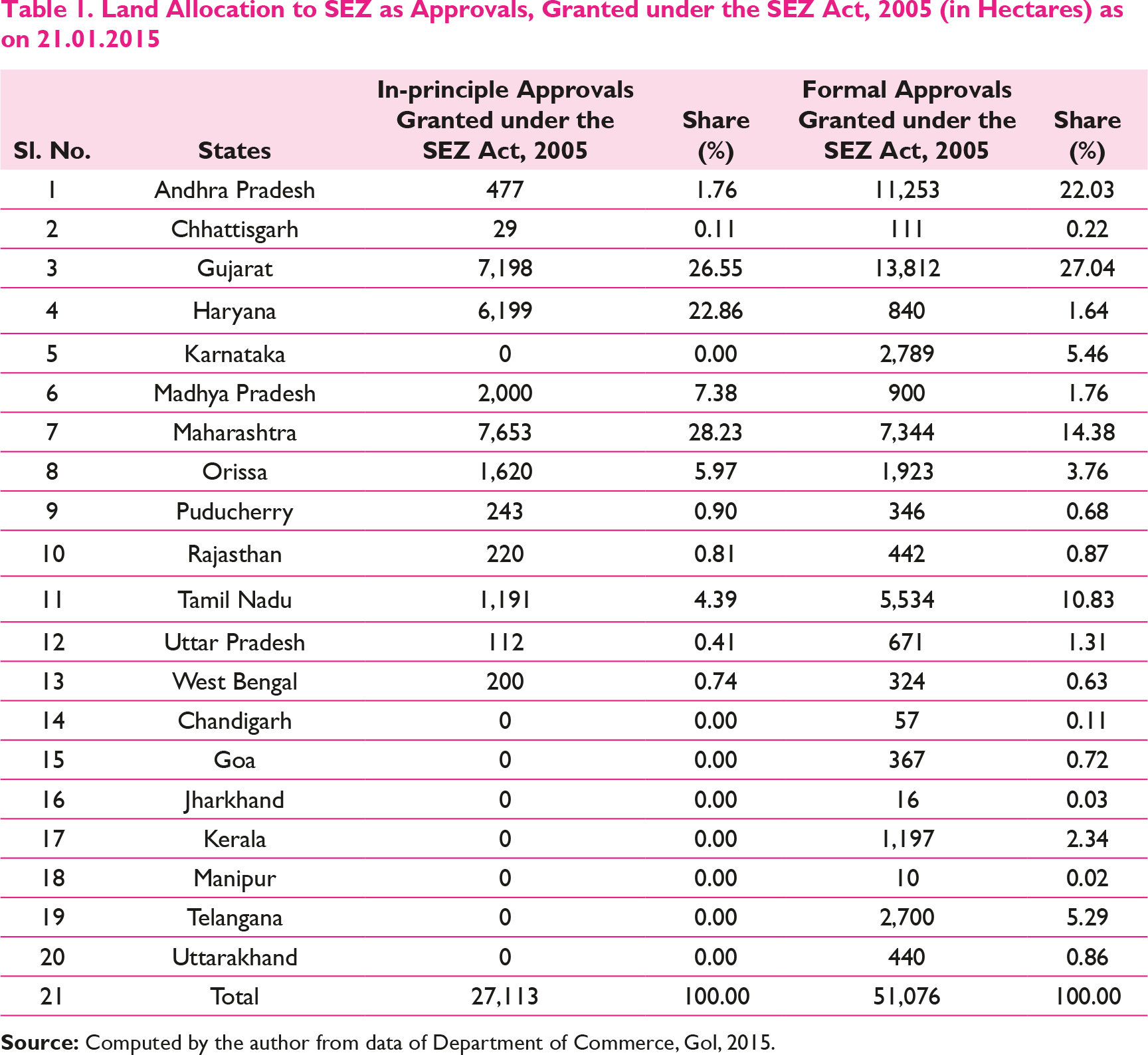
The acquirement of agricultural land for setting up SEZs is one of the most serious and vital implications of the SEZ policy of the Indian government, and price being paid by the poor farmers. Findings of the Committee on State Agrarian Relations and Unfinished Task in Land Reforms (Government of India, 2009) raise many questions on India’s SEZ policy as the report highlighted that the total area of land under SEZs is expected to be over 200,000 hectares next few years and this much of land on current production capacity is capable of producing more than 1 million tons of food grains. The policy with agricultural land acquisition drive may lead India’s toward food security risk in near future.
To play the political brokerage role visualized for state governments, they will have to devise a way to be proactive, vigilant and reformative for fulfilling on their promises. State government need to apply context-sensitive approaches to compensating appropriately the affected population. All action of the state government should incorporate transparency, accountability, and citizen-friendly mechanisms, if they are to be credible and trustworthy. One reason why even apparently attractive offers of compensation are declined by affected people is the lack of credibility and responses. State government should create institutions for better implementation and coordination between government and citizens.
It is an open question whether SEZs will develop into islands of docile modernity amongst a bundles of undefined dysfunctional mechanism, which symbolize the beset India’s democratic experiment, or whether SEZs can create new and responsible model of governance that the rest of Indian economic and industrial establishment will emulate to create quality it democratically processes as modern as its inclusiveness.
The land acquisition mechanism under the SEZ scheme has been contentious in nature across the country. The result was most of the approved SEZs never became operational. It was also suspected that some of the SEZ acquired more land than need to while some tried to divert the acquired SEZ purpose land to some other more profitable commercial uses.
All these in the name of economic development raises many questions on SEZ policy and its implementation mechanism with state governments is allowed to violate their own land use plans for establishment of SEZs, without inviting public interest litigation. Another serious issue is government allowing the acquisition of prime agricultural land from farmers for industrial purposes in the name of development of public purpose. A major issue is that state is not doing enough to encourage industry to develop and establish their unit in the more than 20 percent (680,000 sq. km) of the country’s land area that is officially declared as wasteland. These are very serious questions marks on India’s SEZs and land acquisition policy, which need to be addressed.
SEZ and Utilization Pattern of Land
Land appeared to be the utmost decisive and attractive element of the scheme. In total 45,635.63 hectares of land notified in the country for SEZ activities, but functional area is only 28,488.49 hectares (62.42 percent) of acquired land. Furthermore, it can be observed that a pattern in which developers approached the government for allotment/purchase/acquisition of huge amount of land in the name of establishing a SEZ.
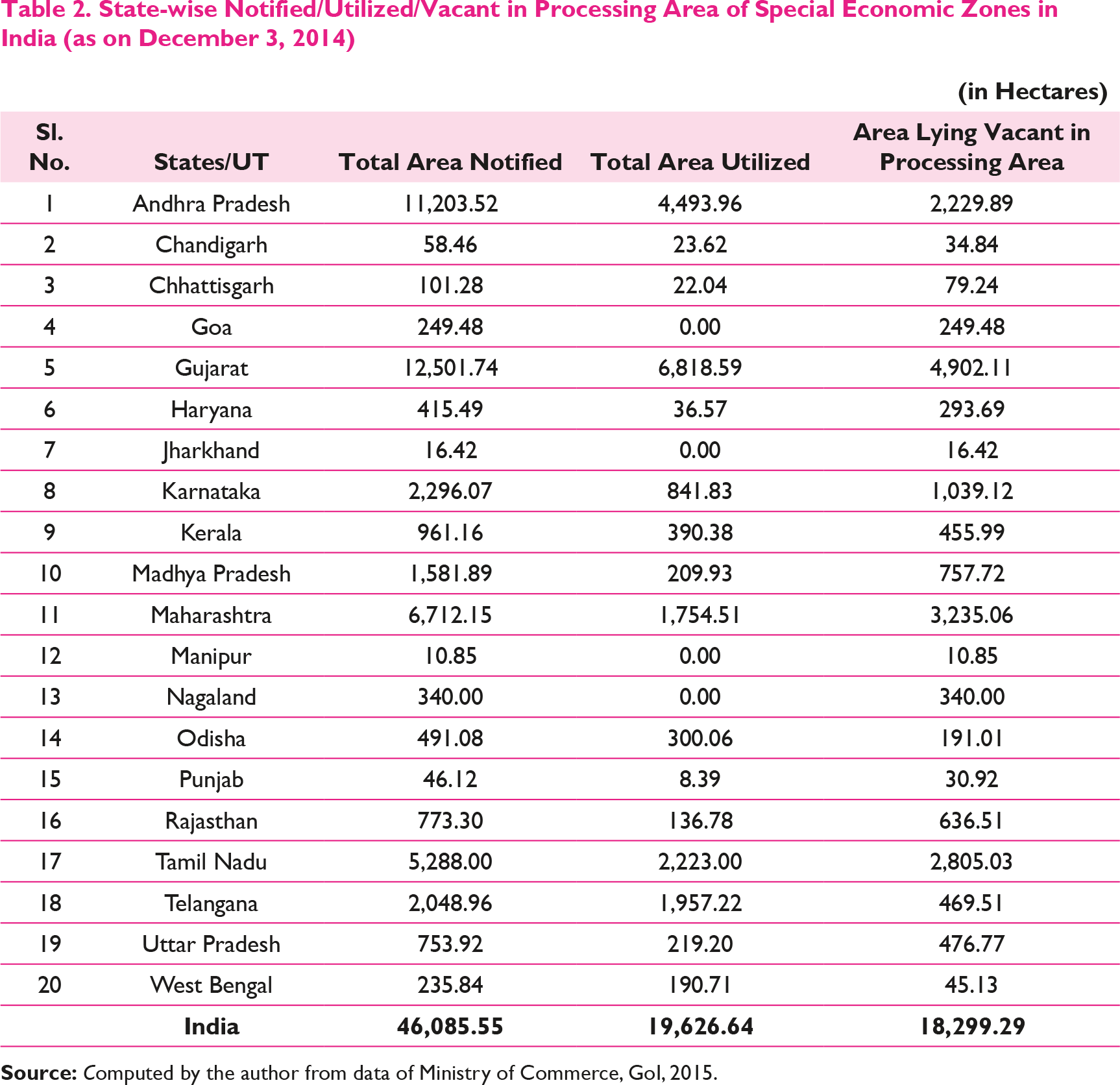
Though, only a portion of the land so far acquired has been notified for development of SEZ and later on denotification was also resorted within a few years of profit from price appreciation. In terms of land area diverted to commercial use, out of 39,245.56 hectares of land notified in the six major states, 5,402.22 hectares (14 percent) of land was denotified and diverted for other profitable purposes (not related to SEZ see Table 2). A lot of area of these lands was acquired in the name of the “public purpose” clause of LAA 1894 (Comptroller General of India, 2014). It is evident that land acquisition is not meeting the core objectives of the SEZ Act.
State-wise Notified/Utilized/Vacant in Processing Area of Special Economic Zones in India (as on December 3, 2014)
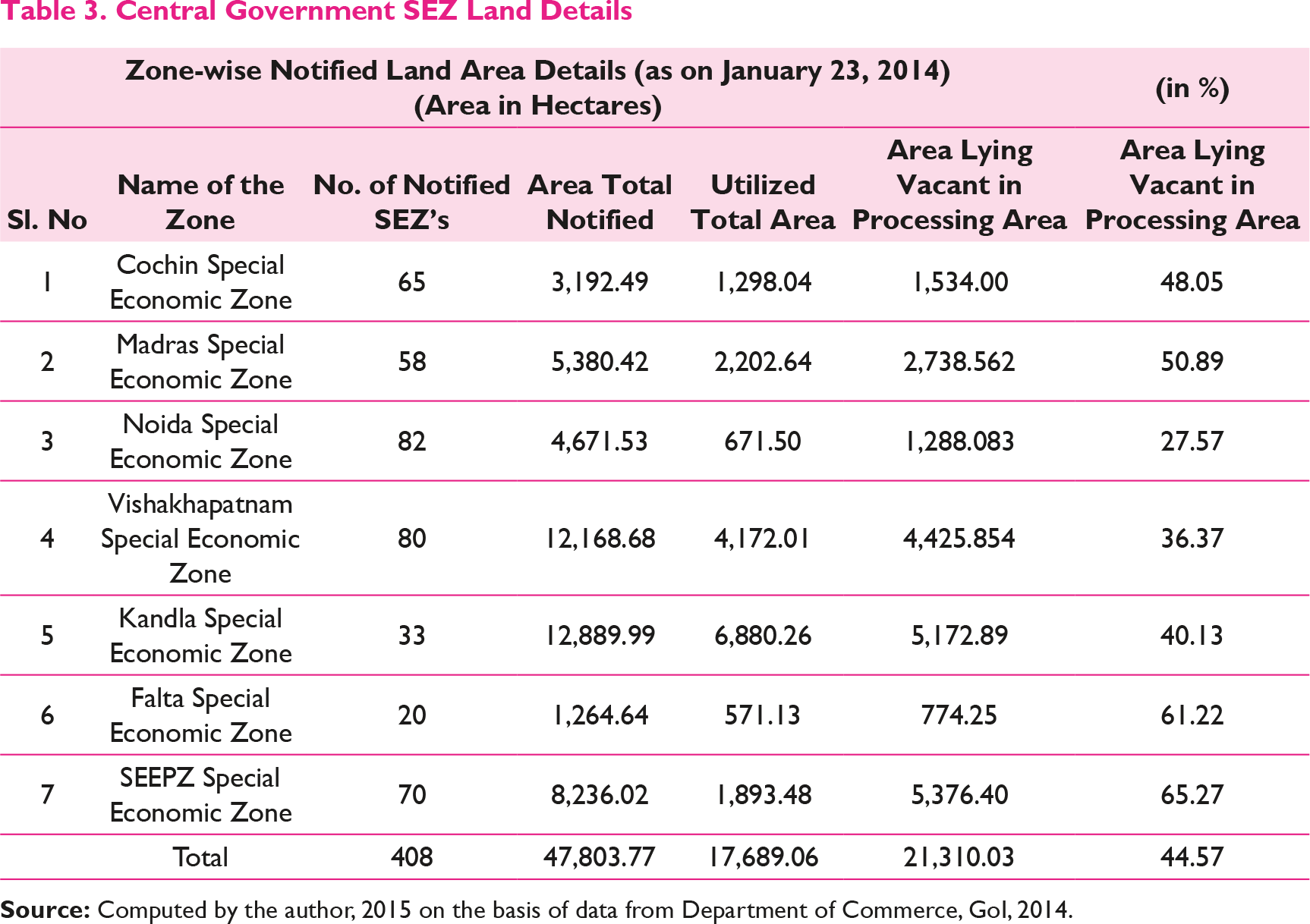
Central Government SEZ Land Details
Underutilized Land in Processing Area of SEZ in Major States
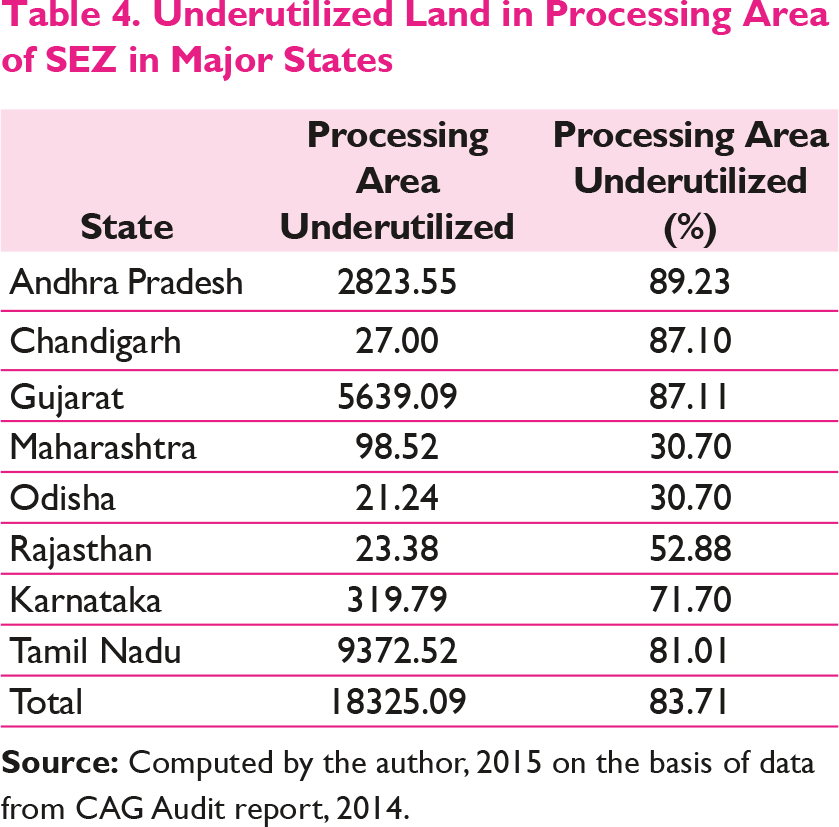
There are major 17 SEZs even though were notified as early as 2006 with unused land lying empty is up to 18325.09 hectares (83.71 percent) of total processing area earmarked. In case of one of biggest economic zone, Adani Ports notified in 2009 with area of 6472.86 hectares but only 833.77 hectares has been operational and remaining 5639.09 hectares (87.11 percent) still unused so far (see Table 4). It has also been observed that some activities of the units in SEZs were not related to the sector specific in allotted land (see Figure 2).
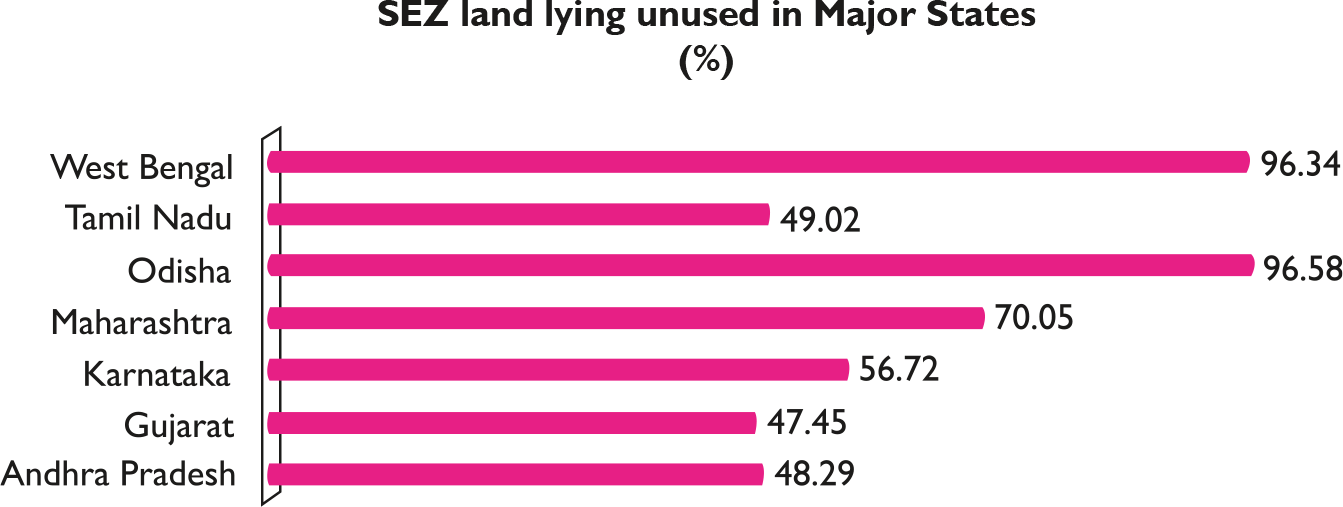
It is fact that land in SEZs also remain vacant due to non-setting up of unit for years which also reflect on gestation period leads to loss of revenue and employment due to absence of economic activities. It must be noted that investment in SEZs depends on many factors like change of government policies, market conditions, on-going global recession, industry-specific reasons, domestic factors, and so on.
It has been observed that out of 392 notified zones, only 152 zones are at functional capacity (28,488.49 hectares). The land allocated to the rest of 424 SEZs (31,886.27 hectares) has been laying unused (52.81 percent of total approved SEZs) even though in more than 54 cases the approvals and notifications date back to 2006. It was also observed that out of the total 392 notified SEZs, in 30 SEZs (1,858.17 hectares) in Gujarat, Maharashtra, Andhra Pradesh, and Odisha, the developers had not commenced investment activity in the proposed projects and the land had been lying idle in their custody for 2–10 years.
Further, considering that agricultural land was acquired in many cases in the midst of protest and controversies, yet persistence of acquiring vast tracts of land without any real economic activity is a matter of serious social and economic concern, demanding a cautious approach toward policy of allocation agricultural land for industrial purposes.
Agricultural and Livelihood Implications
SEZs are noted for their ability to create new employment opportunity. India being the country with a labor surplus, consequently employment creation is a policy priority. SEZs have a dualistic employment-generation effect. SEZs create direct employment for individuals employed in units operating within the SEZ. It create indirect employment for individuals engaged in industries and services which support the activity within SEZs, such as trucking of goods to SEZs. In all, SEZs have generated substantial employment and are predicted to continue generating employment in increasing volumes.
But on the other side of coin, India’s SEZ policy bases their contentions on few unwanted consequences of the policy. SEZ development leads to unjust and inequitable seizure of agrarian land. Second, land acquisition for SEZs promotes underhanded real estate dealing. India may suffer huge socio-economic loss on the SEZ policy, which has been ignored, it is well supported by the estimates of ministry of rural development (2010), which reveals that close to 114,000 farming households (each household on an average comprising five members) and an additional 82,000 farm worker families who are dependent upon these farms for their livelihoods, will be displaced due to establishment of SEZ all over India. In other words, at least 10 lakh people who primarily depend upon agriculture for their survival will face eviction. Experts calculate that the total loss of income to the farming and the farm worker families is at least Rs. 212 crores a year. This does not include other income lost (for instance of artisans) due to the demise of local rural economies. The government promises “humane” displacement followed by relief and rehabilitation. However, the historical practices does not offer much hope on this count: an estimated 40 million people (of which nearly 40 percent are scheduled tribes and 25 percent scheduled castes) have lost their land since 1950 on account of displacement due to large development projects. At least 75 percent of them still await rehabilitation. Almost 80 percent of the agricultural population owns only about 17 percent of the total agriculture land, making them near landless farmers. Far more families and communities depend on a piece of land (agricultural labor, for work, grazing) than those who simply own it. However, compensation is being discussed only for those who hold titles to land. No compensation has been planned for those who do not own the land but highly depend on the land for their livelihood.
Another interesting concept emerged from special survey conducted by the National Sample Survey Organisation (NSSO, 2003) on farmer’s reflects on the other side of farming activities. Nearly, 40 percent of the farmer households disliked farming and wanted to give up the profession due to its unprofitable nature. These farmers largely belong to the small and marginal category (84 percent of the farmer households belong to this group), which are characterized by extremely low levels of income and involved in subsistence cultivation. Moreover, with rising costs of cultivation, low remunerations, high risks with crop failure occurring frequently, declining agricultural growth, and mounting debts have led the farmer to a distress-like situation of the kind mentioned earlier (Parwez, 2015).
SEZ has been established in either in outer part of cities or interiors of states, which attract mostly, displace local population, agricultural labor and farmers as prospective manpower, which does lead to creation of few jobs but may destroy thousands of livelihood opportunities. Individual do get attracted to SEZ-related employment opportunities, mainly not due to a better earning opportunity but main reason has been less productive nature of farming in the country and lack better options.
When land is acquired from the farmers, the farmers and agricultural laborers lose their employment, as they are not skilled laborers to relocate them to other jobs. The problem of displacement and rehabilitation of farmers and agricultural laborers also comes to the fore. Indian farmers are mostly uneducated, so they cannot get high-rank jobs in SEZs, they can work only as casual laborers in SEZs. Farmers and agricultural laborers are suffering dismal situation of productivity, low price, and survival issue. Land acquisition of farmers will lead to worsening of their socioeconomic condition.
However in reality, land as livelihood generates much more complex security and lifestyles, than what the money can offer. Besides the main crop, land provides certain foods, environmental services, wild fodder, and medicinal plants. Thus those entirely dependent on the land, say artisans, pastoral communities will be at loss. Even today in the villages the common practice is to share grain with the black smith, the potters, and pastoralists. In fact the ones worst affected will be the share-croppers and laborers, the petty traders and service providers. These landless people do not even have a legal basis for compensation. The rehabilitation package offers one job per displaced family, and that also requires the member to have a certain basic educational qualification. For land-acquired households, higher likelihood of engaging in salaried or self-employed activities could explain their lower participation rate within SEZ.
As such, the gains generated by SEZs in terms of employment have not been viewed upon as long term. According to a study conducted by Society for Participatory Research (PRIA, 2000) on the workers plight of SEZ in India, only few workers have been provided with long-term employment contracts. Short-term contracts are used for flexible hiring and firing and for avoiding costs such as maternity and redundancy pay (Swaminathan, 2007). Further, with regard to the impact of SEZs on local livelihoods, the opinion is not positive as it has been argued that the SEZs will not create employment for local population but will instead lead to distress migration of locals since the jobs created will need education and skill levels unreachable for most of the people. Therefore, the communities such as those of the fisher folks, farmers, landless laborers, women, Dalits and other marginalized will remain untouched by all new employment opportunities arising out of the SEZs (Agarwal, 1994).
Given arguments does raise several questions such as, are the SEZs in the interest of the farmers, agricultural and non-agricultural communities who are living off the land. Is the land acquired in the name of “compelling and overriding national interest” is really for the masses? Actually, in the name of “development,” we are only creating disparities with wealth in a fewer hands and nowhere near making growth “inclusive” which would be based on the concepts of sustainability, ecological sensitivity, and an ingrained understanding of the cultural roots of a people (Levien, 2011). Besides farm size distribution, tenure systems and changing farm types, developments in terms of diversification and pluriactivity, that is, labor allocation changes, are attributed to the phenomenon of structural change. The effective direction is not always unambiguous: labor markets determine structural change and vice versa. Labor allocation decisions are driven by economic incentives such as wage differentials, but non-economic motives may also play a decisive role (Swaminathan, 2005).
Land acquisition has resulted in the disruption of the livelihoods of affected households, lasting several years. Unemployment was a direct result of loss of land, and also of the absence of wage labor in neighbors’ farms. Increased unemployment was also due to the large scale conversion of farmland into non-farmland also reduced the scope for work in common lands such as the collection of fruits and fodder for domestic as well as commercial ends. Households engaged in offering services (barbers, washer men, artisans, molla, etc.) lost employment with the decline in the economic status of the farmers who were their patrons (Venugopal, 2005).
The impact of SEZ on rural employment can be considered as negative in the sense that it may generate a labor shortage and deprive rural areas of the youngest and best-educated people. The impacts, whether positive or negative, vary greatly and depend on a number of factors and variables, which policy makers and development practitioners need to address. SEZ is hiding behind myths of “trickle-down” growth to give itself license to strengthen the hand of corporate elites, thereby contributing at once to accelerated growth for the already enriched and growing poverty for the impoverished (Parwez, 2015). It is thus contributing to rapidly rising economic inequality. Only when the goals and processes of the SEZs, policy are aligned, when evaluation of proposals are based on hard economic criteria and when the government tries to partner with the local community rather than forcing against their will.
Therefore, in addition to suitable financial compensation, the displaced farm labor and allied workers are given preference in employment by the SEZ developer or in the business units in the SEZ. There should be a provision for their subsequent absorption in employment in the SEZ establishment and in the processing units. They should get a preferential treatment. Each SEZ proposal must include a plan for rehabilitation of the workers who would be displaced from their traditional employment. A proper implementation of that plan should be a specific condition attached to the approval of the SEZ and the Development Commissioner of the SEZ should be enjoined to supervise the implementation of the rehabilitation plan.
Concluding Remarks
This article provides an overview of land acquisition and diversion of land from the primary sector to establishment of SEZ. Based on evidences from standing literature, the study tries to develop a comprehensive picture of land acquisition and its implications. Even though large amount of tract remains to be used for industrial activity under SEZ policy, yet the drive for land acquisition is relentless and continuous. Underutilization of acquired land raises question on land acquisition policy in general.
It is evident that the entire mechanism of land acquisition, development, and transfer to corporates involves profits for rich, without the primary landowners gaining anything in process. It has been observed that the issue is not about the magnitude of land acquisition, but rather about undiscriminating practice of power by the state, and it is becoming a party to accumulation of profit.
Footnotes
Author’s Biography
His major area of interest includes Labour Economics, Informal Sector, Macroeconomics, Tribal Economy. Research Methodology and Economics of Growth and Development. Dr. Sen has also completed one foreign consultancy project funded by Institute d’etudes politques et internationales Geopolis,Universite de Lausanne, Switzerland He is an Executive Committee member of the Indian Society of Labour Economics, life member of the Indian Economic Association, and Madhya Pradesh Economics Association. Under his supervision 1 Ph. D awarded and 2 Ph.D has been submitted and 18 M.Phil degree have been awarded.