



Abstract
This article examines views of Batswana faith healers on medication and Christian medical mission in a context where official health policy generally does not recognize alternative health systems. It is based on fieldwork among Batswana designed to establish the impact of religion on those who seek healing and on health providers. Overall, the study established that faith healers do not discourage their clients from taking modern medication. They strongly believe, however, that faith healing contributes significantly to healing and health and needs to be recognized in the country’s health policy; they support and encourage collaboration between themselves and modern medical practitioners.
From the time of its introduction in Southern Africa, Christianity has been associated with the healing of the body. As early as 1841, David Livingstone entered Southern Africa as a medical missionary, thereby defining the future work of the church as both evangelistic and medical. 1 Medical mission resulted in the establishment of several mission hospitals (particularly by mainline churches), all of which continue to offer health services to this day. Although governments have opened some hospitals, Christian hospitals are still playing a significant role in the provision of health services in countries such as Botswana and Zimbabwe. Christian medical mission, however, is not limited to the running of hospitals and clinics that provide allopathic health services.
Background of the study
In many African countries alternative health systems exist alongside hospitals and clinics, but unfortunately they are not generally recognized by national health policies. These alternative health systems nevertheless remain very popular in most African countries. 2 However, because they are not officially recognized and are sometimes heavily criticized by biomedical practitioners, citizens do not feel free to openly utilize them. When they consult biomedical practitioners, they often do not disclose that they are taking alternative medicines. This lack of forthrightness sometimes results in people mixing both alternative and bio medicines, resulting in overdoses, with sometimes negative consequences. Thus in 2002 the World Health Organization called for the integration of alternative health systems into national health policies. Despite this call, Botswana remains one of the countries that have not developed guidelines for engaging alternative health practitioners (traditional healers and faith healers) 3 in overall health provision. The Botswana Public Health Act (1981) does not recognize the role of faith healers, traditional medicine, or other alternative treatment and healing modalities, 4 despite ample evidence that Batswana 5 make widespread use of alternative health systems. 6
This article focuses on Batswana faith healers’ views of biomedicine and Christian medical mission (specifically faith healing) in a context where this healing practice is not officially recognized. Despite providing medical mission through establishing medical institutions, the contemporary church in Africa also provides faith healing. 7 Although this kind of healing has been questioned with the rise of scientific medicine and science in general, today there is a growing interest in it, particularly in Africa. As correctly observed by S. O. Abogunrin, “More and more Christians have come to accept the fact that there is no reason to believe that the gift of healing (as was practiced in biblical times) died with the passing away of the Apostolic Age.” 8 In Botswana, at the height of the HIV pandemic, because of some churches’ teaching that “with faith, nothing is impossible,” some believers gave up medication for faith healing. 9 According to K. Hulela and M. Thobega, this attitude is often a result of the teaching of faith leaders. It is believed that some pastors discourage the faithful from seeking medical assistance, teaching them rather to rely on faith healing. 10 Cases have been reported of people who gave up their blood pressure, diabetes, and mental health medication in hope of miraculous healing through faith alone. 11 For this reason, knowledge of faith healers’ teachings concerning medication is increasingly becoming necessary. Are scholars such as Hulela and Thobega correct that negative attitudes displayed by some believers toward biomedicine are influenced by the beliefs and teachings of faith healers? What are faith healers’ beliefs concerning scientific medication? Do they believe that there are certain diseases that can be healed only by faith healers? In short, what do Batswana faith healers consider to be the Christian medical mission? This article answers these questions by presenting and discussing findings on Batswana faith healers’ views on medication and the implications that can be drawn from these findings for holistic health care provision in Botswana. It is based on data collected from a field study conducted between July 1, 2018, and September 30, 2019, as part of a large study on the impact of religious beliefs on the behaviors of Batswana in seeking and providing health for themselves. Below we discuss the methodology of this study. This will be followed by the presentation of the findings, the discussion of the findings, and then a conclusion.
Methodology
This fifteen-month study adopted a mixed-methods approach. Beginning with detailed review of existing literature on religion and health, it collected quantitative data using questionnaires and qualitative data through focus-group discussions and individual in-depth interviews. The quantitative and qualitative tools sought to collect information from four different groups of people: medical health practitioners, traditional healers, faith healers, and health seekers. We collected their views on the causes of illness, medication, collaboration of alternative health systems, organ and blood donation, and curriculum issues in religion and health. Data for this article, however, are limited to faith healers’ views on medication. The participants were drawn from eight different geographic areas, representing the north-south and the rural-urban divides of Botswana. The faith healers were drawn from the three Christian umbrella organizations in the country: the Botswana Christian Council for mainline churches, the Evangelical Fellowship of Botswana for Pentecostal and evangelical churches, and the Organisation of African Independent Churches for African Independent Churches (AICs). A total of fifty-six faith healers completed the questionnaire, over eighty participated in key informant interviews, and over thirty took part in focus-group discussions. Both purposive and snowball sampling methods were utilized to recruit the participants, and both male and female respondents participated.
Study findings
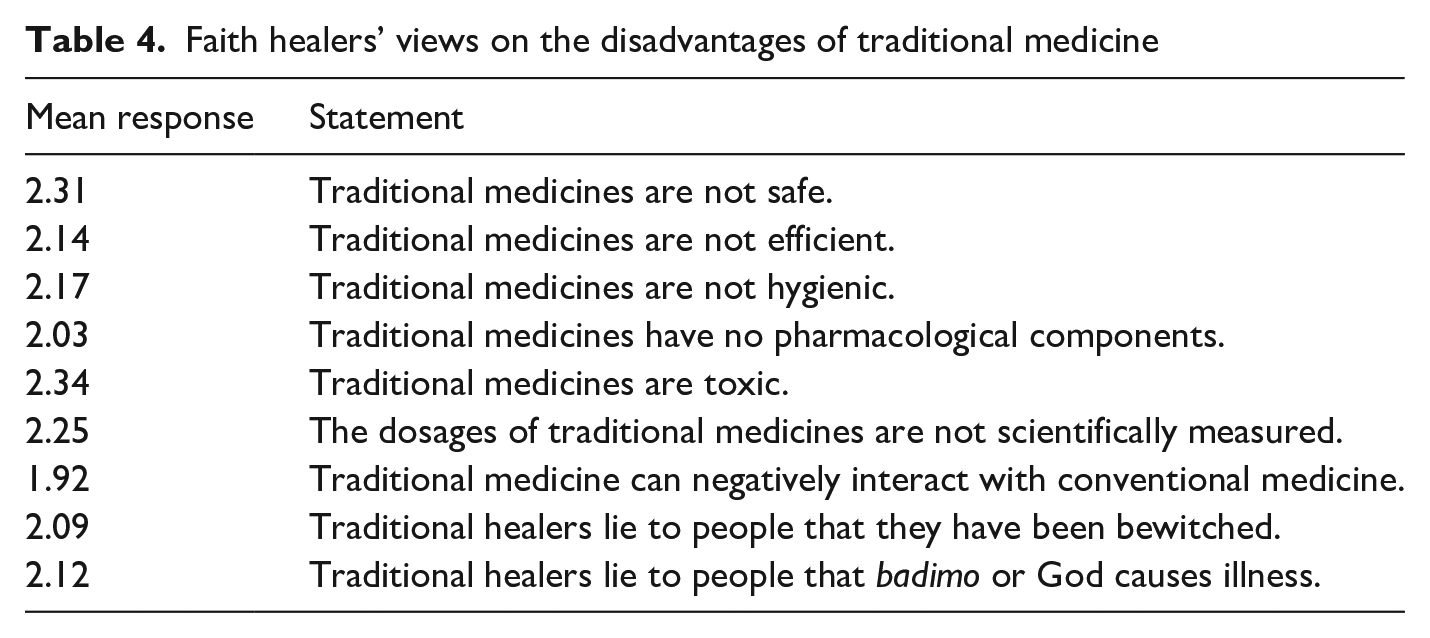
Both the quantitative and the qualitative tools had questions to establish the faith healers’ views on God and modern medicine, traditional and faith healing, specific diseases and who best treats them, and the faith healers’ practice of faith healing. We present the findings under these themes below. For quantitative data, respondents chose their response from a five-point Likert scale, with 1 for strongly agree; 2, agree; 3, neutral; 4, disagree; and 5, strongly disagree.
Views on God and modern medicine, traditional and faith healing
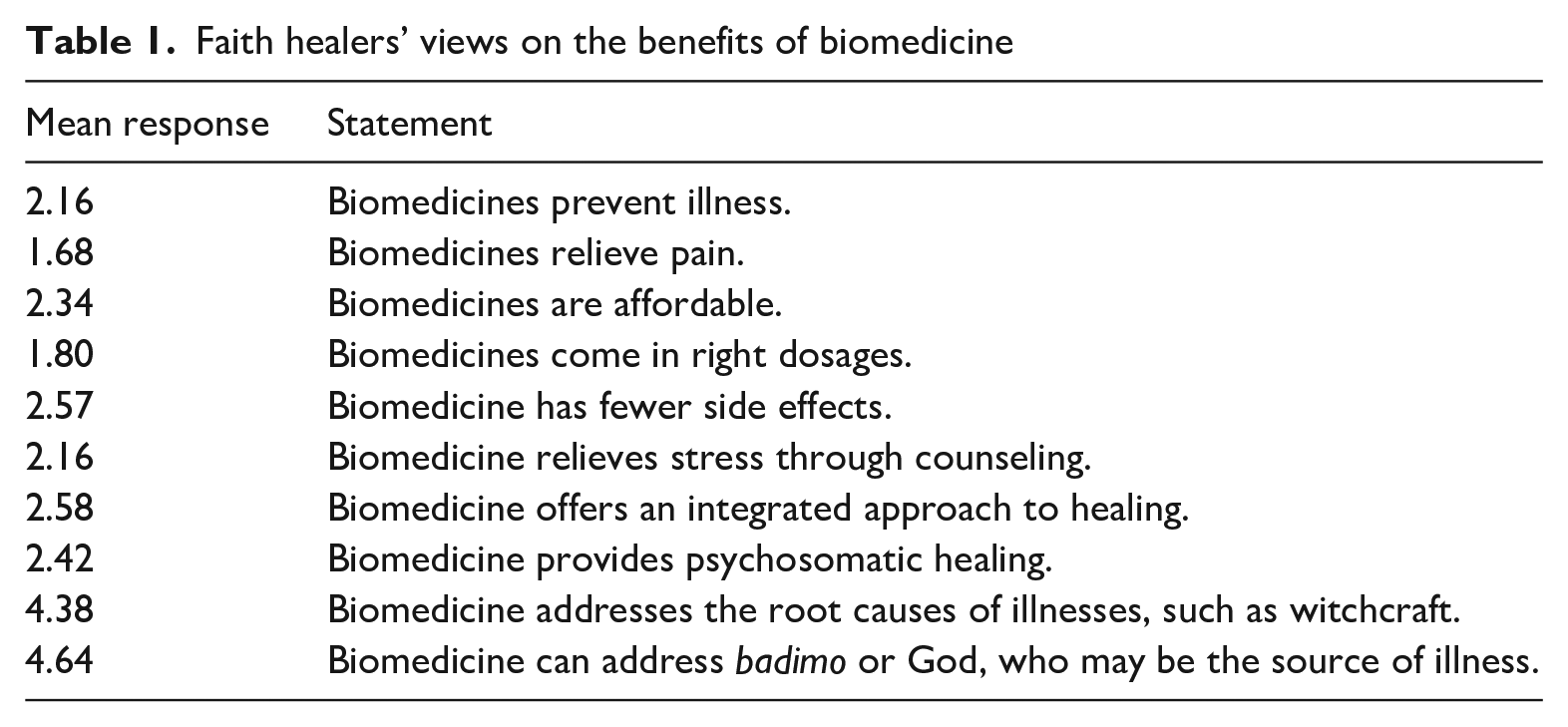
As table 1 shows, faith healers affirmed that biomedicine is generally beneficial to patients. They had some reservations, however, and so chose to be neutral when it comes to viewing biomedicine as offering an integrated approach to healing. And they completely disagreed that biomedicine addresses the root causes of conditions attributed primarily to witchcraft, to badimo (ancestors), or to God.
Faith healers’ views on the benefits of biomedicine
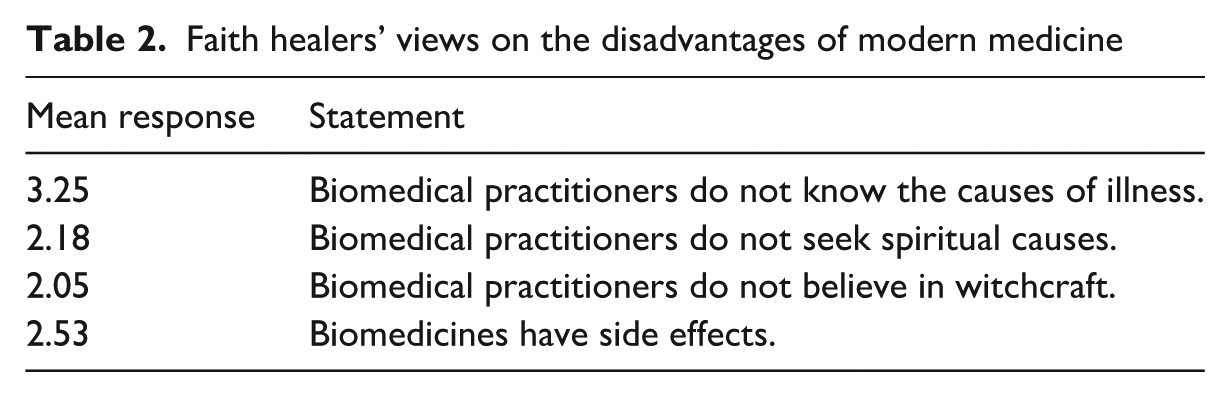
As table 2 below shows, faith healers were neutral on biomedical practitioners’ knowledge of the causes of illness. They agreed, however, that biomedical practitioners do not seek spiritual causes, that they do not believe in witchcraft, and that their medicines have side effects.
Faith healers’ views on the disadvantages of modern medicine
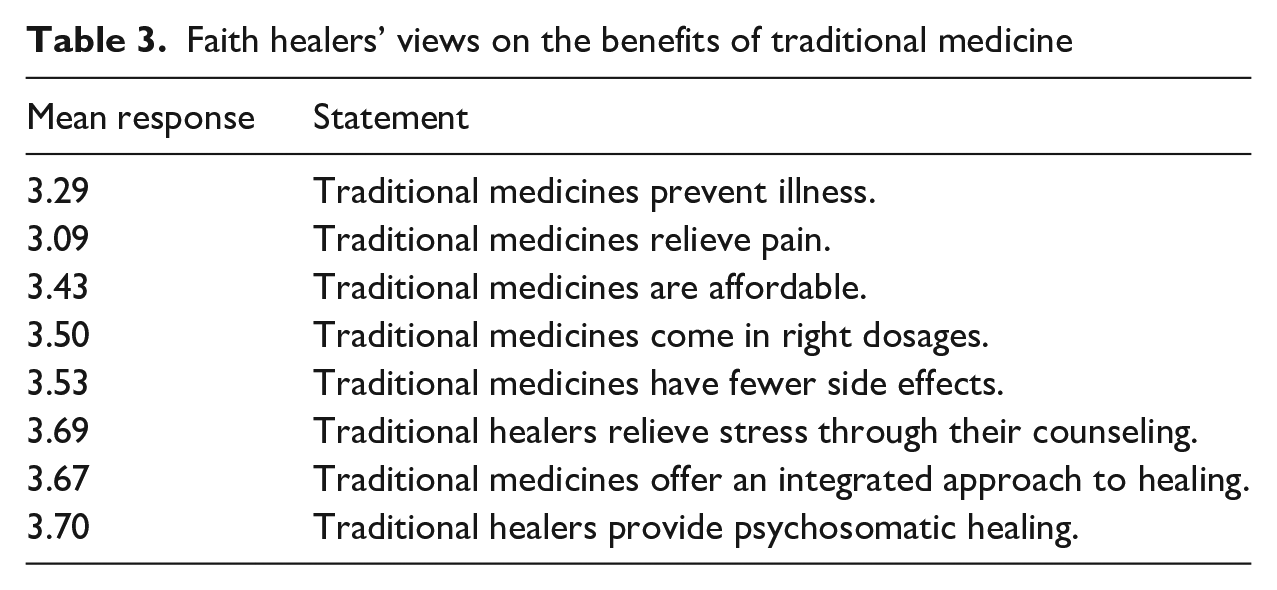
When it comes to traditional medicine, faith healers generally found no benefits in it, as shown in table 3 below.
Faith healers’ views on the benefits of traditional medicine
As table 4 shows, faith healers generally agreed that there are disadvantages in using traditional medicine.
Faith healers’ views on the disadvantages of traditional medicine
The above quantitative findings were also confirmed by the qualitative findings. Although all faith healers affirmed biomedicine, there was an overwhelming agreement by the faith healers that God can heal without medication, as stated by one respondent, “Yes, God can heal you without any medication, just by prayer he can heal you” (MOFH-001). 12 They said that healing occurs when the person performing healing has God in them and when both the healer and the patient have faith in God’s healing power. Respondent MAFH-002 stated, “God can heal diseases without any medication if God is in you.”
The belief that God can heal without medication was supported by use of several biblical texts, especially Jesus’s healing practices, “We read in the Bible that Jesus Christ touched a sick person, and the person got healed. Even now in life, a man of God or a pastor can pray for a person, and the person gets healed” (MOFH-003). This belief could lead one to conclude that faith healers are against the use of biomedicine. This was not the case. Rather, they emphasized that, “As God can heal without any medication, he can also heal with medication” (MOFH-002). Another respondent elaborated, “As a pastor, I believe in two types of healing. The first one is where God uses modern medical practitioners to heal; another one is that God uses prayer and laying on of hands to heal illnesses” (MOFH-003). Thus, the work of doctors was defined as God’s healing work, and plants that are used for medication were viewed as having been provided by God for that purpose. “I believe that God gave us doctors; if God could heal without medication, he would not have given doctors the knowledge to heal. God has a power to heal without doctors and also chose to give us doctors so that his power of healing may touch others who are of little faith” (HUFH-001).
Although respondent HUFH-001 alluded to the use of medication as a sign of little faith, this belief was dismissed by most of the faith healers, with one respondent refuting this belief emphatically: “[Such people] . . . need to repent. They need to go and teach their followers the truth; they need to reverse their words” (MOFH-001). MOFH-003 said such people are theologically confused: “That is a misleading belief and doctrine. This doctrine lacks what is called a sound mind. . . . Faith is not stupidity; it is the wisdom of God. Those who believe using medication is lack of faith, I personally believe they are wrong.”
Although respondents generally agreed that God can heal all diseases, they also believed that sometimes God may decide not to heal some diseases as a form of punishment. HIV/AIDS was cited as one such disease that God has decided not to heal.
Views on the best healers to treat specific diseases
The study also sought to establish whether faith healers thought there were specific diseases best treated by specific practitioners. Generally, the respondents agreed that medical doctors can treat most diseases, while faith healers can treat all diseases as long as they have faith in God and it is the will of God for healing to happen. “According to me, even though we have specified things that say this can heal that and this can heal that, my one and only belief is that God is healer of all diseases” (HUFH-002). Faith healers said they are specialists in treating conditions that are related to emotions and feelings such as spiritual illness, curses, and evil spirits. They said that medical doctors cannot treat these conditions. A respondent in one focus-group discussion described a spiritual sickness as a disease or condition that does not get healed even after one has been given all kinds of medication, “It needs God’s intervention because the doctors and nurses can do nothing about it. That is now when we need God” (MHFGD). For MHFH-001, such illnesses and conditions require the collaboration of both faith healers and modern doctors. The need for collaboration of medical doctors and faith healers was highlighted by several faith healers. TSFH-002, who used the case of mental illness, said, “Let’s say a person has a mental problem. The best people to calm the person are medical doctors. In that state I take it that the patient is senseless, so faith won’t work, but after he or she is calm, that is when they can be prayed for.”
Although faith healers generally tended to attribute healing of most diseases to medical doctors and faith healers, a few of them believed certain diseases were best treated by traditional doctors. Traditional food poisoning (sejeso), severe coughing (thibamo), migraine headaches, and mental illness are some of the diseases that were mentioned by respondents; “there is also go wa dikoto [falling down that is associated with epilepsy]; that one is for traditional healers, medical doctors cannot cure it. There is sejeso that is best cured by faith healers, but if the sejeso has been in you for so many years, it needs traditional healers to cure it” (FRFH-001). Other faith healers, particularly from AICs, said they used the services of traditional healers and even referred their patients to them. One respondent from a mainline church also said he believed in the services offered by traditional healers, although he said he does so secretly. “I have not openly referred someone to traditional healers, but it is out of fear that the members will look down on me and say that our pastor can’t help us and he is referring us to people who believe in badimo. Even when I go there, I go in secret. I don’t want people seeing me because they might end up losing confidence in me . . . and if I see that the illness needs traditional doctors, I sometimes talk to the family members and secretly tell them to take the patient to the traditional doctor” (GAFH-001).
Concerning their ability to treat diseases such as high blood pressure, diabetes, cancer, and mental illness, faith healers had various views. Whereas some said these can be treated only by medical doctors, others claimed to heal them. For example, MOFH-001 said, “Faith healers cannot heal these diseases. These can be healed only by medical practitioners.” MAFH-002, however, claimed to be able to heal all these diseases. “Exactly! In fact, if you had come here on Friday, I would have shown you someone from ——. It was mental illness, and they were keeping him in chains. They had failed in Gumare hospital. I healed him. He is well. Diabetes we can treat if one comes early. . . . BP [high blood pressure]—we can! BP is not compatible with stress. . . . It comes when a person is in pain and is in chronic depression, deep thought, and when a person thinks a lot, this causes the blood to be hot full time. Cancer also, cancer I can [heal]. Cancer is like a hereditary disease.”
Others said faith healers can heal these diseases only if they collaborate with medical doctors, as stated by MOFH-003: “Many illnesses such as HIV/AIDS, cancer, diabetes, high blood pressure—I believe these illnesses can be healed by both if there is collaboration. Yes, even mental illness, because mental illness is caused by so many things like depression and evil spirits.” GAFH-001, however, cautioned that the collaboration needs to be closely monitored to ensure there is no overdose because of taking medication from two practitioners, “Yes, but you have to be wise; it’s possible that my herbs would not react well with the modern medicines. We have to make sure that these medicines work together in order to fight the illness. For example, a diabetes patient may have low libido. We can provide something to help that, . . . but we need to work with those providing modern medicine so that we don’t disturb their treatment.”
The practice of faith healing
Not surprisingly, all faith healers said they practiced some form of faith healing. Common forms mentioned were prayer, prayer with laying on of hands, use of water, use of oil, use of sacraments such as the Eucharist, and use of other healing objects such as stones, candles, leaves, and other objects. The Bible was often cited in support of the practice of faith healing, “We believe that the great physician is God; that is why we base [our work] on God. Yes, in the Bible some people were healed after prayers. But we encourage people to go back to the hospital for check-up, to prove that they are healed” (MAFH-001).
For most faith healers, the Bible not only influences the practice of healing but also is the medium of healing. HUFH-002 stated, “I do believe in faith healing because in the Bible there is a Scripture that says, ‘Let those that are sick come before elders of the church so that they may lay hands on them so that they may be healed.’” Similarly, MOFH-003, commeneted, “I believe for healing to take place there must be prayer and the Word of God. You must teach a sick person how to pray for their healing and encourage them to read the Word of God. Reason being, we must observe how Christ and prophets healed in the Bible.”
Discussion and recommendations
Despite the presence of several allopathic health service facilities in Botswana, 13 faith healers believe that faith healing is still an important part of the mission of the church, in spite of the government position of largely promoting only the biomedical health system. As the results presented above show, nearly all respondents said they practiced some form of faith healing. Other studies have also shown that people feel the need to go beyond physical healing. M. Gluckman, for example, observes that healing among most Africans normally involves diagnosis of both the nature of the ailment and its cause, both a curative method and a preventive measure by protection and strengthening against witchcraft. 14 These religious and cultural beliefs have a great influence in how people actually seek health improvement. The popularity of alternative health services is therefore not necessarily a result of the teaching of church leaders, who are in most cases also the faith healers. As M. M. Tabi, M. Powell, and D. Hodnicki established in a study in Ghana, patients’ health-seeking behaviors are influenced by pressure from the family, relatives, friends, employers, education, and religion. 15 Batswana’s search for faith healing should therefore be understood in this light. While hospitals and clinics provide physical healing, the people believe that faith and traditional healers are able to address the social causes and consequences of illness. For the faith healers who participated in this study, this belief explains why people flock to them for healing.
As the study has shown, faith healers are generally not against biomedicine. Although biomedical practitioners do not refer patients to faith healers, most of the latter said they referred their patients to hospitals and clinics and indeed pointed out several diseases they believe are best treated by biomedicine. But despite the usefulness of biomedicine, Batswana faith healers believe that faith healing remains an important part of the medical mission of the church, simply because they believe that biomedicine does not address social and spiritual causes of illness. Faith healers therefore called for close collaboration with medical practitioners. This call for incorporating religion and spirituality in health care has found support in many studies. R. D’Souza argues that there is a need to incorporate the spiritual and religious dimension of patients into their treatment and health management. 16 He states that recent surveys on the link between religion and health have indicated that separating patients’ beliefs and spiritual/religious needs from their care deprives them of an important element that is likely to be at the core of their coping and support systems. According to J. M. Bolhari, H. D. Alivand and M. Mirzaee, religious and spiritual aspects may be integral to patients’ well-being, as well as to their recovery. 17
The above findings therefore establish that faith healers are not against biomedicine. Their belief that God can heal all diseases does not mean that they discourage their members from taking biomedicine. What they highlight, however, is the fact that biomedicine on its own does not provide holistic healing to Batswana. They see that Batswana, like many people in all other African cultures, believe that social and spiritual factors play an important role in a sick person’s recovery. From these findings, we propose the following recommendations for incorporating the church’s medical mission into the Botswana national health system:
Promote collaboration of all health-service providers by incorporating alternative health systems into the national health policy. The necessity of collaboration was highlighted by one faith healer, who said (implying that people listen to him more than to medical doctors), “If l tell 100 people to stop taking drugs, and the medical doctor tells the same 100 people to continue taking drugs, I will win!” (MAFGDHP).
Promote patient referrals among faith healers and biomedical practitioners through direct communication, as highlighted by one respondent, “My desire is to have direct communication with hospital practitioners, where I can say, ‘I am referring my patient X to you; would you check him/her for me? I started here and I have ended here.’ That is my desire, if it is possible” (MAFH-003).
Develop a communication format or tool for cross-referrals of patients between faith healers and biomedical practitioners, “My vision is to have a form, when I realize that there is need for hospital intervention, I write my observation—a written statement in which I write what I have done, clearly stating what has been given, and I say to the patient, ‘When you go for hospital consultation, use this form, which shows how far I have gone and where I have ended.’ And I say to the medical personnel, ‘Would you check my patient for A, B, and C?’” (MAFH-003).
These recommendations are best carried out by the Ministry of Health and Wellness, which is the government arm for developing health policies. To do so, the ministry would need to work closely with churches through the umbrella Christian organizations to which churches belong.
Conclusion
Against the background that some believers shun biomedicine because of the teaching of faith healers, this article presents the views of Batswana faith healers themselves concerning biomedicine. It was established that the faith healers who participated in this study were not against biomedicine. They actually believed that both biomedicine and the work of medical practitioners are sanctioned by God. Thus, although they held that God can heal people even without medication, they believed medical healing is also the work of God. Respondents, however, strongly believed that biomedicine cannot address specific health conditions, especially those of a spiritual nature. These, they believed, are best addressed by the church and sometimes by traditional healers. The respondents, therefore, underlined the importance of Christian medical mission, especially faith healing, in the national health system. They called for close collaboration between the biomedical health system and alternative health systems for holistic health provision for Batswana.
Footnotes
Funding
The research project received a grant from the Nagel Institute for the Study of World Christianity, Calvin University, Grand Rapids, MI, USA, which was funded for the African Theological Advance initiative by the Templeton Religion Trust, Nassau, Bahamas.
Notes
Author biographies
(Left to right: top) Lovemore Togarasei, Lesego Gabaitiri, Rebecca Kubanji, Tshenolo Jennifer Madigele; (bottom) Amon Marwiro, Sana K. Mmolai, Tinoonga Shanduka, Abel Tabalaka.