




Abstract
Demographic and labour market changes increase the need to enhance the employability of employees across all ages. The purpose of this study is to explore the role of transformational leadership in employees’ employability. While we hypothesised that age is negatively related to perceived internal and external employability, we expected a positive relationship for transformational leadership, and that transformational leadership would moderate the relationship between age and employability. Hypotheses were tested using a sample of 1006 employees in the German automotive industry. Results show age to be negatively related to internal and external employability, with both relationships being comparably strong. Transformational leadership was positively related to internal and external employability, with the relationship with internal employability being stronger. Moreover, transformational leadership buffered the negative relationship between age and internal employability. These results suggest that transformational leadership is crucial in protecting lifetime employability and that it should be promoted.
Keywords
Introduction
In times of frequent organisational change (Wittekind et al., 2010), employees are facing deteriorating job security and need to show increased flexibility in terms of changing job content, working for multiple employers and working in different locations. Hence, a single career path within the boundaries of one employer is being substituted by a boundaryless career (Briscoe et al., 2006). For employees this means greater individual responsibility as well as a higher relevance of updating their own work-related knowledge and skills (Berntson et al., 2006). Likewise, the idea of employment based on stable long-term relationships between employees and employers is losing credibility (Arocena et al., 2007), resulting in a higher staff turnover. Because employee turnover entails significant costs for the organisation (Tziner and Birati, 1996), the prevalent career changes pose a challenge for employers.
A second challenge organisations currently face is the workforce’s demographic change. In the European Union (EU), the number of older employees is starting to exceed that of younger co-workers (Jeske and Stamov Roßnagel, 2015). At the same time, many organisations complain of a shortage of skilled workers (Bieling et al., 2015). Because older workers tend to have more job-specific know-how and experience (Beehr, 1986), employing older workers to retain critical-skill talent becomes more and more important.
In sum, the prevalent change of the economic environment together with the ageing of the workforce leads to an increased need to sustain employability of workers across the whole span of their working life (De Lange et al., 2011; Deller et al., 2009; Pruijt and Dérogée, 2010). Employability is seen as a pivotal factor in job performance and organisational success (see Van der Heijden et al., 2015; Villanueva, 2005) as well as employees’ occupational well-being and career success (De Cuyper et al., 2008; De Vos et al., 2011; Wille et al., 2013). Therefore it is crucial to explore how employees’ employability can be enhanced (Kinnunen et al., 2014). Furthermore, the problem of how to protect older workers’ employability in particular is extremely important for organisations because older employees tend to perceive themselves as less employable when compared with younger employees (Froehlich et al., 2015; Kinnunen et al., 2014; Peeters et al., 2016; Rothwell and Arnold, 2007; Van der Heijden, 2002; Wittekind et al., 2010). In view of these considerations, the main aim of our study is to investigate how perceptions of employability are shaped and developed – with a focus on the role leaders play in protecting employees’ employability in general and older employees’ employability in particular.
There are several distinctive conceptualisations of employability: on a societal level, employability has been considered an aim of government policies and has been analysed in the context of specific industries (e.g. De Grip et al., 2004). On an individual level, definitions of employability focus, for example, on a combination of (stable) individual differences predisposing ‘employees to (pro)actively adapt to their work and career environments’ (Fugate and Kinicki, 2008: 504), on activities that employees adopt and engage in to remain employable (Nauta et al., 2009; Van Dam, 2004), and on an individual employee’s subjective perception of his or her opportunities to achieve or keep a new and equivalent job (Rothwell and Arnold, 2007). In this study, we adopt the latter conceptualisation and examine perceived employability, which is considered to be built upon both personal and situational characteristics (Martini and Cavenago, 2017; Törnroos et al., 2017). Although perceived employability is positively related to rather stable traits (e.g. optimism, work locus of control, self-esteem: Fugate and Kinicki, 2008; self-efficacy: Berntson et al., 2008), it is also related to a number of malleable individual factors (e.g. knowledge and skills: Hillage and Pollard, 1998; Van der Heijden, 2002) and situational factors (e.g. labour market: Kirschenbaum and Mano-Negrin, 1999; HR practices: Martini and Cavenago, 2017).
Importantly, we differentiate between two subdimensions of employability, namely internal perceived employability, which refers to opportunities on the within-company labour market, including perceived opportunities to remain employed by one’s current employer and one’s internal labour market value, and external perceived employability, which focuses on the external labour market, including employees’ perceived opportunities to switch to a similar or particular job in another firm, and their external labour market value (De Grip et al., 2004; Groot and Maassen van den Brink, 2000; Rothwell and Arnold, 2007; Tisch, 2015; Van den Broeck et al., 2014). Whereas internal employability has positive consequences both for the individual (e.g. well-being; De Cuyper et al., 2011) and for the organisation (e.g. performance; Van der Heijde and Van Der Heijden, 2006), high external employability may increase the risk of less desirable outcomes for the organisation, such as employee turnover (Kang et al., 2012; Kluytmans and Ott, 1999). Hence, from an organisational perspective, fostering and enhancing internal employability but not external employability is of interest (Tisch, 2015), raising a need to identify differential predictors of internal and external employability.
Generally speaking, work-related experiences of employees are fundamentally determined by the behaviour of their supervisors (Sparrowe and Liden, 1997). As such, Kang and colleagues (2012) consider leaders to be instrumental in developing their team members’ employability on the one hand and, at the same time, countering the unwanted effects of increased (external) employability (such as employee turnover) on the other hand (Kang et al., 2012). According to Smith and Comyn (2004), encouragement, praise, respect, empathy, the sharing of experiences and a strong role model as leader – in short, behaviours that describe transformational leaders (Antonakis, 2012; Bass, 1985) – motivate employees to deploy their employability skills. Transformational leadership behaviour, which characterises leaders who are closely engaged with their followers, constitutes the most effective form of leadership (Judge and Piccolo, 2004; Wang et al., 2011). It is thus conceivable that transformational leadership is related to employees’ perceived employability – both directly (Camps and Rodriguez, 2011) and by buffering the negative relationship between age and perceived employability.
In sum, in this study we explore (1) age as a person-related variable, (2) transformational leadership as a structural work-related variable, and (3) the interaction of both in their associations with perceived internal and external employability. In doing so, we contribute to organisational knowledge in several ways. First, by considering internal and external employability, we help to identify predictors of these distinct constructs, emphasising their contrasting consequences for organisations. Second, by relating transformational leadership to employability in addition to employee age, we address calls to explore the under-researched role of work-related variables in perceived employability (Camps and Rodriguez, 2011; Schyns et al., 2007; Smith and Comyn, 2004; Van der Heijden, 1998; Van der Heijden and Bakker, 2011) and, at the same time, point out how organisations and leaders might contribute to their employees’ employability. Despite the fact that two studies have already investigated the relationship between transformational leadership and employability (Camps and Rodriguez, 2011; Van der Heijden and Bakker, 2011), to the best of our knowledge our study is the first to differentiate between internal and external employability and to examine employee age and transformational leadership in conjunction. By examining the interaction between transformational leadership and employee age, we further our knowledge of how leadership behaviours might help sustain the employability of older employees in particular. Furthermore, Vanhercke et al. (2014) state that the interaction between personal and structural factors is a central element in the development of perceived employability, a notion that has not received sufficient empirical attention. However, given the changing world of work, this knowledge is crucial for organisations in order to fully utilise the potential of (older) workers.
In the following, we review the extant literature on the concept of perceived employability and elucidate the distinction between internal and external employability. We then derive our hypotheses regarding the relationships between age and employability and transformational leadership and employability. Subsequently, we explain how transformational leadership might help in protecting older workers’ employability, deriving our moderation hypothesis. Then, we describe our study’s methodology, present and discuss our findings, and outline limitations and implications for future research as well as practice.
Perceived employability
Perceived employability reflects a person’s subjective ability to obtain and maintain employment (Rothwell and Arnold, 2007; Van den Broeck et al., 2014). It entails the notion of future success (Van der Heijden, 2002) as well as of keeping the current job (Iles, 1997). This definition is compatible with those of Forrier and Sels (2003) and Fugate et al. (2004) as it includes the acquisition and maintenance of employment within the internal or external labour market including future expectations of doing so. As such, perceived employability can be concerned with internal employability regarding one’s current employer as well as external employability regarding employment outside of one’s current organisation (Rothwell and Arnold, 2007). The theoretical distinction between internal and external employability has been widely agreed on (Arocena et al., 2007; Hillage and Pollard, 1998; Kluytmans and Ott, 1999; Rajan, 2000; Rothwell and Arnold, 2007; Sanders and De Grip, 2004) and recent papers have empirically underscored the validity of this distinction (Rothwell and Arnold, 2007; Rothwell et al., 2008, 2009; Sanders and De Grip, 2004).
Internal and external employability have been associated with different outcomes. Specifically, networking behaviour within one’s organisation – an indicator of internal employability (Rothwell and Arnold, 2007) – has been associated with employees’ desire to remain with their employers (Hom et al., 2012; Wolff and Moser, 2009), thus reducing the likelihood of voluntary employee turnover (Porter et al., 2016). Furthermore, having a broad knowledge of an organisation may make it more likely to be selected for a managerial position because the employee’s organisational experience and career progression are known to decision makers and influence decisions regarding promotion (Hurley and Sonnenfeld, 1998). That is, individuals who perceive their internal employability as high are less likely to voluntarily leave the company because they have more internal career opportunities (Dries et al., 2012). Alternatively, however, highly employable staff may be more likely to leave their current employer if external career development opportunities arise (Fugate et al., 2004). Networking across different organisations – an indicator of external employability (Rothwell and Arnold, 2007) – has been found to positively predict change of employer because of increased opportunities to leave (i.e. job offers; Porter et al., 2016). Moreover, perceived employability has been found to positively correlate with preparatory job search (Onyishi et al., 2015), external job mobility (Sullivan and Arthur, 2006), workers’ training participation and task flexibility (Sanders and De Grip, 2004), job-seeking skills and labour-market knowledge (Hillage and Pollard, 1998) and resilience (Rajan, 2000).
In sum, extant research suggests that employability is related to both lower and higher employee turnover. A more in-depth look at these studies reveals that indicators of internal employability (e.g. internal networks, internal knowledge) are negatively related to employee turnover, but indicators of external employability (e.g. external networking) are positively related to employee turnover. As employee turnover is not in the interest of employers, protecting employees’ internal but not external employability is of high value to organisations.
Employee age and employability
Populations in most developed countries are aging (Organisation for Economic Co-operation and Development (OECD), 2012). As a result, employees will need to stay in the workforce for longer (Billett et al., 2011) and organisations will be forced to attract, motivate and retain senior employees (e.g. Kunze et al., 2011; Midtsundstad, 2011). At the same time, however, the European Commission notes higher unemployment rates for older age groups – and links them to lower employability (European Commission, 2010).
Taking these aspects into account, organisations are gradually encouraging life stage-oriented human resource management (HRM) (Maltby, 2011). Research has shown that age-conscious human resource (HR) practices (e.g. developing educational trajectories for older workers or employing older workers to coach younger employees) enhance older workers’ employability (Fleischmann et al., 2015; Remery et al., 2003; Ybema et al., 2017), and that investments in older workers’ employability enhance their labour market participation (e.g. De Grip et al., 2004). Furthermore, general HRM practices such as autonomy, participation and challenging work assignments may facilitate a sustained working life for older workers, enhancing their employability (Kooij et al., 2011, 2014; Veth et al., 2017). However, due to age-related stereotypes, such as the belief that older workers are resistant to technological and organisational change and that older employees are less flexible and motivated (Bal et al., 2011; Posthuma and Campion, 2009), employers might hesitate to actually utilise practices that foster the employability of their older workers (Fleischmann et al., 2015). In other words, age-related stereotypes may lead to age discrimination by managers (Collien et al., 2016; Wood et al., 2008), which in turn may reduce older workers’ employability. For instance, senior employees are given less training and development opportunities (Martini and Cavenago, 2017; Rosen and Jerdee, 1976) and receive less learning support (Maurer et al., 2003). Moreover, employers are less likely to fund the training of older workers (Brunello and Medio, 2001). Consequently, older workers participate less in training and career development activities than their younger co-workers (Colquitt et al., 2000; Kooij et al., 2011; Ng and Feldman, 2012). Personal development and formal training participation, however, are assumed to foster workers’ internal and external employability (Groot and Maassen van den Brink, 2000; Hillage and Pollard, 1998; Nauta et al., 2009; Rothwell and Arnold, 2007).
Furthermore, employees may start to adopt age-related stereotypes when they perceive age discrimination (Rabl, 2010), resulting in older employees’ lack of confidence in their ability to learn and their willingness to develop (Jeske and Stamov Roßnagel, 2015; Maurer, 2001; Maurer et al., 2008), and ultimately lower perceived employability. In this regard, studies did report an age-related decline in general self-efficacy (Dingemans and Henkens, 2015) and in learning self-efficacy (Kochoian et al., 2017), and found a negative relationship between age and self-efficacy linked with development (Maurer, 2001; Maurer et al., 2003).
In sum, as a result of age stereotypes and associated age discrimination, older workers may perceive their employability to be lower than their younger co-workers. Indeed, previous studies predominantly reported a negative relationship between age and perceived employability (Froehlich et al., 2015; Kinnunen et al., 2014; Peeters et al., 2016; Rothwell and Arnold, 2007; Van der Heijden, 2002; Wittekind et al., 2010). In particular, other studies have found that the number of career-oriented job changes declines with age (Carless and Arnup, 2011) and that older workers losing their job struggle to find new employment (Dietz and Walwei, 2011). The latter findings point to the possibility that it is external employability in particular (as opposed to internal employability) that is negatively related to age. In line with this assumption, Rothwell and Arnold (2007) found age to be negatively related to perceived external employability, but not to perceived internal employability. One potential explanation may be that older workers, due to greater job and organisational tenure, tend to have higher professional and organisation-specific expertise as well as relevant knowledge and skills when compared with their younger co-workers (e.g. Van der Heijden, 2002). More knowledge and skills in turn heighten organisations’ willingness to retain older employees to avoid loss of human capital and organisational knowledge. Indeed, human capital factors such as work experience and organisation tenure have been shown to positively relate to career success (Ng et al., 2005) and employability (Van den Broeck et al., 2014). In addition, age has been related to organisational identification, person–organisation fit and continuance commitment (Ng and Feldman, 2010), factors that likely add to employees’ subjective perception of their internal employability in particular. At the same time, age-related stereotypes, such as expecting a higher productivity–pay gap with regard to older employees compared with younger ones (Van Ours and Stoeldraijer, 2011), are prevalent in personnel decisions, making organisations less likely to employ older people when hiring from outside the organisation (Bal et al., 2011; Finkelstein et al., 1995; Ng and Feldman, 2012; Wanberg et al., 2016). Hence, the negative relationship between employee age and external employability should be stronger than the negative relationship between age and internal employability. Based on the literature review, we hypothesise the following:
Hypothesis 1a: Age has a negative relationship with perceived internal employability.
Hypothesis 1b: Age has a negative relationship with perceived external employability.
Hypothesis 1c: The negative relationship of age and perceived internal employability is weaker than the negative relationship of age and perceived external employability.
Transformational leadership and employability
Besides personal factors such as age, perceived employability is largely dependent on structural factors (see Vanhercke et al., 2014), including work-related variables such as the behaviour of leaders (e.g. Martini and Cavenago, 2017). Ideas on how leaders can promote employability coincide strongly with the concept of transformational leadership developed by Bass (1985). However, only a few studies have so far focused on transformational leadership as the most promising leadership style when it comes to fostering employability (Camps and Rodriguez, 2011; Van der Heijden and Bakker, 2011).
Transformational leadership consists of four dimensions, namely idealised influence (attributed and behavioural), inspirational motivation, intellectual stimulation and individual consideration. Transformational leaders behave in admirable ways that cause followers to identify with the leader and connect on an emotional level (idealised influence). Furthermore, transformational leaders articulate a vision that is appealing and inspiring to followers (inspirational motivation); they challenge assumptions, take risks and ask followers for ideas, thus stimulating and encouraging creativity and innovation in their followers (intellectual stimulation). They also attend to followers’ needs, act as mentors or coaches, listen to their followers’ concerns, and develop the potential of their followers (individual consideration) (Avolio et al., 1999; Bass, 1985; Bass and Riggio, 2006; Judge and Piccolo, 2004). Transformational leaders rely on the problem-solving skills of their employees, they align the goals of individuals with those of the organisation, and offer employees support, mentoring and coaching (Bass and Riggio, 2006). Transformational leaders also influence the values of their followers, which leads to higher levels of employee performance, effort and commitment (Bass, 1985; Judge and Piccolo, 2004; Shamir et al., 1993), all of which in turn foster employability (Kres, 2003).
Another potential link between transformational leadership behaviours and follower employability is through constructs that broadly fall into the domain of core self-evaluations (mainly self-efficacy and self-esteem; Avolio et al., 2004; Bass, 1985; Shamir et al., 1993). More specifically, transformational leaders empower their followers, resulting in raised self-efficacy beliefs among employees (Kark et al., 2003). Furthermore, followers of transformational leaders are more frequently exposed to mastery and vicarious experiences as well as to verbal persuasion (Gong et al., 2009), all of which are core processes in developing self-efficacy (Bandura, 1997). Likewise, transformational leaders are thought to positively influence their followers’ self-efficacy by expressing high expectations regarding their followers and confidence in their followers’ ability to meet those expectations (Eden, 1992; Pillai and Williams, 2004). Positive self-evaluations in turn are considered to be a core precursor of employability (Dacre Pool and Sewell, 2007).
Moreover, by sharing their vision and intellectual stimulation, transformational leaders motivate their followers to question norms and rules and to present creative observations (Bass, 1998), thereby providing their followers with the opportunity to learn (Di Schiena et al., 2013; Froehlich et al., 2014; Vera and Crossan, 2004). Learning opportunities and personal development are thought to be important factors in increased employability (Hillage and Pollard, 1998; Martini and Cavenago, 2017; Nauta et al., 2009; Rothwell and Arnold, 2007). In addition, transformational leaders allow followers to approach difficulties from diverse and differing angles (Breevaart et al., 2014) and encourage team members to explore new ways and work processes (Elkins and Keller, 2003; Vera and Crossan, 2004), thus giving them autonomy and freedom to search for innovative solutions (Herrmann and Felfe, 2014). Innovative skills and coping with change (Herrmann et al., 2012) support career development (Rocha, 2012). Accordingly, innovative behaviours are important aspects of employability (Van der Heijde and Van der Heijden, 2006).
Finally, research has shown transformational leadership to be an important predictor of career success (Avolio, 1999; Bass, 1985; Sosik et al., 2004), with perceived employability being an indicator of intrinsic and extrinsic career success (De Vos et al., 2011; Forrier and Sels, 2003; Hall, 2002; Van der Heijde and Van Der Heijden, 2006). Froehlich et al. (2014) found a strong positive effect of transformational leadership on perceived career development.
In summary, transformational leadership behaviours seem to be crucial predictors of both antecedents and components of employability. We are aware of two studies that have looked into this relationship: in their explorative study Van der Heijden and Bakker (2011) showed that the direct path from transformational leadership to employability is significant; likewise, Camps and Rodriguez (2011) reported a positive relationship between transformational leadership and perceived employability.
However, to our knowledge, no empirical research exists that specifically addresses the relationship between transformational leadership and internal and external employability. Due to their different consequences for organisations (such as employee turnover) it is nonetheless essential to investigate the relationship between transformational leadership and both dimensions of employability. While we assume transformational leadership to be positively linked to both internal and external employability, we postulate this relationship to be stronger in the case of internal employability. Specifically, by encouraging information sharing within the organisation (Vera and Crossan, 2004), transformational leaders particularly foster their followers’ internal networking behaviour and therefore their internal career opportunities (Hom et al., 2012; Rothwell and Arnold, 2007; Wolff and Moser, 2009). Furthermore, adaptability to change and adjustment to new roles in the organisation are thought to increase internal employability (Solberg and Dysvik, 2016). In addition, transformational leaders foster the development of followers’ specific competences that are linked to a common goal or vision in the organisation and also build strong relationships within their team, thus strengthening team and organisational commitment (Jung and Sosik, 2016). Based on the above discussion, we hypothesise the following:
Hypothesis 2a: Transformational leadership has a positive relationship with perceived internal employability.
Hypothesis 2b: Transformational leadership has a positive relationship with perceived external employability.
Hypothesis 2c: The positive relationship of transformational leadership with perceived internal employability is stronger than the positive relationship of transformational leadership with perceived external employability.
The interaction between transformational leadership and age in predicting employability
In general, it is suggested that leadership plays an important role in sustaining mainly older employees’ employability (Froehlich et al., 2015). In the following, we argue that transformational leadership in particular may weaken the negative relationship between age and perceived employability. Transformational leaders help to sustain older employees’ employability specifically by enhancing older followers’ perceived self-efficacy (Shamir et al., 1993) and by fostering learning (Di Schiena et al., 2013; Zagoršek et al., 2009) and internal networking (Vera and Crossan, 2004), as well as by encouraging innovative employee behaviour (Breevaart et al., 2014; Elkins and Keller, 2003; Vera and Crossan, 2004). Without a transformational leader these aspects would decrease with increasing age.
A crucial factor regarding the employability of senior employees is their supervisor’s evaluation of their adaptability, flexibility and growth potential (Van der Heijden, 2002). The supervisor’s attitude towards older workers shapes recruiting and retention efforts and support for development opportunities, which in turn foster employability. Unfortunately, however, supervisors often perceive the work performance and adaptability of older employees negatively (Billet et al., 2011), hindering older workers’ employability perceptions. Conversely, supervisors who use their coaching abilities and carry out support activities – behaviours that are linked to transformational leaders – will give more support to older employees (Leisink and Knies, 2011), thereby enhancing their employability (e.g. Martini and Cavenago, 2017). Transformational leaders may also foster the dissemination of age-conscious HR practices to their subordinates, thus additionally stimulating in particular older workers’ employability (Ybema, 2017).
In general, learning-oriented work settings increase learning and development (Maurer et al., 2003), something that is particularly relevant for older employees (see Ybema, 2017). As outlined earlier, transformational leaders foster followers’ perceived self-efficacy (Shamir et al., 1993), learning (Di Schiena et al., 2013; Zagoršek, 2009) and perceived career development (Froehlich et al., 2015), all of which are crucial to enhancing employees’ competencies and positive attitudes towards development. This in turn leads to stronger intentions (Maurer et al., 2002; Sadri and Robertson, 1993) and eventually to actual participation in development activities (Maurer and Tarulli, 1994; Maurer et al., 2003) of older workers, ultimately fostering their employability (De Vos et al., 2011; Forrier and Sels, 2003; Nauta et al., 2009; Van der Heijden et al., 2009).
In addition, (older) employees’ opportunities to actually participate in training activities are likely influenced by leaders. For example, supervisors’ perception of trainability and flexibility of older workers influences training opportunities made available to them (Beier et al., 2012). Van Vianen et al. (2011) showed that perceived developmental support by supervisors was positively related to training and willingness to develop in older employees. Moreover, transformational leaders encourage employees to explore new, diverse and differing methods and work processes (Breevaart et al., 2014; Elkins and Keller, 2003; Vera and Crossan, 2004), thus encouraging innovative behaviour, which seems to decrease at older ages (Frosch, 2011).
In summary, older employees with a transformational leader possibly perceive and receive greater career opportunities and career prospects within the organisation that are believed to match their career plans and goals (Lu et al., 2016). They are also likely to work in a more supportive work environment, receiving greater informal learning opportunities. Based on the theoretical and empirical evidence presented, we assume that transformational leadership moderates the relationship between age and perceived internal and external employability. Hence, we establish the following hypotheses:
Hypothesis 3a: Transformational leadership moderates the negative relationship between age and perceived internal employability. The relationship is weaker for employees with a transformational supervisor.
Hypothesis 3b: Transformational leadership moderates the negative relationship between age and perceived external employability. The relationship is weaker for employees with a transformational supervisor.
Our hypotheses are summarised in Figure 1.

Overall representation of the hypothesised relationships.
Method
Sample and procedure
Data were collected in two different organisational units of a large German automotive company. Employees were notified of the data collection via email by the company’s HR department, pointing out the support of both the management board and the workers’ council. Subsequently, an email containing an online link to the survey was sent to all 3049 white-collar employees working at a plant for utility vehicles (n = 2462) and the financial services subsidiary (n = 587) asking for participation in our study. The survey was online for a month and all employees received a reminder email 2 weeks after the data collection. Of those contacted, 1758 (58%) clicked on the link provided. After clicking on the link, 190 individuals chose not to respond at all (11%) and a further 562 individuals (32%) did not respond to the measures relevant to our study, resulting in a final sample size of 1006 and a total response rate of 33%. The mean age of our sample was 42.07 years (standard deviation (SD) = 8.84) and 79% of the sample were male. On average, participants had worked for the organisation for 18.91 years (SD = 10.44), with work experience being only slightly higher (mean (M) = 21.93 years, SD = 10.79). On average, participants had had 3.54 different positions during their professional career (SD = 1.94). Roughly half of the sample had obtained a university degree (45.8%), followed by 36.8% who were master technicians (Meister), and 11.7% who had had professional training. Nearly one-fifth of the sample (19%) held a managerial position. Of those, 24% reported to have fewer than five, 34% five to nine, 30% 10 to 19 and 12% more than 20 direct reports. On average, participants had reported to their current supervisor for 4.21 years (SD = 3.75). The majority of supervisors were male (94%). All participants had permanent contracts.
Measures
All measures were in German. Participants were asked to rate their agreement on 5-point Likert scales, ranging from 1 (strongly disagree) to 5 (strongly agree).
Perceived employability was assessed using the respective scale developed by Rothwell and Arnold (2007). The scale consists of 11 items and allows for a distinction between perceived internal and external employability. A sample item for internal employability is ‘My personal networks in this organisation help me in my career’. An example of external employability is ‘If I needed to, I could easily get another job like mine in a similar organisation’. Cronbach’s alpha was .79 for external employability (seven items) and .55 for internal employability (four items).
The rather low Cronbach’s alpha of .55 for internal employability might cause biased estimates concerning the relationships of interest (Schmitt, 1996). The apparent internal inconsistency might be due to the item content, with the four items tapping into different aspects of internal employability (e.g. confidence of keeping a job within one’s current organisation, internal networks) that do not necessarily co-occur. To counter the potential threat as a result of low internal consistency, we conducted all analyses regarding internal employability using the one item most closely representing our definition of internal employability (i.e. to keep a job within one’s current organisation) in addition to the full internal employability measure. The item in question reads: ‘Even if there was downsizing in this organisation I am confident that I would be retained.’
Transformational leadership
Transformational leadership was assessed from the employee’s perspective using the respective items of the German version of the Multifactor Leadership Questionnaire 5X Short (Felfe, 2006), originally developed by Bass (1985). This measures the following dimensions of transformational leadership behaviour with four items each: idealised influence attributed, idealised influence behaviour, inspirational motivation, intellectual stimulation and individual consideration. Sample items include ‘My supervisor goes beyond self-interest for the good of the group’, ‘My supervisor talks optimistically about the future’, and ‘My supervisor re-examines critical assumptions to question whether they are appropriate’. The scales displayed good internal consistency, with Cronbach’s alphas being .91 for idealised influence attributed, .82 for idealised influence behaviour, .85 for inspirational motivation, .83 for intellectual stimulation, and .80 for individual consideration. Cronbach’s alpha for overall transformational leadership was .96.
Age
Participants were asked to indicate their age in years. The mean age was 42.07 years (median: 42.00, SD = 8.84, skew: –.18, standard error (SE) skew: .08, kurtosis: –.62, SE kurtosis: .15), ranging from 19 to 63 years.
Control variables
Previous research reported gender to be related to employability (e.g. Kirves et al., 2014a; Tisch, 2015). Hence, we controlled for employee gender. Moreover, we controlled for employees’ relationship tenure with their current supervisor in years.
Construct validity
In order to prove discriminant validity among our measures, we conducted a set of confirmatory factor analyses using Mplus 7.1 (Muthén and Muthén, 1998–2012). Specifically, we tested whether a two-factor model with transformational leadership and employability as two separate factors fit the data better than a one-factor model. In the two-factor model, we modelled employability as a higher-order factor comprising internal and external employability as lower-order factors, and transformational leadership as a higher-order factor comprising idealised influence attributed, idealised influence behaviour, inspirational motivation, intellectual stimulation and individual consideration as lower-order factors. This two-factor model showed satisfactory fit to the data: χ2 (426) = 1657.898, p < .001, Comparative Fit Index (CFI) = 0.922, Tucker Lewis Index (TLI) = 0.915, Roman Mean Square Error of Approximation (RMSEA) = 0.0556, Standardized Root Mean Residual (SRMR) = 0.043.
The alternative one-factor model, in which all employability and transformational leadership items loaded on one common factor, did not achieve an acceptable fit, χ2 (434) = 4053.945, p < .001, CFI = 0.771, TLI = 0.754, RMSEA = 0.095, SRMR = 0.089, and fit the data significantly worse than the intended two-factor model, Δχ2 (8) = 2396.047, p < .001. Moreover, the intended two-factor model fit the data significantly better compared with a two-factor model not considering internal and external employability as separate factors (i.e. considering one overall employability factor), χ2 (428) = 1903.228, p < .001, CFI = 0.906, TLI = 0.898, RMSEA = 0.061, SRMR = 0.064, Δχ2 (2) = 245.330, p < .001. We conclude that employability and transformational leadership represent distinct constructs and that, in addition, considering internal and external employability as separate factors is reasonable.
Results
Descriptive statistics and bivariate correlations
As can be seen in Table 1, age was negatively related to both internal (r = –.11, p < .01) and external employability (r = –.17, p < .01), providing initial support for Hypotheses 1a and 1b. In order to test whether these two correlations significantly differed from each other (i.e. to test Hypothesis 1c, which proposes the relationship of age with internal employability to be smaller compared to the relationship of age with external employability), we compared the correlations using the online tool cocor (Diedenhofen and Musch, 2015). Using a one-tailed test, we found that the correlations were not different; z = 1.71, p = .96. Hence, we had to reject Hypothesis 1c. In line with Hypothesis 2, transformational leadership was positively related to both internal (r = .32, p < .01) and external (r = .16, p < .01) employability. Again, we tested whether these two correlations significantly differed in such a way that the correlation of transformational leadership with internal employability was larger than the relationship with external employability (Hypothesis 2c). Using a one-tailed test, we could confirm a significant difference; z = 4.60, p < .01. Thus, Hypothesis 2c was confirmed.
Descriptive statistics, bivariate correlations and Cronbach’s alphas of study variables.
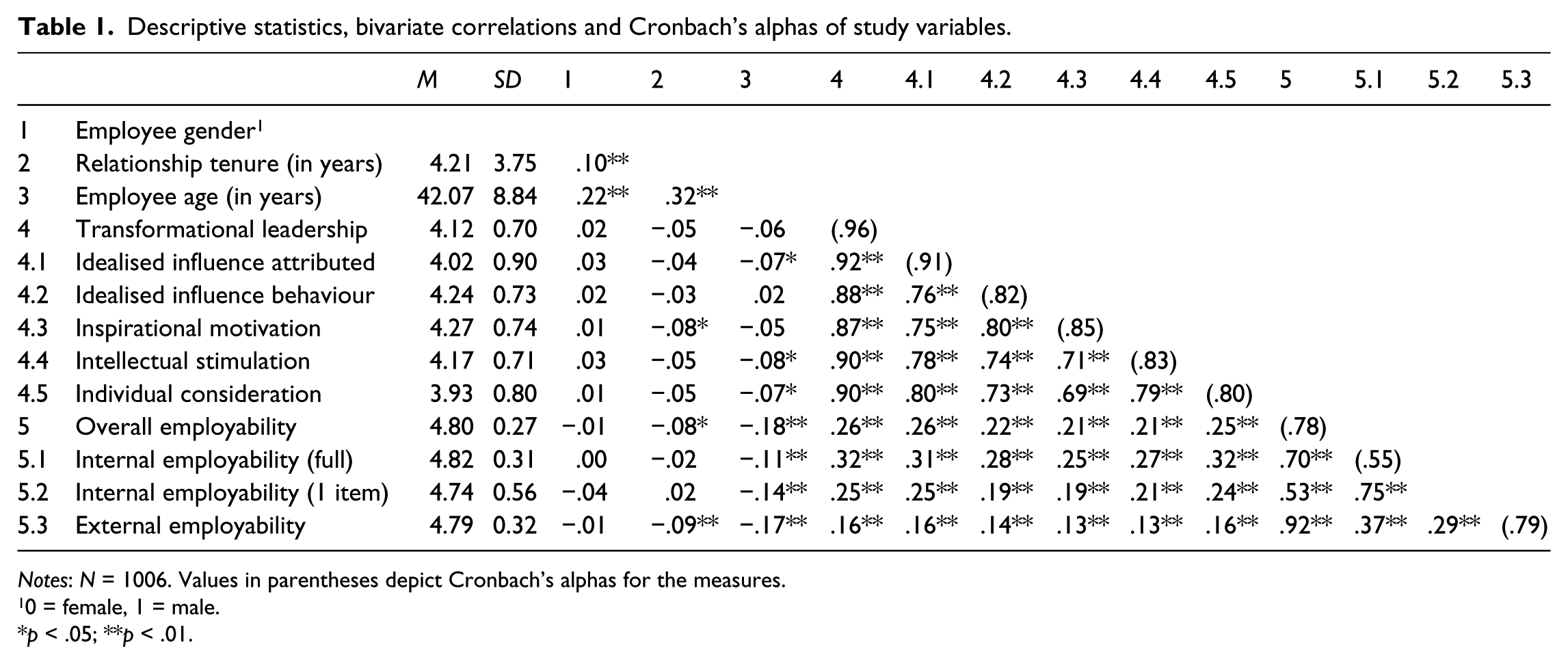
Notes: N = 1006. Values in parentheses depict Cronbach’s alphas for the measures.
10 = female, 1 = male.
p < .05; ** p < .01.
Results of regression analyses
We tested our main effect and moderation hypotheses applying hierarchical linear regression analyses. We mean-centred age and transformational leadership and calculated interaction terms using the mean-centred variables. We plotted significant interaction effects using a tool provided by Dawson (2014) and calculated simple slopes by means of a tool provided by Preacher et al. (2006). Results are shown in Table 2. Of the control variables entered in Model 1 of the regression analyses, employee gender was neither significantly related to internal employability (β = .00, p = .90 and β = –.03, p = .31 for the full and the one-item measure respectively) nor to external employability (β = .00, p = .91). Relationship tenure with one’s supervisor was unrelated to internal employability (β = –.02, p = .48 and β = .02, p = .52 for the full and the one-item measure respectively) and negatively related to external employability (β = –.09, p < .01).
Hierarchical moderated regression of employability on employee age and transformational leadership.

Notes: Shown are the results of hierarchical regression analyses: Model 1 includes the control variables employee gender and relationship tenure; Model 2 also includes the hypothesised predictor variables employee age (Hypothesis 1) and transformational leadership (Hypothesis 2); Model 3 also includes the interaction term between employee age and transformational leadership (Hypothesis 3).
N = 1006.
p < .10; * p < .05; ** p < .01.
Hypothesis 1 proposed a negative relationship between age and (a) internal and (b) external employability. Hypothesis 2 suggested a positive relationship between transformational leadership and (a) internal and (b) external employability. We simultaneously entered age and transformational leadership in Model 2 of the regression analyses. In support of Hypothesis 1a, the results demonstrate a negative relationship between age and internal employability (β = –.11, p < .01 and β = –.14, p < .01 for the full and the one-item measure respectively). In addition, transformational leadership was positively related to internal employability (β = .31, p < .01 and β = .24, p < .01 for the full and the one-item measure respectively), supporting Hypothesis 2a. In support of Hypothesis 1b, we found age to be negatively related to external employability (β = –.16, p < .01). In addition, transformational leadership was positively related to external employability (β = .15, p < .01), providing support for Hypothesis 2b.
Hypothesis 3 is concerned with the interaction effect between age and transformational leadership. Specifically, we hypothesised that transformational leadership moderates the negative relationship between age and perceived (a) internal and (b) external employability in a way such that this relationship is weaker for employees with a transformational supervisor. The interaction term between age and transformational leadership entered in Model 3 explained significant variance in internal employability (β = .05, p < .10 and β = .08, p < .01 for the full and the one-item measure respectively), but not in external employability (β = .01, p = .65). Hence, Hypothesis 3b was not supported. As can be seen in Figure 2, the negative relationship between age and internal employability was weaker for employees with a supervisor scoring high in transformational leadership (+1 SD; simple slope = –.00, t = –1.41, p = .16 and simple slope = –.00, t = –1.45, p = .15 for the full and the one-item measure of internal employability respectively) as compared with employees with a supervisor scoring low in transformational leadership (–1 SD; simple slope = –.01, t = –4.17, p < .01 and simple slope = –.01, t = –5.05, p < .01 for the full and the one-item measure of internal employability respectively). Thus, Hypothesis 3a was supported.

Transformational leadership buffers the negative relationship between employee age and internal employability.
Results of additional analyses using transformational leadership dimensions
Our measure of transformational leadership comprised several subscales. Given the opportunity to have a closer look at which leadership behaviours are most relevant, and because the interaction effect between age and overall transformational leadership in predicting internal employability was only marginally significant for the full measure, we repeated our analyses using the single dimensions of transformational leadership instead of overall transformational leadership to explore our hypotheses in greater depth.
Considered separately, idealised influence attributed, idealised influence behaviour, inspirational motivation, intellectual stimulation and individual consideration were each significantly and positively related to internal employability over and above employee gender, relationship tenure and employee age. When entered simultaneously in Model 2, idealised influence attributed (β = .12, p < .05), idealised influence behaviour (β = .11, p < .05) and individual consideration (β = .20, p < .01) significantly predicted internal employability (full measure), but inspirational motivation (β = –.04, p = .45) and intellectual stimulation (β = –.05, p = .38) did not. As for the one-item measure of internal employability, idealised influence attributed (β = .15, p < .05) and individual consideration (β = .20, p < .01) significantly predicted internal employability, but idealised influence behaviour (β = .02, p = .73), inspirational motivation (β = –.00, p = .94) and intellectual stimulation (β = –.05, p = .36) did not. As for external employability, when considered separately, idealised influence attributed (β = .15, p < .01), idealised influence behaviour (β = .14, p < .01), inspirational motivation (β = .13, p < .01), individual consideration (β = .15, p < .01) and intellectual stimulation (β = .11, p < .01) were significantly related to external employability. When entered simultaneously, however, none of the dimensions of transformational leadership were significantly related to external employability.
Results of moderation analyses using single transformational leadership dimensions to predict internal employability imply that the interaction effect between age and overall transformational leadership on internal employability was mainly driven by the dimensions of idealised influence attributed (β = .09, p < .01 for the one-item measure of internal employability), idealised influence behaviour (β = .08, p < .01 and β = .11, p < .01 for the full and the one-item measure respectively), and individual consideration (β = .05, p < .10 and β = .07, p < .05 for the full and the one-item measure respectively). The respective interaction plots mirror those depicted in Figure 2. The interaction effects between age and idealised influence attributed (for the full measure of internal employability), inspirational motivation and intellectual stimulation were not significant (p > .05). As for external employability, none of the interaction effects between the dimensions of transformational leadership and age were significant.
Discussion
A recent special report in The Economist (2017), titled ‘The new old’, describes why older individuals may carry on working for longer and how societies and organisations may benefit. In our view, fostering and sustaining employability is one important building block in retaining crucial employees in times when talent is scarce (Bieling et al., 2015). This article furthers knowledge of how leaders may help in shaping their followers’ perceived employability in general and their older followers’ perceived internal employability in particular. Based on survey data from 1006 employees, we replicated previous studies’ findings showing a negative relationship between age and employability (e.g. Froehlich et al., 2015; Kinnunen et al., 2014). More specifically, our findings show age to be negatively related to both internal and external employability, with both relationships being comparably strong. In addition, transformational leadership contributes to both internal and external employability, but, as hypothesised, the relationship with internal employability was stronger. Finally, we found that transformational leadership buffers the negative relationship between age and internal employability, but not between age and external employability. Additional analyses revealed that idealised influence and individual consideration play the most important role in internal employability. Specifically, when considered together, idealised influence attributed and idealised influence behaviour and individual consideration predicted internal employability above and beyond each other. Moreover, the interaction effect between age and overall transformational leadership was mainly driven by the dimension of idealised influence behaviour as well as by individual consideration. In summary, our results show that transformational leadership behaviours, in particular idealised influence and individual consideration, enhance perceived employability of followers independent of their age. Moreover, transformational leadership behaviours prevent a drop in internal employability for older employees.
Empirical implications
This study has several theoretical and research implications. Whereas the negative relationship between age and employability (e.g. Camps and Rodriguez, 2011; Froehlich et al., 2015; Peeters et al., 2016; Rothwell and Arnold, 2007; Van der Heijden, 2002; Van der Heijden and Bakker, 2011; Wittekind et al., 2010) as well as the positive relationship between transformational leadership and employability have been established in previous research (Camps and Rodriguez, 2011; Van der Heijden and Bakker, 2011) – both of which we also found in our study – previous studies largely missed the opportunity to examine both in conjunction. However, both personal and structural factors – and their interaction – are crucial in the development of perceived employability (Vanhercke et al., 2014). Moreover, with regard to structural factors, previous studies tended to examine societal predictors of employability (e.g. labour market; Hillage and Pollard, 1998) and organisational predictors of employability (e.g. career development programmes; Nauta et al., 2009), more or less overlooking structural factors related to the individual workplace. Hence, by considering age as a person-related factor and transformational leadership as a work-related factor in conjunction – and moreover by testing their relationships with both external and internal employability – our study meaningfully extends existing research on employability.
Whereas we could confirm previous studies’ findings of a negative relationship between age and employability, our results did not align with previous results that suggested age to be less strongly related to internal employability (Rothwell and Arnold, 2007). One explanation for the finding that age was by comparison strongly negatively related to internal and external employability in our sample might lie in the changing nature of careers: while in former times the functions and tasks of older employees varied only little, careers and jobs nowadays are characterised by frequent change for employees across all ages (Van der Heijden, 2002). As a result, specialised skills and knowledge might no longer be as valuable in helping to remain employed by the same employer, hampering internal employability perceptions of older employees.
In line with previous studies we found transformational leadership to be positively related to employability (Camps and Rodriguez, 2011; Van der Heijden and Bakker, 2011). That is, transformational leadership was positively related to both self-rated internal and external employability – with the relationship with internal employability being stronger. This is an important finding, demonstrating that the desired effects of increased internal employability in particlar, like lower employee turnover, may be strengthened by transformational leadership.
Furthermore, in our study transformational leadership not only positively predicted employability, but also buffered the negative relationship between employee age and internal employability. This finding supports the notion that a central element in the development of perceived employability is the interaction between personal and structural factors (Vanhercke et al., 2014).
In summary, our results imply that transformational leadership behaviours support the employability of employees of all ages and in addition prevent a drop in internal employability for older employees. Further analyses revealed that the two transformational leadership dimensions of idealised influence and individual consideration play the most important role in this regard. Idealised influence ‘reflects the ethical component of transformational leadership’ (Barling, 2014: 6), with supervisors engaging in idealised influence behaviours often being described as role models (Yukl, 2009). Role models are considered to be relevant for illustrating career or organisational paths for individuals to follow (e.g. Gibson, 2004). Moreover, idealised influence is associated with leaders’ moral commitment to the collective good rather than their own interests (Barling, 2014), for example considering their followers’ needs above their own (Avolio, 1999; Bass, 1985). Followers experiencing idealised influence behaviours may therefore expect their supervisors to support their career rather than hindering advancement for the sake of their own department. The behaviours included in individual consideration ‘define the quality of the leader–follower relationship and influence how followers will respond to the leaders’ idealised influence, inspirational motivation and intellectual stimulation’ (Barling, 2014: 7–8). In line with the idea of age-differentiated leadership approaches (Wegge et al., 2012), being sensitive to individual followers’ needs seems key to protecting older employees’ internal employability.
Limitations and directions for future research
We acknowledge this study’s limitations, which should be considered when interpreting the results. First, our findings are based on a cross-sectional data collection approach, which raises concerns about causality. Despite the fact that we followed theoretical assumptions that personal and situational factors predict perceived employability (Vanhercke et al., 2014), our data does not allow for such a causal interpretation. It might, for example, be the case that employees with high perceived employability in general and high perceived internal employability in particular make more favourable evaluations of their workplace characteristics, including their leader. While we share this limitation with the two existing previous studies on transformational leadership and employability (Camps and Rodriguez, 2011; Van der Heijden and Bakker, 2011), future research would greatly profit from using multiwave data to examine relationships over time.
Furthermore, our correlational findings regarding the relationship between age and employability are not suitable for drawing inferences on the development and change of employability across the working life span. Age-related differences in employability found in cross-sectional data may not reflect changes due to an intra-individual ageing process, but may rather be due to generational or birth cohort differences. Hence, research designs are needed that allow the isolation of the effects of age, generation and cohort. Furthermore, it seems crucial to understand the process that underlies the development of employability across the working life span (see also Wiernik and Wille, 2018). For instance, we argued that older employees might perceive their employability as reduced because of age-related decreases in factors such as learning self-efficacy (Kochoian et al., 2017) on the one hand, and because of age-related situational constraints such as fewer development opportunities and support (Maurer et al., 2003), challenges in hiring processes (Wanberg et al., 2016) and age discrimination (e.g. Bal et al., 2011; Finkelstein et al., 1995) on the other hand. Similarly, we argued that one way in which transformational leadership aids the development of employability is by enhancing employees’ self-efficacy. Future research should test these mediating mechanisms using suitable longitudinal designs.
Second, we obtained our data using employees’ ratings only (see e.g. De Cuyper et al., 2011; Kirves et al., 2014b; Rothwell and Arnold, 2007; Van den Broeck et al., 2014, for the same approach). Hence, our results may suffer from same source and common method bias (Podsakoff et al., 2012). However, perceived employability represents, per definition, a subjective evaluation (Vanhercke et al., 2014) which is best measured using self-ratings. Moreover, as employees act based on their own perceptions, self-ratings of employability are suggested to be of greater importance than the ratings of others (e.g. Froehlich et al., 2015; Kirves et al., 2014b). In addition, chronological age, albeit assessed via self-report, represents a rather objective variable, and the mean age, standard deviation and age range in our sample give us no reason to believe that participants did not provide their exact age. It should also be borne in mind that common method bias is not an alternative explanation for finding moderation effects (Siemsen et al., 2010) and therefore cannot explain the interaction we found between transformational leadership and age. To combat common method bias, future research may want to extend our study by including leaders’ self-rating of their leadership behaviour (see Felfe et al., 2004) or by examining teams (e.g. assessing the perceived employability of multiple team members reporting to the same supervisor).
Moreover, future research could gain by including objective outcomes of employees’ perceived employability, such as actual employee turnover or career success in terms of, for example, income. Additionally, further facets and understandings of the concept of employability as a multidimensional construct exist and have been addressed in diverse studies, including a competency-based approach (Van der Heijde and Van der Heijden, 2006), which has been used to gather supervisors’ ratings of individual employees’ employability in earlier studies (e.g. Van der Heijden and Bakker, 2011; Van der Heijden et al., 2009). Future research might benefit from studying employability from different angles in order to identify relevant personal, organisational and labour market-related variables, using different sources (e.g. supervisors) of employability ratings.
Third, this study has been conducted using a sample of white-collar workers in one organisation in Germany. Hence, the generalisability of our findings across different organisations, branches and cultures is limited. Furthermore, we found relatively high mean levels and small standard deviations for perceived employability, potentially due to the fact that the vast majority of our study’s participants had permanent contracts. The high values obtained for employability possibly resulted in underestimated coefficients because of ceiling effects (Wang et al., 2008). However, for both predictors included in our study, as well as for their interaction, we still found significant relationships with employability. Nevertheless, future studies should try to replicate our findings using more heterogeneous samples from a broad range of organisations and branches.
The low Cronbach’s alpha we obtained for the four-item measure of internal employability – which might be due to the fact that the single items tap into different aspects of internal employability – may have resulted in an underestimation of the correlations of age and transformational leadership with internal employability (see Schmitt, 1996). To counteract this potential threat to our results, we also computed all analyses regarding internal employability by using a one-item measure. Single-item measures, however, also have potential downsides (e.g. their reliability may be particularly low). To eliminate the potential risk of finding attenuated relationships due to low criterion reliability, future studies on internal and external employability may want to use different scales.
Practical implications
Given the manifold positive consequences of high internal employability for employees and organisations alike (De Cuyper et al., 2011; Van der Heijde and Van Der Heijden, 2006), protecting employees’ employability is a crucial goal in HRM (Peters and Lam, 2015). As we found transformational leadership to positively relate to employees’ perceived employability, our results imply that organisations should enhance transformational leadership behaviours among their managers. In order to achieve this, training and development programmes enhancing supervisors’ transformational leadership (see Abrell et al., 2011) should be implemented.
Leading an ageing workforce is one of the big challenges nowadays (Rosing and Jungmann, 2015), and in light of the changing nature of careers, ensuring ‘lifetime employability’ from career entry to career exit (Pruijt and Dérogée, 2010) becomes an important task for HRM. Our finding of transformational leadership buffering the negative relationship between employee age and internal employability implies that transformational leadership development programmes may be particularly useful in this regard. The finding that the buffering effect of transformational leadership is mainly due to idealised influence behaviour and individual consideration shows that leadership behaviours that are sensitive to followers’ individual needs are important to protect older employees’ internal employability and thus to help maintain critical talent, human capital and organisational knowledge. Individualised leadership behaviours that take each follower’s needs and values into account should therefore be particularly promoted (Rosing and Jungmann, 2015; Wegge et al., 2012).
Footnotes
Funding
This research received no specific grant from any funding agency in the public, commercial or not-for-profit sectors.