



Abstract
Despite the ongoing public debate about precarious working conditions in academia, there is only little evidence on working hours and overtime work for the group of (non-tenured) junior academics. We make use of unique longitudinal survey data on the occupational situation and careers of doctoral students and doctorate holders in science, technology, engineering and mathematics fields in Germany. We find that overtime hours are less pronounced among firm employees holding a doctorate and among postdocs than they are among doctoral students. This result is prevalent both between individuals in the cross-section and with regard to individual fixed effects panel estimations. In contrast to firm employees, overtime hours are in a considerable way positively associated with part-time contracts for doctoral students. Furthermore, our results reveal that individuals’ career orientation is positively associated with extra hours. In contrast, individuals with family responsibilities spend significantly fewer hours at work.
Motivation
Average working hours have considerably decreased since the early years of industrialization, when many individuals worked more than 14 hours per day (Ausubel and Grübler, 1995). However, there are recent hints of increasing dispersion in working hours. Whereas the share of part-time employees is becoming larger, there is also general evidence of excessively long working hours for a meaningful number of employees (Messinger, 2011, provides an overview for Europe).
In academia, long working hours have been often linked to academic culture and to a notion of researchers escaping from everyday life into the ‘ivory tower’ of science, where they can fully dedicate themselves to puzzle-solving activities. Over the past decades, however, the academic landscape has undergone a transformation from ‘ivory towers’ to entrepreneurial enterprises (Etzkowitz, 1998; Fritsch and Krabel, 2012). The present-day university is characterized by entrepreneurial and managerial practices, such as competition for external research funding, accountability, performance management and external evaluation (Hakala, 2009). The view of an academic has shifted from a disciplinary-based, autonomous, curiosity-motivated researcher to a transdisciplinary, application-oriented research manager or ‘knowledge worker’ striving for higher productivity and efficiency in research and teaching (Gibbons et al., 1994; Hakala, 2009; Kenny, 2017). Consequently, reasons to invest longer hours are no longer solely due to a pure devotion to research but are also essential in order to succeed careerwise in academia.
Many of the changes have also deeply affected the academics’ experiences of time and space with regard to their working lives (Anderson, 2006). The above-mentioned developments have contributed to ‘the speeding up and general acceleration of daily life and work’ (Adam, 2003: 96). Apart from studies that illustrate that long working hours are a relevant issue in academia (Jacob and Teichler, 2011; Link et al., 2008) including working at night and at weekends (Anderson, 2006; Bentley and Kyvik, 2012; Kinman and Jones, 2008; Sang et al., 2015; Wang et al., 2012), a growing number of studies report that increasing professional demands and raising expectations have led to the intensification of academic work, time pressure and higher levels of stress among academics (Hartman and Darab, 2012).
In more detail, this strand of research examines implications of long hours and increased workload demands for health, stress and work–life balance of faculty members. Qualitative interviews with academics reveal that this group of employees has to cope with time pressure and an increased stress level (Gillespie et al., 2001; Ylijoki and Mäntylä, 2003). Work overload is found to be one of the main sources of stress (Gillespie et al., 2001; Kinman, 2001). In addition, empirical results hint for a positive link between time invested in various activities and burnout among academics (Anderson, 2006; Lackritz, 2004). Including the non-academics working at universities as a comparison group, Torp et al. (2018) find that workaholism and work–family conflict more often occur among academics than technical and administrative personnel.
In our contribution, we focus on junior academics, doctoral students and postdocs, without a tenured position. We want to add to the literature by addressing the following two research questions: What factors are related to overtime (the difference between actual working time and contractual working time) of doctoral students compared to postdocs and firm employees holding a doctorate? To what extent are career transitions (e.g. from being a doctoral student to being engaged in postdoctoral employment inside academia or in private-sector firms) related to changes in overtime hours?
By using a unique longitudinal survey data set on the occupational situation and careers of German doctoral students and doctorate holders, focusing on STEM fields (Science, Technology, Engineering and Mathematics), we are able to compare the actual and contractual weekly working hours of different groups of highly educated individuals. We distinguish between doctoral students and postdocs and use firm employees (holding a doctorate) as a comparison group. Tracking the participants’ career development, we are able to observe the changes in the working time allocation after completion of doctoral studies. Thus, to our knowledge, we are the first to analyse working time habits of academics longitudinally next to a cross-sectional examination.
The remainder of the article is structured as follows: In ‘Working as a junior academic in Germany’ section, we present the institutional context of our study. In the section ‘Theoretical considerations and hypotheses’, we first derive hypotheses with respect to antecedents of overtime. Subsequently, we introduce our data and variables in the section ‘Data and variables’ before presenting our empirical findings in the ‘Results’ section. We discuss limitations of our study in the ‘Limitations’ section. The ‘Conclusion’ section concludes.
Working as a junior academic in Germany
In 2015, about 29,000 doctoral titles were awarded in Germany (Organisation for Economic Co-operation and Development (OECD), 2015). According to the German Statistical Office, in 2018, around 42,000 individuals were enrolled in doctoral studies in science and 31,000 in engineering (Statistisches Bundesamt, 2019). Unlike in many other countries, where doctoral studies are predominantly pursued by those individuals who want to start an academic career, the doctoral degree is of great value both inside and outside of academia in Germany (Konsortium Bundesbericht Wissenschaftlicher Nachwuchs, 2017). Many individuals consciously and voluntarily leave academia after receiving their doctoral degree and start a career in a private-sector firm, for instance. Insecurity in academic career prospects is considered to be an important reason, though (Ortlieb and Weiss, 2018).
There are different ways to work towards a doctorate with regard to the financial backing of doctoral students in Germany. In the German university system, it is very common for doctoral students to be employed on fixed-term contracts by a university on either a full-time or a part-time basis as research and teaching assistants (Konsortium Bundesbericht Wissenschaftlicher Nachwuchs, 2017). Weekly working time is explicitly determined in the employment contracts like it is for other employees of the private and public sector outside academia. In most cases, it is explicitly written into the contract or it constitutes an implicit norm that a part of the working time can be used for the doctoral student’s own research. It is prescribed by the so-called Wissenschaftszeitvertragsgesetz (academic employment law) that academic staff can be employed by German universities for an overall period of 12 years on temporary contracts, inclusive of up to 6 years before the completion of the doctorate. Wages are determined by collective agreements. Gross monthly pay of doctoral students with full-time contracts starts at about €3500 in the first year and increases to €3900 in the second and €4100 in the fourth year (salary grade TVL-13 in 2017). Hence, starting wages are comparable to those of university master graduates who begin a career in a private firm (Absolventa, 2017).
The traditional path is also compatible with employment at a university of applied sciences, research institutions (e.g. Fraunhofer, Helmholtz, Max-Planck) or as an external doctoral student in a private-sector firm, as long as the candidate’s dissertation project is being supervised by a university professor (Konsortium Bundesbericht Wissenschaftlicher Nachwuchs, 2017). Further institutions, such as the DFG (German Research Foundation), the European Union and the BMBF (Federal Ministry of Education and Research), also provide universities and research institutions with financial resources or directly offer scholarships for young researchers (Konsortium Bundesbericht Wissenschaftlicher Nachwuchs, 2017).
Apart from traditional doctoral studies, there is also a possibility to earn a doctorate by being involved in a structured doctoral programme at special Graduate Schools. Similar to the US case, candidates acquire important fundamental methodological skills, often in an interdisciplinary atmosphere. Usually, doctoral candidates in structured doctoral programmes are funded through scholarships or are employed by the involved institutes as research assistants (Konsortium Bundesbericht Wissenschaftlicher Nachwuchs, 2017).
Theoretical considerations and hypotheses
Employees at various stages of their careers in different jobs might have various motives for spending extra hours at work.
At the early career stage as a doctoral student, working unpaid overtime hours may act as a signalling device (Spence, 1973). If an employee’s productivity is not completely observable, working time can act as an indicator for that employee’s promotability (Golden and Altman, 2008). In addition, the adverse selection model states that employers purposely create a long working hours culture as a mean to separate potentially less productive workers from more productive ones for hiring or promotion decisions (Rebitzer and Taylor, 1995). Landers et al. (1996) show that this process may result in a rat race equilibrium with promotion decisions based on the amount of overtime hours. They also provide corresponding empirical evidence for professional jobs such as law firms and academic departments. In this sense, we assume a negative link between workers’ productivity and the cost of working additional hours. For junior academics, performing extra work beyond the contract specifications, then, will lead to a higher publication output which acts as a signal for the scientific community with regard to academic ability and commitment towards an academic career. We consider this argument to be even more relevant for postdocs than it is for doctoral students since positive signals to the scientific community are essential in order to increase chances for a tenured position.
Analogously to the group of junior academics, the considerations of the signalling theory can also be adopted to the group of firm employees holding a doctorate. An employer outside academia considers additional working hours to be a credible signal of a worker’s underlying productivity, motivation and loyalty (Golden and Altman, 2008). Hence, overtime hours could increase chances of future promotions, and pay rises, and could decrease the risk of dismissal. We think signalling considerations are less relevant compared to the group of doctoral students and postdocs, though. Since doctoral students are at a more critical point in their careers, they have to make more effort in order to increase their chances of a new job after earning the doctorate. The incentive may be the strongest for those doctoral students who pursue an academic career, because the path to a professorship is considered to be more selective.
In addition, job insecurity and scarcity of job alternatives may force employees, particularly at early career stages who have to work overtime in order to prove themselves (Stewart and Swaffield, 1997; Weber and Zimmert, 2017). Thus, doctoral students who start their first job after their university degree may be more willing to accept working overtime compared to employees at later career stages. In addition, successfully completing doctoral studies also means obtaining a valuable educational degree that can act as an additional incentive for doctoral students to work overtime. Thus, in general, we assume that firm employees will have fewer incentives to work extra hours compared to doctoral students. In the case of status changes (from doctoral student to firm employee), overtime hours might increase due to initial training in the short run, though.
Apart from aforementioned considerations, academics are presumed to derive satisfaction from the work itself (Feld et al., 2015; Throsby, 1994). Stephan (2012) shows that a factor academics are motivated by is the ability to solve puzzles. Roach and Sauermann (2010) find that PhD students’ ‘taste of science’ predicts their employment sector. Thus, we assume doctoral students and postdocs to have a particular intrinsic motivation/taste for their jobs and work overtime even if not paid.
These considerations with regard to the relative relevance of overtime work between the three groups can be reinforced by differences in career incentives. According to tournament theory (Lazear and Rosen, 1981), the number of winner prizes (future promotions, etc.) within a firm is limited. Thus, employees enter into a competition between each other, getting an incentive to increase their performance in order to achieve higher future rewards (e.g. future promotions to better positions). In academia, tenured positions for postdocs are scarce (Cyranoski et al., 2011). Furthermore, academic careers often have the character of an up-or-out tournament (Ghosh and Waldman, 2010). If a postdoc does not manage to get a tenured position within a limited period of time, this probability will decrease substantially afterwards. Thus, the relatively high career insecurity in academia may increase the incentives to perform additional hours in order to improve the chances of winning the career tournament. Whereas postdoctoral researchers are more focused on academic careers and compete directly with other postdocs for the limited tenured positions in academia, doctoral students are far less restricted in their career choices. We therefore assume postdoctoral researchers to do more overtime compared to doctoral students. Similar to postdoctoral researchers, firm employees holding a doctorate also compete with their colleagues for the few promotions within a firm if internal labour markets in the sense of Doeringer and Piore (1971) are relevant. Thus, this group also has incentives to work additional hours in order to increase their chances of winning a certain promotion tournament. Nevertheless, the incentives may be less strong compared to those of postdocs. Due to the aforementioned characteristics of a career tournament in academia, the costs involved are relatively high compared to a career tournament in a firm where employees holding a doctoral degree can participate in a greater variety of job or career tournaments.
Apart from more individual-driven (voluntary) reasons for performing overtime, it is also conceivable that an employer demands working extra hours. Besides, the specific working culture prevailing in academia requires academics to be fully committed to their jobs and to sacrifice private interests for professional ones (Anderson, 2006; Ylijoki, 2013). Due to contractual constraints and competition for tenured positions, doctoral students and postdocs in particular may experience higher time pressure, forcing them to work in excess of their contracts.
The aforementioned considerations lead to
Hypothesis 1a: Postdoctoral researchers do more overtime compared to doctoral students.
Hypothesis 1b: Firm employees (holding a doctorate) do less overtime compared to doctoral students.
Next to job status, we consider the type of employment contract (part-time vs full-time employment) to be an important driver of overtime hours. In academia, this employment form plays a substantial role, since there are often only part-time positions in particular for doctoral students (Jacob and Teichler, 2011). Consequently, in Germany around 38% of research assistants at universities have part-time contracts.
Following the human capital theory (Becker, 1962), working hours constitute an investment in human and social capital. Since part-time employees have fewer hours at their disposal to acquire human capital, they could suffer future economic disadvantages (e.g. lower promotion probability and future wages) compared to full-time employees. A number of studies have confirmed negative consequences of part-time employment on the opportunities to learn on the job (Billett, 2001) and social relations at work (Walsh, 2007). With respect to overtime patterns of part-time compared to full-time employees, there is hardly any empirical evidence, in particular for the subsample of junior academics. Using representative data of the German Socio-Economic Panel (SOEP), Zapf (2015) finds a significant negative correlation between part-time employment and unpaid overtime hours, but a positive association between part-time employment and paid overtime in general.
Since academic and non-pay-scale firm employees are not compensated for overtime, we expect a negative link between part-time employment and overtime in general. Depending on the job status, the negative consequences of part-time employment could turn out to be different. At earlier career stages, part-time employment could have more detrimental effects compared to later career stages. As doctoral students have a longer future employment period compared to employees holding a doctorate, foregone human capital might be associated with greater financial burdens.
Besides, part-time employment at later career stages could be related to different motives. Postdocs and firm employees could enter part-time employment because of family obligations or personal preferences. Doctoral students, however, could potentially be forced into part-time employment because of the lack of full-time positions, as is often the case in academia (Jacob and Teichler, 2011). Following a simple costs-utility perspective, it could be worthwhile for part-time employed doctoral students to invest in longer hours in order to achieve higher utility in future (e.g. a full-time position as a postdoc or outside academia) due to completion of their doctoral studies. Dörre and Neis (2008), indeed, state that most doctoral students accept this condition of part-time and fixed-term employment because they perceive this period to be transitionary and consider it necessary in order to improve their situation in future.
Hypothesis 2: Part-time employment positively moderates the relationship between the status as doctoral student and overtime.
Work represents a central part of an individual’s life (Kahn, 1990; Lloyd et al., 2011). Nevertheless, there is much inter-individual heterogeneity with respect to the importance of work for one’s self-concept. Work identity may explain such heterogeneities. Walsh and Gordon (2008) define an individual’s work identity as ‘. . . a work-based self-concept, constituted of a combination of organizational, occupational, and other identities that shapes the roles a person adopts and the corresponding ways he or she behaves when performing his or her work’ (p. 47). Empirical findings demonstrate that individuals with a strong work identity devote more time to their work compared to those individuals with a weak work identity (Brett and Stroh, 2003; Greenhaus et al., 2012; Major et al., 2002). According to Walsh and Gordon (2008), organizations and occupations play a crucial role in the formation of work identity. In the case of junior academics, the occupational identity may be an important source for the development of work identity. In this vein, Ashforth and Kreiner (1999) see occupational identity as ‘the set of central, distinctive and enduring characteristics that typify the line of work’ (p. 417). Literature on occupational research shows that occupations are characterized by their own norms, values and culture (Trice, 1993; Van Maanen and Barley, 1984). Junior academics’ career orientation and the extent to which individuals prefer a special career path may be an expression of their occupational identity and may enhance a stronger work identity. Thus, we expect individuals with ambitious career goals to show more effort and, consequently, to be more inclined to spend more time at work in order to achieve these goals.
Another expression – or one dimension – of one’s work identity might constitute an individual’s work involvement. Lodahl and Kejnar (1965) define work involvement as the degree of importance of work in an individual’s total self-image. Empirical studies have confirmed the positive relationship between working hours and job involvement (Major et al., 2002; Wallace, 1997). Although junior academics are thought to have a relatively high level of work involvement, there can still be much heterogeneity within this group. Hence, a higher level of work involvement may strengthen the salience of individuals’ work identity and lead individuals to more easily identify themselves as members of their organization or occupation. Interviews with academics demonstrate that those who did not pursue the professoriate or had doubts to reach it, often reported unwillingness to accept the long-hours culture (Baker, 2010). Because individuals tend to invest more time in those activities that enhance their social identities the most (Ng and Feldman, 2008: 856), we hypothesize
Hypothesis 3: Junior academics with a more pronounced work identity will do more overtime.
We predict a reversed association for academics with family identity. As individuals take on different roles that compete for a person’s limited amount of time, a time-based role conflict can arise. Empirical evidence from social psychology indicates that individuals with multiple salient identities find it hard to satisfy all identities simultaneously in an equal way (Day and Chamberlain, 2006). Thus, time spent on family activities cannot be dedicated to work activities (Greenhaus and Beutell, 1985; Greenhaus et al., 2012). Toutkoushian and Bellas (1999) indeed show that academics with more children spent fewer hours per week at work than those with fewer children. Those individuals who strongly identify themselves with the family role or those who put more emphasis on personal interests could be confronted with a time-based role conflict and make hour restrictions to the disadvantage of work.
Hypothesis 4: Junior academics who have family responsibilities will do less overtime compared to colleagues without family responsibilities.
Data and variables
Data
We conducted a longitudinal online survey among young academics in STEM disciplines (science, technology, engineering and mathematics) which was carried out between 2014 and 2017 and consists of overall six survey periods at 6-month intervals. With respect to survey strategy, we first contacted technical universities, research institutions and associations in the field of natural sciences and engineering in Germany, asking them to forward information about our survey to potential participants. Besides, we collected information on e-mail addresses of potential doctoral students and postdocs working at German technical universities and research institutions and directly contacted these individuals by sending them information on our project. We complemented activities with regard to data collection by directly contacting possibly relevant individuals via social media and other career platforms in order to extend our sample to firm employees holding a doctoral degree, who are intended to act as a control group. Participants who completed a questionnaire had the opportunity to take part in a lottery with 123 cash prizes (€20 to €500) after each survey period.
Participants, first, include doctoral students with employment contracts at universities or research institutions. We only consider doctoral students who have been working on their doctoral studies for at least 1 year. This restriction should guarantee that the doctoral students have already gained a realistic picture of academic work. Second, we survey postdocs working in academia and employees who already hold a doctoral degree in a STEM discipline and who work outside academia, as we are interested in contrasting the working hours of these three groups. We refer to the latter category as firm employees hereafter. The consideration of employees who left academia after earning the doctorate constitutes a unique feature of our data set and enables us to contrast two different career systems appropriately. We restrict our sample to individuals with either part-time contracts of a minimum of 17.5 weekly hours or full-time contracts of up to 42 weekly hours. 1 Besides, we exclude those participants who are not employed or are on parental leave at the time of the survey.
These restrictions lead to a sample of n = 6165 observations of 2148 individuals over the six waves of the survey. The majority of observations in our sample are from doctoral students (3026); 1615 are postdocs working at universities or research institutions and 1524 are (firm) employees holding a doctorate. 2
Variables
Dependent variable
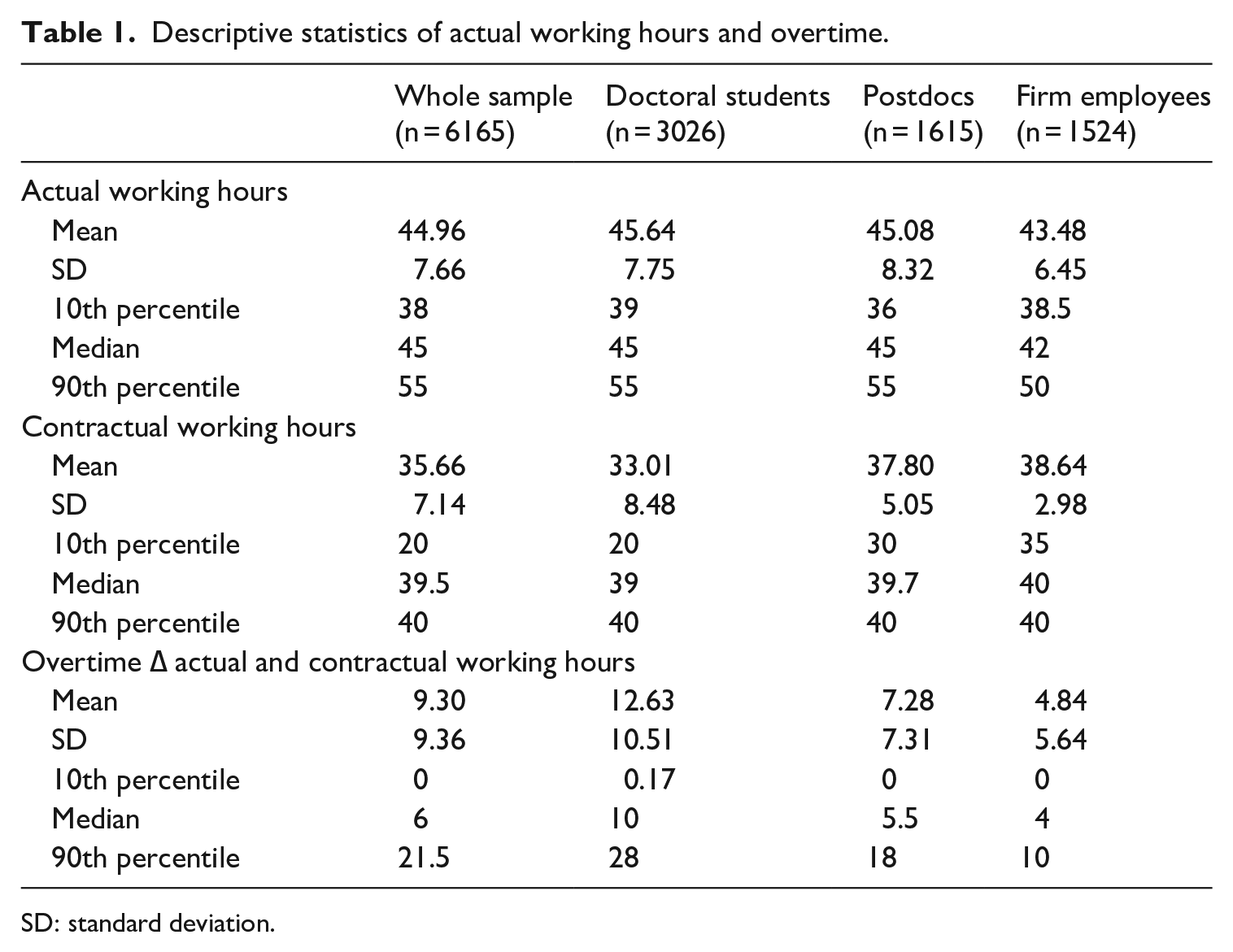
Actual working hours are based on participants’ self-reports of the number of average hours worked in a week (paid or unpaid overtime work included). Doctoral students (45.64 hours) and postdocs (45.08 hours) report similar actual weekly hours on average, whereas the mean is somewhat lower for the group of firm employees (43.48 hours). Percentiles show a considerable variation in each group. One of 10 respondents reports at least 55 hours of weekly working time (see Table 1). We also ask our respondents to state the number of hours as provided by their contract, without any overtime work. On average, the participants report having a contract of 35.66 hours. Among postdocs and employees holding a doctorate, full-time contracts are much more common compared to among doctoral students. Within the group of doctoral students, however, the dispersion regarding contractual hours is much higher and ranges between 20 (10th percentile) and 40 hours (90th percentile).
Descriptive statistics of actual working hours and overtime.
SD: standard deviation.
We define overtime by subtracting the contractual working hours from the actual working hours. The latter exceed those of contracts by an amount of 10 hours on average. The number is less pronounced for firm employees (5 hours) than for postdocs (7 hours) or doctorate students (13 hours). One in 10 respondents reports even more than 22 hours of overtime work per week.
Independent variables and controls
Table 2 displays the descriptive statistics of study variables (see Table 9 in Appendix 1 for a detailed description of our variables).
Descriptive statistics of independent variables.

SD: standard deviation.
We define those participants as part-time employees (1 = yes) who have a contract of less than 35 hours. In addition, we know whether our participants manage or coordinate co-workers or a team, or whether they have the authority to hire and dismiss employees. We combine this information into a dummy variable called managerial responsibilities (1 = yes). We also control for the job focus ranging from 1 (very basic job/research contents) to 6 (very applied or practical job/research contents). We also consider demographics such as age, gender as well as the family responsibilities. We account for the incidence of children (1 = yes) and whether the respondent has a partner (1 = yes).
In addition, we consider the participants’ work identity. We make use of two dimensions: First, we use information on participants’ career orientation. In every survey wave, the respondents are asked about their career intentions via the following question: ‘How much do you aspire to the following career goals: (i) professor and (ii) executive function in industry?’ each on a 6-point rating scale ranging from 1 (not at all) to 6 (totally). Second, the participants assess in each of the six survey waves their work involvement (Gould, 1979) in the current job on a 6-point rating scale with the three items ‘I identify strongly with my chosen line of work’, ‘I get a sense of pride from my chosen line of work’ and ‘Sometimes I wish I had chosen a different career field’ (reverse coded). The reliability of this scale is regarded as being acceptable (Cronbach’s α = 0.72). 3 By averaging and standardizing the items, we construct a score for work involvement. Finally, we include dummies for the survey waves in order to capture the role of aggregate trends.
Empirical strategy
Our empirical analysis is quite straightforward. We start by examining potential determinants of overtime hours cross-sectionally applying pooled ordinary least squares (OLS) estimations, which can be written as

As described above, we distinguish between the job status of doctorate students (reference group), postdocs and firm employees. The set of other job characteristics, demographics and individuals’ career orientation is denoted by
In addition, we apply estimations for subgroups of employees with regard to job status in order to explore possible differences in the relevance of determinants of overtime between doctoral students, postdocs and firm employees. We also do some robustness checks, including focusing on the direct transitions to becoming a postdoc or firm employee by applying a difference-in-differences approach.
Results
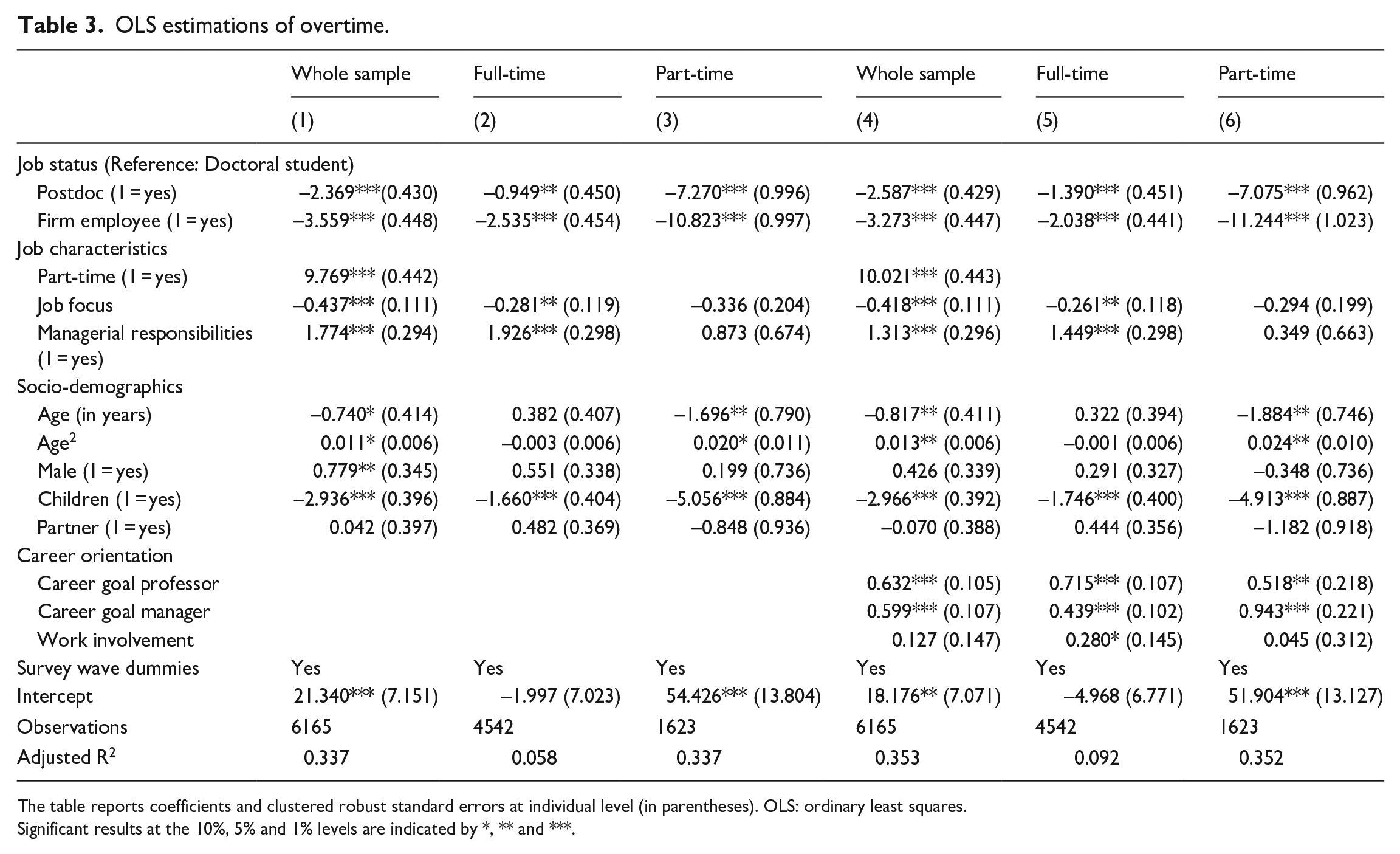
We start our empirical part with analyses regarding the determinants of overtime hours. Models 1 and 4 in Table 3 present the results of OLS estimations on weekly hours of overtime work as the dependent variable for the whole sample.
OLS estimations of overtime.
The table reports coefficients and clustered robust standard errors at individual level (in parentheses). OLS: ordinary least squares.
Significant results at the 10%, 5% and 1% levels are indicated by *, ** and ***.
Contrary to our Hypothesis 1a, the results reveal that postdocs do significantly less overtime compared to the reference category of doctoral students of about 2 hours per week. Doctorate holders working in a firm even do 3.6 hours less overtime compared to doctoral students. This result is in line with our Hypothesis 1b. Due to the temporary nature of doctoral studies, doctoral students may be under higher pressure to finish their studies in a timely manner and to qualify themselves for the next career stage.
Regarding job-related variables, we find support for our Hypothesis 2. In detail, we observe a considerably positive relationship between part-time employment and overtime hours. Participants who have part-time contracts perform on average around 10 extra hours per week. The effect appears quite large in spite of the fact that there is only unpaid overtime and thus no direct financial incentives to work longer hours in academia.
In order to check whether the results are different for full-time and part-time employed participants, we performed additional estimations. The corresponding results can be found in models 2 (5) and 3 (6) of Table 3. For the group of full-time employees, the results are roughly in line with the aforementioned observations. The corresponding coefficients are much smaller, though (models 2 and 5). When looking at the group of the part-time employed in model 3, the differences appear to be much larger. In more detail, part-time employed postdocs report working around 7.3 hours less overtime and firm employees even 10.8 hours compared to part-time employed doctoral students. Hence, differences across the three groups are driven by part-time employment in particular. Additional estimations with interaction terms (Table 7, model (2), in Appendix 1) confirm that part-time employment positively moderates the link between the status as doctoral students and overtime.
As further antecedents of overtime hours, we find that individuals who have managerial responsibilities work significantly more overtime.
We add important dimensions of work identity in models (4) to (6). As expected, individuals’ career orientation, incorporated by the two career goals of professor and manager, is strongly positively associated with overtime work. For work involvement and overtime hours, we only find a weak statistical relationship for the group of full-time employees. Thus, the results lend support to Hypothesis 3.
Looking at family responsibilities, participants with a child are working around 3 hours less in excess of their contracts compared to their childless co-respondents. The coefficient is much smaller for the group of full-time employees (1.7 hours) compared to the group of part-time employees (5 hours). This result is in line with our Hypothesis 4. Since the relationship between having a child and overtime hours might vary with participants’ gender, we additionally interact having a child with gender. The significant interaction term reveals considerable gender differences. Interestingly, the results (see Table 7 in Appendix 1) show that only females work less overtime hours, if having a child, whereas there is no relation for males. 4
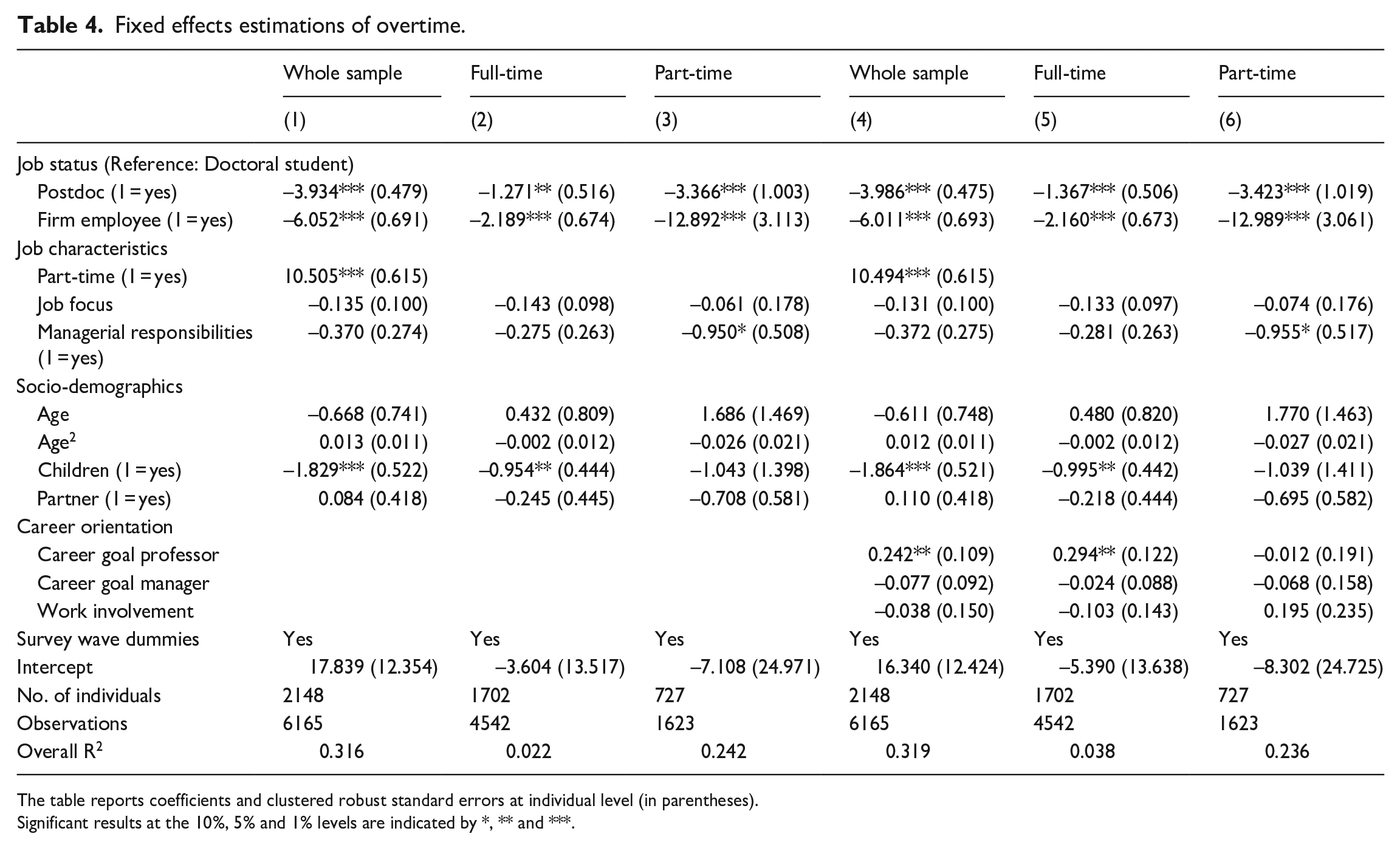
The aforementioned results reveal differences between individuals. As described above, we complement our analysis with corresponding person fixed effects panel estimations in order to capture the possible relevance of within-individual changes over time. The results are presented in Table 4 (models 1–6). The main results are notably robust. Not surprisingly, the significance level of some control variables with little within-person variation decreases. However, more importantly, the results coincide with the aforementioned pooled OLS models with respect to career stage and part-time employment. The coefficients for both job status variables (postdocs and firm employees) are even larger compared to the OLS models. These results are identified by transitions from being a doctoral student to becoming a postdoc (n = 157) and those becoming a firm employee (n = 55). Focusing on the transition directly before and afterwards confirms the results as shown by average overtime hours and corresponding difference-in-differences estimation (Figure 1 and Table 8 in Appendix 1).
Fixed effects estimations of overtime.
The table reports coefficients and clustered robust standard errors at individual level (in parentheses).
Significant results at the 10%, 5% and 1% levels are indicated by *, ** and ***.
In addition, having a child reduces individuals’ overtime hours and an increasing career goal to become a professor increases overtime work.
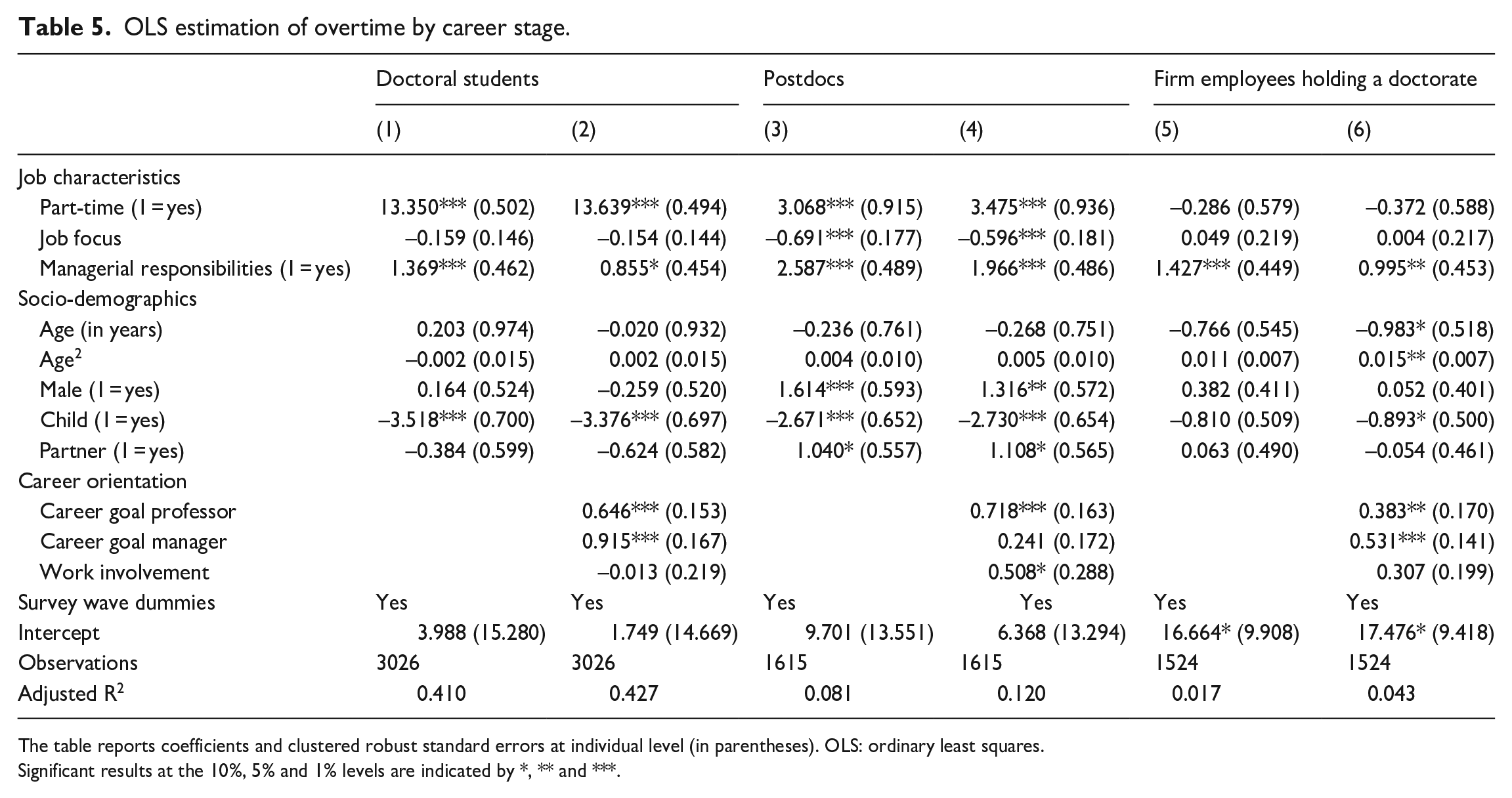
In a next step, we perform group-specific estimations with respect to career status. Tables 5 and 6 present the corresponding results for the three groups of doctoral students, postdocs and firm employees with regard to respective OLS and person fixed effects estimations.
OLS estimation of overtime by career stage.
The table reports coefficients and clustered robust standard errors at individual level (in parentheses). OLS: ordinary least squares.
Significant results at the 10%, 5% and 1% levels are indicated by *, ** and ***.
Fixed effects estimations of overtime by career stage.
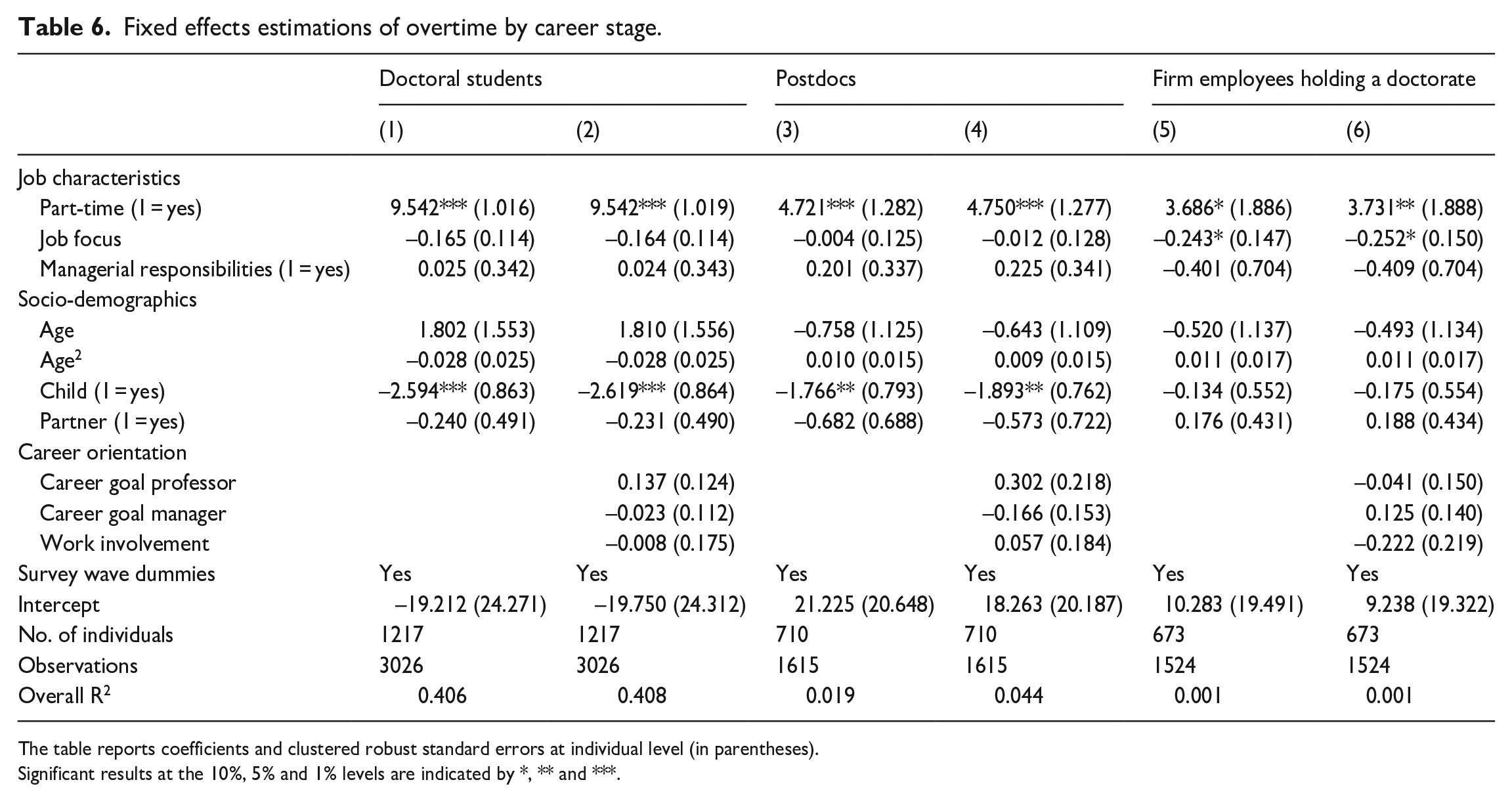
The table reports coefficients and clustered robust standard errors at individual level (in parentheses).
Significant results at the 10%, 5% and 1% levels are indicated by *, ** and ***.
When looking at the three groups separately, we observe substantial differences regarding the effect of part-time employment as also mentioned above in the cross-section. While we do not find any statistically significant relationship between part-time employment and overtime hours among firm employees (Table 5, models 5 and 6), the great positive link between the two variables prevails for the group of doctoral students (models 1 and 2). More precisely, part-time employed doctoral students report working around 14 extra hours more compared to their full-time employed colleagues. These results again stress the finding that part-time employed doctoral students are at high risk of working in excess of their contracts.
The correlation between overtime hours and working time mismatch (defined as the difference between actual and preferred working hours) might be interpreted as an indicator of involuntary overtime among academic employees (Wooden et al., 2009; Wunder and Heineck, 2013). Indeed, working time mismatch is positively correlated for with being a doctoral student (p < 0.000). For firm employees, a significant negative correlation can be observed with respect to working time mismatch, whereas we find only a weak negative correlation with being a postdoc (p = 0.042). Besides, the correlation between overtime and hours mismatch is remarkable (r = 0.45 for the whole sample). 5 We cannot distinguish involuntary overtime hours stemming from pressure applied by the supervisor and ‘self-made’ pressure to improve an individual’s own career chances, though.
When additionally controlling for individual career orientation (see models 2, 4 and 6 of Table 5), we find that doctoral students with academic and non-academic career goal of manager do more overtime. Note that the career goals professor and manager are not mutually exclusive. Within the group of postdocs, however, stronger academic career interests are associated with more overtime hours. As the path to a full professorship is highly selective and competitive, an individual has to make more effort in order to achieve this specific goal. Interestingly, both career goals and work involvement are also positively linked to overtime hours within the group of firm employees holding a doctorate. 6 One explanation for the positive link between the career goal professor and overtime hours may be the relatively high permeability between the career systems in the STEM fields and engineering, in particular. Professors in engineering are often appointed from the private sector and thus, switches between the career systems are common.
Besides, we check whether the between-person relations also hold for corresponding person fixed effects estimations (see Table 6). Some differences to the pooled OLS models occur with respect to part-time employment. Contrary to the pooled OLS model, changes from full-time to part-time employment are associated with an increase in overtime hours for the subgroup of firm employees, too (see models 5 and 6). In addition, no significant link can be found between having a child and overtime hours for this group in contrast to employees in academia. This hints for a greater authority of working hours for academics.
Limitations
In sum, we present some new evidence on the working hours of young academics. Due to data limitations, we are not able to explore long-term consequences in working time stemming from job transitions. It is worth mentioning, though, that doctorate holders tend to reduce their working time when starting a job in a firm, although individuals have to familiarize themselves with somewhat different tasks compared to tasks in academia. It would be interesting to examine the further development over a longer observation period.
Since our survey data are based on subjective reports of our respondents, potential biases associated with working time should be taken into account. Contrary to academia, where no detailed records are kept on working hours, employers in the private sector often systematically register working hours. Furthermore, intra-firm-specific regulations on overtime work and the existence of works councils could prevent employees from accumulating too many extra hours. Hence, those participants who have started a job in a firm could assess their working hours more precisely compared to participants who remain within academia. However, Jacobs (1998) provides evidence for a strong correlation between self-reported weekly working hours and workweek hours calculated from departure-and-return-time. He only finds deviation between the two measures at the upper and lower extremes. Thus, he concludes that ‘the standard self-reported measure of working time is a reasonably reliable indicator of time use’ (Jacobs, 1998: 51).
Apart from the issue of limited information on overtime monitoring, another limitation concerns the lack of information on additional potential determinants of overtime compensation. While exempt employees’ overtime hours are often compensated with higher base salaries, non-exempt employees are compensated by additional pay or vacation. Since different overtime compensation creates different incentives, this information would enable us to derive more nuanced conclusions. Additional information on the type of institution and its location/region would help to capture the relevance of both different working cultures and research policies. Unfortunately, we are not able to control for these variables with our data. We neither have data on tenure track positions, which may considerably affect the motivation to work long hours in academia to meet target agreements. However, our conjecture is that tenure track positions are not of great relevance for our sample since our survey was conducted between 2014 and 2017. During these years, there were only few first tenure track junior professorships at certain universities in Germany. Besides, our study focuses on STEM fields. Although transitions from doctoral students to postdocs and firm employees are prevalent in all academic fields, patterns might differ in other fields such as the humanities.
At first glance, one could argue that individuals can choose the number of working hours more autonomously in academia. Indeed, the fixed effects results with regard to having children hint for this intuition. However, we are not able to differentiate explicitly between involuntary and discretionary overtime. Our results also reveal that academic employees report mismatches in working hours, and this mismatch is considerably correlated with overtime. Our perception is that supervisor pressure plays a smaller role than in private-sector firms. Instead, junior academics are assumed to feel pressure to ensure a follow-up temporary contract or to qualify for a tenured position. Previous qualitative research highlights that working hours in academia are rather a result of individual choice and of external constraints, in particular due to the normative pressures rooted in the cultural and structural academic workplace (Sang et al., 2015). Further research should address this issue in more detail.
Notwithstanding the aforementioned limitations, it has been worthwhile conducting our own survey, because general and meaningful existing data are very limited in corresponding sample size. The SOEP, a representative yearly survey of people living in Germany, also asks respondents for actual, contractual and desired working hours. Although some thousands of individuals are interviewed, it is not easily possible to separate young academics, and only about 300 responding full-time employees (anywhere!) with a master’s degree in the corresponding age group in the wave for the year 2013 are captured, for instance.
Conclusion
By using unique longitudinal survey data on careers of German doctoral students and doctorate holders, we explore antecedents of overtime. Our results enable us to draw the following conclusions:
First, our results highlight that overtime is particularly relevant for doctoral students with part-time contracts. While previous research often focusses on working hours of full-time employed academics, we also consider part-timers in our study since this form of employment is widespread in academia. Generally, the functions of part-time employment and the individual motives to enter this form of contract appear to be different inside and outside of academia. Part-time employment in the private sector, especially for the highly educated group of doctoral holders, serves rather as a temporary flexibility instrument that enables individuals to better combine their working and private life domains after certain life events, such as child birth. In academia, the lack of funding and the surplus of doctoral students in some disciplines (e.g. chemistry or life sciences) often do not leave doctoral students any choice other than to accept part-time employment. Other studies highlight that many doctoral students readily accept this temporary period of precarious employment (Dörre and Neis, 2008). In this sense, long working hours during this phase of the career may be interpreted as an investment in future employment possibilities either within or outside academia. Indeed, Ortlieb and Weiss (2018) show that spending more time on research helps to reduce academic career insecurity. However, Castelló et al. (2017) show that part-time employed doctoral students are at a higher risk of abandoning their studies and have difficulties with socialization into the researcher community. Thus, future empirical work has to pay more attention to this type of enrolment. Besides, further empirical work is required in order to scrutinize as to what extent overtime is conducive to career development. The evaluation of excess work is closely linked to the question whether junior academics are able to devote enough time to activities that foster their careers. As further avenue for research, it may be interesting to follow doctoral part-time employed students over a longer period and to elaborate whether they manage to get out of precarious employment after completion of their doctoral studies and to reduce the gap between actual and contractual hours.
Second, our findings reveal that overtime varies with the career stage. More precisely, doctoral students work significantly more overtime hours compared to firm employees holding a doctorate. A higher urgency among doctoral students to accumulate career-enhancing human capital could be a possible explanation. We examine this issue by providing longitudinal evidence on factors associated with the supply of overtime for the group of junior academics working inside or outside of academia. Contrary to previous research that solely examined working hours at one point of time, we are able to follow our participants’ career development. The longitudinal structure of our data set enables us to observe the changes in overtime hours after completing doctoral studies and starting a new position as a postdoc in academia or as a firm employee. This is an important extension to the previous empirical evidence since we can show that at higher ranks, junior academics inside and outside academia succeed to reduce overtime. Previous studies highlight a high level of stability and persistence of existing excessive working time regimes and systematic difficulties with changing such regimes (Blagoev et al., 2018; Blagoev and Schreyögg, 2015; Kärreman and Alvesson, 2009; Kellogg, 2011). Our findings contribute to this strand of literature by providing evidence for the variability of overtime work at the turning points of individuals’ careers. Our results are also in line with empirical work on effects of job changes on working hours (Blundell et al., 2008; Böheim and Taylor, 2004; Euwals, 2001; Gong and Breunig, 2014). Their findings illustrate that job movers adjust their actual work hours to a much larger extent in the preferred direction than job stayers. A better match between individual preferences and job characteristics among postdocs and (firm) employees compared to doctoral students (Kristof-Brown et al., 2005), higher job-specific human and social capital, or less precarious employment conditions compared to the doctoral studies could be mentioned as possible explanations.
Third, we find that more career-oriented individuals are performing more extra hours while individuals with family responsibilities spend significantly fewer hours at work. This result is in line with the findings of Toutkoushian and Bellas (1999) who show that caring responsibilities are associated with constraints in working hours. Hence, preference differences between individuals have to be taken into account. Future research may therefore address preference-specific path dependencies of previous working hour contracts and overtime hours in early (academic) career and future career progress within and outside academia.
Footnotes
Appendix 1
Variable definitions and operationalisations.
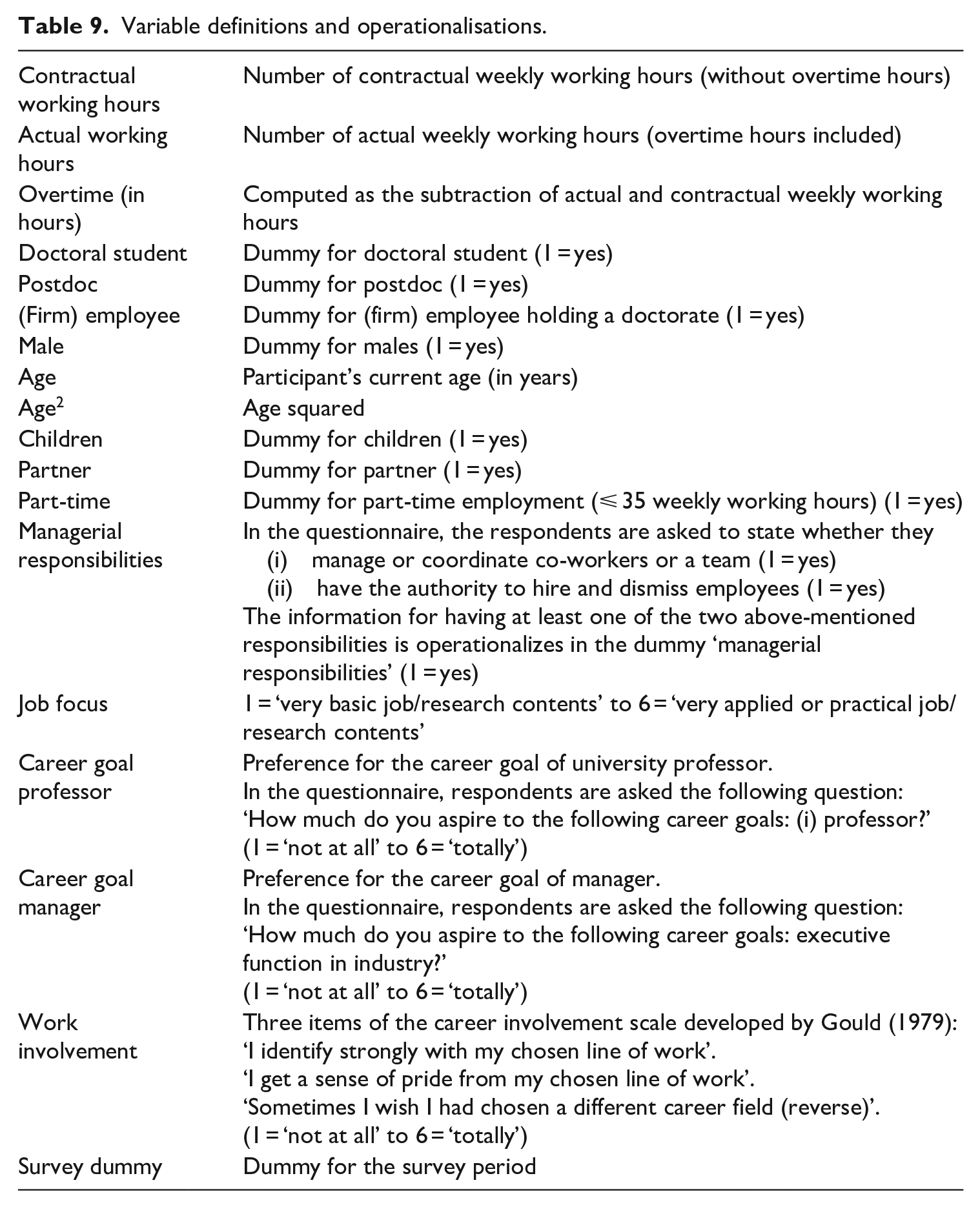
| Contractual working hours | Number of contractual weekly working hours (without overtime hours) |
| Actual working hours | Number of actual weekly working hours (overtime hours included) |
| Overtime (in hours) | Computed as the subtraction of actual and contractual weekly working hours |
| Doctoral student | Dummy for doctoral student (1 = yes) |
| Postdoc | Dummy for postdoc (1 = yes) |
| (Firm) employee | Dummy for (firm) employee holding a doctorate (1 = yes) |
| Male | Dummy for males (1 = yes) |
| Age | Participant’s current age (in years) |
| Age2 | Age squared |
| Children | Dummy for children (1 = yes) |
| Partner | Dummy for partner (1 = yes) |
| Part-time | Dummy for part-time employment (⩽ 35 weekly working hours) (1 = yes) |
| Managerial responsibilities | In the questionnaire, the respondents are asked to state whether they (i) manage or coordinate co-workers or a team (1 = yes) (ii) have the authority to hire and dismiss employees (1 = yes) The information for having at least one of the two above-mentioned responsibilities is operationalizes in the dummy ‘managerial responsibilities’ (1 = yes) |
| Job focus | 1 = ‘very basic job/research contents’ to 6 = ‘very applied or practical job/research contents’ |
| Career goal professor | Preference for the career goal of university professor. In the questionnaire, respondents are asked the following question: ‘How much do you aspire to the following career goals: (i) professor?’ (1 = ‘not at all’ to 6 = ‘totally’) |
| Career goal manager | Preference for the career goal of manager. In the questionnaire, respondents are asked the following question: ‘How much do you aspire to the following career goals: executive function in industry?’ (1 = ‘not at all’ to 6 = ‘totally’) |
| Work involvement | Three items of the career involvement scale developed by Gould (1979): ‘I identify strongly with my chosen line of work’. ‘I get a sense of pride from my chosen line of work’. ‘Sometimes I wish I had chosen a different career field (reverse)’. (1 = ‘not at all’ to 6 = ‘totally’) |
| Survey dummy | Dummy for the survey period |
Acknowledgements
The authors are grateful to comments of participants of the workshop ‘Exploring the Dynamics of Organizational Working Time Regimes’ in Graz 2017, in particular to Silvana Weiss, as well as to two anonymous reviewers and the external managing editor for helpful suggestions and valuable input.
Funding
The author(s) disclosed receipt of the following financial support for the research, authorship and/or publication of this article: We gratefully acknowledge financial support from the German Federal Ministry of Education and Research (programme: ‘Forschung zum wissenschaftlichen Nachwuchs’, grant number: FWN009). The German Federal Ministry of Education and Research had no impact on study design, collection, analysis or interpretation of the data or the writing of the manuscript.
