



Abstract
Research suggests that work-related use of information and communication technologies (ICTs) after hours involves both harms and benefits for employee well-being. Yet, these findings are mainly based on examining the extent of ICT use as the focal construct of interest. Based on cognitive appraisal theories of stress, we argue that research needs to include individuals’ evaluation of their work-related ICT use after hours as well as the conditions shaping this appraisal to explain double-edged effects of ICT use on well-being. Thus, we investigate (1) how situational and personal factors influence whether work-related ICT use after hours is evaluated as positive or negative, and (2) how these factors and ICT use appraisal relate to employee well-being and recovery, beyond the extent of ICT use. We collected data in a daily diary study over five consecutive days. Multilevel path analyses with data from 51 employees and 151 daily observations indicated that goal progress and autonomous motivation for ICT use were positively related to positive ICT use appraisal. Besides, goal progress predicted less and overload predicted more negative ICT use appraisal. In turn, ICT use appraisal was associated with employees’ affective states and psychological detachment in the evening, beyond the extent of ICT use. Additionally, we found several indirect effects of goal progress and overload on employee well-being and recovery via ICT use appraisal. Our findings emphasize the need to investigate ICT usage experiences to explain the double-edged consequences of work-related ICT use after hours on employee well-being.
Keywords
Introduction
The use of information and communication technologies (ICTs) forms an essential part of many jobs in today’s working world. As ICTs enable to stay connected to work without any temporal or spatial boundaries, more and more employees use ICTs for work also after hours (Fenner and Renn, 2004). In the past decades, an increasing number of studies have examined the consequences of work-related ICT use after hours for employee well-being. This research has provided substantial support that work-related ICT use after hours may impair recovery experiences, particularly by decreasing psychological detachment (Derks et al., 2014a; Park et al., 2011). Yet, some studies also found beneficial effects, such as feelings of increased autonomy and flexibility, increased work satisfaction, and better coordination of the interface between work and personal life (Allen and Shoard, 2005; Diaz et al., 2012; Golden and Geisler, 2007).
Hence, research suggests that work-related ICT use involves both harms and benefits for employee well-being, and thus often is regarded as a double-edged sword (Diaz et al., 2012). Yet, we still know very little about the conditions determining whether ICT use involves beneficial or detrimental effects for employee well-being. This may be due to research mainly focusing on the extent of ICT use, examined as frequency or duration, as the focal construct of interest. Although this approach yielded valuable insights on the adverse effects of the extent of ICT use on well-being, it treats ICT use as a uniform construct, which only varies in quantity. However, recent research shows the importance of acknowledging that ICT use is composed of varying, diverse usage experiences, which in turn may relate differently to employee well-being (Braukmann et al., 2018; Butts et al., 2015).
In line with these studies, we argue that potentially distinct effects of ICT use on employee well-being may depend on how this use was experienced. According to cognitive appraisal theories of stress, a critical determinant of an individual’s reaction toward a certain stimulus is the individual’s subjective appraisal of it (Lazarus, 1966; Lazarus and Folkman, 1984, 1987). Hereby, individuals evaluate the relevance of the situation for their well-being as well as their available options to cope with it. Hence, the theory suggests that whether individuals experience beneficial or harmful effects of a certain stimulus on their well-being depends on this appraisal process (Lazarus and Folkman, 1987). Besides, the theory implies that the appraisal of the same stimulus might not be stable but instead may vary both between-person and within-person in time, depending on personal characteristics as well as on environmental conditions (Lazarus and Folkman, 1987). Building on these core assumptions, an important determinant of the double-edged effects of ICT use may be the individual’s appraisal of it, and thus, the conditions leading to a certain appraisal (Ďuranová and Ohly, 2016). Hence, we regard work-related ICT use after hours itself—such as “responding to emails” or “writing a report”—as a rather neutral stimulus, which is evaluated by the individual, and consequently prompts a specific reaction. Following this approach brings two important implications for our research. First, we propose that the individuals’ evaluation of work-related ICT use after hours as positive or negative should be critical to explain whether it has beneficial or detrimental effects on their well-being. Second, we suggest that individuals’ evaluation of work-related ICT use after hours should not remain constant but vary in time, depending on fluctuating, situational factors as well as personal factors. Thus, our research includes the individual’s evaluation of work-related ICT use after hours in the equation, and examines both its antecedents and consequences for employees’ well-being on a daily basis. In particular, we aim to investigate (1) how situational and personal conditions determine whether work-related ICT use after hours is evaluated as positive or negative, and (2) how these conditions and the individuals’ appraisal of work-related ICT use after hours relate to their daily well-being. To address the first research goal, we draw on appraisal theory (Lazarus and Folkman, 1984, 1987) and integrate prior findings with goal setting theory (Locke and Latham, 2002, 2006) and self-determination theory (Deci and Ryan, 2000). Building on these, we identify both situational factors, that is, goal progress and overload, as well as personal factors, that is, an employee’s general motivation for work-related ICT use after hours, as relevant conditions that may influence individuals’ overall appraisal of their work-related ICT use after hours. To address the second research goal, we examine the relationships of these conditions and the individuals’ appraisal of ICT use with their affective states and psychological detachment in the evening, beyond the effect of extent of ICT use. To test our hypothesized relationships, we conducted a daily diary study over five consecutive days with 51 employees who provided data on 151 daily surveys. Together, the present study contributes to research on ICT use by shedding light on the conditions under which work-related ICT use after hours may be perceived as a benefit or harm, applying a theoretical framework for its double-edged effects on employee well-being.
Work-related ICT use after hours and employee well-being
In the past decades, research on the consequences of work-related ICT use after hours has constantly grown. Studies provide increasing evidence that ICT use involves detrimental effects on important individual outcomes such as increased work-life conflicts, reduced organizational commitment, and impaired health (Arlinghaus and Nachreiner, 2013; Boswell and Olson-Buchanan, 2007; Ferguson et al., 2016). Thereby, research has pointed out that being connected to work and engaging in work-related ICT use after hours may particularly impair employee recovery. As such, it has been shown that work-related ICT use after hours prevents employees from engaging in important recovery experiences such as psychological detachment (Derks et al., 2014a, 2014b; Park et al., 2011). In turn, psychological detachment is an important predictor of employees’ well-being and performance (e.g. Binnewies et al., 2009; Sonnentag and Fritz, 2014), enabling individuals to rebuild their resources (Sonnentag and Fritz, 2007). Hence, work-related ICT use after hours bears the risk of increasingly blurring the boundaries between work and personal life domains, reducing psychological detachment and impairing employee well-being.
Yet, research also suggests beneficial effects of ICT use, such as increased flexibility and feelings of autonomy, which in turn enhance employees’ ability to meet demands in their work life and personal life, and better manage the interface between work and personal life domains (e.g. Allen and Shoard, 2005; Cavazotte et al., 2014; Towers et al., 2006). Moreover, resources linked to ICT use such as predictability of ICT use and perceived control were found to be positively related to employee well-being, by increasing psychological detachment and reducing emotional exhaustion (Dettmers et al., 2016). Further, studies suggest that ICT use fosters feelings of accomplishment and productivity, and is positively associated with work satisfaction (Diaz et al., 2012; Middleton and Cukier, 2006; Towers et al., 2006).
Theoretical framework and hypotheses: The role of appraisal
Together, research in the past decades has provided valuable insights on the double-edged effects of work-related ICT use on employee well-being, identifying both harms and benefits. Thereby, the majority of studies have focused on the consequences of extent of ICT use, examined as its frequency or duration. To shed light on the conditions under which work-related ICT use after hours is beneficial or detrimental for employee well-being yet requires taking a more differentiated perspective. Focusing on the extent of ICT use treats ICT use as a uniform construct only varying in quantity, and thus does not account for potential variations in the individual’s experience of ICT use across time. However, recent studies emphasize the importance to acknowledge that ICT use is not a uniform construct that only varies in length or frequency. Instead, their results point out that ICT use represents a “diversity of ICT-related experiences” (Braukmann et al., 2018: 529), which may affect individuals’ well-being differently (Braukmann et al., 2018; Butts et al., 2015). In more detail, Butts et al. (2015) found that affective tone of a communication relates to momentary anger and happiness. In addition, Braukmann et al. (2018) developed a taxonomy of ICT events, suggesting that they can be clustered in positive ICT event clusters, that are perceived as beneficial, and negative ICT event clusters, that are perceived as detrimental. Building on these findings, we argue that potentially differential effects of ICT use after hours on well-being should depend on how this usage was experienced. Thus, a critical determinant of the double-edged effects of ICT use should be the individual’s appraisal of it and, ultimately, the conditions that shape a positive or negative appraisal of ICT use.
To explain this notion in more detail, we draw on the transactional theory of stress and coping (Lazarus, 1966; Lazarus and Folkman, 1984) as a theoretical framework. According to the theory, an individual’s reaction to a stimulus depends on the interplay of two appraisal processes, primary and secondary appraisal. During the primary appraisal process, individuals evaluate the relevance of the stimulus they encounter for their well-being. When perceived as relevant, it may be either evaluated as positive or as negative, that is, as a challenge, threat or harm. During the secondary appraisal process, individuals assess whether they are able to successfully cope with the stimulus. When individuals evaluate a stimulus as relevant for their well-being and the demands exceeding their capabilities and resources, they experience stress (Lazarus and Folkman, 1984, 1987). Following this reaction, individuals are suggested to engage in coping strategies, which, in turn, may lead to a reappraisal of the stimulus as beneficial or detrimental. Hence, this transactional process between a stimulus and an individual’s reaction to it “involves change over time or across situations” (Lazarus and Folkman, 1987: 143). Accordingly, the theory suggests that the appraisal of a stimulus does not only vary between-person but also within-person across different experiences, depending on both situational attributes and a person’s characteristics (Lazarus and Folkman, 1987).
Thereby, the theory provides a valuable framework for explaining differential effects of a certain stimulus on an individual’s well-being as a result of the varying appraisal of this stimulus. We draw two important implications from the theory for our research. First, we argue that an individual’s appraisal of their ICT use and consequently, the conditions influencing this appraisal, are critical to determine the consequences of ICT use for their well-being. That is, a negative appraisal should result in negative effects on well-being, whereas a positive appraisal should foster positive effects on well-being. Second, we suggest that the evaluation of ICT use should not remain stable within persons but should fluctuate across time, depending on both situational and personal factors. Building on these core assumptions of the transactional theory of stress and coping, we examine antecedents and effects of the appraisal of daily work-related ICT use on well-being. Figure 1 shows our proposed research model.

Hypothesized research model.
Situational and personal factors shaping ICT use appraisal
Following principles of the transactional theory of stress and coping, how an individual evaluates a certain ICT usage experience should be influenced by both situational factors as well as psychological characteristics of the person (Lazarus and Folkman, 1987). A core assumption of the theory is that individuals evaluate a stimulus as a source of harm or threat, when it interferes with their personal goals, and as beneficial, when it contributes to their goals (Lazarus and Folkman, 1987). Transferring this notion in regard of relevant situational factors, one important determinant of individuals’ appraisal of ICT use may be the level of progress toward their work goals individuals achieve by engaging in work-related ICT use after hours. Further, as suggested by research on goal-setting theory (Locke and Latham, 2002), experiencing goal progress is an important predictor of well-being and feelings of success (Klug and Maier, 2015; Locke and Latham, 2006). This was found not only for goal progress over a longer time period but also on the situational level (Ohly and Schmitt, 2015; Zohar et al., 2003), indicating that goal progress represents an important determinant of positive work events (Ohly and Schmitt, 2015). In line with that, previous research suggests initial support for the important role of goal progress when conducting supplemental tasks on weekends, showing that progress toward finishing tasks may buffer detrimental effects of unfinished tasks on psychological detachment (Weigelt and Syrek, 2017). Building on these notions, we argue that individuals should evaluate their work- related ICT use after hours as positive when it enables them to make progress on their work goals. Conversely, individuals should evaluate their work-related ICT use after hours as negative, when they did not achieve progress in their work goals by the means of their ICT use after hours. Accordingly, we hypothesize:
Hypothesis 1: Daily ICT-related work goal progress is (a) positively related to positive appraisal and (b) negatively related to negative appraisal of work-related ICT use after hours.
In addition, a critical negative work experience that has been shown to affect employee well-being is overload (Ohly and Schmitt, 2015). Overload describes the feeling of being burdened by an amount or kind of requests, demands, or information that are too excessive to be processed (Elloy and Mackie, 2002). Hence, feelings of overload imply that the individuals’ perceived demands exceed their resources to cope with the stimulus, which should result in a negative appraisal (Elloy and Mackie, 2002; Lazarus and Folkman, 1987). In the context of ICT use, previous research has linked work-related ICT use to feelings of overload, resulting from the accumulation of work requests, the perceived pressure to immediately respond to and handle those incoming requests, as well as the instability of requests (Barley et al., 2011; Braukmann et al., 2018; Thomas et al., 2006). Accordingly, when individuals feel overloaded when using their ICTs for work after hours, they should evaluate their ICT use as negative. Thus, we hypothesize:
Hypothesis 2: Daily ICT-related overload is (a) negatively related to positive appraisal and (b) positively related to negative appraisal of work-related ICT use after hours.
Aside from these situational factors that vary across time, rather stable attitudes and characteristics of individuals may also affect how they evaluate their work-related ICT use after hours (Lazarus and Folkman, 1987). Studies have shown that employees differ in their motivation of why they generally engage in work-related ICT use after hours (Matusik and Mickel, 2011; Ohly and Latour, 2014). According to self-determination theory, motivation for certain activities and behaviors can be described on a continuum, ranging from autonomous motivation to controlled motivation (Deci and Ryan, 2000). Autonomous motivation includes engaging in an activity because it is fun and pleasant (intrinsic regulation), because it corresponds to personal values, or because it is seen as personally important (integrated and identified regulation). Following prior research, we focus on intrinsic and identified regulation as indicators of autonomous motivation in this study since intrinsic and integrated regulation are difficult to differentiate (Ohly and Latour, 2014; Ryan and Connell, 1989). In the context of ICT use, autonomously motivated, self-determined individuals generally engage in work-related ICT use after hours because they find it fun or personally important to stay connected (Ohly and Latour, 2014), for example, as it allows them to be flexible and efficient (Mazmanian, 2013). On the other hand, controlled motivation includes engaging in a certain behavior due to external rewards, threats of punishment (external regulation), or external standards without fully identifying with these standards (introjected regulation, Deci and Ryan, 2000). Hence, employees who engage in work-related ICT use after hours with a controlled motivation may do so to prevent disapproval by their supervisor, or to fulfill established norms and expectations in their organizations with which they do not fully identify (Mazmanian, 2013; Ohly and Latour, 2014). In turn, differences in motivation for work-related ICT use after hours may impact employees’ well-being: Ohly and Latour (2014) found that autonomous motivation for smartphone usage after hours was positively related to positive affect and negatively related to negative affect, while controlled motivation for smartphone usage after hours showed the opposite effects on positive and negative affect.
Building on these findings and assumptions from the transactional theory of stress and coping, the appraisal of work-related ICT use after hours should differ between individuals who are autonomously motivated to use their ICTs, and individuals who experience controlled motivation to engage in work-related ICT use after hours. When ICT use is self-determined, it should be experienced as consistent with one’s values and goals. Hence, self-determined use should not represent a threat to well-being, and be evaluated as positive (Lazarus and Folkman, 1987). On the other hand, when employees feel pressured to engage in ICT use due to external norms and standards, ICT use after hours should be in conflict with one’s goals and values. Accordingly, work-related ICT use should be evaluated as a threat, resulting in a negative appraisal (Lazarus and Folkman, 1987). Hence, we hypothesize:
Hypothesis 3: Autonomous motivation for work-related ICT use after hours is (a) positively related to positive appraisal and (b) negatively related to negative appraisal of work-related ICT use after hours.
Hypothesis 4: Controlled motivation for work-related ICT use after hours is (a) negatively related to positive appraisal and (b) positively related to negative appraisal of work-related ICT use after hours.
Relationships between ICT use appraisal, employee well-being, and recovery
Recent research has examined the effects of work-related ICT use after hours on various indicators of employee well-being (Butts et al., 2015; Lanaj et al., 2014; Park et al., 2011). In our study, we examine well-being as a dynamic concept, investigating fluctuations in employee well-being across days (Sonnentag, 2015). Core indicators of well-being that are suggested to vary substantially across time are positive and negative affect (Shockley et al., 2012; Sonnentag, 2015). Hence, we examine positive and negative affect in the evening, which reflect the affective states individuals experience at a certain time. In addition, we examine one particularly important recovery experience in the context of ICT use, that is, psychological detachment (Derks et al., 2014b; Sonnentag and Fritz, 2014). Psychological detachment refers to mentally disengaging from work during nonwork hours, refraining from work-related thoughts and activities (Sonnentag and Fritz, 2007), and is a strong predictor of strain levels and individual well-being (Sonnentag and Fritz, 2014). According to Lazarus and Folkman (1987), the appraisal of a stimulus as a threat or benefit then determines an individuals’ reaction to it, and thus, the effects on their well-being. Following this argument, we argue that individuals’ positive appraisal of their ICT use after hours should result in higher levels of positive affect and lower levels of negative affect, whereas negative ICT use appraisal of their ICT use after hours should reduce levels of positive affect and increase levels of negative affect—beyond the effects of extent of ICT use. Similarly, Ohly and Schmitt (2015) have found that positive work experiences were largely related to higher positive and lower negative affect, whereas negative work experiences showed the opposite effects on positive and negative affect. In addition, we expect incremental effects of ICT use appraisal on psychological detachment, beyond the extent of ICT use. In particular, we expect positive ICT use appraisal to allow employees to stop ruminating and leave their work behind after their ICT use, thus facilitating subsequent psychological detachment (Ohly and Latour, 2014; Weigelt and Syrek, 2017). In contrast, negative appraisal of ICT use should make it more difficult for individuals to stop ruminating and mentally disengage from their work (Braukmann et al., 2018; Ďuranová and Ohly, 2016). Based on these considerations, we hypothesize:
Hypothesis 5: Daily positive appraisal of work-related ICT use after hours is (a) positively related to positive affect, (b) negatively related to negative affect, and (c), positively related to psychological detachment in the evening.
Hypothesis 6: Daily negative appraisal of work-related ICT use after hours is (a) negatively related to positive affect, (b) positively related to negative affect, and (c), negatively related to psychological detachment in the evening.
Methods
Sample and data collection
We conducted a daily diary study among knowledge workers from various professions and industries in Germany over five consecutive days (Monday–Friday). We selected knowledge workers, that is, employees who primarily create or apply knowledge for work (Davenport, 2005), because the use of ICTs is typically important for them to carry out their job (Wajcman and Rose, 2011). Overall, 51 employees completed the general survey and at least two daily surveys in the evening (N = 151). Of the 51 participants, 24 participants (47.1%) were women. Mean age was 37.6 years (SD = 10.93) and 66.7% were married or in a relationship. Participants worked in various sectors (23.5% chemistry and pharmacy, 13.7% industry, 11.8% transport and logistics, 9.8% service industry, 7.8% banks and insurances, 5.9% sales and marketing, and 27.5% from different other sectors), their average professional experience was 15.6 years (SD = 10.91) and their average working hours per day were 9.2 hours (SD = 1.13).
Measures
Situational factors
The situational factors ICT-related goal progress and overload were both assessed in the daily evening survey with a single item each on a five-point Likert scale. We decided to use single items here for two reasons: First, we aimed at keeping participants motivated to respond regularly to the surveys (Fisher and To, 2012). Second, ICT-related goal progress and overload represent rather specific aspects of recent experiences, as opposed to multi-faceted, higher-order constructs. For these concrete constructs, single items are suggested to represent adequate and valid measures in ESM studies (e.g. Fisher and To, 2012; Gabriel et al., 2019). Items were self-developed, based on their theoretical conceptualization. ICT-related goal progress was measured with the item “Today, I was able to make progress toward my professional goal due to my ICT use for work after hours.” ICT-related overload was measured with the item “Today, I experienced overload due to my ICT use for work after hours.”
Personal factors
Motivation for work-related ICT use after hours was measured in the general survey, adapted from the established work motivation scale (Gagné et al., 2015). All items were assessed on a seven-point Likert scale. Autonomous motivation was assessed by six items measuring the extent of intrinsic and identified motivation to use ICTs for work after hours. A sample item for autonomous motivation is “I use mobile technologies for work after hours because it is personally important to me.” Controlled motivation was measured with ten items assessing the extent of external and introjected motivation for work-related ICT use after hours. A sample item for controlled motivation is “I use mobile technologies for work after hours in order to receive recognition from others (supervisor, colleagues, clients).”
Appraisal of ICT use
Positive and negative appraisal of work-related ICT use after hours were both assessed with four items each on a five-point Likert scale in the daily evening survey. Items were self-developed. Participants were asked to rate their work-related ICT use after hours, for example with the items “rewarding” and “expedient” for positive appraisal and with the items “burdening,” and “tedious” for negative appraisal.
Affective states
Positive affect and negative affect were measured in the daily evening survey with six items each, assessed on a five-point Likert scale. Positive affect was measured with three items from Watson et al. (1988) and three items from Kessler and Staudinger (2009). A sample item for positive affect is “In the moment, I feel enthusiastic.” Negative affect was measured with three items from Watson et al. (1988) and three items from McNair et al. (1971). A sample for negative affect is “In the moment, I feel upset.”
Recovery
Psychological detachment from work was measured in the daily evening survey with three items from the well-established Recovery Experience Questionnaire (Sonnentag and Fritz, 2007). Items were adapted to the daily level and measured on a five-point Likert scale. A sample item is “Today after work I didn’t think about work at all.”
Control variables
The extent of ICT use was found to be related with employee well-being in various previous studies (e.g. Lanaj et al., 2014; Park et al., 2011). Therefore, we controlled for the length of work-related ICT use after hours in order to examine the effects of the appraisal of ICT use beyond the effects of its duration.
Data analysis
To account for the hierarchical structure in our data with days (Level 1) nested in participants (Level 2), we conducted multilevel path analyses with Mplus 8.3 software (Muthén and Muthén, 1998-2017). We calculated the intraclass correlation coefficients (ICCs) by specifying null models that only include all variables as dependent variables to examine the within- and between-person variance for each variable. Results show that all within-person study variables provide sufficient within-person variance, ranging from 52.2% to 82.5%. Next, we specified the within-person and between-person paths from independent variables, that is situational and personal factors, to outcomes in a first model (Model 1). In a second step, we added the mediators positive and negative ICT use appraisal to the model (Model 2). For both models, we used the TYPE = TWOLEVEL function. This approach allowed us to specify the relationships on the within-person as well as the between-person level at the same time in one model, decomposing the variance of our day-level variables into their within-person and between-person parts. Thereby, within-person variables were group-mean centered, and between-level variables were centered around their grand mean. Further, to inspect the indirect effects of the situational and personal factors on employee well-being via ICT use appraisal, we used the MODEL INDIRECT function for the second model and examined 95% confidence intervals of the indirect effects.
Results
Table 1 shows the means, standard deviations, ICCs, and intercorrelations for the study variables. Regarding Model 1, the model resulted into a just-identified model, for which model fit statistics cannot be reported. Yet, we can still examine the path coefficients of this model, which are shown in Table 2.
Descriptive statistics, ICCs, and correlations among study variables.
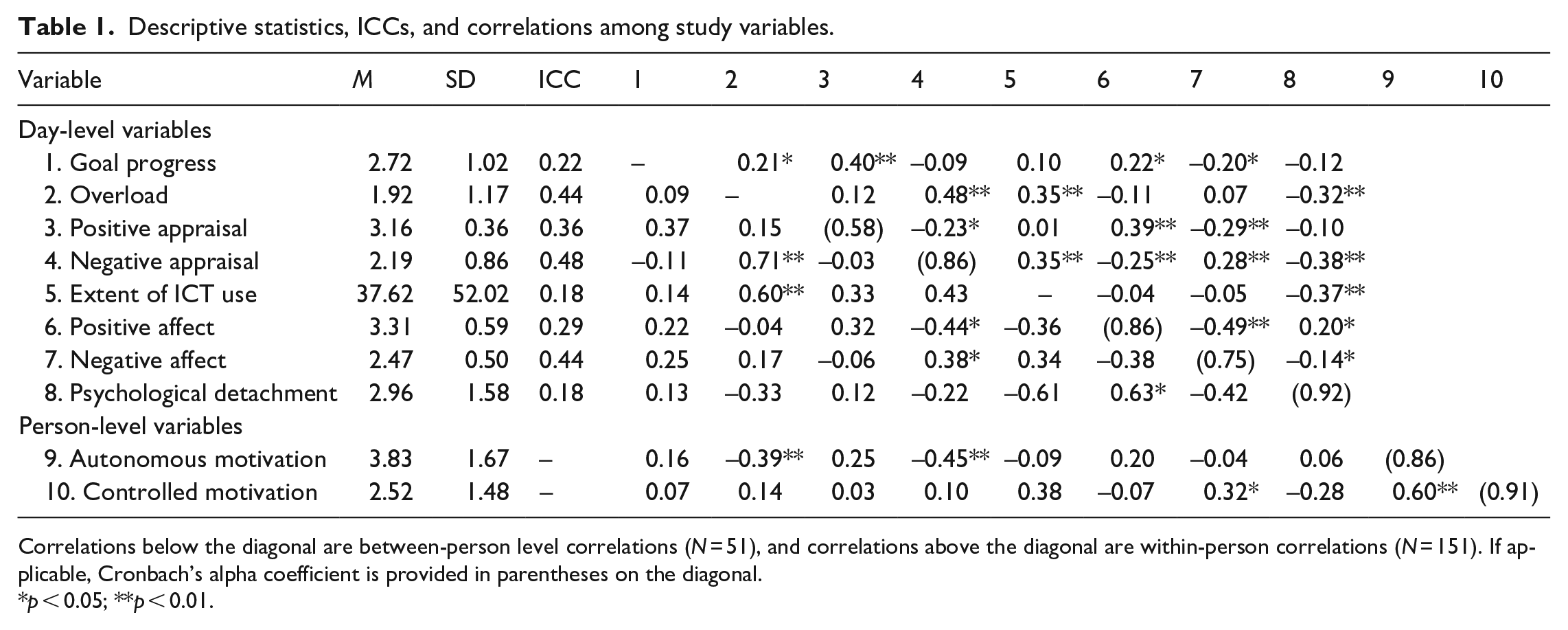
Correlations below the diagonal are between-person level correlations (N = 51), and correlations above the diagonal are within-person correlations (N = 151). If applicable, Cronbach’s alpha coefficient is provided in parentheses on the diagonal.
p < 0.05; **p < 0.01.
Results from multilevel path analyses: Model 1.
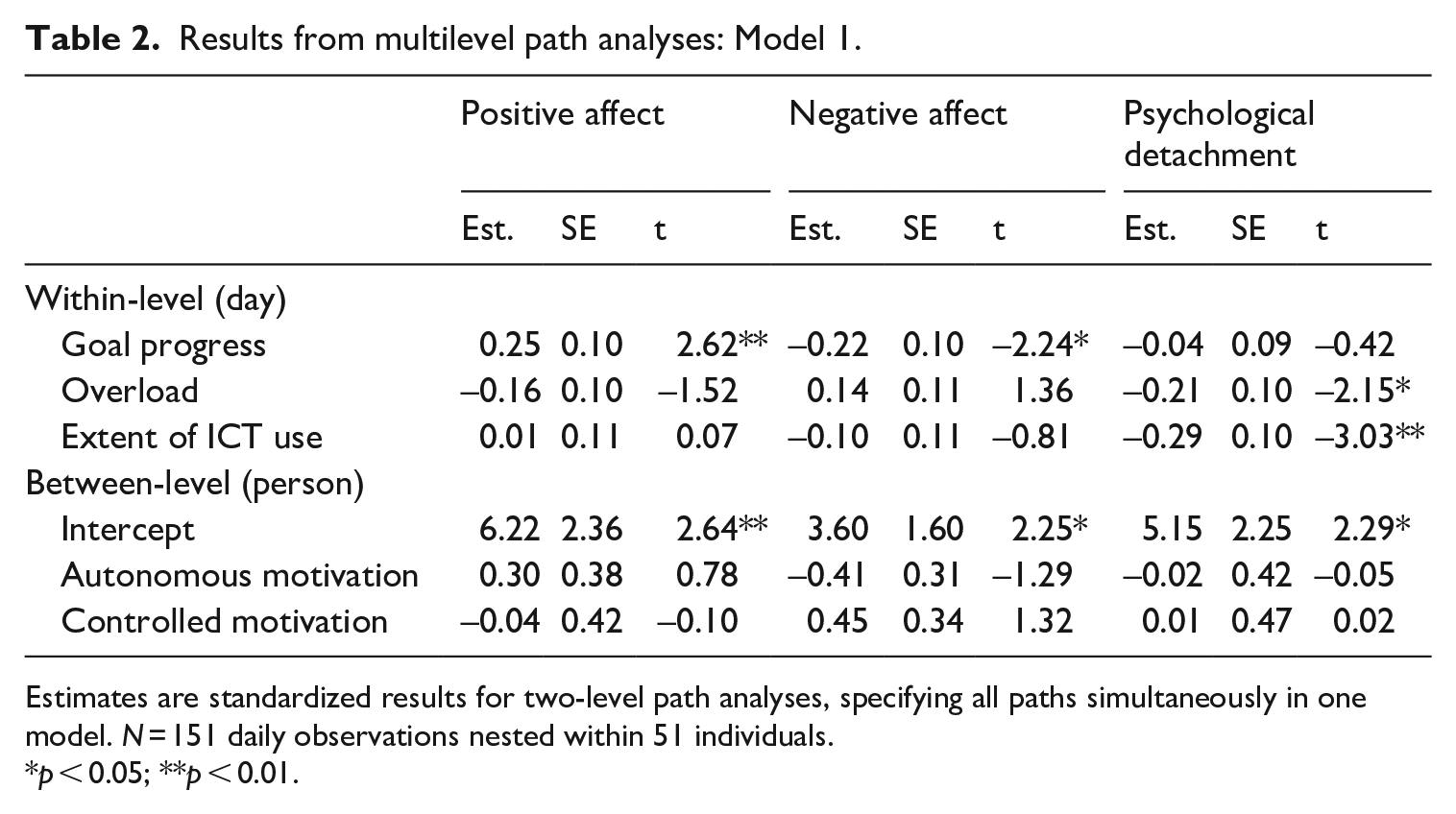
Estimates are standardized results for two-level path analyses, specifying all paths simultaneously in one model. N = 151 daily observations nested within 51 individuals.
p < 0.05; **p < 0.01.
In regard of the within-person effects of situational factors, ICT-related goal progress was positively related to positive affect (β = 0.25, p < 0.01) and negatively related to negative affect (β = −0.22, p < 0.05). Further, feelings of overload as well as the extent of ICT use were negatively related to psychological detachment (β = −0.21, p < 0.05 for overload; β = −0.29, p < 0.01 for extent of ICT use). All other relationships including the associations between personal factors and outcomes were not significant.
In a second step, we added positive and negative ICT use appraisal as mediators to the model (Table 3). Model fit was good with χ2 = 14.984, df = 6, comparative fit index (CFI) = 0.956, root mean square error of approximation (RMSEA) = 0.100, standardized root mean residual (SRMR)within = 0.052, SRMRbetween = 0.036.
Results from multilevel path analyses: Model 2.
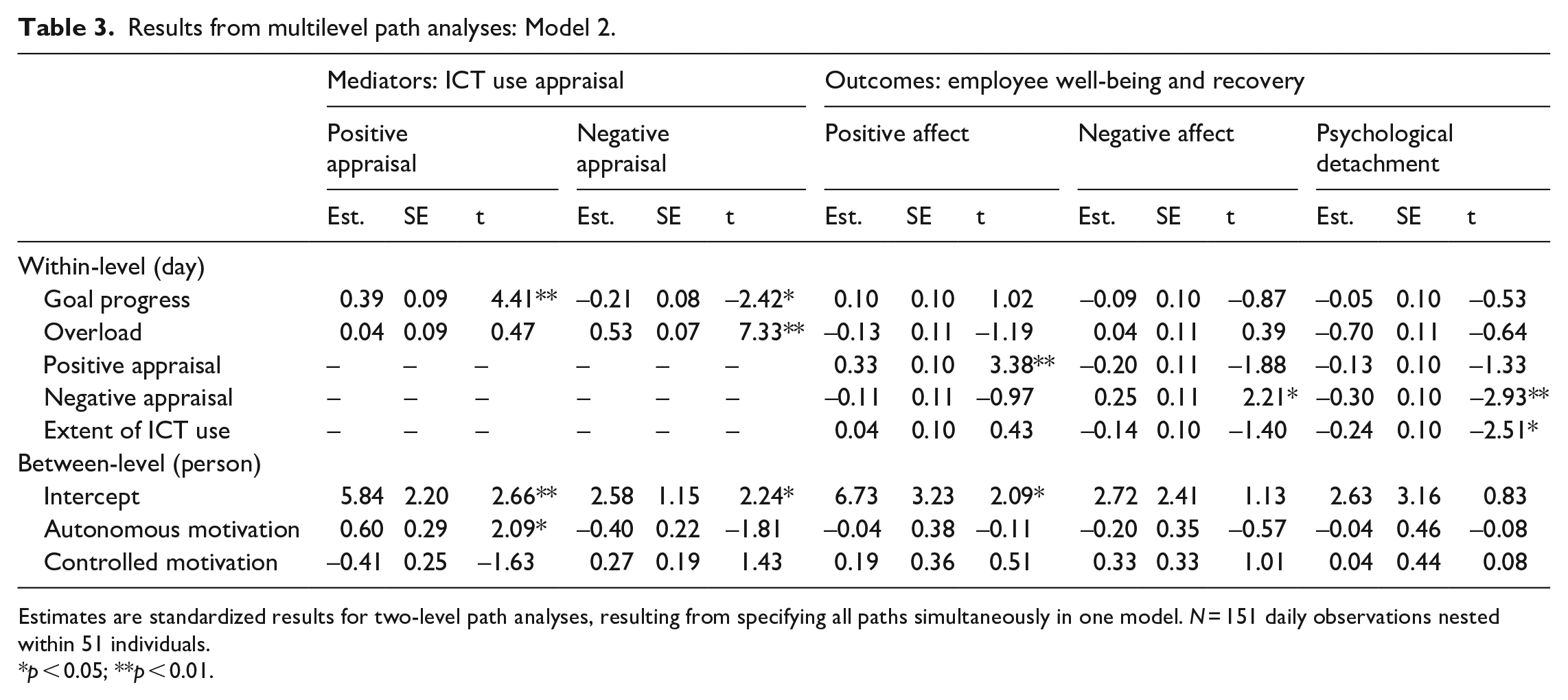
Estimates are standardized results for two-level path analyses, resulting from specifying all paths simultaneously in one model. N = 151 daily observations nested within 51 individuals.
p < 0.05; **p < 0.01.
In regard of the within-person relationships between situational factors and ICT use appraisal, ICT-related goal progress was positively related to positive appraisal (β = 0.39, p < 0.001) and negatively related to negative appraisal of ICT use (β = −0.21, p < 0.05). Thus, on days where employees made progress toward their work goals by the means of ICT use, they evaluated their ICT use as more positive and less negative, compared to days when they did not make progress 1 . Hypothesis 1 was supported. Further, feelings of overload were positively related to negative ICT use appraisal (β = 0.53, p < 0.001) but showed no significant relationship with positive appraisal. Hence, on days when employees felt overloaded by their ICT use, they evaluated it as more negative compared to days when they did not feel overloaded. Hypothesis 2 was only partially supported. Regarding personal antecedents of ICT use appraisal, individuals’ autonomous motivation for ICT use significantly predicted positive appraisal of ICT use (β = 0.60, p < 0.05), yet the association between controlled motivation and positive appraisal was nonsignificant. Both autonomous and controlled motivation were unrelated to negative ICT use appraisal. Thus, Hypothesis 3 was only partially and Hypothesis 4 was not supported.
Turning to the effects on employee well-being and recovery, results showed that the former significant effects of ICT-related goal progress and overload on well-being outcomes (Model 1) became nonsignificant when the two mediators were added in Model 2. Thereby, positive ICT use appraisal was significantly related to positive affect (β = 0.33, p < 0.01) but unrelated to negative affect and psychological detachment. Thus, on days where employees evaluated their ICT use as positive, they reported more positive affect compared to days where they did not evaluate their ICT use as positive. Hence, Hypothesis 5a was supported but Hypotheses 5b and 5c were not. Besides, negative appraisal showed a positive relationship with negative affect (β = 0.25, p < 0.05) and was significantly related to psychological detachment (β = −0.30, p < 0.01). Thus, on days when employees evaluated their ICT use as negative, they reported more negative affect and were less able to detach compared to days when they did not appraise their ICT use as negative. Hypotheses 6b and 6c were supported but 6a was not. Further, the control variable extent of ICT use was negatively related to psychological detachment (β = −0.24, p < 0.05). All other effects of extent of ICT use were not significant.
To investigate the potential role of ICT use appraisal as a mediator between the relationships of situational factors of ICT use and personal characteristics with employee well-being and recovery, we further inspected the results of indirect effects and their corresponding 95% confidence intervals (CI, Table 4). Results showed a significant indirect effect of ICT-related goal progress on positive affect via positive ICT use appraisal (indirect effect: 0.13, p < 0.01; 95% CI = 0.035; 0.222). Besides, ICT-related overload showed a significant indirect effect on negative affect as well as on psychological detachment through negative ICT use appraisal (indirect effect on negative affect: 0.13, p < 0.05; 95% CI = 0.008; 0.253; indirect effect on psychological detachment: −0.16, p < 0.01; 95% CI = −0.276; −0.042). All other indirect effects were not significant.
Indirect effects for Model 2.

Estimates for the indirect effects are standardized results. Paths from situational and personal factors to positive affect, negative affect and psychological detachment via positive and negative appraisal, respectively, were specified simultaneously in a two-level path model.
CI = Confidence interval. N = 151 daily observations nested within 51 individuals.
p < 0.05; **p < 0.01.
Supplemental analysis
In our research model, we focused on the conditions shaping ICT use appraisal and their relationships with well-being and recovery, beyond the extent of ICT use. Hereby, we found that positive ICT use appraisal was unrelated to psychological detachment, contradicting our hypothesis. A possible explanation for this finding might be that the relationship between positive ICT use appraisal and psychological detachment is moderated by the extent of ICT use: If ICT use is evaluated as positive but at the same time, extent of ICT use after hours is high, there should be very little time left to detach and recover in the evening (Weigelt and Syrek, 2017). Thus, the relationship between positive appraisal and psychological detachment might only be positive if extent of ICT use is low. Similarly, the negative relationship between negative appraisal and psychological detachment might even be stronger when extent of ICT use is high. Consequently, we tested these moderating effects of the extent of ICT use on the relationships between positive and negative appraisal of ICT use, respectively, and psychological detachment in an additional third model. 2 To do so, we added the two moderators as interaction terms to Model 2. Results showed a nonsignificant moderating effect of extent of ICT use on the relationship between positive appraisal and psychological detachment (β = −0.38, p = 0.38), as well as on the relationship between negative appraisal and psychological detachment (β = 0.53, p = 0.086).
Discussion
With this study, we aim to further shed light on the determinants of the double-edged effects of work-related ICT use after hours on employee well-being. We contribute to research on ICT use and well-being by specifying conditions under which work-related ICT use after hours may be beneficial or harmful to employees’ well-being, drawing on the transactional model of stress and coping (Lazarus and Folkman, 1987) as a theoretical framework. Transferring principles of the theory to the context of ICT use, we derive and test two important propositions: First, we assume that the appraisal of an individual’s work-related ICT use after hours is important to explain its double-edged effects. Second, we propose that the appraisal of ICT use should not be stable but vary across time, depending on situational as well as personal factors. Thus, our study investigates relevant conditions that may shape ICT use appraisal and examines their relationships with employee well-being and recovery, beyond the extent of ICT use. With this approach, we followed recent calls to apply a more differentiated perspective on work-related ICT use, taking into account that ICT use does not represent a uniform construct, which only varies in its length or duration but consists of distinct usage experiences with differential consequences for employee well-being and recovery (Braukmann et al., 2018; Butts et al., 2015).
Implications for research
Our findings provide initial support that employees’ appraisal of their work-related ICT use after hours, and ultimately, the conditions shaping this appraisal, play a critical role to explain double-edged effects on well-being. The results show that certain situational as well as personal factors may predict whether ICT use is evaluated as positive or negative. In turn, ICT use appraisal is associated with employee well-being and recovery, beyond the effect of extent of ICT use. Besides, the situational factors showed some indirect effects on well-being and recovery through ICT use appraisal. These findings provide two important overarching implications. On the one hand, our study supports previous research suggesting that the extent of ICT use has detrimental effects on recovery (Derks et al., 2014b; Park et al., 2011): Our results showed that longer duration of ICT use after hours predicts less psychological detachment, hence preventing employees from engaging in an important recovery experience. On the other hand, our findings emphasize that distinguishing between extent of ICT use and ICT usage experience enables to gain a more differentiated understanding of the relationship between ICT use and employee well-being. In particular, inspecting the ICT usage experience allows to shed light on the conditions driving double-edged effects of ICT use on well-being.
In our study, we examined two situational antecedents of daily ICT use appraisal: ICT-related goal progress and overload (Locke and Latham, 2006; Ohly and Schmitt, 2015; Thomas et al., 2006). The results suggest that both of these situational factors are linked to individuals’ evaluation of their work-related ICT use after hours, and thereby indirectly affect their well-being and recovery. In regard of positive ICT usage experiences, our findings showed that when employees’ work-related ICT use after hours allowed them to make progress on a working goal, they evaluated their ICT use as more positive. In turn, positive ICT use appraisal was related to higher positive affect in the evening. Hereby, positive appraisal significantly mediated the relationship between goal progress and positive affect. This finding contributes to research on unfinished work tasks and well-being (e.g. Syrek et al., 2017; Weigelt and Syrek, 2017), suggesting that work-related ICT use after hours may represent a means to make progress on working goals and unfinished tasks, thereby benefiting employees’ well-being by increasing positive affective states.
Contrary to our hypothesis, although goal progress was associated with higher positive appraisal, positive appraisal did not predict higher psychological detachment in our study but showed a nonsignificant relationship. Correspondingly, the indirect effect of goal progress on psychological detachment was not significant. This result is surprising, as it contrasts prior perspectives on the relationship between goal progress and recovery: On the one hand, it can be argued that on days when employees make progress toward their work goals by the means of ICT use and consequently evaluate their ICT use as positive, thoughts on their work are still present. This continuing work-related cognitive activation (even if positive) should impair the recovery process, resulting in lower psychological detachment (Geurts and Sonnentag, 2006; Meier et al., 2016). For example, in the course of a working week, there might simply not be enough time left to detach between ICT usage experiences after hours—even if they are evaluated as positive—and going to sleep. On the other hand, prior research on unfinished tasks, goal progress, and recovery (Syrek et al., 2017; Weigelt and Syrek, 2017) indicates that employees may be more successful to detach from work when they have made progress toward their goals by the means of ICT use after hours. Mentally detaching from work implies to stop ruminating about work, leaving work behind (Sonnentag and Bayer, 2005), and the best way suggested to achieve this is “to attain the goal that is driving the rumination” (Martin and Tesser, 1996: 42). Hence, this approach indicates that goal progress and subsequent positive ICT use appraisal should ultimately facilitate psychological detachment.
Integrating these two perspectives, we may conclude that even positive ICT usage experiences after hours should have immediate negative effects on psychological detachment due to continuing cognitive activation. In addition, they may have lagged positive effects on psychological detachment—yet the positive effects should become apparent only when employees have enough time to mentally detach from their work after their ICT usage experiences. This could be possible (1) when the duration of work-related ICT use in leisure time is short and (2) during longer periods of leisure time, such as the weekend.
As we collected data during the working week, the first possibility should be more relevant for our study. Thereby, extent of work-related ICT use should moderate the relationship between positive appraisal and psychological detachment, such that their relationship should be positive when the extent of ICT use is low, and negative when extent of ICT use is high. We explored this possibility in additional analyses but found no support for the suggested moderation effect. Hence, extent of ICT use as moderator cannot explain the nonsignificant relationship between positive ICT use appraisal and psychological detachment in our study. Therefore, future research should validate this finding and further identify other relevant factors that may moderate their relationship. For example, Firoozabadi et al. (2018) highlight the important role of self-regulation for recovery, as they found that problem-solving pondering may have positive or detrimental effects on recovery, depending on employees’ ability to regulate their feeling and cognitions. In addition, our nonsignificant finding might indicate that positive ICT usage experiences may influence employees’ affective states but are less critical for recovery processes. Instead, our results suggest that the more crucial requirement for detaching is a low negative ICT use appraisal instead of a high positive appraisal, since negative ICT use appraisal showed a strong negative relationship with psychological detachment. This notion is in line with the principle “bad is stronger than good,” which suggests that negative experiences impact individuals stronger than positive experiences (e.g. Baumeister et al., 2001).
In regard of the second possibility, it seems worthwhile in future research to measure psychological detachment directly after the work-related ICT usage experience, as well as a second time later, for example during the weekend, in order to investigate the suggested immediate and lagged effects on psychological detachment. Hereby, it might be fruitful to integrate the process of detaching in its measurement, as the wording of the items does not reflect the possibility to detach after finishing work tasks after hours. For example: “Today after I finished my work in leisure time, I did not think about work at all.” Together, it becomes clear that the relationship between positive ICT use experiences and psychological detachment needs to be examined further, while also considering methodological aspects and thereby paying more attention to recovery as a process (Heissler and Ohly, 2018; Sonnentag et al., 2017). The aforementioned approaches would also shed light on whether experiences of work-related ICT use after hours, even if they are positive, are always detrimental for recovery (Braukmann et al., 2018) —or whether work-related ICT after hours may possibly help employees to recover even better under specific conditions.
Turning to negative ICT usage experiences, our results suggest that ICT use may particularly have detrimental effects on well-being when individuals have difficulties to cope with their workload. When employees experienced higher feelings of overload and were not making progress toward their goals by the means of their ICT use, they evaluated their ICT use as more negative. Yet, as the bivariate correlation between goal progress and negative appraisal was nonsignificant, the effect of goal progress on negative ICT use appraisal might depend on the covariates included in the model, that is overload, and their significant positive correlation. Hence, the results suggest that individuals appraise their ICT use as more negative when not making goal progress only when simultaneously taking their overload into account. In addition, negative ICT use appraisal was found to predict higher negative affect and lower psychological detachment, beyond the extent of ICT use. Thereby, negative ICT use appraisal significantly mediated the relationship between overload and negative affect, as well as between overload and psychological detachment. This finding further contributes to literature on ICT use and well-being, specifying the conditions under which work-related ICT use after hours is detrimental for employees’ affective states and recovery (e.g. Butts et al., 2015; Derks et al., 2014a; Ďuranová and Ohly, 2016). In particular, the results indicate that the core of detrimental effects of ICT use on employee well-being lies in the underlying perceived work demands, with high feelings of overload resulting in negative appraisal and, consequently, impaired well-being and recovery.
Integrating our findings on the two situational factors, both goal progress and overload were supported as relevant conditions shaping ICT use appraisal, with goal progress indirectly predicting more positive affect through its effect on positive appraisal, and overload indirectly predicting more negative affect and less psychological detachment through its effect on negative appraisal. Yet all other, converse relationships remained nonsignificant. It is interesting to note that the nature of these relationships, with positive situational factors relating to positive affect through positive appraisal, and negative situational factors relating to negative affect through negative appraisal, is in line with the valence-symmetry mechanism (Sonnentag, 2015; Thoresen et al., 2003). Valence-symmetric links have been found in previous research on work events, with negative work events mainly influencing negative indicators of well-being and positive work events primarily impacting positive indicators of well-being (e.g. Dimotakis et al., 2011; Ilies et al., 2011). This points to two discrete biobehavioral response systems (Sonnentag, 2015). However, research has likewise found mixed support for asymmetric relationships (Bono et al., 2013; Thoresen et al., 2003), indicating that future studies should continue to examine asymmetrical effects of positive and negative ICT usage experiences on well-being. This may particularly help to comprehend the potential of positive experiences of not only enhancing positive indicators of employee well-being but also reducing negative indicators of well-being, for example, through their resource-building capacities (Bono et al., 2013).
In regard of personal factors that influence the appraisal of ICT use, the results suggest that employees who engage in work-related ICT use after hours with autonomous motivation evaluate their ICT use as more positive. However, autonomous motivation did not have direct nor total effects on employee well-being through positive appraisal. This result contradicts prior findings showing that autonomous motivation positively predicts psychological detachment and positive affect in a cross-sectional study (Ohly and Latour, 2014). Further, contrary to our expectations, controlled motivation was not related to employees’ appraisal of ICT use, and neither showed a direct or total effect on employee well-being. These findings may indicate that self-determined ICT use plays a role for appraisal of ICT use, yet situational factors may be relatively more important than personal factors in determining how employees evaluate their daily ICT use, and in turn, how this evaluation affects their well-being.
Together, our study shows that employees’ varying experience of their ICT use plays an important role in explaining differential effects on well-being. Our findings add to research on determinants of the double-edged effects of ICT use on employee well-being (Braukmann et al., 2018; Butts et al., 2015), and provide support for a theoretical mechanism that explains those double-edged effects. Future research may build on the approach in this study and further focus on the ICT usage experience, investigating its appraisal and the conditions shaping this appraisal to gain a more differentiated understanding of the consequences of work-related ICT use after hours for well-being and recovery.
Implications for practice
Our findings provide several insights for organizational measures on managing work-related ICT use after hours. As our study and numerous other studies showed, the extent of ICT use may impair recovery by reducing psychological detachment (e.g. Derks et al., 2014a; Park et al., 2011). Thus, aiming at limiting ICT use after hours is one lever to avoid detrimental effects for employee recovery—but should not be the only focus. Rather, employers likewise need to address the potential causes of detrimental effects of ICT use on employee well-being. Our results indicate that ICT use after hours particularly entails harmful consequences when employees have strong feelings of overload. Hence, organizations should aim at altering the working environment and work demands, for example, by encouraging employees and supervisors to openly discuss and develop strategies for reducing feelings of overload.
Furthermore, the results suggest that when work-related ICT use after hours is appraised as positive, it may have beneficial effects on employee well-being. This finding underlines that a company-wide policy that aims at reducing or even prohibiting ICT use after hours bears the risk of likewise eliminating positive ICT usage experiences. Yet, it should still be acknowledged that the extent of work-related ICT use after hours may reduce psychological detachment. Hence, while ICT use after hours should be allowed as it has the potential to enhance employee well-being when experienced as positive, organizations should not promote or even demand work-related ICT use after hours. An organizational culture promoting work-related ICT use after hours may lead to normalizing a high extent of ICT use after hours, resulting in an “always on culture” and impaired recovery in the long-term.
In addition, while previous research suggests that controlled motivation for ICT use after hours may have a detrimental effect on well-being (Ohly and Latour, 2014), our study hints at the particular relevance of self-determined ICT use after hours instead. Results showed that autonomous motivation for ICT use is linked to positive ICT use appraisal, which in turn predicts employee well-being.
Together, these findings point out the need to establish more flexible, individualized regulations in organizations, which enable work-related ICT use after hours but do not expect it. To achieve such a renunciation of an “always on culture,” organizations should sensitize employees as well as supervisors for beneficial and detrimental effects of work-related ICT use after hours and their underlying conditions, for example in specific trainings. Learning about the consequences and circumstances may support employees to reflect on and adapt their ICT use and their communication behavior after hours. Further, organizations should encourage their employees to discuss actual and perceived expectations of being connected to work after hours as well as preferences. This may help to create a working environment in which a diverse, self-determined ICT use is enabled (Mazmanian, 2013).
Limitations and directions for future research
Our study applied a daily diary approach to examine employees’ work-related ICT use after hours. Yet, we do not know how the results generalize beyond the population in focus of this study, namely knowledge workers. Further, the results are based on self-reports with a relatively small sample that includes only one measurement per day. This cross-sectional diary data does not allow to detect causal relationships. Thus, future studies should examine situational factors, ICT use appraisal, as well as employee well-being and recovery at different points in time and with a larger sample to disentangle causal effects and validate the proposed mediation model. This approach seems particularly fruitful to detect the discussed immediate as well as lagged effects of situational factors and ICT use appraisal on psychological detachment. In addition, this would allow future research to reassess the interaction between extent of ICT use and ICT use appraisal, which may help to further unravel the impact of both extent of ICT use and ICT usage experience on recovery processes. Besides, measuring ICT-related variables and well-being outcomes at different points in time helps to reduce the possibility of common method biases (Podsakoff et al., 2003), which also represents a limitation of our study.
Another methodological limitation is the use of single items for the two situational factors ICT-related goal progress and overload in our study. We have decided to use single items since they are suggested to be adequate and valid measures in ESM studies, if individuals’ recent experiences tend to be rather unidimensional and specific (e.g. Bono et al., 2013; Fisher and To, 2012; Gabriel et al., 2019). Nevertheless, those items should be validated in future studies, as well as their relationships with ICT use appraisal, well-being and recovery.
Besides, we focused on ICT-related goal progress and overload as two situational factors in our study, since they have been shown to be relevant for affective work experiences in general (Ohly and Schmitt, 2015) as well as in the context of ICT use (Barley et al., 2011; Thomas et al., 2006; Weigelt and Syrek, 2017). However, previous research has identified other relevant situational factors that might potentially influence the appraisal of work-related ICT use after hours, such as affective tone of a communication (Butts et al., 2015) or helping others (Braukmann et al., 2018). Future studies may integrate these different situational factors to further specify determinants of employees’ appraisal of their ICT use.
Moreover, we conceptualized motivation for work-related ICT use after hours as a rather stable attitude in our study, reflecting employees’ general motivation to use their ICTs for work after hours (Ohly and Latour, 2014). This conceptualization corresponds to findings that employees generally differ in their preference to segment or integrate work and personal life, and consequently should also differ in their attitude toward work-related ICT use after hours as a form of integration (Kossek and Lautsch, 2012; Kreiner, 2006). However, since ICT use is not a uniform construct but composed of diverse usage experiences, it is possible that motivation for work-related ICT use after hours may vary not only between employees but also within persons, depending on the specific task an employee is involved in during an ICT usage experience (Deci and Ryan, 2000; Ryan and Deci, 2000). Thus, future studies should consider motivation for ICT use as an additional situational factor to explain fluctuations in appraisal of ICT use.
Lastly, research should also examine other relevant personal factors that have been shown to affect individuals’ ICT use after hours, such as general preferences to segment or integrate work life and personal life, ambition, and job involvement (Boswell and Olson-Buchanan, 2007; Park and Jex, 2011). Since our results indicate that situational factors may be more relevant than personal factors in influencing ICT use appraisal, it may further be worthwhile to consider moderating effects of personal factors. For example, the positive relationship of ICT-related goal progress and positive ICT use appraisal may be stronger for more ambitious employees, as they should evaluate a goal-enhancing ICT usage experience as a strong benefit to their values and goals. Further, it may be possible that for employees who prefer to separate work and personal life, detaching after ICT usage experiences (irrespective of whether they were evaluated as positive or negative) is more difficult than for employees who prefer to and are used to frequently transit between work and personal life domains (Ashforth et al., 2000; Butts et al., 2015).
Conclusion
The present study takes into account the subjective experience of work-related ICT use after hours beyond the extent of ICT use to explain differential effects on employee well-being and recovery. Our findings show that certain situational and personal factors shape individuals’ ICT use appraisal, which in turn relates to employees’ affective states and psychological detachment, beyond the extent of ICT use. Thereby, this study contributes to shed light on determinants of the double-edged effects of work-related ICT use after hours on employee well-being and recovery, and adds to our understanding of their underlying theoretical mechanisms.
