




Abstract
A meme consists of any words or images in a text that can be replicated across communicators in the exchange of information. This study tests the Multilevel Model of Meme Diffusion (M3D) in a case study in the digital electronic technology that captures the controversial opinions regarding death penalty abolishment in Nebraska. The objective is to demonstrate that an internet-based study using social media data can be used to analyze and predict social processes engaging with phenomena in real space. The authors utilize the meme death_penalty in Twitter texts to predict public perception of death penalty abolishment in Nebraska. The M3D theory integrates the fields of geography and computer-mediated communication technology to explain and predict public opinion on the death penalty.
Background
The death penalty, or capital punishment, has been reinstated in the United States since 1976 (Dezhbakhsh & Shepherd, 2006). In 2015, approximately 30 inmates were executed by six US states (Florida, Georgia, Missouri, Oklahoma, Virginia, and Texas) and 2984 were waiting on death row (BJS, 2015). Capital punishment has been declining, and is geospatially highly concentrated (Garrett, Jakubow, & Desai, 2017). During this data collection, in May 2015, Nebraska became the first conservative state in more than four decades to repeal its death penalty option (R. Berman, 2015). Since 1972, the majority of American citizens have supported the death penalty, although the level of support has been falling consistently for two decades (Hood & Hoyle, 2015; Jones, 2017; Oliphant, 2016; Pew Research Center, 2015). Capital punishment is supported by more than three-quarters of Republicans, but it is opposed by a majority of Democrats (M. Berman, 2015). Rather than rely on self-report surveys, this study investigates social media representations of capital punishment. Public opinion on the death penalty was captured in tweets compiled from 27 May to 31 December 2015, with approximately 389,800 geotagged tweets.
The development of communication theory has evolved rapidly in conjunction with the advancement in information technology. This study aims to test a new perspective toward “meme diffusion” as a technique to explain and predict social phenomena (Spitzberg, 2014). The model is explored by using online data mining applications in collecting conversations of social groups as reactions to the prospect of the abolishment of the death penalty in Nebraska. In this application, the issue of the death penalty as a controversial political agenda serves as an exemplary cyberspace canvas upon which public attitudes are expressed in online and social media messaging.
The purpose of this study is to assess public opinion on the abolishment of the death penalty to predict whether it will be abolished or reinstated in Nebraska. The use of social media offers new insights into testing the power of communication technology as a tool to predict social phenomena in general, and policy formation. Tracking these message exchanges will assist in the early detection of social phenomena related to public opinion regarding criminal justice and human rights. This study evaluates the application of the meme diffusion model to public reactions represented by social media groups as a reaction to the repeal of capital punishment in Nebraska.
Conceptual framework
The conceptual framework in this study is adopted from the M3D framework developed by Spitzberg (2014) with slight modification from the case study (Figure 1). The word “meme” was developed by Richard Dawkins in his book The Selfish Gene (Dawkins, 1976). Dawkins defined memes as cultural units of transmission, analogous to genes that spread from person to person by copying or imitation (Shifman, 2013). According to Spitzberg (2014), in this digital era, the term “memes” emerges in two typical ways—evememic (event-based) messages arise when events in the world elicit topically and group-based symbolic and visual representations of those events across communicators (e.g., tweets, emails, and images from a new year’s eve crowd experience), whereas etymemic (text-based) messages arise from texts that are replicated and evolve as they are adapted across communicators (e.g., the “=” equal sign in the US expressing agreement with gay marriage). Polymemic episodes occur as etymemic—evememic reciprocities, in which events generate memes, which then take on a life of their own through memetic diffusion and evolution, and/or when those memes generate activity in cyberspace that evokes real space behaviors. For example, a measles outbreak might evoke social media panic, which results in political pressure for passing stricter mandatory vaccination policies. Conversely, social media may stimulate a flash mob, which evokes violent confrontations with police, which stimulate waves of social media diffusion of the event and further public reactions.
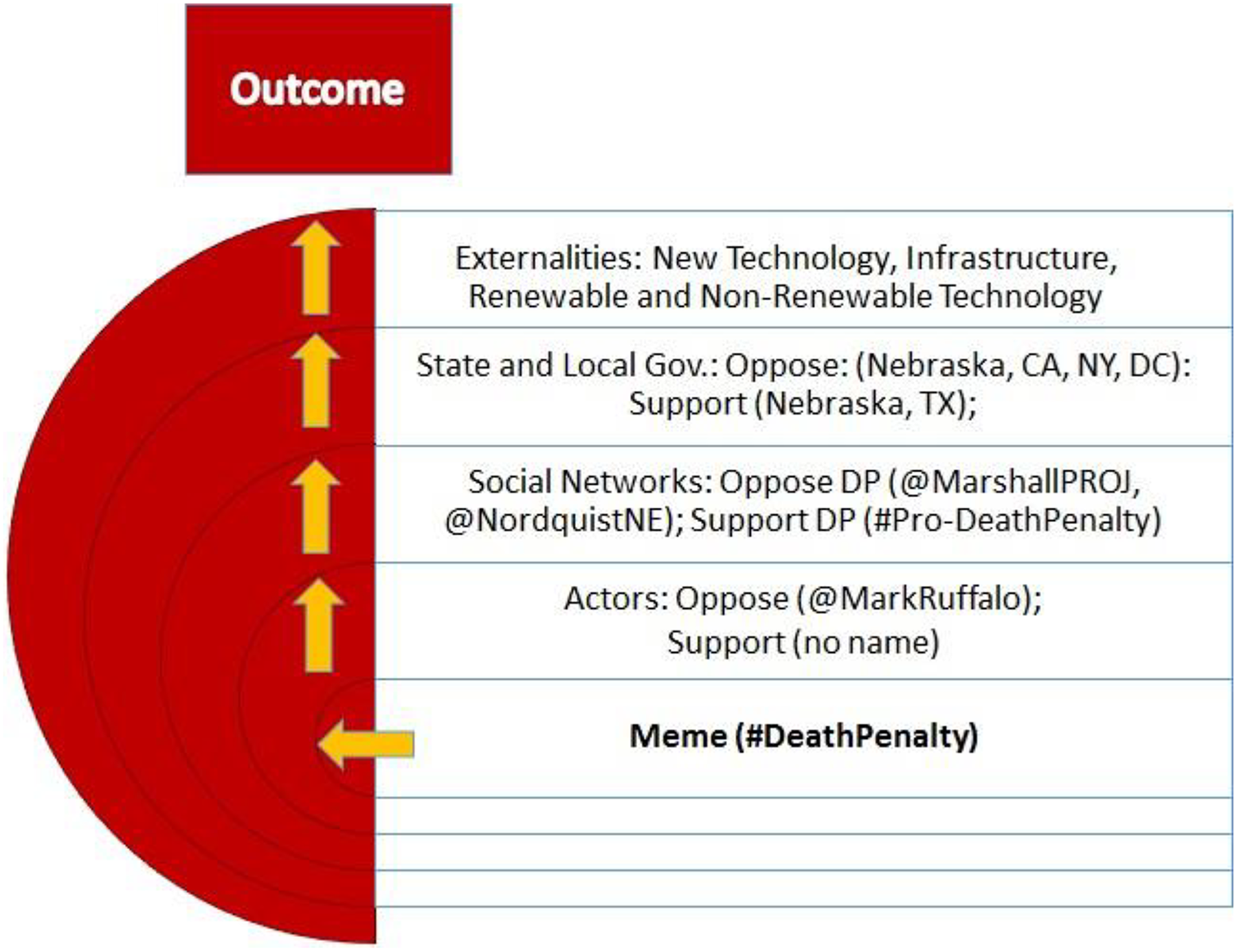
The M3D model.
M3D proposes five macro-levels of factors influencing meme diffusion outcomes, within which the model organizes almost 40 micro-level variables. While no study is likely to be able to operationalize the entire model contents, the macro-levels provide a useful heuristic for isolating certain variables in any given research project. In any analysis of memetic episodes, the highest macro-level of analysis is the meme itself. Thus, the first level of M3D hierarchy level is the meme level given the fact that a meme has the potential for replication and transfer of information. In this study, the authors used the hashtag term death penalty (#death_penalty) as a seed for replication under the expectation that it would be the most inclusive and integrating meme representing public sentiments regarding capital punishment. Individual conversations are ephemeral, but digital memes such as hashtags enable the diffusion of sentiment and influence through communication, especially for an issue that has a specific term for a vast and complex set of processes (Heylighen & Chilens, 2009). The hashtag phrase is expected to be repeated and replicated across the social media.
Memes originate from actors communicating, and therefore, the next level of the M3D theory is the actor or source. In general, actors who are more competent, credible, and popular are more capable of producing memes likely to be replicated widely (Spitzberg, 2006). The status and popularity of the actor are important factors in the process of diffusion. For example, we know more about the death penalty after reading the news about an inmate, Kelly Gissendaner, who was executed in Georgia in September 2015 (Fins, 2015). Ms. Gissendaner was the first woman executed in the state of Georgia in 70 years (Baker, 2015). Another example is the media exposure surrounding a series of contemporary “botched” and questionable actual and attempted executions (Gill, 2017). Media consumers may be more influenced by certain spokespersons or pundits than others, and such influentials may dominate any given network of interactions on a given topic. The more the communication technologies support or maintain a social network, the more potential there is for both the technologies and the social network to facilitate meme diffusion (Wellman & Haythornthwaite, 2002; Zhao, 2006).
The next macro-level of the M3D theory represents the social networks through which memes propagate (Sharag-Eldin, Ye, & Spitzberg. 2018). Social media memes are units of information that spread from person to person through the internet and social network (Kwak, Lee, Park, & Moon, 2010). Certain features of social networks may provide some memes with better affinity paths for diffusion than other memes (Iribarren & Moro, 2009). For example, some research indicates that memes diffuse better with a sender who has many friends (Kee, Sparks, Struppa, & Mannucci, 2013), especially within homophilous network groups. Examples of social networks that are supportive of death penalties include groups of terrorist victims. In contrast, opponent groups with like-minded attitudes toward abolishing capital punishment include Amnesty International and the National Coalition to Abolish the Death Penalty (NCADP).
In the theoretical metaphor of M3D, each meme enters an informational ecosystem, in which it competes for attention relative to other memes in general (i.e., the overall attention available relative to all the memes seeking such attention) and memetic predators, or counter-frames that reflect memes generated by a network in direct opposition to a given meme. Thus, when a meme proposes a sentiment toward the death penalty, it not only has to compete for attention in a crowded cyberspace of attentional resources, it may also draw direct attack by users and groups in networks seeking to extinguish or ‘out-voice’ such memes.
Some memes find either favorable or unfavorable resources when societal macro-level factors or institutions seek to either amplify or silence such memes. Thus, some relatively local memes find purchase in the glare of national media institutions or organized campaigns, whereas the vast majority of memes fail to propagate beyond their initial receiver for lack of institutional broadcast pathways. Societal experiences, such as disease outbreaks (e.g., measles, Ebola) or terrorist events (e.g., Paris attacks), provide an information ecology readied for the emergence of more collective attention to certain memes relative to others.
In this study, this macro-level was influenced when the Nebraska repeal of capital punishment was challenged by supporters of the death penalty. The citizens of Nebraska signed up to collect signatures for the ballot to reinstate the death penalty in the November 2016 election. This study analyzes the opinions from the tweets posted in Nebraska from 19 May 2015 to 31 December 2015. The data collected from Twitter API contains recoverable online conversations, information sharing forums, news commentary broadcasts, and social media news circulation. This study will utilize the feature of “retweeting” (@RT) and hashtags (#) as simple yet powerful mechanisms to detect information diffusion through data mining. This study also examines the geographic distributions of opinions on the death penalty including the probability of pros (support) and cons (opposed) by states using tweets data as input indicators.
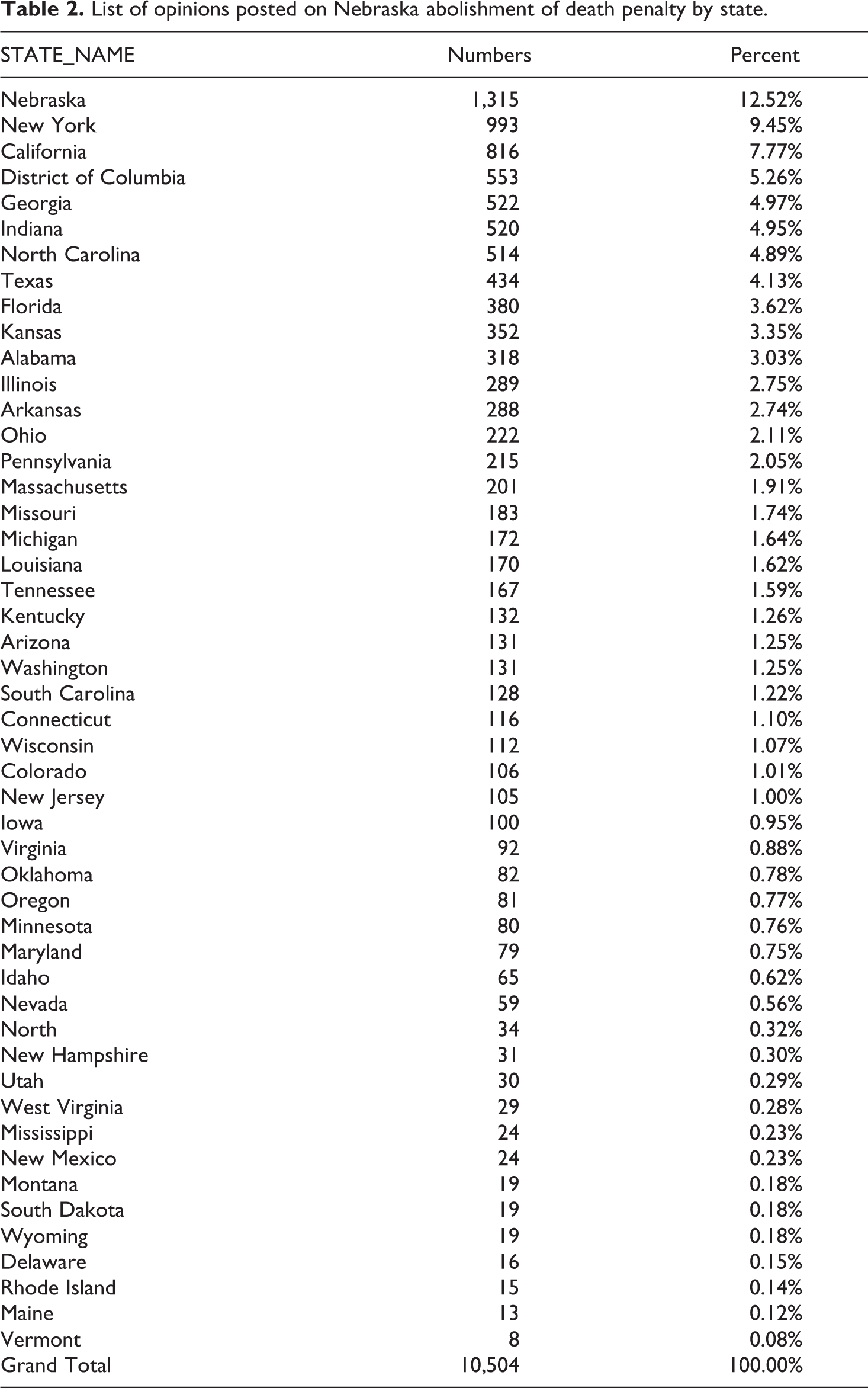
In May 2015, the state of Nebraska banned the death penalty. The reactions to this event were captured for all the 50 states, with the highest geotagged tweets from Nebraska (1315 tweets), New York (993 tweets), California (816 tweets), and Washington DC (553 tweets). Although the large numbers of tweets posted from Washington DC do not represent the residents of Washington DC, the tweets were sent by Twitter users who work in the adjacent areas around Washington DC. The fact that state-level local groups often have their lobbying groups and political representatives headquartered in DC is a socio-geographic parameter when examining policy-based issues. More specifically, on policy-related issues to which lobbying groups and politicians are sensitive, it should be expected that Washington DC will reveal geospatial concentrations of social media traffic on such issues, even when the jurisdictional legislation is located over a thousand miles away.
As a default prediction, the status quo government policy on the death penalty in any given state is likely to predict the dominant valence of online communication content on the death penalty. Specifically, in politically conservative states, in which the political party and religious leaders support the installation of the death penalty, memes are likely to reflect highly polarized social networks that evoke the passions of the opposition campaigns. In contrast, in states that have effectively banned the death penalty or that face no prospect of the death penalty, there should be a relatively more randomized distribution of memes. Similarly, the greater the majority of the Democratic or Republican primary state-level officeholders, and the longer those majorities have been in place, the more asymmetric (i.e., disproportionate) the meme sentiments will be in that state in favor of the legislation’s status quo. Exceptions to this default prediction are likely to arise when specific legislative options (such as laws or propositions) elicit social movements and campaigns that may provide more voice for change in the status quo.
Furthermore, even when the “red state/blue state” divergences are clear, within such states the dueling nature of social media may heighten the salience of the topic in general, amplifying and polarizing the dominant sentiment. In the M3D invocation of Wilson and Wilson’s (2007) axiom, “Selfishness beats altruism within groups. Altruistic groups beat selfish groups. Everything else is commentary” (Wilson & Wilson, 2007, p. 71). Wilson and Wilson (2007) developed this axiom based on Darwin’s original insight and development, reviewed in his book Descent of Man (Darwin, 1888). Selfish individuals might out-compete the altruists within the groups, but internally the altruistic groups are the one who beat the selfish group. The axiom by Wilson and Wilson is applicable in the context of social media. The polarized debates may well activate internal cohesion among the groups and energize social media campaigns that result in even more dominant and organized social media landscapes in the evolutionary war of the memes. Among the implications of this axiom, therefore, is that within relatively homogenous groups, there are likely to be opinion leaders competing for status, but the more collaborative these competing voices are overall, the more influential or dominant that group will be relative to other groups. In network structures, dominant networks would reveal complex structures with dominant nodes within the network but a high density of interconnectedness within that network or clique.
At the community levels, the demographic diversity may affect significant differences between “pro” and “con” groups and some “neutral” groups; for example, the urban-rural differences and some racial-ethnic differences would probably correlate statistically in supporting or opposing the death penalty. Another example for the state level, Texas, which has a majority of its population belonging to the Republican Party, would have a broad majority in the pro-death penalty (pro-DP). However, its urban areas such as Austin, Dallas, and Houston would probably be much more balanced, or even more Democratic or anti-DP in sentiment, due to the high proportion of black populations in those cities.
In contrast, California, for example, will be broadly more anti-DP overall because it is so solidly Democratic, even though it still allows the death penalty. There are 743 death-row inmates in California. However, depending on the topic and uniquely homogeneous communities, the decision of “pro” or “con” in the death penalty varies by individuals in the community. For example, the Catholic communities may be anti-DP, but may not be very interconnected or embedded within the more politically-active (i.e., lobbying) communities.
Finally, M3D anticipates that external factors at the geotechnical macro-level also play a significant role in how memes diffuse. The geospatial locality of death penalty opinions is likely to interact with proximity dynamics of social networks and neighborhoods, from the personal level to the state level of meme diffusion. Death penalty opinion is geospatially clustered in ways that reflect population and political topographies and occur in spaces that vary in their online and social media demographics and political leanings. The death penalty events in Nebraska offer a potentially varied set of contextual applications of M3D theory.
Literature review: Connecting communication theory and geography theory
Communication and geography are two academic disciplines that share a border where interdisciplinary activities constitute liminal movements in both their territories and boundaries (Adams & Jansson, 2012). The social scientific study of the use of space and communication, or proxemics, dates back to the 1960s (Forston & Larson, 1968; Hall, 1963; Hall et al., 1968). The connection between communication theory and geography was first revealed by Hägerstrand in his publication “Innovation diffusion as a spatial process”, based on his doctoral thesis in 1953 (Hägerstrand, 1967). He defined the diffusion of innovation as a function of social communication. Hägerstrand also introduced the time and space model, which included features such as a space-time path and a space-time prism that was the beginning of the time geography studies (Kraak, 2003). Throughout the years the Hägerstrand model has been applied and improved to understand movements through space (Gale, 1972; Hägerstrand, 1970).
In another development related to communication and human geography, Lefebvre introduced the concepts of the right to the city and the production of social space (Lefebvre, 1974). Lefebvre suggested that representation of space as the social space of communication is occupied by artists, writers, and philosophers. In today’s context, the space of communication is also shared by internet bloggers, celebrities, political figures, and virtual relationships.
Another geographer, Adams, conceptualized the social space of communication as the abstract, theoretical, and production-oriented spaces involving the formal plans and abstract blueprints of powerful actors whose formalizations of space control actions (Adams & Jansson, 2012). This statement is supported by Yi-Fu Tuan, a human geographer who argued that space and place are virtual areas we come to know and visualize instead of being a fixed location (Tuan, 1977). Place captures the idea of deeply layered subjective experience grounded in the particularity of local conditions and discourses, whereas space implies potential as well as actual movement of bodies, goods, capital, information, and communication (Edwards & Usher, 2000).
Geographers have focused on the traditional role of communication in exerting and legitimizing political and economic power at various scales in the fundamental concept of space and mobility that is addressed in communication geography (Harvey, 1989; Sassen, 1991, 2004; Scott, 2011). Efforts are progressing in theorizing the role of geospatial factors in mediated communication (Couldry & Hepp, 2013; Hampton & Ling, 2013; Spitzberg, 2014).
There are promising developments in social media communication with the advancement of internet technology and its computer applications in the social media that make online data mining possible (Ye, Li, Yang, & Qin, 2016). These new developments represent a breakthrough for internet users, marketing experts and researchers in their access to data in real-time and global coverage (Ye & He, 2016). Research is capitalizing on social media data in understanding emergency disaster response (Comfort, Oh, Ertan, & Scheinert, 2010; Curtis, Mills, & Leitner, 2007), social movements (Earl & Kimport, 2016; Nagel et al., 2013), terrorism (Chen, Reid, Sinai, Silke, & Ganor, 2008) and environmental issues (A. Hansen, 1993). Recent studies have found that social media both reveal and represent sources of the influence on personal opinions (Gunther, 1998; Spitzberg, 2006). According to Noelle-Neumann, people learn about public opinion from media coverage, especially when the news contains a contradiction (Noelle-Neumann, 1974). In today’s information society, these media are increasingly both mass and social in transmission and influence.
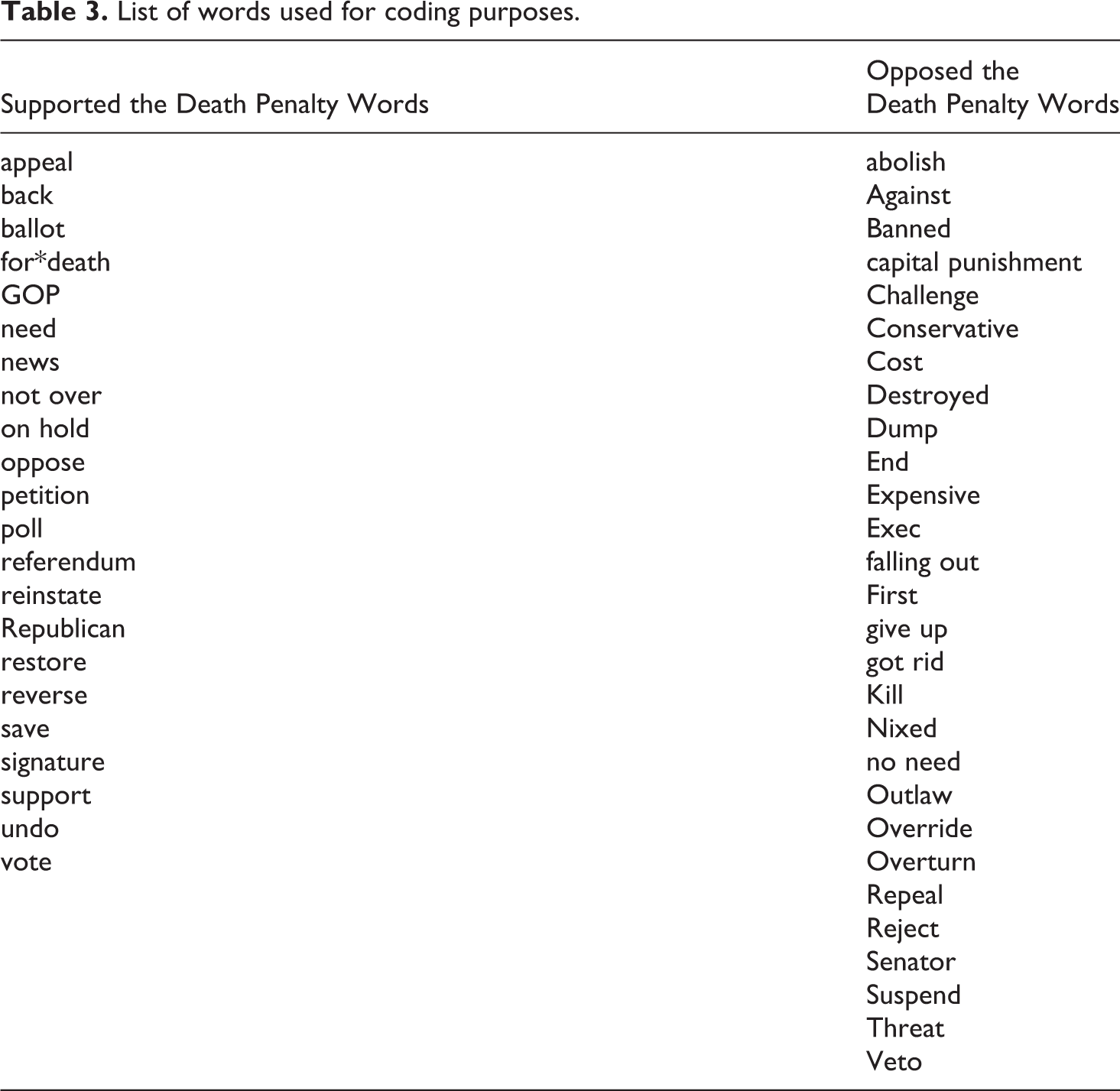
Given this rationale, we focus on the role of opinion leaders or actors who influence the public using their media power. The research question is to what extent M3D accounts for the meme diffusion patterns of social media messages related to death penalty abolishment. The actors are identified from keywords that distinguish the actors as supporters of the death penalty (appeal, ballot, referendum, pro-death penalty, etc.) or antagonists of the death penalty (abolish, repeal, reject, brute). The list of chosen words is shown in the Appendix. Among the pro-death penalty groups are included the individuals or group(s) associated with the government, families of terrorist victims, and conservative groups. In contrast, the anti-death penalty groups consist of amnesty groups, liberal groups, and groups of lawyers. Given the intersections of communication and geography available in the social media context, we examine the following research questions.
Methodology and data preparation
This study adopted mixed quantitative and qualitative methods to examine the death penalty controversy. The data were collected with the free version of Twitter API with hashtag #death_penalty, as mentioned in the Conceptual Framework section. The objective of data collection using Twitter was to capture a large data corpus and to identify the viral messages among the text messages.
The initial data were appended in a spreadsheet for the text sorting purpose. After the Twitter download, the data were analyzed based on the specific event(s) of the death penalty. The event that stirred the most salient Twitter reactions in Nebraska was the proposal to repeal the death penalty in Nebraska, representing 10,500 Twitter users. Since this study focuses on this episode in Nebraska, other high-profile events mentioning the death penalty messages are excluded, including the death penalty for ex-Egyptian president Mohamed Morsi, death penalty and executions in Saudi Arabia, and the death penalty for the Boston Bomber.
The next step was coding the database using familiar words or phrases to identify the Twitter users’ opinions on the death penalty debate. R-programming was used to create word-clouds of the most popular words posted in the initial database (O’Sullivan & Perry, 2013; Waller & Gotway, 2004). The words in the word-clouds were used to identify the opinions reflected by the tweet. The coding of the tweet users’ opinions will be explained in the data preparation section.
The text messages were sorted, coded and ranked to generate a list of words and phrases that could be interpreted as supportive of the death penalty as an extreme method of capital punishment (coded as +1), or words and phrases with sentiments toward banning or abolishing the death penalty (coded as -1). Tweets with unrelated or neutral messages that were nevertheless captured with the hashtag “death penalty” were coded as 0 and discarded from the process.
After coding the text messages, the next step was to group the tweets based on large numbers of repeated texts, retweets (RT@) and mention name (@) sent by the same users. This grouping of the tweets was a preliminary step to identify the names of the opinion leaders or actors and their Tweet account profile data information. To understand the diffusion of the keyword “death penalty,” the texts from the opinion leaders, or “actors”, were examined separately. In general, Twitter uses the retweeted messages with the symbol “RT@”. The retweeted messages are messages originating from a certain actor or actors captured by the followers and then retweeted in the social media (Cha, Haddadi, Benevenuto, & Gummadi, 2010). From the M3D perspective, every retweet verifies the message as a meme replication and represents an index of social influence in a diffusion adoption process.
The groups of high volume tweets sent out by the same user names were sorted and identified separately. Another group of tweets containing most retweeted messages were analyzed separately using NodeXL to visualize the direction of relationship between the news creators (or those whose tweets were retweeted by other users) and the regular Twitter users. The NodeXL methods followed the examples in Hansen et al. (D. L. Hansen, Shneiderman, & Smith, 2010).
Data preparation involved downloading Twitter data with the keyword #death_penalty from 27 May 2015 to 31 December 2015. The data download resulted in a sample of 389,800 worldwide geotagged tweets. From the geographic locations and time-stamps obtained in the data, tweet data point locations were assigned to their respective states. For the geographical map limitations, data assigned as originating in Alaska and Hawaii were omitted in this study. The data were sorted using the daily time series to show the peak of daily tweets captured during the study period (Figure 2).

Public opinion on the death penalty captured in Twitter.
The first step of data analysis is to sort all data points based on time stamps to identify the events resulting in the most tweets, or the underlying meaning of peaks in Twitter activity. The time series chart in Figure 2 showed the highest peak of tweets during 28 May 2015. This peak was triggered from the memes related to the abolishment of the death penalty in Nebraska (“Nebraska abolished death penalty”). The meme was retweeted and replicated over 10,500 times during the study period.
The reaction to executions in the Islamic countries (Saudi Arabia, Pakistan, Iran, Bangladesh, Sudan) is another major topic that triggered public opinions. The list of public reactions to events related to the death penalty captured in the geotagged tweets data is shown in Table 1. According to Human Rights Watch and Amnesty International, from the hundreds of people on death row from various nations, over 175 people were executed from 1 January to 31 December 2015 ( The Guardian Staff, 2015).
List of articles related to “death penalty”.

In this study, we captured the highest numbers of tweets that mentioned the combination of keywords using hashtags of “death penalty” and the name of the state “Nebraska” to compile the US public reaction to the abolishment of the death penalty in Nebraska at the time. Most tweets were posted from Nebraska with 1315 tweets, followed by New York (993 tweets), and then California (816 tweets). The list of the highest 20 states in response to Nebraska’s repeal decision is shown in Table 2. A list of words used in this study to identify the “pros” and “cons” of “death penalty” is listed in Table 3.
List of opinions posted on Nebraska abolishment of death penalty by state.
List of words used for coding purposes.
The next step is to identify the opinion leaders as an indicator of the source of meme diffusion among the tweet users. Katz and Lazarsfeld (1955) demonstrated that information is disseminated through opinion leaders rather directly from mass media. To understand the diffusion of the key term “death penalty,” the texts from the opinion leaders, or “actors,” were grouped and examined separately. We identified the opinion leaders using the retweeted messages. The Twitter users whose messages were retweeted the most may be an indicator of opinion leaders. The retweeted messages with the symbol @RT are the messages originated from a certain actor or actors captured by their followers and then retweeted in the social media.
From the M3D perspective, every retweet both verifies the message as a meme replication but also represents an index of social influence in a diffusion adoption process. Internet memes depend on collective creation, circulation, and transformation. The memes are multimodal texts that facilitate participation by re-appropriation, by balancing a fixed premise with novel expression (Milner, 2016). This study traced the repeated phrases that were circulated among the tweet users that originated from the opinion leaders.
We used NodeXL to map the visual connection between the opinion leaders and their followers. From a total of 10,500 tweets related to the abolishment of the death penalty in Nebraska, approximately half of the text messages (5400 tweets) were retweets. NodeXL was used to create clusters of the 20 most retweeted text messages that originated from actors or opinion leaders with large numbers of followers. Multi-scale layout algorithms were chosen to achieve an aesthetic visualization of undirected graphs with curved edges. The algorithm is capable of drawing graphs of large-sized data sets. For example, the algorithm achieved optimal drawings using the Harel-Koren Fast Multiplex layout to find clusters in the network that have the same attributes in the settings (D. L. Hansen et al., 2010). Figure 3 shows an example of actors – EJUSA, NE4PublicSafety, and CCATDP – that are visually grouped in the purple vertices.
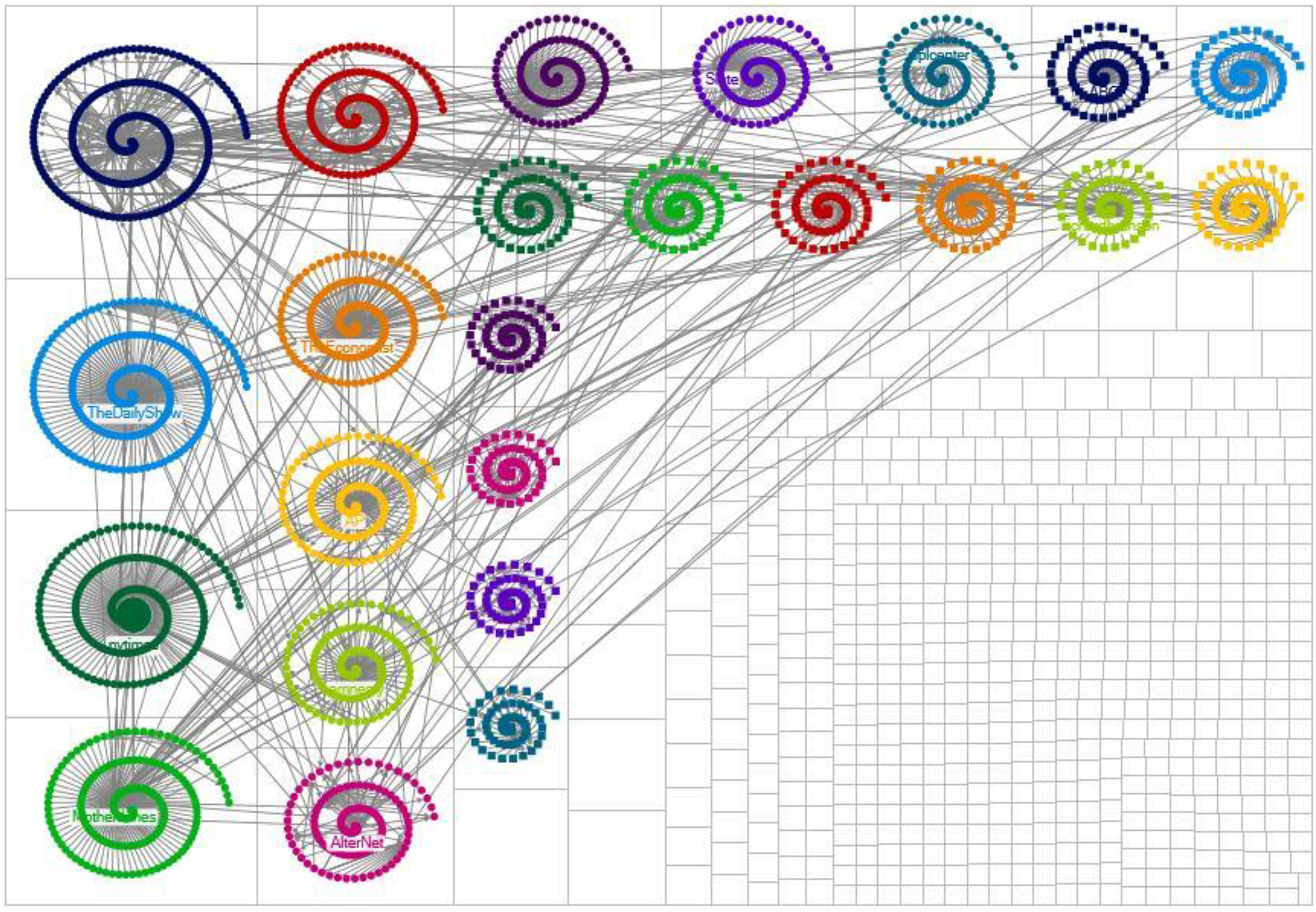
NodeXL groups of tweet actors.
Figure 4 shows the chart of public opinion on the abolishment of capital punishment in Nebraska by selected states based on the list of the highest states in response to Nebraska’s abolishment of capital punishment listed in Table 2. The first column in Figure 4 shows the state of Nebraska’s social media zeitgeist with 658 tweets of support for the death penalty versus 421 tweets opposed to the death penalty.

Summary of public opinion on Nebraska abolishment of death penalty by states.
Findings
The information from NodeXL represents the relationship between regular or frequent tweeters and their group relationships. After setting up the groups, actors’ usernames were traced in Twitter to interpret which categories of the M3D model were represented. This process led to the following initial results: Individual actors consisting of movie stars, entrepreneurs, and politicians with between 2 million and 7 million followers diffused memes more extensively than typical Twitter users. The sample of actors is listed in Table 4. One group of actors belongs to media businesses or political affiliations, which have larger numbers of followers than individual actors (up to 15 million followers). This information supports the second hierarchy of M3D, that the more popular the actor initiating the meme (i.e., the more influential the source, vis-à-vis the average individual actor), the more widely the meme diffuses. The news agencies and social media applications revealed their own social networks. Their representations in meme diffusion were many times more extensive than the individual and group actors, presumably because such organizations often have the responsibility or task of diffusing newsworthy issues and have the collective resources to repeat and reinforce such diffusion processes. The sizes of their follower networks collectively represent 15 million to 30 million people. This finding supports the third level of M3D, in which social network structures moderate public opinions reflected in meme diffusion patterns. The abolishment of capital punishment in Nebraska is a government action. The influence of the government actions in this sensitive issue stirred up reactions in public opinion, reflecting peak social media reactions to real space events. This supported the fourth level in the M3D societal entities such as government institutions and policies moderating the diffusion of the memes to citizens.
Sample of actors in meme diffusion “death penalty”.
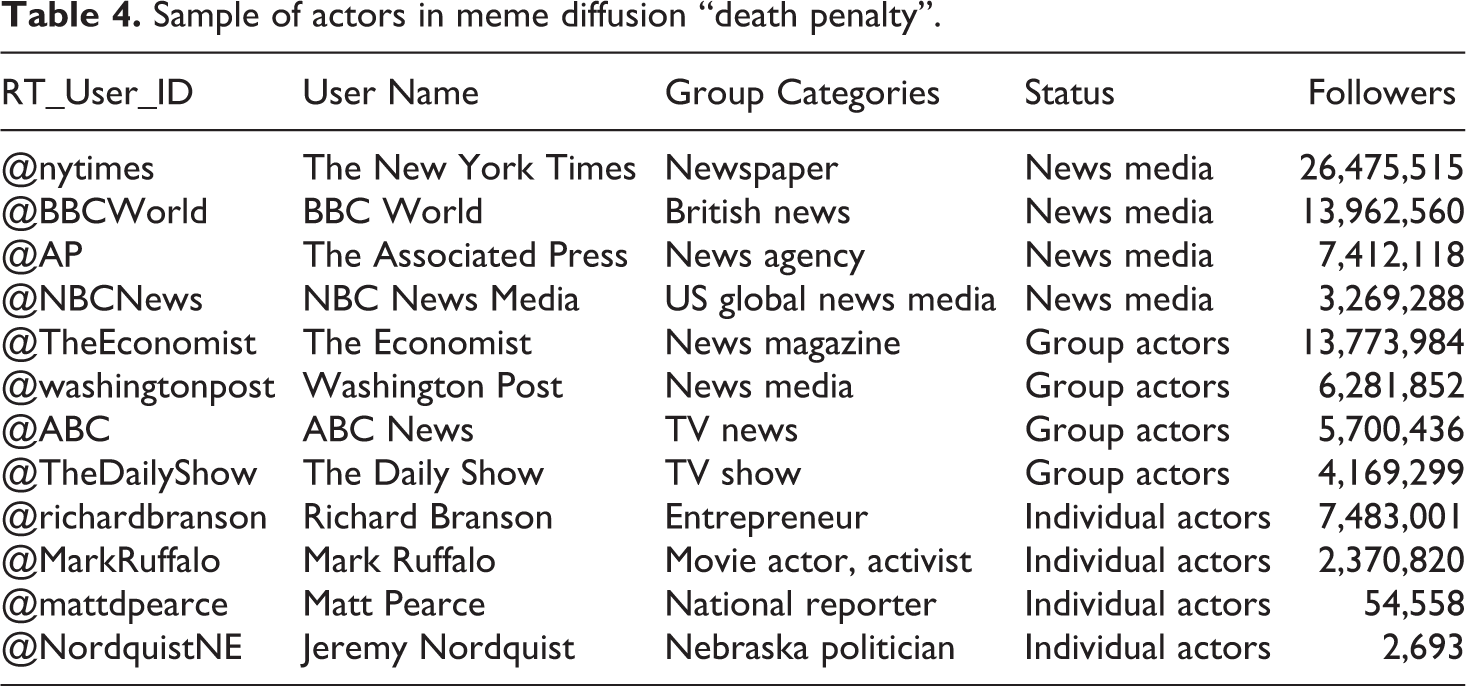
All of the above three points in the findings indicate that the hierarchical levels of the M3D, from actors to social networks to societal groups (i.e., state or government institutions), play important roles in the meme diffusion using #death_penalty. Thus, the research question #1 (RQ#1) is affirmed—public opinion on issues such as death penalty legislation, as reflected by memes in social media, can be mapped conceptually and empirically at multiple hierarchical levels of influence.
In the United States, there is a fluctuating tendency to enforce, and to abolish, the death penalty. Such legislative episodes have been influenced as well by Supreme Court decisions. Michigan was the first state to abolish the death penalty, in 1847. Four other states prohibited the death penalty in 1907 and 1911, and seven more between 1913 and 1918 (Hartung, 1952). Until recently, most Americans did not think much about the possibility that some percentage of people sentenced to death might actually be innocent (Baumgartner et al., 2008).
In May 2015, the Nebraska Legislature voted to repeal capital punishment. Nebraska became the first conservative state (Jones, 2016) in more than 40 years to abolish the death penalty (Connor & Chuck, 2015). After more than two hours of emotional speeches at the Capitol, the Legislature, by a majority vote that cut across party lines, overrode the governor’s veto of the bill repealing the state’s death penalty law. After the repeal measure passed, by just enough votes to overcome the governor’s veto, dozens of spectators in the balcony burst into applause (Bosman, 2015).
The Nebraska bill’s passage was unusual because some states that have abolished capital punishment in recent years are politically inclined toward the Democratic Party. During the last 20 years, numerous empirical studies have concluded that the death penalty has no measurable deterrent effect beyond that of life imprisonment (Baldus & Cole, 1975; Dölling et al., 2009; Gerritzen & Kirchgassner, 2013). Nebraska, a Republican state with the majority of its legislative body consisting of people with a conservative view, defied the odds by eliminating capital punishment in 2015. The last conservative state to abolish the death penalty was North Dakota in 1973 (M. Berman, 2015).
Nebraska’s supporters of the death penalty challenged the Nebraska Legislature’s decision by collecting signatures of support for the death penalty. They needed 57,000 signatures (or 5% of the state’s voters) but collected over twice the number needed (120,479 signatures). Thus, the proposition to repeal the abolishment of the death penalty made it to the ballot for the 2016 election (Bellware, 2015). The decision to revive the death penalty was not necessarily surprising, given that the majority of US citizens still support the death penalty (Cassell, 2008; Soss, Langbein, & Metelko, 2003). In 2017, a Gallup poll on public opinion in the US found that the majority of the general public (55%) was in favor of the death penalty compared to 41% who opposed it. However, support for the death penalty is as low as it has been in the past 40 years (Jones, 2017). Furthermore, what is true at the national or international level may or may not reveal relevance or influence at the more localized state level.
The tweets collected in this study indicated that the majority of US citizens supported the state of Nebraska’s repeal of its capital punishment law. The tweets from Nebraska, however, indicated that over half of tweeting Nebraskans (57% of Nebraska voters) supported the reinstatement of its death penalty. This study also found that some major states showed support of the abolishment of the death penalty in Nebraska (i.e., Texas, Georgia, and North Carolina; see Table 2). As an additional triangulation that social media are diagnostic of public opinion, these states also reveal higher execution indexes per capita in the United States (Death Penalty Information Center, 2016), although the tweets also captured a high number of opinions against the death penalty across these states as well. This illustrates that memes compete in contexts in which there are often counter-framed memes, and these competing memeplexes thrust and parry in sometimes symbiotic ways, each side supplying fuel for the other side’s reactions and attempts to overcome the competition (Clark & Spitzberg, 2017). However, in the end, it appears that state governments tend to decide on death penalty policies based on how the majority of the electorate within those states feels.
As predicted by the analysis using Twitter data on death penalty opinion in Nebraska, the voters decided to repeal the ban on capital punishment (Hammel, 2016). The results from the election showed that 61.2% voted to repeal the death penalty ban and 38.8% voted to retain or keep the death penalty prohibition. The results from the election were consistent with posted public opinion in social media, as the majority of Nebraska voters wanted to reinstate capital punishment. The few digit anomalies of the percentages between tweet data results and ballot measure results are possibly caused by the distribution of Twitter users who were skewed toward younger population cohorts (Mislove, Lehmann, Ahn, Onnela, & Rosenquist, 2011). The results from the death penalty vote indicated that social media data were relevant for analyzing social phenomena regarding public policy development. This evidence supports provides an answer to RQ2, that social media data are relevant for analyzing social phenomena.
Conclusion
Social media processes often foment public attention through both opinion divergence and convergence. Sometimes, social media sometimes also evoke public action and reaction. Such actions and reactions, in turn, result in polymemic feedback loops that activate more social media processes. This study captured public perceptions regarding the abolishment of the death penalty in Nebraska. Although the Legislature and electorate decided to reinstate capital punishment, as of this writing, a large and active contingent of Nebraska citizens are mobilizing once more against the death penalty (e.g., http://nadp.net/; http://retainajustnebraska.com/facts/cost/). Such propositional debates and social movements will increasingly be resolved in the competitive environment of public attention. Memes, both pro and con, will continue to compete in the informational ecosystem in which they seek compatible environs and a comfortable foothold for the issue species at stake.
The objective of this study was to use public opinions expressed through tweets to test certain macro-level parameters of the M3D. The M3D model anticipates that a meme has the potential to replicate, and the social network may provide some memes with better paths than other memes. M3D proposes that some memes’ diffusion levels will be influenced by highly centralized actors such as news media, state or local government policy, as well as external geotechnical factors, ranging from demographics that influence media literacy and engagement, to geospatial factors affecting the liberal—conservative value and belief polarizations.
The study found evidence of the influence of several major actors and actor groups at different state levels. The news media have hybridized social media since Twitter was created in 2006. The tweets from the traditional news media have been retweeted to other groups of media and regular Twitter users. Newspapers have a large number of followers since they joined Twitter in 2007. The top newspapers on the list were the New York Times, with more than 2.6 million followers, followed by the Wall Street Journal, with 465,000 followers (Porter, 2010). News organizations may not always be the first to publish the news, but their agendas and discussions continue to shape conversations around major news stories (Newman, 2011). As agenda setting theory suggests, the content of media may not determine what people think, but they may significantly both influence and reflect what they think about (Gruszczynski & Wagner, 2017; Vargo & Guo, 2017).
In addition to news media, state governments and their decisions can influence public opinion in at least two ways: by instigating religious leaders to engage in social activation to ban the death penalty by restricting the use of lethal drugs in capital punishment.
Such factors may help explain why Georgia and Texas, which have executed the highest number of people since 1976, revealed tweets mostly opposed to the death penalty.
In Nebraska, public opinion was mixed between those in favor of the death penalty and those against it. The analysis of the tweets sample results showed that 57% of the Nebraska population supported the reinstatement of the death penalty, compared to 21% of the population against the death penalty, and 22% with opinions unrelated to the death penalty. The prediction from the findings strongly indicated that the death penalty will be reinstated in Nebraska due to popular vote. On election day in November 2016, Nebraska citizens voted to bring back the death penalty, with 61.2% voting to repeal its abolishment. Thus, the results from the election are consistent with the public opinions posted on Twitter.
In this paper, there were not enough data to investigate the roles of geotechnical external factors such as technological penetration of the population to localizable clusters of tweets. Geotechnical factors in this case study might have included population demographics affecting the adoption of Twitter (which is a “younger generation” medium), the concentration of major media outlets, urban versus rural divisions that index political ideologies, and perhaps even neighboring state politics or shared urban metropolitan areas. Future research will need to utilize several software packages and datasets to examine research how Twitter data offer research opportunities for geographers to analyze human activities and communications (Issa, 2016).
Another possible geotechnical factor would be the proportion of a local population that has directly experienced (been victimized by) violent crime. Cultivation theory research demonstrates that both prior victimization and media consumption tend to disproportionately increase fear of crime, which may be reflected in an evememic cycle of influence (Custers & Van den Bulck, 2011; Elchardus, De Groof, & Smits, 2008; Grabe & Drew, 2007). For example, the state of Illinois abolished the death penalty in 2011, after more than a decade of a moratorium on executions out of concern that innocent people could be put to death by a justice system (NPR, 2011). It would be an important pursuit of this prospect by investigating how the public in Chicago express their opinion about the death penalty after a couple of years of escalating violence and homicide.
Footnotes
Declaration of conflicting interests
The author(s) declared no potential conflicts of interest with respect to the research, authorship, and/or publication of this article.
Funding
The author(s) disclosed receipt of the following financial support for the research, authorship, and/or publication of this article: The author(s) received financial support from the National Science Foundation, (Grant / Award Number: 1416509) for the research, authorship, and/or publication of this article.