



Abstract
Sustainable development recently topped the universal agenda again when the United Nations adopted its Sustainable Development Goals on 25 September 2015. Yet, since the 1990s, the concept has prompted different actors to reformulate their relations with the environment in line with different narratives on the concept. This inherent contradiction becomes all the more salient during sustainable development debates on nuclear, which has often been dominated by the expert-oriented politics prioritizing carbon-free economic growth by “post-politicizing” the issue at stake. In this light, the main objective of this paper is to contribute to nuclear related literature stressing on broader conceptions of sustainability by going beyond those techno-economic discussions. Hinging on the multi-faceted nature of Turkey’s nuclear energy debate, this paper argues that multitude of state and non-state discourse coalitions (i.e. nuclear advocacy, nuclear opposition and ambivalent) has constructed sustainability of nuclear differently through their narratives. To substantiate its argument, through a narrative analysis, this paper examines competing narratives over nuclear energy’s economic, environmental and societal impacts in Turkey. The findings have challenged pro-nuclear techno-economic discourse coalition’s attempt to “post-politicize” Turkish nuclear debate by revealing complex and multi-faceted nature of the debate.
Introduction
By adopting the 17 Sustainable Development Goals (SDGs) with 169 associated targets on 25 September 2015, the United Nations (UN) has set the new universal agenda. Considering vast number of those determined goals, several pundits argue that they are too many with little focus to make a big impact (Lomborg, 2015; Selin, 2015). To make it more complicated, there is no universal consensus whether the concept of [sustainable] “development” should be understood narrowly, as measured by economic growth, or broadly, as measured by human development (Kuzemko et al., 2016: 126). On the other hand, Swyngedouw considers the concept of sustainable development as an example of “postpolitics”, where dissensus or dispute is not allowed and political debate foreclosed and highly technical expert opinions dominate the debate (2009: 4).
This contradiction inherent in the concept of sustainable development becomes all the more salient in nuclear energy debates. Nevertheless, most of the academic literature on nuclear energy has narrowly focused on techno-economic expert concerns (i.e. zero-emission economic growth) around nuclear, culminated in “the adaptation-mitigation dilemma” (Jordan et al., 2010; Kopytko and Perkins, 2011; Moser 2012; Pidgeon et al., 2008). Nonetheless, broader discursive, political and governance related factors have been often neglected in the literature (Johnstone and Stirling, 2015; Sovacool, 2014; Sovacool and Valentine, 2012; Valentine and Sovacool, 2010). Few academic studies examine how nuclear energy is discursively presented to the public (for example, Bickerstaff et al., 2008; Lovell et al., 2009; Rogers-Hayden et al., 2011; Verbruggen and Laes, 2015; Windisch, 2008). Such studies mostly focus on developed countries such as the UK and Switzerland and how the discourse surrounding their energy policies relate to the discourse on climate change (Bickerstaff et al., 2008; Lovell et al., 2009; Rogers-Hayden et al., 2011; Scrase and Ockwell, 2010; Windisch, 2008).
In this light, this paper aims to fill the research gap in the academic literature on sustainability of nuclear debates by revealing complex and the multi-faceted nature of the debate. In doing so, the paper also contributes to a social science perspective to the literature, which has been an under-represented scientific discipline in the literature on sustainability of nuclear energy. Therefore, this paper contributes to emerging literature on sustainable development-good governance nexus, which mainly proposes multiple modes of governance with the inclusion of multiple actors in the decision-making process (Johnstone, 2014; Jordan, 2008; Zeijl-Rozema et al., 2007). As such, the paper is a contribution to bring politics back into sustainability of nuclear energy debate that has so far been post-politicized by the extensive construction of nuclear energy as the solution to the greatest problem of humanity, which is climate change (Johnstone, 2010: 94) while maintaining energy security.
This condition of “post-political” becomes more salient when (sustainable) development is narrowly confined to economic growth while fighting climate change. Hinging on climate action and the nuclear technology’s carbon-free characteristics, expert led pro-nuclear discourses could easily set the agenda, regardless of its socio-economic shortcomings (e.g. democratic, social, waste problems, etc.) (Swyngedouw, 2010; Verbruggen et al., 2014). In this context, even those anti-nuclear groups with well-grounded reasons (e.g. radioactive waste management problems, accident/terror risk, etc.) to oppose nuclear could be pushed to take ambivalent stance or “reluctantly accept” going nuclear as a way to tackle climate change (Bickerstaff et al., 2008).
Against this backdrop, controversial Turkish nuclear debate is an interesting case – despite understudied – in terms of examining multitude of actors’ contending narratives on the sustainability of nuclear energy. Before delving into its controversies, it would be plausible to elaborate on Turkey’s most recent nuclear turn. Three earlier attempts had failed as economic and environmental concerns actually have begun in the second half of the 2000s, culminating in the ratification of the law on the establishment of nuclear power plants and the sale of generated energy in 2007 (Unofficial Translation of the Turkish Law No. 57102). Following a two-year long tender and amendment process, on 27 August 2010, Turkey and Russia reached a nuclear deal for the establishment and operation of a nuclear power plant in Akkuyu, Mersin. The agreement stipulated that the executing Russian company Rosatom would build and operate the nuclear power facility at Akkuyu. Besides, Turkey made another nuclear deal with a Japanese–French consortium to build the second nuclear plant in Sinop (Euractive, 3 May 2013). The Ministry of Energy and Natural Resources (MoE) projected that when Akkuyu and Sinop nuclear power plants will be online by 2023, 20% of the country’s presently established power will be generated from in-house nuclear power plants (MoE, 2011). In addition to those two nuclear sites, Turkey has determined İğneada, Tekirdağ as the site for its third nuclear plant and China is poised to build it (WNA, 2016).
Turkey’s most recent nuclear adventure has been controversial. Although the license to build a nuclear power plant in Mersin Akkuyu was taken in 1976, the construction of the power plant is now very close to realization after the nuclear agreement signed between Turkey and Russia in 2010. In 2013, the first Environmental Impact Assessment Report for the nuclear plant project was submitted to the Ministry of Environment. Yet the report was not found satisfactory in terms of nuclear waste management, impact on the marine ecosystem, procedures of dismantlement and procedures of natural disaster and risk management. The company resubmitted another report in 2014, which was accepted by the assessment committee this time (2016). This led to an array of lawsuits filed for the stay of execution. When the Administrative Court demanded to see the report on Akkuyu power plant by the International Atomic Energy Agency (IAEA), the ministry of energy refused to share the report with the court citing national security reasons (Tanis, 2015).
Against the backdrop of these controversies, this paper argues that various discourse coalitions have constructed alternative sustainabilities of nuclear energy through their narratives in Turkey. To substantiate its argument, through a narrative analysis, the paper examines competing narratives in the ongoing debate over nuclear energy’s sustainability in Turkey. In order to do this, we conduct a narrative analysis of the accessible official non-technical reports on Turkey’s nuclear energy policy by state and non-state actors that have participated in public debate through the reports they published.
The outline of the paper is as follows: First, it examines multitude of sustainability perspectives on nuclear energy in the academic literature. Secondly, it elaborates on the conceptual framework and the narrative approach adopted. Third, after providing brief background information on nuclear energy in Turkey, the paper proceeds with its narrative analysis of the public reports published in the Turkish nuclear debate. It concludes that different discourse coalitions in the Turkish nuclear debate painted different pictures of nuclear energy as a sustainable energy source.
Contending sustainability perspectives on nuclear energy
Despite nuclear energy’s shortcomings (e.g. good governance, social, waste, etc.) to be considered as sustainable energy source (Pearce, 2012; Soykenar and Coşkun, 2015; Swyngedouw, 2010; Verbruggen et al., 2014), regardless of the Fukushima Nuclear Disaster, nuclear industry has been postulating that nuclear power might have been undergoing a “renaissance” (WNA, 2015). Comparing contributions of renewable energy sources and nuclear technologies for sustainable development, a recent study has found that both have been producing limited amounts of carbon emissions (close to zero for the nuclear technologies) (Karakosta et al., 2013). On the one hand, renewable energy sources generate no significant waste, thereby, favored by policy incentives, but some of them are plagued by high production costs and low efficiency, on the other hand, those examined nuclear technologies, despite their enhanced safety, reduced costs and minimized waste, still have to address the major issues of weapons proliferation, safety, waste handling and high costs as well as public approval (Karakosta et al., 2013). Several academics have proposed that nuclear energy should be combined with renewable energy sources in energy systems. Indeed, recent technological developments such as nuclear-fossil systems and nuclear-renewable systems have the prospect of enabling nuclear source’s efficient integration to energy mix (Forsberg, 2009). Some scholars even go further and propose nuclear as the only developed energy source that is capable of delivering the enormous quantities of energy that will be needed to run modern industrial societies safely, economically, reliably and in a sustainable way (Brook et al., 2014). In this parallel, there are scholarly articles favoring nuclear energy for sustainable development with reluctance on safety, nuclear waste, and public consent though (Adamantiades and Kessides, 2009; Develi et al., 2011; İşeri and Özen, 2013). Such contrasting scholarly perspectives on the sustainability of nuclear energy also reverberate in domestic debates on nuclear energy worldwide including developing countries.
Conceptual framework and methodology
Our focus is on the analysis of discourse coalitions in Turkey and their narratives constructing alternative sustainabilities of nuclear energy. We define discourse as “an ensemble of ideas, concepts and categories through which meaning is given to social and physical phenomena, and which is produced and reproduced through an identifiable set of practices” (Hajer and Versteeg, 2005: 175). In short, discourse is a meaning-making system that enables agents to define problems, suggest solutions, debate and persuade each other.
We are interested in how problems are defined, solutions are prescribed on the basis of various perceptions of the context in relation to nuclear energy in Turkey and how sustainabilities are constructed through different narratives on nuclear energy. We utilize a narrative analysis of the nuclear energy discourse in Turkey (Berg and Hukkinen, 2011; Curran, 2012; Hajer, 1995; Hay, 1996; Rafey and Sovacool, 2011). There exists a wide range of narrative analysis (Holstein and Gubrium, 2012: 1). Although the analysis of stories is very common in narrative analysis, not all narratives are stories. Accordingly, the narratives we analyze are written accounts with a beginning and end, in the form of arguments with a premise and a conclusion that is used by an actor to navigate herself in an issue with high uncertainty (Roe, 1992). The narratives to be analyzed can be drawn from a variety of sources including interviews, documents, conversations and research reports (Lee, 2012; Silvermann, 2015: 132). In this line, we draw our narratives from research reports on nuclear energy. Therefore we had to exclude websites, where questions and answers are the common format rather than a narrative format (Türk Atom Enerjisi Kurumu: taek.gov.tr; Türk Elektrik İletim AŞ: teias.gov.tr; Türkiye Nükleer Teknoloji Platformu: trntp.org; nukleerakademi.org). Likewise, we excluded academic work, which produces narrative in the form of technical accounts offering scientific causal relations in scholarly articles and books. Technical accounts “can look like stories, especially when they are popularized” (Tilly, 2006: 154 as cited by Frank, 2012: 41), the way they are narrated to the public is more relevant for our purposes than the technical information these reports provide. The research reports published by state and non-state organizations narrate scientific and technical accounts of nuclear energy in their reports to “popularize” them. This is why we collect reports written by state and non-state organizations that aim to explain nuclear energy to the public in general. In doing so, these reports filter and utilize technical accounts in narrative form. Although there is abundant academic work on nuclear energy and its sustainability, we are interested in how their work is filtered, cited by and therefore popularized by state and non-state organizations (Ateş and Saraçoğlu, 2013; Ertör-Akyazı et al., 2012; Özdemir and Çobanoğlu, 2008).
As “[n]arratives need a ‘valued endpoint’ (e.g. capturing the heart of the princess) and a set of events and characters that make the endpoint more or less probable, accessible or vivid,” they can easily take the form of arguments for or against a policy option (Maitlis, 2012: 492). Therefore, we categorize the narratives as nuclear opposition, advocacy and ambivalent depending on the valued endpoints and preferred set of actions to reach them.
We opt for narrative analysis as we are interested in understanding contestation over the meaning of sustainability of nuclear energy within the nexus of environment, economy and society. We also aim to bring to the fore those narratives that have not gained a salience in this debate. Finally, by focusing on narratives we aim to reveal how particular narratives become dominant, leading to certain practices and prescriptions in the nuclear energy debate in Turkey (Harris, 2009: 703). There are several concepts in the literature to study the relationship between actors, their context and the meanings they create. Once a new discourse emerges on any environmental problem, this discourse breeds alternative narratives supporting it and translating it on specific problems (Hajer, 1995: 47). In Harris’s words, “particular narratives of environmental conditions or changes are often structured in ways that enable the reader or listener to come to certain conclusions about the world” (Harris, 2009: 703). Different actors may converge on competing discourses thereby constructing “discourse coalitions” (Hajer, 1995: 45).
Considering that energy sits at the centre of “the three pillars of sustainability”, namely economic, social and environmental factors (Figure 1) (Rodriguez et al., 2002), this paper adopts these pillars to categorize contending discourses in Turkish nuclear debate.
The three pillars of sustainability.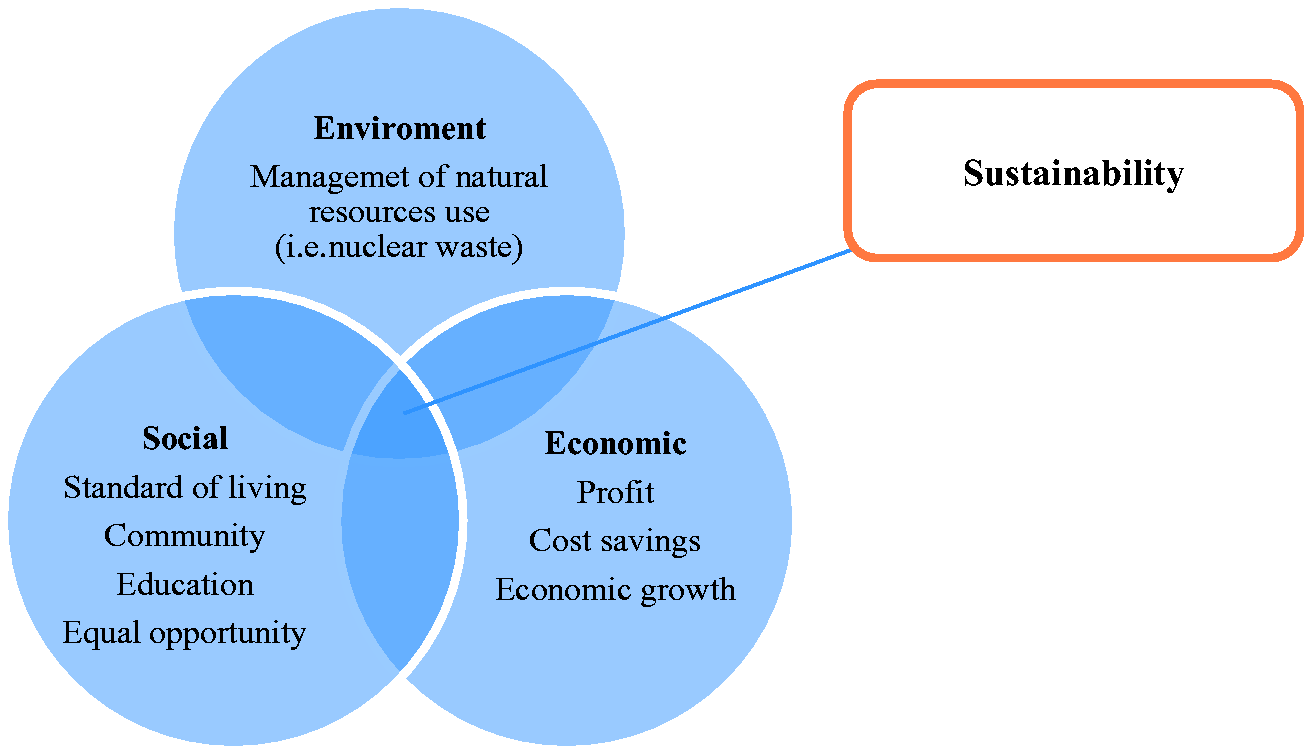
Leaving aside political elite perceptions such as status building ambitions, national pride, grander country to favor nuclear option (Bacık and Salur, 2010; Hecht, 1998; Jasper, 1990), nuclear advocacy discourse coalition narrowly equates (sustainable) development to carbon free economic growth at the expense of broader public needs and environmental considerations. Nuclear opposition coalition on the other hand approaches sustainability from an egalitarian perspective, highlighting the need to ensure social and environmental justice rather than economic growth. This also covers the narratives that portray economic growth as the primary reason for environmental degradation (Best and Anthony, 2006; Daly, 1973).
Resembling “reluctant acceptance” stance on nuclear, with variety of interpretations through, the ones adopting ambivalent position consider that environmental protection should be primarily for the sake of humankind, their strategy is to incorporate market processes to improve natural resource allocation and environmental quality (Anderson and Leal, 1991). This way nuclear ambivalent group sit somewhere at the intersection of advocates and opposers.
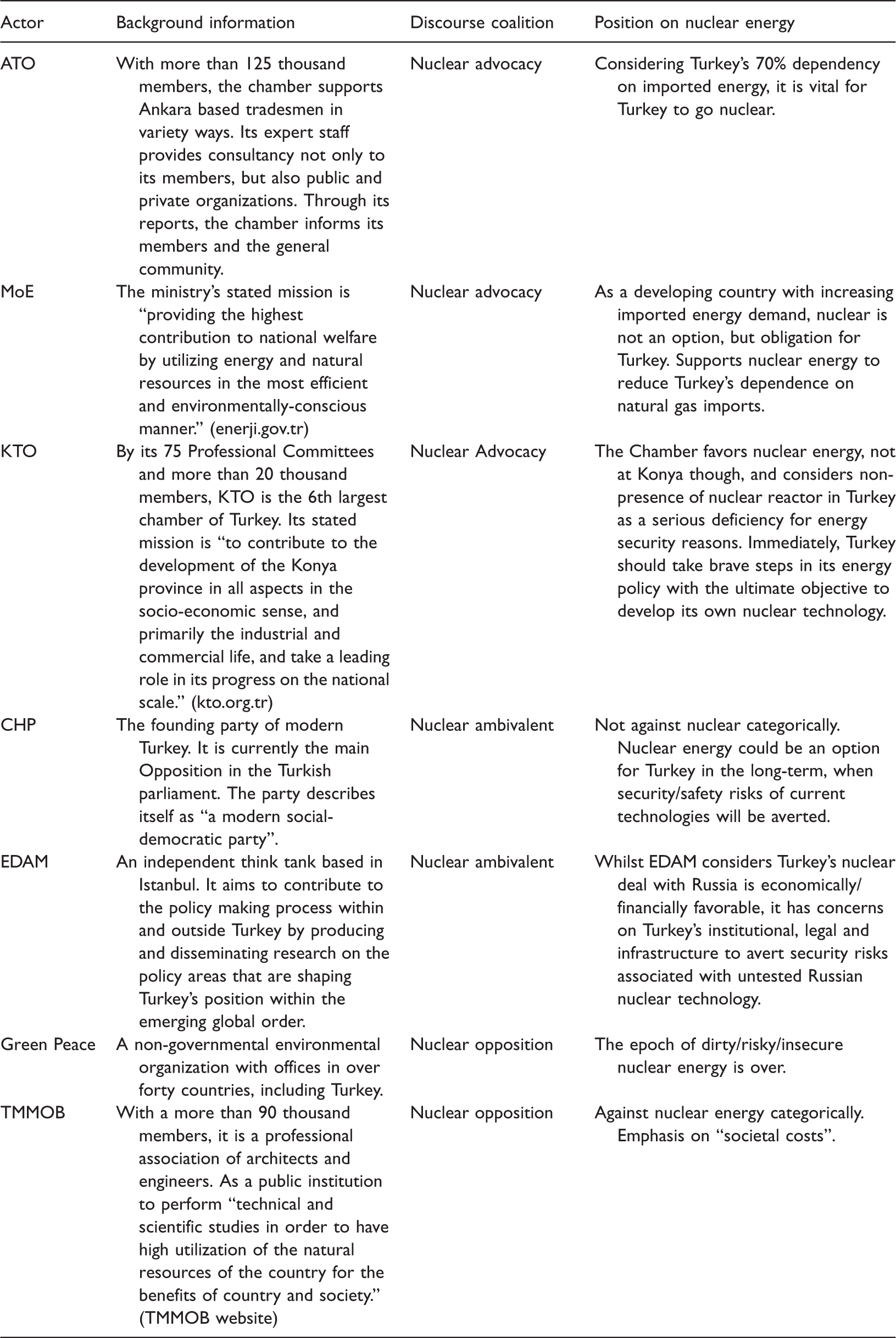
This global debate over the concept has also become salient in the battle among different discourse coalitions on the sustainability of nuclear energy in Turkey. To map this discursive battle, we collected eight reports in total of seven organizations from 2006 to 2014. The organizations whose reports we reached are the MoE, Ankara Chamber of Commerce (ATO), Konya Chamber of Commerce (KTO), Republican Peoples’ Party (CHP), Centre for Economics and Foreign Policy Studies (EDAM), Turkish Union of Chambers of Architects and Engineers (TMMOB) and Greenpeace. We then analyzed their reports within the framework of economic, societal and environmental stories they put forward on the sustainability of nuclear energy (drawing from Figure 1 above). Economic stories include those relating to economic growth, profit, costs and savings; societal ones include standard of living, community, education and equal opportunity; and finally environmental stories are those relating to the use of natural resources and nuclear waste in along with carbon emission levels.
Actors, discourse coalitions, positions on nuclear energy.
Nuclear energy debate in Turkey
Narratives of three discourse coalitions on the sustainability of nuclear energy.

Nuclear advocacy discourse coalition
In general, nuclear advocacy discourse coalition advocates nuclear energy and they accept it as a tool for assisting Turkey's economic growth. Second, narratives on nuclear energy point out its role in mitigating global warming, reducing pollution and in return contributing to environmental sustainability. Third, nuclear energy is seen as a key to enhancing standard of living, acquiring nuclear technology and creates new employment opportunities.
Economic narratives: “Fear of the dark”
As one of the main responses to the growing energy demand, Turkey’s energy strategy aims to integrate nuclear energy into energy mix while preventing dependence on imported fuels (MoE, 2011: 6–7, 27–32). Besides, it is underlined that there has been an increasing demand for and consumption of energy in Turkey due to the high economic growth rates experienced in the early 2000s. In fact, a considerable part of Turkey's current account deficit comes from its energy imports. Therefore, taking into account Turkey's energy dependency on foreign supplies and current account deficit, MoE puts that any supply disruption or energy crisis could severely affect Turkey's economic growth (MoE, 2011: 6).
The establishment of nuclear power plants is thus narrated as a key to achieve sustainable economic growth by Turkish officials, decrease energy dependence and strengthen its industrial competitiveness. When analyzing reports on nuclear energy, dominant discourses revolve around obligation to have nuclear energy to sustain economic growth. Report, entitled Information on Nuclear Plant and Nuclear Power Plants to be established in our country, released by the MOE underlines Turkey's “urgent need” for nuclear energy so as to fuel its economic growth. Indeed, the report states that “Until 2023, in order to achieve $ 500 billion in export, have a GDP per capita of $ 25,000 and become the 10th largest global economy with a gross domestic product of $ 2 trillion, establishment of nuclear power plant producing sustainable energy appears to be an obligation not an option” (MoE, 2011: 6–7) [emphasis by the authors]. There are also non-state organizations highlighting the importance of having nuclear power plants for sustainable economic growth. According to the ATO, due to Turkey's recent economic revival Turkey will need more energy for sustaining its economic success: “So as to meet electricity demand in the long run, Turkey needs to establish several nuclear power plants. If we delay more, we might have to celebrate the 100th anniversary of the foundation of our Republic in the dark” (ATO, 2010) [emphasis by the authors]. In the same vein, the KTO considers Turkey’s lack of its own nuclear reactor as a serious deficiency for energy security and propose immediate adoption of brave energy policies to meet Turkey’s incrementally increasing energy needs (KTO, 2006: 18). The nuclear advocacy coalition this way invokes a fear of disrupted growth at best and “remaining in the dark” at worst as a consequence of not going nuclear immediately. Such “fear of the dark” is a central narrative in their argument for the economic sustainability.
Environmental narratives: “Nuclear is low-carbon”
While economic growth-oriented narrative justifying the need for nuclear power plants in Turkey is dominant in the nuclear advocacy discourse coalition, they also argue that nuclear energy is environmentally sustainable. Nuclear is regarded as less of an evil when compared to the detrimental impact of fossil fuels on earth. The nuclear advocacy coalition adopts the narrative that nuclear power plants are the cleanest choice in the short and long run since they do not release greenhouse gases to the atmosphere when they are in operation (KTO, 2006: 14). Nuclear energy plays an important role in reducing greenhouse gases concentration leading to climate change (MoE, 2011: 26). In other words, the nuclear advocacy discourse coalition trades radioactive waste with high carbon emissions in this narrative (Bickerstaff et al., 2008).
Social narratives: “Nuclear brings better opportunities for all”
Nuclear advocacy coalition also adopts a societal narrative for nuclear power plants in Turkey. Some of them focus on creation of new job opportunities with nuclear power plants, others emphasize on increasing quality of life. Besides, it is asserted that construction of nuclear power plants will make Turkey's long-standing nuclear programme come true.
First, proponents of nuclear energy always refer to increasing energy needs and portray nuclear power as a tool to meet rising energy demand as well as support economic growth in Turkey. Having stable energy supply that nuclear power plants is alleged to provide is seen a key to a prosperous life by the pro-nuclear groups. It is also asserted that the construction of nuclear power plants will boost employment in the region which in turn increases the level of income and standard of living (KTO, 2006: 15; MoE, 2011: 45). Second, pro-nuclear groups propound that new job opportunities will be created not only for the people in the region but also in whole Turkey (MoE, 2011: 45–46). Third, the nuclear advocacy coalition narrates the nuclear power plants as an important instrument for Turkey in acquisition of nuclear technology (MoE, 2011: 6). In this argument, hundreds of students will be sent to Russia for training nuclear energy and they will be recruited at the nuclear power plant to be built in Turkey. In sum, the nuclear advocacy coalition narrates nuclear energy as not only an economic necessity and a low-carbon energy source, but also an incubator for technological transfer and employment in Turkey.
Nuclear opposition discourse coalition
Nuclear opposition coalition includes narratives that fundamentally challenge the dominant nuclear advocacy discourse coalition and the nuclear energy project that is practiced by them. First, high and unknown costs associated with construction and operation of the nuclear power plants have been emphasized in the narrative that nuclear energy is not the cheapest option for energy generation. Second, as opposed to environmental sustainability narrative, anti-nuclear narratives focus on nuclear waste and its negative impacts on the environment. Third, narratives against nuclear energy point out health problems resulting from the radioactive waste and “forced” population movement.
Economic narratives: “Expensive energy increasing national debt”
One of the main opposition arguments to the construction of nuclear energy plants in Turkey revolves around the economics of nuclear. According to the nuclear advocacy discourse coalition, the need for energy in Turkey is dramatically increasing due to its fast pace of economic growth and nuclear is regarded as the cheapest, best and sustainable solution to tackle with energy-related challenges. Energy crisis is very likely to occur if nuclear is not added to Turkey's energy mix. Also, the nuclear advocacy coalition asserts that high foreign trade deficit arising from energy imports could be decreased if nuclear power plants are constructed and put into operation.
The nuclear oppositions reject the narrated benefits of having nuclear power plants in Turkey. First, the idea of obligation to construct nuclear power plants so as to have large amounts of energy required to fuel economic growth is completely declined. According to the TMMOB Energy Report, the argument of possibility of being in the dark has been used by the government as a tool to legitimize the construction of nuclear power plants despite its economic, environmental and societal costs (TMMOB, 2013: 162). Besides, the same report argues that all the numbers and calculations about Turkey's desperate need for energy are exaggerated and Turkey's domestic energy resources are enough to keep the lights on (TMMOB, 2013: 153, 161, 248). For instance, contrary to the fact that Turkey's hydro potential totals 130 billion KWh, TMMOB asserts that Turkey could reach to 190 billion KWh if hydroelectric power plants are constructed on small rivers. The difference between the official figures and those of the TMMOB, 90 billion KWh, is almost three times bigger than the expected production capacity of planned nuclear power plant (50). Furthermore, this narrative underlines the significance of energy loss, resulting from leakage. Through investing on energy transmission loss, it is possible to decrease energy transmission loss rate (TMMOB, 2013: 162). Thus, TMMOB rejects the argument that nuclear power plants are needed as sustainable source of energy in Turkey and suggests ways of altering “consumption practices” as an alternative solution among other solutions (Johnstone, 2010: 94).
Second, nuclear oppositions make references to the costly nature of the nuclear power plants. The high and unknown costs of construction of and operating nuclear power plants and high price for electricity generated from nuclear power plants are narrated as reasons not to opt for nuclear energy in some of the analyzed reports (for instance, TMMOB, 2013, Greenpeace). TMMOB points at the expensive electricity generation with nuclear power plants. Based on the report, a kilowatt-hour of electricity has cost for Turkey 8.9 cent/KWh for the last ten years; however, when Akkuyu is put into operation, the cost will rise to 12.35 cent KWh (2013: 16). While the nuclear advocacy discourse coalition claims that Turkey needs to choose to have nuclear power plants since they provide cheap electricity, according to the chamber of electrical engineers, it is not cheap electricity (TMMOB, 2013: 16). Furthermore, there is an issue of unknown/unaccounted costs for having nuclear power plants. For instance, responsibility to bear the cost of waste and fuel management and dismantling power plants is not explicitly written in the agreement. To put it differently, if there is nobody taking responsibility to cover cost resulting from dismantling the plants, waste and fuel management in the agreement, this makes the government of Turkey automatically responsible for compensating all the costs. Due to this ambiguity in the agreement, costs could become heavier for the government in the future (TMMOB, 2013: 105). Therefore, along with environmental and societal costs, economic costs would be unaffordable for Turkey according to this discourse coalition.
Third, as it is pointed out previously, the nuclear advocacy coalition asserts that Turkey's foreign trade deficit is very likely to decrease when nuclear power plants start to generate electricity in Turkey. In other words, Turkey is believed to import less energy resources. However, nuclear opposition group strongly disagrees with this argument and develop a narrative of cost around Turkey's increasing import dependency with nuclear power plants. All the costs regarding the construction of nuclear power plants and operating them will be paid in dollars. Every year, Turkey will pay around $3.5 billion dollars to the Russian company (TMMOB, 2013: 104). Hence, rather than reducing foreign trade deficit, having nuclear power plants will lead to increase in foreign trade deficit. The same report also claims that with $3.5 billion, Turkey could buy 9 billion tons of natural gas which could produce more electricity than Akkuyu could generate. The chamber of electrical engineers sets forth that Turkey would become more dependent on other countries since it will need to import necessary uranium to fuel nuclear plants (TMMOB, 2013: 104). Thus, the nuclear opposition discourse coalition unites on the narrative that due to nuclear power plants trade deficit will soar and dependency on foreign suppliers will go up.
Environmental narratives: “Fear of a nuclear apocalypse”
The construction of nuclear power plants in Turkey has received resistance from several groups due to its possible impacts on the environment and human health. The nuclear opposition coalition has drawn their attention to Turkey's earthquake-prone location. Greenpeace narrates nuclear energy not as a solution to energy deficit but a threat to humankind due to the risk of disastrous accidents (Greenpeace, 2010: 5). Any high or medium degree earthquake would result in a catastrophic nuclear accident. It is also argued that the region has a high amount of accumulated energy and a serious earthquake is expected to hit the region in the future. According to a statement endorsed by the TMMOB in its report, the most harmful source of radioactive emission is nuclear power plants accidents and radioactive wastes classified as the riskiest, unobservable and uncontrollable risks (TMMOB, 2013: 10).
Secondly, while the TMMOB acknowledges the nuclear power plants’ positive role in decreasing greenhouse gas emissions, the narrative goes on to focus attention to that carbon emission of required fuel and construction materials for building a nuclear power plant is higher than other type of energy plant construction. As a solution to this problem, the chamber of electrical engineers advises to make use of renewable sources for electricity generation due to its low level of carbon emission potential (TMMOB, 2013: 98).
Societal narratives: “Nuclear plants hurt the local population”
In addition to the economic and environmental narratives used for delegitimizing the construction of nuclear power plants, there are also societal narratives on why Turkey should not go nuclear. First, this narrative emphasizes the reduction in the standard of living on the site of nuclear power plants and their surroundings because of the high level of radiation. Especially, people who work at nuclear power plants and live close by are under serious risk of radioactive discharges. TMMOB also raises concerns about long-lasting severe impacts of radiation on society (2013: 187). The report argues that if food chain is contaminated by radiation, it couldn't be understood as radiation can never be tasted and smelled (TMMOB, 2013: 188). To put it differently, as opposed to the argument that nuclear is likely to enhance standard of living, opponents focus on high level of radiation that could spread from the reactors and its negative impacts on public health.
Second, as one of the main energy policies, the Turkish government has long desired to develop nuclear energy in Turkey so as to fuel its economic growth. With the latest agreement with the Russian company to construct the nuclear power plant in Akkuyu, it is asserted that nuclear power plants could contribute to Turkish economy through creating new employment opportunities. Contrary to the idea of creating new employment opportunities with nuclear power plants, nuclear oppositions assert that there will be no new job opportunities for the people living in the Akkuyu site, which in turn will not boost regional development (Greenpeace, 2010; TMMOB, 2013). The nuclear oppositions highlight contradiction in the narratives of the nuclear advocacy discourse coalition (Greenpeace, 2010: 4). On the one hand, it is claimed that high technology will be used for the nuclear power plants that requires recruitment of high-skilled labors. On the other hand, most of the labor force in the region consists of farmers and animal breeders, not highly qualified workers (Greenpeace, 2010: 4). As a result, nuclear oppositions narrate that it is nearly impossible to recruit the labor living in the region as most of them are unlikely to meet job requirements. In a similar vein, TMMOB portrays nuclear energy sector as the most expensive and the least employment generating sector (TMMOB, 2013: 5).
Third, it is believed that nuclear power plant construction in Akkuyu and Sinop would result in the displacement of people from their lands. Along with those nuclear energy associated security concerns, nuclear is thought to pose threat to tourism and agriculture (local people's main source of income) as well as the development of renewable energy resources both in Sinop and Akkuyu, thereby, young generation constituting active labor force has been migrating to urban areas (Greenpeace, 2010: 4).
Fourth, pro-nuclear discourses on nuclear technology transfer by the Akkuyu plant are completely rejected by opponents (TMMOB, 2013). The TMMOB criticizes pro-nuclear groups accusing anti-nuclear groups of being against high technology (TMMOB, 2013: 247). TMMOB further propounds that any country lacking of technology transfer and development policy and institutional infrastructure could not acquire a nuclear technology through construction of nuclear power plants by private sector (TMMOB, 2013: 133–134). On the other hand, pro-nuclear groups have tried to take attention to the agreement on training of Turkish staff for nuclear sector in Russia. This is regarded as a victory from standpoint of proponents. However, TMMOB warns that even though there will be training provided for Turkish staff, it will not cover nuclear technology transfer (2013: 102).
Nuclear ambivalent coalition
The nuclear ambivalent coalition has an important place in our analysis as they stand in a grey area between the nuclear advocacy and nuclear opposition coalitions. Their position thereby shows that as discourse coalitions are not always diametrically opposed to each other in a struggle over making their version of reality dominant. Rather, sometimes discourse coalitions emerge that combine narratives from other discourse coalitions. What unites the nuclear ambivalent coalition is their narrative “reluctant acceptance” of nuclear energy as a possible and feasible energy source with zero-carbon emissions to combat climate change only if it is used and regulated in the right manner.
Economic narratives in the EDAM report reveal narrative convergence with the nuclear advocacy discourse coalition on economic sustainability of nuclear energy due to its low price, and it’s financing by the company that will construct the power plant (EDAM, 2011: 6). The same report also mentions nuclear energy will provide job opportunities for Turkish firms (EDAM, 2011: 104, 189, 190). Other nuclear ambivalent economic narratives converge with the nuclear opposition coalition’s narrative that nuclear energy is neither necessary nor feasible or cheap (CHP, 2012). This narrative emphasizes the same elements in the nuclear opposition discourse coalition’s approach to the high costs of investment in nuclear waste storage as well as the increased dependency on imports from Russia (CHP, 2012: 19).
Environmental narratives in the nuclear ambivalent coalition cover all the environmental sustainability narratives by both nuclear advocacy and nuclear opposition discourse coalitions. For example, the nuclear advocacy narrative that nuclear energy is low-carbon is adopted also by some nuclear ambivalents. For instance, EDAM report provides a narrative of calculations underlining the positive role of nuclear energy in reduction of greenhouse gas emissions since nuclear power plants work almost with zero emissions. Indeed, the report claims that when Akkuyu and other planned two nuclear power plants are in operation, 20% reductions in emissions arising from electricity generation will be observed (EDAM, 2012: 31). However, the nuclear ambivalents converge with the nuclear opposition narrative on the potential dangers of nuclear energy (CHP, 2012: 18; EDAM, 2012: 6). A narrative in the CHP report underlines that if radioactive waste will be taken out of Turkey through the Mediterranean Sea, the Aegean Sea, the Turkish Straits and the Black Sea the waste problem will get riskier (CHP, 2012: 3). In the event of an accident while transporting radioactive waste would be detrimental to the environment (aquatic life and contamination of water) and millions of people.
Societal narratives in the nuclear ambivalent discourse coalition focus on the need to build domestic institutional capacity as well as social consensus at all levels. Moreover, they also emphasize the need to build the necessary human and institutional capacity in Turkey to oversee the transition to nuclear energy and international assistance (EDAM, 2011: 4). CHP report also converges with this narrative by demanding a nuclear energy policy, where Turkey is capable of implementing all stages of nuclear energy production cycle (CHP, 2012: 33). Another narrative of the nuclear ambivalents is the narrative on achieving a clear social consensus on the nuclear energy policy in domestic politics (CHP, 2012: 29; EDAM, 2011: 112). Likewise, there is convergence with the nuclear oppositions on the ambiguity surrounding the details of technology transfer that is alleged by the nuclear advocacy discourse coalition (CHP, 2012: 23; EDAM, 2012: 51).
Conclusion
At a time of non-existent nuclear renaissance, academic discussions on nuclear have been focused on techno-economic arguments with their narrowly defined (sustainable) development agenda prioritizing carbon free economic growth. Discourses and multi-faceted governance on broader interpretations of sustainable development have often been neglected. In order to fill this gap, this paper has revealed the presence of contending narratives on the sustainability of nuclear energy in Turkey as an understudied case study. This analysis showed that in the case of Turkey the debate on nuclear energy goes beyond the narrow understanding of sustainability that focuses on carbon-free growth as sustainable development.
One finding is that contrary to the post-political turn in the literature on sustainability of nuclear energy, there exists multiple voices and political antagonism in the debate in Turkey. Therefore, the post-political condition is yet incomplete in the case of debate on the sustainability of nuclear energy in Turkey (Johnstone, 2014: 699). The nuclear advocacy coalition uses the fear of stagnating economic growth, electricity shortages, and climate change to narrate nuclear energy as necessary for a sustainable economy. On the other hand, the nuclear opposers use the fear of a nuclear disaster, an accident to narratively construct nuclear energy as unsustainable environmentally.
Secondly, “fear” is used by both nuclear advocacy and nuclear opposition discourse coalitions as a narrative strategy to construct alternative sustainabilities of nuclear energy. Consequently, in line with Bickerstaff et al.’s concept of “reluctant acceptance” of nuclear energy, there emerged an ambivalent discourse coalition on nuclear energy. The nuclear ambivalent discourse coalition agrees with using nuclear energy for economic and climate change reasons, yet they challenge the cost, waste management and the lack of a social consensus as well as the lack of technology transfer and employment opportunities in the current state of affairs.
All in all, this paper has contributed to the under-studied issue of nuclear energy policy discourses in Turkey and showed that pro-nuclear techno-economic narratives prioritizing energy access to foster growth and climate change are not the only discourses. At this point, further studies are needed on how certain energy narratives have become hegemonic and/or transform into policies, but not the others.
Footnotes
Authors' note
The early version of this paper was presented at Turkish Political Economy Society (TPES), the 2nd International Conference, Sabancı University & Istanbul Policy Center, Minerva Han, Karaköy, Istanbul, December 9, 2016.
Declaration of conflicting interests
The author(s) declared no potential conflicts of interest with respect to the research, authorship, and/or publication of this article.
Funding
The author(s) received no financial support for the research, authorship, and/or publication of this article.