



Abstract
Wittfogel’s Oriental Despotism is not only a scholarly exposition of the ‘hydraulic hypothesis’ but also a political polemic about Soviet ‘totalitarianism’. Wittfogel does not mention that these two themes are connected: the USSR itself may be construed as a hydraulic state, especially in the Central Asian periphery, where expansion of irrigation depended on and cemented the power of the apparatus. The environmental consequences famously include the regression of the Aral Sea. This article first explores irrigation in Soviet Central Asia: while there was a connection between the centralizing tendency of Soviet bureaucracy and water’s susceptibility to political control, environmental problems were exacerbated by relatively weak control from the centre and by material qualities of water which escaped control. I then draw on my ethnographic research in Aral’sk, Kazakhstan, to examine the role of hydraulic infrastructure in imagining the strong, centralized state. I take Wittfogel’s particular constellation of connections between water, infrastructure and power as a Cold War artefact, which I compare with accounts of Soviet hydraulic projects from inhabitants of the Aral region today. Finally, I examine post-Soviet projections of statehood through a recent dam which has restored part of the Aral and mixed local reactions to it. Hydraulic infrastructure may project centralized authority, but I show that readings of the relationship between the two depend on contextual factors.
Introduction: Wittfogel’s anti-Communism and his hydraulic hypothesis
Karl Wittfogel’s (1957) Oriental Despotism makes a strange read: on the one hand, it is a scholarly historical account locating the roots of ‘Oriental despotism’ in large-scale hydraulic infrastructure; on the other, it is a political polemic against the strong state, against planning, and for freedom, private property and the rule of law – a polemic directed particularly at the postcolonial states of the 1950s, tempted as they were by the lure of Communist China and the USSR. This polemic depends on a second hypothesis which posits the Soviet apparatus state as a totalitarian entity whose total bureaucratic power resembles but exceeds the despotic power Wittfogel finds in ‘hydraulic civilization’.
What Wittfogel does not mention is that large-scale hydraulic infrastructure was a powerful technology of Soviet rule: the furthest-flung reaches of the vast country were to be linked with canals; huge dams were to provide the country with electricity; the deserts of Central Asia were to bloom through irrigation. 1 As Wittfogel was writing Oriental Despotism, irrigation systems were being massively expanded across Uzbekistan, Turkmenistan, southern Kazakhstan, and the lowland parts of Kyrgyzstan and Tajikistan, along the rivers Amu Darya and Syr Darya, which feed the Aral Sea, then the world’s fourth largest inland waterbody. In the late 1950s, the ecological effects were already becoming evident: the Aral Sea became increasingly saline, and gradually began to shrink, leading to the collapse of the freshwater fishery, a myriad of health problems for the region’s inhabitants and widespread migration from the region. Ecological damage extended to the cotton-growing regions themselves, where soils were heavily salinized and drinking water polluted. 2 The unfolding disaster may be directly linked to the bureaucratic structures managing irrigation – so this is an apt site for exploring both Wittfogel’s concerns about water infrastructure and his political polemic against the USSR. Drawing on my ethnographic research in the Aral Sea region of Kazakhstan, as well as secondary literature, this article examines the history of the sea’s regression, before turning to local understandings of the sea’s regression and of a recent project to restore part of the sea. My argument is threefold. First, while there was a connection between centralized power and Soviet hydraulic infrastructure, based on water’s ‘tendency to gather in bulk’ (Wittfogel, 1957: 18), control was less perfect than Wittfogel assumed: other material qualities of water confounded Soviet bureaucratic management, which itself was inherently inefficient. Second, asking how Cold War fears of the Soviet other shaped Wittfogel’s argument, I put him in dialogue with my interlocutors in Aral’sk, whose narrations of Soviet hydraulic authority are contingent on their experiences within Soviet and post-Soviet Kazakhstan. I show that, while hydraulic infrastructure is often used to project the strong centralized state, evaluations of this relationship vary according to different life-stories, unfolding within larger historical processes. Finally, combining these two points, I look at a post-Soviet project to restore part of the sea, showing how projections of the strong state based on ‘water’s tendency to gather in bulk’ can be undermined when people cite other material qualities of water, especially its tendency to leak and overflow.
In the ‘Water in Soviet Central Asia’ section, drawing on secondary literature, I assess the connections between hydraulic infrastructure and central state power in Soviet Central Asia. Obertreis et al. (2016) offer a less deterministic reformulation of Wittfogel’s hydraulic hypothesis, arguing that political regimes shape water management systems in their image, and that these systems in turn sustain or undermine political regimes. In this vein, while centralized irrigation expansion emerges in various political-economic configurations, I relate Soviet planners’ urge to expand irrigation systems to the specific political economy of state socialism. However, I also emphasize the limits of bureaucratic control. As has been widely argued, the power of centralizing bureaucracies over both people and things is more limited than Wittfogel assumed: things are unruly (Banister, 2014; Ertsen, 2016; Hodder, 2012; Mitchell, 2002; Protevi, 2007). Wittfogel (1957: 18) formulated his hypothesis on the basis of ‘the distinctive quality of water – its tendency to gather in bulk’: it is this which renders it susceptible to political control; and Soviet irrigation projects were built on the same premise. But other material qualities of water can exceed control: its tendencies to leak, to evaporate, to hold minerals and deplete the soil. 3 The Aral Sea regression reveals not only the centralizing tendencies of bureaucratic control but also, pace Wittfogel, the Soviet bureaucracy’s formal weakness.
Hydraulic infrastructure also played an important role in projecting Soviet statehood. Indeed, as scholars have shown, hydraulic infrastructure is more than the materialization of state power: it is also a symbol of it, particularly in modernist projects which promise a brighter future through transforming landscapes with water infrastructure (Barnes, 2014; Bromber et al., 2015; Féaux de la Croix, 2012; Mitchell, 2002; Mohamud and Verhoeven, 2016; Suyarkulova, 2015). Like other infrastructure, hydraulic infrastructure performs a semiotic function (see Larkin, 2013). Specifically, control over that most elemental of substances, water, offers a dramatic display of technopolitical mastery (Féaux de la Croix, 2012). If, as anthropologists and others have stressed, states are not a priori entities but are imagined ‘as constructed entities that are conceptualized and made socially effective through particular imaginative and symbolic devices’ (Ferguson and Gupta, 2002: 981), water infrastructure can evidently play a role in this imagining of the state. As I elaborate below, water infrastructure forges connections between spaces, thus participating in what Ferguson and Gupta (2002) term ‘state spatialization’: as higher authorities dig canals encompassing disparate parts of the country, the state is imagined in terms of ‘vertical encompassment’.
Yet if such infrastructure projects perform a semiotic function, ‘the political effects of these projects cannot be simply read off from their surfaces’ (Larkin, 2013: 334). How, then, is hydraulic infrastructure read, and how is the state read through it? How do those living amidst the effects of Soviet and post-Soviet hydraulic projects relate the state – past and present – and hydraulic infrastructure? What moral valence do they ascribe to this relationship? I address these questions in later sections of this article, where I argue that the way people think about the state and its hydraulic projects depends on contextual, historically contingent factors.
Wittfogel may be a guide here – though in a counter-intuitive way. Consider again the sheer oddity of Oriental Despotism. Since Wittfogel does not mention Soviet hydraulic projects, the book reads awkwardly today. Certainly, its scholarly and political dimensions are linked through Wittfogel’s location of Russia in the submarginal zone of hydraulic society and through the continuity he posits between hydraulic despotism and Soviet totalitarianism. Nevertheless, more than half a century later, and a quarter of a century after the demise of the USSR, it is hard to know how to approach the book: is the political polemic an awkward addition to the scholarly thesis, or is it all a political polemic in scholarly garb? Read outside its Cold War context, the book appears to lack unity. Accordingly, contemporary engagement with the hydraulic hypothesis tends to ignore, or compartmentalise, the political polemic. 4 Rather than (or as well as) critiquing and honing Wittfogel’s arguments, perhaps we should ask why he arranged water and power as he did, painting a bleak picture of unchanging total power and alienation. Personal history and geopolitical context are key. In his early scholarly endeavours, Wittfogel sought to flesh out Marx’s disparate comments on the Asiatic mode of production, in a period when the very notion of an Asiatic mode of production was deemed un-Marxist within the USSR for reasons of political expediency (Peet, 1985). 5 Wittfogel’s gradual disillusionment with Soviet Communism during the 1930s was not wholly separable from his personal history of acrimonious scholarly disputes, culminating in his transformation into a red-baiting Cold Warrior – albeit one who maintained a commitment to materialist analysis (Peet, 1985; Price, 2008; Smith, 1987).
As Smith (1987) and Price (2008) argue, this personal and geopolitical context influenced Wittfogel’s framing of his hydraulic hypothesis. For Smith (1987), because Wittfogel read the present through the lens of past history, he presented a bleak picture whereby change in any despotic regime is impossible. For Price (2008), Wittfogel’s professed anti-Communism – evident in his McCarthyite testimonies against former colleagues as well as in his polemical and academic writing – allowed him to engage in Marx-based materialist analysis without political risk. The anti-Communism of Oriental Despotism – encompassing a polemic against Soviet planning, a detailed rebuttal of Soviet scholarship, and a break with Marx himself – is thus key to understanding why Wittfogel arranged the various components of the hydraulic hypothesis (water, infrastructure and power) as he did. The outcome, an anachronistic presentation of Oriental despotism as an unchanging, monolithic system of absolute power and alienation, evidently owes as much to his views about the USSR as it does to reasoned argument. Moreover, as Price (2008: 40) elaborates, ‘Wittfogel came to see all oppressive states as expressions of the same forces that gave rise to hydraulic states’. Not only, then, did he read hydraulic societies through his views on the USSR; he also read Soviet socialism through his version of Oriental despotism. The link between scholarly thesis and political polemic thus lies in Wittfogel’s positioning of the partial despotism of hydraulic societies as a precursor of the total despotism of Soviet socialism – connected by themes of weak or no private property, unchecked state power and alienation.
So, if we approach the text as a Cold War artefact, it seems that Wittfogel’s reading of the water/power/infrastructure nexus is contingent on his personal scholarly trajectory within a particular historical context. Later in this article, I draw on my ethnographic material from Aral’sk to explore how those who lived through the disastrous effects of Soviet projects narrate this nexus in retrospect. I conducted participant observation and semi-structured, informal interviews in Aral’sk and surrounding fishing villages between 2012 and 2014, seeking to understand how vast ecological and political-economic changes have shaped lives and livelihoods in the region. In the ‘Wittfogelian narratives in Aral’sk’ section, I draw on two contrasting narratives about hydraulic projects in Soviet Central Asia, and I compare their readings of the water/power/infrastructure nexus to Wittfogel’s. These narratives emerged in wide-ranging interviews spanning individual lives and the broader history of the region. These discussions allowed me to assess how individuals’ life-stories have been shaped by processes within Aral’sk as well as broader Soviet and post-Soviet trends; in turn, I have explored how these personal histories affect how people narrate the past, including accounts of the sea’s desiccation. Although I focus on two narratives in particular, I draw out their specificity by contextualizing them in a more general picture of the town, based on other interviews and informal discussions with a wide range of inhabitants. In all this, I have been attentive not only to what is said but also to what is not said, including the puzzle of why the sea’s regression is talked about less than I had expected. In my analysis, both past and present contexts are crucial: as I explain below, the sense of post-Soviet decline is key to my interpretation, including the question of why some narratives have little salience today.
I thus hope to elucidate the contingency of connections between water and power: hydraulic infrastructure proves unpredictable not only as a materialization of statehood but also as a symbol of it. If water materially exceeds planners’ control, the way it plays on the imagination, the meanings ascribed to it, depends on the life-story of the person doing the imagining, and the nostalgia, hope or expectations which they attach to it. As recent work on infrastructure shows, as materializations of ideological projects, infrastructures ‘become entangled with a variety of local hopes, desires, fears, and contestations in ways that are themselves consequential’ (Reeves, 2016: 6).
In the final section, I return to hydraulic infrastructure as a projection of state power, exploring a recent World Bank/Kazakhstan government project to restore part of the North Aral by building the Kökaral dam. I draw here on informal discussions both among townspeople and among fishermen in surrounding villages; the dam has had strikingly different effects for these two groups, which helps explain, I suggest, the divergent ways of talking about it. I argue that, if water’s power to project statehood depends on its ‘tendency to gather in bulk’, different material features of water play on the imagination in different ways. Although the Kazakhstani government has sought to project sovereign power through the dam, I reiterate the limits of this projection. When water escapes perfect control, those whose expectations and hopes are not fulfilled by the project allude to water’s unruliness to critique the sovereign power being projected.
Over the course of the article, I weave a narrative of Soviet socialism and post-Soviet transformations which runs against the grain of the totalitarian assumptions of Wittfogel, who proposed a condition of ‘total alienation’ in the USSR (Wittfogel, 1957: 156–157). Although my ethnographic artefacts are very different from Oriental Despotism, I believe that it is instructive to put them into dialogue with Wittfogel, because they are shaped by linked historical processes – from the battle of ideas over private property and state planning of the early Cold War to the post-Cold War demise of state planning and imposition of private property across the post-Soviet sphere. As Buck-Morss (2002) argues in Dreamworld and Catastrophe, socialist modernity, like modernity’s capitalist variant, was premised on dreams of mass utopia, and water played an important part in these dreams in the USSR. In Buck-Morss’s (2002) terms, the Aral Sea regression is a story of a dreamworld turned into environmental catastrophe. But both dimensions of Soviet rule, dreamworld and catastrophe, as well as the loss of the promised dreamworld, have shaped the lives of my informants in the Aral region and inform their narrations of Soviet and post-Soviet hydrological projects.
Water in Soviet Central Asia
Human life in Central Asia has for millennia been shaped by, and shaped, hydrological systems. The volume of water in the region’s rivers, and their courses, has been dramatically altered as irrigation systems, dams and dykes have been built and destroyed within different political formations, for economic development or political domination, or as acts of war (Boroffka, 2010; Brite, 2016; Oberhänsli et al., 2007; Stride et al., 2009; Wood, 1876). Before the 20th century, the Aral Sea had receded twice owing at least partly to human interventions (Boroffka et al., 2005). The roots of the 20th century regression lie in the colonial period, when Tsarist colonizers saw irrigation as a means of transforming a supposedly backward region – both civilizing it and rendering it economically useful; in particular, as Central Asia fell under Russian control, irrigating its warm, fertile lands seemed to promise the Russian Empire’s cotton independence – a pressing issue after the ‘cotton famine’ of the American Civil War (Obertreis, 2017). However, while Tsarist administrators undermined pre-existing patterns of irrigation management (Thurman, 1999), they lacked the capacity to bring about any substantial increase in irrigated area. Meanwhile, the Aral Sea itself was recognized as an important transport link and a valuable fishery, and, from 1906, was integrated into imperial markets via the Tashkent--Orenburg railway. Nevertheless, irrigation and cotton took priority. This was supported by contemporary scientific theory: as the geographer AI Voeikov (1949 [1908]) argued, water was only useful to humans if it evaporated from plants; flowing into the sea, it was wasted. From this perspective, the Aral’s very existence was a scandal.
As Obertreis (2017) stresses, there were considerable continuities between Tsarist and Soviet rule in Central Asia, shaped by a blend of civilizing mission, political aims and economic priorities, although the Bolsheviks also brought an anti-colonial vision. While Soviet modernization projects in Central Asia included mass education, emancipation of women, an assault on religion, and delineation of nations and national languages, water remained a key priority: water projects offered a means of transforming local society in a region characterized by relatively weak ties to the Soviet centre (Teichmann, 2016). However, the goal of cotton independence tended to override emancipatory goals (Teichmann, 2007). Within the Soviet system of economic specialization, Uzbekistan in particular was designated a cotton-growing republic (Obertreis, 2017). Accordingly, Soviet rule in Central Asia involved expanding irrigation systems through bureaucratic management – which would have caused Wittfogel little surprise. With collectivization, irrigation management was centralized, and cotton monoculture predominated in oases along the major rivers (Micklin, 2000). Meanwhile, populations were collectivized and consolidated, and Wittfogel would again have been unsurprised by the forced labour involved in digging canals and coercion involved in settling people on collective farms, dependent on deportations of enemy peoples to the region (Pohl, 2007) and resettlements from the mountainous regions of Central Asia (Bichsel, 2012; Loy, 2006).
After the Second World War, irrigation expansion along both rivers took off, and the area sown with cotton grew dramatically, both in old oases and in newly constructed oases. A canal was built across the Karakum desert; vast dams were built in the upstream Kyrgyz and Tajik SSRs for hydroelectricity and to regulate flow for irrigation. The Ministry of Land Reclamation and Water Management (Minvodkhoz) acquired immense bureaucratic power, and the interests of irrigation took precedence over those of the fishery and of the population whose livelihoods were connected to the sea. The financial benefits of cotton were deemed to far exceed those of fish; as the sea began to retreat, much of the population was relocated to other regions, including cotton- and rice-growing regions. The constant drive for expansion and plan fulfilment remained, even as the damage both to the Aral Sea and to the reclaimed lands themselves became evident (Obertreis, 2017). In sum, through irrigation, dams and canals, the bureaucratic apparatus effected gigantic transformations on nature and society together. Beyond the vast Aral basin, there were plans to divert the Siberian rivers Ob’ and Enisei to Central Asia for irrigation and to top up the shrinking Aral. Just as Voeikov had deemed it wasteful for rivers to flow into the Aral, it was deemed similarly wasteful for the Siberian rivers to flow into the Arctic Ocean, when Central Asia was in water deficit. This project, dubbed ‘the project of the century’ (Ru.: proekt veka), was only abandoned during perestroika, partly owing to a sustained environmentalist campaign (Bressler, 1995; Obertreis, 2017; Petro, 1987).
Told like this, the story of the Aral Sea’s regression would seem to support both Wittfogel’s hydraulic and totalitarian hypotheses, and would suggest a crucial link between them: bureaucratic control over water was one of the foundations of Soviet governance in Central Asia. Like Worster’s (1985) American West, Soviet Central Asia may be cast as a ‘hydraulic society’. However, the dynamics of the Soviet state differed from the capitalist state depicted by Worster: although it shared an excess of instrumental reason, prioritizing means over ends, the interests served in Soviet socialism were those of the apparatus, not of capital. As the dissident Hungarian thinkers Fehér et al. (1983: 65) argued, in state-socialist economies, the central goal-function was not profit, as in capitalist economies, but ‘the maximization of volume of material means (as use-values) under the global disposition of the apparatus of power as a whole’. From this perspective, the material quality of water highlighted by Wittfogel – its tendency to gather in bulk – satisfied the apparatus’s ongoing desire to accumulate fixed assets, in the form of irrigation systems and dams. Power over these fixed assets also granted the apparatus control over agricultural production and increased the volume of use-values at their disposal, in the form of raw cotton. Moreover, when landscapes were transformed to make millions of people dependent on centrally controlled water, labour too was controlled by the apparatus. The Aral fisheries were also centrally controlled, with plans to raise outputs continuously. But the fisheries were never a particularly labour- or capital-intensive industry, and their growth was constrained by the volume of fish in the sea. Hydraulic infrastructure provided a much more expansive way for the apparatus to accumulate use-values. It would thus appear that Soviet Central Asia was indeed shaped, in certain respects, by the relationship between centralized political power and hydraulic infrastructure.
However, we can also tell the Aral Sea story against Wittfogel. Indeed, there was a paradox: on the one hand, centralized control; on the other, a lack of control, and a system characterized throughout by massive waste. As in other modernizing projects, material things, in this case water, proved unruly (Hodder, 2012; Mitchell, 2002). If Wittfogel highlighted its tendency to gather in bulk, and its concomitant susceptibility to political control, as time went on, other material qualities of water escaped any sort of control (Banister, 2014): its tendency to hold toxic minerals, leak, and thus deplete the soil. This tendency was exacerbated by the rudimentary technology used, as expansion was prioritized over efficiency – most canals were unlined with concrete; by the 1970s, water losses on irrigated areas amounted to 11–12,000 m3/ha (Micklin, 2000: 34). Meanwhile, a lack of drainage and collector systems meant that heavy pesticide and fertilizer use depleted the soil, and more water was needed to flush out toxic salts (Obertreis, 2017).
Furthermore, although the command economy was premised on total control, pervasive shortages frustrated fulfilment of plans through formal means, necessitating informal practices (Kornai, 1980). Unlike the total power proposed by Wittfogel and other Cold Warriors, Soviet socialism, including in Central Asia, was marked by negotiation at every level (Humphrey, 1998; Kandiyoti, 2002; Verdery, 1996). As Teichmann (2007) shows, cotton yields only grew in the 1930s when the level of coercion fell, resulting in a system premised on complicity: informally arranged ‘accidents’ and ‘inefficiencies’ provided water for kolkhozniks’ personal plots. Whereas Wittfogel claims that everyone in the USSR toils ‘for a single master: the new apparatus state’ (1957: 440), there was actually competition over water between different branches of the apparatus – between different republics and regions, and between different departments (fisheries ministers and managers consistently lobbied, nearly always unsuccessfully, for more water) (Weinthal, 2002). Water was allocated centrally by Minvodkhoz, but actual water usage at farm level was not monitored. Indeed, because water had no price, far more was used than was needed, which, given the heavy mineralization of the water, further depleted the soil (Weinthal, 2002). 6
In sum, the Aral regression lies in two contradictory tendencies of state socialism, both of which played on different material qualities of water: on the one hand, the urge towards centralized bureaucratic control was satisfied by water’s tendency to gather in bulk; on the other, what Wittfogel – as a product of his time – failed to see, the weakness of the Soviet bureaucracy in fulfilling its formal goals, exacerbated by water’s tendency to leak and deplete the soil, resulting in uncontrolled waste. 7
In the following section, I turn to my ethnographic material from Aral’sk to explore water infrastructure and imaginings of the strong centralized state. As Obertreis (2017) argues, water infrastructure in Central Asia, as part of a civilizing mission promising to deliver modernity, legitimized Soviet rule, particularly as high economic growth came to the region in the 1960s. Images portrayed grand plans to regulate nature, to integrate the far-flung corners of the Soviet state in a single, gridded space – and water was crucial to such visions. Writers too, as ‘engineers of the soul’, were to help create this imaginary, with heroic tales of Soviet might overcoming nature (Westerman, 2010). 8 For Gestwa (2010), hydraulic infrastructure promised a dream of progress, a hopeful future to mitigate a bleak present. When the dreamworld turned into catastrophe – and as the escalating damage to ecology, economy and human health became widely known during perestroika – this became, as I argue elsewhere, a means of critiquing the whole Soviet project, re-reading its past through the catastrophic outcomes of irrigated agriculture (Wheeler, 2016). But what, several decades after the USSR’s demise, do these dreams look like today? How do those who lived through the Aral Sea’s regression narrate the nexus of state power, water and hydraulic infrastructure? I first outline some ethnographic context.
Wittfogelian narratives in Aral’sk
Aral’sk was formerly a major transport hub: cotton was shipped there from Qaraqalpaqstan in the south and loaded onto trains, to be sent for processing in the Russian SFSR, while wheat and other foodstuffs were brought by train and loaded onto ships, sent to the cotton-growing regions of Central Asia. Aral’sk was the centre of the fishery on the Kazakh part of the sea, boasting a large processing plant for smoking and curing fish; there was also a shipyard. The region attracted migration from elsewhere in the USSR – and there were also many deportations to the region. When the sea retreated, the fishery contracted sharply as freshwater species died in the increasingly saline water; fishing became impossible on the sea from 1978. The port also closed. The climate became drier and hotter; frequent dust storms from the dried-up seabed caused widespread health problems. Gradually, the non-Kazakh population left, as well as many Kazakhs. But many stayed: people would explain to me that they were attached to their homeland (Kaz.: tughan zher), and that Kazakhs, formerly nomads, were used to adapting to harsh conditions. Their capacity to stay also depended on official policies: although there was no official recognition of environmental disaster, some measures were taken to improve living conditions and keep people in work. Fishermen were sent, often thousands of kilometres, to fish on other lakes in Kazakhstan, while fish were imported from the vast Soviet fisheries of the Far North, the Baltic and the Far East – all for processing in Aral’sk and small plants around the former sea. Meanwhile, the shipyard stayed open, building cross-sections of barges to be sent by train to Siberia. These processes were far from efficient: they by no means fully mitigated the escalating ecological damage, and largely failed to address the severe health problems; but, as people stress today, they provided employment for the region’s inhabitants (Wheeler, 2018).
With the USSR’s collapse, all this ended: without subsidies, these practices became unaffordable; the oceans fish were imported from were now in different countries; there was no more demand for Aral’sk-built barges in Siberia. However, the ecological situation on the Kazakh part of the Aral has recently improved: in 2005, a World Bank/Kazakhstan project resulted in the construction of the Kökaral dam – more on this below. The sea is now 10–20 km from its former shoreline in most places, and freshwater species have recovered, resulting in high catches and some prosperity for fishing villages. But for most in Aral’sk itself, who do not depend on fishing for a living, the sea’s return has had less impact. Although new factories have opened in the town, they often stand idle: most fish are caught illegally and exported before processing (Wheeler, 2017). The economy of Aral’sk itself remains depressed – in many ways, this is a typical small post-Soviet town, peripheral to a Kazakhstani economy based largely on oil. Most formal employment is found in shift work on oilfields hundreds of kilometres away. Accordingly, many older people in Aral’sk look back with nostalgia on the late Soviet period – which, from the outside, looks like a time of environmental disaster. My informants would emphasize that the authorities imported ocean fish so as to provide work, stressing the morality of this practice. For many, as they look back on Soviet times, the USSR’s demise looms as the larger catastrophe.
I found it rare for people to relate the sea’s desiccation to the exercise of power in the USSR. Indeed, many in Aral’sk today are not particularly interested in talking about the sea’s regression – and are surprised that foreigners (including me) show such an interest in the region. Most people are more worried about everyday concerns – the difficulties of finding work, the corruption they perceive at all levels of the state, the rising costs of once affordable everyday goods. Indeed, while there is an awareness of ongoing ecological problems, especially dust in the air, this tends to be discursively entangled with contemporary corruption, not with the Soviet period. Certainly, people are aware of what happened to the sea. Younger people in particular repeat the official version of the desiccation, which simply blames Uzbekistan for taking all the water; there is little sense of Moscow’s role – although with further questioning, most would say that, in their opinion, they knew about the sea’s desiccation ‘higher up’. But it can be difficult to reconcile this knowledge with nostalgia for Soviet times, which perhaps explains why nostalgic narratives predominate. Moreover, if narratives perform a social function (Cruikshank, 1998), in everyday life, this story has little salience today. Some explanations also posit an underground connection with the Caspian (a theory encouraged by Soviet scientists); and there is a widespread belief that the regression was hastened, or even caused, by evaporation from rockets launched from the nearby Baikonur cosmodrome. But Wittfogelian constellations of totalitarian power and water infrastructure are rare. Evidently, then, there is no single way to read the political effects of hydraulic infrastructure (cf. Larkin, 2013): despite the importance of irrigation in legitimizing Soviet governance in Central Asia, and despite the ecological damage it actually caused, Aral’sk inhabitants today do not tend to make such connections in memories of Soviet rule.
But on occasion, I did hear more political narratives. These would emerge in different contexts from the nostalgic memories of full employment, as if these two sorts of knowledge about the past needed to be compartmentalised. The most striking was that of Iura, a school laboratory technician, who presented a much bleaker picture of Soviet rule than many other inhabitants – which relates not least to his family history. Iura, born in 1955, one of the very few remaining non-Kazakhs in Aral’sk, is ethnically Korean, his parents having been deported from the Soviet Far East in the late 1930s; his father, a fisherman, was sent to work in the villages of Ūialy and Bögen – and was not allowed to travel more than a few kilometres from the village until after the war. This deportation was part of ‘Stalinist policy’ (Ru.: stalinskaia politika), Iura said. His account was hedged with silences, gesturing at an unspeakable horror which I did not seek to elicit in more detail. While other residents boast of the ethnic harmony among the various nationalities, including deportees, living in the region, they are largely silent about why they came. But one contemporary of Iura, not from a deportee family, once told me how the deportees could not speak of their experiences for fear of being reported to the KGB – nevertheless, he hinted, everyone knew why they were there. Despite this dark history, Iura stressed that, while the Aral had been a place of exile for his parents, for him it is a homeland (Ru.: rodina): he has never wanted to move to his parents’ home of Vladivostok. Although he keeps in touch with friends and family living in Russia, he is well integrated into local society – he speaks some Kazakh; he and his Russian wife attend Kazakh festivities.
Iura talked happily of his childhood: long summer days spent on the sea, perpetual good health and abundant fish. But on his return from military in 1976, the sea had gone. His explanation for the sea drying up was much more political than that of other inhabitants. Indeed, it became clear that Iura had read widely on the sea’s desiccation, and his account echoed perestroika-era intellectuals’ critiques of Soviet attitudes to nature and their environmentally catastrophic effects (see Obertreis, 2017; Wheeler, 2016). William: Did you know why the sea was going away? Iura: Yes of course. Everyone knew. William: Knew what? Iura: That they were taking water. There are records… They were taking water in the 30s, in the time of Stalin…
After talking of the hubris of Soviet scientists, Iura leant forward, and said slowly and quietly: ‘Everyone needed cotton and rice. That’s all. And the fact that they destroyed the sea: they didn’t care…’ His voice rose as he went on: ‘There were lots of grandiose projects: the Enisei – they wanted to bring the Enisei to fill the Aral! If they’d done that we’d all have been underwater! It was stupidity, idiotic!’ Hydraulic projects integrate spaces: they scale up. If, as Ferguson and Gupta (2002) argue, the state is imagined spatially, through metaphors of verticality and encompassment, water infrastructure can form part of this ‘state spatialization’. For Soviet planners, the Siberian rivers scheme, the ‘project of the century’, offered a bright future where centralized authority would integrate the Soviet state’s most diverse climatic regions. But for Iura, when higher authority threatens to encompass disparate spaces, local people and environments become vulnerable to the distant, uncaring state. There is a homology between his narratives about his family and about his sea: in both, a terrifyingly arbitrary, despotic state has disastrous effects. If for others, nostalgic memories of late Soviet times tend to displace political narratives of the sea’s regression, Iura, with his family history of Stalinist repression, portrays an image of Soviet hydraulic totalitarianism which is redolent of Wittfogel.
By contrast, Daniiar, a Kazakh of Iura’s age, is staunchly nostalgic for the USSR. While today he remains relatively well-off, his narratives about state socialism are shaped by a sense of a present marked by decline and corruption. He evidently enjoyed talking in his army Russian to me, a foreigner, over endless cups of tea. He would reminisce about his travels across the USSR and about his Russian friends and acquaintances, presenting himself as a cosmopolitan man of the world, in contrast to other, less well-travelled Aral’sk residents – he would describe other Kazakhs as lazy and limited in their horizons. In the 1980s, he worked for the Aral fishing industry, travelling across the country to procure fish for processing in Aral’sk. His stories are full of the informal practices and gifts necessary to get hold of fish – nothing, of course, went according to plan. However, he stressed the morality of informal practices in Soviet times, mediated by reciprocity, trust and gifts – in contrast, he emphasized, to the present of bribery and corruption (cf. Dunn, 2004; Ledeneva, 1998; Pine, 2015). For Daniiar, as for many in Aral’sk, Soviet space was structured by the overarching rationality of the state providing employment; he sees no contradiction between the formal promise and the chaotic manner in which it was fulfilled.
One day, when we were discussing the sea’s regression, Daniiar told me, quite reasonably, that it cannot be filled until the independent Central Asian states coordinate the regulation of the rivers. Indeed, inter-republican competition for water exacerbated the problem even in Soviet times. But from here, Daniiar slipped into describing in detail Stalin’s plans to connect all the rivers and lakes of the USSR with canals so that the Far East and the Black Sea would be connected by water. Had they done that, he said, vast swathes of desert could have been irrigated and, moreover, the sea would have been saved. ‘But,’ he said regretfully, ‘the war got in the way.’ When I asked about the promise of the Siberian rivers scheme in the 1970s and 1980s, he declared that, by then, the USSR was no longer at full strength: after Stalin’s death, it had been taken over by rogues and weakened by American rock music. If for Iura the name of Stalin gestures towards the unspeakable, for Daniiar, it signifies a time of greatness, looked back to wistfully after years of stagnation and collapse. While Gestwa’s (2010) historical account posits that dreams of a hydraulic future helped people cope with the bleak Soviet present, Daniiar’s utopian yearning for a never-quite-realized hydraulic dreamworld acts as a critique of the bleak post-Soviet present. For Iura, the problem was the integration of Central Asia into an arbitrarily structured space, but for Daniiar the problem was rather a lack of integration. The Aral Sea regression, on this view, was the culmination of the USSR’s decline as a hydraulic state, as the spatial reach of vertical authority contracted.
If, then, hydraulic infrastructure was a means of projecting the Soviet state in Central Asia, how that state is read as people look back depends on divergent personal experiences and the shifting political-economic context. For most in Aral’sk, who are today both dependent on Kazakhstan’s oil economy and marginalized within it, hydraulic infrastructure plays little role in memories of Soviet socialism. However, as Wittfogel’s interpretation of irrigation, ‘Oriental despotism’ and Soviet totalitarianism was imbued with his specific experiences as a Marxist scholar turned Cold Warrior, Iura’s family history arguably attunes him to read hydrological projects as instances of despotic rule that linked disparate spaces of the USSR in a catastrophically arbitrary way; by contrast, Daniiar’s positive memories of late Soviet life, his travels throughout Soviet space, and his experience of a parochial post-Soviet decline lead him to present the same connections in a positive light, presenting a morally structured space. However, despite their different evaluations, Daniiar and Iura seem to concur with Wittfogel in connecting hydraulic infrastructure with the strong state. In the following section, I explore how hydraulic infrastructure may instead be connected with state weakness.
Hydraulic authority in post-Soviet Kazakhstan
I turn now to the relationship between centralized power, hydraulic infrastructure and imagination in post-Soviet Kazakhstan. The Kökaral dam, constructed through a World Bank project, has saved and restored the North Aral Sea by closing off a channel through which water flowed into the much larger South Aral. Although the dam has been strikingly successful, its construction was not inevitable: in the 1990s, it was widely assumed that the Aral Sea was dead and that nothing could be done. There were some local attempts to build a dam, but the central government lacked the capacity and willpower to support these efforts, and these early dams were destroyed in storms (Kouraev and Crétaux, 2010). This relates in part to the declining significance of hydraulic infrastructure within post-Soviet Kazakhstan: although irrigated agriculture (mainly rice) continues along the Kazakh reach of the Syr Darya, the Kazakhstani economy today is largely based on oil. 9 After independence, the once powerful water management ministry, Minvodkhoz, became the Committee for Water Resources, part of the Ministry of Agriculture, and was much weakened and under-resourced. Accordingly, the Kökaral dam was part of a larger project, SYNAS-1 (Syr-Darya Control and North Aral Sea Phase 1 Project), aimed at upgrading the hydraulic infrastructure along the lower Syr Darya and strengthening the Committee for Water Resources through capacity-building. 10 Unlike in Soviet times, water infrastructure is now the site of interaction between supranational and national forms of authority.
However, my concern here lies in the power of hydrological projects over the imagination – evident in the image below. Despite the rolling back of the state and the rapid dismantling of the command economy, authority in contemporary Kazakhstan remains highly centralized, especially in the figure of the president. Although the Kökaral dam was built jointly by the World Bank and the Kazakhstan government, President Nazarbayev takes the credit (see Figure 1). 11 The caption, in Kazakh, reads: ‘Kökaral, the project of the century (ghasyr zhobasy)’ – a translation of the Russian proekt veka, the phrase used for the Siberian rivers scheme. This project is intimately connected with personalized central authority in the figure of the president. The image evokes the power of water as it pours through the sluices, but it also shows it safely contained and channelled by concrete. It is an effective display of technopolitical mastery (cf. Féaux de la Croix, 2012). The picture elides the contingent processes through which the dam came into being, involving a messy assemblage of various actors. It is also of course on a far smaller scale than the Siberian rivers project; indeed, the dam’s effectiveness lies in its modest simplicity, deploying a beach effect so as to minimise wave erosion – but this is not emphasized in the picture, being hardly conducive to imagining a strong state. The image thus plays on Wittfogelian tropes of hydraulic infrastructure and central state power.
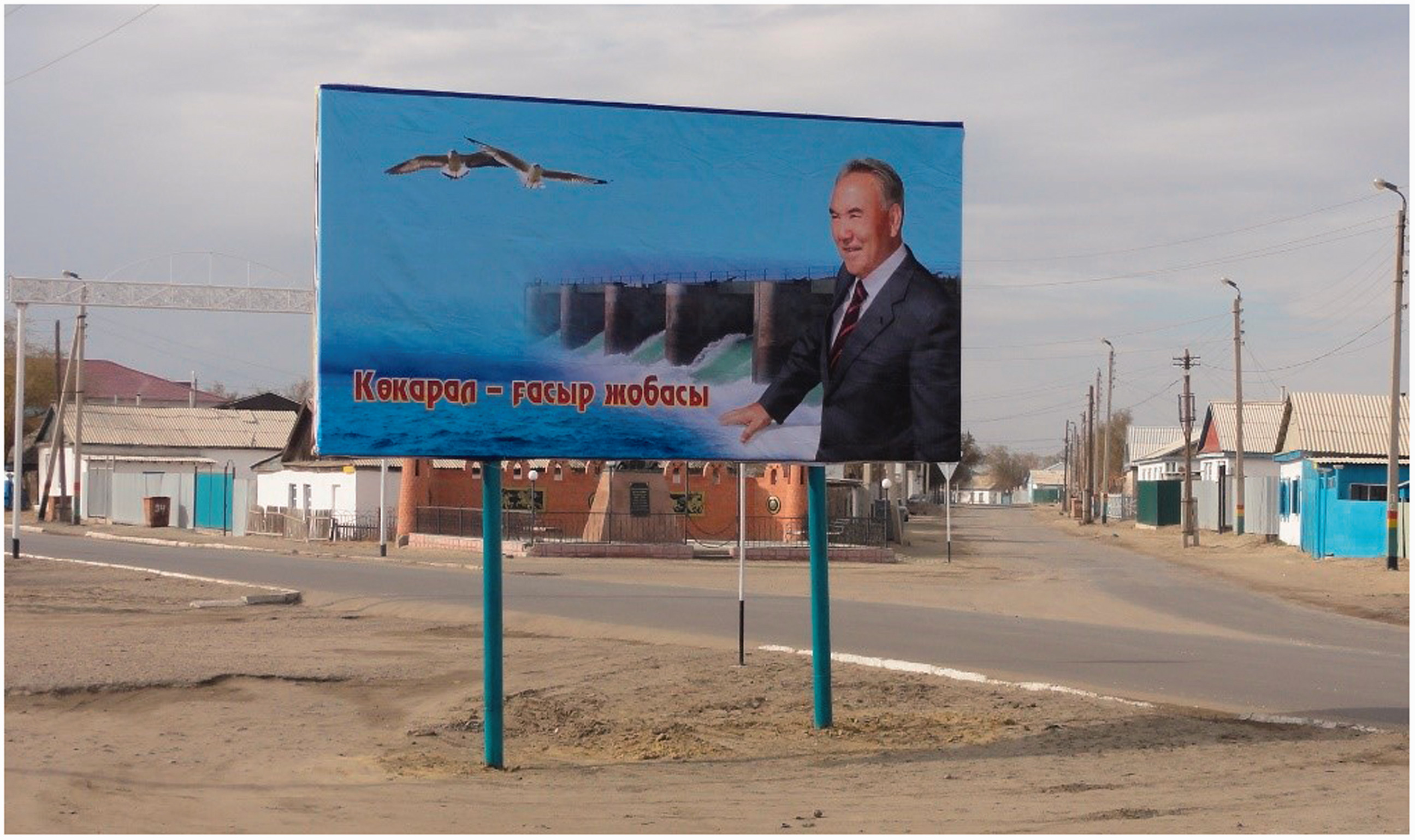
Poster showing the Kökaral dam, Aral’sk, October 2013.
However, despite the dam’s evident success, material substances have proved, again, unruly: control is, as ever, incomplete. Beyond its tendency to gather in bulk, which Wittfogel highlights, water can also overflow – with troubling consequences. The dam was built according to climate statistics from previous years, which were particularly dry. As one of the engineers explained to me, when construction began, the climate entered another wet cycle, and there was much more water than expected, which delayed the project’s completion. It also meant that the sea filled much more quickly than expected – and indeed, could have held more water. The high-water cycle, however, was far from disastrous: the planners had included sluice-gates (which are shown in the image above) to release water during spring floods. However, fish and fry are washed down through the sluices, into the salty waters to the south, where, it has been assumed, they will perish. Today, a new water-body has formed in a remote area between the North and South seas – but it is unknown whether it is salty or not. It is a striking irony that what is actually shown in this picture is the water flowing through the sluices, carrying fish down to the toxic waters to the south! But the actual content of the image is less important than its associations.
Unsurprisingly, in many local narratives, the Kökaral dam is associated with Kazakhstani sovereignty (Kaz.: egemendïk), especially with President Nazarbayev. Among fishermen in particular, who have benefited from high catches on the restored sea, which are sold on lucrative markets as far afield as Germany, teleological narratives pass through various stages of history, through Communism, to the endpoint of Kazakhstani sovereignty – the moment when Nazarbayev built the dam. This is far from the bureaucratic despotism projected by Wittfogel and Iura, and far too from the hydraulic utopia imagined by Daniiar. It is rather a benevolent realization of national belonging in the figure of the president, restoring natural balance through hydraulic intervention – the vertical authority of the president in the distant capital encompasses the remote Aral region.
I found that fishermen were relatively sanguine about the problem of fish escaping: they insisted that it was a problem to be resolved ‘higher up’ (Kaz.: zhoghary), thus voicing an expectation that hydrological installations should be centrally managed. Many townspeople, however, are more dissatisfied: as a projection of the state, water also proves unruly. Their dissatisfaction is informed by nostalgia for the old encompassing Soviet state, and widespread assumptions of corruption permeating every level of the Kazakhstani state. People complain that the dam was not built higher, meaning that it does not reach Aral’sk. But the sea does not reach most of the villages, and such complaints are not heard in villages: more to the point, the fish themselves do not reach the town, being spirited mysteriously out of the region for processing elsewhere. Thus, this new ‘project of the century’ does not integrate Aral’sk into broader spaces, and the town remains marginal within post-Soviet Kazakhstan. Accordingly, narratives about the dam often slip into narratives about corruption – the dam was not built high enough, I often heard, because so much money was stolen while the project was implemented. And because it was not built high enough, the fish escape when the water overflows. When townspeople talk about the problem of the fish being lost, the dam’s promise of solidity, containment and re-birth is contradicted by the emotive image of fish being swept to the poisoned waters below the dam. Such narratives thus play on the tendency of water to escape political control.
Conclusion
In sum, then, water’s tendencies to leak, evaporate and overflow may frustrate centralized control, but its tendency to gather in bulk, its manipulability through technology, suggests that control is possible – which is perhaps why it figures so often in projections of a strong centralized state. But, as I have shown, how states are read through their hydraulic infrastructure is not a given. In different narratives, water infrastructure shapes spaces in different ways; allusions to water’s capacity to leak query technopolitical projections of control; and moral evaluations of the state and its hydrological projects vary contextually.
As a Cold War artefact, Oriental Despotism was written firmly against the notion of state planning, a threatened future which Wittfogel feared. As a post-Soviet artefact, Daniiar’s narrative is shaped by nostalgia for the integrated, gridded space produced by bureaucratic planning, which was known to him from his travels – even if this nostalgia, shaped by present concerns, obscures the unevenness of Soviet development, which differentiated peripheral regions from the metropolitan core. Critically, the realization of the Soviet promise of employment depended on the centralizing tendency within state socialism to accumulate use-values under the disposition of the apparatus, which, as we saw, led to the sea’s demise: had the ocean fisheries not been under the control of the apparatus, there would have been no fish to support the factory in Aral’sk. But these tendencies, which, for Daniiar, morally structured Soviet space, are quite the reverse of the total alienation proposed by Wittfogel. Hence, he tells a story similar to Iura’s tale of bureaucratic despotism, but with the value signs reversed. Iura narrates the USSR’s hydraulic civilization as a social and ecological catastrophe, Daniiar as a lost dreamworld.
For all the strong vertical authority of Nazarbayev, contemporary Kazakhstani processes of state-making are far less encompassing than in Soviet times: as elsewhere in Central Asia, post-Soviet transformations have been experienced as a process of disconnection (Alexander, 2004; Pelkmans, 2013; Reeves, 2014). The Kökaral dam, like other infrastructure projects in Central Asia (Mostowlansky, 2014; Reeves, 2016; Suyarkulova, 2015), re-makes connections, but does not integrate the Aral region into a gridded space of redistribution. Those who benefit from the restored sea can thus narrate a connection between the central state and the region through the Kökaral dam. But for those marginalized within the political economy of contemporary Kazakhstan, and who miss the dreamworld of the USSR, this connection has less purchase. Thus, if for Wittfogel water’s tendency to gather in bulk points to total state power over its citizens, Aral’sk inhabitants focus on its tendency to overflow, to escape control, to point to the opposite conclusion – an incomplete connection with a state which is felt to be insufficiently encompassing.
Footnotes
Acknowledgements
Many thanks to editors of the special issue and to Catherine Alexander for comments on earlier drafts. I would also like to thank the two anonymous reviewers for their constructive engagement with the text.
Declaration of conflicting interests
The author(s) declared no potential conflicts of interest with respect to the research, authorship, and/or publication of this article.
Funding
The author(s) disclosed receipt of the following financial support for the research, authorship, and/or publication of this article: The research described in this article was conducted as part of an ESRC-funded PhD at Goldsmiths College, University of London.