



Abstract
It is generally accepted that the State plays an important role in promoting and facilitating practices of dispossession; yet there is little reflection on its role in prevention, processing, and reversion (restitution). Our research focusses on dispossession understood as a crime. The criminal classification of dispossession as well as the continued reporting of its frequency and magnitude, suggest that crucial State institutions, such as those which form part of the criminal justice system, play a determining role in both how certain property conflicts are denominated as well as the trajectory, duration, and ways in which these are processed. Using a spatial analysis of criminal records of dispossession on a municipal level, from 2015 – 2020 in Mexico, we aim to demonstrate dispossession as a highly collective, contested, and concentrated process of changing relations of land and property that materialize in unequal ways on specific regulated spaces, rather than as a random occurrence on institutionally and socially empty territories.
Introduction
In contemporary societies, the transfer of private property rights is often seen as a matter of contracts and the real estate market. However, at least in the Global South, the criminal justice system is playing an increasingly active role in the transfer of land. In many ways, this process implies that force and violence are more and more frequent means of land exchange, instead of peaceful agreement and free will. However, the lack of reliable and systematic institutional information regarding property rights has limited the opportunity to illustrate the magnitude and location of this process, within a given time and space. Here, we aim to address this gap trough the study of the crime of dispossession in Mexico, one of the largest countries in Latin America.
Dispossession refers to the violent transfer of property, almost always of spaces that are neither socially nor institutionally empty. In general, the literature accepts that the State plays an important role in promoting dispossession, by exercising its monopoly of force on the territories in dispute, through tax or credit burdens on the land, or by underselling rural work (Navarro, 2013). The literature also highlights the way in which dispossession mainly affects land inhabited by vulnerable populations, be it due to their ethnic or community origin (indigenous groups or rural populations), gender (patrimonial violence) or social status (low-income populations). Further, many studies argue that dispossession is a growing practice through which the State has opened land and territories to the market – public spaces, common properties, historical spaces, farmland, indigenous land, natural areas –, land which had, until a few decades ago, remained outside of the market logic.
However, little has been studied regarding the role of the State in preventing, processing, and reversing practices of dispossession, at least in Mexico. In this article, we highlight the need to examine and consider this dimension of the relationship between the State and dispossession. To do this, we turn to the study of dispossession as a crime, a highly unstable legal category (with its very definition changing according to circumstances). In some cases, mobilizing dispossession as a criminal act has been conceived as a way through which the most dominant and experienced social actors use the courts to reclaim and expand the limits of their (illegitimate) property (Visser, 2012). Alternatively, the criminalization of dispossession has been understood as a state response to processes of illegal land occupation and the development of irregular settlements (Sieder, 2017). However, the criminalization of dispossession is also a way in which the population may appeal for State intervention (through the criminal justice system) in processing certain conflicts around property and land tenure. In this context, we pose the following research questions: what property conflicts are processed by the criminal justice system and under what rules? What type of dispossession practices are considered as crimes? What properties are the main focus of dispossession?
Much of the literature dealing with property conflicts, particularly in the Global South, suggests that instability or fragility of property relations and land tenure tend to occur in contexts of impunity, institutional weakness or in the absence of State. 1 However, the criminal classification of dispossession as well as the continued reporting of its frequency and magnitude, suggest that crucial State institutions, such as those which form part of the criminal justice system, play a determining role in both how certain property conflicts are conceptualized as well as the trajectory, duration, and ways in which these are processed. By analyzing dispossession practices as crimes, this article advances the discussion around dispossession in four ways: First, it highlights the role played by the criminal justice system in processing dispossession and other property conflicts. Second, it demonstrates that dispossession is a strongly spatialized and collective practice, subject to judicial processes. Our results confirm that criminal records of high levels of dispossession are not randomly distributed in space, but rather, are evident in municipalities that are predominately: 1) urban 2) of high social status; 3) populated by women over the age of 18; and 4) ejido land – collective property/agricultural land. Furthermore, our findings confirm the presence of “landscapes of dispossession”, that is, municipalities with high levels of dispossession surrounded by other municipalities where dispossession rates are also high. Third, based on this analysis, we argue that it is fundamental to understand dispossession in Mexico as a highly collective, contested but concentrated process of changing relations of land and property, that materializes unequally on specific regulated spaces, rather than as an isolated practice around disputed land with an absence of authority and occupants seeking to recover their dispossessed properties.
Fourth, by identifying where criminal records of dispossession are concentrated (in which territories and populations), we argued that it is also possible to highlight the insufficiency of regulatory devices developed by the State to prevent and revert the dispossession of land and property. This is particularly important for rural communities and areas inhabited by low-income populations. In other words, we suggest that the fact that criminal records of dispossession are concentrated in high-income, urban areas, does not imply that only these populations are dispossessed of their properties. Indeed, this may show that those living in rural areas and belonging to low social strata are not able to mobilize any regulatory mechanisms for redressing dispossession
This article is divided into four sections. The first comprises a review of the literature on dispossession and explains the advantages and limitations of the proposed approach. In the second section, we present the data and the methodology. The main source of information are records from the (Executive Secretariat of the National Public Security System SNSP, 2021). These records are based on a registry, at the municipal level, of the number of complaints (prosecutions) of dispossession and other crimes - homicide, kidnapping, extortion, robbery - during the indicated period. In the third section, we present our findings which show that most records of criminal events of dispossession are concentrated in highly urbanized municipalities, with a high percentage of land dedicated to collective and agricultural use (ejidos), low socioeconomic gap indices, and high rates of female population over the age of 18. The fourth section contains a discussion regarding the scope of our findings.
Dispossession as a criminal category
Dispossession is a means of forced and violent redistribution of territory that frequently appears in different narratives regarding the constitution and reproduction of urban landscapes (Harvey, 2012). 2 Within these accounts, dispossession is presented as one of the practices which, both in the north as well as in the global south, have ensured a new era of expansion and reproduction of capital, no longer only through the exploitation of labor, but also by the forced occupation of specific spaces and territories: those that had not previously been available for sale—public spaces, state properties, historical spaces- or that constitute alternative millenary and community ways of inhabiting the planet—agricultural land, indigenous territories, natural areas (Roux, 2012).
Behind the various ways of naming dispossession, lie concrete political positions and forms of administering territory and processing social conflicts related to ownership. In fact, the multitude of meanings and ways of defining dispossession as a practice of violent and forced redistribution of territory has enriched its qualitative study, to the detriment of studying its magnitude, frequency, and concentration. Within the multiple discourses and records, we propose studying dispossession as an activity recognized by state authorities as a prohibited social practice, sanctionable by criminal laws.
One of the main implications for conceptualizing dispossession as a crime, is the observation of the social practice through the lens of the State (Scott, 1998), that is, as a social construction mediated by various actors who exercise the power to impose their imagination on the way in which they believe space should be distributed and function (Azuela et al., 2005). As a legal category, dispossession is as old as the regulation of the limits of ownership and territory (Cramer and Richards, 2011; Peña-Huertas, et al., 2017; Gutiérrez Sanín, 2014; Meneses-Reyes et al., 2021). However, it is important to recognize that the various form of land takeover follow different trajectories and conform unique political configurations (Lu et al., 2017). Among these, the legal system—regulations, institutions, and expectations (Friedman, 1975)—plays an important role in defining which type of dispossession event may be considered a crime.
The existence of certain legislative restrictions that define dispossession as a crime, as well as its spatial-temporal qualities, mean that it is unlikely that the number of reports of dispossession as a crime will vary considerably within a short lapse of time, and even less so within the same space (Meneses-Reyes et al., 2021). In fact, evidence shows that in contemporary societies, official registries of dispossession change rapidly in situations of war, internal armed conflict, or during times of serious violations of human rights (Cramer and Richards, 2011), that is, in particularly dramatic and violent situations.
Nevertheless, the literature also indicates that dispossession practices are not always associated with criminal, military, or paramilitary armed conflicts, and even less do they necessarily imply immediate physical violence. Dispossession practices are also constructed upon a heterogenous set of unequal power relations, where the dispossessed subject is in a permanently disadvantaged position in relation to the dispossessing actor, due to class (Harvey, 2012), gender (Bairenmann et al., 2007; Méndez Gutierrez and Carrera Guerra, 2014), community origin (Lizárraga Morales, 2008; Janoschka, 2009; Sequera and Janoschka, 2012; Jackiewitz and Craine, 2010; Blázquez et al., 2011), capacity to exercise violence (Gutiérrez Sanin and Vargas Reina, 2016; Meneses-Reyes et al., 2021) or social capital (Gutiérrez Sanin and Vargas Reina, 2016; Lu et al., 2017). Analyzing dispossession practices as a crime also implies an effort to explain where and how frequently the population will use the criminal justice system as a means of recovering dispossessed property, and what rules and procedures dispossessed owners should follow to access a judicial remedy.
It is common in literature on dispossession to represent the State as a complex network of bureaucratic (judges, prosecutors, notaries) and armed (military, police) actors who facilitate, promote and, in some cases, benefit from the dispossession (rather than as an institution obligated or interested in ensuring the rights of the dispossessed). Even so, in most legal systems there is a regulatory figure within the criminal justice system to which the population can appeal to report the dispossession of their property. In fact, in many countries of the global south – for example, Colombia, Mexico, and Guatemala-there is a wide production and use of procedures and regulatory mechanisms to ensure the return of dispossessed land and, in particular, the restitution of rural land violently dispossessed (Counter, 2019; Wiig and García-Reyes, 2020).
An exhaustive account of the procedural difficulties involved in processing a complaint of dispossession is not possible, 3 however the simple normative configuration of the crime of dispossession already suggests that it is a legal category that is difficult to prosecute. In the Mexican judicial system, legislators have, since the beginning of the 20th century, prescribed that the appropriation of authority and the use of violence or furtiveness on another’s property is recognized by the State as a criminal activity commonly known as dispossession (Diario oficial de la Federación DOF, 1931: own emphasis). However, behind this generic and practically immutable definition to date, lie different rules, modalities and qualities that judges, lawyers, and legislators have developed to regulate, organize, and hierarchize the conditions under which a dispossession event deserves the intervention of the criminal justice system.
Among these procedural requirements, the following three stand out: first, from the first half of the 20th century, Mexican legislation has classified dispossession as a crime that can only be prosecuted by the State at the request of the parties – by complaint-. This means the State is not obliged to intervene ex officio if dispossessed owners do not report the fact to the competent authorities. Second, in order for a criminal report of dispossession to be justifiable, the victim must show that the event occurred violently or furtively. Third, the victim must prove that the event occurred within a period of no more than 1 year. This issue has transcendental consequence as, within the current Mexican regulatory framework, a year after the event, victims of dispossession can no longer aspire to recover their property through the penal system and State legal representatives—public prosecutors or attorneys—but need to begin civil proceedings, and likely hire a lawyer or other services associated with the resolution of these types of affairs. 4 Furthermore, this has consequences in terms of the time victims need to wait to recover ownership of their dispossessed property, as well as for the requirements, formalities and bureaucratic procedures needed to do this.
The above nature of the crime of dispossession (as a device for selecting and stratifying social conflicts that mobilize the justice system) accounts for the magnitude, frequency, and location of this specific type of property conflict whose existence is temporally, individually, and spatially limited by state regulations. However, analyzing property conflicts through dispossession is extremely limited or, at best, only barely representative of the social reality. First, not all dispossessions are reported to the authorities as crimes, nor are the authorities obliged to act on all reported dispossessions (the State is only required to respond to those dispossessions that comply with the abovementioned characteristics). Furthermore, the report of a crime of dispossession does not mean that it has been resolved by a judge, and even less, that a peaceful restitution of property has occurred. To ensure this, the dispossessed need to overcome various barriers and procedures, including the burden of confronting the possible dispossessors, who may be affiliated with criminal organizations linked to an increase in homicides in their area of operation (Meneses-Reyes et al., 2021; Gutiérrez Sanín, 2014).
Second, given that registers of criminal events are always mediated by a state authority, there is little possibility of accessing independent and autonomous sources of information. Registers of dispossession in Mexico refer to highly individualized (State intervention depends on the actions of the dispossessed owner), clearly traceable (the dispossessed property must be a constructed building or a previously delimited and registered property), and temporally delimited events (the possibility of requesting intervention by the criminal justice system to recover a dispossessed property, expires in 1 year). The regulatory configuration of dispossession generally defines it as a minor crime, that is, a situation in which the State is not responsible for intervening unless requested to do so by the victim. Even in cases where various people have been dispossessed of their property in the same space and time, or when the dispossessed act in a collective, organized, and hierarchized manner, each criminal act is recorded individually.
Finally, it is important to highlight the emergence of a series of official instruments (surveys) and authorities charged with registering and systematizing crimes during the period analyzed, which facilitated a deeper understanding of dispossession. Despite this, it is important to keep in mind that records reported by the authorities tend to contain inconsistencies, not only between different agencies, but also between administrations. 5 In this case, data from the Executive Secretariat of the National Public Security System (SNSP, Mexico, by its Spanish acronym) were used, whose function is precisely to standardize and offer a relatively homogenous synthesis of the information obtained from each reported spatial unit. The data used consist of alleged crimes of the common or federal jurisdiction, registered in preliminary investigations or investigation folders of the Prosecutors and Attorney Generals of the country (Fondevila et al., 2019).
The variables of dispossession
As previously stated, dispossession does not occur unidirectionally on spaces lacking authority and population. On the contrary, the literature tends to associate dispossession with a set of independent variables, such as the social class (Harvey, 2012) or gender (Varley, 2010; Méndez Gutierrez and Carrera Guerra, 2014) of the victims of dispossession, as well as the type of land (urban/rural/agricultural land) (Lizárraga Morales, 2008; Janoschka, 2009; Sequera and Janoschka, 2012; Jackiewitz and Craine, 2010; Blázquez et al., 2011).
Considering this association of variables, the analysis of dispossession in this study is undertaken according to the following assumption: Causally and territorially, dispossession in Mexico is not random. At the municipal level, general characteristics exists that explain the territorial distribution pattern of this criminal phenomenon, among which are: 1) level of urbanization; 2) presence of productive land; 3) unprotected properties; and 4) degree of socioeconomic gap.
According to the theory of the urban land market (Alonso, 1960), higher levels of urbanization imply higher value of urban land. A first exploration of the phenomenon of dispossession in Mexico indicates that almost 75% of dispossessions occur in municipalities with high and very-high levels of urbanization. Dispossession is thus aimed at land or property from which it is possible to generate a profit.
In 1991, article 27 of the Mexican constitution was modified to eliminate the imprescriptible, non-transferable, and inalienable right of ejido (communal) property. This constitutional reform stimulated the creation of a (legal and illegal) market of ejido land throughout the country, with the greatest impact registered in the peri-urban areas of cities (Cruz Rodrigues, 1994). The availability of ejido agricultural land on the outskirts of urban areas (constituting land reserves for future urban growth) is attractive for real estate developers, and is thus also attractive for criminal groups focused on dispossession.
A higher rate of male emigration from Mexico to the United States (Duran et al., 1999), and in recent years, a higher female birth rate (INEGI, 2021), has created a predominately female population in some areas of the country, who are more vulnerable to violence by criminal groups (headed up mainly by men). This means a greater lack of protection of land ownership, both in terms of being subject to force and violence, as well as in relation to the uncertainty around property titles, which enables dispossession. 6
Depending on the degree of socioeconomic gap, the dispossessed either have the resources to lodge a report, or do not. Furthermore, higher social strata often imply the presence of guards and the respective institutions that receive complaints or reports. In other words, we hypothesize that the degree of the socioeconomic gap is useful for characterizing not only the populations that are victims of dispossession, but more specifically, those who have the capacity to report such events to the justice authorities.
Based on these characteristics, we designed a GWR model for the quantitative analysis of dispossession, where the natural logarithm (LN) of the number of dispossessions (between 2015 and 2020) was designated as the dependent variable. The data were obtained from the SNSP, and reports were constructed based on a record of the number of reports (prosecutions) of dispossession and other crimes - homicide, kidnapping, extortion, robbery—during the indicated period, at the municipal level. Sources of complementary Mexican data came from the 2020 Population and Housing Survey (INEGI, 2021), the National Agrarian Register (RAN, 2021), and the National Council for the Evaluation of Social Development Policy (Coneval, 2021).
To incorporate the above complexity, the selected independent variables were: (1) level of municipal urbanization −2020-; (2) percentage of ejido land—collective, agricultural land- (of the municipal land); 7 (3) rate of female population over the age of 18 (per 10 thousand)-2020-; and (4) index of socioeconomic gap −2020-. Based on their spatial interaction, it was expected that the independent variables would contribute to understanding the territorial pattern of distribution/concentration of criminal records of dispossession in Mexico, at the municipal level.
Landscapes of dispossession
We posed the following questions: Where does dispossession, reported as crime, occur and how is it distributed territorially? To answer these, a Geographically Weighted Regression (GWR) was used with which we sought to highlight the territorial distribution/concentration of dispossession. The fundamental difference with logistical regression (linear or multiple), where the independent variable is explained through the interaction of a series of independent variables of predictors but without considering the spatial component (Hosmer et al., 1989), is that the GWR, through the localization of various variables, estimates spatial weight, and thereby confers a territorial-based character to the analysis (Brunsdon et al., 1996). The notation is as follows (Fotheringham et al., 2002)

Where β
0i
(u) indicates that the parameter describes a relationship around the location (u) and is specific for this location; thus, it is possible to predict the dependent variable if the measurements of the independent variables are also available for location (u) (Brunsdon et al., 1996). In this way, the GWR equation that emerges from the logistic regression is

OLS model.
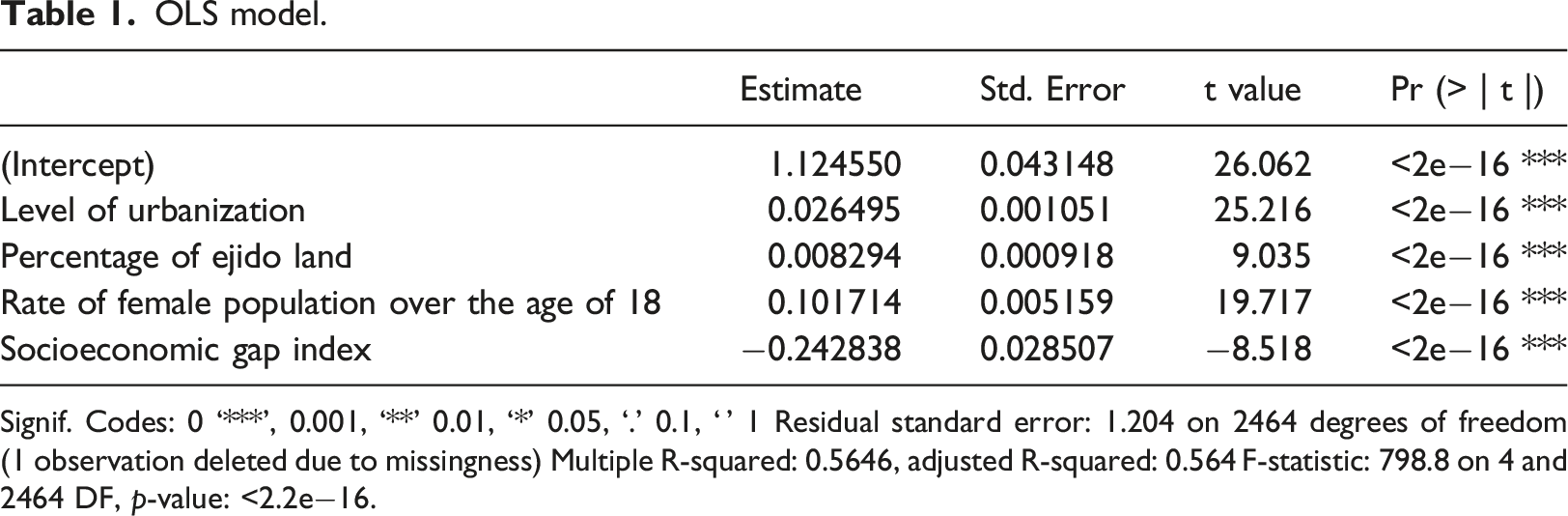
Signif. Codes: 0 ‘***’, 0.001, ‘**’ 0.01, ‘*’ 0.05, ‘.’ 0.1, ‘ ’ 1 Residual standard error: 1.204 on 2464 degrees of freedom (1 observation deleted due to missingness) Multiple R-squared: 0.5646, adjusted R-squared: 0.564 F-statistic: 798.8 on 4 and 2464 DF, p-value: <2.2e−16.
The coefficients suggest that: (1) the lower the socioeconomic gap index (that is, the lower the levels of poverty), the greater the dispossession, meaning that those reporting dispossession are subjects inhabiting higher socio-economic areas; (2) more dispossession events are reported in consolidated cities, or those in process of consolidation (urban municipalities or metropolitan areas in process) than in rural or non-urbanized areas; (3) there is a greater incidence of dispossession in municipalities with a high population of women over the age of 18; and (4) regarding ejido territory, its explicative capacity is associated with a combination of variables, and shows that agricultural land and collective property, until recently not subject to the market, have acquired a significant value and are highly contested and dispossessed spaces.
An OLS model determines the statistical weight and the direction of the correlation of a series of variables in order to explain a phenomenon, without considering the spatiality of these variables. A GWR model enriches the OLS model by incorporating, through a matrix of spatial weights, the territorial interaction between the independent variables and the dependent variable. In this case, as the study was conducted at the municipal level, the GWR model spatially associated the value of the correlation to statistically recognize clusters or outliers of the dispossession phenomenon. The result of the GWR model thus identified the tendency of the greatest concentrations of the phenomenon in the country. Furthermore, the contribution of the GWR model is evident in the value of the statistics. For example, for Fotheringham et al. (2002), a lower AICc value, as well as the value of the sum of the minimum squares implies a greater adjustment of the GWR model with respect to the OLS model. A greater R2 value points to a greater explanatory capacity of the GWR model.
Comparison of GWR-based prediction model and OLS model.

Summary statistics for GWR parameter estimates.

In sum, these figures indicate that in addition to presenting in urbanized, feminized, and collective spaces subject to judicial processes, the dispossession phenomenon has a regional expression and is consequently, collective. Spatially, when comparing the regression residuals, the GWR model shows a random pattern, while the OLS model tends towards concentration (Figure 1). The territorial distribution of the local R2 values show the areas with a higher intensity of dispossession. Residual distribution Local R2.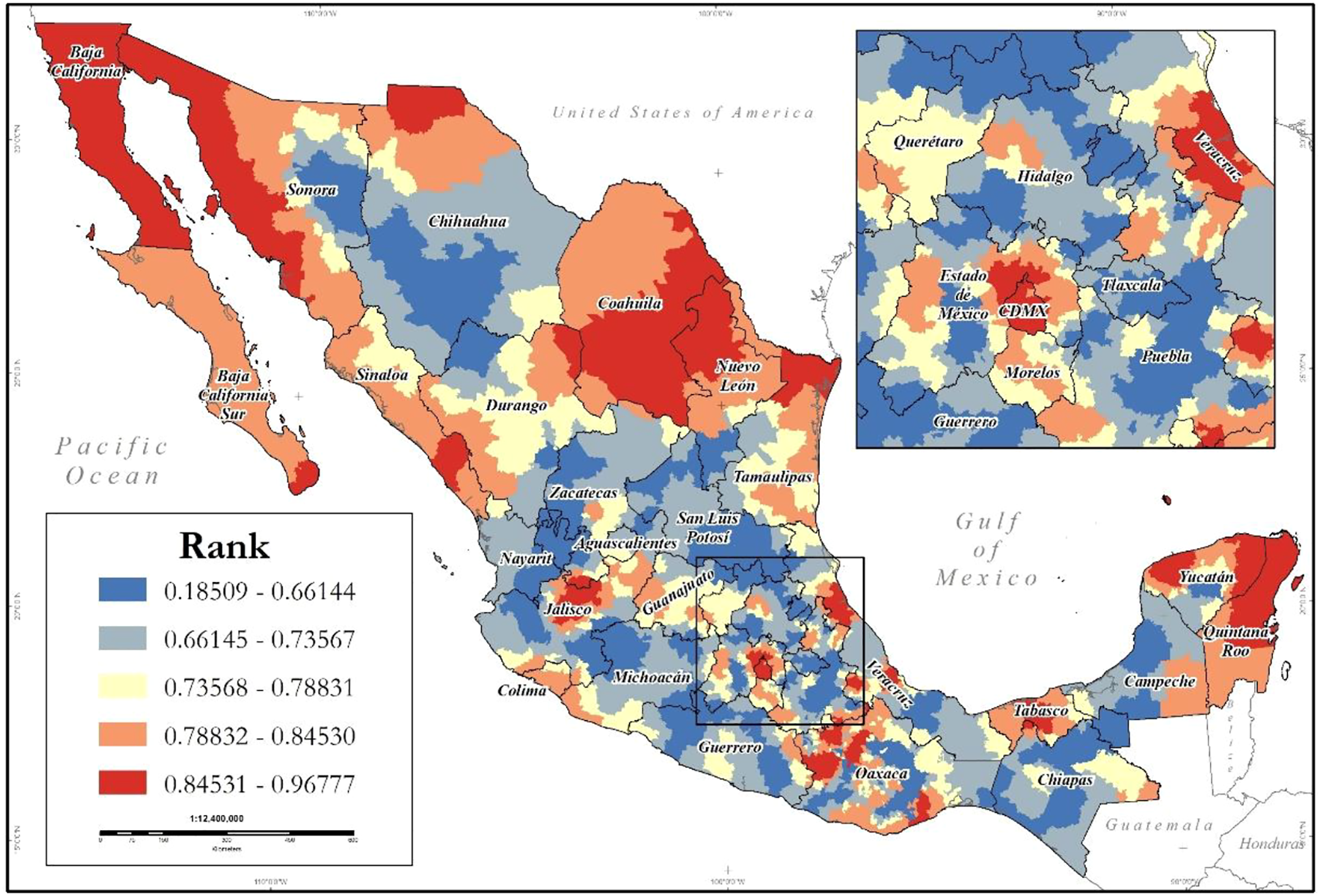
By mapping the spatial association, it is possible to detect the formation of clusters (concentration) and outliers (dispersion as a function of outliers), from a high or low record of the variable under study (Anselin, 1995). In order to do this, we applied the Local Moran’s I test to the local R2 values, to obtain the Local Indicators Spatial Association (LISA) and its statistical significance (Figure 2). Local Moran’s I test map incidence and corresponding significance for GWR Local R2.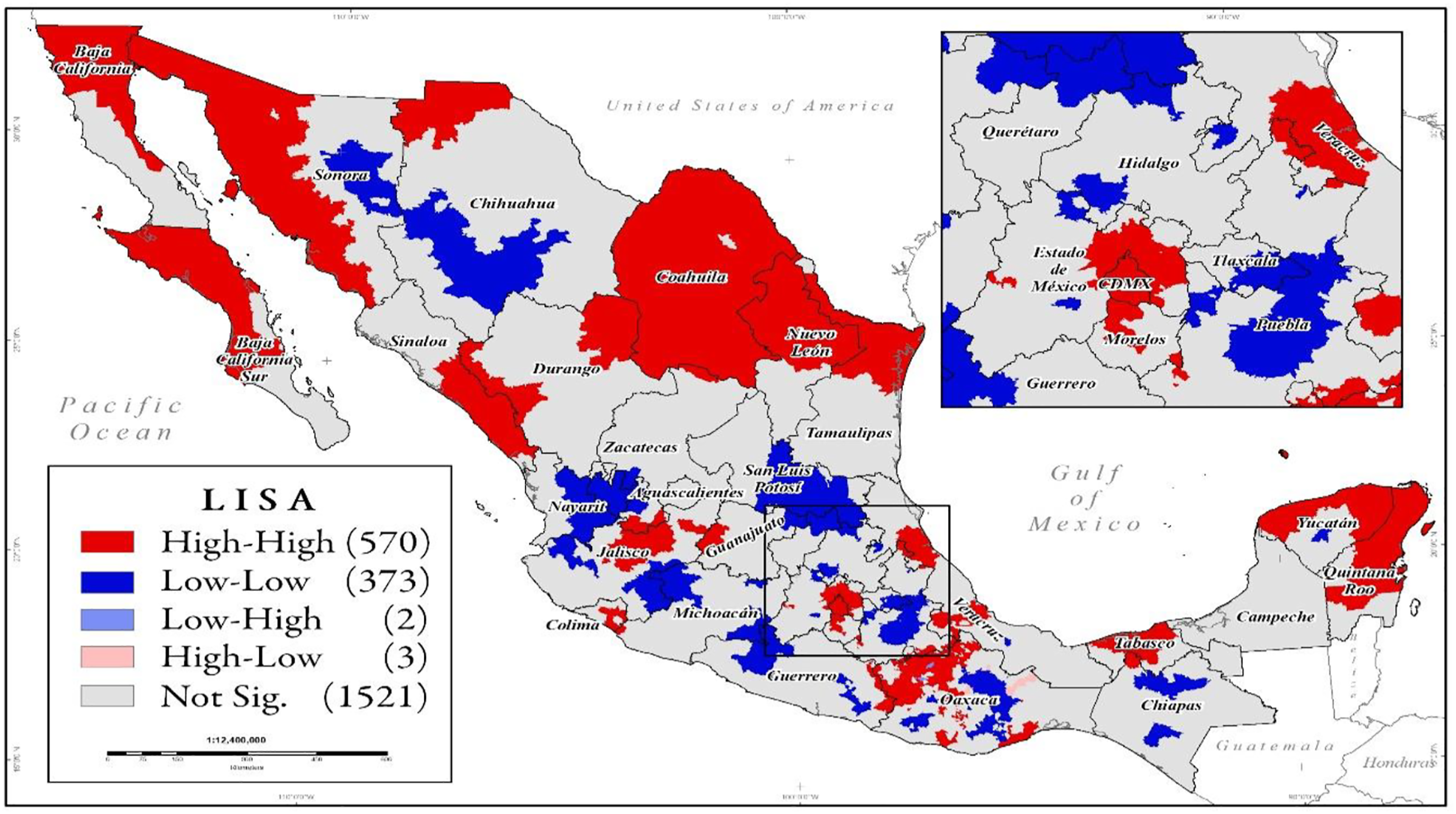
Figure 3 confirms and represents the spatial association relationship between the crimes of dispossession among specific regions in Mexico. The maps show that during the period analyzed, criminal records on dispossession were significantly concentrated in 948 of the 2400 Mexican municipalities (39.5%). In other words, in four of 10 Mexican municipalities, dispossession is spatially significant for the violent transfer of land on one of four levels: (1) low-low; (2) low-high; (3) high-low; (4) high-high. In some cases, marked in dark red, dispossession appears to generate clusters in which land tenure and property rights could not be taken for granted. The dark red color represents those municipalities with high levels of dispossession surrounded by municipalities that also experience high levels of dispossession (high-high) and comprise almost 60% of all municipalities in which criminal records on dispossession are significantly associated. The other cases, shown in blue, are those areas of the country in which levels of dispossession are low and the relationship is significant (N = 373). Interestingly, municipalities with high levels of dispossession surrounded by municipalities with low levels of dispossession (high-low) are as infrequent as those in which the relation is the opposite (low-high), together accounting for a total of five localities. LISA Significance of spatial assotiation.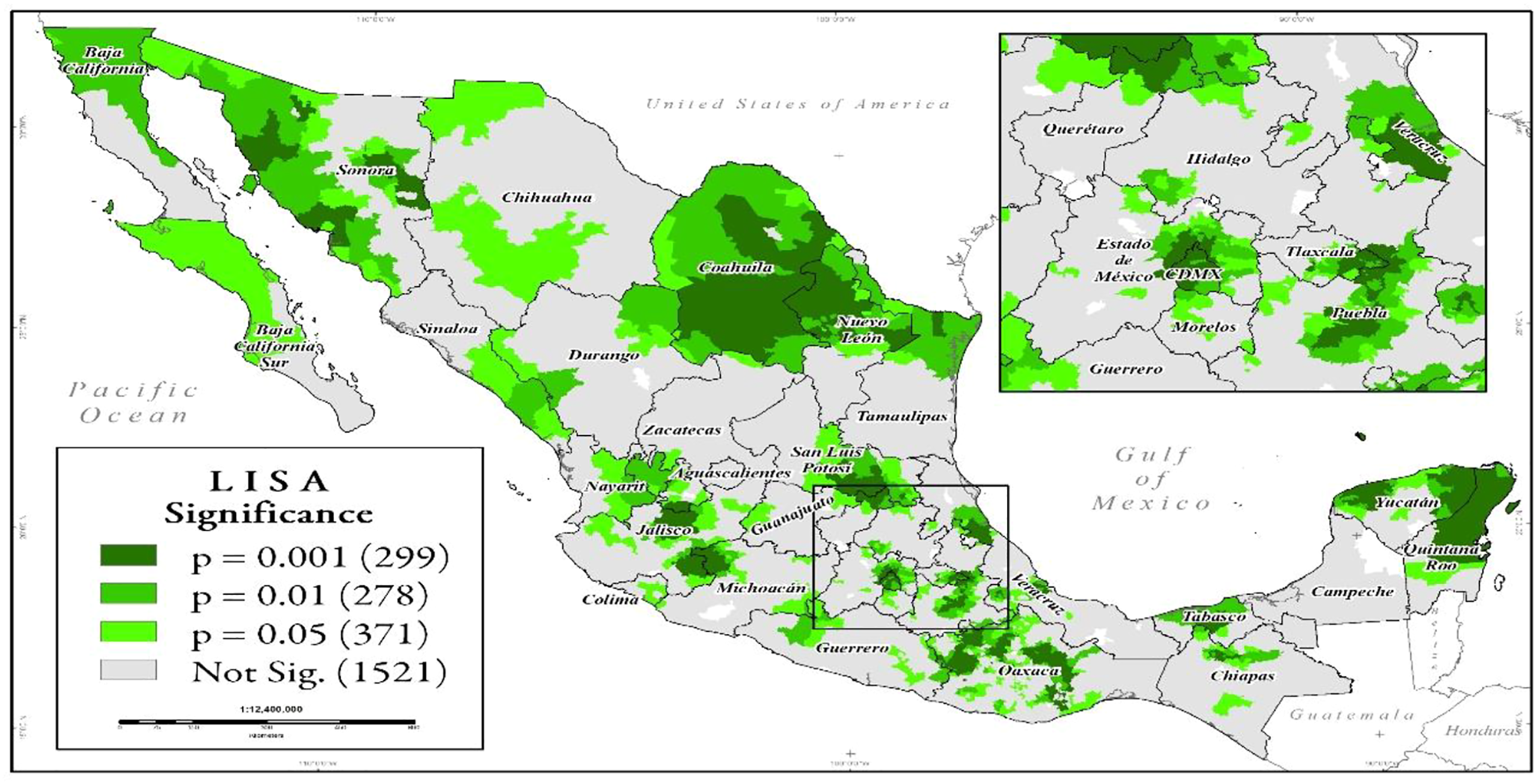
From this perspective, criminal reports of dispossession events have formed a pattern of forced and violent transfer of property that extends throughout the seven areas or specific regions of the Mexican territory: (1) the pacific coast, particularly the municipalities bordering the Sea of Cortés and including almost all the coastal municipalities of the state of Sonora, part of Sinaloa, Tijuana and extending to the Rosarito area (Baja California Sur); (2) the north-east border, comprising almost all Mexican municipalities that border the US state of Texas and municipalities across the states of Tamaulipas, Nuevo Leon and Coahuila; (3) the Yucatan peninsula, comprising almost all the coastal municipalities of the states of Yucatan and Quintana Roo, from the localities neighboring the Celestun biosphere, to Chetumal, and including the coasts of Cancun, Cozumel, Tulum and Mahahual; (4) the coast of the Gulf of Mexico, including almost all municipalities of the state of Tabasco, as well as the metropolitan area and southern parts of the state of Veracruz; (5) the Metropolitan Area of the Valley of Mexico, with Mexico City at the center, as well as some municipalities of the state of Morelos (in the north), and almost all municipalities of the State of Mexico (to the south); (6) the Bajio region, composed of municipalities in the states of Guadalajara, Michoacan and Guanajuato; and (7) Oaxaca, particularly those municipalities bordering the states of Guerrero and Puebla.
Discussion
The literature suggests that, in contemporary societies, the State plays an important role in promoting and facilitating dispossession. It is even argued that the legal system may represent one of the ways through which the State opens the door to dispossession practices. In this article, we have explored the role of the State in defining, recording, and processing dispossession. We have focused on the way in which the criminal justice system is used by the population, in Mexican municipalities, to report an act of dispossession within a specific time period (2015–2020).
Our findings show that, first, dispossession is a strongly territorialized practice. Specifically, we identified that dispossession is a criminal practice concentrated in 570 municipalities of the country. Furthermore, from the mapping of these municipalities, it was possible to identify seven specific areas in which dispossession appears to be a highly stable and consistent practice, but also subject to a judicial process. These records show that in 24% of Mexican municipalities (N = 2400), dispossession is a frequent and real means of violent and forced transfer of property. Nevertheless, the very existence of the records analyzed implies that it is in these same landscapes of dispossession that the criminal justice system represents a recurrent path used by the population to recover dispossessed properties.
Second, our findings suggest that the territoriality of dispossession is not random. In fact, the landscapes of dispossession have the following four common features: 1. The level of urbanization. Records of dispossession are largely concentrated in urban and metropolitan municipalities, rather than in rural or non-urbanized areas. This may be due to a variety of factors. It is possible that these localities have greater concentrations of spaces (apartments, buildings, wasteland, houses, terrains, warehouses, premises, and different types of businesses) and properties available for dispossession than rural municipalities. It is also likely that the same material transformations associated with urbanization– paving of streets, sewage, electricity, water, garbage collection, etc.—not only improve living conditions and value of properties, but also increase interest in, and conflict and speculation around the urbanized space (Varley and Salazar, 2009). Finally, it is important to note that urbanization also implies the invasion/occupation/colonization of agricultural land and rural communities, and the conversion of these into new cities or metropolitan areas, resulting in less agricultural land and the growth of urbanized spaces. 2. The socioeconomic gap. Records of dispossession tend to be concentrated in areas with low levels of poverty, suggesting the presence of more property owners. That is, the lowest social strata may not be victims of dispossession as they do not have property that can be dispossessed. It is also possible that the higher socio-economic sectors are more quickly and easily able to access legal representation and seek judicial remedies in the event of dispossession. In the case of the crime of dispossession, the time involved for victims to seek a judicial remedy is crucial in determining how to proceed (criminal vs civil), as well as the costs and time involved in reaching a solution through the criminal system. Also, poverty level may be associated with the type of properties that are dispossessed, that is, those that are in the hands of the wealthier or who those have accumulated more properties. Finally, the concentration of criminal records regarding dispossession of land occupied by the highest social strata may suggest that these social sectors can access and mobilize the justice system more frequently, while the poorest sectors, or those inhabiting non-urban areas have less possibility of doing so. 3. Demographic proportion of women. Dispossession records are concentrated in municipalities where the proportion of women over the age of 18 is highest. The literature provides different interpretations of the way in which dispossession disproportionately affects or can affect the female population. On one hand, it is well documented that in Mexico, as in other Latin American countries, women tend to own fewer properties than men. However, these same studies highlight that even when the female population are owners, dispossession accompanies and forms part of a systematic pattern of patriarchal violence (Meertens, 2016). On the other hand, it is widely recognized that, at least in Mexico, dispossession forms part of a set of violent and exclusionary practices to which women who live in localities with high migration rates, are subjected (Velázquez and Galeano, 2020). In any case, our results are consistent with these interpretations of dispossession as a practice of patrimonial violence against women. 4. Agricultural and collective (ejidos) territories in urbanized municipalities. Dispossession records tend to be concentrated in urbanized municipalities with large extensions of ejido land, a particular form of collective property that, for almost an entire century, was legally reserved for agricultural use. According to some studies, this pattern of dispossession may be explained by the urbanization process in Mexico which has occurred on ejido property – subsequently sold, divided, dispossessed, occupied, or regularized - (Azuela and Cruz, 1989; Sánchez-Mejorada and Fernández Landero, 2005; Perló Cohen, 1981). Other authors argue that the urbanization of ejido land intensified towards the end of the 20th century, as a result of various legal reforms that allowed the ejidos to be sold on the open market and that, in one way or another, have been accompanied by dispossession practices (Varley and Salazar, 2021). Our results are also consistent with the highly conflictual and contested character of these territories.
Third, the crime of dispossession is a highly unstable and difficult to process legal category. Each of the records analyzed reveal three elements of a highly bureaucratized relationship between the population and the state. First, the existence of a presumed act of violent and forced transfer of property. Second, each record represents a citizen capable of and prepared to denounce a dispossession event, and also prepared to recover a property that has be violently taken. Third, each record implies that a legal authority (prosecutor) received a complaint of dispossession. However, the records do not contain information regarding the outcome of these complaints, how they were resolved nor what type of property or extension of land was involved in each act of dispossession. In some jurisdictions, it is estimated that dispossession is a difficult crime to process and resolve. In fact, the literature reports that even when dispossessed citizens achieve a favorable sentence, additional procedures are needed to ensure that their property is finally restored to them. In addition, victims of this crime must overcome fear of the threats and aggressions to which they may have been subjected at the time of the dispossession, without any protective measures provided by the State. The crime of dispossession does not appear to constitute a means of protecting and restoring property rights. On the contrary, it adds further uncertainly and precariousness to the already weak rights of deprived citizens (Imbett, 2015; Olea Monge and Reyes Salazar 2013; Vega, 2014).
Fourth, our results show the way in which dispossession practices form patterns of socio-territorial relations that transcend administrative and jurisdictional divisions of space. The Pacific coast, north-eastern border and Yucatán peninsula are clear examples of this. Neither state nor municipal limits appear to have much effect in controlling dispossession. This is important as Mexico is a Federal State, comprising 32 federal entities, each with its own specific criminal code. Each municipality even has its own exclusive security force. However, none of these factors seem to impact the control of dispossession, at least not in the areas identified. In fact, these findings appear to confirm that although the crime figure of dispossession has been practically immutable since the beginning of the 20th century, as a social practice, dispossession is an extremely arranged and lively means of transferring land and property through violence. As such, it deserves an integrated intervention by the state, far beyond the criminal justice system.
Finally, it is important to highlight the fluid and unstable nature of criminal records of dispossession in Mexico. Unfortunately, precise information with which to estimate dispossession events that are not reported to the authorities is not available. Throughout the country, it is estimated that more than 95% of potential criminal events are not reported to the authorities. This suggests that many instances of dispossession may not be included in official criminal records. Given this, it is notable that within a context in which most criminal events are not reported, records of dispossession are so systematically and consistently concentrated in certain parts of the country. In other words, the spatial analysis of criminal records of dispossession presented in this paper should not be seen only as an attempt to distinguish between spaces with dispossession and those without, but rather as an exercise in determining those spaces in which this is concentrated, and those populations who are able to overcome the various economic, territorial, social, and psychological barriers that interaction with the criminal justice system may entail, in order to recover their land and properties.
Footnotes
Declaration of conflicting interests
The author(s) declared no potential conflicts of interest with respect to the research, authorship, and/or publication of this article.
Funding
The author(s) received no financial support for the research, authorship, and/or publication of this article.
