



Abstract
This article examines the expansion of border control and migration strategies in Cuba following the COVID-19 pandemic. Despite the biomedical response to the pandemic by the Cuban state, this context was marked by unprecedented levels of social mobilization and the largest migratory exodus in Cuban history. The first section discusses several of the migratory modalities used by Cubans in a context marked by the precarization of life, accentuated by the economic reform adopted by the Cuban state. The second one explores the political function of the border regime in the state response to an unprecedented moment of oppositional activism. Specifically, it analyzes how the practices of banishment, denial of entry, and control of exits, are used as part of the repertoire of repression, underscoring the importance of the border regime vis-a-vis the notions of citizenship and belonging in the Cuban context. The article argues that in the analyzed context of deepening internal economic crisis and political retrenchment, the border regime plays a central role in managing political decisions in Cuba. While Cuban migrants find themselves navigating ever more complex, dangerous border regimes abroad, they also contend with the Cuban state’s instrumental and often repressive use of a border regime at home.
Introduction
In April 2021, a drifting raft appeared on the shores of Miami, Florida, with an inscription that caught the attention of local media and bystanders: “Cuba Viva” (Cuba alive), a political slogan used by current Cuban state officials and supporters on social media and public events. Considering the political nature of this expression, it was evident the ironic gesture of those who re-inscribed it on a flimsy balsa (raft), confronting “Cuba alive” with its obvious denial. However, the irony did not end here. Somewhat tenuous, drawn in reddish spray paint, it could be read the acronyms “CG OK.” This inscription, known by balseros (raft migrants), means “Coast Guard” and “OK” and is frequently found in washed boats on U.S. shores. It signaled that the raft was interdicted at sea by the United States Coast Guard (USCG) and its occupants most likely deported to Cuba. 1 In the context of the COVID-19 pandemic, such a saturated and ghostly image speaks about existential and political aspirations, escape and control, rescue and expulsion, and the condition of people on the move caught between conflicting and totalizing narratives.
That raft was also a concrete expression of the gradual increase of what would end up configuring the largest mass exodus in Cuban history. From the beginning of the pandemic until December 2023, Cuban health authorities reported 8530 deaths from COVID-19 (MINSAP, 2024). According to official data, Cuba experienced an exit of over 1 million people in the same period, a decrease of more than 10% of the population. 2 The U.S. alone registered 630,865 Cubans in the fiscal years (FY) 2020 to 2023, 3 while countries like Spain and Russia also reported increased Cuban arrivals. 4
Multiple factors conditioned this scenario. The Cuban economy, already vulnerable due to its dependence on tourism and remittances, was severely impacted by the pandemic (Duany, 2016; Morales, 2019). This condition was further accentuated by Donald Trump’s expansion of the embargo/bloqueo, which hampered the Cuban government’s response. 5 As a result, Cuban families faced rapidly deteriorating living conditions, with food, medicine, and fuel shortages, long queues, electricity outages, and lack of public transportation. At the same time, the Cuban government implemented a general economic reform in December 2020 with unprecedented consequences.
The reform, known as Tarea Ordenamiento (Ordering Task), advanced a long-postponed monetary unification and significantly reduced subsidies. 6 These measures, executed at the worst moment, had an anticipated inflationary effect (Bahamonde, 2021; Brismat, 2021; Mesa-Lago, 2021). The reduction of subsidies, increased prices, and the creation of state-owned and private stores in foreign currency had a deepening impact on poverty and social inequality. The economic collapse, with a GDP falling by 11% in 2020, boosted popular discontent. Tellingly, Cuban President Miguel Díaz-Canel Bermúdez declared that the new measures “are not a neoliberal paquetazo” (Martínez and Perera, 2024). In the 2 years following the reform, the number of people, especially elders, begging on the streets increased alarmingly. Several interviewees from Holguin and Havana asserted: “It’s worse than Período Especial,” referring to the conditions during the so-called Special Period in Time of Peace crisis that followed the collapse of the Soviet Union. As a result, Cuba has seen an unparalleled and interrelated increase in social protests and migratory departures.
In this article, I examine the migratory dynamics of the Cuban population and the political role of the Cuban border regime in the context of the COVID-19 pandemic and the post-pandemic scenario that followed the lifting of all major travel restrictions in late 2021. Specifically, it covers from March 2020 to December 2023. I argue that in the analyzed context of deepening internal economic crisis and political retrenchment, the border regime plays a central role in managing political decisions in Cuba. While Cuban migrants find themselves navigating ever more complex, dangerous border regimes abroad, they also contend with the Cuban state’s instrumental and often repressive use of a border regime at home.
In the first section, I explore the surge of Cubans migratory fluxes during the pandemic, focusing on four of these modalities. Secondly, I will turn to the political function of the border regime as part of the Cuban state’s repressive response to unprecedented oppositional activism in the context of COVID-19. Here, I analyze the actions of denial of entry, banishment, and prohibition of exits as forms of repression used by the Cuban state during and after the pandemic.
Cuba is not typically a case considered within the border studies scholarship. Following an interdisciplinary approach, this article stresses the importance of the border for understanding contemporary Cuba. It is part of a broader historical study that, beyond traditional territorial metaphors (wall, fence, etc.), examines the border’s function in specific Cuban contexts. Accordingly, it draws on key concerns within migrant and refugee studies and border studies (Mezzadra and Neilson, 2013; Balibar, 2002; Mbembe, 2000; Anzaldúa, 1987). At the same time, it dialogues with other reflections on the border in the context of the Caribbean (García-Peña, 2016; Moreno, 2022). The analysis of Cuban state practices of repression tied to migratory control, along with the border regime’s role in producing citizenship and exclusion, serves as a compelling example of similar dynamics in other contexts.
The sources used for this article include journalistic materials, digital archives, written media reports, materials with an autoethnographic or testimonial nature, and live broadcasted recordings shared on digital platforms. In addition, I relied on official communications, legislation, and other state documents issued in the context of the pandemic, as well as materials produced by Cuban civil society actors. I have also resorted to the information collected in 10 interviews. These include formal semi-structured interviews and conversations with friends and relatives who have been directly or indirectly affected by the dynamics of mobility during the pandemic. At the time of the interviews, informants were in Cuba, Spain, Russia, and the U.S. Pseudonyms have been used in all cases.
The reemergence of migration during COVID-19 times
Following the COVID-19 outbreak, the Cuban government sought to restrict mobilities within provincial and municipal territories while furthering border control at a national and transnational level. Along with the use of internal circulation permits implemented by local authorities, the government established measures to determine entries and exits of Cuban nationals (OnCuba, 2020). Similarly, it suspended legal obligations such as returning to Cuba before completing 24 months of stay abroad and the obligation to renew the Cuban passport. 7 However, despite the immediate attempt to restrict mobility, the pandemic was marked by increased migratory dynamics.
Like other countries (Joseph and Neiburg, 2020; Álvarez, 2021), Cuba registered an initial reverse migration process in the first months after the outbreak. Until July 31, 2020, more than 5 thousand people returned through Cuban state-sponsored repatriation flights. 8 A year later, what followed was a steady increase in the emigration of Cubans and the ramifications of their exit strategies. Some of those leaving Cuba in this context lost their jobs in the tourism sector and the service economy. However, the deterioration of basic living conditions impacted all sectors of the social fabric. Many forced to leave Cuba had not considered emigrating before, such as Carmen, a 62-year-old doctor who, with the help of their daughters abroad, completed a risky trip before reuniting with them in Miami. Others with valid visas or citizenships in other countries could travel once receiving countries lifted COVID-19 restrictions. Cubans with a Spanish passport traveled to both Spain and the U.S. 9 In the latter case, they were required to present an ESTA (Electronic System for Travel Authorization), a possibility restricted in early 2021 after the U.S. designation of Cuba as a State Sponsor of Terrorism.
Without seeking to propose a definitive taxonomy, media information and interviews allow us to identify several modalities of Cubans’ mobility following the pandemic: First, the increase of trips to Guyana to attend visa appointments at the U.S. consulate in Georgetown; secondly, a surge of sea migrants seeking mainly, but not exclusively, U.S. shores; thirdly, the transits from South America through the Darién Gap; and lastly, the increase of exits through Nicaragua to the U.S. southern border.
These strategies should be understood as flexible alternatives. Many of the stories of Cubans on the move in the last 3 years show that they are often intertwined. That was the case of Yovany, 32 years old, who was in Russia for nearly 5 months before returning to Cuba. Then he left through Nicaragua, aided by his siblings in the U.S., and a month later was attempting to cross the border from Mexico as part of a small group of Cubans who met during the transit. These stories also illustrate the need to read opportunities and adjust plans. Travels are preceded by the circulation of information through various channels. Information about free visa countries, plane tickets, lodging places and meals, and contact information of trustworthy coyotes (smugglers) shape decisions while planning trajectories. However, none of these eliminate uncertainty. If conditions change, plans are modified, rerouting when needed (Domenech, 2013; Álvarez, 2020; Freire et al, 2019).
These modalities also convey differences in social class, racial composition, and access to social resources and networks. They themselves speak about the profound process of social stratification that has shaped Cuban society since the 1990s, and that has been accentuated by the economic reforms implemented during the COVID-19 crisis (Acosta, 2020; Sweig and Bustamante, 2013). Despite these differences, they should not be understood as configuring a discerned hierarchy of migratory paths. As Gioconda Herrera argues “mobility in immobility makes it evident that the migrant condition is part of that intersection of various dimensions of inequality that have impacted in a differentiated way on the impoverished populations of Latin America” (Herrera, 2020: 115).
Waiting in Guyana
In the context of COVID-19, the U.S. Embassy in Guyana became a site of hope for many Cubans trying to reach the U.S. After the closing of the U.S. embassy in Havana in 2018 following the so-called “sonic attacks,” some Cubans managed to travel to Mexico to attend their visa appointments. Others lost their appointments, including paid administrative fees. However, after the designation in 2021 of the Embassy in Georgetown, Guyana, for nationals of “Guyana, Cuba, Suriname, and French Guiana” applying for immigrant visas, Cubans traveled there to attend their visa appointments. 10
Regional border restrictions, the suspension of direct flights by the Cuban government, and the intervention of profiteers, gouged air tickets to Guyana for as much as $7000. The available routes sometimes involved stops in countries such as Russia, Turkey, or the United Arab Emirates (Martinez, 2021). Many of these trips were conceived with the support of relatives residing in the U.S., who helped finance trips, medical examination costs, and other associated expenses, and often joined their relatives by traveling to Guyana. 11 Others sold all their belongings in Cuba to finance their stay in Guyana while awaiting the results of their immigration processes at the embassy. However, these preliminary trips did not always have satisfactory results. In addition to the prolonged waiting and denial of visas, many Cubans denounced episodes of scams in Guyana.
By June 2021, the Guyanese government implemented visa requirements for Haitian and Cuban nationals. Responding to claims of racial discrimination, Anil Nandlall, Attorney General and Minister of Legal Affairs argued that the measure was not different from most countries in the Caribbean (PPP/C, 2021). Focusing on Haitians, he insisted that smugglers were using Guyana as a “transshipment point,” moving Haitians to Suriname en route to Brazil. Ironically, government officials concerned with Guyana becoming a transit place for precarious and irregularized fluxes overlooked the fact that the U.S. designation of their embassy in Georgetown to solve visa applications for nationals from several countries turned Guyana into a formal and institutionalized trampoline for other migrants in the context of COVID-19. However, as has been indicated by different studies (Cejas, 2015; Cordero et al., 2019; Freier et al., 2019; Álvarez, 2016), this type of restrictive policy, far from stopping said movements, provokes rather multidirectional and fragmented journeys and greater exposure to different forms of violence.
In cases where visas were approved, people traveled directly from Guyana to the U.S. Nevertheless, many remained expectant in Guyana in a suspended temporality characterized by economic burden and uncertainty. Such temporal disjuncture, often seen as the natural effect of bureaucratic procedures, can be understood as an anticipated product of contemporary refugee and migratory control practices (Bendixsen and Eriksen, 2018; Cejas and Miranda, 2022; Jacobsen et al., 2021). Until February 2022, the media reported cases waiting at Georgetown for more than 4 months (Telemundo 51, 2022). Accounting for a state of liminality, many of these families’ testimonies convey feelings of being “stuck” and “stranded” in Guyana. And for those who sold their houses and belongings in Cuba, returning was not an option.
By sea
Since the COVID-19 pandemic, the Straits of Florida has seen a surge of rafters. According to the International Organization of Migration’s Missing Migrants Project (started in 2014), the year 2022 registered the highest number of deaths and disappearances in the Caribbean Sea, led by nationals from Haiti and Cuba. (Table 1).
Cubans Interdicted by the USCG

Source: USCG Press Release.
The so-called “thaw” that came with the Barack Obama and Raúl Castro dialogues announced on December 17, 2014, precipitated a surge of Cuban migrants by sea and land from 2015 until the measures adopted by Obama in 2017, significantly reducing arrivals by sea. The figures registered in 2022 and 2023 surpass those of interdicted Cubans in that period, even though current rafters do not have the possibilities of regularization that existed before 2017. Reaching U.S. soil after completing a 90-mile journey in balsa no longer guarantees a regularization path. Most interdictions at sea lead to direct repatriations, albeit these can be avoided by those who can prove “credible fear.”
Not all exits by sea from Cuba are made on rafts but may also include pick-ups on high-speed boats often paid for by relatives abroad and exits on vessels used by fishermen or for recreational purposes (Henken, 2005). Even though the current economic crisis in Cuba has generated an expansion of the precariousness of life across Cuban society, the balsa continues to be a signifier of poverty, a paradoxical symbol of both death and hope. Throughout 2021, several deaths of Cubans at sea were reported. According to an operation led by the USCG on June 1st, eight people were rescued, but twelve went missing, of which only two bodies were recovered. By the end of June 2021 alone, 22 people disappeared at sea in various shipwrecks. Most of these capsize are not documented (Williams and Mountz, 2018), furthering the invisibility of rafters’ deaths at the sea-border.
On January 3, 2022 alone, the USCG repatriated 119 migrants to Cuba following 12 different interdictions. The intergovernmental management of the rafters’ surge in the context of the COVID-19 pandemic reveals the complementary relationship in the border control rationality between the U.S. and Cuba, exerted upon the political significance of disposable and racialized bodies in precarious vessels in the Straits of Florida (Crichlow, 2012; Moreno, 2022). 13 Repatriated balseros—like those aboard the raft with the Cuba Viva inscription—are usually transported by a U.S. cutter to Orozco’s port in Bahia Honda or Cabaña Bay. Most face no legal consequences despite the prohibition of “illegal exit” in the Cuban penal code. Televised reports show Cuban coast guards trying to persuade rafters at sea while alerting them about worsening weather conditions. These discursive strategies are linked both to the increase of migratory experiences in Cuban families and to a post-“Wet feet/dry feet” scenario. Attune to this context, the Cuban official discourse replicates a vocabulary where rafters are represented as negligent, frequently endangering the lives of minors, and ultimately, as disaffected, if not enemies of the revolution; and during the pandemic, could also represent a source of epidemic propagation. Therefore, the specific conditions that force people to risk their lives are silenced, and the political meaning of exits is transformed into a victimhood role caused solely by the U.S. economic embargo/blockade and their disregard for the migratory agreements.
Exits of impoverished people in artisanal and feeble rafts generate a double anxiety for the Cuban government. Rafters impinge the ideal of border security while simultaneously challenging the ideological discourse of the Cuban state upholding a “social revolution” meant for the most disadvantaged. In the past, the management of raft exits by the Cuban state, resorting to the defense of sovereignty argument, has included positions ranging from imprisonment to literally “letting die” on the sea. Even though deportations have been mediated in the past by the temperature of political relations between both states, current expedited refoulement—called repatriations in the CBP’s vocabulary—were conceived as part of the agreements between Raúl Castro and Barack Obama, as established in the Joint Declaration of Migration and Refuge, signed on January 12, 2017.
For its part, the U.S. Coast Guard management of the balseros surge deploys an exclusionary humanitarianism upon the bodies of interdicted Cubans, saved at sea, and deported. The rescue maneuvers, exhibited in social media, include high-speed boats, helicopters, and night vision equipment military structures in a humanitarian operation over the blue Caribbean Sea. In De Genova’s terms (2013), the spectacle of rescued drifting rafters at the sea-border is redundantly represented along with the deployment of border security technology, while expedited deportations are rendered as a second chance at life. As in previous humanitarian intervention experiences, rescue operations’ performative nature is emphasized (Le Espiritu, 2014). Consequently, American militarized benevolence is highlighted through digital media and disconnected from a history of military interventions, economic blockades, and the instrumental and racist control of contagion.
Through the Darién gap
The uncertainty of irregularized flows in South America can be attested from the figures of those crossing the Darién Gap jungle at the border between Panamá and Colombia. The changes in the crossings recorded in the Darien Gap provide an approximation to a global map of displacements. From 2010 to 2019, Cubans and Haitians led the number of entries through this route.
Irregular Transit Through Colombia – Panamá Border.
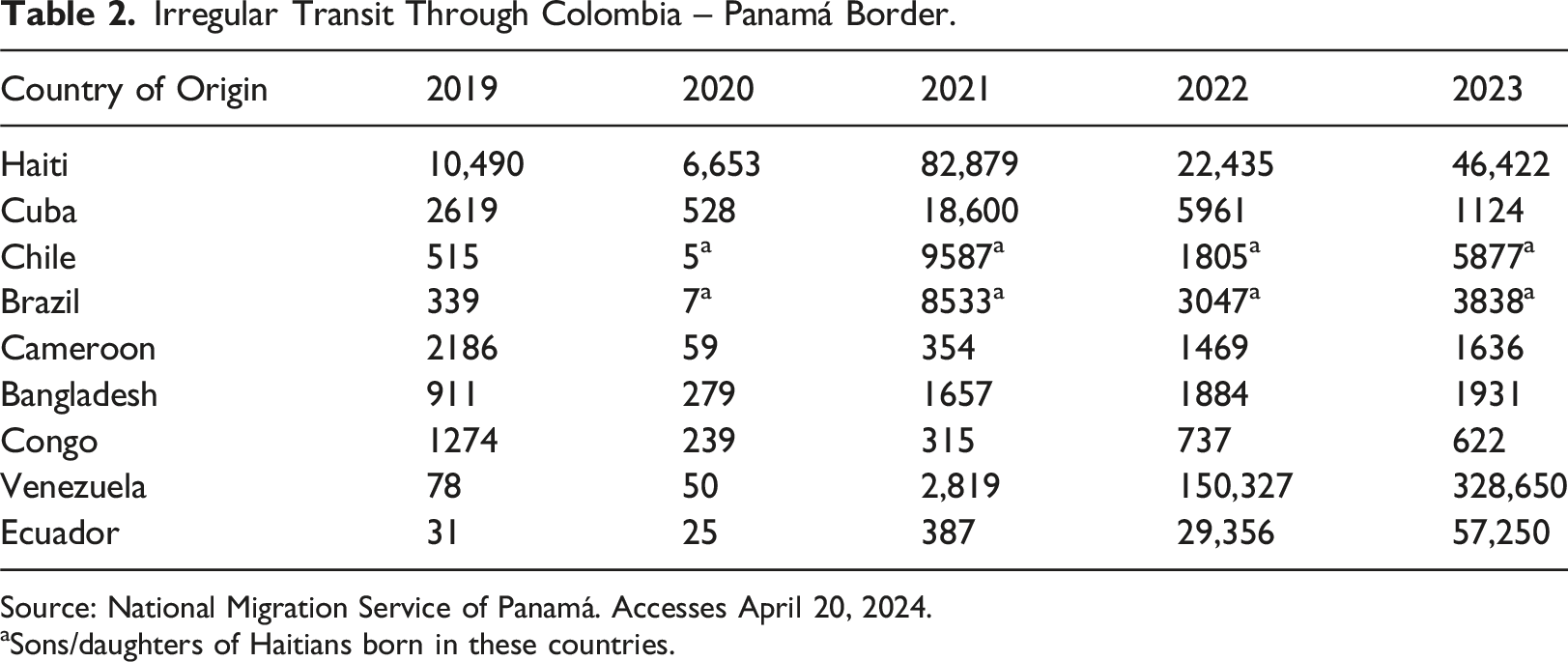
Source: National Migration Service of Panamá. Accesses April 20, 2024.
aSons/daughters of Haitians born in these countries.
Now, if 2021 registered an increase in the transit of Cubans, this number was visibly reduced in 2022. This reduction is explained by the fact that Nicaragua became the new exit route for Cubans.
The Nicaraguan door
On November 22, 2021, the Government of Nicaragua, a Cuban government’s political ally, eliminated the visa requirement for Cuban citizens “to promote commercial exchange, tourism, and humanitarian family relations.” This decision starkly contradicted their stance in 2015, when they violently rejected the entry of in-transit Cuban migrants heading north through Costa Rica (Correa, 2019; Moreno, 2019).
Cubans arrived in Nicaragua to then enter clandestine flows towards the north, bringing the numbers to unprecedented levels. Although it was not clear how many Cubans have left through Nicaragua, the numbers of detentions in Honduras or Mexico, as well as “encounters” on the U.S. southern border, showed a notable increase through this route (EFE, 2022).
The “opening” of Nicaragua suggests the instrumental facilitation of exit, aided by an ally, of an impoverished and discontented population in the context of a generalized crisis. Visa waiver for Cubans in Nicaragua took place 4 months after the unprecedented and massive anti-government protests of July 11, in which, for several days, thousands of Cubans throughout the country denounced the shortage of medicines and food and the lack of civil liberties. Such “exit valve” strategy is not new in the Cuban context, considering that Camarioca 1965, Mariel 1980, and the Rafters crisis of 1994, constituted antecedents of mass emigration facilitated in previous contexts. However, the recent emigration volume only confirms the depth of the current crisis. The number of people displaced under Diaz-Canel’s government, primarily because of the profound effects of economic reform but also due to repressive practices, exceeds the combined total of those who left during mass exodus events in Cuba for political and/or economic reasons during and after the Cold War.
Furthermore, as part of the political positions that shape the region’s geopolitical map, several responses sought to curtail Nicaragua’s route. In February 2022, the Costa Rican government, against their 2015 stance, imposed a transit visa for Cubans traveling to Nicaragua, a decision that caused protests outside their embassy in Havana (Rodríguez, 2022). The weaponization of migrations is rendered through the mobilization of border regimes on the board game of regional interests, played against the lives of displaced people.
In March, the U.S. government announced that in May 2022, the U.S. Embassy in Havana would resume its service, but only for immigrant visas, “prioritizing applicants in the IR-5 (parent of U.S. citizen) category”. The Embassy in Guyana continued to process the rest of Cubans’ applications. That same month, Panamá, too, imposed visas for Cubans in transit to Nicaragua, and its immediate application sparked massive protests outside the Panamanian embassy in Havana for several days. Thousands of Cubans demanded the elimination of the transit visa or the reimbursement of their tickets. This protest was successful, and the Panamanian authorities postponed for 72 hours the application of the visa requirement and offered guarantees to help those who could not obtain a visa before their flight date (Puertas, 2022).
…
The trajectories presented here have also been met by regional dynamics of migratory control. Despite Cuba’s designation as a “recalcitrant”—or uncooperative—by the U.S., repatriation processes have continued between both governments. Cubans removed reported by ICE included 463 in FY2018, 1179 in FY2019, and 1583 in FY2020 (ICE 2020). Cuba’s government has a long record of refusing to receive deported co-nationals, not only from the U.S. (Correa, 2014; Loyd and Mountz, 2018). Notwithstanding, deportation flights enforced by the Trump administration reportedly included migrants with COVID-19. Hence, deportees’ human rights get obfuscated between a necropolitical imperial practice and the invocation of sovereignty’s discourse. Still, border control collaboration has operated at a regional level vis-à-vis Cubans’ migratory strategies in the current context. In 2021, 1441 Cubans were returned in 56 “devolutions,” of which 46 came from the U.S., five from Bahamas, five from Mexico, and one from Cayman Islands (Cubadebate, 2021). By the end of 2023, Cuba received 5253 repatriated in 132 air and sea “returns” (14ymedio/EFE, 2023).
Despite the restrictions imposed by COVID-19, Cubans set out to explore other routes, even beyond Latin America. Entering often through Russia, where Cubans do not need visas, many seek to cross countries such as Greece or Turkey to reach mostly Spain or Italy. In November 2021, the presence of Cubans in Greece captured the attention of various media (Psaropoulos, 2021). However, their asylum claims in Europe did not yield positive results, and many were violently returned to their ports of entry, leaving them stranded.
Different countries have waived or imposed visa requirements for Cubans in recent years, which accounts for a shifting map of migratory strategies. Visited or destination countries can later become stepping-stones to reach mainly the U.S. That was the case of Esther, 30 years old, who lost her job as a tour guide during the pandemic. After trying other jobs, she decided to use her visa to Mexico to get to the U.S. She was held in three private facilities in the U.S. for 2 months before her release.
The Cuban state discourse often resorts to notions of “illegality” to represent the recent surge and ramification of Cuban migratory fluxes (De Genova, 2002). This designation, deployed through official media and government speech, has a twofold effect. It conceals the political implications of these practices as “escape impulses,” that denote a collective “praxis of secession” (Mezzadra, 2005). On the other hand, by replicating the hegemonic discourse of migratory control, the Cuban government offers the U.S. government a discursive gesture that elicits a collaboration possibility despite the framework of dispute that publicly characterizes diplomatic relations between the two states (LeoGrande and Kornbluh, 2014).
On April 21, 2022, the U.S. and Cuban governments announced the return to diplomatic talks suspended since 2018. The resuming of dialogue revealed the concurrence of shared and contrasting interests. Despite the political context in Cuba, the Biden administration needed to mitigate the increase of encounters at the southern border. For its part, Cuba sought to alleviate restrictions in the context of neoliberal cuts. Shortly after, the U.S. released Measures to Support the Cuban People, including actions to reestablish the Cuban Family Reunification Parole, expanded travel support to reinstate “people-to-people,” increased support for independent Cuban entrepreneurs encouraging commercial opportunities, and removed the limits of remittances, ensuring free flow of remittance to the Cuban people.
However, by January 2023, the Biden Administration implemented the Parole Process for nationals of Cuba, Haiti, Nicaragua, and Venezuela (CHNV), designed to reduce entries on the southern border. The application process requires the support of a sponsor in the U.S., a security vetting check, a valid passport, and the means to afford flight expenses. Despite complaints about the digital application and the random order in which authorities have processed applications, nearly 160,000 Venezuelans, Haitians, Nicaraguans, and Cubans entered the U.S. during the program’s first 6 months (Homeland Security, 2023a). But while encounters on the southern border of CHNV nationals decreased, the 4 months following the implementation of this policy saw an “increasing number” of Cubans and Haitians “traveling to the U.S. by sea without authorization.” In response, Homeland Security amended the process for Cubans and Haitians, making “individuals detained at sea after April 27, 2023, ineligible for the parole process” (2023b). However, of the 6967 apprehensions of Cubans at sea between October 2022 and August 2023, more than 2000 took place after April 27 (Table No. 1). Perhaps because of the urgency of poverty, and the lack of resources or sponsor support, the incorrigible autonomy of sea migrants still escaped the controlling designs of migratory policies (De Genova, 2017; Papadopoulos et al., 2008).
Border, belonging, and exclusion
Cuban migrants have navigated increasingly complex border regimes as they have sought changing pathways abroad in recent years. The pursuit of flexible strategies clearly responds to a deep economic crisis at home. At the same time, one cannot understand Cubans’ motivations to confront border regimes outside of their country as economic alone. Cuban migrants today are also responding to, and navigating, a deteriorating political climate in their country, which has included the instrumental and punitive use of border regimes by the Cuban state to both prevent human mobility at times and incentivize it in others.
It is revealing that amid a global pandemic, the Cuban population has received a significant level of biomedical attention while experiencing one of the deepest levels of repression and its highest level of emigration. While most industrialized countries struggled to respond to the pandemic outbreak, the Cuban health system’s experience with previous pandemics gave Cuba ground to respond to the novel coronavirus SARS-CoV-2 (Burke 2021). Since its free health system has been one of the key conquistas (achievements) of the revolution, the pandemic outbreak was also weighted as a test for the Cuban system.
Cuba kept relatively low levels of contagious and proportionally low figures of deaths, while it is the only Latin American and Caribbean country to develop its own vaccines. 14 However, as Sean Brotherton (2012) argues in his ethnography about the Cuban health system, “statistical fetichism” tends to prevent critical examination of the role of health as a form of biopower and how ordinary people experience its challenges. The COVID-19 crisis in Cuba had an amplifying effect. Since the pandemic, the Cuban health system has shown signs of deterioration of medical infrastructure, inefficient organization of responses to contagion that neglected pre-existing medical and socioeconomic conditions, and alarming signs of corruption that include the informal sale of medicines, payments for medical services, and other practices that existed on a smaller scale before the COVID-19 outbreak (Brotherton, 2012).
In the same way that bureaucracy’s capacity to allocate resources—insightfully explained by Katherine Verdery (2002)—operated as a “legitimating principle” in Eastern European socialism, access to quality health services in Cuba during the pandemic was a matter of political legitimacy, especially for newly appointed president Díaz-Canel. Notably, the lack of medicines was among the claims that triggered the July 11 social protest following the spike in Covid cases in the summer of 2021. Whereas in most countries, the COVID-19 health crisis has allowed to—at least nominally—challenge neoliberalism’s privatizing and profiting ethos, in Cuba, it also implied a scenario of questioning and scrutiny of the system by the citizenry. However, if capitalist re-accommodation amidst COVID-19 has seen this “seesaw between neoliberal and Keynesian—or even state capitalist—responses” (Bhattacharya and Dale, 2020), Cuban policymakers curtailed the social safety net and deepened Cuban state repressive tendencies (Cilano, 2020; Pérez and Correa, 2020).
Echoing a similar wave of mobilizations in other countries since at least 2019 (Almeida and Pérez, 2022), Cuba experienced an unprecedented moment of oppositional activism. This scenario, unseen since 1959, unfolded after the violent interruption of the San Isidro Movement’s collective hunger strike, the dawn of November 26, 2020. After several days of fasting for the release of rapper Denis Solís, health authorities showed up in artist Luis Manuel Alcantara Otero’s house, where the strike was being held and broadcasted through social media. Authorities argued that one of the participants in the strike, Cuban writer Carlos Manuel Alvarez, who traveled from the U.S. to join the group, had not complied with the isolation measures and represented a risk of contagion. In an unambiguous expression of biopower deployment, state personnel entered the house and resorted to epidemiological reasons to request the end of the gathering. One of them told Alvarez: “We are here as a function of sanitary authority. And as a sanitary authority, we tell you that you violated a sanitary law of this country by declaring an address and being in another” (Diario De Cuba, 2020). Once the strikers refused to finish their collective action, authorities wearing medical clothing, including goggles, skullcaps, and masks, entered the house, detained the group, snatched cell phones used to broadcast the operation, and put them in vehicles with police logos. The blurring between security forces and health agents mirrored practices extended everywhere during COVID-19. Here again, migrant mobility is met by policing expansion since it is the presence of the Cuban migrant, who is coming from abroad, which is used by the Cuban authorities as the necessary pretext to invoke medical concerns and suppress an emerging political action.
Yet, the detention was followed on social media. The next day, many people gathered in front of the Ministry of Culture, denouncing the violent operation and demanding to be listened to by the Minister of Culture (Fusco, 2020; Guanche, 2020). Their initial requests sought a dialogue with state institutions seeking the release of several detained artists, the repeal of Decree 349 of 2018, and guarantees for free artistic creation (Fusco, 2018). However, the calls for dialogue were gradually crushed, giving rise to an increase in repression, including house arrests, virtual surveillance on social networks, detentions, and legal processes against activists. The state also deployed a media slander campaign that, replicating Cold War logic, linked opponents with foreign destabilization interests—something built on a history of the U.S. supporting and funding anti-governmental groups in Cuba (Arboleya, 2013; Farber, 2015; Portes, 2005). Meanwhile, artists, journalists, intellectuals, and activists galvanized around several heterogeneous and oppositional organizations: the Movimiento San Isidro, the 27N, the group Archipiélago, among others.
This context reached its most crucial moment in the abovementioned July 11, 2021 protests, which started with a popular walkout that erupted in rural San Antonio de los Baños. The live broadcasts through cellphones generated a cascade effect, sparking similar uprisings in more than 50 cities throughout the country. Protests remained for at least three consecutive days in various cities. Beyond specific violent episodes, popular demands pointed to problems with health services and lack of medicines, the high cost of living accentuated by the government’s measures, the accumulated exhaustion of decades of economic crisis, and the restriction of dissent and individual freedoms. Despite the unquestionable popular nature of this scenario of widespread protests, the government persisted in its traditional discourse. According to a report periodically updated by civil society group Justicia 11J, 15 a total of 1470 people were detained, including a considerable number of minors. Although around 700 were released, more than 500 trials were celebrated. By January 2022, the Cuban General Prosecutor informed that 790 people had already been convicted of different crimes, and sanctions ranged from probation to 30 years of imprisonment (Granma 2022). 16 Quelling the emergent popular projects fueling the cycle of protests was, along with the economic reform’s impact, co-constitutive of the recent mass exodus of Cubans.
The response of President Díaz-Canel Bermúdez to the protest can be illustrated in his repetition of a historical formula: “!la calle es de los revolucionarios!” (the street belongs to revolutionaries). In the spatial configuration of this political motto, it is possible to guess where non-revolutionaries should go. Either through emigration, detention, or social exclusion, exit continues to be the natural space for dissenters in the political imaginary of the Cuban state order. Just as the understanding of labor mobility and migration control regimes is a fundamental component to understanding the history of capitalism, the social order that has been produced since the 1959 Cuban revolution, its territorial and existential imagination, is intimately linked to the political significance of exit, and the place of the afuera (outside). Building on Agamben’s theorization (1988), this is not a simple reference of spatial location since that outside is brought to the center of the political-national design in the form of an exception, as a negative referent with a constituent function of the Cuban social order. Here, again, the notion of the border is not limited to the logic of exclusion of migrants and refugees but rather as a regime of political control defining the inside and outside, which aims to ideologically delimit the national collective and, therefore, legitimize the exclusion of political opponents. This order implies a legal and political structure that reproduces forms of exclusion, rendering rightless those considered emigrados (emigrated)—colloquially referred to as those who lost their residence, or simply those que se quedaron (who stayed abroad). Apátrida (stateless) is not simply an epithet used against those conceived as political enemies but a consequential frame that is also activated through a temporal dimension of borders (Mezzadra and Neilson, 2013). Albeit formal links are maintained with the state, surpassing the 24 months allowed to reside outside Cuba, implied an exclusion expressed in the stripping of civil, political, and social rights, leaving some migrants in a rightless condition vis-à-vis the Cuban state. 17
As Margaret R. Somers proposes, despite formal recognition, statelessness is configured by “losing the right to have rights,” which implies “losing the protection of a social state” (2008: 119). The condition of non-belonging of Cubans legally considered “emigrated” was conveyed in the institutional isolation measures for international travelers that came into force on February 6, 2021. Besides establishing rules for different modalities of foreigners arriving in Cuba, it clearly distinguished between Cuban residents and non-residents. For the former, isolation would be done “in authorized centers in the provinces and will be free of charge.” In the case of “foreigners and non-resident Cubans who arrive in the country, they will be isolated in designated hotel facilities in each territory, with travelers assuming the cost of stay and transportation” (OnCuba, 2021). Such logic expresses the limits of the 2012 migratory reform, tensions within the state campaigns of Diálogo con la Emigración (Dialogue with Emigration), and the paradoxical exclusionary recognition of the Cuban diaspora—invited to participate and submit opinions in the context of the 2018 constitutional reform process but denied the possibility to vote in the Constitutional referendum and ultimately excluded from the text of the constitution (Correa, 2018).
Entry denied, banishment and regulated
Several events revealed the operation of the border as part of political control in Cuba during the pandemic. These bordering practices have involved forms of mobility management both to prevent dissent from reaching international forums and to “externalize dissent” (Pedraza, 1995: 316). A notorious case was the denial of entry to Cuban journalist Karla Pérez in March 2021. Flying back to Cuba from Costa Rica, Pérez was prevented from boarding her flight due to her political activism. Her exclusion highlights the political relationship between the rights of entry and exit, regulated in articles 23 and 24 of the Cuban Migration Law, legally producing de facto forms of statelessness. 18 It is no accident that since November 2020, one of the repeated slogans by Cuban activists was the Arendtian formula of “the right to have rights.” Although this statement appears as a claim connected with her broader formulation against totalitarian regimes—and without overlooking Arendt’s politically motivated omissions—this formula is developed around the experience of stateless persons in Europe in the interwar period of the last century (Arendt, 1951). In this sense, the use of Arendt’s formula not only revindicates liberties and political rights vis-à-vis the Cuban regime. It also conveys the ways in which the legal production of statelessness by Cuban migratory legislation is still an effect of the understanding of citizenship and national belonging.
Numerous cases of blatant banishment of political dissenters followed the denial of entry to Pérez. By November 2020, state security officers summoned Cuban activists to interviews at the Identification, Immigration, and Foreigners Offices of the Ministry of Interior. Some of the interviewed reported being “exhorted” to leave the country. By mid-2021, in response to the escalating protests, state officials increased efforts to force activists to leave the country. Journalists, artists, and other political dissenters were either released from detention on the condition of leaving the country or coerced to leave as an alternative to imprisonment. According to the abovementioned Justicia 11J report, there are at least 31 cases of people identified in the report as “emigrated/exile,” who either were threatened or directly forced to leave Cuba because of their involvement with the July 11 mobilizations. As a response to the surge of destierros (banishments), the International Institute of Artivism “Hannah Arendt” (INSTART) created the series Desterrados, which gathers oral histories of those forced to leave Cuba in different ways. 19
Banishment has been a recurring practice in the history of political violence in the Americas, in both colonial and post-colonial contexts (Goldstein, 2001; Morgan and Rushton, 2013; Sznajder and Roniger, 2013). Beyond the instability of a precise definition, which responds to the diversity of cases and its association with other concepts, e.g., exile, displacement, etc., banishment is “a tool deeply used by states to eliminate political dissent” (Sznajder and Roniger, 2013: 31). In that sense, political dissenters’ entry ban also constitutes a form of banishment since its distinctive hallmark is the effective prohibition of return.
These practices express much of the Cuban regime’s nature and how repression has been deployed in the current cycle of contention. In general, it is not through death that the physical elimination of political activists is achieved but through exile. Both banishment and refusal of entry are reaffirmed as a form of repression against dissenters.
The recent increase in banishments is part of the economy of repression following the 2021 protests. In the past, the control of dissenters entailed instead the prohibition of departure. Despite the celebrated changes introduced with the 2012 migratory reform, including the elimination of travel restrictions, several political opponents have been prohibited from traveling abroad. This condition is known as regulados (regulated), which refers to the administrative designation by the Ministry of Interior of the exit ban contained in article 24.1 subsection d) of the Migration Law 1312 of 1976, modified in 2012. It is not that one prohibition has given way to the other but that the Cuban state uses them alternatively for each case, expecting to contain the political agency of opponents. While some are forced into exile, others, perhaps seeking to return in the short term, are prohibited from leaving Cuba. 20 That was the case of independent journalist Maria Matienzo and activist Kirenia Núñez, who, in January 2022, tried to update their travel documents but were instead told that they “were regulated.”
Rather than contradictory, expelling through banishment, and exit prohibition, are parts of the Cuban government’s repertoire of repression. 21 Considering that the heterogeneous Cuban civil society often participates in international spaces of different nature and purposes, it is possible to understand that both exit—as banishment—and its prohibition—being regulated—seek to silence the dissenter voice (Hirschman, 1978).
Especially after November 27, 2020, it is possible to account for a growing number of Cubans residing outside Cuba of different ages and political affiliations directly related to diverse forms of political activism. Its composition can no longer be compressed within the image of post-1959 right-wing organizations. It also entails bringing awareness to topics such as gender and racial issues in Cuba while using non-traditional political languages like different forms of artistic interventions and the use of digital platforms. Therefore, against the old expression, Cuban migrants not only “vote with their feet.” They rather engage systematically in what Dana Moss (2016) calls diaspora mobilizations and express their different political positions by holding rallies, protesting outside Cuban embassies, participating in political podcasts, donating to activists and organizations in Cuba, or families affected by the pandemic, but also engaging international organizations of different scope. On other occasions, recalling James Scott’s strategies of subordinates (1990), they draw ironic messages, fugitive transcripts perhaps, on the wooden structure of a raft before crossing the Straits of Florida.
Although the Cuban government adopted various measures to control international entries and circulation within the country, it is in the management of dissent that the border regime is expressed in terms of the reproduction of national belonging. This involved sophisticated narratives labeling activists as mercenaries and apátridas. The existence of extremist positions among the Cuban diaspora in the U.S., demanding an American military intervention as a response to the repression of social protest in Cuba, cannot be thought of apart from the effects of exclusion that this framework produces, along with the historic cooptation of Cuban migrants by conservative forces within the U.S. political system (Portes, 2005). Even though Cuba did not formally declare a state of exception during the pandemic, the exception is revealed against those labeled as dissidents-apátridas-annexationists-counterrevolutionaries. This designation operates as a structure of exclusion (Agamben, 1998). It is a device anchored to an insular nationalism that manages the relationship between the inside and the outside. That outside also designates the place of dissent because to be considered a dissident in Cuba is to live in a state of exception. It is to be on the other side of the border and be located outside the law.
Conclusion
Following the pandemic outbreak, at least 112 countries declared states of emergency. 22 In others, as it happened in Cuba, the absence of a formal declaration of a state of emergency has not prevented human rights violations in the name of preventing contagion and protecting public health. Notwithstanding, we have simultaneously witnessed a revitalization of social protest. An analysis of the measures and the vocabulary of these orders refers to migration control as a paradigm of government in the face of the pandemic. The permanent exception that regulates the migrant condition is now extended over societies in the COVID-19 context. Although rendered as a naturalized response from a national public health reason, the limitation of mobilities during the pandemic has meant an added risk for the lives of impoverished and racialized populations, women subjected to domestic violence, elders, and others dependent on care and lacking social assistance, as well as populations subject to different forms of displacement (Freier and Vera, 2021; Garth, 2021; Torres, 2020). At the same time, whereas the biopolitical concern is articulated with the expansion of virtual capitalism, necropolitical practices are administered upon deportable and disposable bodies (Mbembe, 2006).
As this article argues, rather than an exception, Cuba’s context ratifies some of the global tendencies. The recent context of the pandemic in Cuba confirms the importance of the border control regime for squashing dissent and reproducing ideals of national belonging and citizenship. The border control regime has been fundamental in the grammar of the political regime that emerged after the 1959 revolution. But even though the re-bordering process unfolding in Cuba during the context of COVID-19 entailed the reactivation of previous logics of power, it has substantiated an intensification of border and mobility control that found momentum as the natural form of state response to the virus. Albeit an expression that verifies the biopolitical response to the virus, it manifests itself—in Cuba as in many places—as a device of control in the face of social protests. In addition to arbitrary temporary detention (including here forced house arrest of dissenters) and the imprisonment of dissidents through the use of forms of legal repression, the Cuban state has resorted to the use of forced banishment, prohibition of entry, and denial of exit of those declared as regulados (regulated) as forms of repression.
Footnotes
Acknowledgements
This article would not have been possible without the support of Soledad Álvarez, Nicholas De Genova, and Stephan Scheel. I am grateful to the reviewers for their detailed observations and suggestions. My gratitude goes also to Robin DeLugan, Raúl Fernández, Ignacio López-Calvo, and Dylan P. Lee. Lastly, I am grateful to my partner Amalia and my son’s grandmothers, who cared for him while I worked on the final corrections of this article.
Declaration of conflicting interests
The author(s) declared no potential conflicts of interest with respect to the research, authorship, and/or publication of this article.
Funding
The author(s) received no financial support for the research, authorship, and/or publication of this article.
