




Abstract
The contemporary comprehensive urban planning in Iran suffers from lack of mechanisms for accountability and monitoring, as well as weak implementation. In response, in the Comprehensive Plan of Tehran, developed in 2007, evaluation and monitoring gained new significance, however, a gap remaining about temporal aspects. This article proposes some criteria of so-called time-oriented policies for evaluating planning practices, through a specific analytical framework. Despite development of theory on time-oriented approach in Europe, such an evaluative framework for plans had not been developed yet. The proposed ‘urban temporal studies framework’ consists of two main groups of attributes: surveying ‘time orders’ such as urban rhythms under descriptive part and considering major normative principles of ‘ordering time’ such as temporal equity, efficiency and institutionalisation. Using a content-analysis methodology, we have applied the proposed framework evaluating the recent Comprehensive Plan of Tehran. The results of the analysis indicate that the planning system in Tehran has mostly considered normative temporal aspects and they are mainly implicit in the plan. The frequent considerations of temporal organisation in our case clarify the strength of ‘planning in time’, occurred implicitly in this plan. On the other hand, the absence of descriptive elements in the plan notices a lack in awareness or a weak interest of planners and decision makers in Tehran about social structure of time of the city.
Introduction
In response to the enormously increasing population of Iranian cities due to the urban drift phenomenon, city managers thought that modern urban planning methods should have been implemented (Mashadizadeh, 2003). Therefore, comprehensive planning in Iran began in 1960s (Madanipour, 2006) and it is more than five decades now since comprehensive and detailed plans have provided the basis for all other planning policies (Farhoodi et al., 2009). As the term ‘comprehensive’ suggests, this is a complete approach to address the issue of a community’s future growth (Goodman and Freund, 1968). The plans that flow from it are naturally based on this principle. In recent decades however, as a result of global planning movements and local changes, the comprehensive approach has faced criticism from several different perspectives (Farhoodi et al., 2009). Because of this criticism, a structural-strategic approach enriched the recent comprehensive plan of Tehran, developed in 2007. Its evaluation process has become more serious as well. Tehran Urban Planning and Research Centre tries to push different types of ex-ante, ongoing and ex-post evaluations. Their focus is mostly on evaluating the policies’ performance-based evaluation (Alexander, 2009) and tries to cover different aspects.
A major reason for the lack of efficiency of current comprehensive planning procedure in Iran is related to the temporal monitoring (Hoseinzadeh et al., 2010). Therefore, this article focuses on the evaluation of Tehran comprehensive plan (2007), adopting a temporal-spatial approach. In fact, the contemporary cities underline that the relationships are more and more complex than comprehensive planning proposes to manage in its still hegemonic discourse in developing countries (Farhoodi et al., 2009). Moreover, some scholars consider time as a major descriptor of contemporary cities, and today we are facing ‘cities of time’ (Bonfiglioli, 1997; Henckel et al., 2013), and implicit decisions about time are constantly being taken within planning policies. Thus, the assessment of comprehensive planning is significant from a time-oriented point of view, due to the importance of time as a needful factor of complexity in societal and environmental challenges and the importance of a people-centred approach in planning, that a daily life perspective can introduce.
Although considering time seems to be an inseparable part of each planning process, it is hardly explicitly conceptualised in planning literature. Specifically, literature on time is virtually non-existent in Iranian urban planning debate. Additionally, despite development of theory on time-oriented approach based on European time planning practices (Boulin, 2008; Mareggi, 2002; Mückenberger, 2011; Henckel et al., 2013), such an evaluative framework for plans had not been developed yet. Therefore, the need for introducing a framework that helps to study and evaluate the use of concepts of time in urban planning has emerged. Such framework, while filling the applicability gap of temporal-spatial knowledge in planning, is able to increase the present validity of policies and reveal complex patterns of the environment (Lefebvre, 2004; Mareggi, 2013a) and anticipate the future, what planning generally makes effort for (Faludi, 1973). The article aims to underline how time should be considered in planning processes, proposing a first example of the applicability of such principles in evaluating planning practices.
The paper first presents a conceptual framework for the evaluation of an urban plan based on a discussion of time in planning and time planning practices, through a literature review. Secondly, content analysis is discussed as a relevant method to test the proposed evaluation framework in the urban plan. Finally, with the help of a proposed framework for time studies in planning, authors will determine how and to what extent a time-oriented approach is embedded in the Tehran Comprehensive Plan.
Building an evaluation framework
Time in urban planning literature
There is a broad range of literature on the nature of time and its categories, such as the philosophical works of Heidegger (1962) and Whitehead (1993). Specifically this approach built upon studies on the sociology of time (Adam, 1995; Lefebvre, 2004) and time geography (Hägerstrand, 1970; Thrift, 1977; Amin and Thrift, 2002). Time geography combines temporal dimensions with concepts such as traffic studies and time schedules of facilities, focusing on people and individual daily behaviours. The debate on time in urban planning is less explicit. To explain the position of this article within the broad literature on time, we present below a number of major general approaches towards time.
Time as an urban structure is related to the fact that time per definition shapes urban space and frames the activities of inhabitants. Related to this, a basic distinction emerges between linear and cyclic time. Linear time is a progressive phenomenon, consisting of quantitative and measurable sequences, while cyclic time is about the feeling of a reciprocal influence of repetitive events without direction (Rapoport, 1982). Nearly all different theories on time assume its subjective nature, albeit two diverging approaches towards time can be distinguished: substantivist and relational (Dodgshon, 2008). The substantivist approach towards time assumes that it has an existence that is independent of processes. Relational thinking assumes that time derives its meaning entirely from the relationship between events (Dodgshon, 2008). Here we suppose that both of these two approaches should be regarded in urban planning.
The urban theorist Lynch considered time as an element of place quality and he underlined the relevance of the temporal structure of space for planning processes (Lynch, 1972). Drawing on this, Rapoport believes that time is one of the elements that environment consists of. In order to orderly organise an environment, four elements – space, time, relations and meanings – should be organised and managed (Rapoport, 1982). Similar to Rapoport, the sociologist Zerubavel (1981) saw that the orderliness of an environment is represented through numerous temporal patterns, which have the characteristics of time and occur in urban space. Carmona et al. (2003) have the same view although their focus is on planning in time (concepts of change, transformation, phasing of plans) rather than on planning with time (considering time structures and societal processes as given and as conditions in urban planning) or planning of time (considering directly the structure of time and proposing interventions to alter these structures) (Schaick, 2011).
Being more descriptive, Carmona et al. (2003) also explain that cycles are one of the first but not the only ways of surveying time. It seems that these cycles and orderly repetitive patterns, which these authors refer to, are kind of urban rhythms. Taking urban rhythms as a combination of both linear and cyclic time, one could see this categorisation either from a substantivist or relational viewpoint or as a mix of both. Rhythms in substantive time are based on clock time and relatively independent, but rhythms are also a form of relational time such as the socio-cultural rhythms of events that may be considered in urban planning. In fact, urban rhythm is repetition of movements, actions, conditions and distinctions; it is the frequency of linear process (continuous experiences such as everyday behaviours) and cyclic processes (like repetitive events), that make sense of time (Lefebvre, 2004; Wunderlich, 2007). Moreover, working on urban rhythms is a way of revealing the hidden generative matrix of a city from a temporal perspective, focusing on the effects and/or the producers of rhythm that determine. The process to recognize temporal identities of places, that is to say ‘time-spaces’, can follow different approaches.
Amin and Thrift (2002) underline rhythms as a theoretical tool to analyse the urban dimension in everyday life, a research a little bit forgotten by current debate (see also: Lazzarini, 2016). Lefebvre (2004), moreover, sets out a qualitative framework for understanding time, introducing the concepts of eurhythmia as a symbiotic relation between rhythms and arrhythmia as a disruption in rhythms. There are also different proposed categories of rhythms. Zerubavel (1981) assumes natural, social and physical rhythms, while Edensor (2010) states that rhythms can be categorised under concepts of people, bodies, mobility and the non-human. Besides these, Wunderlich (2013) supposes social-cultural, natural and spatial rhythms. Closer investigations show that these classifications are mostly content-oriented and they overlap with each other.
Urban rhythms and their application in urban planning have been further elaborated in the past decade. Wunderlich, as an urban designer, looking towards Lefebvre, has investigated rhythm from both affective and sensorial aspects in urban spaces (Wunderlich, 2007, 2013). Beginning from a similar position, and combining it with time geography based on Hägerstrand’s work, Schaick tried to investigate the possibilities of applying temporal order in planning research. More ambitiously, he argued that the temporal order could be seen in terms of ‘activity systems’ as part of a wider systems-based view of urban planning. Moreover, he traced the theoretical basis of Hägerstrand’s temporal constraints – capability, coupling, authority and packing – to frame his work. According to these constraints, he showed that time-space in the context of urban and regional design and planning needs to be looked also in terms of time-space ordering – structuration (Schaick, 2011). Actually, in this domain, societal and individual patterns should be continuously adapted through mechanisms like time-space compression, time-space individualisation and time-space convergence.
With regard to this adaptation between time, space, life patterns and spatial structure of the city, specific normative concepts about the quality of time and space and about the quality of life arise, which are based on the aforementioned mechanisms. These concepts such as temporal efficiency (coordination and convergence) and temporal justice (distribution effects) are often the subject of implicit decisions in urban planning (Henckel et al., 2013; Shahab et al., 2018). Temporal efficiency has been described as an approach to organise and coordinate public time. This perspective also raises questions of distribution and temporal justice, particularly when one keeps in mind that transparency, (temporal) availability, coordination and accessibility are among the essential conditions for time efficiency (Henckel and Thomaier, 2013: 113). However, temporal justice is closely associated with time autonomy, the ‘right to one’s own time’ (Henckel and Thomaier, 2013: 101). Despite overlaps between these, which are called ‘twin concepts’ (Shahab et al., 2019), it is worthy to consider them separately because they represent different normative viewpoints. In this article, accessibility and distribution effects are perceived to be at the core of temporal justice, and transparency and coordination at the centre of time efficiency.
The notions of time in urban planning discussed so far are rather theoretical. To use notions of time for the analysis of urban plans we need to address time within a more practical terrain. Therefore, we first draw lessons from a planning context where time is central to its practice. There are limited practical experiments that have been done on time-oriented approaches. Italians were the pioneers of application of urban time policies since the 80s, in what has been defined as Time-of-the-City approach. In the 90s, this was disseminated in France, Germany and the Netherlands (Bonfiglioli, 1997; Boulin, 2008; Mareggi, 2002; Mey and Heide, 1997; Mückenberger, 2011). The use of this approach to urban planning has progressed in these domestic contexts (Zambianchi, 2013), even if the application of space-time dimension to land-use planning has been scarce (Mareggi, 2013a). Not many critical reviews of these practices have been published yet with the exception of Schaick (2011, 2013) and Radoccia (2013).
From the literature on Italian policies of time-space planning, we derive a number of principles we can use in our framework. Briefly, the principles extracted from the case study review are that consideration of time in a city planning approach includes: implementing a shared vision, considering experiences of daily life and public participation, providing institutional context (legal and administrative) and considering time in all scales of planning (from strategic legal framework to local plans and project) (Mareggi, 2002, 2013a; Radoccia, 2013; Zambianchi, 2013). Summing up all these theories and practices (Table 1), in the next step we are going to build our framework.
Summary of key elements derived from major time related studies.
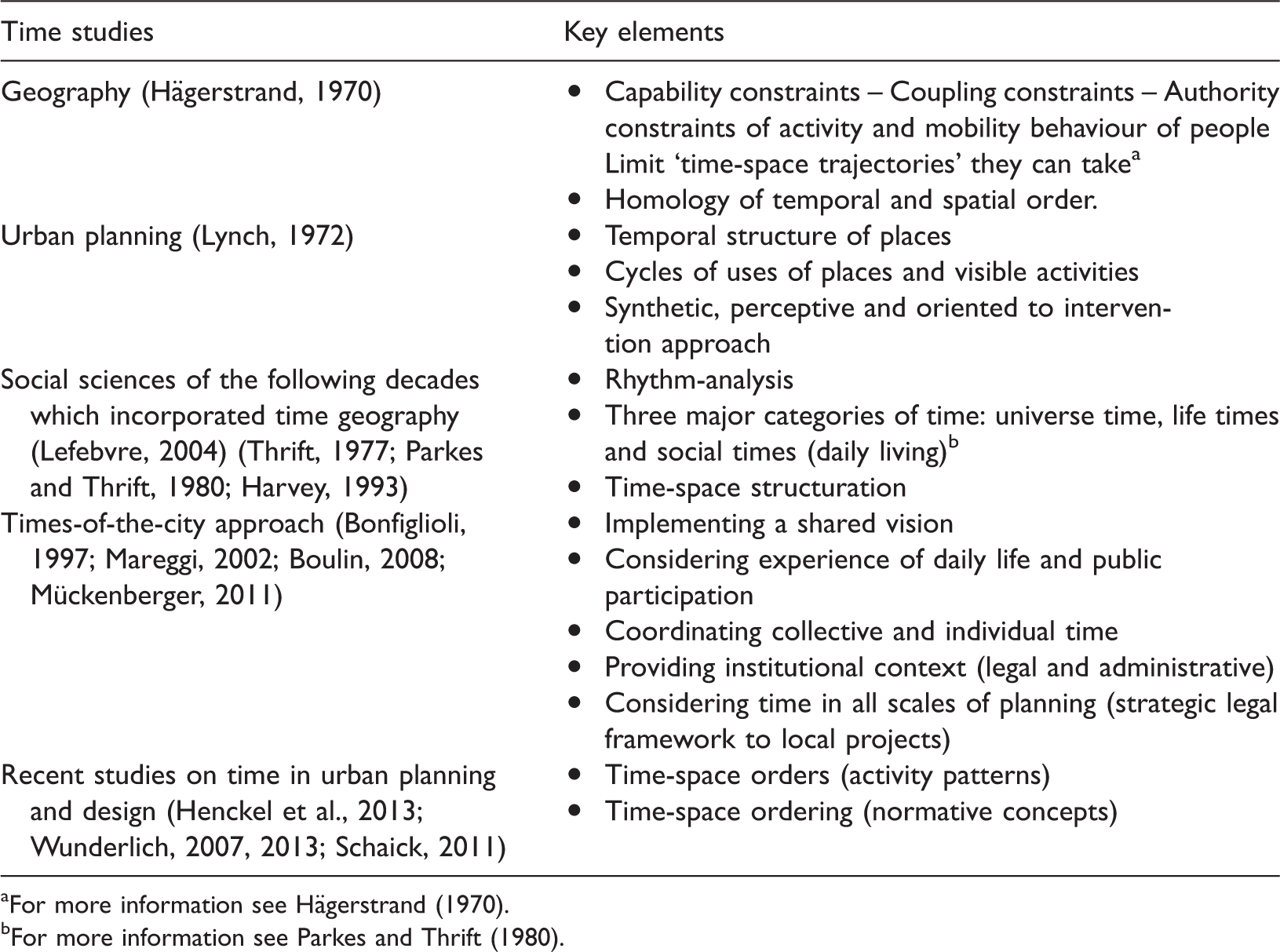
For more information see Hägerstrand (1970).
For more information see Parkes and Thrift (1980).
Spatio-temporal conceptual framework
Reflecting on literature, concepts and principles of urban times is useful to deal with contemporary cities and evaluating planning tools, which address spatial-temporal problems and issues relevant in the daily life of citizens. The proposed framework functions as a vehicle for accessing, organising and displaying information in the analysis of concepts of time in specific plans (Figure 1). Different from most of the studies up to now merely descriptive, we propose to consider both descriptive and normative aspects.
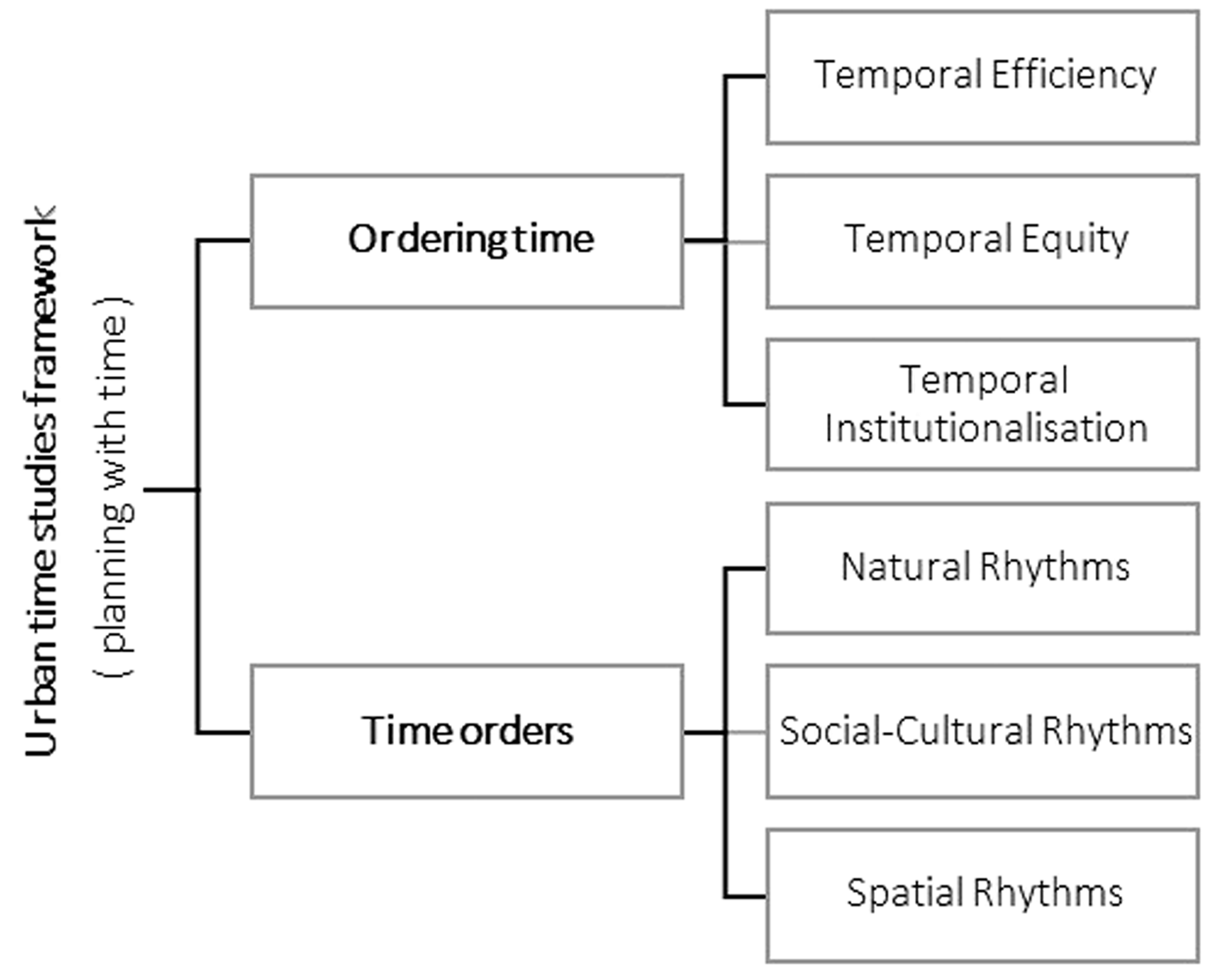
Urban time studies framework.
The first part of the framework, based on the descriptive concept of ‘rhythms’, consists of elements which define the time order. The study of rhythms is important as they make it possible to get closer to familiar phenomena (Lefebvre, 2004). Moreover, they allow us to discover concordances, dissonances and conflicts between different phenomena (Mareggi, 2013b). Actually, in comparison to common observed behaviour, rhythms tell us much about the constant change in the potentials of each pocket of space-time (Thrift, 1977). In this way, it can reveal hidden social 'rules' within urban context (Zerubavel, 1981).
The second part of the framework, named ordering time, is based on the normative concepts of time. Albeit rhythms can be considered indicators of quality of life, they do not say much yet of what is desired or wanted. Normative choices are an integral part of urban planning. Indeed, ‘the planning profession requires normative criteria to shape the plans it produces’, also to evaluate plans from both theoretical and practical perspectives (Alexander, 2002: 191). Such set of normative criteria helps planners in making judgments (Alexander and Faludi, 1989). For the sake of clarity, we now define the concepts of proposed framework.
Urban rhythm
Urban rhythm is repetition and frequency of phenomena that make sense of time. These phenomena are like linear experiences such as everyday behaviours and cyclic processes like natural cycles (Lefebvre, 2004; Wunderlich, 2007). We suggest to use socio-cultural, natural and spatial rhythms as main 'descriptive' categories with significant effect on how we inhabit urban environments and how we manage activities and spaces temporally. This categorisation also covers issues of planning from a sensorial, physical and functional perspective. Socio-cultural rhythms refer to particular social and spatial events/activities/practices taking place repeatedly. Natural rhythms are circadian and circannual natural changes. Besides these, there are two groups of spatial rhythms: (1) dynamic rhythms such as movements, trajectories and intensities of flows of people for given periods of time; and (2) static rhythms such as the repetition of elements or colours and harmonious displacement of objects (Wunderlich, 2007). This first part of the framework expected to be most applicable at the scale of local projects. It is mostly about surveying the temporal behaviour of different kinds of phenomena such as human behaviour and patterns of daily life, and finally integrating them into urban planning.
Temporal equity
Central concept of temporal equity is accessibility (Henckel and Thomaier, 2013). As a fundamental normative concept that should be basis for planning, evaluation and policy analysis, it concerns the distribution of resources, goods and services among individuals (Shahab et al., 2019). Urban planners try to address temporal equity by improving the level of connections between the various networks and broadening the range of modal choices (Henckel and Thomaier, 2013: 101). In other words, being able to reach facilities by walking within an acceptable threshold of time is considered the most important indicator of urban accessibility.
Temporal efficiency
Due to the most widely used Pareto’s definition of efficiency, temporal efficiency is about optimizing the allocation of resources and maximising the outcomes (Shahab et al., 2019). This concept is central in daily life; for example usually people complain about public transport and time lost here and there. Also they do not often match with the functions that are not available at the same time, for instance post offices are not open when people are not at work and need their services. Such transparency and harmonization is achievable through considering concept of temporal efficiency. Specifically, for achieving temporal efficiency or, at least, improving the current situation, certain key preconditions need to be met: accordance of individual and collective time and transparency of the temporal implications. For achieving transparency, both related information and actual conditions should be clear for users in addition to new spatial and social sorting, which are opened up by the emergence of new technologies (Henckel and Thomaier, 2013). Although these two concepts are important, they do not address performative and institutional aspects. Considering this and with regard to literature on Time-of-the-City approach we propose a third normative concept: institutionalisation.
Institutionalisation
Institutionalisation can occur through legitimised policy as well as establishment of an administrative context, in order to decrease uncertainties in human interactions (North, 1990 cited in Shahab et al., 2019). According to Schaick (2013: 196), the success of a time-oriented approach can be measured according to its level of institutionalisation. The degree of institutionalisation is a normative question as it opens the engineering-based view of planning up to a human-centred view of planning. The shift of time of the city approach from experimentation to that of legitimised policy by means of a national law in Italy in 2000 was an important phase in urban time policies (Schaick, 2013: 204), since it incorporated a feminist rationale into urban planning. The Italian national law no. 53/2000, named Turco act, proposed the formulation of territorial timetable plans obligatory for Italian municipalities with more than 30,000 inhabitants as well as the establishment of a Time Office in each municipality (Mareggi, 2002).
The second part of the framework, consisting of normative concepts for ordering time, expected to be usable at the scale of providing a legal context and for policy making, which supports the development of urban time plans and temporal strategies at other scales and planning tools (Radoccia, 2013; Zambianchi, 2013). So, on the one hand, we identify temporal elements emphasising natural, spatial and socio-cultural rhythms. We call them ‘concepts of time order’ since they represent different time characteristics. Secondly, considering changes in space, needs and development of technology, we propose normative elements and the prerequisites for the consideration of time in planning. These are temporal efficiency, equity and institutionalisation. We call these ‘ordering concepts of time’ as they say something about the way in which time itself is ordered in time structures.
Method
Adaptation of content analysis as a method
Most of researchers studying planning and development have employed content analysis (CA) to evaluate plans and zoning codes (Norton, 2008: 433). In this article, we try to adopt and contextualise this method for the evaluation of comprehensive planning from a temporal approach. As CA is a method for interpreting the meaning of texts and quantifying the frequency of those interpretations, and texts have no independent meaning since people differently interpret them (Dumay, 2014), researchers faced two main challenges. First, superficial analysis did not respect latent contents and contexts, and worked with simplifying and distorting quantification (Mayring, 2000). Secondly, the four aspects of context, implicit sense, distinctive individual cases and things that do not appear in the text are not taken into account appropriately by quantitative content analysis (Kohlbacher, 2005). These critiques finally led to the development of qualitative approaches to content analysis (Kohlbacher, 2005) and, to enrich CA as a method, specific suggestions were presented.
Steenkamp and Northcott (2007) recommended the use of themes rather than sentences or paragraphs. Another suggestion raised by the same authors was to conduct this method by adding interpretation of texts by someone other than just researchers. Consequently, themes could be developed within contexts and the subjectivity of the findings would be reduced by using multiple coders. According to these critiques and suggestions for enriching CA as a method, we try to adopt this method for the context of comprehensive urban planning. For ensuring a meaningful analysis, it is necessary to “separate the master plan’s communicative content from its quality”, also framing analysis in terms of the larger policy goals of interest (Norton, 2008: 433). So, we follow Norton’s separation of communicative content and quality of plans and we only assess the content of a plan, because evaluation of quality would need more accurate data, which were not available to the authors. Additionally, in order to frame the analysis within larger policy goals, this article took the spatio-temporal proposed framework as criteria for a specific assessment of the comprehensive plan of Tehran in Iran.
Our approach
We use a combination of qualitative and quantitative CA. This article considers themes as a unit for analysis, since multiple themes may be present within a single sentence or vice versa they might best overcome the problems encountered with sentences and paragraphs (Patton, 2002; Steenkamp and Northcott, 2007; Zhang and Wildemuth, 2009). Additionally, since themes are not clear-cut, self-evident units in the way that words or sentences are, they must be very clearly defined, preferably by illustration and examples rather than in generalised, abstract terms to ensure the consistency of the analysis (Steenkamp and Northcott, 2007).
In response to these two challenges, we also developed a coding manual, which consists of category names, definitions, subcategories and exemplars. These categories were used to code the Tehran 2007 Comprehensive Plan according to the presence or absence of each theme in the plan. Two different groups of coders made the scoring (coding): researchers and practitioners, bringing different viewpoints to the coding process. Stratified purposive sampling technique was regarded for involving participants. The sample size should be determined on the basis of informational needs so that the research question can be answered with sufficient confidence (Patton, 2002). It has been suggested that saturation of data may indicate the optimal sample size (Patton, 2002). Regard to these points, data gathered through participation of 10 alumni in planning verified the saturation. All coders had master’s degree in urban planning, while some continue their career in research and others in practice. In total, 10 coders coded both documents, five from each group.
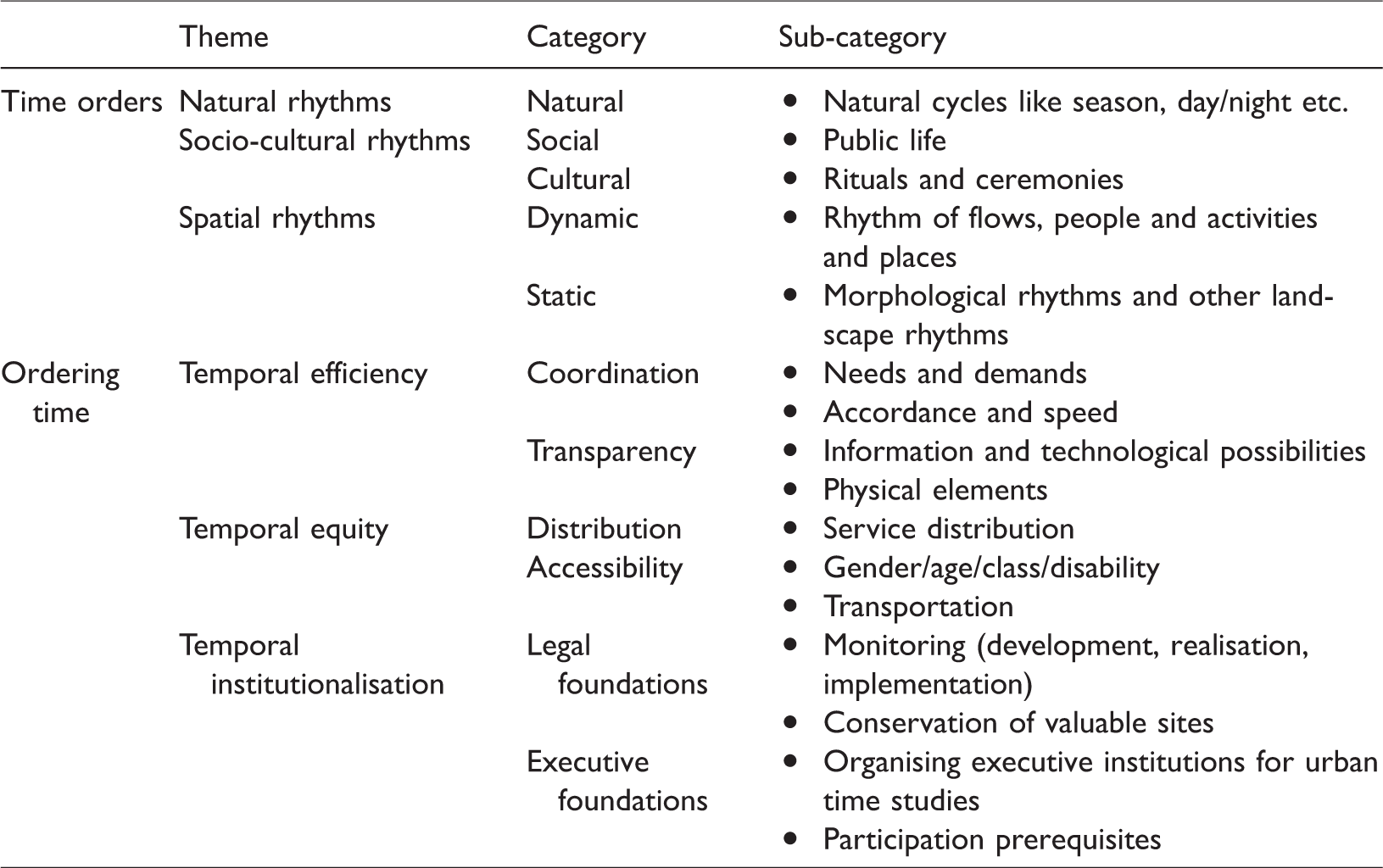
The findings are based on the comparison of data gathered by the help of these two groups of coders and reflect their varying inferences and coding outcomes. Coders were instructed how to apply the evaluation protocol. Coders were additionally asked to propose new themes and categories for the framework if they thought it was needed. In a scientific context, our analysis must be read as a 'proof-of-concept' to explore if the combination of theoretical framework, method and case studies work together to provide results. As explained before, the first step in the investigation of time embeddedness in urban plans in this article is searching for themes. Table 2 presents the theory-based themes we used to code the planning documents. For searching these themes in the text, we request the coders while considering themes and categories in Table 2, asking themselves “what is this expression an example of?” (Ryan and Bernard, 2003). The considered processing technique is 'Cutting and Sorting', while other techniques are word lists and key words in context, word co-occurrence and metacoding (Ryan and Bernard, 2003). We initially analysed the filled out coding forms.
Evaluation categories and criterion for urban time study framework.
Assessment of the case of Tehran’s Comprehensive Plan
Aims and structure of the plan
At first, the critics of Tehran’s Comprehensive Plan were narrowly focused on the legal processes around plan preparation and implementation, but their scope has gradually broadened to embrace the content and fundamental theoretical bases of this pattern of planning (Ministry of Housing and Urban Development, 2006). Therefore, they began to insert new perspectives into the dominant paradigm of comprehensive planning in Iran. These resulted in the development of the Tehran Strategic-Structural Plan in 2007. This is the reason why planners are cautious to the term comprehensive.
The population of Tehran within the horizon of the plan (up to 2027) – considering its natural population growth and the analysis of the results of the last census (2007) – is predicted to be 8.7 million people (Bum Sazgan Consultor, 2007) while the area of Tehran is 614 km2 within its official limits. This plan was created with the major aims of improving Tehran’s international role, defining its official borders, improving the conditions of its residential area, encouraging economic growth, ensuring environmental protection, improving transportation infrastructure, progressing urban environmental quality and emphasising Iranian-Islamic identity in the organisation and improvement of the urban landscape (Shafigh, 2007). It is defined under nine major headings: development vision, development strategies, city boundaries, city region, spatial structure and zoning, construction rules and regulations, local and thematic plans, and terms of feasibility and implementation mechanisms (Shafigh, 2007) .The following paragraph aims at investigating this planning tool through the proposed criteria of urban time studies framework.
Findings and discussion
Using CA, we evaluate if and how descriptive and normative aspects of the proposed framework are present in the Tehran Plan. That is to say, we try to discover if patterns of life and changes in the pockets of space-time (Lefebvre, 2004; Mareggi, 2013b; Thrift, 1977) are employed and become normative criteria to improve city’s habitability. Firstly, with regard to the extent of time consideration in comprehensive planning, analysis revealed that the elements of our urban time studies framework are not much considered within the Tehran Plan. Coded forms show many empty fields in return to framework which, according to our method, show lack of consideration of themes related to time, presented in Table 2, in the content of the Tehran Plan.
We further reviewed the quality of consideration of all themes of the urban time studies framework as indicated by all coders to find out how time is generally considered in comprehensive planning. We operationalise ‘quality’ here in terms of explicit-implicit. This shows, when coders indicate a theme in the plan, that use of concepts of time is mostly implicit. The graph in Figure 2 reveals that from all scored accounts of time considerations, more than 60% are implicit and very implicit. This supports the assumption that time aspects is poorly considered in this plan. Additionally it verified the argument made by Henckel et al. (2013) that planning decisions about time are usually being taken implicitly.

Quality of time embeddedness in Tehran’s comprehensive plan.
Figure 3 shows the degree to which the comprehensive plan is enriched with different concepts of our framework. Each theme is analysed from the viewpoint of both practice-based coders and research-based coders. A percentage is calculated by looking at the total appearance of each theme and the different qualities of each presence (e.g. implicit/explicit), which has been divided by total occurrence of each theme with all qualities.
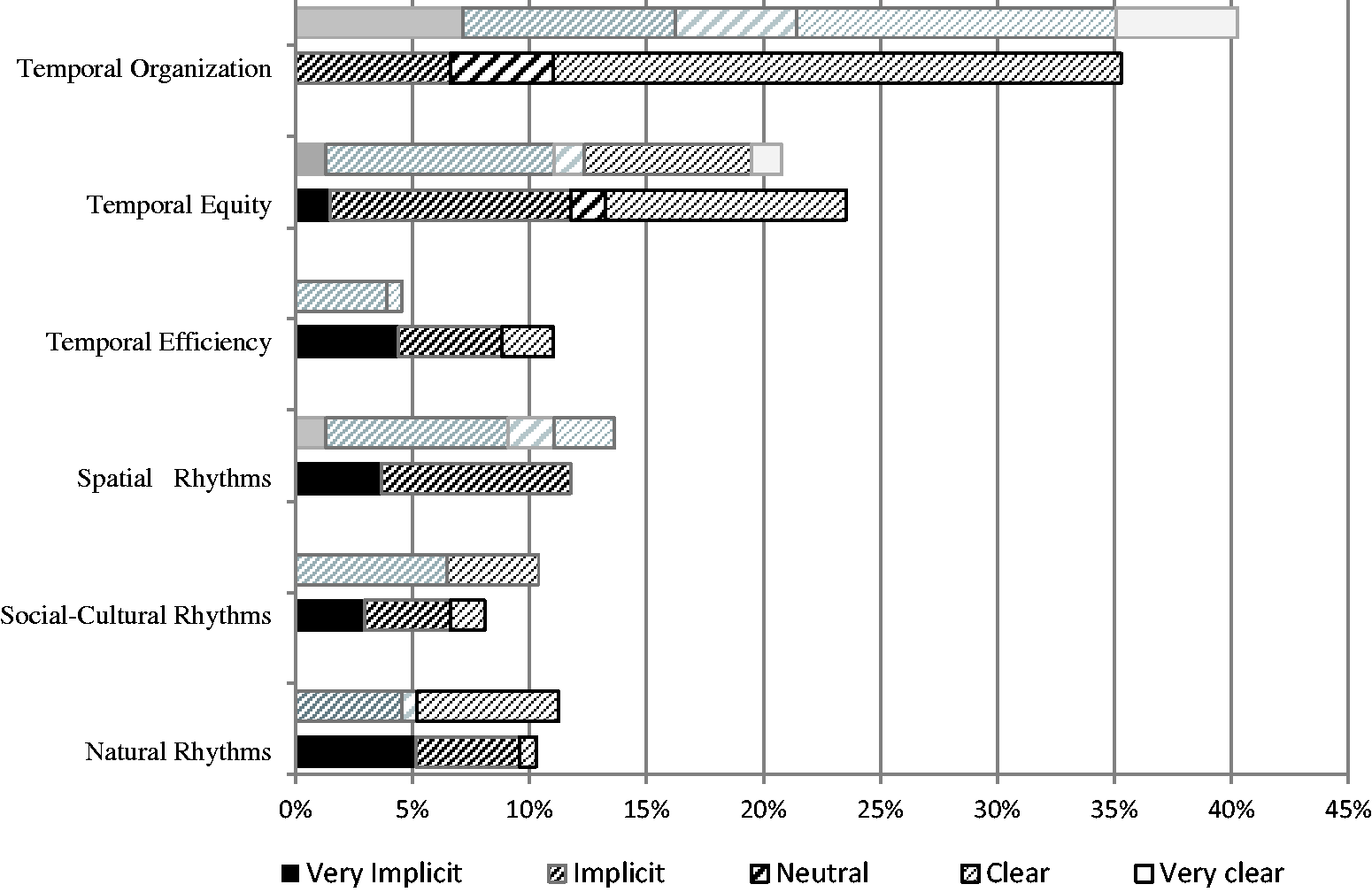
Themes of time embeddedness in the Tehran’s Comprehensive Plan: researchers view (upper bar) and the practitioners view (lower bar).
It is evident that both groups of coders largely agree that the normative themes of time-oriented framework for planning, such as theme related to temporal equity, are considered more than the descriptive themes. Although up to now most of time studies in urban planning area considered this topic from a descriptive point of view, in our analysis this finding makes sense and it is not far from our expectations, as comprehensive plans mostly are expected to be normative tools in the planning system. Some examples of normative themes in the Comprehensive Plan of Tehran are related to the “spatial structure and zoning of the city”: for instance, it is implied that “in each zone a large empty area should be saved as supply-of-renovation due to the equity in distribution of services in the future renovation of that zone”. Additionally, the “vision” of the plan refers to “Tehran as a smart city with good public welfare, along with the adjustment of inequalities and the fair provision of all citizenship rights”. There are also many other examples in other parts of the plan, such as in the policies part.
As it is clear in the examples, time concept has been mostly considered normatively and implicitly in Tehran’s comprehensive plan. The more implicitly represented themes are temporal equity and temporal organisation. However, Alexander stated that these normative criteria are essential in planning evaluation to emphasize the importance of planning decisions and their substantial impacts on quality of life, social justice and sustainability (Alexander and Faludi, 1989; Shahab et al., 2019). “Friedman rejects both a purely normative approach, as well as the mere description of planning ventures” (Faludi, 1973: 320).
Delving into detail (Figure 4) of the three subcategories evaluated in temporal equity, it was shown that the elements directly related to service distribution and accessibility (transportation) received the most attention. In the case of the subcategory of transportation, it was not unexpected because an urban network map is one of the expected outputs in comprehensive plans (Saeed Nia, 1999). Accessibility due to gender, class, age and ability, as other subcategories of temporal equity, has been less considered. Indeed, social division and marginalisation of the poorest social classes is one of the major issues in the Tehran case and the introduction of the urban development plans during the 1960s in Iran only aggravated the situation (Zebardast, 2006; Zonnooz, 2016). While some researchers defined accessibility and distribution of resources, goods and services among individuals as a central concept of temporal equity (Henckel et al., 2013; Shahab et al., 2019). This means that considering accessibility from both dimension of physical and social is essential in temporal approach to planning.
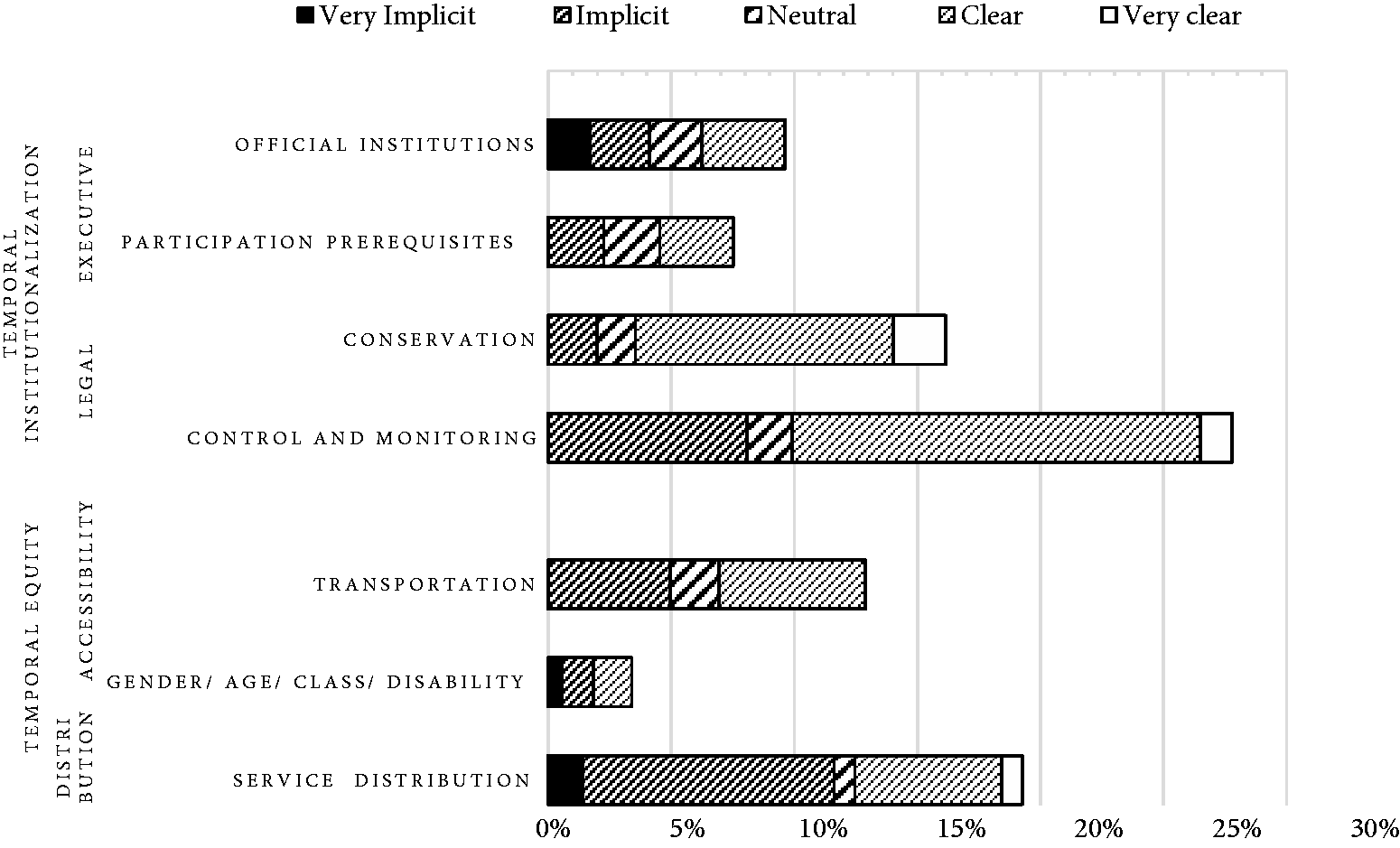
Detailed survey of temporal institutionalization theme in Tehran’s Comprehensive Plan.
Within the detailed evaluation of temporal institutionalization, the considered subcategories are mostly related to manage, control and monitor. These elements chiefly relate to time scheduling, which address performance and institutional aspects of planning analysis and evaluation. Their clear consideration is obvious from the data. However, this topic is mentioned as one of the reasons of the lack of efficiency and realization in current comprehensive planning procedure in Iran (Hoseinzadeh et al., 2010; Zonnooz, 2016). Although revealing that time scheduling was more regarded in the process of shaping this plan, it has not been well achieved in implementation. This is while according to some scholars, success of a time-oriented approach is measured due to its level of institutionalisation (Schaick, 2013).
The frequent considerations of temporal institutionalization in our case clarifies the strength of ‘planning in time' (Schaick, 2011), occurring implicitly in this comprehensive plan. However, the modest consideration of ‘time orders' means that time structures and societal processes in urban planning – ‘planning with time' (Schaick, 2011) – is less considered. However, this is not along with the fact of hiring local consultants, in developing the recent Tehran Comprehensive Plan (Ministry of Housing and Urban Development, 2006), regard to the idea of Italian ‘territorial timetable plans’ which helped clarifying patterns at local level (Mareggi, 2013a; Zambianchi, 2013).
It should be considered that, according to the scale and goals of each plan, different parts of the framework (descriptive and normative) might get more consideration. In general findings show that consideration of time was not systematic and clear in Tehran Comprehensive Plan and however it was mostly implicit, that is usual in urban planning in relation to specific aspects, such as transportation. According to Mückenberger (2011), awareness about urban time aspects could be a first step to consider time as a relevant component of urban planning and management. Moreover, we invite to reflect upon the lack of a proper institutional context related to space-time aspects that has faced challenges related to their implementation: this can lead to the non-efficiency of these plans. Therefore, these concepts can be so important that deserve to be taken consciously and systematically into account.
Nevertheless, findings highlight that some major elements of the proposed framework are not present in the Tehran Plan. As stated before, studying rhythms and social time are important since they reveal how people use urban environments and how we can manage activities and spaces temporally (Lefebvre, 2004; Mareggi, 2013b), this is while our findings in addition to APUR (Atelier Parisian d’urbanisme) report verify that they are underestimated in the Tehran Comprehensive Plan (Mansouri, 2007). For instance the Plan mostly emphasized on empty lands and ignored the social time in discovering potential of current urban spaces for enriching local identity, also it did not consider social time of flows in estimation of road demand, while APUR counts this as a prerequisite in discovering urban challenges (Mansouri, 2007).
Additionally, since comprehensive plans are generally considered as normative policy tools, we expected more consideration of normative part of framework in the Tehran Plan. Although normative part of urban time study framework was more implicitly considered in comparison to descriptive part, most concept of this part are subject of critics in this plan. For instance scholars believe that this plan missed concepts such as temporal justice and the subcategory of distribution due to the class and hence it strengthened the social segregation of north and south in Tehran (Zonnooz, 2016). Normative concepts of the proposed framework should be considered in policies presented in these plans, which will increase the possibility of realizing them in local operational plans. Considering development of territorial time plan with focus on daily patterns in addition to comprehensive plan as a normative policy tool will bring together both descriptive and normative types of planning.
Conclusion
The experience learning process can only lead to knowledge by adopting pertinent evaluations and development of useful examples. This is why we proposed a conceptual framework for temporal studies based on experiences of developed countries and we investigated it in a developing country case. The major contribution of this paper is to propose a protocol for studying rigorously and systematically urban time to give suggestion for integrating these aspects in urban spatial planning.
This paper was primarily based on Hägerstrand (1970), Lynch (1972), Thrift (1977) and, later, Lefebvre (2004) intellectual thoughts; it drew on recent research by Schaick (2011), Henckel et al. (2013) and Mareggi (2013b), each of them trying to uncover the role of normative or descriptive concepts of time in urban context. This paper went forward and offered an integrated framework for temporal evaluation of plans and actually responded to the concern by Henckel et al. (2013). Indeed the offered conceptual framework made possible the systematic use of temporal concepts and increased the validity of policies, answering to the invitation by Faludi (1973) to find “what planning is searching for”.
This framework is significant in two ways. First, in our view, time orders should be investigated as part of urban planning descriptions to reveal patterns of life and behaviour. This contributes to shed lights on the awareness of planners to social structures of time in cities, affected by urban planning. Second, it is important to enrich and broaden the conceptualization of time in planning through normative concepts with the aim to contribute directly to the enrichment of urban life quality. Issues emerge from the applicability of the cross-cultural use of concepts of time planning to the Iranian context, but the coding process has not delivered arguments against the use of time concepts from other cultures to their use in the evaluation of Iranian planning. And all findings taken together have delivered meaningful results.
In conclusion, the system of urban planning in Iran, specifically with regard to comprehensive plans, has mainly implicit overlaps with our framework, and these mostly relate to its normative part. Time is considered because it is impossible to forget it in many implementation and management urban activities. Currently implicit considerations could be seen as possibilities for the enrichment of such plans with a time planning approach if the needed institutional context will be regarded. To improve awareness and institutionalisation of social aspects in comprehensive plans in Iran, concepts and criteria of temporal organisation could be considered more consciously and explicitly in the legal description of work (scope) for these plans. Normatively consideration of time in comprehensive plan was not far from our expectations as these plans are normative tools themselves. However, this study attempted to provide a theoretical framework for temporal studies in different types of plans; more work needs to be undertaken to apply empirically the proposed framework in different plans, also for particularly addressing Tehran’s current deep planning challenges.
Footnotes
Acknowledgements
The authors thank Jeroen Van Schaick for helpful comments on earlier drafts of this paper.
Declaration of conflicting interests
The author(s) declared no potential conflicts of interest with respect to the research, authorship, and/or publication of this article.
Funding
The author(s) received no financial support for the research, authorship, and/or publication of this article.