




Abstract
The difference in the individuals’ preference of activity destination choice is a new explanation for the activity-space segregation. This study investigates individuals’ preference in the destination choice for their daily activities. It uses revealed preference survey for the choice of the activity destination, and mobile phone dataset for the ambient population at the activity destination in Guangzhou, China. It has found that (1) the activity-space segregation is strongly influenced by the residential segregation, but disadvantaged populations are more spatially constrained by the distance decay effect; (2) all individuals prefer a destination with high diversity of built environment; and (3) migrant people tend to be self-segregated at the activity space, but people with higher education status prefer to take activities at an integrated place.
Keywords
Introduction
Social-spatial segregation has been a hot research top for decades. Most literature focuses on the residence space as the spatial context, but scholars have noticed that the daily activities and social communication outside the residence space are ignored (Tammaru et al., 2016). Omitting the out-of-home activities defects the accuracy of the segregation assessment (Kwan, 2013; Park and Kwan, 2018; Wang and Li, 2016). Therefore, the research interest of the spatial segregation has been shifting to the activity space (Ellis et al., 2004).
What mechanism causes the activity-space segregation has been one of the most concerned research questions. However, current literature did not give a full explanation yet (Zhang et al., 2019). In the limited studies, the mechanisms can be summarized into social mechanism, geographical mechanism, and behavioral mechanism. The social mechanism emphasizes the social interaction and isolation from perspectives of social stratification and social organizing. Mechanisms of material difference, direct or indirect discrimination, and similar values and culture of minorities (Silm and Ahas, 2014b; Zhang, 2011) explain the social reasons of the activity-space segregation partly. However, the dynamics aspects of the activity space are not captured. Differently, the geographical mechanism emphasizes geographical constraints of daily activity to explain the dynamics of segregation. Based on time geography theory, individual daily activity trajectory is described by a space-time prism under constraints of capability, coupling, and authority (Hägerstraand, 1970). Thus, activity-space segregation is a result of spatiotemporal constraints (Silm et al., 2018; Wang and Li, 2016). However, the constraint-based approach neglects the importance of individual’s subjective choice. People have high degree of freedom to choose a destination for an activity. The third mechanism, behavioral mechanism, issues this problem sharply. Originally it models how each individual’s subjective preference influences racial segregation in a simulation way. The behavioral rules of the simulation, however, are arbitrarily assumed by researchers and an individual’s preference and choice are not empirically evidenced yet.
In summary, the framework of the dynamics of the activity-space segregation is not completed. Activity-space segregation is not only the aggregation of ecological community described by Chicago school (Park and Burgess, 1925) but also a dynamic process embedded in the dual tension between urban spatiotemporal structure and individual daily life. The process from daily life practice to activity-space segregation has not been studied thoroughly.
An overarching goal of this study is to unravel the behavioral facets of activity-space segregation by scrutinizing the daily life practices to the actual formation of segregated activity spaces. Thus, this study identifies a key research question: how the individual choice and preference affect the activity-space segregation. Particularly, it would discuss
Literature review
Mechanism of activity-space segregation
The explanation of the activity-space segregation can be generally summarized into three mechanisms: social, geographical, and behavioral mechanism.
Firstly, the social mechanism includes the economic disadvantage, systematic discrimination, and similar value and culture of minorities (Silm and Ahas 2014b; Silm et al., 2018; Zhang 2011). Specifically, people in disadvantaged economic status cannot afford housing in well-developed neighborhoods. They have poor accessibility to job opportunity, public transport, and leisure activity space. Also, discrimination and prejudice from the majorities restricts minorities’ entry to public service and resources. It causes an invisible barrier between different groups at the daily activity space. In addition to the external disadvantage and discrimination mechanisms, minorities themselves also tend to be self-isolated because of similar traditions and culture. This ethnicity effect (Silm and Ahas, 2014b) increases the segregation at the activity space.
Secondly, the geographical mechanism refers to the influence from the mobility and the activity spatial context. Researchers have different opinions that the influence from the mobility should be positive or negative on the activity-space segregation. The mainstream view is that the mobility helps reduce the activity-space segregation. When individuals from different residential neighborhood encounter at the same activity space, the socio-economic level of them would be averaged. This phenomenon is described as the neighborhood effect averaging problem (NEAP) (Kwan, 2018). People have more opportunities of contacting with different population at the activity space where the socio-economic attributes of the population is more heterogeneous (Wang and Li, 2016). Also, people with the same interest rather than the social characteristics improve the social integration at the activity space (Silm et al., 2018). However, some researchers argue that people’s activity space is constrained by the accessibility to public services and transit, which increases the spatial segregation. Minorities with poor mobility may also be self-isolated because of the same identities and values, and they tend to participant in activity with higher social tie and cultural homogeneity (Zhang et al., 2017, 2019).
Thirdly, agent simulation also provides an approach to explain the activity-space segregation. In a simulation way, Thomas Schelling points out that a collection of individual preferences will cause racial segregation in the whole society. Even if everyone accepts racially mixed residence, it will still form absolute spatial segregation on the macro level. The reason is that everyone has the same preference of unwilling to become a minority (Schelling, 1971). It is further described as the difference between micro motivation and macro behavior, that is, each individual’s choice might be diverse, but the similar preference of not being minority cause the spatial segregation in macro level (Zhang, 2011). In empirical researches, scholars integrated the Schelling model and the discrete choice model to explain how segregation arises from individual’s preference for the residential choice (Bayer et al., 2004, 2005; Crooks, 2010; Zhang, 2011). The Schelling model explains the micro mechanism of residential segregation. Similarly, the choice mechanism can also be applied to the activity-space segregation. It not only provides a feasible research method but also gives the theoretical basis for the explanation.
The existing literature gives theoretical explanations of the activity-space segregation from different perspectives. These mechanisms can be summarized into two dimensions: constraints and preferences. There is a huge potential between these two polar to interpret the mechanism of activity-space segregation. Most social mechanisms are constraint mechanism. The economic disadvantage and systematic discrimination are constraints particularly on disadvantageous populations, which block their opportunities to interact with high earning people. Geographical mechanism, or mobility, is also viewed as a constraint mechanism currently. Disadvantage populations are constrained by less free time, poor accessibility to public transit, and remote residential locations. Current literature emphasizes the constraints explanation for the activity-space segregation. However, the choice of daily activities still has a high degree of flexibility. Constraint can be seen as the relative differences of degrees of freedom, and whether it has a positive or negative effect on the activity-space segregation is still controversial. The preference mechanism provides a promising approach to explain the dynamic and flexible aspects of the activity-space segregation. The social mechanism involves part of the preference mechanism. For example, the minority groups’ tendency of gathering by similar culture and value derives from their preference that they are initiative to contact with similar people. The behavioral mechanism exactly emphasizes the preference. The theory of Schelling model reveals people’s same preference of living with similar residence, whose behavior leads to a total residential segregation.
The discrete choice theory shed light on this topic. It emphasizes individual preference and the free choice under subjective willingness. Following the discrete choice theory, we will discuss studies of the destination choice in the next section.
Destination choice of daily activity
The free choice of individual’s daily activities is the micro motivation of the activity-space segregation. Particularly, the social interaction behavior is a crucial factor of the social segregation and isolation (van Den Berg et al., 2014). Individual’s choice of activity space is used to reveal the formation process of activity-space segregation. Discrete choice theory holds that daily activity and travel behavior are the results of choices made by decision-makers from a series of alternatives. When making a choice, the decision-maker selects the alternative with the highest utility (Ben-Akiva and Lerman, 1985). From this perspective, studies of activity destination choices focus on the influencing factors, the psychological process of decision-making, and the personal preference. The aggregation of individuals’ activity destination choices forms the activity-space segregation in the macro level (Bayer et al., 2004, 2005).
According to the discrete choice theory, multinominal logit (MNL) model and its derivatives are widely usually used in the studies of the activity destination choice. Researchers have found that some non-social factors are associated with the choice of activity destinations. For example, shopping destinations with higher accessibility and service diversity are more attractive (Huang, 2014; Huang and Levinson, 2012; Recker and Kostyniuk, 1978). For the choice of leisure destination, travel distance, service, retail facilities, open space, land mixture, functional agglomeration, and income have a significant influence (Pozsgay and Bhat, 2001; Simma et al., 2001). Kemperman et al. (2002) used stated-preference survey on the destination choice of theme parks, and found the importance of diversity and seasonality. In general, these influencing factors can be summarized as price, transport convenience and accessibility, facilities and services of the destination, built environment, and personal preference. These non-social factors potentially affect the activity-space segregation, although it is not explicitly noted in these studies. According to the social mechanism of the residential segregation, disadvantaged groups have poor residential locations, accessibility to public transit and living environment, and they cannot afford the cost in high consumption places.
Social interaction is also an important factor of the activity destination choice. The social interaction behavior refers to the activities carried out by two or more people for entertainment or support in face-to-face or virtual ways (Carrasco and Miller, 2006). According to the homogeneity theory, it is easier for similar people to establish social ties (Silm and Ahas, 2014a). In the empirical study, van Den Berg et al. (2014) found that the choice of the type of social interaction activity destination is not only related to personal attributes and built living environment but also has population-specific preference. They also found that local social frequency is influenced by personal attributes, mobility, community size, and public facilities (Van Den Berg and Timmermans, 2015). It is exactly the social interaction and people’s preference to the social environment that leads to the direct activity-space segregation. However, in the existing literature, the preference-based activity choice studies did not take the activity-space segregation as the research subject. The relation of the utility of choice and the activity-space segregation is not logically connected. The reason is that activity-space segregation is not people’s direct demand in daily life. In other words, the degree of segregation is not a direct motivation of choosing the destinations of daily activities such as shopping, leisure, and fitness.
Nevertheless, existing literature still provides a huge potential to give a behavioral explanation to the activity-space segregation. Our brief review presents the underlying logical connection of the destination choice and the activity-space segregation. Theoretically, within a certain space-time range, people choose an activity destination according to their preferences and personalities. The different preference from different socio-economic groups is a fundamental reason for the spatial segregation. It has been soundly proved in the Schelling model (Schelling, 1971), although the individual preference emphasized by Schelling model mainly focuses on the residential places but not applied to the dynamic activity space. Therefore, applying a choice-based approach to the activity-space segregation is a promising way to examine the influence from people’s preference. The aim of this study is to reveal the behavioral mechanism of activity-space segregation and contribute to the segregation theory.
Study area and data
Study area
The inner city of Guangzhou is selected as the study area. Guangzhou is the capital city of Guangdong Province, China Figure 1. It is the first batch of cities in China to reform and opening-up. It has been experiencing a transformation stage. In the rapid development process, it has formed a social stratum structure and obvious social segregation (Li and Wu, 2010). In addition, as the central city of South China and the Pearl River Delta, Guangzhou is attracting a large number of migrants, making the social structure even more complex. Therefore, selecting Guangzhou as the study area is representative. Study area and sampled neighborhoods.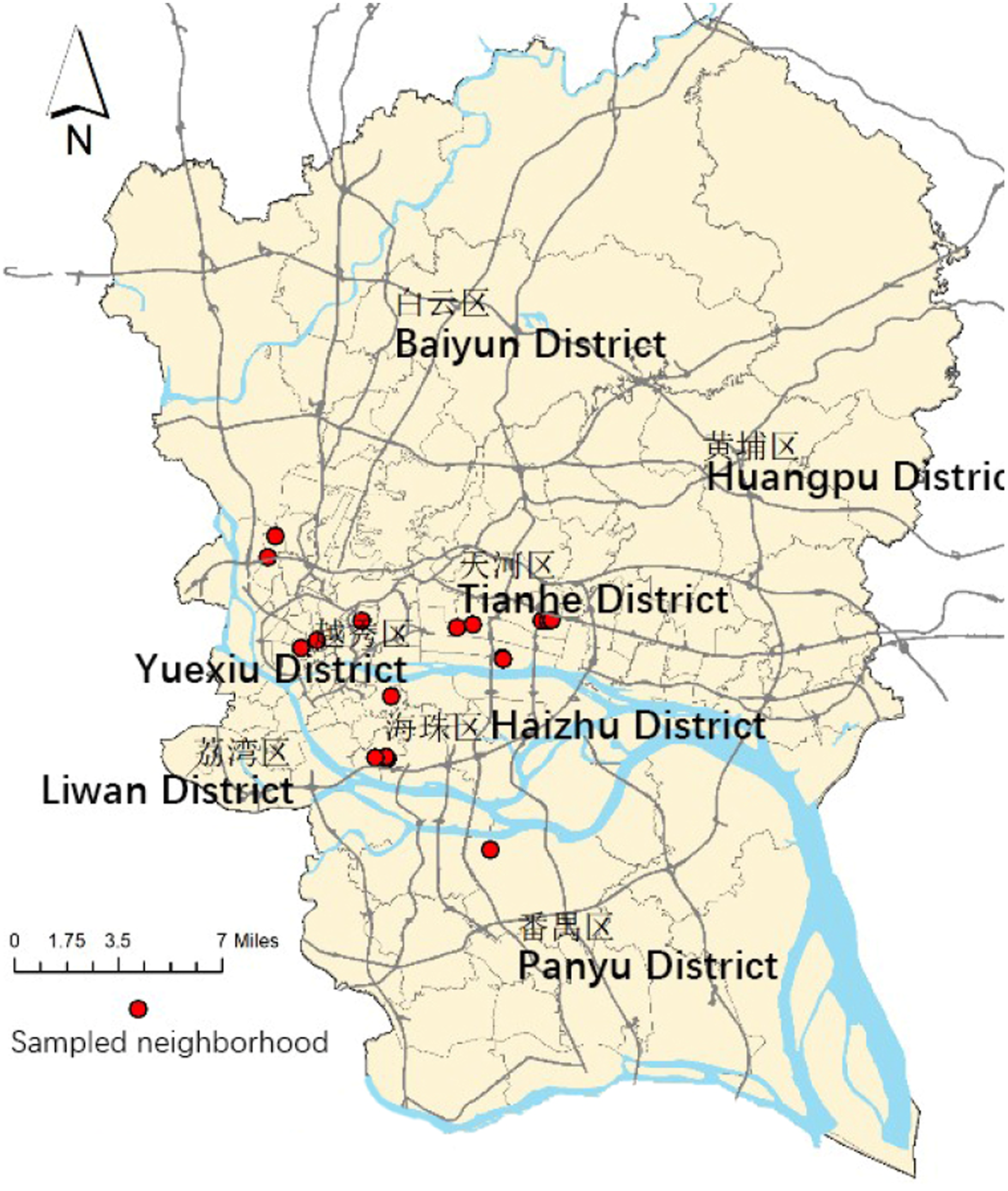
Revealed preference survey
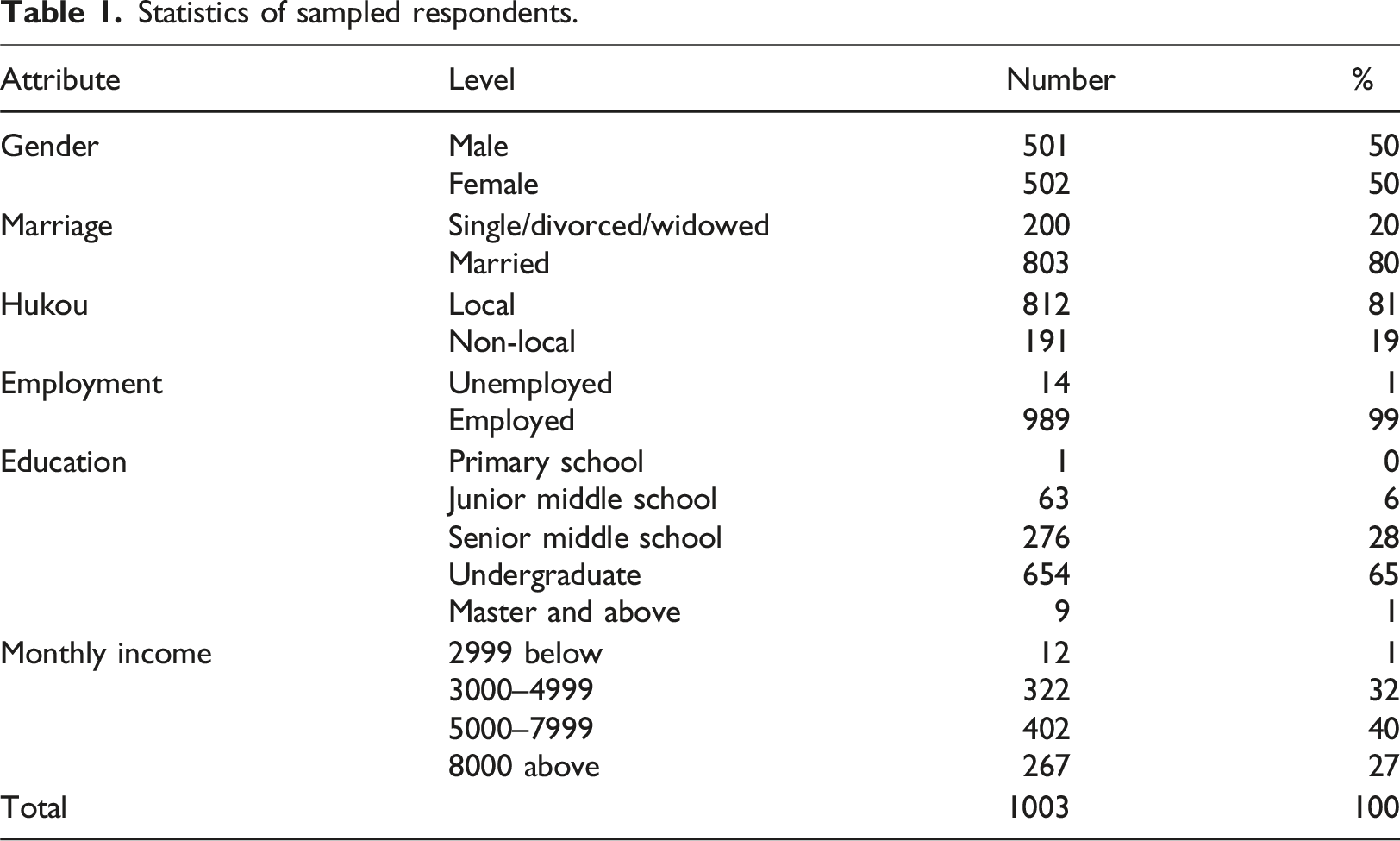
This study applies a revealed preference survey. The revealed preference survey is advantageous in reflecting the real behavior of an individual when choosing an activity destination. A revealed preference survey is equivalent to travel diary survey in this study. The travel diary dataset was collected in 11 residential communities from June 24 to July 20, 2017.
Statistics of sampled respondents.
Built environment data
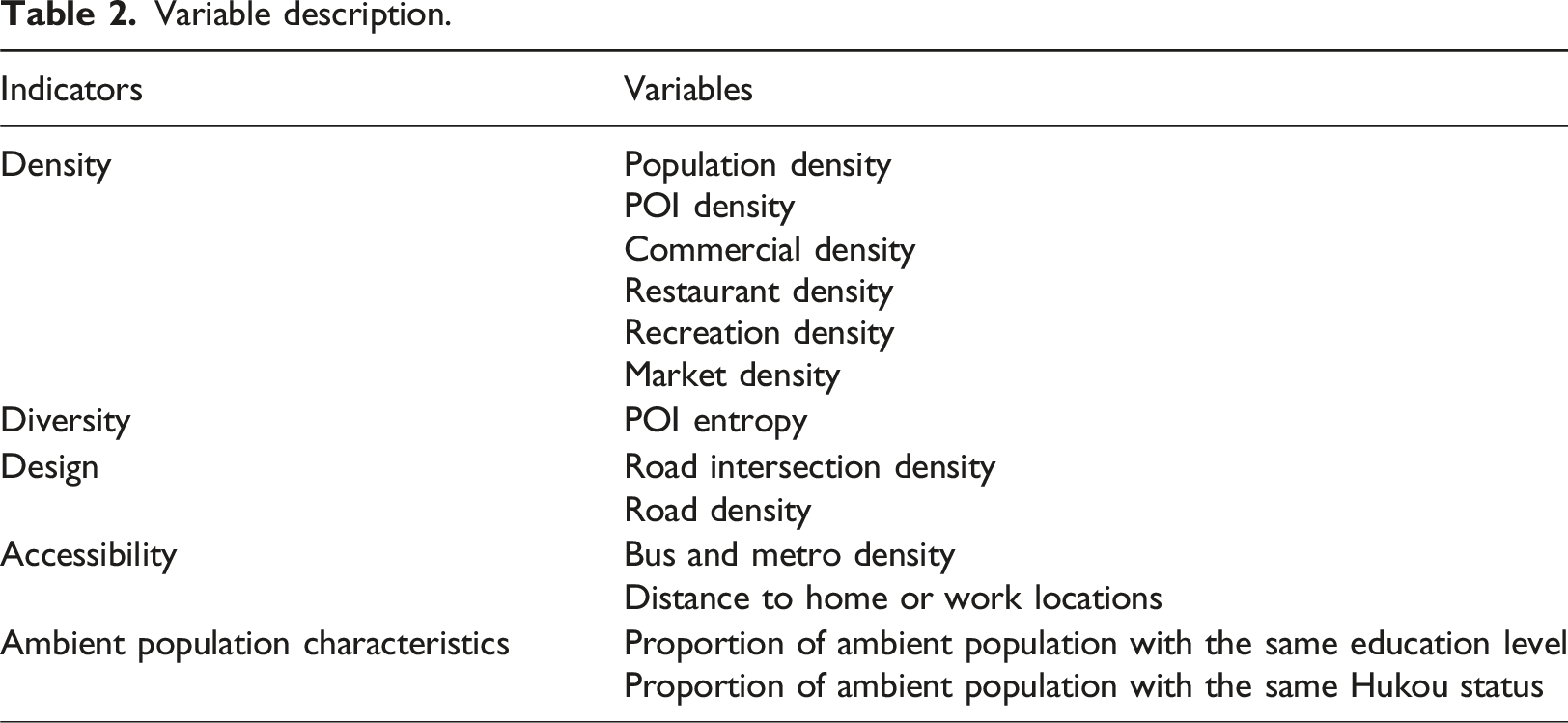
The built environment data, including the points of interest (POIs), road network, bus, and metro data, are provided by Daodaotong Company in 2016. The company provides map and navigation service. Built environment data are used as independent variables that influence individuals’ destination choice. Built environment is generally measured from “D” indicators such as density, diversity, design, and destination accessibility (Ewing and Cervero, 2010).
Density reflects the attractiveness of a destination. The higher the density of destination implies more activities, and it will increase the possibility of people to visit. Population density and employment population density are common indicators, and the POI density is increasingly used as well. This study also uses the population density and POI density as indicators.
Diversity reflects whether the destination can meet the people’s diverse demand of daily activities. For the specific indicators of diversity, researchers generally use land-use mixture or entropy index of POIs (Zheng et al., 2021). This study applies the entropy index of POIs, which is expressed as follows. 
Design is measured by the form of the road network—the road density and the interaction density.
The choice of a destination is also influenced by destination accessibility. It reflects whether a destination is convenient for people to visit. This study uses the public transport accessibility as one of indicators, the density of bus stops and metro. The destination’s distance to the anchor points (home or workplace) is also an indicator of accessibility since the distance determines the easiness to reach.
Ambient population data
Ambient population data are collected by mobile phone signaling data. The dataset is in individual form. It is also used as independent variables that affect the destination choice. The ambient population is the social environment to which an individual exposes at the activity space. A mobile operator company provided the dataset. The dataset tracked the locations of phone users on a workday (December 28, 2016) without extreme weather and special events. The dataset includes user’s time and location information, but does not include users’ socio-demographic attributes. Particularly, the time was recorded by each 1-h period. A user’s location was coded by the base station within which the use was. The radius of a base station’s coverage range is normally between 200 and 1000 m, dependent on the density of base stations. Since the dataset does not include user’s socio-demographic attributes, we integrate census data into the mobile phone data to assign user’s socio-demographic attributes. In brief, people’s education and Hukou information are identified from the sixth national census in 2010, and then assigned to mobile phone users proportionally according to their residential locations. A detailed introduction of the data fusion method can be found in Zheng et al. (2023).
Variable description.
Method
Measurement of the activity-space segregation
This study uses education and Hukou to measure the activity-space segregation. As the racial and ethnic segregation is slowly declining in western countries due to the antidiscrimination movements, segregation by socio-economics is increasing (Browning et al., 2017), such as the segregation by income, education, housing condition, and migrant (le Roux et al., 2017; Zhang et al., 2019; Wang et al., 2012; Wang and Li, 2016). In the process of reforms and rapid development in China, two types of segregation become increasingly prominent. One is segregation by economic status. Income, education, and the housing type are measurement of economic status. Particularly, education largely affects people’s opportunity of accessing jobs (le Roux et al., 2017). Empirical studies have confirmed that the education largely determines an individual’s occupation and income in China (Zhang et al., 2022). This study uses the education as an index of the economic segregation, considering the difficulty of collecting the income information of the dynamic ambient population. We classify the education level into three classes: low (junior middle school and below), middle (senior middle school), and high (undergraduate and above).
Another type of segregation is the social segregation between local and migrant people. The integration of migrant people into local society is a crucial problem in Chinese cities. Locals and non-locals are differentiated by Hukou, a particular Chinese household registration system. It records a person’s permanent residential places. There has been rich literature on the segregation between local and non-local people (Järv et al., 2015; Silm and Ahas, 2014a; Tammaru et al., 2016; Zhang et al., 2017; 2019). Low educated and non-local people are indicated as disadvantaged population in this study.
This study uses the exposure index to measure the activity-space segregation (Schnell and Yoav, 2001; Schnell et al., 2015). The index indicates the degree of homogeneity between an individual and the ambient population at the activity space. A higher value implies a stronger segregation.
The individual’s segregation is measured in two spatial contexts: activity space context and the whole day context. The activity space context is where people take out-of-home nonemployment activities, and the whole day context includes space of all activities—home, work, and activity space. The whole day segregation is calculated by the summation of 
The segregation at the activity-space context, similarly, is a weighted cumulation of the exposure index at each single activity space, since a person may have several activities at different locations. Space j only belongs to the space set of activity space 
Creating the choice set
The choice set is created to generate a series of destinations from which an individual chooses for an activity. A destination is defined by a spatial grid. This study uses 500 m*500 m spatial grid as the basic spatial unit. All grids within the range of the potential activity space are alternatives. An individual is assumed to choose one of spatial grid as the activity destination. The choice set includes several destinations that an individual did not choose and a destination that an individual actually chose. It is necessary to firstly identify the potential activity space since the out-of-home non-work activity is constraint in a certain spatiotemporal range.
Daily activities can be classified into three types: home activity, work activity, and out-of-home nonemployment activity (Silm and Ahas, 2014b). The activity space in this study is the place at which people conduct out-of-home nonemployment activities. The size and shape of the activity space is greatly affected by the locations of residence and work, which can be seen as the anchor points of the daily activity space.
The potential activity space is the spatial opportunity that an activity occurs around one or between two anchor points. The size of the potential activity space is restricted by the time budget and movement capability between fixed anchor points. Therefore, the potential activity space is determined by the locations of anchor point(s), the travel time, and the travel mode. This study applies a standard ellipse method (Kim and Kwan, 2003) to identify the potential activity space. The definition of potential activity space can be found in Supplemental Material (Figure S1).
The choice set of the activity destinations is created according to potential activity space. A spatial grid within the range of his/her potential activity space is an alternative of the choice, and all of them consist the choice set (Figure S2).
The discrete choice model
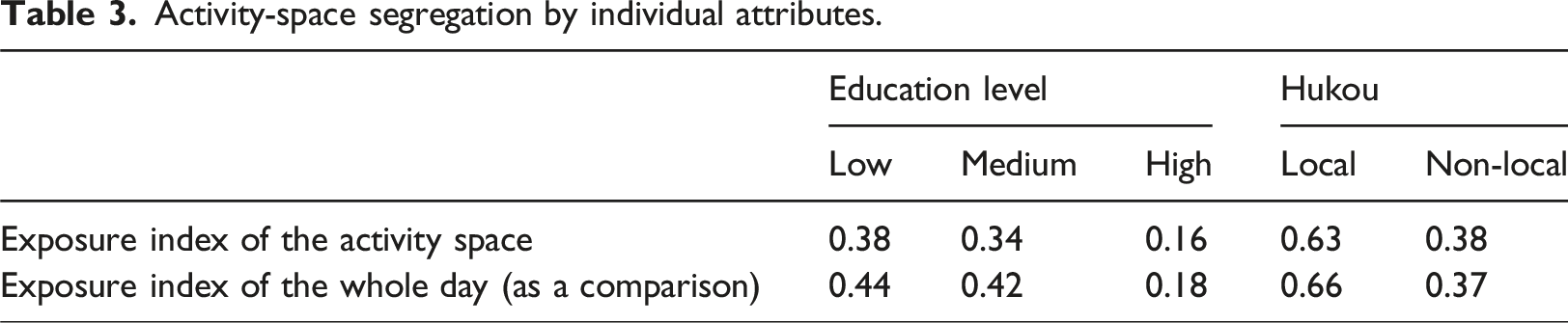
Activity-space segregation by individual attributes.
According to the hypothesis of utility maximization, individuals choose the alternative with the highest utility from a set of alternatives. Suppose an individual n chooses a destination from a set of alternative spatial grids y = 1, 2, 3, …, J, the utility of alternative i is:

The choice probability of all destinations is 1 that
Results
Activity-space segregation
The activity-space segregation is slightly smaller than the whole day’s segregation Table 3. The activity space can reduce the segregation to some extent. An exception is that non-local people’s segregation at the activity space is larger than the whole day segregation. For the group difference, local and non-local people have greater segregation than that by the education level. The segregation of local people is significantly larger than non-locals. Local people tend to be self-segregated, and non-locals are better integrated into the local society. For the education level, high education people are well integrated with the whole population, and less-educated people experience higher segregation.
Destination choice preference by education level
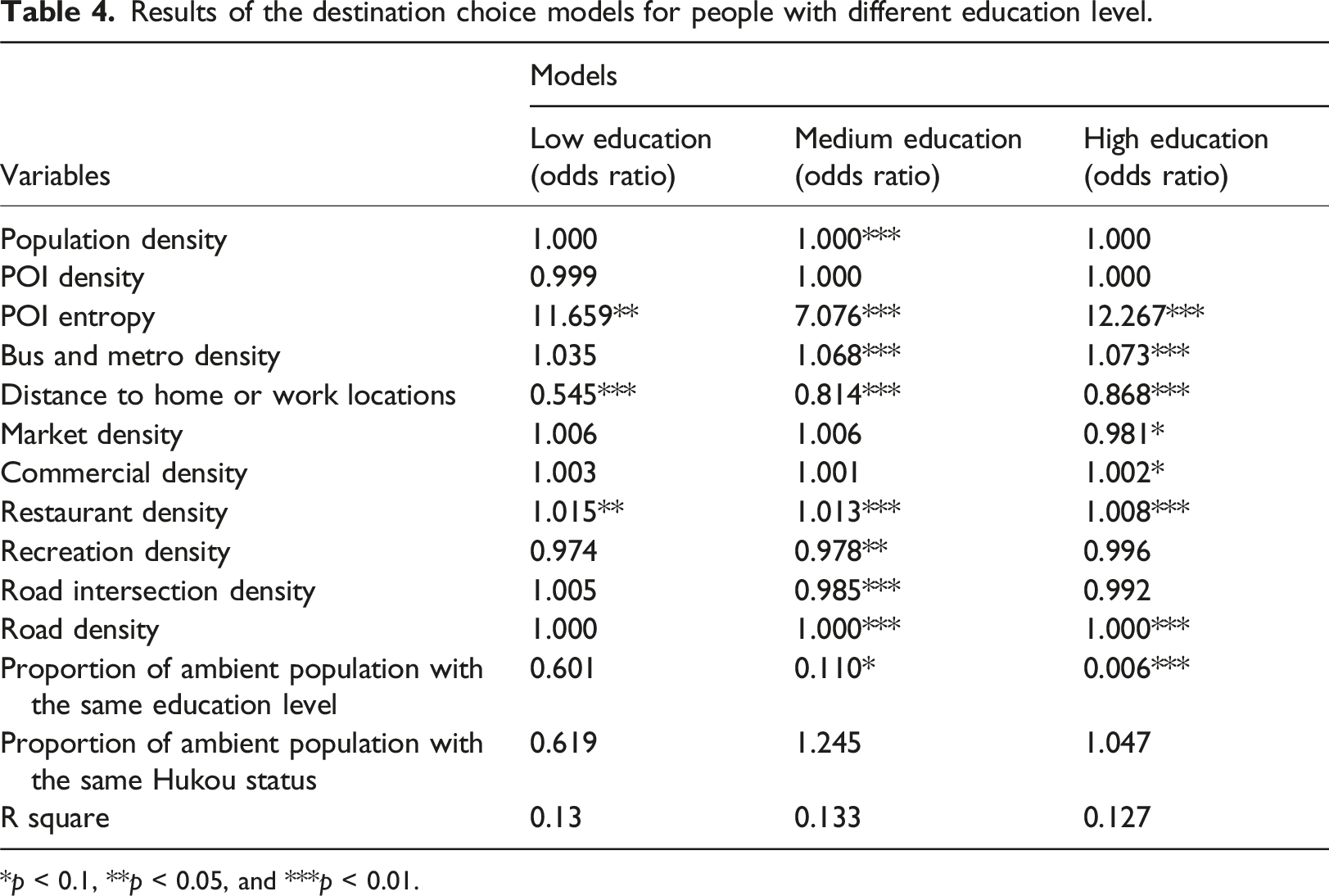
Results of the destination choice models for people with different education level.
*p < 0.1, **p < 0.05, and ***p < 0.01.
In terms of the preference on the built environment, POI mixture has a significant positive relationship with the choice of activity destinations in the three models, with odd ratios of 11.659, 7.076, and 12.267, respectively. That is, a destination with higher POI diversity will greatly attract people to visit. Note that POI diversity has higher attraction to the high- and low-education groups than the moderate group, but it is no doubt all of three groups prefer it greatly. It conforms to the theory that a destination with mixed land-use or urban functions meet with people’s diverse activity demand (Cervero and Kockelman, 1997). The distance between the destination and the home/work location has a significantly negative impact. The odd ratios for the three models are 0.55, 0.81, and 0.87, respectively, indicating that the distance has a greater impact on people with lower education level, but less on moderate and high educated people. People with lower education are more sensitive to the distance decay effect since they have poorer mobility. The finding is consistent with previous evidence that disadvantaged populations (lower educated and non-local people) are confronted with higher spatial constraint (Wang and Li, 2016; Zhang et al., 2019). The impact from facility density and design is also different. For example, the density of commercial facilities shows a significant positive correlation for people with higher education, but the correlation is not significant for lower and medium educated people. The road intersection also shows a significant positive correlation for medium educated people (p-value <0.01), but it does not affect the destination choice of the other two types (p-value >0.1).
In terms of the preference on the social environment, there is a significant difference in the proportion of ambient population with the same education level, with odd ratio of 0.601, 0.110, and 0.006, respectively. One may doubt whether the social environment influence is from constraint, for example, people only have access to facilities surrounded by similar people, or from subjective preference. To be precise, we conducted a statistical description of the built and social environment of destination choice sets (see Table S1 in Supplemental Material). It supports to answer whether people’s choice is from constraint or preference.
For people with low education level, they do not have significant preference on the social attributes of ambient population (p-value >0.1). Precisely, 0.43 proportion of their surrounding people are also of low education. It implies that low education people are more constrained within a segregated space. Thus, the social-spatial constraint results in an insignificant effect (Table S1). Differently, in the medium and high education models, the proportion of ambient population with the same education has a significant correlation, with the odds ratio of 0.110 and 0.006, respectively. That is, when the proportion of ambient population with the same education level of the individual decreases, the probability of choosing the spatial unit as the destination will increase significantly. People with medium education level prefer to visit a socially integrated destination for activities. Considering 0.37 proportion of their surrounding people are from the same education level, they are neither too segregated nor too integrated. Thus, they have an obvious integration preference. For people with high education level, who have only 0.12 proportion of the same ambient population, their choices of visiting activity space with more different people might be from both constraint and preference.
Destination choice preference by Hukou
Results of the destination choice models for people with different Hukou status.

*p < 0.1, **p < 0.05, and ***p < 0.01.
We find that POI mixture has a significant positive impact in both models, but the impact is particularly strong for non-local people. The odds ratio is 39.198, which means that the diversity of activity destinations is particularly important for non-local people. Comparatively, the odds ratio for local people is 6.448. There are also differences in the influence of the distance, 0.843 for locals and 0.798 for non-locals, and activity space of non-local people are more constrained by the residential or work location.
There are also significant differences in their preferences for the social environment, with odds ratio of 0.605 (p-value >0.1) and 11.304 (p-value <0.01) for local and non-locals, respectively. The proportion of ambient population with the same Hukou status has a great impact for non-local people. Note that non-local people’s ambient population with the same Hukou status is 0.39 (Table S1), a relative low value, which means less than half of their surrounding people are also non-local. Surprisingly, however, the odds ratio of the ambient population factor is as high as 11.304. The non-local people will choose a destination with more non-locals to carry out their activities. It exhibits an obvious tendency of self-isolation. This also explains the results in the previous section that the degree of the activity-space segregation is higher than their residential segregation for non-local people. Through the daytime movement, the non-local people will go to a destination with a more familiar social environment for activities, which strengthens their segregation throughout the day. Comparatively, local people do not have significant preference on social environment of local or non-local people (p-value >0.1).
Conclusions and discussions
The activity-space segregation is a new topic in urban studies. Previous researches discussed the degree and spatial distribution of the activity-space segregation by integrating the traditional residential segregation and individual space-time behavior analysis. In addition to current explanations, we believe there is a new logic underlying the activity-space segregation phenomenon—the individual’s destination choice. The degree of the segregation is determined by the composition of populations’ socio-demographic attributes at an activity space. According to the discrete choice theory, an individual’s behavior of visiting a place is a result of the activity destination choice. Different from the constraint theory, the discrete choice theory emphasizes individual’s subjective preference. It assumes that an individual makes a choice from a set of alternative destinations when the actual choice has the highest utility. Individuals’ preference of the destination choice is critically important for understanding the mechanism of the activity-space segregation.
This study applies the discrete choice theory to uncover the mechanism of the activity-space segregation. It uses a revealed preference survey for individuals’ activity destination choices and a mobile phone dataset for identifying ambient population of the activity space. We have following findings. First, in general, people prefer a destination with high POI mixture, high density of spatial facilities, close to residential locations, and convenient transit. Second, different people have different preference for the built environment. Low-educated and non-local people are more affected by the distance to the destination. They prefer a destination closer to their home or work locations. Non-local people are also significantly affected by the POI mixture. The group differences in the preferences of these activity destinations are an important reason for the activity-space segregation. In addition, we find that the difference between local and non-local people is most obvious among these characteristics of population groups. The huge difference of the choice preference explains the activity-space segregation between locals and non-locals. Third, preference for the ambient population further strengthens or weakens the activity-space segregation. People with medium and high education level prefer a destination with mixed social environment, and their daily segregation is weakened by the daily activity. In contrast, non-local people prefer a destination with more non-local ambient population. Their active isolation tendency strengthens their daily segregation.
This study explains the activity-space segregation from the perspective of the individual destination choice. The innovation is that it provides a direct explanation and emphasizes the behavioral mechanism. The behavioral mechanism is reflected from the process of environmental factor—destination choice—individual level activity-space segregation.
First, people’s preference of built environment diversity leads to social diversity. One behavioral motivation of visiting a destination is people’s interest of the activity. When people have same interest in a particularly type of activity, the activity space would be a socially integrated place. A destination with diverse functions is attractive for all groups of population. It meets with people’s various demand for activities. Literature has already confirmed that a destination with diverse service or mixed land-uses would attract visitors (Huang, 2014; Huang and Levinson, 2012; Pozsgay and Bhat, 2001; Recker and Kostyniuk, 1978; Simma et al., 2001). We further find that this functional diversity would cause social integration. This finding provides a suggestion for policy makers that diverse spatial function or mixed land-use helps improving the spatial integration and an inclusive society.
Second, people’s destination choice behavior is also influenced by their diverse preferences for social environment. Migrant people tend to be self-isolated at the activity space. One reason is that they prefer to visit a destination with a familiar social environment. Their behavior exhibits an obvious self-isolated tendency at the activity space. It can be further explained by the ethnicity effect that minorities seek for a social environment with similar traditions, culture, and identity (Silm and Ahas, 2014b; Zhang et al., 2017, 2019). This identify seeking behavior increases the activity-space segregation. This behavioral mechanism is consistent with Schelling model that residential segregation arises from individual’s preference for the social environment choice (Bayer et al., 2004, 2005; Crooks, 2010; Zhang, 2011). However, researchers recently argued that the social interaction is based on interest but not social characteristics, and the activity space would be socially integrated (Silm et al., 2018). We need further evidence to respond to these different opinions.
In addition, the behavioral mechanism is not parallel to the geographical and social mechanism. Rather, it incorporates basic ideas of the other two. It relates to the geographical mechanism that an individual makes a choice from a limited set of alternatives. The space-time constraint from the geographical mechanism has been widely accepted as an explanation of the activity-space segregation (Kwan, 2009; Wang and Li, 2016; Zhang et al., 2019). This study has similar findings. Disadvantaged populations are more spatially constrained by the destination accessibility. The disadvantaged populations, including less educated and non-local people, are more strongly influenced by the negative utility of the travel distance. Their activity-space segregation is largely determined by the residential/workplace segregation, and it is difficult to improve it when the activity space is not accessible to them. The behavioral mechanism is also associated with the social mechanism in a way that minorities tend to interact with people with similar culture. However, collected data in this study cannot provide sufficient evidence on issues of cultural identity. It urges us to apply further interview survey to incorporate the social mechanism into the complete framework.
This study discussed people’s choice preference by socio-economic groups separately, and a better approach should include personal attribute into the model and examine the preference of the destination choice in a general but not a pre-assumed model. We believe that incorporating the preference mechanism in to the spatial segregation research is a promising approach, and there will be deeper understanding to the spatial segregation in a complex urban system.
This study uses a data fusion method which integrates mobile phone data and travel diary. There is temporal mismatch of the two datasets. The ambient population identified by mobile phone that respondents interact with is not the exact one in reality. It is difficult for us to collect both datasets from the same day. We have to assume that the ambient population at the activity space is stable within a certain period of time. We believe that the mismatch within half a year is still sufficient to support our research aim, but we admit it may produce a biased result to some extent.
Supplemental Material
Supplemental Material - A behavioral explanation of the activity-space segregation: Individuals’ preference of choosing an activity destination
Supplemental Material for A behavioral explanation of the activity-space segregation: Individuals’ preference of choosing an activity destination by Fei Chen, Suhong Zhou, Junwen Lu, and Zhong Zheng in Environment and Planning B: Urban Analytics and City Science.
Footnotes
Declaration of conflicting interests
The author(s) declared no potential conflicts of interest with respect to the research, authorship, and/or publication of this article.
Funding
The author(s) disclosed receipt of the following financial support for the research, authorship, and/or publication of this article: This project is funded by National Natural Science Foundation of China (42101223 and 42271234), Guangdong University Innovation Team Project (2021WCXTD014).

Supplemental Material
Supplemental material for this article is available online.
References
Supplementary Material
Please find the following supplemental material available below.
For Open Access articles published under a Creative Commons License, all supplemental material carries the same license as the article it is associated with.
For non-Open Access articles published, all supplemental material carries a non-exclusive license, and permission requests for re-use of supplemental material or any part of supplemental material shall be sent directly to the copyright owner as specified in the copyright notice associated with the article.
