



Abstract
Each year, freeze–thaw cycles expose seasonally frozen soils, which deteriorates their mechanical properties. Machine learning technology is utilized to develop an anticipation pattern for soil static strength (
Introduction
Deeply frozen soil, known as seasonally frozen soil, undergoes a winter freeze and a complete summer thaw (Esmaeili-Falak et al., 2017; Esmaeili-Falak et al., 2018). This freezing and melting cycle typically occurs within a few meters from the ground surface. Areas characterized by the presence of seasonally frozen soil are commonly known as seasonally frozen regions. Due to the presence of seasonally frozen soil, soils in these zones go through multiple cycles of freezing and thawing every year. This process is particularly pronounced for soils located just under the surface. After undergoing freeze-melting cycles, the attributes of the soil in seasonally frozen areas undergo significant changes. This phenomenon is a key contributor to engineering challenges in these areas and has been widely acknowledged by scholars (Afkhami Hoor & Mahzad, 2024; Shen et al., 2022; Yu et al., 2022). Given the impact of freeze-melting cycles on soil attributes in seasonally frozen areas, it is pivotal to analyze the mechanical characteristics of the soil (Kotov & Stanilovskaya, 2022; Vahdani et al., 2020; Wei et al., 2009).
As of now, laboratory testing is the prevailing approach for investigating the freeze-melting traits of seasonally frozen soils. This method is widely utilized in research studies aimed at understanding the behavior of these soils in response to freeze-melting cycles. In recent decades, researchers have extensively explored the mechanical attributes of soils that have undergone freeze-melting cycles. Through their research, they have identified the patterns of change in different soil mechanical attributes under several terms (Katariya et al., 2025). The findings indicate that freezing and melting significantly alter soil attributes, including mechanical properties (Li et al., 2004), stickiness (Adeli Ghareh Viran & Binal, 2018), and attrition angle (Aydin et al., 2020). These changes in soil attributes are influenced by various agents, such as freezing temperature (Xu et al., 2020), straining velocity (Xu et al., 2017), and the count of freeze-melting cycles (Han et al., 2018; Hou et al., 2020; Liu et al., 2016). Nevertheless, conducting these tests can be expensive and time-consuming, particularly when a huge tally of freeze-melting cycles are involved. To minimize the need for extensive experiments, researchers have proposed numerical formulas for forecasting soil attributes based on finite experimental results. To develop an accurate forecasted model, it is important to consider multiple agents at the same time (Ebrahim & Mahzad, 2024; Fan et al., 2020; Hao et al., 2022; Sarkhani Benemaran, 2023; Zou et al., 2022). Currently, the majority of these forecasted models are developed by straightly using empirical data. But it's very hard, maybe even impossible, to fully consider all of these influencing agents in this manner. Moreover, issues including complex derivation procedures and improper execution further restrict the usage and advancement of this tactic.
In the past few years, ML tactics
A comprehensive study evaluated ML and DL models for estimating the characteristics of fiber-reinforced concrete at elevated temperatures, emphasizing their superiority over conventional methods in modeling intricate nonlinear connections. It underscored the necessity for comprehensive data collections, refined feature selection, and hybrid models to augment prediction precision and interpretability (Alkayem et al., 2024).
In the following, Section 2 delineates the methods employed in this exploration, encompassing data collection, preprocessing, and the machine learning models utilized for estimating soil mechanical attributes. Section 3 delineates the experimental configuration and assessment criteria utilized to evaluate the scheme's productivity. Section 4 defines the findings and discourse, which finally underscore the precision and dependability of the machine learning tactics. Section 5 closes the investigation, encapsulates the principal findings, and proposes prospective avenues for future research.
Contribution of This Study
According to the previous statements, it was concluded that utilizing machine learning techniques is advisable to conserve financial resources and time. Thus, two machine learning-based methods for assessing the static strength (
Methodology
Data Collection
A comprehensive review of the literature was conducted to collect the necessary databases for estimating the model. The input elements were identified, and the algorithms’ output was established based on the factors that had an impact.
The collection process involved two distinct phases, namely training and evaluation. In the evaluation stage, 30% (equivalent to 30 instances) of the database was utilized, while the remaining 70% (equivalent to 90 instances) were allocated to the training stage. To guarantee the incorporation of diverse observations in the training and testing stages, the database was divided into two separate sets following the criteria of normal dispersion. Table 1 provides a statistical representation of the dependent and independent metrics in the training and testing databases.
Statistical Specification of the Database for Training and Testing Phases.

Statistical Specification of the Database for Training and Testing Phases.
To showcase the comprehensiveness of the data, Figure 1 provides a detailed representation of the sample points for each input and output. The database comprises a total of 120 test samples, which is over twenty times larger than the size of the input vector in the database. Consequently, the fundamental requirement for developing a data-driven forecasting model is fulfilled (Hastie et al., 2009).
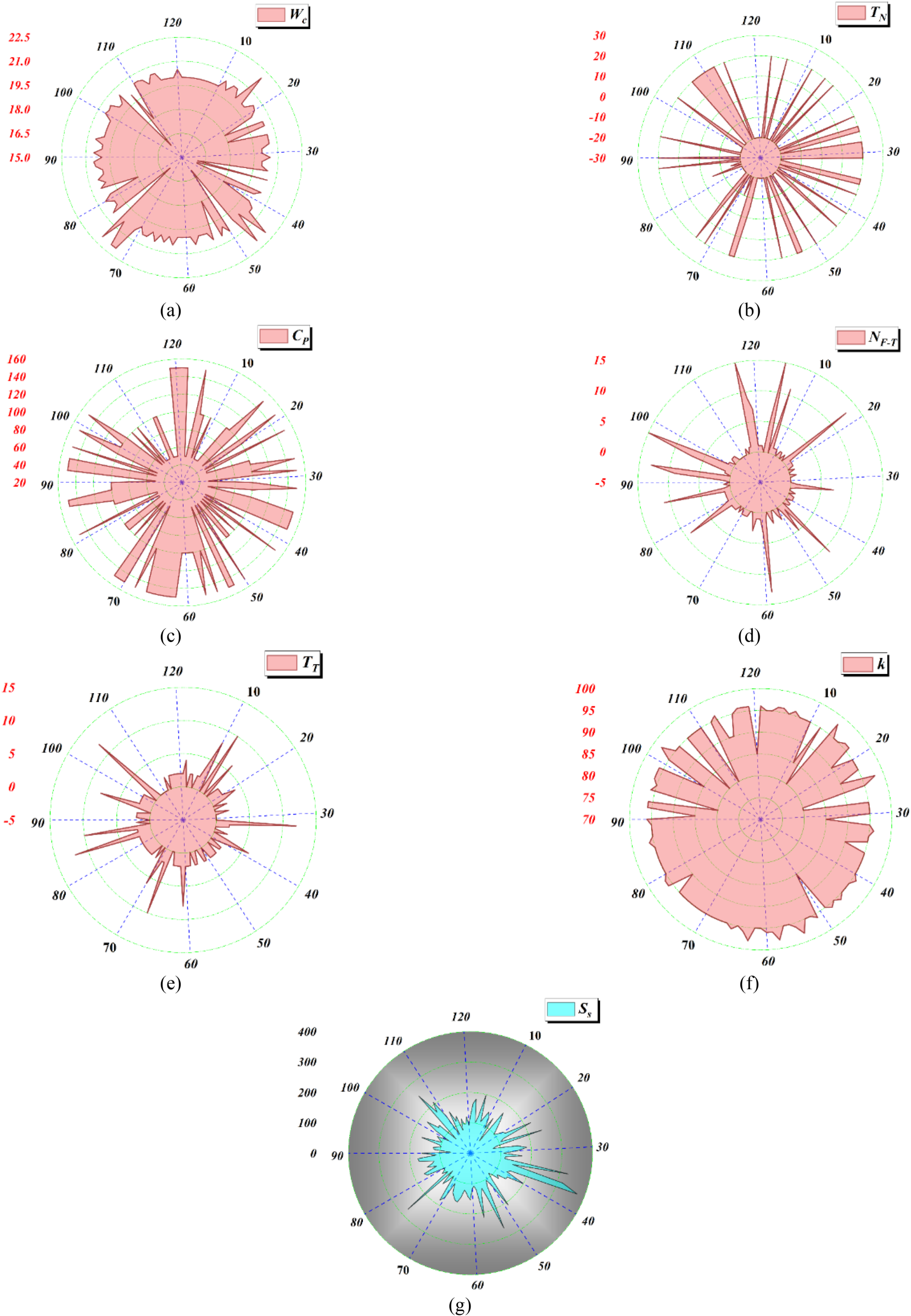
Circular Distribution of the Database.
The image displays a Pearson correlation coefficient (

A positive value of
The strength of the connection is identified by the magnitude of r. A value close to 1 or −1 showcases a robust connection, while a value close to

The Spearman Rank Correlation Coefficient.
Golden Jackal Optimization Algorithms (
)
In the initial stage, the situation of the victim is represented by an accidental matrix (Chopra & Ansari, 2022):

Here, N depicts the count of victim crowd and n displays the dimensions.
Catching the victim is not an easy task owing to the inherent capability of jackals to track their targets (Akbarzadeh et al., 2022). As a result, the jackals will patiently wait for another opportunity to catch their victim. The predation conduct can be described by the below equations, where the absolute value of E is more than 1 (Chopra & Ansari, 2022):


In the algorithm's current repetition, the male and female jackals are represented by
The calculation for the volatile energy of the victim 

The variables used in the calculation are as follows:
In Equations (3) and (4), the expression 

In the calculation, the variable “
The variable
The harassment by golden jackals leads to a decline in the volatile energy of the victim. The conduct of jackals during the process of siege and devouring their victim can be modeled in this context, where the absolute value of E is less than or equal to 1 (Chopra & Ansari, 2022).


The

(A) Pair of Golden Jackal, (B) Golden Jackal Searching for Prey, (C) Stalking and Enclosing of Prey, (D and E) Pouncing on Prey.

Attacking Versus Looking for Prey (Chopra & Ansari, 2022).
The pseudo-code of

Accidental Forest
In 
In the equation, 
Each tree's training collection is unique and contains duplicated training specimens. Another property of
Boosting the pivotal parameters the
River flow forecast using the Hybrid 
In the given context, the weight vector
Min,



In this case, 
Once the
The previous clarification demonstrates how the
The optimization of hyperparameters with the
The creation of effectiveness comparison measures was motivated by the need for a standardized and quantitative tactic to appraise and compare the general efficacy of diverse approaches. As part of their inquiry, the academics gauged the subsequent measurements and included their findings in the examination:
Root mean square error ( Normalized root-mean-square ( Relative absolute error ( Root relative square error ( Mean absolute error ( Performance index
Variance account factor ( Scatter index
a10 index (Asteris et al., 2024; Asteris et al., 2021a)







where:
Process of Models
The creation of optimization-based models comprised the implementation of the following stages: (a) Configuring the first
The Initialization Process and Tunned Values.

The Initialization Process and Tunned Values.
This paper presents the results of integrating the

The Models’ Outcomes, Left: Correlation, Right: Error (%) (a: Train Subset, b: Test Subset).
The Results of Regression Models.

The results obtained reveal that the
Additionally, a comparison between the outperforming models (
On the right side of Figure 5, you can see the error percent dispersion of the estimates made by the two
The models may be tailored to the specific characteristics of the database used, raising concerns about their generalizability to different geographical locations, soil types, or environmental conditions. It acquired a more diverse database that displays a broader range of geographical locations, soil types, and environmental conditions. This can enhance the generalizability of the models. Consider collecting longitudinal data to capture changes in soil properties over time. If the properties of the seasonally frozen soils change over time or under different conditions, the assumption of stationarity may not hold, impacting the model's accuracy over the long term. Machine learning models, like
Conclusions
Two machine learning-based methods for assessing
The results obtained indicate that the
It was observed that
Although the performance of the literature's models was acceptable, the framework created in this article presented better workability, by attaining higher
Because the models use certain database properties, they may not apply to varied geographical locations, soil types, and environmental circumstances. Adding variability to the database improves generalizability. Since seasonally frozen soils may not be stationary, longitudinal data collection is essential to capture temporal changes in soil characteristics and ensure long-term accuracy. In addition, “black-box” approaches like
The models may be used for infrastructure design, risk assessment, and material optimization in seasonally frozen soils. They reliably forecast freeze–thaw static strength degradation to help engineers build lasting foundations, pavements, and embankments. The models also measure structural stability, reducing failure risks and maintenance costs. These models may also help choose and optimize soil stabilizing methods and materials for better performance in different environments.
Footnotes
Funding
The authors disclosed receipt of the following financial support for the research, authorship, and/or publication of this article: The project funded by Heilongjiang Natural Science Foundation No. LH2023D021 Project name. The research focuses on investigating the freeze-thaw stability mechanism of roadbeds based on the non-thermal equilibrium theory of porous media.
Declaration of Conflicting Interests
The authors declared no potential conflicts of interest with respect to the research, authorship, and/or publication of this article.