




Abstract
I illustrate through this paper how contemporary water (in)justice results from interactions between historical, socio-political, technical, and economic relations, and how such water (in)justice is emotionally experienced and embodied. Focusing on the case of Faizalpur, a low-income Muslim neighborhood in segregated Ahmedabad, I draw on lived experiences approaches to water justice and on an emotional political ecology framework to offer a multi-scalar analysis set across urban, community, and individual scales. I show how the settlement of low-income Muslim families in Faizalpur is inseparable from both the (il)legal status of this land and the religious segregation that have shaped this city. In turn, everyday experiences of water injustice in Faizalpur are premised in contestations relating to the site's land use zoning history. I illustrate how in this contested site carefully framed requests make municipal water infrastructure possible even though such infrastructure is technically disallowed here. The careful-ness of such requests lies in skirting issues pertaining to (il)legality, instead activating other discursive categories, such as ‘humanitarian’ need: categories that possess the moral power to outweigh legal and technical arguments. I suggest that everyday experiences of water (in)justice cannot be understood without attending to the discursive power of planning terms like ‘illegality’ and ‘land use zoning’. Emotionally experienced everyday water struggles in Faizalpur, in the form of anger, trust, fear, grief, etc., need to be understood then as emotional everyday experiences of religious segregation.
Introduction
“For two years we took water from tankers… Even in the summer, during Ramzan. While fasting we would fill from tankers. We have suffered terribly… Right now, because it is cold, we get some water (from informal connections). But in March, April, at the time of Ramzan, it will stop again. Then tankers will come again. This is how we make do.”
“The (municipal) bore(well) has been built since over a year, yet no water is being given from it… He (gesturing at the councilor) has been saying for over a year now that water will come. But they are not giving lines.”
“Oi, lady! Don't keep harping on! Okay, the bore has been built. Now take the water through your eyes! Take it. How many times have I told you? Demand! If you want water lines, fill in the application forms and submit them at the corporation. I have told you to make written applications, haven't I? How many times did I tell you this? There is a system! Papers will be made. Files will go. Then lines can come!”
Faizalpur 1 is a low-income Muslim neighborhood in southern Ahmedabad. Technically designated as a “no-development” zone, Faizalpur is technically ineligible to receive municipal infrastructure (GTPUD Act, 1976: 129). Yet, a municipal borewell was built here in late 2018, on ‘humanitarian grounds’ I was told, despite planning guidelines expressly disallowing it. I visited the neighborhood in January 2020 alongwith a local municipal councilor to understand the borewell construction from a planning and water justice perspective. But what started out as a discussion between the councilor and a group of resident women escalated quickly into a heated argument. The women were concerned that the little water they currently received through informal connections would soon dry out. They wanted the councilor to deliver on his promise of installing water lines and household connections from the new municipal borewell. One woman, dismissive of the councilor's efforts, implied that he was not doing enough to bring water to their homes. The councilor grew visibly aggressive towards the woman for challenging his efforts. Fortunately, some of the other women intervened, distracting the councilor by praising his efforts, and diffused the tension. As the councilor calmed down, one of the women turned to me and said in a low voice, “this is everyday” (“yeh roz ka hai”).
Faizalpur is located in a predominantly Muslim ward 2 of Ahmedabad called Makhtampura, one of the many inadequately serviced Muslim areas that have emerged along the city's southern peripheries, notably since the 2002 Hindu–Muslim violence (Desai, 2011; Mawani, 2019). Low-income Muslim families displaced from other parts of Ahmedabad settled in Faizalpur following the gruesome 2002 riots, part of decades-long marginalization experienced by the city's Muslim community. The scale and nature of violence unleashed during 2002 have been described extensively. 3 Briefly, the riots led to the destruction of over 100,000 houses and 15,000 businesses belonging predominantly to Muslims, horrific cases of violence against Muslim women and children, and the death of more than two thousand Muslims (Desai, 2011: 112).
Back in Faizalpur, the exchange between the councilor and women residents recounted above illustrates that while the borewell construction might indeed be a technical feat given the land tenure complexities here (details in later sections), it has not improved everyday water access for residents. Despite material water infrastructure built on ‘humanitarian grounds’, water struggles in the neighborhood have persisted because water lines from the borewell to individual homes have not yet been laid. Set against this context, the women of Faizalpur describe their ongoing struggles of accessing water – struggles produced through an interaction of interests and emotions across scales – as everyday experiences of ‘making do’.
It is these everyday struggles of water access, essentially everyday water (in)justice experienced by low-income Muslim households in Ahmedabad, that I make visible through this paper. In investigating water access, I examine tangible aspects constituting access – such as quality, quantity, reliability, and affordability of water – as well as intangible aspects – like personal and community dynamics that individuals engage in to access water. 4 To conduct this inquiry, I contextualize contemporary everyday water access in Faizalpur against wider historical socio-political, technical, and economic relations undergirding the neighborhood's waterscape. In doing so, I add empirical depth to the growing body of scholarship on South Asia which has made visible the many ways in which class, caste, gender, and religion come together to shape unequal access to water (Sultana, 2011; Truelove, 2011, 2019). I show that the settlement of poor Muslim families in Faizalpur post-2002 is inseparable from both the (il)legal status of this land and the Hindu-Muslim riots and ensuing segregation that have shaped Ahmedabad. In turn, everyday experiences of water injustice are premised in contestations relating to the site's land use zoning history. It is because of these entanglements between land-related legal-technical specifics and religious identity that the everyday water struggles narrated in this paper are particularly struggles of religious segregation. Next, I make visible how contemporary everyday water struggles here are emotionally experienced and embodied. To do so, I offer a multi-scalar analysis, set across urban, community, and individual scales. The legal-technical context of land-use zoning against which my account is set is at an urban scale, the practical efforts of infrastructure building and accessing water that I describe are at community level, while the emotional experiences narrated are at the scale of individuals. Analytically, I draw on the lived experiences approaches to water justice (Peloso et al., 2018; Perreault, 2018; Rodina, 2016) and on an emotional political ecology framework (Sultana, 2011, 2015; Truelove, 2011, 2019). Using such approaches makes visible the real-time human impact of water injustice – something that a focus on rational-technical approaches premised in distributive justice perspectives occludes. Distributive approaches to water justice often focus on technical and material arrangements, taking such arrangements as given. But as I show through this paper, legal and material arrangements are themselves borne out of a discursive circulation of technical categories. I argue then that everyday experiences of water (in)justice in Faizalpur cannot be understood outside of the discursive power of planning terms like ‘illegality’ and ‘land use zoning’. A grounded understanding of water justice, I suggest, requires tracing discursive circulations of technical planning categories and identifying fault lines reproducing water injustice, as well as making visible real-time, human impacts of water injustice.
I collected data over 30 months from October 2016 to December 2017 and from January 2019 to March 2020 for the research that this paper is based on. I used an ethnographic approach, combining: (a) in-depth dialogues and semi-structured interviews with residents and with actors identified by residents as important for their everyday access to water; (b) neighborhood walks; and (c) secondary research, including collecting and analyzing relevant documents identified by research participants. I used elements from the Institutional Ethnography framework (Smith, 2005) to organize my fieldwork and from critical discourse analysis to investigate relationships between “‘micro’ events… and ‘macro’ structures” (Fairclough, 1985: 739) by examining the multi-scalar role of discursive categories such as “illegality”. I conducted in-depth interviews with 64 people, neighborhood walks with 21, and short but often insightful conversations with many more. Being an outsider to Ahmedabad's Muslim community, maintaining reflexivity was critical so as to not offend the sensibilities of my research participants while also eliciting meaningful and relevant data. However, being born and raised in the city and being able to speak both local languages (Hindi and Gujarati) helped me navigate data collection.
The remainder of this paper is organized as follows: I begin by discussing how water justice has been conceptualized to locate my focus on ‘situated’ understandings privileging lived experiences. I then locate everyday water struggles of Faizalpur's residents within the socio-political and technical context of this neighborhood. I show how these struggles are materially characterized and reproduced at once by the borewell constructed against all odds and the conspicuously absent water lines. Following this, I narrow my focus on everyday experiences further and turn to the literature on emotional and embodied experiences to sketch a framework for analyzing everyday water struggles. I conclude by presenting an account of how everyday water struggles of ‘making do’ in Faizalpur are emotionally experienced and embodied.
Locating the lived experiences approach to water justice
Following the tradition of environmental justice studies, inquiries into water justice have historically focused on questions of distribution, inequality, and water struggles of individuals or groups (Movik, 2014: 187). Embedded in a distributive perspective, early approaches to water justice emphasized questions relating to (in)equality and (in)equity in distribution of access to, use of, and control over resources (Perreault et al., 2018: 347). After all, technical and material water arrangements constitute the physical context for water justice (Boelens, 2014). As a result, they have often been the focus for policy recommendations (Truelove, 2019: 2). But focusing attention to only technical and material arrangements is problematic in two ways. First, a distributive justice focus does not sufficiently engage with the social, spatial, political, and material specificities undergirding unequal distribution to begin with (Schlosberg, 2004). As a result, it risks rendering ‘natural’ the causes of water shortages and injustice (Loftus, 2015). Premised in the assumption that ‘better’ technical, material arrangements are in themselves enough to yield water justice, such an approach privileges technocratic quick fixes. Yet this assumption is far from reality. Practically, water justice is shaped in important ways by how water is perceived, used, and governed based on locality-specific social, cultural, and political norms (Lahiri-Dutt and Wasson, 2008). Second then, and in extension, focusing only on technical and material aspects risks depoliticizing water justice. It obfuscates an understanding of how local power structures complicate technical and material water arrangements (Loftus, 2015).
In recognition of these shortcomings, inquiries into environmental justice have increasingly turned attention to procedural aspects relating to fairness in distribution, representation, participation, and recognition, as well as to impacts of distribution patterns on broader life possibilities of individuals or groups (Schlosberg, 2004; Walker and Bulkeley, 2006). Contemporary water justice studies are emblematic of this expanded analytical scope of the environmental justice field. They focus on issues ranging from ‘allocation discourses’ driving water policy (Movik, 2014), to the reconfiguration of hydrosocial territories (Swyngedouw and Boelens, 2018), to water privatization and mobilization of notions of scarcity (Ahlers, 2010), to lived experiences of water insecurity (Perreault, 2018; Rodina, 2016; Sultana, 2011).
The lived experiences approach to water justice is particularly important because it invites inquiries not only into notable crises that make for headlines but also into “mundane and enduring” everyday water struggles (Peloso et al., 2018). This approach recognizes that everyday water struggles might stem as much from tangible, measurable factors like quality, reliability, and affordability (Mitlin, et al., 2019), as they might from socio-political and cultural specificities like gender, class, and occupation (Harris, 2008). Some water justice studies employing such an approach have highlighted the entanglements of physiological and emotional health with water struggles (Collins et al., 2018; Sultana, 2011). For instance, Collins and colleagues (2018) illustrate how water insecurity experienced by pregnant and post-partum women in western Kenya has inordinate impacts on their physical and psychosocial health, nutrition, and economic wellbeing. Others have articulated water justice in terms of material experiences of water infrastructures and ways of negotiating access to water (Rodina, 2016; Anand, 2011). Some have even noted how individual and collective memories take material shape and assume form as “monuments, memorial sites… landscapes” (Perreault, 2018: 316), or, as the accounts offered in this paper suggest, water arrangements. Water justice then is located equally in everyday experiences of technical and economic concerns over quantity, quality, reliability, and affordability (Sultana, 2018: 484); in politics over material objects such as pumps, pipes and valves (Anand, 2011; Bjorkman, 2015); and in negotiating thoroughly intangible aspects such as social networks (Anand, 2011) and individual and collective experiences and memories (Perreault, 2018).
Additionally, everyday water struggles unfold across four interconnected procedural and spatial sites: water resources/infrastructures themselves; legal stipulations and norms undergirding water distribution; distribution of power and authority influencing decision-making and water management; and discourses and knowledge through which water distribution is legitimized (Zwartaveen and Boelens, 2014: 155). These sites become key junctures at which to anchor empirical studies into everyday water struggles. Inquiries into water justice from a lived experiences lens have relatedly been multi-sited and tied variously to community and household-level storage methods, hygiene (Dapaah and Harris, 2017), education, income, location, and disease prevalence (Mahama et al., 2014). Equally, a lived experiences approach recognizes the multi-scalar nature of water justice, with everyday water injustices often found “nested” within ever-shifting physical and political boundaries of land, identity, and power (Joshi, 2015).
Recognizing the multiplicity of factors influencing water justice, scholars foregrounding the lived experiences approach have demanded an intersectional understanding of water struggles. Grasping water justice, they suggest, requires attention to multi-scalar dynamics (Wilson, et al., 2019), stretching from abstract and technical planning processes to politics and experiences at regional, urban, community and individual levels. Drawing on these suggestions, I turn next to how water arrangements in Faizalpur have evolved over the past 20-odd years since its emergence as an urban neighborhood.
Early water struggles of settling in a reserved zone
Faizalpur’s growth as an urban neighbourhood can be traced back to the 2002 Hindu-Muslim violence for which Ahmedabad was a key site. Displaced Muslim households from across Ahmedabad and other parts of the state moved to Makhtampura in search for safety in numbers. To meet this sudden influx of people, hurried construction under diverse tenure conditions followed
5
(Mahadevia et al., 2014; Mawani and Leaf, 2019). Poorer families bought cheaper, illegally constructed houses, leading to the settlement of Faizalpur and its surrounding areas. Families I met recounted how when they first moved to in Faizalpur, groundwater was available at a depth of 15 feet and could be drawn from household-level borewells. Access to water, they said, started becoming a problem 2009 onward, with the simultaneous depletion and pollution of groundwater
6
(Figure 1). One resident told me: “We are here since 20 years. First we had our own bore… We made it in 800 rupees
7
… We used to get good water from it. That lasted for 5–10 years. But after that the water became undrinkable.”
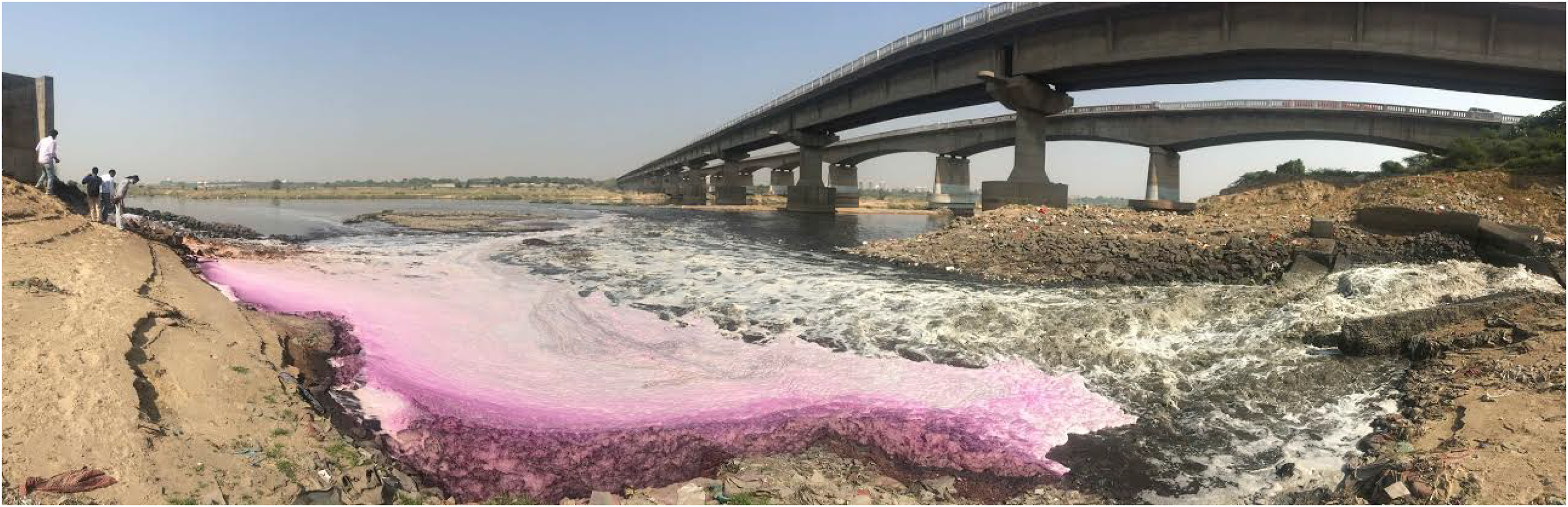
Industrial effluent released close to Faizalpur. Source: Author, September, 2016.
The water turning “undrinkable” was partly a consequence of the area's proximity to the release point for (mostly untreated) industrial effluent and wastewater from across the city (cf. Maheshwari, 2016; see image below). Equally, residents also also linked this groundwater pollution to the scores of septic tanks, rapidly and often poorly constructed for individual homes in the absence of municipal sewage and drainage systems, which then leaked into upper aquifers: “There were no drainage lines at that time. The septic tanks which were 7 feet under (ground) would become filled with drainage water, and all of this would overflow and get mixed with drinking water. Because of this, once bug-infested water started coming out of our taps. Inch-long bugs. And the smell was also so bad!” “When water from the 15 feet river (aquifer) went bad, we made deeper bore(wells). (Building these) meant more money. But what could we do? At that time, even tankers didn't come. And bottled water was too expensive.”
Bore ‘Failures’
“Six years ago, we made a bore at 80 feet. But water doesn't come. It gave water for 1.5 / 2 months. Then it failed. Money got wasted. We had paid 15,000 (for it).”
As the resident quoted above describes, borewells at 80–100 feet also ‘failed’ soon after they were built because of increased groundwater extraction through an ever-growing numbers of borewells. Safe groundwater in Faizalpur soon receded further, and currently is available only at a depth of 500–700 feet. Building a borewell that can tap into aquifers this deep is significantly more expensive. Low-income families in Faizalpur with average sizes of 5 to 7 people, have monthly incomes of 10,000 to 15,000 rupees.
8
Constructing borewells that can reach aquifers at 500–700 feet costs over three times this average household income. Incurring such large costs is not an option for most families, especially given uncertainties around how long even these aquifers will yield water. One resident described her experience of uncertain groundwater and consequent decision-making as follows: “those who have more money build deeper borewells. So they get water. But poor people like us can't dig (deep wells) right. We don't have that much money. And who knows how long even that borewell will give water. That's why we took this water line (from an informal private borewell operator).”
With most households unable to build individual borewells, informal borewell businesses promising water have proliferated in Faizalpur. These businesses seek advance monies - between 5000 and 7000 rupees 9 per household - for laying distribution networks from borewells to homes. In addition, they solicit monthly maintenance charges of 250 to 400 rupees 10 for paying electricity bills associated with running the borewell pump, and so on. In return, households receive water for half hour to an hour every day. But even these investments are not risk-free. There is no paperwork involved in transactions relating to informal water provision, and in extension, no liability for informal providers to deliver on their promises. Faizalpur residents reported having lost money to multiple such vendors, who sought advance monies and disappeared. One resident woman said she had lost over 25,000 rupees – more than twice her family's monthly income – to three informal borewell businesses, and still didn't have a connection that gave water.
It is these everyday struggles upon which the construction of the municipal borewell described in the introductory section is premised. In the next section, I discuss how the borewell construction was accomplished and contextualize the conspicuous and continuing absence of water lines.
A borewell built on humanitarian grounds that gives no water
The municipal borewell in Faizalpur was built on “humanitarian grounds” in subversion of land-use zoning guidelines with special permission from senior municipal officers. But since water lines have not yet been laid, the borewell lends no relief to residents. On the contrary, being able to see the borewell everyday, yet not getting water from it, only deepens the residents’ despair and frustration as this resident woman describes: “The bore has been built since a year and a half, and yet no water is being given from it… It is a big government bore. (One) can see it even from this distance. Behind that wall. But when the line will come, when we will get water, who knows…”
A municipal borewell that gives no water because of absent water lines then constitutes the material context shaping everyday experiences of water injustice in Faizalpur. Probing this material context requires interrogating the paralysis in installing water lines here. When I ask the councilor why no water lines have been installed, he draws my attention back to the neighborhood's designated land-use status as an ‘acquired zone’: “This entire area is an “acquired zone”. The land has been acquired by the Government for (Sewage) Treatment Plant. So each time we ask for municipal infrastructure, the AMC says “how can we give water there?” But it hasn't been used for the Treatment Plant. So many people live here! Look at it! It is a residential zone!”
In response to my question on absent water lines then, the councilor offers the fervent appeal that Faizalpur, a visibly dense occupied area, has no business being labeled a no-development zone, and in extension, being deprived of municipal water infrastructure. He insists that Faizalpur's designated ‘legal’ land-use zoning is incongruent with observable reality. The contradiction he highlights between purported legality and reality is further complicated by institutional ambiguity regarding the current legal status of these lands. While over two decades have passed since Faizalpur and its surrounding areas were declared reserved for STPs, no STPs have been built. Legal decrees 11 require that lands declared as reserved zones but not physically acquired within 10 years of reservation be released by planning authorities for development. 12 Since Faizalpur has not been physically acquired since 20-plus years, it should have been released for development. 13
Simply put, had all legal guidelines been followed, Faizalpur would today be entitled to receive municipal water. But neither have these lands been physically acquired, nor have they been released for development. When I ask the Makhtampura ward engineer about the current status of the Faizalpur lands, he responds with a vagueness that mirrors the ambiguity that characterizes Faizalpur's zoning history: “our internal paperwork is ongoing to understand the status of these lands”.
With municipal infrastructure provision in Ahmedabad thus entangled with zoning status, and zoning status in Faizalpur being suspended in animation, building new water infrastructure in this neighborhood has been fraught with obstacles. The legalities and technicalities governing municipal infrastructure building in this neighborhood render the construction of the municipal borewell no small feat (Figure 2). In the words of a senior officer from Makhtampura ward: “… No government officer will dare to do such a thing. The Faizalpur bore(well) has been made in the cemetery (kabrastaan). You should study it to understand out-of-the-box administrative and planning decisions! This thing that I have told you, no one has ever done in the history of the corporation. No one. Show her that bore!”
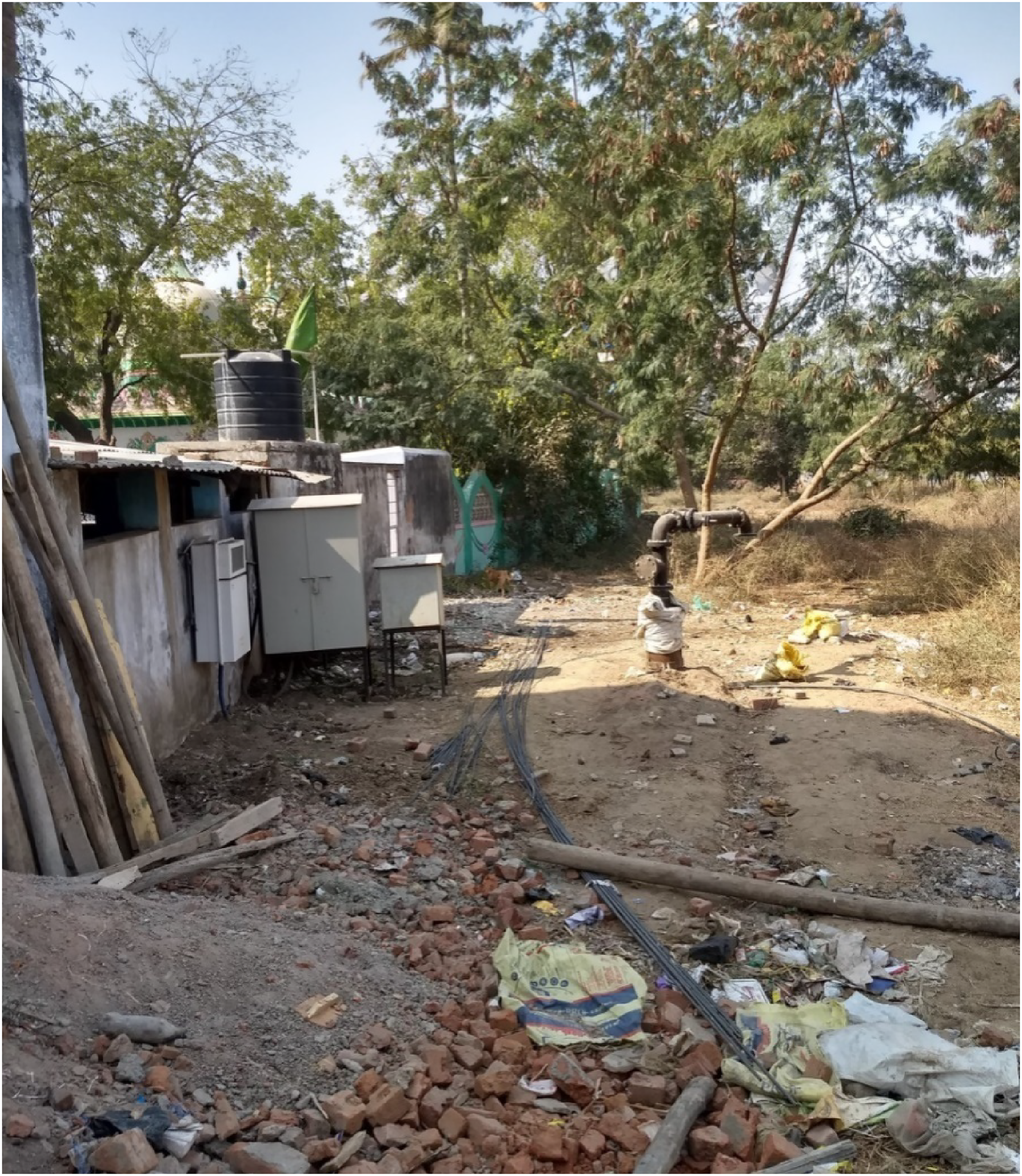
Municipal borewell that gives no water. Source: Author, May 2019.
Deeper engagement with the tactics that made this borewell construction possible contextualizes the continuing absence of water lines and in turn the everyday water struggles of Faizalpur's residents. The councilor tells me that the contentious, difficult, and “out-of-the-box” construction of the borewell became possible because the request for the borewell was framed as a plea for “making work possible in non-TP areas 14 on humanitarian grounds”. Town planning schemes are technical planning tools through which municipal infrastructure is planned and built in areas identified for development (Mawani, 2019). Referring to an area as “non-TP” means highlighting the fact that municipal infrastructure through a town planning scheme has not been provided here. But Faizalpur, a “no-development” zone, is ineligible to receive a town planning scheme in the first instance. Technically then, the reference to the “non-TP” nature of Faizalpur in framing the request for a municipal borewell is irrelevant. Yet, the councilor emphasizes, holding the “non-TP” status of the Faizalpur lands central while requesting a borewell for the neighborhood, and simultaneously avoiding mention of the zoning status of the lands, was critical. He contextualizes his assertion by referring to a 2015 resolution mandating the provision of municipal basic services even in areas where town planning schemes have not been approved. In his view, this manner of argument framing allows for a careful avoidance of the ‘acquired’ status of the Faizalpur lands, which is very important, because, in his words, “if we talk about acquired, we will get nothing… Then they will start talking about demolishing in the acquired…”. He suggests then that since the Faizalpur lands are technically ‘acquired’ no-development zones, any reference to the ‘acquired’ status of these lands risks attention to how there should be no construction on this land in the first place. The councilor thus simultaneously argues for activating the discursive power of terms like ‘humanitarian’ and ‘non-TP’, while carefully avoiding reference to designated land-use zoning.
Water justice at the scale of municipal infrastructure building in Faizalpur then is sought based on a careful assessment of which legalities to activate and which to skirt. The designated technical specificity of this neighborhood, i.e. its zoning status, which prohibits the building of municipal infrastructure, is carefully kept off the table. And, as explained by the councilor, it is critical for it to continue being kept off the table, if water justice is a goal. Simultaneously, the emphasis on the “humanitarian” nature of fulfilling the request for water lines is important. At the time of sanctioning municipal infrastructure for an area not eligible to receive it, a request framed on ‘humanitarian grounds’ can outweigh counter-arguments based on technicalities. In other words, what we see in Faizalpur is how technical categories like ‘legal/illegal’ and ‘non-TP’ do not really determine what happens. Instead they are part of the discursive landscape of explanations and narrations that reproduce persistent water struggles.
This discussion highlights the strategic discursive choices that have facilitated the construction of the Faizalpur borewell. But it does not yet explain the absence of water lines. I turn to this next.
Absent water lines
“Since there are no lines (we) have to fill water from tanker(s). My clothes don't fit me properly because my shoulder has started hanging lower. Because of carrying buckets (from the tanker) all the time.”
“When older women or pregnant women have to fetch water (from tankers), it becomes very difficult. They bring small utensils and fill those. How much can that water last? If we get (municipal) water lines, these troubles will diminish.”
As the quotes above suggest, many Faizalpur residents experience the absence of municipal water lines in terms of myriad bodily struggles. Here, as in many other low-income neighborhoods across the world, women are predominantly responsible for fetching water for their families. The embodied struggles narrated here are thus centrally women's experiences. Faizalpur's resident women link their everyday embodied water struggles with the material absence of water lines. And the absence of municipal water lines in Faizalpur is indeed puzzling. Typically, when a water distribution station or a borewell is built in Ahmedabad, a distribution network plan is already in place even if its construction follows later. For instance, in the case of a new water distribution station currently under constructed in north-eastern Makhtampura ward, a water distribution network is already being installed! Citing this instance from the same ward, I ask the councilor why the network from the Faizalpur borewell has not been laid. He responds by circling back, yet again, to contestations over the area's land-use zoning status.
Given the reserved status of lands in Faizalpur, he says, demands for material infrastructure need to be made “one after the other” instead of all at once. Capital costs required for building all material water networks at once in an area legally ineligible to receive municipal networks would have been too large to sanction. In his opinion, requesting water lines at the time as requesting the borewell would have paralyzed the decision-making process entirely, potentially obstructing even the borewell construction. The ward engineer confirms this rationale. Larger the capital investment required for physical infrastructure, greater the time required to process its sanction, and in extension, higher the likelihood of the project being put on hold. Faizalpur's contentious land-use zoning status could easily become a further obstruction in the sanction of the work. The councilor's logic was, “now that the borewell has been built… (water lines) will come too, some day or the other, on humanitarian grounds.” Infrastructural requests for water justice then are not only carefully framed, but also strategically timed.
While these myriad legal and technical conjectures continue to shape the material water networks of Faizalpur, residents continue to experience water struggles every day. Water justice studies, even those premised in a lived experiences approach, have historically focused on national, regional, watershed, and neighborhood scales (Truelove, 2019: 2). But such a focus occludes a spatially, temporally, and socially specific understanding of everyday water struggles. For instance, the two quotes at the start of this sub-section highlight how everyday water struggles for older women and pregnant women would be different to those of many other residents. Their experiences of water justice then would also be diverse. Even with ubiquitously absent water lines, everyday water struggles experienced by an older woman would be shaped by whether her neighbors or family members help her carry the water or not; how many family members she has; how close to her home the tanker stops; whether a hose can be attached from the tanker to fill water for her, and so on. This woman's experience of fetching water will in turn inform her future decisions of accessing water. On the one hand then, water struggles are arenas across which power and authority are performed, negotiated, and experienced at multiple scales. On the other, they are “emotive realities” (Sultana, 2011: 163) that impact how water access in vulnerable communities is not just sought, but also fought over.
A deeper, disaggregated account of water justice then requires attending to individual negotiations over water, and how they are emotionally experienced and embodied. In the sections that follow, I offer an account of this nature. I first discuss work that relates emotional and embodied everyday water struggles with water justice, and then use insights from this discussion to make visible the everyday water struggles of Faizalpur's residents.
Everyday “emotive realities” 15
A growing body of empirical work on water governance and justice argues that, “(e)motions matter in resource struggles… (and) influence the outcomes of practices and processes of resource access/use/control.” (Sultana, 2011: 164). This provocation builds on assertions by the sub-field of emotional geographies, 16 on how emotions might deliver the radical potential of critical geography 17 (Bondi, 2005; Thein, 2005). Studies grounded in feminist political ecology (FPE) frameworks have advanced this approach by making visible how “gender – in relation to class, race and other relevant axes of power – shapes access to and control over natural resources” (Sundberg, 2017). They have illuminated how social identities are relationally produced through everyday material practices. Integrating ideas from the fields of emotional geographies (Bondi, 2005; Thien, 2005) and feminist political ecology (Harris, 2015; Nightingale, 2017), recent work on emotional political ecology (Gonzalez-Hidalgo and Zografos, 2020; Sultana, 2015, 2020), and embodied political ecology (Doshi, 2017; Truelove, 2019) has urged for the need to refocus analytical attention to “embodied emotions, feelings, and lived experiences” (Sultana, 2015: 634) as sites for understanding resource conflicts..
These approaches to understanding environmental justice privilege epistemological frameworks based on affect and emotion, as opposed to economics-based dimensions such as property rights, productivity, efficiency, and so on (Doshi, 2017; Harris, 2015: 167; Sultana, 2015). For instance, Sultana (2015) highlights the multiple kinds of sufferings and emotional distress experienced and embodied by women as a result of water stress in rural Bangladesh. These bodily experiences are central to accessing and using water, as Truelove (2011: 147) notes, and include “the wear and tear of water labor, water-related health problems, the physical experience of criminalization for illegal practices and the disciplining required for water-related health issues (including diarrhea and menstruation for example), (and) are intimately tied to the experience of urban space and rights.” Attending to “everyday, embodied, and emotional relations” with water helps challenge hegemonic practices of water distribution (Harris, 2015: 158). It shifts analytical focus away from scales entangled in distributional assumptions such as the national, regional, and so on, attending instead to the scale of the body (Truelove, 2019). As well, it allows an examination of the many ways in which these scales, from “the intimate” to “the national”, are connected (Elmhirst, 2011). Shaped by the myriad ways in which authority is enacted, these embodied experiences significantly impact women's everyday lives, influence opportunities they might or might not be able to access and reproduce social identities (Elmhirst, 2011).
Embodied and emotionally experienced water struggles also spill over into familial and other social relations (Harris, 2006; Sultana, 2011; Truelove, 2011). For instance, Sultana notes that in an “arsenic waterscape”, women in rural Bangladesh resort to drawing water from contaminated sources to meet their families’ needs. Being aware of risks associated with consuming polluted water, yet requiring basic amounts of water and thus exercising this choice, carries its own emotional anxieties for the women (2015: 637). For women who work as domestic helpers in urban India, having to ask for water from employers to meet their families’ needs might mean working longer hours, or otherwise ingratiating employers; acts experienced as embodied and emotional burdens in and of themselves. Or in areas with informal water arrangements and established power and authority structures, fetching water might mean women being tagged as criminals ‘stealing’ water, and in turn having to contend with the embarrassment and frustrations associated with bearing these labels (Truelove, 2011). Multiple scales of authority – regional, community, neighborhood-based, and domestic – thus constitute emotive realities and influence water justice.
Understanding everyday experiences of water justice requires careful attention to such emotive realities shaped by how authority is exerted within a context. I draw on these insights to probe in the following section the various scales of authority exerted, and emotive realities (re)produced, in Faizalpur, and their role in facilitating or obstructing water justice. Specifically, I attend to the plura emotive realities produced when social and spatial differences (gender, age, affordability, geographical location) interact with material experiences of water and water infrastructures (through pumps, tankers, pipes, and seasonal variations).
“Making Do” (“chalaa rahein hain”)
While strategically framed and timed demands for municipal water infrastructure continue to shape Faizalpur's waterscape (“A borewell built on humanitarian grounds that gives no water”), residents “make do” in various ways to meet their water needs. Households that can afford it buy water from informal borewell operators. These connections give them water for an hour a day on good days and for half hour a day or every alternate day in the summer months. Despite informal connections being unreliable, women are thankful for them, primarily because of the much higher distress experienced when they were entirely reliant on tankers (Figure 3). The quote below captures this experience of relief: “It (household water connection from private borewell) has solved such a big problem for us. We had to depend completely on tankers earlier, and there used to be so many fights. Stone pelting, physical violence, police cases. So much has happened. At least all that has stopped because of this bore.”

Water lines from an informal borewell. Source: Author, January 2020.
But even on good days, water pressure in connections from informal borewells is low, and the water collected is insufficient to meet basic needs for drinking, cooking, washing, and cleaning. To increase pressure and draw more water, as well as to pump water to overhead storage tanks, better off households attach motors to their connections. This further reduces water pressure in the connections of their neighbors. In an already anxious waterscape, differential water pressure then transforms into, and erupts as, fights between neighbors. “Making do” in this fragile waterscape involves adhering to locally established norms such as not attaching motors to connections towards sharing available water equitably and amicably; norms that are followed more in some neighborhoods and less in others.
Unreliable tankers and neighborhood politics
While conventions around attaching motors partially mitigate fights over the use of informal connections, water collected and stored by households is never enough. Consequently, many households additionally rely on tankers for drinking water. Households located further away from distribution networks of informal borewells, and families unable to afford advance monies and monthly charges, don't have informal connections. They rely entirely on water tankers since tanker water is supplied free of cost by the municipal corporation. Accessing water from tankers has its own set of challenges, including quality and reliability of water supplied; fights among residents over who gets to fill first and how much, what time the tankers come and how often, where in the neighborhood they stand and how long they wait at each spot, how much water they bring, and so on. As one woman told me, “We have had so many fights because of this… So much time is spent just in wrapping up fights that filling water gets left by the wayside… Imagine how much it must mess with our minds (“sochiye, kitna dimaag kharaab hota hoga”).” “Rahim (the tanker driver) is such a rascal (kameena)! He doesn't give water even once in three days. Even when we shout after him, he goes away… He gives water only to the neighbourhoods that call him up and register requests.”
The role of neighborhood leader, often assumed by an older woman, involves liaising with the tanker operator, regulating the supply of tankers, and keeping peace at the time of filling water each time a tanker comes. One such leader, a grandmother of four, told me how her tasks as neighborhood leader include calling out to everyone when tankers arrive, ensuring that only a few women fill water at one time, checking that no water is wasted at the time of filling, and even checking people's homes unannounced for motors attached to informal water connections. Keeping peace while filling water from tankers is especially important, she said, for if fights break out frequently, tankers stop coming. And to ensure peace while filling, she told me, leaders like her resort to threats if they have to: “the public listens to me, but I have to threaten sometimes. (If they fight) I call out to the tanker guy and tell him to stop the water and start the tanker and leave. I tell the women that no one will fill water. I also will not fill. If there are fights, no one gets to fill water. Sometimes I stop the tanker completely for a few days. Then they (the women) come and say ‘please call the tanker’. I tell them that if they fight in the future, the tanker will be stopped. That's how they have become disciplined… But I lose my mind in managing all this.” “The councilor left the application here with us a long time ago. But since she said no, we couldn't do anything about it. She wants to be the leader here. The water situation is going to become so bad in April. We must do something soon. But if we do something when she has said not to, we have to listen to everyone's curses (gaaliyaan khaani padti hain). That is a big problem. After all, we have to live here right?”
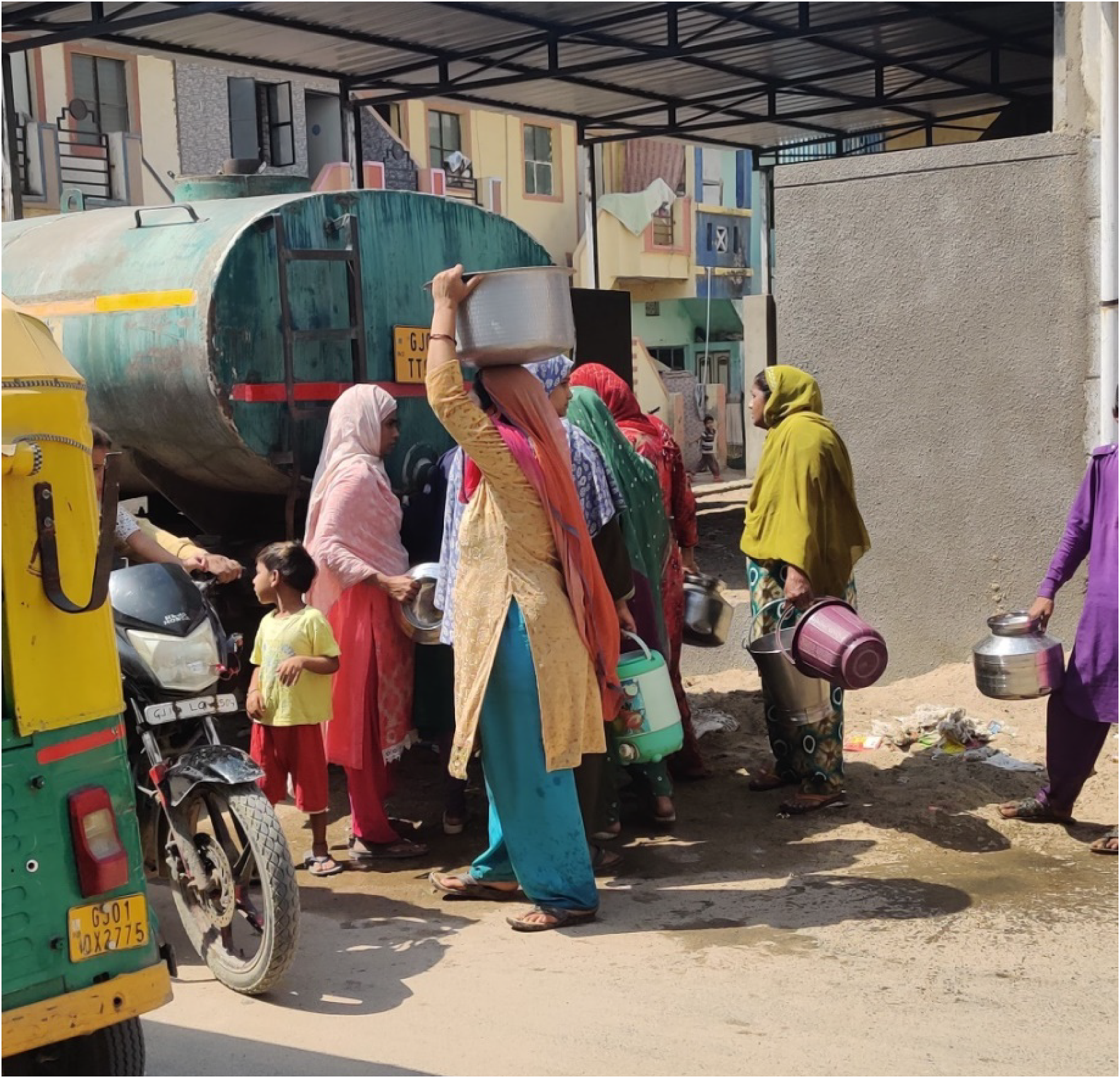
Women fetching water from tankers. Source: Author, January 2020.
Micro-politics at community level, and emotions experienced and embodied as a result of authority exerted at this scale, thus play a critical role in determining water justice.
Ramzan in Summers
The month of fasting and spiritual reflection for Muslims, Ramzan, coincides with Ahmedabad's worst summer months. With temperatures soaring well above 40 degrees Celsius, water supplied through informal connections dries up across Faizalpur and dependance on water tankers increases. The women's struggles, of fasting from dawn to dusk in exceedingly hot weather, with the more devout even abstaining from drinking water, are compounded with the additional burden of having to fetch water from tankers. This is particularly problematic when the job of fetching water falls on elderly women or women unable to lift weight for health reasons. A middle-aged woman resident, anxious for the months to come, said: “In those months, we don't wash clothes for 2–3 days sometimes. And if water still doesn't come, we bundle up our clothes and take them to the homes of our relatives who have water… We wash and bathe there and come back. But this takes time, and we have to take care of jobs and businesses. Even sending kids to school becomes difficult. And how many times can we go to others’ homes? In those days, we go mad, (thinking) where do we go for water.” “Their current supply of one hour a day, they will cut down to half an hour on purpose. Then they will start talking about increasing money. They always do this… And if the summer is bad, their bores might even fail. Like so many others… When these bores fail, who will spend the money to repair them? Money spent becomes gutter then.”
Conclusion: Water justice as multi-scalar and differentially embodied
The case of Faizalpur narrates how social, material, and technical aspects relating to water access interact in space and time to produce differential emotional and embodied experiences of water justice.
The settlement of poor Muslim families in Faizalpur post-2002 is inseparable from the (il)legal status of this land. Yet, while the legal-technical specificity of this neighborhood, i.e. its zoning status, prohibits the building of municipal water networks here, a municipal borewell has been built in Faizalpur based on requests foregrounding the enduring everyday water struggles of residents. Land use zoning then is a key discursive category around which water justice in Faizalpur has coalesced. This case shows how carefully framed requests can make municipal water infrastructure possible even in areas where such infrastructure might legally be prohibited. The careful-ness of such requests lies in skirting issues pertaining to (il)legality, instead activating other discursive categories, such as ‘humanitarian’ need: categories that possesses the moral power to outweigh legal and technical arguments. I suggest through this part of my analysis that categories like ‘legal/illegal’ do not really determine what happens; instead, they are part of the discursive landscape of explanations and narrations that reproduce persistent water struggles. These findings lend important nuance to calls by water justice scholars to challenge “distributional assumptions and consequences” (Roth et al., 2018: 43). The case of Faizalpur suggests that challenging foundational distributional assumptions in contested geographies might, counter-intuitively, obstruct water justice. Instead, careful selectivity might be the only way for real-time water justice endeavors to succeed.
However, the effectiveness of a water justice strategy that requires selective activation of discursive categories is tenuous and always contingent on other variables such as costs. As a result, water justice in contested sites like Faizalpur is sought at a very slow pace, implying protracted water struggles for residents. Prolonged everyday water struggles in turn, are arenas where power and authority are performed, negotiated, and experienced. Paraphrasing Andrea Nightingale (2011: 154), the identity of Faizalpur's residents, as low-income Muslims unable to access housing elsewhere in the city, is deeply intertwined with their water struggles and embodied as firmly material everyday experiences. Such materiality might be noted as much in rapidly falling groundwater levels, ever-deepened borewells that ‘fail’, visible municipal borewells that do not give water, conspicuously absent water lines, everyday negotiations with neighbors on pumps, water pressure, tanker timings, queues for fetching, and not being able to bathe or wash for days. Just as much, it might be located in frequent aggressive exchanges with local leaders and acquiescence to local authority structures.
Attention to community level micro-politics and everyday water struggles reveals how water justice is emotionally experienced and embodied in Faizalpur's fragile waterscape. Everyday water struggles of ‘making do’ here involve practices like constantly assessing risks involved in paying for unreliable water connections versus depending on equally unreliable tankers and fetching water from tankers in peak summer while fasting. For those with informal connections, ‘making do’ also means being prepared to pay more or get lesser water than promised. Sometimes it means all of these. For older women and women with health issues, ‘making do’ involves drawing strength from Ramzan prayers to bear bodily suffering to meet their families’ water needs through hot summer weeks. These everyday struggles are also experienced variously - as gratitude when informal connections yield promised water, fear while paying for informal connections, and grief when invested monies are lost.In other words, religious segregation is experienced by Faizalpur's residents not only spatially and materially, but also emotionally in the form of everyday struggles over accessing water. These everyday water struggles, experienced emotionally as anger, trust, fear, and grief., need to be understood as everyday emotional experiences of religious segregation.
In segregated Faizalpur's contested landscape where water struggles have coalesced around discourses and practicalities pertaining to (il)legality and land-use zoning, residents have been “making do” for water in these myriad ways for close to two decades. In their words, “yeh roz ka hai”. This is everyday.
Highlights
Water (in)justice results from interactions between multi-scalar historical, socio-political, technical, and economic relations, and is emotionally experienced and embodied.
Carefully framed requests can make municipal water infrastructure possible even in areas where such infrastructure might legally be prohibited. The careful-ness of such requests lies in skirting issues pertaining to (il)legality, instead activating other discursive categories, such as ‘humanitarian’ need: categories that possesses the moral power to outweigh legal and technical arguments.
Categories like ‘legal/illegal’ do not really determine what happens; instead, they are part of the discursive landscape of explanations and narrations that reproduce persistent water struggles.
Everyday experiences of water (in)justice in segregated cities cannot be understood without attending to the discursive power of planning terms like ‘illegality’ and ‘land use zoning’.
Segregation is experienced by residents of minority communities not only physically, but also emotionally, as everyday struggles over accessing water. Emotionally experienced everyday water struggles, in the form of anger, trust, fear, grief, etc., need to be understood as emotional everyday experiences of religious segregation.
Footnotes
Acknowledgments
I extend sincere thanks to the people of Faizalpur for generously sharing their time and experiences with me, and to Leila Harris, Jordi Honey-Rosés, Lisa Björkman, and Malini Ranganathan for their critical comments which helped sharpen my arguments in this paper.
Funding
The author(s) disclosed receipt of the following financial support for the research, authorship, and/or publication of this article: This work was supported by the International Development Research Centre (grant number 108279-027).